seats Hyundai Elantra 2009 Инструкция по эксплуатации (in Russian)
[x] Cancel search | Manufacturer: HYUNDAI, Model Year: 2009, Model line: Elantra, Model: Hyundai Elantra 2009Pages: 308, PDF Size: 15.03 MB
Page 11 of 308
Safety system of your vehicle
2
3
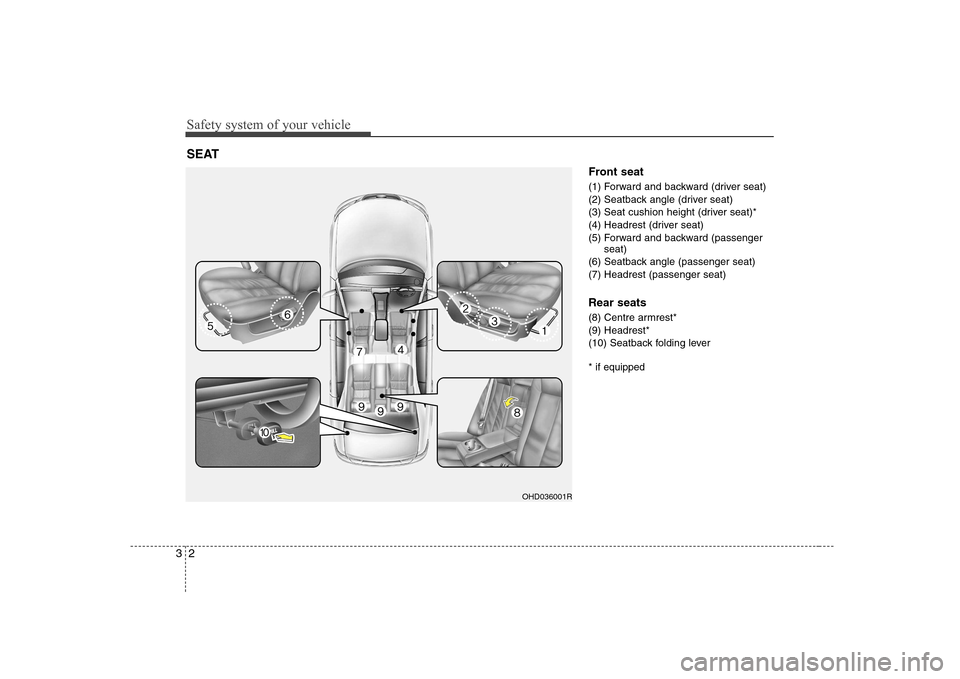
Front seat
(1) Forward and backward (driver seat)
(2) Seatback angle (driver seat)
(3) Seat cushion height (driver seat)*
(4) Headrest (driver seat)
(5) Forward and backward (passenger
seat)
(6) Seatback angle (passenger seat)
(7) Headrest (passenger seat) Rear seats
(8) Centre armrest* (9) Headrest*
(10) Seatback folding lever
* if equipped
SEAT
OHD036001R
Page 12 of 308
33
Safety system of your vehicle
Front seat adjustment
Forward and backward
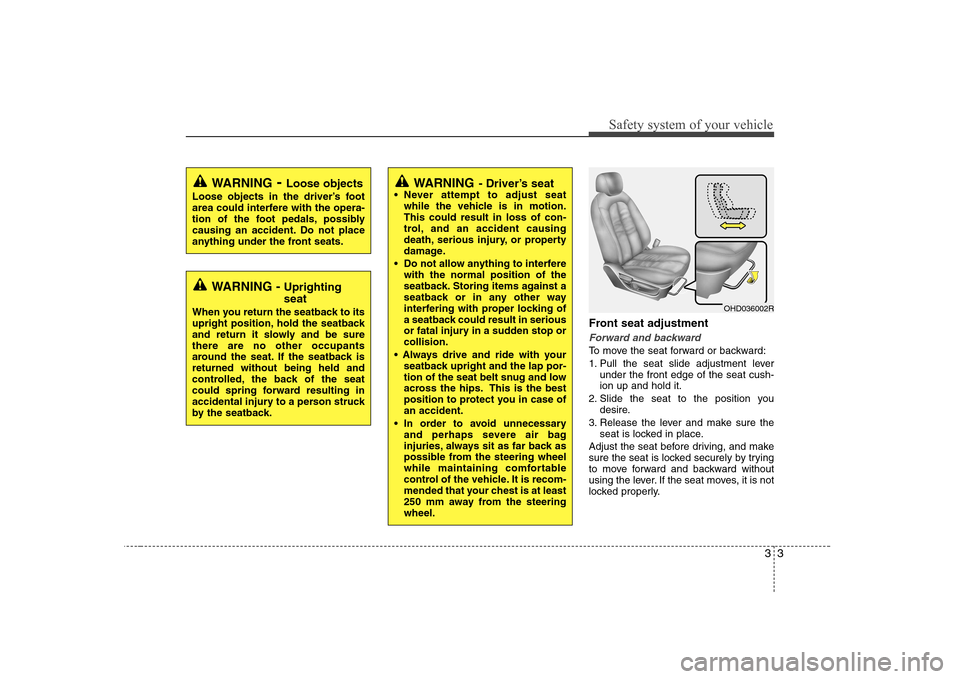
To move the seat forward or backward:
1. Pull the seat slide adjustment leverunder the front edge of the seat cush- ion up and hold it.
2. Slide the seat to the position you desire.
3. Release the lever and make sure the seat is locked in place.
Adjust the seat before driving, and make
sure the seat is locked securely by trying
to move forward and backward without
using the lever. If the seat moves, it is not
locked properly.
WARNING - Driver’s seat
Never attempt to adjust seat while the vehicle is in motion. This could result in loss of con-
trol, and an accident causing
death, serious injury, or property
damage.
Do not allow anything to interfere with the normal position of the
seatback. Storing items against a
seatback or in any other way
interfering with proper locking of
a seatback could result in serious
or fatal injury in a sudden stop orcollision.
seatback upright and the lap por-
tion of the seat belt snug and low
across the hips. This is the best
position to protect you in case ofan accident.
In order to avoid unnecessary and perhaps severe air bag
injuries, always sit as far back as
possible from the steering wheel
while maintaining comfortable
control of the vehicle. It is recom-
mended that your chest is at least
250 mm away from the steeringwheel.
WARNING - Uprighting seat
When you return the seatback to its
upright position, hold the seatback
and return it slowly and be surethere are no other occupants
around the seat. If the seatback isreturned without being held and
controlled, the back of the seat
could spring forward resulting in
accidental injury to a person struck
by the seatback.
OHD036002R
WARNING - Loose objects
Loose objects in the driver’s foot
area could interfere with the opera-
tion of the foot pedals, possibly
causing an accident. Do not place
anything under the front seats.
Page 14 of 308
35
Safety system of your vehicle
Headrest
The driver's and front passenger's seats
are equipped with a headrest for the
occupant's safety and comfort.
The headrest not only provides comfort
for the driver and front passenger, but
also helps to protect the head and neck
in the event of a collision.Active headrest (if equipped)
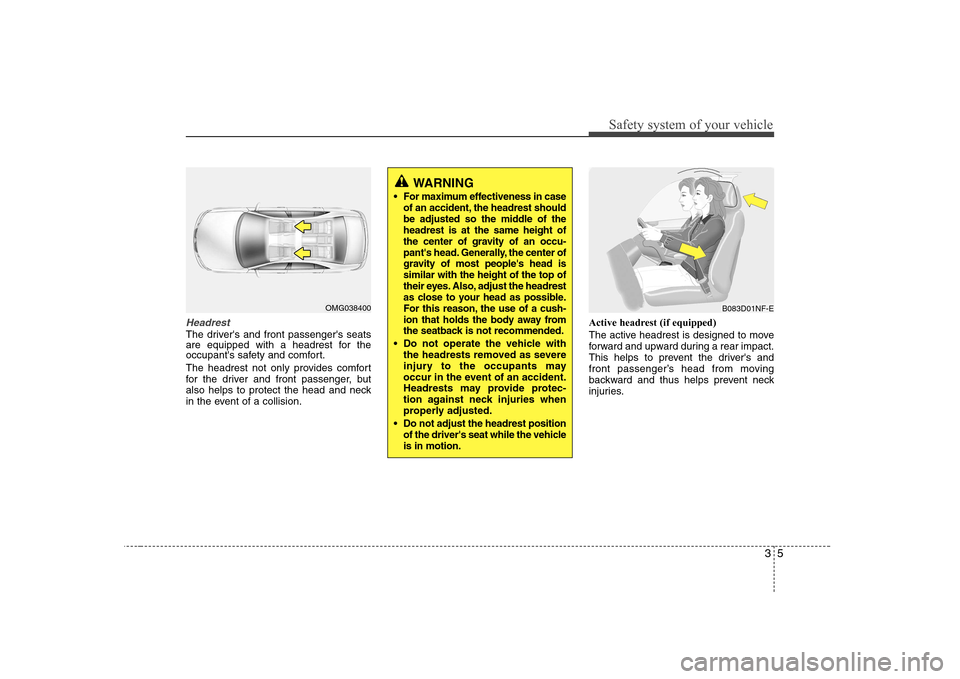
The active headrest is designed to move
forward and upward during a rear impact.
This helps to prevent the driver's and
front passenger’s head from moving
backward and thus helps prevent neck
injuries.
B083D01NF-E
WARNING
For maximum effectiveness in case
of an accident, the headrest should
be adjusted so the middle of theheadrest is at the same height of
the center of gravity of an occu-
pant's head. Generally, the center of
gravity of most people's head issimilar with the height of the top of
their eyes. Also, adjust the headrest
as close to your head as possible.
For this reason, the use of a cush-
ion that holds the body away from
the seatback is not recommended.
Do not operate the vehicle with the headrests removed as severe
injury to the occupants may
occur in the event of an accident.
Headrests may provide protec-
tion against neck injuries when
properly adjusted.
Do not adjust the headrest position
of the driver's seat while the vehicleis in motion.
OMG038400
Page 17 of 308
Safety system of your vehicle
8
3
Armrest (if equipped)
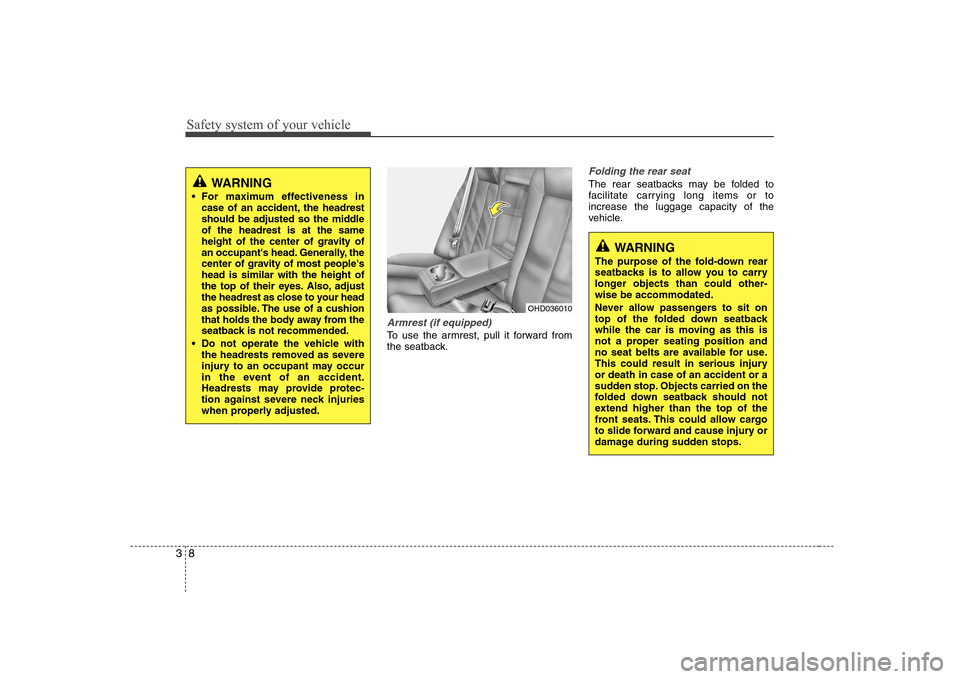
To use the armrest, pull it forward from
the seatback.
Folding the rear seat
The rear seatbacks may be folded to
facilitate carrying long items or toincrease the luggage capacity of the
vehicle.
OHD036010
WARNING
The purpose of the fold-down rear
seatbacks is to allow you to carry
longer objects than could other-wise be accommodated.
Never allow passengers to sit on
top of the folded down seatback
while the car is moving as this is
not a proper seating position and
no seat belts are available for use.
This could result in serious injuryor death in case of an accident or a
sudden stop. Objects carried on the
folded down seatback should not
extend higher than the top of the
front seats. This could allow cargo
to slide forward and cause injury or
damage during sudden stops.
WARNING
For maximum effectiveness in case of an accident, the headrest
should be adjusted so the middleof the headrest is at the same
height of the center of gravity of
an occupant's head. Generally, the
center of gravity of most people'shead is similar with the height of
the top of their eyes. Also, adjust
the headrest as close to your head
as possible. The use of a cushion
that holds the body away from the
seatback is not recommended.
Do not operate the vehicle with the headrests removed as severe
injury to an occupant may occur
in the event of an accident.
Headrests may provide protec-
tion against severe neck injuries
when properly adjusted.
Page 19 of 308
Safety system of your vehicle
10
3
Seat belt restraint system
The use of seat belts reduces the risk of
accident injury by avoiding collision with
the interior of the car and by preventing
the occupants from being thrown out of
the car. This makes them the most impor-
tant safety feature available for you and
your passengers. Adequate protection is
afforded only when the belt is worn cor-
rectly. You should always fasten and
adjust your seatbelts before the car is put
in motion and encourage your passen-
gers to do the same.
WARNING - Cargo
Cargo should always be secured to
prevent it from being thrown about
the vehicle in a collision and caus-
ing injury to the vehicle occupants.Special care should be taken ofobjects placed in the rear seats,
since those may hit the front seat
occupants in a frontal collision.
WARNING - Cargo loading
Make sure the engine is off, the transaxle is in P and the parking
brake is applied whenever loading
or unloading cargo. Failure to take
these steps may allow the vehicle
to move if shift lever is inadvertent-
ly moved to another position.
SEAT BELTS
OHD036124L
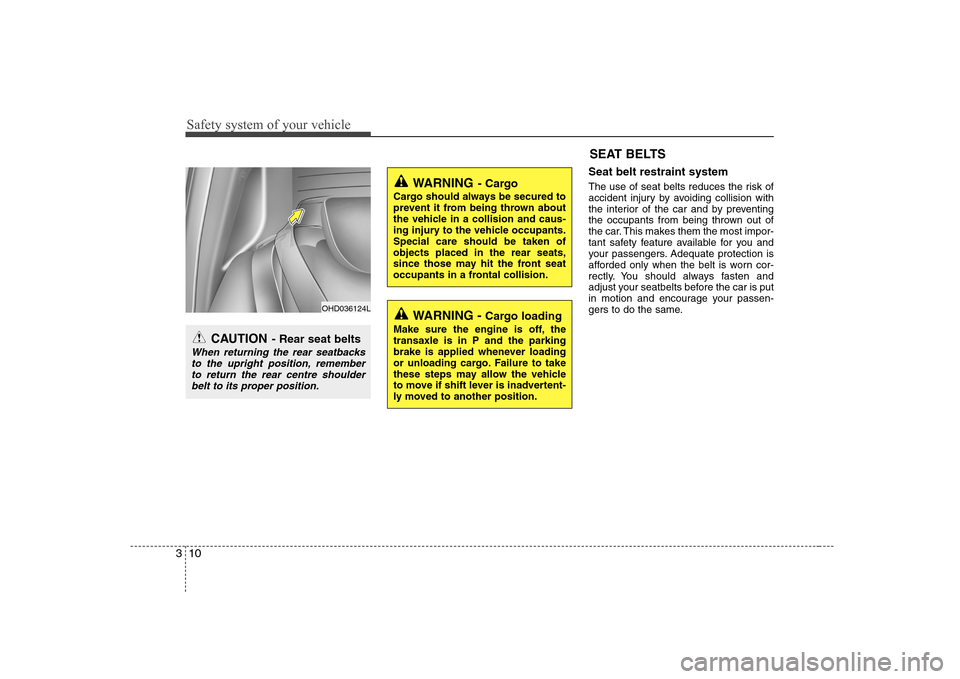
CAUTION - Rear seat belts
When returning the rear seatbacks
to the upright position, rememberto return the rear centre shoulderbelt to its proper position.
Page 26 of 308
317
Safety system of your vehicle
Seat belt precautions
Infant or small child
You should be aware of the specific
requirements in your country. Child
and/or infant seats must be properly
placed and installed in the rear seat. For
more information about the use of these
restraints, refer to “Child restraint sys-
tem” in this section.
✽✽NOTICE
Small children are best protected from
injury in an accident when properly
restrained in the rear seat by a child
restraint system that meets the require-
ments of the Safety Standards of your
country. Before buying any child
restraint system, make sure that it has alabel certifying that it meets Safety
Standards of your country. The restraint
must be appropriate for your child'sheight and weight. Check the label on
the child restraint for this information.
Refer to “Child restraint system” in thissection.
Larger children
Children who are too large for child
restraint systems should always occupy
the rear seat and use the available
lap/shoulder belts. The lap portion should
be fastened snug on the hips and as low
as possible. Check belt fit periodically. A
child's squirming could put the belt out of
position. Children are afforded the most
safety in the event of an accident when
they are restrained by a proper restraint
system in the rear seat. If a larger child
(over age 13) must be seated in the frontseat, the child should be securely
restrained by the available lap/shoulderbelt and the seat should be placed in the
rearmost position. Children under the
age of 13 should be restrained securely
in the rear seat. NEVER place a childunder the age of 13 in the front seat.
NEVER place a rear facing child seat in
the front seat of a vehicle.WARNING
Every person in your vehicle needs
to be properly restrained at all
times, including infants and chil-
dren. Never hold a child in yourarms or lap when riding in a vehi-
cle. The violent forces created dur-
ing a crash will tear the child from
your arms and throw the child
against the interior. Always use a
child restraint appropriate for your
child's height and weight.
WARNING
All occupants of the vehicle must wear their seat belts at all times.
Seat belts and child restraintsreduce the risk of serious or fatal
injuries for all occupants in the
event of a collision or sudden stop.
Without a seat belt, occupants
could be shifted too close to a
deploying air bag, strike the interior
structure or be thrown from the
vehicle. Properly worn seat belts
greatly reduce these hazards.
Always follow the precautions
about seat belts, air bags and occu-
pant seat contained in this manual.
Page 27 of 308
Safety system of your vehicle
18
3
WARNING
Riding with a reclined seatback
increases your chance of serious
or fatal injuries in the event of a col-
lision or sudden stop. The protec-
tion of your restraint system (seat
belts and air bags) is greatly
reduced by reclining your seat.
Seat belts must be snug against
your hips and chest to work proper-
ly. The more the seatback is
reclined, the greater the chance
that an wearer’s hips will slideunder the lap belt causing serious
internal injuries or the wearer’s
neck could strike the shoulder belt.
Drivers and passengers should
always sit well back in their seats,
properly belted, and with the seat-
backs upright.
If the shoulder belt portion slightly touch-
es the child’s neck or face, try placing the
child closer to the centre of the vehicle. If
the shoulder belt still touches their face
or neck they need to be returned to a
child restraint system. In addition, after-
market devices are available from inde-
pendent manufacturers which help pull
the shoulder belt down and away from
the child’s face or neck.Pregnant women
The use of a seat belt is recommended
for pregnant women to lessen the chance
of injury in an accident. When a seat belt
is used, the lap belt portion should be
placed as low and snugly as possible on
the hips, not across the abdomen. For
specific recommendations, consult a
physician.
Injured person
A seat belt should be used when an
injured person is being transported.
When this is necessary, you should con-
sult a physician for recommendations.
One person per belt
Two people (including children) should
never attempt to use a single seat belt.
This could increase the severity of
injuries in case of an accident.
Do not lie down
To reduce the chance of injuries in the
event of an accident and to achieve max-
imum effectiveness of the restraint sys-tem, all passengers should be sitting upand the front seats should be in an
upright position when the car is moving.
A seat belt cannot provide proper protec-
tion if the person is lying down in the rearseat or if the front seat is in a reclinedposition.
WARNING - Shoulder belts
on small children
Never allow a shoulder belt to be in contact with a child’s neck or
face while the vehicle is inmotion.
If seat belts are not properly worn and adjusted on children, there is
a risk of death or serious injury.
Page 29 of 308
Safety system of your vehicle
20
3
CHILD RESTRAINT SYSTEM
Children riding in the car should sit in the
rear seat and must always be properly
restrained to minimise the risk of injury inan accident, sudden stop or sudden
manoeuvre. According to accident statis-
tics, children are safer when properly
restrained in the rear seats than in the
front seat. Larger children not in a child
restraint should use one of the seat belts
provided. If the child is old enough to sit alone and the car is not equipped with a proper
child or infant seat, the child should be
placed in the rear seat and restrainedwith a lap/sash belt.
You should be aware of the specific
requirements in your country. Child and/or
infant safety seats must be properly
placed and installed in the rear seat. You
must use a commercially available child
restraint system that me ets the require-
ments of the Safety Standards of your
country. Child restraint systems are
designed to be secured in vehicle seats by
lap belts or the lap belt portion of a
lap/shoulder belt, or by a tether anchorand/or ISOFIX anchors (if equipped). Children could be injured or killed in a
crash if their restraints are not properly
secured. For small children and babies, a
child seat or infant seat must be used.
Before buying a particular child restraint
system, make sure it fits your car seat
and seat belts, and fits your child. Follow
all the instructions provided by the man-
ufacturer when installing the child
restraint system.
WARNING
A child restraint system must be placed in the rear seat. Never
install a child or infant seat on the
front passenger's seat. Should anaccident occur and cause the
passenger side air bag to deploy,
it could severely injure or kill an
infant or child seated in an infant
or child seat. Thus only use a
child restraint in the rear seat of
your vehicle.
Since a safety belt or child restraint system can become
very hot if it is left in a closed
vehicle, be sure and check the
seat cover and buckles before
placing a child there.
When the child restraint system is not in use, store it in the bootor fasten it with a seat belt so that
it will not be thrown forward in
the case of a sudden stop or anaccident.
A child restraint system should be placed in the vehicle's rearseat since this can make an
important contribution to safety.
(Continued)
Page 31 of 308
Safety system of your vehicle
22
3
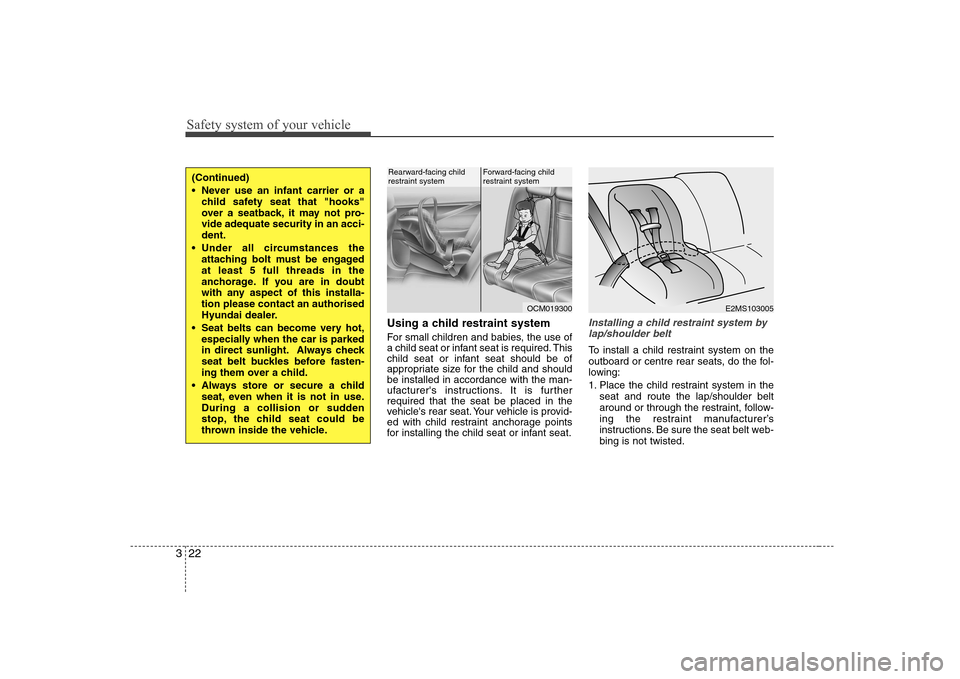
Using a child restraint system
For small children and babies, the use of
a child seat or infant seat is required. This
child seat or infant seat should be of
appropriate size for the child and shouldbe installed in accordance with the man-
ufacturer's instructions. It is furtherrequired that the seat be placed in the
vehicle's rear seat. Your vehicle is provid-
ed with child restraint anchorage points
for installing the child seat or infant seat.Installing a child restraint system by
lap/shoulder belt
To install a child restraint system on the
outboard or centre rear seats, do the fol-
lowing:
1. Place the child restraint system in the seat and route the lap/shoulder belt
around or through the restraint, follow-
ing the restraint manufacturer’s
instructions. Be sure the seat belt web-bing is not twisted.
(Continued)
Never use an infant carrier or achild safety seat that "hooks"
over a seatback, it may not pro-vide adequate security in an acci-dent.
Under all circumstances the attaching bolt must be engagedat least 5 full threads in the
anchorage. If you are in doubt
with any aspect of this installa-tion please contact an authorised
Hyundai dealer.
Seat belts can become very hot, especially when the car is parked
in direct sunlight. Always check
seat belt buckles before fasten-
ing them over a child.
Always store or secure a child seat, even when it is not in use.
During a collision or sudden
stop, the child seat could be
thrown inside the vehicle.
E2MS103005OCM019300
Rearward-facing child
restraint systemForward-facing child
restraint system
Page 32 of 308
323
Safety system of your vehicle
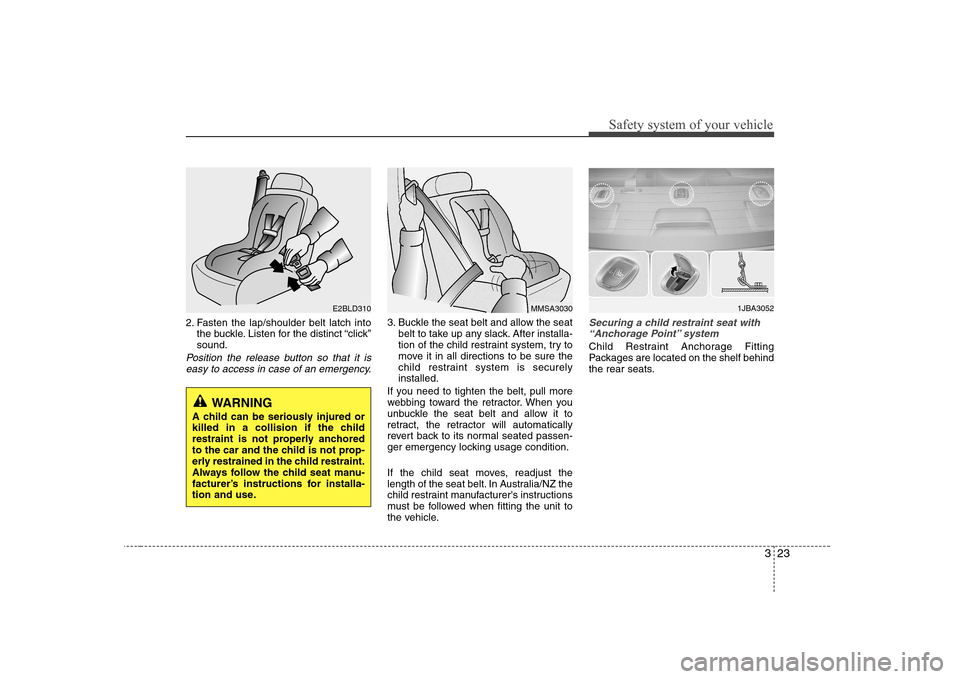
2. Fasten the lap/shoulder belt latch intothe buckle. Listen for the distinct “click” sound.
Position the release button so that it is
easy to access in case of an emergency.
3. Buckle the seat belt and allow the seat belt to take up any slack. After installa-
tion of the child restraint system, try to
move it in all directions to be sure the
child restraint system is securelyinstalled.
If you need to tighten the belt, pull more
webbing toward the retractor. When you
unbuckle the seat belt and allow it to
retract, the retractor will automatically
revert back to its normal seated passen-
ger emergency locking usage condition.
If the child seat moves, readjust the
length of the seat belt. In Australia/NZ the
child restraint manufacturer's instructions
must be followed when fitting the unit to
the vehicle.Securing a child restraint seat with “Anchorage Point” system
Child Restraint Anchorage Fitting
Packages are located on the shelf behind
the rear seats.
E2BLD310
WARNING
A child can be seriously injured or
killed in a collision if the child
restraint is not properly anchored
to the car and the child is not prop-
erly restrained in the child restraint.
Always follow the child seat manu-
facturer’s instructions for installa-
tion and use.
MMSA30301JBA3052