power steering Hyundai Elantra 2016 - RHD (UK. Australia) User Guide
[x] Cancel search | Manufacturer: HYUNDAI, Model Year: 2016, Model line: Elantra, Model: Hyundai Elantra 2016Pages: 498, PDF Size: 9.45 MB
Page 314 of 498
Driving your vehicle
10 5
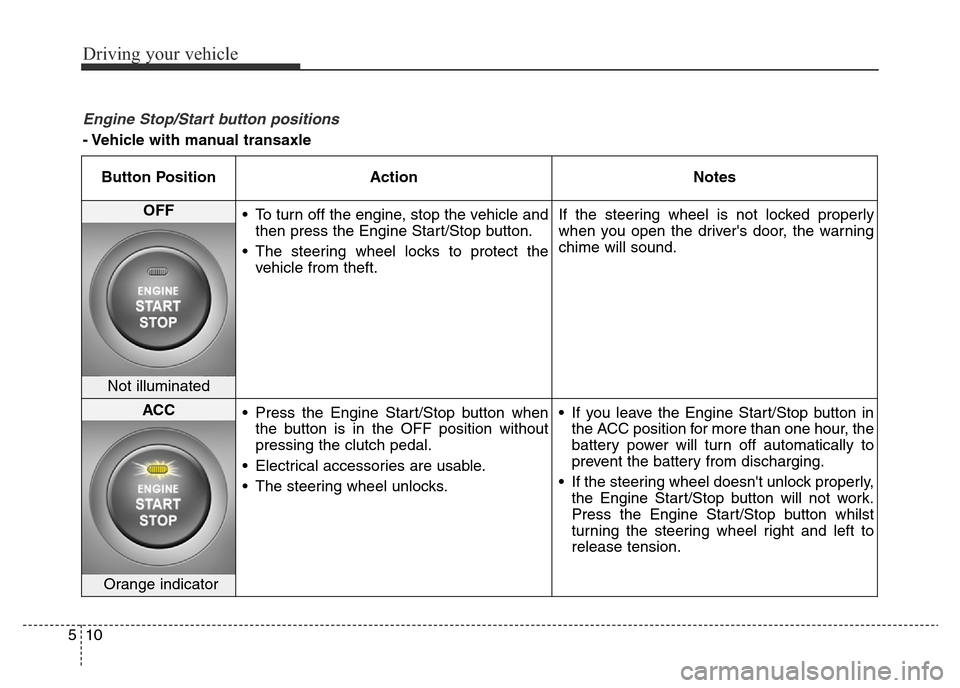
Engine Stop/Start button positions
- Vehicle with manual transaxle
Button Position Action Notes
OFF
• To turn off the engine, stop the vehicle and
then press the Engine Start/Stop button.
• The steering wheel locks to protect the
vehicle from theft.If the steering wheel is not locked properly
when you open the driver's door, the warning
chime will sound.
Not illuminated
ACC
• Press the Engine Start/Stop button when
the button is in the OFF position without
pressing the clutch pedal.
• Electrical accessories are usable.
• The steering wheel unlocks.• If you leave the Engine Start/Stop button in
the ACC position for more than one hour, the
battery power will turn off automatically to
prevent the battery from discharging.
• If the steering wheel doesn't unlock properly,
the Engine Start/Stop button will not work.
Press the Engine Start/Stop button whilst
turning the steering wheel right and left to
release tension.
Orange indicator
Page 316 of 498
Driving your vehicle
12 5
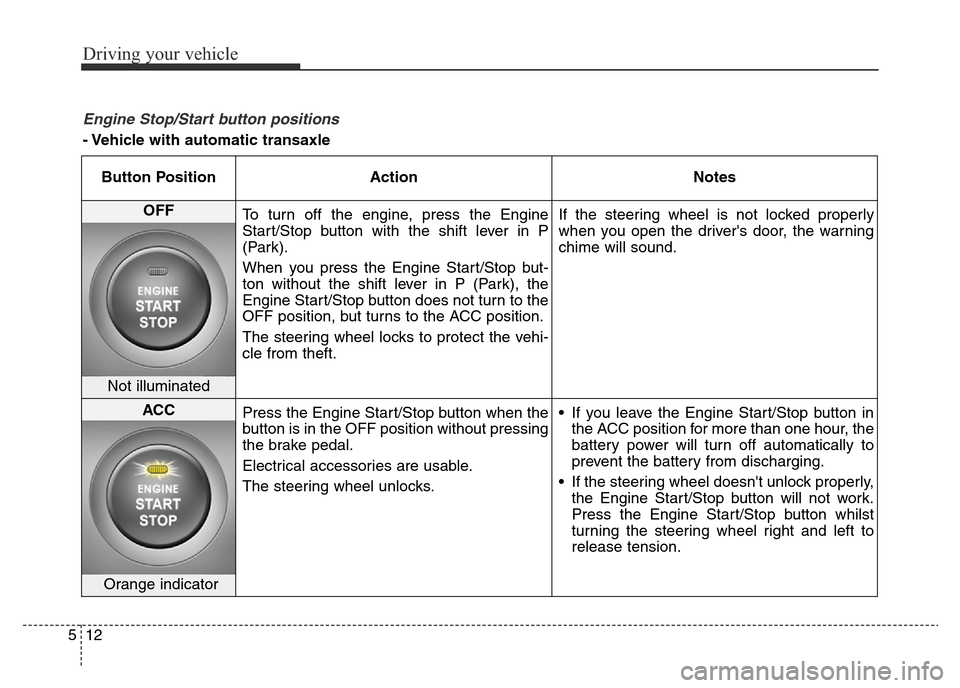
Engine Stop/Start button positions
- Vehicle with automatic transaxle
Button Position Action Notes
OFF
To turn off the engine, press the Engine
Start/Stop button with the shift lever in P
(Park).
When you press the Engine Start/Stop but-
ton without the shift lever in P (Park), the
Engine Start/Stop button does not turn to the
OFF position, but turns to the ACC position.
The steering wheel locks to protect the vehi-
cle from theft.If the steering wheel is not locked properly
when you open the driver's door, the warning
chime will sound.
Not illuminated
ACC
Press the Engine Start/Stop button when the
button is in the OFF position without pressing
the brake pedal.
Electrical accessories are usable.
The steering wheel unlocks.• If you leave the Engine Start/Stop button in
the ACC position for more than one hour, the
battery power will turn off automatically to
prevent the battery from discharging.
• If the steering wheel doesn't unlock properly,
the Engine Start/Stop button will not work.
Press the Engine Start/Stop button whilst
turning the steering wheel right and left to
release tension.
Orange indicator
Page 333 of 498
529
Driving your vehicle
Power brakes
Your vehicle has power-assisted
brakes that adjust automatically
through normal usage.
If the engine is not running or is
turned off whilst driving, the power
assist for the brakes will not work.
You can still stop your vehicle by
applying greater force to the brake
pedal than normal. The stopping dis-
tance, however, will be longer than
with power brakes.
When the engine is not running, the
reserve brake power is partially
depleted each time the brake pedal
is applied. Do not pump the brake
pedal when the power assist has
been interrupted.
Pump the brake pedal only when
necessary to maintain steering con-
trol on slippery surfaces.
BRAKING SYSTEM
WARNING
Take the following precautions:
• Do not drive with your foot
resting on the brake pedal.
This will create abnormal high
brake temperatures, exces-
sive brake lining and pad
wear, and increased stopping
distances.
• When descending a long or
steep hill, shift to a lower gear
and avoid continuous applica-
tion of the brakes. Applying
the brakes continuously will
cause the brakes to overheat
and could result in a tempo-
rary loss of braking perform-
ance.
(Continued)
(Continued)
• Wet brakes may impair the
vehicle’s ability to safely slow
down; the vehicle may also
pull to one side when the
brakes are applied. Applying
the brakes lightly will indicate
whether they have been
affected in this way. Always
test your brakes in this fash-
ion after driving through deep
water. To dry the brakes, light-
ly tap the brake pedal to heat
up the brakes whilst maintain-
ing a safe forward speed until
brake performance returns to
normal. Avoid driving at high
speeds until the brakes func-
tion correctly.
Page 343 of 498
539
Driving your vehicle
Vehicle Stability Management
(if equipped)
Vehicle Stability Management (VSM)
helps ensure the vehicle stays stable
when accelerating or braking sud-
denly on wet, slippery and rough
roads where traction over the four
tyres can suddenly become uneven.
VSM operation
VSM ON condition
The VSM operates when:
• The Electronic Stability Control
(ESC) is on.
• Vehicle speed is approximately
above 15 km/h on winding roads.
• Vehicle speed is approximately
above 20 km/h when the vehicle is
braking on rough roads.
When operating
When you apply your brakes under
conditions which may activate the
ESC, you may hear sounds from the
brakes, or feel a corresponding sen-
sation in the brake pedal. This is nor-
mal and it means your VSM is active.
✽NOTICE
The VSM does not operate when:
• Driving on a gradient or incline
• Driving rearward.
• ESC OFF indicator light is on.
• EPS (Electric Power Steering)
warning light ( ) is on.
WARNING
Take the following precautions
when using the Vehicle Stability
Management (VSM):
• ALWAYS check the speed and
the distance to the vehicle
ahead. The VSM is not a sub-
stitute for safe driving prac-
tices.
• Never drive too fast for the
road conditions. The VSM sys-
tem will not prevent acci-
dents. Excessive speed in bad
weather, slippery and uneven
roads can result in severe
accidents.
Page 394 of 498
What to do in an emergency
18 6
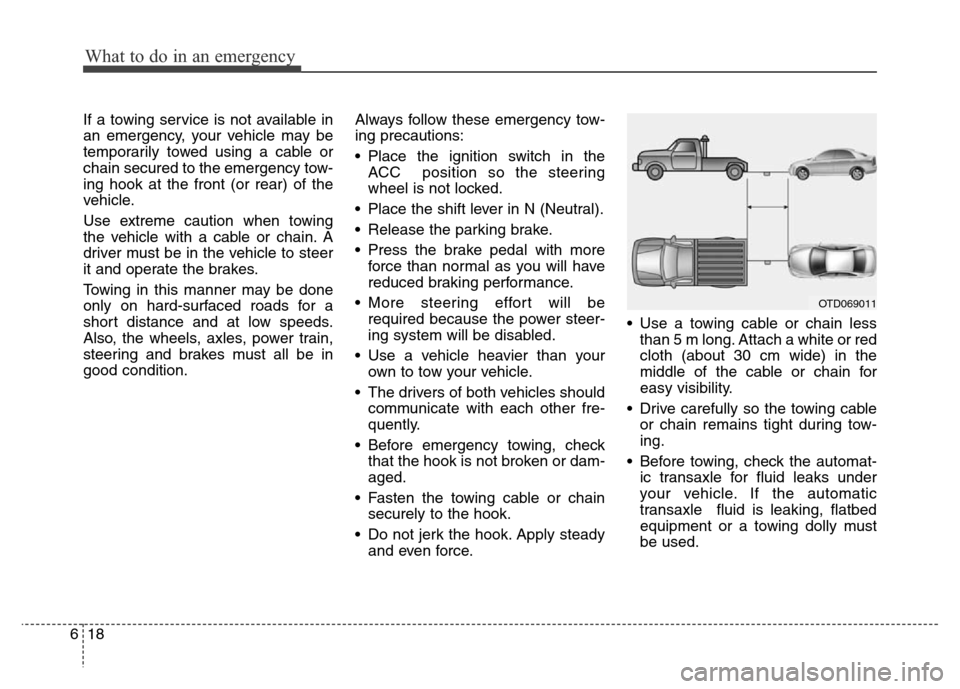
If a towing service is not available in
an emergency, your vehicle may be
temporarily towed using a cable or
chain secured to the emergency tow-
ing hook at the front (or rear) of the
vehicle.
Use extreme caution when towing
the vehicle with a cable or chain. A
driver must be in the vehicle to steer
it and operate the brakes.
Towing in this manner may be done
only on hard-surfaced roads for a
short distance and at low speeds.
Also, the wheels, axles, power train,
steering and brakes must all be in
good condition.Always follow these emergency tow-
ing precautions:
• Place the ignition switch in the
ACC position so the steering
wheel is not locked.
• Place the shift lever in N (Neutral).
• Release the parking brake.
• Press the brake pedal with more
force than normal as you will have
reduced braking performance.
• More steering effort will be
required because the power steer-
ing system will be disabled.
• Use a vehicle heavier than your
own to tow your vehicle.
• The drivers of both vehicles should
communicate with each other fre-
quently.
• Before emergency towing, check
that the hook is not broken or dam-
aged.
• Fasten the towing cable or chain
securely to the hook.
• Do not jerk the hook. Apply steady
and even force.• Use a towing cable or chain less
than 5 m long. Attach a white or red
cloth (about 30 cm wide) in the
middle of the cable or chain for
easy visibility.
• Drive carefully so the towing cable
or chain remains tight during tow-
ing.
• Before towing, check the automat-
ic transaxle for fluid leaks under
your vehicle. If the automatic
transaxle fluid is leaking, flatbed
equipment or a towing dolly must
be used.
OTD069011
Page 405 of 498
Maintenance
10 7
NORMAL MAINTENANCE SCHEDULE
The following maintenance services must be performed to ensure good emission control and performance. Keep
receipts for all vehicle emission services to protect your warranty. Where both kilometres and time are shown, the fre-
quency of service is determined by whichever occurs first.
*1: If good quality petrol meeting Europe Fuel standards
(EN228) or equivalent, including fuel additives is not avail-
able, one bottle of additive is recommended. Additives are
available from your authorised HYUNDAI dealer along with
information on how to use them. Do not mix with other addi-
tives.
*
2: Check the engine oil level and leak every 500 km or before
starting a long trip.
*
3: The fuel filter is considered to be maintenance free but peri-
odic inspection is recommended as this maintenance
schedule depends on fuel quality. If there are some impor-
tant issues such as fuel flow restriction, surging, loss of
power, hard starting problems etc., replace the fuel filter
immediately regardless of maintenance schedule and we
recommend that you consult an authorised HYUNDAI deal-
er for details.*
4: Adjust alternator and power steering (and water pump drive
belt) and air conditioner drive belt (if equipped).
Inspect and if necessary repair or replace.
*
5 : For your convenience, it can be replaced prior to it's interval
when you do maintenance of other items.
*
6 : When adding coolant, use only deionized water or soft water
for your vehicle and never mix hard water with the coolant
filled at the factory. An improper coolant mixture can result in
serious malfunction or engine damage.
*
7: Manual transaxle fluid should be changed anytime the vehi-
cle has been submerged in water.
Page 455 of 498
Maintenance
60 7
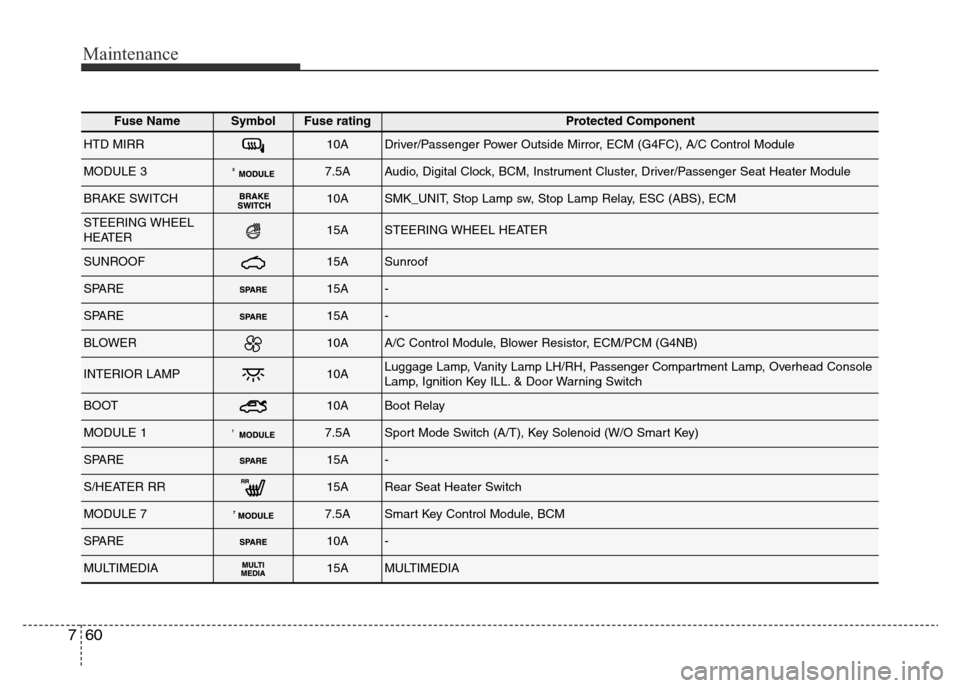
Fuse NameSymbolFuse ratingProtected Component
HTD MIRR10ADriver/Passenger Power Outside Mirror, ECM (G4FC), A/C Control Module
MODULE 37.5AAudio, Digital Clock, BCM, Instrument Cluster, Driver/Passenger Seat Heater Module
BRAKE SWITCH10ASMK_UNIT, Stop Lamp sw, Stop Lamp Relay, ESC (ABS), ECM
STEERING WHEEL
HEATER15ASTEERING WHEEL HEATER
SUNROOF15ASunroof
SPARE15A-
SPARE15A-
BLOWER10AA/C Control Module, Blower Resistor, ECM/PCM (G4NB)
INTERIOR LAMP10ALuggage Lamp, Vanity Lamp LH/RH, Passenger Compartment Lamp, Overhead Console
Lamp, Ignition Key ILL. & Door Warning Switch
BOOT10ABoot Relay
MODULE 17.5ASport Mode Switch (A/T), Key Solenoid (W/O Smart Key)
SPARE 15A-
S/HEATER RR15ARear Seat Heater Switch
MODULE 77.5ASmart Key Control Module, BCM
SPARE10A-
MULTIMEDIA15AMULTIMEDIA