Tire Hyundai Elantra 2017 Owner's Manual
[x] Cancel search | Manufacturer: HYUNDAI, Model Year: 2017, Model line: Elantra, Model: Hyundai Elantra 2017Pages: 637, PDF Size: 15.02 MB
Page 5 of 637
We want to help you get the greatest
possible driving pleasure from your
vehicle. Your Owner’s Manual can
assist you in many ways. We strong-
ly recommend that you read the
entire manual. In order to minimize
the chance of death or injury, you
must read the WARNING and CAU-
TION sections in the manual.
Illustrations complement the words
in this manual to best explain how to
enjoy your vehicle. By reading your
manual, you will learn about fea-
tures, important safety information,
and driving tips under various road
conditions.
The general layout of the manual is
provided in the Table of Contents.
Use the index when looking for a
specific area or subject; it has an
alphabetical listing of all information
in your manual.
Sections: This manual has eight
chapters plus an index. Each section
begins with a brief list of contents so
you can tell at a glance if that section
has the information you want.Your safety, and the safety of others,
is very important. This Owner's
Manual provides you with many safe-
ty precautions and operating proce-
dures. This information alerts you to
potential hazards that may hurt you
or others, as well as damage to your
vehicle.
Safety messages found on vehicle
labels and in this manual describe
these hazards and what to do to
avoid or reduce the risks.
Warnings and instructions contained
in this manual are for your safety.
Failure to follow safety warnings and
instructions can lead to serious injury
or death.Throughout this manual DANGER,
WARNING, CAUTION, NOTICE and
the SAFETY ALERT SYMBOL will
be used.
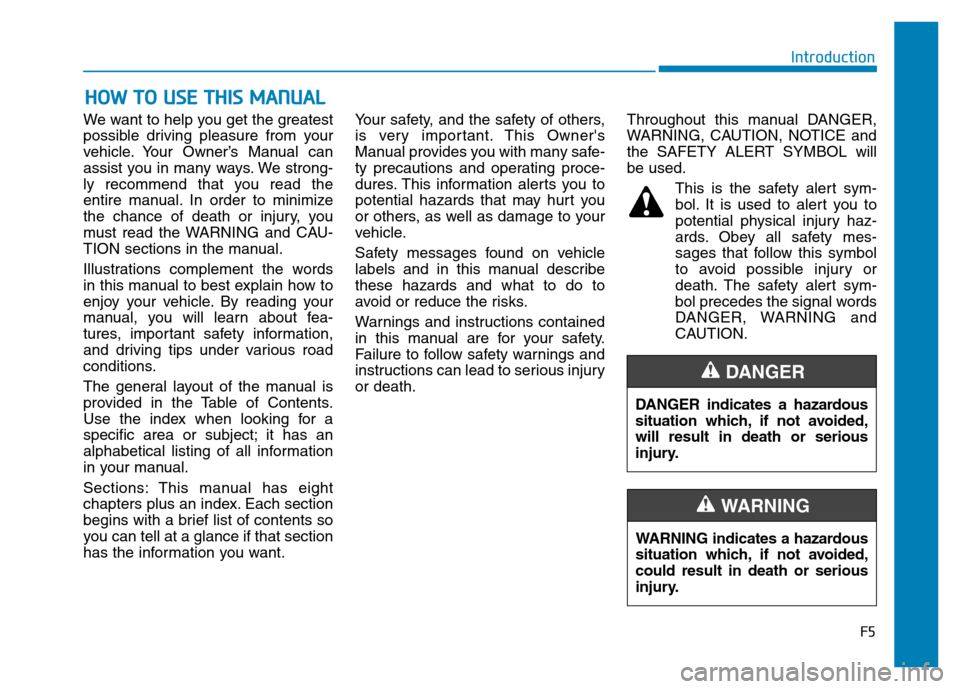
This is the safety alert sym-
bol. It is used to alert you to
potential physical injury haz-
ards. Obey all safety mes-
sages that follow this symbol
to avoid possible injury or
death. The safety alert sym-
bol precedes the signal words
DANGER, WARNING and
CAUTION.
H HO
OW
W
T
TO
O
U
US
SE
E
T
TH
HI
IS
S
M
MA
AN
NU
UA
AL
L
F5
Introduction
DANGER indicates a hazardous
situation which, if not avoided,
will result in death or serious
injury.
DANGER
WARNING indicates a hazardous
situation which, if not avoided,
could result in death or serious
injury.
WARNING
Page 18 of 637
F18
Hazard warning flasher ........................................6-2
In case of an emergency while driving ..............6-2
If the engine stalls while driving ...................................6-2
If the engine stalls at a crossroad or crossing .........6-3
If you have a flat tire while driving..............................6-3
If the engine will not start ...................................6-4
If the engine doesn't turn over or turns
over slowly ..........................................................................6-4
If the engine turns over normally but
doesn't start .......................................................................6-4
Jump starting ..........................................................6-4
If the engine overheats ........................................6-8
Tire Pressure Monitoring System (TPMS).......6-10
Check tire pressure .......................................................6-10
Tire Pressure Monitoring System ...............................6-11
Low tire pressure telltale ..............................................6-12
Low tire pressure position and Tire pressure
telltale ................................................................................6-12
TPMS (Tire Pressure Monitoring System)
malfunction indicator .....................................................6-13
Changing a tire with TPMS...........................................6-14
If you have a flat tire..........................................6-16
Jack and tools ..................................................................6-16
Changing tires ..................................................................6-17
Jack label ...........................................................................6-22
EC Declaration of conformity for Jack......................6-23
Towing ...................................................................6-24
Towing service .................................................................6-24
Removable towing hook ................................................6-25
Emergency towing ..........................................................6-26
Emergency commodity ........................................6-28
Fire extinguisher .............................................................6-28
First aid kit ......................................................................6-28
Triangle reflector ............................................................6-28
Tire pressure gauge .......................................................6-28
F18
6What to do in an emergency
Page 20 of 637
F20F20
Tires and wheels ..................................................7-52
Tire care ............................................................................7-52
Recommended cold tire inflation pressures.............7-52
Checking tire inflation pressure ..................................7-54
Tire rotation .....................................................................7-55
Wheel alignment and tire balance ..............................7-56
Tire replacement .............................................................7-56
Wheel replacement .........................................................7-58
Tire traction ......................................................................7-58
Tire maintenance ............................................................7-58
Tire sidewall labeling ......................................................7-58
Low aspect ratio tire ......................................................7-63
Fuses ......................................................................7-64
Fuse/Relay panel description ......................................7-70
Light bulbs.............................................................7-84
Headlamp, position lamp, turn signal lamp and
fog lamp light bulb replacement .................................7-85
Side repeater lamp replacement .................................7-91
Headlamp and front fog lamp aiming (for Europe) ...7-92
Rear combination lamp bulb replacement ................7-97
High mounted stop lamp replacement .....................7-101
License plate light bulb replacement .......................7-101
Interior light bulb replacement ..................................7-102
Appearance care ................................................7-103
Exterior care ..................................................................7-103
Interior care ...................................................................7-109
Emission control system ...................................7-111
Crankcase emission control system .........................7-111
Evaporative emission control system ......................7-111
Exhaust emission control system .............................7-112
Page 21 of 637
F21F21
Dimensions ..............................................................8-2
Engine ......................................................................8-2
Bulb wattage ...........................................................8-3
Tires and wheels ....................................................8-4
Air conditioning system ........................................8-4
Tire load and speed capacity ..............................8-5
Volume and weight ................................................8-5
Recommended lubricants and capacities ...........8-6
Recommended SAE viscosity number ..........................8-8
Vehicle identification number (VIN) ....................8-9
Vehicle certification label .....................................8-9
Tire specification and pressure label ...............8-10
Engine number .....................................................8-10
Air conditioner compressor label ......................8-11
Declaration of conformity ..................................8-11
8Specifications & Consumer information
Page 23 of 637
1-2
EXTERIOR OVERVIEW (I)
Your vehicle at a glance
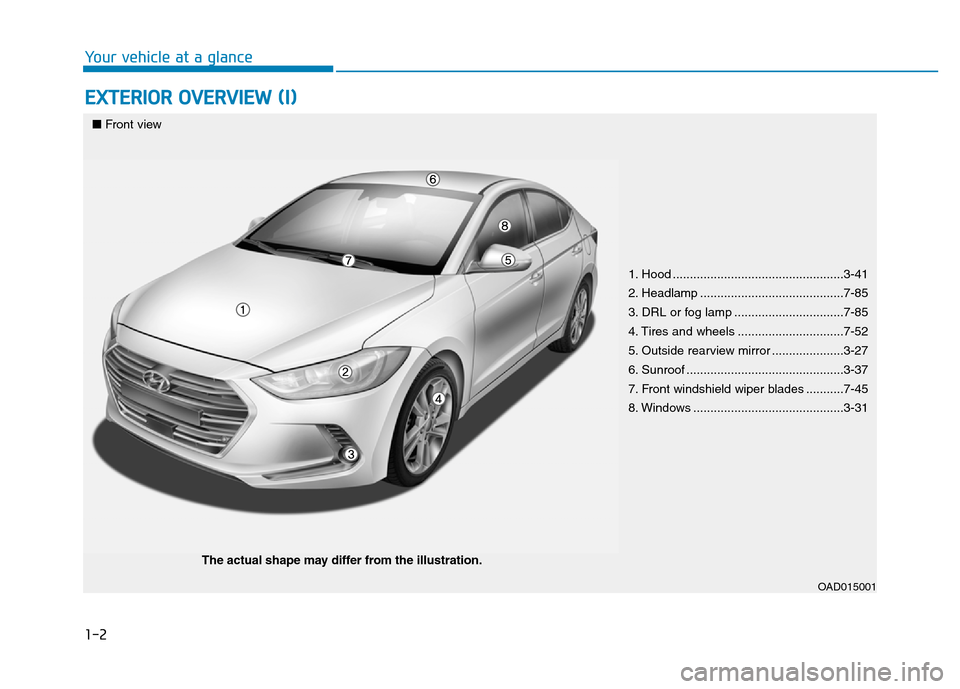
1. Hood ..................................................3-41
2. Headlamp ..........................................7-85
3. DRL or fog lamp ................................7-85
4. Tires and wheels ...............................7-52
5. Outside rearview mirror .....................3-27
6. Sunroof ..............................................3-37
7. Front windshield wiper blades ...........7-45
8. Windows ............................................3-31
OAD015001
■Front view
The actual shape may differ from the illustration.
Page 33 of 637
2-3
Safety system of your vehicle
• NEVER let the use of a mobile
device distract you from driving. You
have a responsibility to your passen-
gers and others on the road to
always drive safely, with your hands
on the wheel as well as your eyes
and attention on the road.
Control your speed
Excessive speed is a major factor in
crash injuries and deaths. Generally,
the higher the speed, the greater the
risk, but serious injuries can also
occur at lower speeds. Never drive
faster than is safe for current condi-
tions, regardless of the maximum
speed posted.
Keep your vehicle in safe condi-
tion
Having a tire blowout or a mechanical
failure can be extremely hazardous. To
reduce the possibility of such prob-
lems, check your tire pressures and
condition frequently, and perform all
regularly scheduled maintenance.
2
Page 55 of 637
2-25
Safety system of your vehicle
2
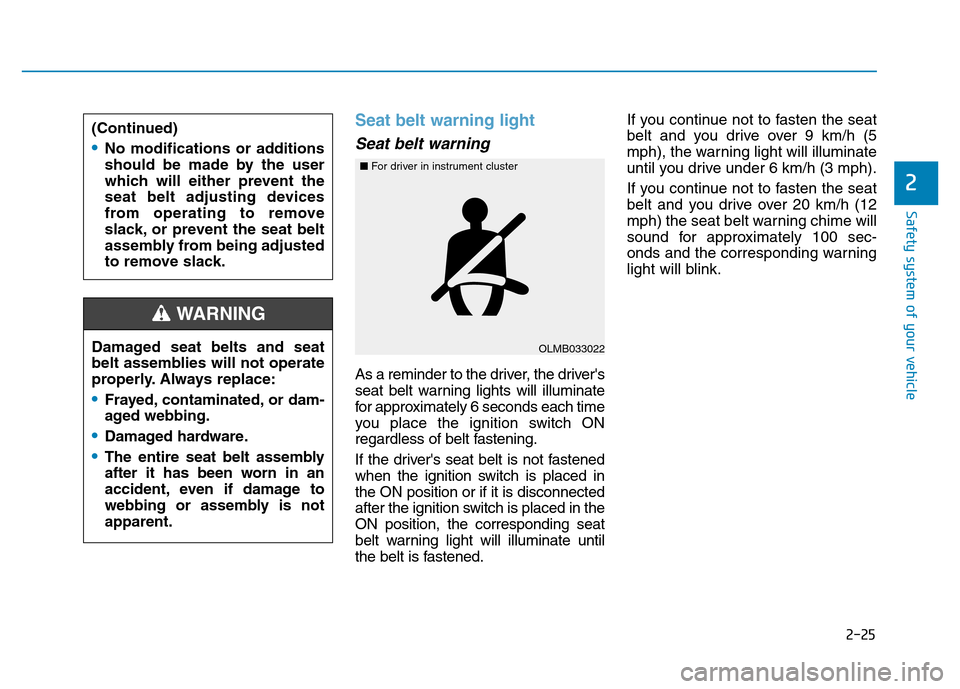
Seat belt warning light
Seat belt warning
As a reminder to the driver, the driver's
seat belt warning lights will illuminate
for approximately 6 seconds each time
you place the ignition switch ON
regardless of belt fastening.
If the driver's seat belt is not fastened
when the ignition switch is placed in
the ON position or if it is disconnected
after the ignition switch is placed in the
ON position, the corresponding seat
belt warning light will illuminate until
the belt is fastened.If you continue not to fasten the seat
belt and you drive over 9 km/h (5
mph), the warning light will illuminate
until you drive under 6 km/h (3 mph).
If you continue not to fasten the seat
belt and you drive over 20 km/h (12
mph) the seat belt warning chime will
sound for approximately 100 sec-
onds and the corresponding warning
light will blink.
Damaged seat belts and seat
belt assemblies will not operate
properly. Always replace:
•Frayed, contaminated, or dam-
aged webbing.
•Damaged hardware.
•The entire seat belt assembly
after it has been worn in an
accident, even if damage to
webbing or assembly is not
apparent.
WARNING
(Continued)
•No modifications or additions
should be made by the user
which will either prevent the
seat belt adjusting devices
from operating to remove
slack, or prevent the seat belt
assembly from being adjusted
to remove slack.
OLMB033022 ■For driver in instrument cluster
Page 63 of 637

2-33
Safety system of your vehicle
2
The more the seatback is reclined,
the greater chance the passenger’s
hips will slide under the lap belt or
the passenger’s neck will strike the
shoulder belt.Care of seat belts
Seat belt systems should never be
disassembled or modified. In addi-
tion, care should be taken to assure
that seat belts and belt hardware are
not damaged by seat hinges, doors
or other abuse.
Periodic inspection
All seat belts should be inspected
periodically for wear or damage of
any kind. Any damaged parts should
be replaced as soon as possible.
Keep belts clean and dry
Seat belts should be kept clean and
dry. If belts become dirty, they can be
cleaned by using a mild soap solu-
tion and warm water. Bleach, dye,
strong detergents or abrasives
should not be used because they
may damage and weaken the fabric.
When to replace seat belts
The entire seat belt assembly or
assemblies should be replaced if the
vehicle has been involved in an acci-
dent. This should be done even if no
damage is visible. We recommend
that you consult an authorized
HYUNDAI dealer.
•NEVER ride with a reclined
seatback when the vehicle is
moving.
•Riding with a reclined seatback
increases your chance of seri-
ous or fatal injuries in the event
of a collision or sudden stop.
•Driver and passengers should
always sit well back in their
seats, properly belted, and with
the seatbacks upright.
WARNING
Page 67 of 637
2-37
Safety system of your vehicle
2
Installing a Child Restraint
System (CRS)After selecting a proper Child Restraint
System and checking that the Child
Restraint System fits properly in the
rear of this vehicle, you are ready to
install the Child Restraint System
according to the manufacturer’s
instruction. There are three general
steps in installing the Child Restraint
Systemsproperly:
•Properly secure the Child
Restraint System to the vehicle.
All Child Restraint System must be
secured to the vehicle with the lap
belt or lap part of a lap/shoulder
belt or with the ISOFIX top-tether
and/or ISOFIX anchorage.
•Make sure the Child Restraint
System is firmly secured.After
installing a Child Restraint System
to the vehicle, push and pull the
seat forward and from side-to-side
to verify that it is securely attached
to the seat. A Child Restraint
System secured with a seat belt
should be installed as firmly as
possible. However, some side-to-
side movement can be expected.When installing a Child Restraint
System, adjust the vehicle seat (up
and down, forward and rearward)
so that your child fits in the Child
Restraint System in a comfortable
manner.
•Secure the child in the Child
Restraint System.Make sure the
child is properly strapped in the
Child Restraint System according
to the Child Restraint System man-
ufacturer’s instructions. Before installing your Child
Restraint System always:
Read and follow the instructions
provided by the manufacturer of
the Child Restraint System.
Failure to follow all warnings
and instructions could increase
the risk of the SERIOUS INJURY
or DEATH if an accident occurs.
WARNING
If the vehicle headrest prevents
proper installation of a Child
Restraint System, the headrest
of the respective seating posi-
tion shall be readjusted or
entirely removed.
WARNING
A Child Restraint System in a
closed vehicle can become very
hot. To prevent burns, check the
seating surface and buckles
before placing your child in the
Child Restraint System.
CAUTION
Page 142 of 637

3-47
Convenient features of your vehicle
3
Information
• If you press the door unlock button
(2), the Smart Trunk function will
be deactivated temporarily. But, if
you do not open any door for 30 sec-
onds, the smart trunk function will
be activated again.
• If you press the trunk open button
(3) for more than 1 second, the
trunk opens.
• If you press the door lock button (1)
or trunk open button (3) when the
Smart Trunk function is not in the
Detect and Alert stage, the smart
trunk function will not be deactivated.
• In case you have deactivated the
Smart Trunk function by pressing
the smart key button and opened a
door, the smart trunk function can
be activated again by closing and
locking all doors.
Detecting area
• The Smart Trunk operates with a
welcome alert if the smart key is
detected within 50~100 cm from
the trunk.
• The alert stops at once if the smart
key is positioned outside the
detecting area during the Detect
and Alert stage.
Information
• The Smart Trunk function will not
work if any of the following occurs:
- The smart key is close to a radio
transmitter such as a radio station
or an airport which can interfere
with normal operation of the
transmitter.
- The smart key is near a mobile two
way radio system or a cellular
phone.
- Another vehicle's smart key is
being operated close to your vehi-
cle.
• The detecting range may decrease
or increase when :
- One side of the tire is raised to
replace a tire or to inspect the vehi-
cle.
- The vehicle is slantingly parked on
a slope or unpaved road, etc.
ii
OAD045033