battery Hyundai Elantra 2018 Workshop Manual
[x] Cancel search | Manufacturer: HYUNDAI, Model Year: 2018, Model line: Elantra, Model: Hyundai Elantra 2018Pages: 526, PDF Size: 17.2 MB
Page 431 of 526

7-13
7
Maintenance
I : Inspect : Inspect and if necessary, adjust, correct, clean or replace.
R : Replace or change.
*
3: Fuel filter & Fuel tank air filter are considered to be maintenance free\
but periodic inspection is recommended for this maintenance scheduledepends on fuel quality. If there are some important safety matters like fuel flow restriction, surging, loss of power, hard starting problem, etc.
replace the fuel filter immediately regardless of maintenance schedule a\
nd consult an authorized HYUNDAI dealer for details.
*
4: Inspect for excessive valve noise and/or engine vibration and adjust if necessary. Have an authorized HYUNDAI dealer perform th e opera-
tion.
Normal Maintenance Schedule (Gamma 1.6 T-GDI) (CONT)
Months1224364860728496108120132144156168180
Miles×1,00061218243036424854606672788490
Km×1,000102030405060708090100110120130140150
Fuel filter *3IIIIIII
Fuel lines, hoses and connectionsIII
Valve clearance *4Inspect every 60,000 miles or 72 months
Engine coolantAt first, replace at 120,000 miles or 10 years :
Thereafter, replace every 30,000 miles or 24 months
Battery conditionIIIIIIIIIIIIIII
Brake lines, hoses and connectionsIIIIIIIIIIIIIII
Parking brakeIIIIIII
Brake/clutch (if equipped) fluidIIIIIII
Disc brakes and padsIIIIIIIIIIIIIII
Steering gear rack, linkage and bootsIIIIIIIIIIIIIII
MAINTENANCE INTERVALS
MAINTENANCE
ITEM
Page 440 of 526
7-22
Maintenance
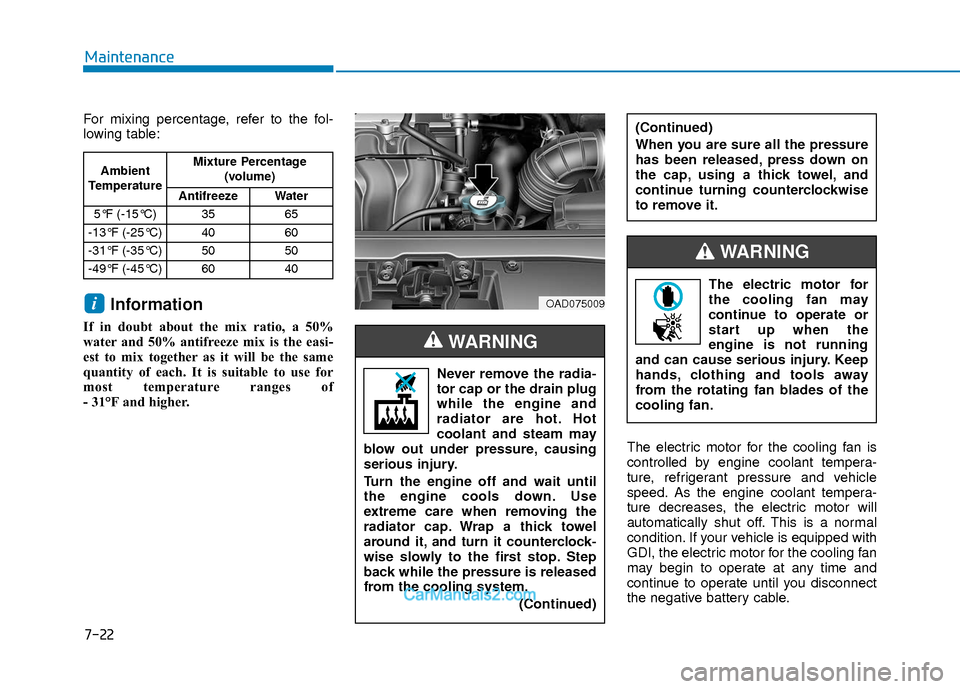
For mixing percentage, refer to the fol-
lowing table:
Information
If in doubt about the mix ratio, a 50%
water and 50% antifreeze mix is the easi-
est to mix together as it will be the same
quantity of each. It is suitable to use for
most temperature ranges of
- 31°F and higher.The electric motor for the cooling fan is
controlled by engine coolant tempera-
ture, refrigerant pressure and vehicle
speed. As the engine coolant tempera-
ture decreases, the electric motor will
automatically shut off. This is a normal
condition. If your vehicle is equipped with
GDI, the electric motor for the cooling fan
may begin to operate at any time and
continue to operate until you disconnect
the negative battery cable.
i
Ambient
Temperature Mixture Percentage
(volume)
Antifreeze Water
5°F (-15°C) 35 65
-13°F (-25°C) 40 60
-31°F (-35°C) 50 50
-49°F (-45°C) 60 40
Never remove the radia-
tor cap or the drain plug
while the engine and
radiator are hot. Hot
coolant and steam may
blow out under pressure, causing
serious injury.
Turn the engine off and wait until
the engine cools down. Use
extreme care when removing the
radiator cap. Wrap a thick towel
around it, and turn it counterclock-
wise slowly to the first stop. Step
back while the pressure is released
from the cooling system.
(Continued)
WARNING
(Continued)
When you are sure all the pressure
has been released, press down on
the cap, using a thick towel, and
continue turning counterclockwise
to remove it.
OAD075009
The electric motor for
the cooling fan may
continue to operate or
start up when the
engine is not running
and can cause serious injury. Keep
hands, clothing and tools away
from the rotating fan blades of the
cooling fan.
WARNING
Page 448 of 526
7-30
Maintenance
B
BA
A T
TT
TE
ER
R Y
Y
To prevent SERIOUS INJURY or
DEATH to you or bystanders,
always follow these precautions
when working near or handling the
battery:
Always read and follow
instructions carefully when
handling a battery.
Wear eye protection
designed to protect the
eyes from acid splashes.
Keep all flames, sparks, or
smoking materials away
from the battery.
Hydrogen is always present in battery cells, is highly
combustible, and may
explode if ignited.
Keep batteries out of reach
of children. (Continued)
WARNING (Continued)Batteries contain sulfuric
acid which is highly corro-
sive. Do not allow acid to
contact your eyes, skin or
clothing.
If acid gets into your eyes, flush
your eyes with clean water for at
least 15 minutes and get immediate
medical attention. If acid gets on
your skin, thoroughly wash the
area. If you feel pain or a burning
sensation, get medical attention
immediately.
When lifting a plastic-cased bat-
tery, excessive pressure on the
case may cause battery acid to
leak. Lift with a battery carrier or
with your hands on opposite cor-
ners.
Do not attempt to jump start your
vehicle if your battery is frozen.
NEVER attempt to recharge the
battery when the vehicle’s battery
cables are connected to the bat-
tery. (Continued)
(Continued)
The electrical ignition system
works with high voltage. NEVER
touch these components with the
engine running or when the
Engine Start/Stop button is in the
ON position.
Leaked battery electrolyte due to
repeated driving on sharp curves
(e.g. on circuits) may cause safe-
ty problem. Avoid repeated driv-
ing on sharp curves.
CALIFORNIA PROPOSITION 65
WARNING
Battery posts, terminals, and relat-
ed accessories contain lead and
lead compounds, chemicals known
to the State of California to cause
cancer, birth defects and reproduc-
tive harm. Batteries also contain
other chemicals known to the State
of California to cause cancer. Wash
hands after handling.
WARNING
Page 449 of 526
7-31
7
Maintenance
When you do not use the vehicle fora long time in a low temperature
area, disconnect the battery and
keep it indoors.
Always charge the battery fully to prevent battery case damage in low
temperature areas.
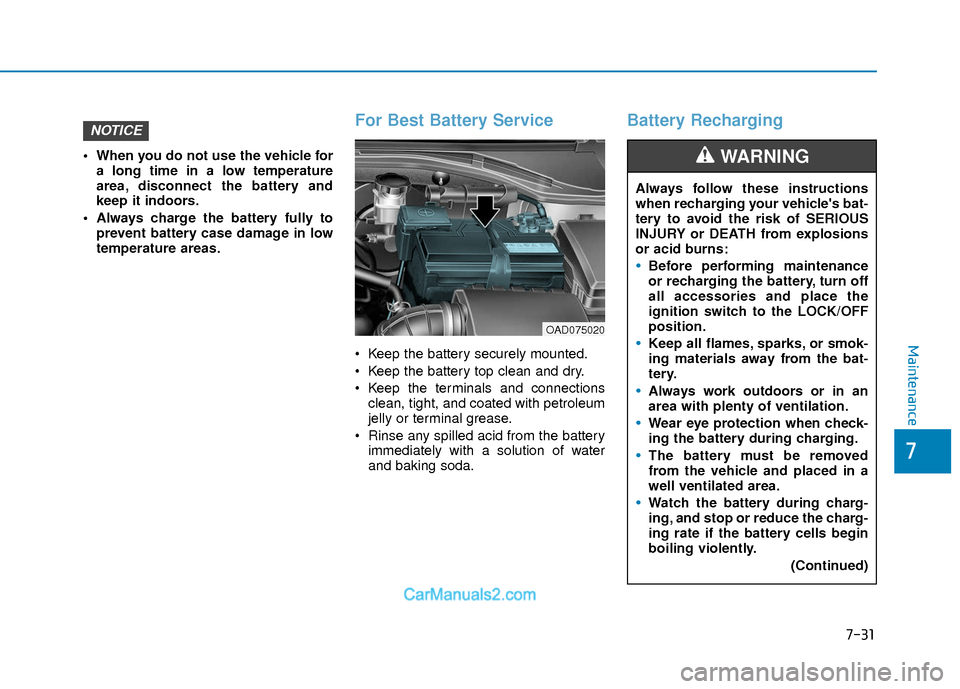
For Best Battery Service
Keep the battery securely mounted.
Keep the battery top clean and dry.
Keep the terminals and connectionsclean, tight, and coated with petroleum
jelly or terminal grease.
Rinse any spilled acid from the battery immediately with a solution of water
and baking soda.
Battery RechargingNOTICE
Always follow these instructions
when recharging your vehicle's bat-
tery to avoid the risk of SERIOUS
INJURY or DEATH from explosions
or acid burns:
Before performing maintenance
or recharging the battery, turn off
all accessories and place the
ignition switch to the LOCK/OFF
position.
Keep all flames, sparks, or smok-
ing materials away from the bat-
tery.
Always work outdoors or in an
area with plenty of ventilation.
Wear eye protection when check-
ing the battery during charging.
The battery must be removed
from the vehicle and placed in a
well ventilated area.
Watch the battery during charg-
ing, and stop or reduce the charg-
ing rate if the battery cells begin
boiling violently.
(Continued)
WARNING
OAD075020
Page 450 of 526
7-32
Maintenance
By jump starting
After a jump start from a good battery,
drive the vehicle for 20-30 minutes before
it is shutoff. The vehicle may not restart if
you shut it off before the battery had a
chance to adequately recharge. See
"Jump Starting" in chapter 6 for more
information on jump starting procedures.
Information
An inappropriately disposedbattery can be harmful to the
environment and human
health.
Dispose the battery according to your local
law(s) or regulation.
Reset Features
The following items may need to be reset
after the battery has been discharged or
the battery has been disconnected.
Power Windows
Trip Computer
Climate Control System
Clock
Audio System
Sunroof
i
(Continued)
The negative battery cable must
be removed first and installed
last when the battery is discon-
nected. Disconnect the battery
charger in the following order:
(1) Turn off the battery charger main switch.
(2) Unhook the negative clamp
from the negative battery ter-
minal.
(3) Unhook the positive clamp
from the positive battery ter-
minal.
Always use a genuine HYUNDAI
approved battery when you
replace the battery.
Page 462 of 526
7-44
Maintenance
Kilopascal (kPa)
The metric unit for air pressure.
Light truck (LT) tire
A tire designated by its manufacturer
as primarily intended for use on light-
weight trucks or multipurpose pas-
senger vehicles.
Load ratings
The maximum load that a tire is rated
to carry for a given inflation pressure.
Load Index
An assigned number ranging from 1
to 279 that corresponds to the load
carrying capacity of a tire.
Maximum Inflation Pressure
The maximum air pressure to which
a cold tire may be inflated. The max-
imum air pressure is molded onto the
sidewall.
Maximum Load Rating
The load rating for a tire at the maxi-
mum permissible inflation pressure
for that tire.
Maximum Loaded VehicleWeight
The sum of curb weight; accessory
weight; vehicle capacity weight; and
production options weight.
Normal Occupant Weight
The number of occupants a vehicle
is designed to seat multiplied by 150
pounds (68 kg).
Occupant Distribution
Designated seating positions.
Outward Facing Sidewall
An asymmetrical tire has a particular
side that faces outward when mount-
ed on a vehicle. The outward facing
sidewall bears white lettering or
bears manufacturer, brand, and/or
model name molding that is higher or
deeper than the same moldings on
the inner facing sidewall.
Passenger (P-Metric) tire
A tire used on passenger cars and
some light duty trucks and multipur-
pose vehicles.
Ply
A layer of rubber-coated parallel
cords.
Pneumatic tire
A mechanical device made of rubber,
chemicals, fabric and steel or other
materials, that, when mounted on an
automotive wheel provides the trac-
tion and contains the gas or fluid that
sustains the load.
Pneumatic options weight
The combined weight of installed
regular production options weighing
over 5 lb. (2.3 kg) in excess of the
standard items which they replace,
not previously considered in curb
weight or accessory weight, includ-
ing heavy duty breaks, ride levelers,
roof rack, heavy duty battery, and
special trim.
Page 466 of 526
7-48
Maintenance
F
FU
U S
SE
E S
S
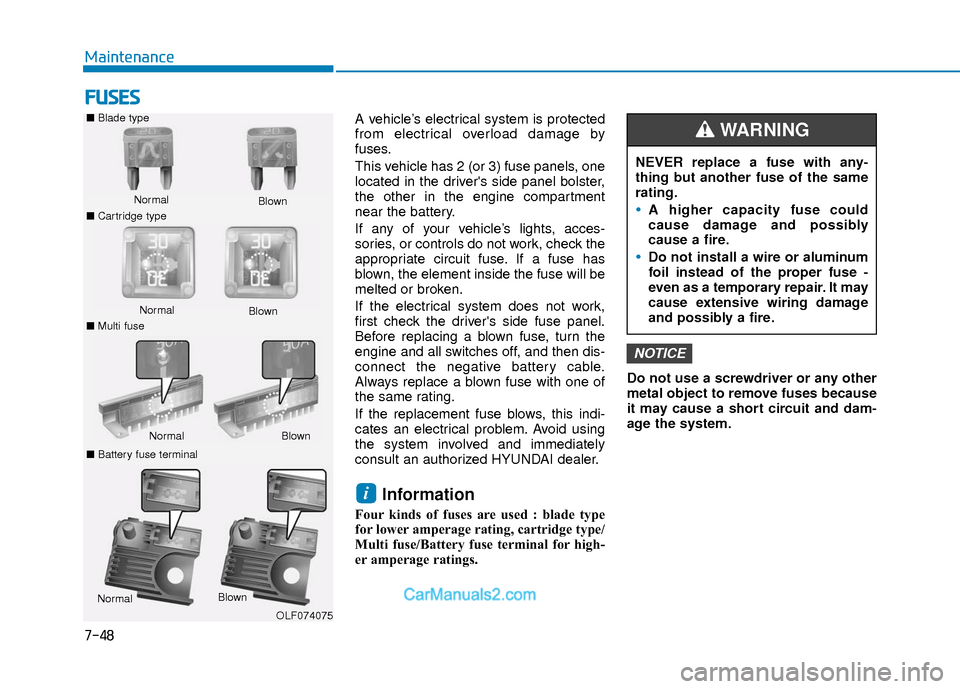
A vehicle’s electrical system is protected
from electrical overload damage by
fuses.
This vehicle has 2 (or 3) fuse panels, one
located in the driver's side panel bolster,
the other in the engine compartment
near the battery.
If any of your vehicle’s lights, acces-
sories, or controls do not work, check the
appropriate circuit fuse. If a fuse has
blown, the element inside the fuse will be
melted or broken.
If the electrical system does not work,
first check the driver's side fuse panel.
Before replacing a blown fuse, turn the
engine and all switches off, and then dis-
connect the negative battery cable.
Always replace a blown fuse with one of
the same rating.
If the replacement fuse blows, this indi-
cates an electrical problem. Avoid using
the system involved and immediately
consult an authorized HYUNDAI dealer.
Information
Four kinds of fuses are used : blade type
for lower amperage rating, cartridge type/
Multi fuse/Battery fuse terminal for high-
er amperage ratings. Do not use a screwdriver or any other
metal object to remove fuses because
it may cause a short circuit and dam-
age the system.
NOTICE
i
NEVER replace a fuse with any-
thing but another fuse of the same
rating.
A higher capacity fuse could
cause damage and possibly
cause a fire.
Do not install a wire or aluminum
foil instead of the proper fuse -
even as a temporary repair. It may
cause extensive wiring damage
and possibly a fire.
WARNING ■
Blade type
Normal
■ Cartridge type Blown
Normal
Blown
■ Multi fuse
Normal Blown
■
Battery fuse terminal
Normal Blown
OLF074075
Page 469 of 526
7-51
7
Maintenance
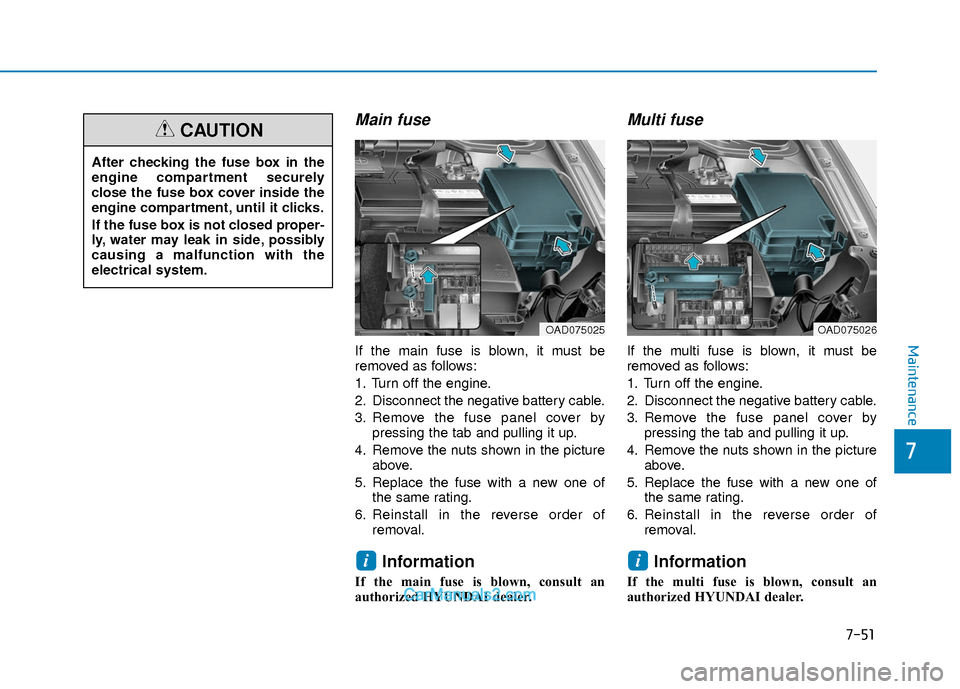
Main fuse
If the main fuse is blown, it must be
removed as follows:
1. Turn off the engine.
2. Disconnect the negative battery cable.
3. Remove the fuse panel cover bypressing the tab and pulling it up.
4. Remove the nuts shown in the picture above.
5. Replace the fuse with a new one of the same rating.
6. Reinstall in the reverse order of removal.
Information
If the main fuse is blown, consult an
authorized HYUNDAI dealer.
Multi fuse
If the multi fuse is blown, it must be
removed as follows:
1. Turn off the engine.
2. Disconnect the negative battery cable.
3. Remove the fuse panel cover bypressing the tab and pulling it up.
4. Remove the nuts shown in the picture above.
5. Replace the fuse with a new one of the same rating.
6. Reinstall in the reverse order of removal.
Information
If the multi fuse is blown, consult an
authorized HYUNDAI dealer.
ii
After checking the fuse box in the
engine compartment securely
close the fuse box cover inside the
engine compartment, until it clicks.
If the fuse box is not closed proper-
ly, water may leak in side, possibly
causing a malfunction with the
electrical system.
CAUTION
OAD075025OAD075026
Page 478 of 526
7-60
Maintenance
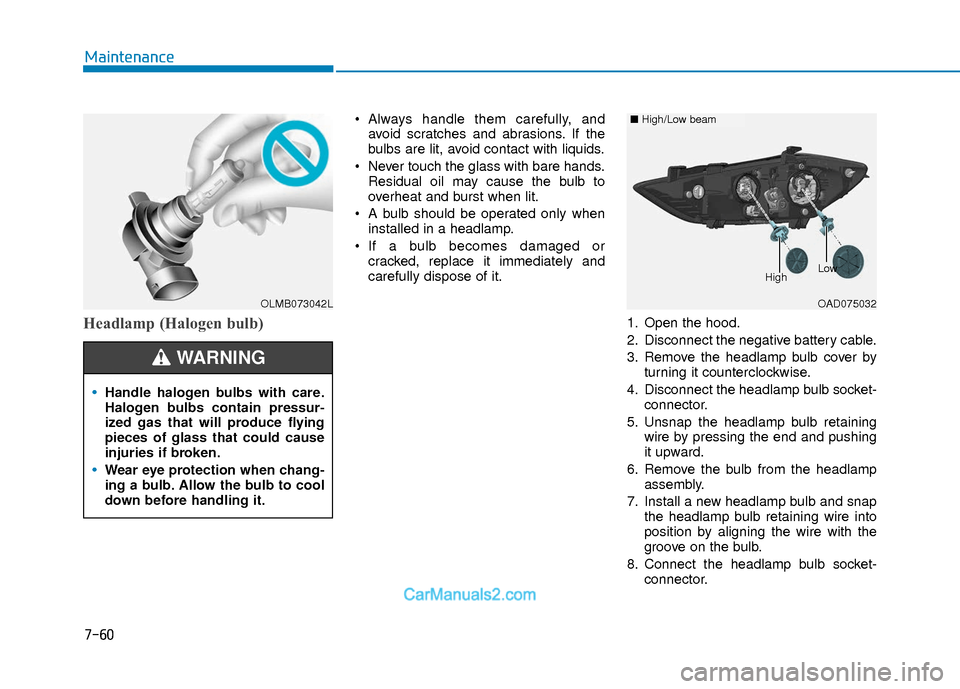
Headlamp (Halogen bulb)
Always handle them carefully, andavoid scratches and abrasions. If the
bulbs are lit, avoid contact with liquids.
Never touch the glass with bare hands. Residual oil may cause the bulb to
overheat and burst when lit.
A bulb should be operated only when installed in a headlamp.
If a bulb becomes damaged or cracked, replace it immediately and
carefully dispose of it.
1. Open the hood.
2. Disconnect the negative battery cable.
3. Remove the headlamp bulb cover byturning it counterclockwise.
4. Disconnect the headlamp bulb socket- connector.
5. Unsnap the headlamp bulb retaining wire by pressing the end and pushing
it upward.
6. Remove the bulb from the headlamp assembly.
7. Install a new headlamp bulb and snap the headlamp bulb retaining wire into
position by aligning the wire with the
groove on the bulb.
8. Connect the headlamp bulb socket- connector.
OLMB073042L
Handle halogen bulbs with care.
Halogen bulbs contain pressur-
ized gas that will produce flying
pieces of glass that could cause
injuries if broken.
Wear eye protection when chang-
ing a bulb. Allow the bulb to cool
down before handling it.
WARNING
OAD075032
■High/Low beam
LowHigh
Page 479 of 526
7-61
7
Maintenance
9. Install the headlamp bulb cover byturning it clockwise.
Information
The headlamp aiming should be adjusted
after an accident or after the headlamp
assembly is reinstalled at an authorized
HYUNDAI dealer.
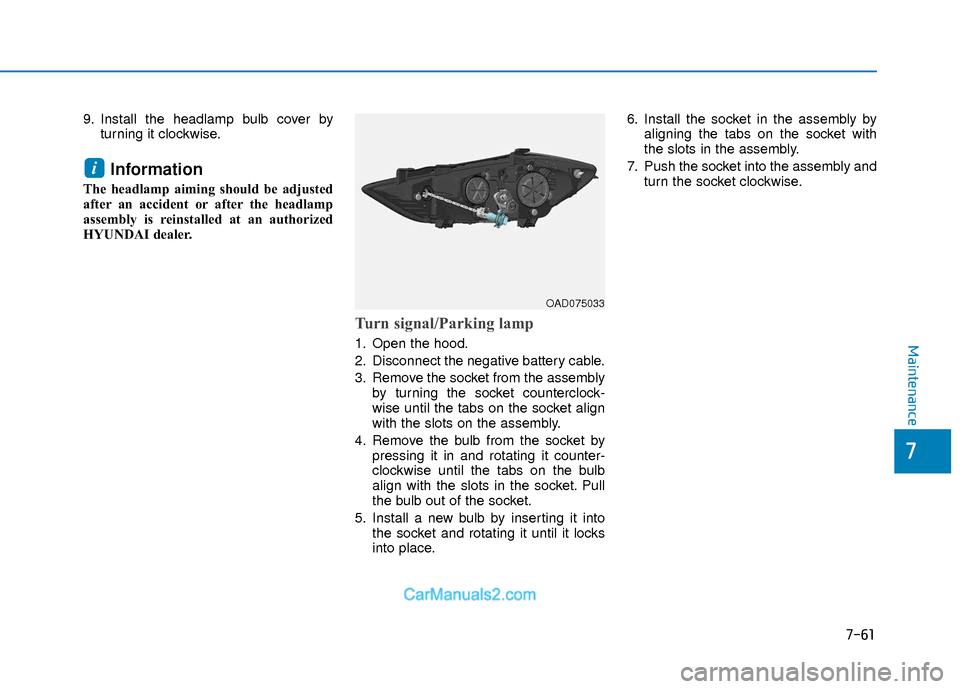
Turn signal/Parking lamp
1. Open the hood.
2. Disconnect the negative battery cable.
3. Remove the socket from the assemblyby turning the socket counterclock-
wise until the tabs on the socket align
with the slots on the assembly.
4. Remove the bulb from the socket by pressing it in and rotating it counter-
clockwise until the tabs on the bulb
align with the slots in the socket. Pull
the bulb out of the socket.
5. Install a new bulb by inserting it into the socket and rotating it until it locks
into place. 6. Install the socket in the assembly by
aligning the tabs on the socket with
the slots in the assembly.
7. Push the socket into the assembly and turn the socket clockwise.
i
OAD075033