ECU Hyundai Equus 2016 User Guide
[x] Cancel search | Manufacturer: HYUNDAI, Model Year: 2016, Model line: Equus, Model: Hyundai Equus 2016Pages: 477, PDF Size: 16.25 MB
Page 66 of 477
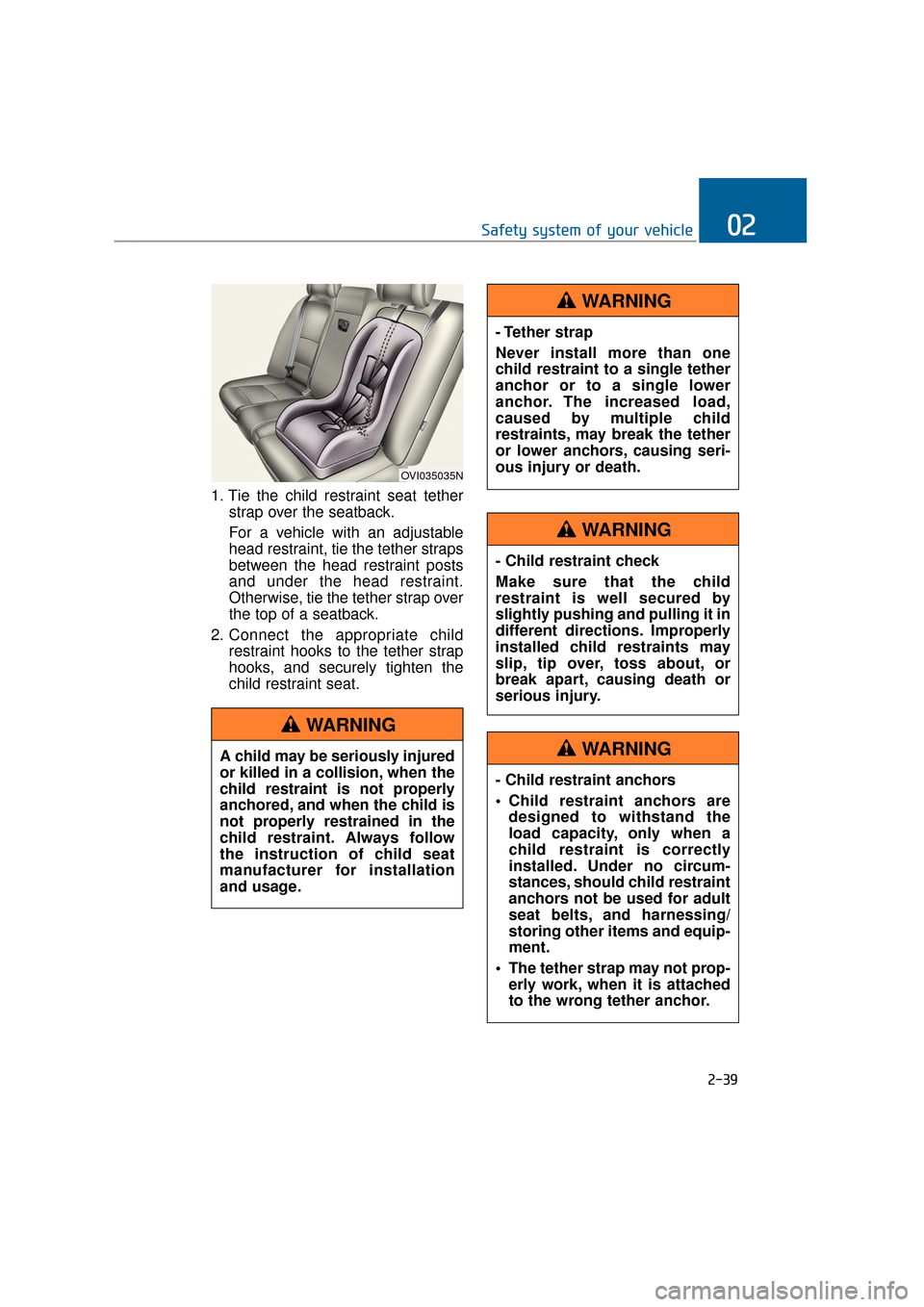
1. Tie the child restraint seat tetherstrap over the seatback.
For a vehicle with an adjustable
head restraint, tie the tether straps
between the head restraint posts
and under the head restraint.
Otherwise, tie the tether strap over
the top of a seatback.
2. Connect the appropriate child restraint hooks to the tether strap
hooks, and securely tighten the
child restraint seat.
2-39
Safety system of your vehicle02
OVI035035N
A child may be seriously injured
or killed in a collision, when the
child restraint is not properly
anchored, and when the child is
not properly restrained in the
child restraint. Always follow
the instruction of child seat
manufacturer for installation
and usage.
WARNING
- Tether strap
Never install more than one
child restraint to a single tether
anchor or to a single lower
anchor. The increased load,
caused by multiple child
restraints, may break the tether
or lower anchors, causing seri-
ous injury or death.
WARNING
- Child restraint check
Make sure that the child
restraint is well secured by
slightly pushing and pulling it in
different directions. Improperly
installed child restraints may
slip, tip over, toss about, or
break apart, causing death or
serious injury.
WARNING
- Child restraint anchors
Child restraint anchors aredesigned to withstand the
load capacity, only when a
child restraint is correctly
installed. Under no circum-
stances, should child restraint
anchors not be used for adult
seat belts, and harnessing/
storing other items and equip-
ment.
The tether strap may not prop- erly work, when it is attached
to the wrong tether anchor.
WARNING
Page 67 of 477
Securing a child restraint to thelower anchor
Some manufacturers produce child
restraints, which are labeled as
LATCH or LATCH-compatible.
LATCH stands for "Lower Anchors
and Tethers for Children". These
child restraints are equipped with two
rigid or webbing-mounted attach-
ments, which are to be connected to
the two LATCH anchors in a specific
seat of your vehicle. This type of child
restraint does not use a seat belt to
be attached in a rear seat.
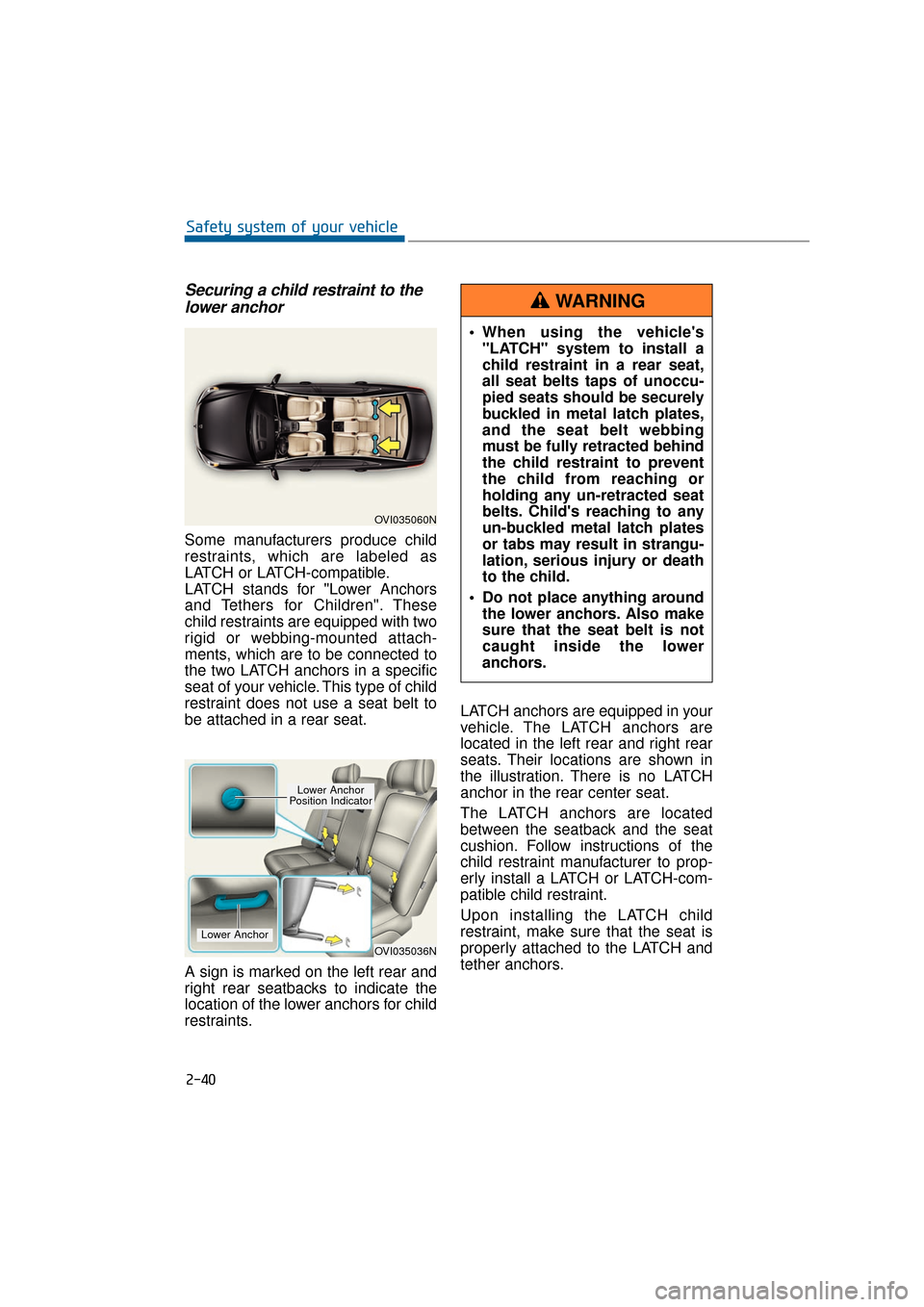
A sign is marked on the left rear and
right rear seatbacks to indicate the
location of the lower anchors for child
restraints. LATCH anchors are equipped in your
vehicle. The LATCH anchors are
located in the left rear and right rear
seats. Their locations are shown in
the illustration. There is no LATCH
anchor in the rear center seat.
The LATCH anchors are located
between the seatback and the seat
cushion. Follow instructions of the
child restraint manufacturer to prop-
erly install a LATCH or LATCH-com-
patible child restraint.
Upon installing the LATCH child
restraint, make sure that the seat is
properly attached to the LATCH and
tether anchors.
2-40
Safety system of your vehicle
OVI035060N
OVI035036N
Lower Anchor
Lower Anchor
Position Indicator
When using the vehicle's
"LATCH" system to install a
child restraint in a rear seat,
all seat belts taps of unoccu-
pied seats should be securely
buckled in metal latch plates,
and the seat belt webbing
must be fully retracted behind
the child restraint to prevent
the child from reaching or
holding any un-retracted seat
belts. Child's reaching to any
un-buckled metal latch plates
or tabs may result in strangu-
lation, serious injury or death
to the child.
Do not place anything around the lower anchors. Also make
sure that the seat belt is not
caught inside the lower
anchors.
WARNING
Page 68 of 477
Also, test the child restraint before
seating your child. Slightly shake the
restraint from side to side. Also try to
tug the restraint forward. Check
whether the anchors securely hold
the restraint in place.
Do not scratch or pinch a rear seat
belt webbing with a child restraint
latch or a LATCH anchor during
the installation.The recommended weight for the
LATCH system is under 65 lbs (30
kg).
How to calculate the child
restraint weight :
Child restraint weight =
65 lbs (30 kg) - Child weightNOTICE
NOTICE
2-41
Safety system of your vehicle02
- LATCH lower anchors
LATCH lower anchors are to be
used only in the left rear and
right rear seats. Never attempt
to install a child restraint in the
rear center seat. You may dam-
age the anchors, or the anchors
may fail and break apart in a
collision.
WARNING
When the child restraint is not
properly anchored, the risk of a
child's serious injury or death in
a collision greatly increases.
DANGER
Page 72 of 477
SRS components and functions
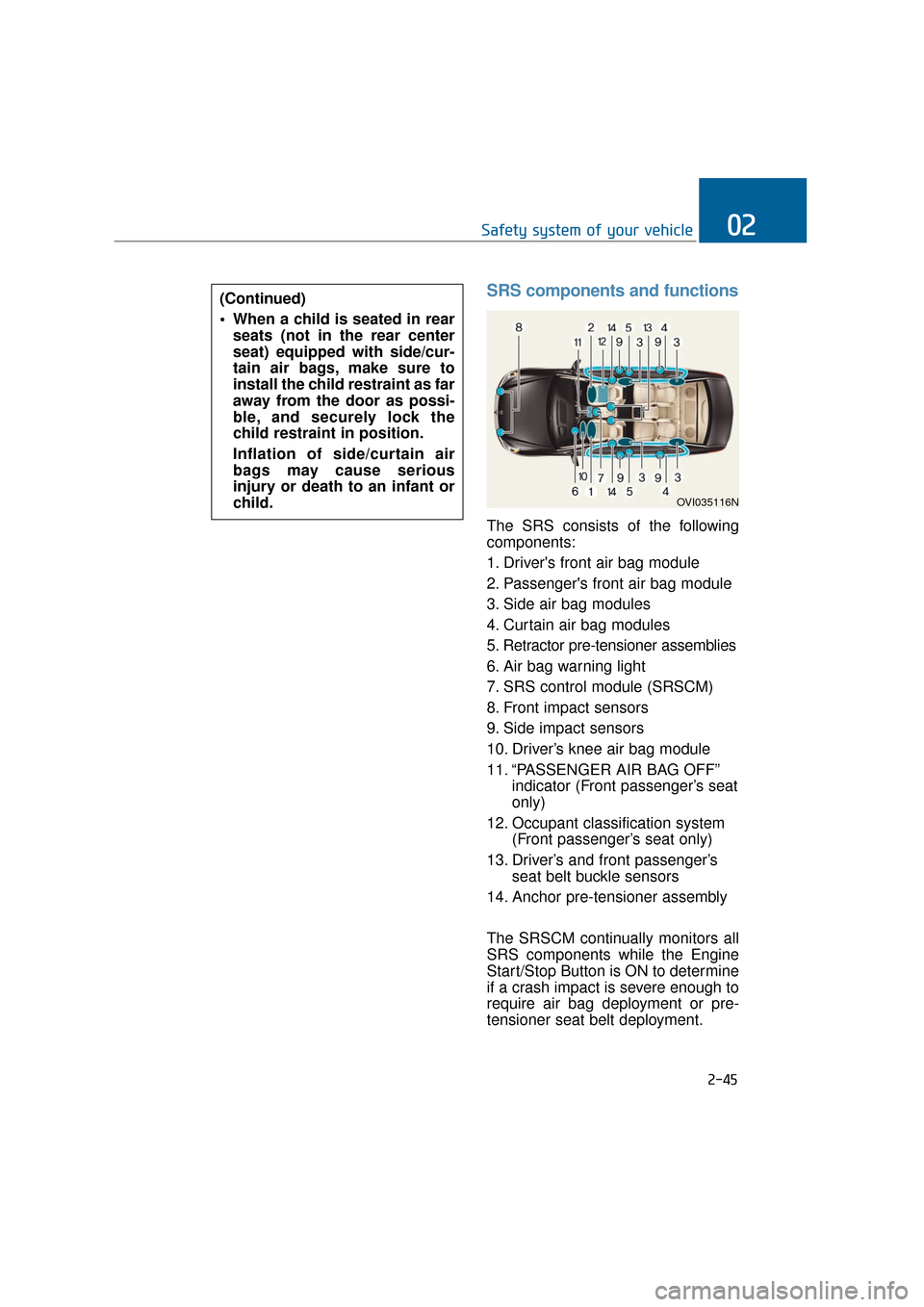
The SRS consists of the following
components:
1. Driver's front air bag module
2. Passenger's front air bag module
3. Side air bag modules
4. Curtain air bag modules
5. Retractor pre-tensioner assemblies
6. Air bag warning light
7. SRS control module (SRSCM)
8. Front impact sensors
9. Side impact sensors
10. Driver’s knee air bag module
11. “PASSENGER AIR BAG OFF”indicator (Front passenger’s seat
only)
12. Occupant classification system (Front passenger’s seat only)
13. Driver’s and front passenger’s seat belt buckle sensors
14. Anchor pre-tensioner assembly
The SRSCM continually monitors all
SRS components while the Engine
Start/Stop Button is ON to determine
if a crash impact is severe enough to
require air bag deployment or pre-
tensioner seat belt deployment.
2-45
Safety system of your vehicle02
(Continued)
When a child is seated in rear seats (not in the rear center
seat) equipped with side/cur-
tain air bags, make sure to
install the child restraint as far
away from the door as possi-
ble, and securely lock the
child restraint in position.
Inflation of side/curtain air
bags may cause serious
injury or death to an infant or
child.
OVI035116N
Page 80 of 477
2-53
Safety system of your vehicle02
Even though your vehicle isequipped with the occupant
classification system, never
install a child restraint system
in the front passenger's seat. A
deploying air bag may forcefully
strike a child, resulting in seri-
ous injury or death. Any child
age 12 and under should ride in
a rear seat. Children too big for
a child restraint should use the
available lap/shoulder belts. No
matter what type of a crash
occurs, children of all ages are
safer, when restrained in a rear
seat.
When the "PASSENGER AIR BAG OFF" indicator illumi-
nates with an adult's occupa-
tion in the front passenger's
seat, he/she sits properly (sit-
ting in an upright position,
and sitting on the center of
the seat cushion with their
seat belt fastened, legs com-
fortably extended and their
feet on the floor), have that
person sit in a rear seat.
Do not modify or replace the front passenger's seat. Do not
place or attach any items, such
as a blanket or seat heater, on
the front passenger's seat.
This may adversely affect the
occupant classification sys-
tem.
When the weight load is changed in the front passen-
ger's seat, the PASSENGER
"AIR BAG OFF" indicator may
flash ON and OFF for a few sec-
onds, enabling and disabling
the front passenger's air bag.
(Continued)
(Continued)
Do not sit over a sharp object,such as a tool, in the front
passenger's seat. This may
adversely affect the occupant
classification system.
Do not use an accessory seat cover over the front passen-
ger's seat.
Accident statistics show that children are safer, when
restrained in a rear than in the
front. It is recommended that
all child restraints be secured
in a rear seat, including a rear-
facing infant seat, a forward-
facing child seat and a boost-
er seat
Air bags can be used only once – have an authorized
EQUUS dealer replace the air
bag immediately after a
deployment.
A tiny adult's incorrect seat- ing (i.e. excessively reclining,
leaning toward the door or the
center console, or slanting
forward) may cause a condi-
tion where the advanced front
passenger's air bag system
senses less weight than occu-
pant's the actual weight (when
properly sitting in an upright
position, and sitting on the
center of the seat cushion
with their seat belt fastened,
legs comfortably extended
and their feet on the floor).
This condition may result in
misclassification of an occu-
pant and illumination of the
"PASSENGER AIR BAG OFF"
indicator.WARNING
Page 87 of 477
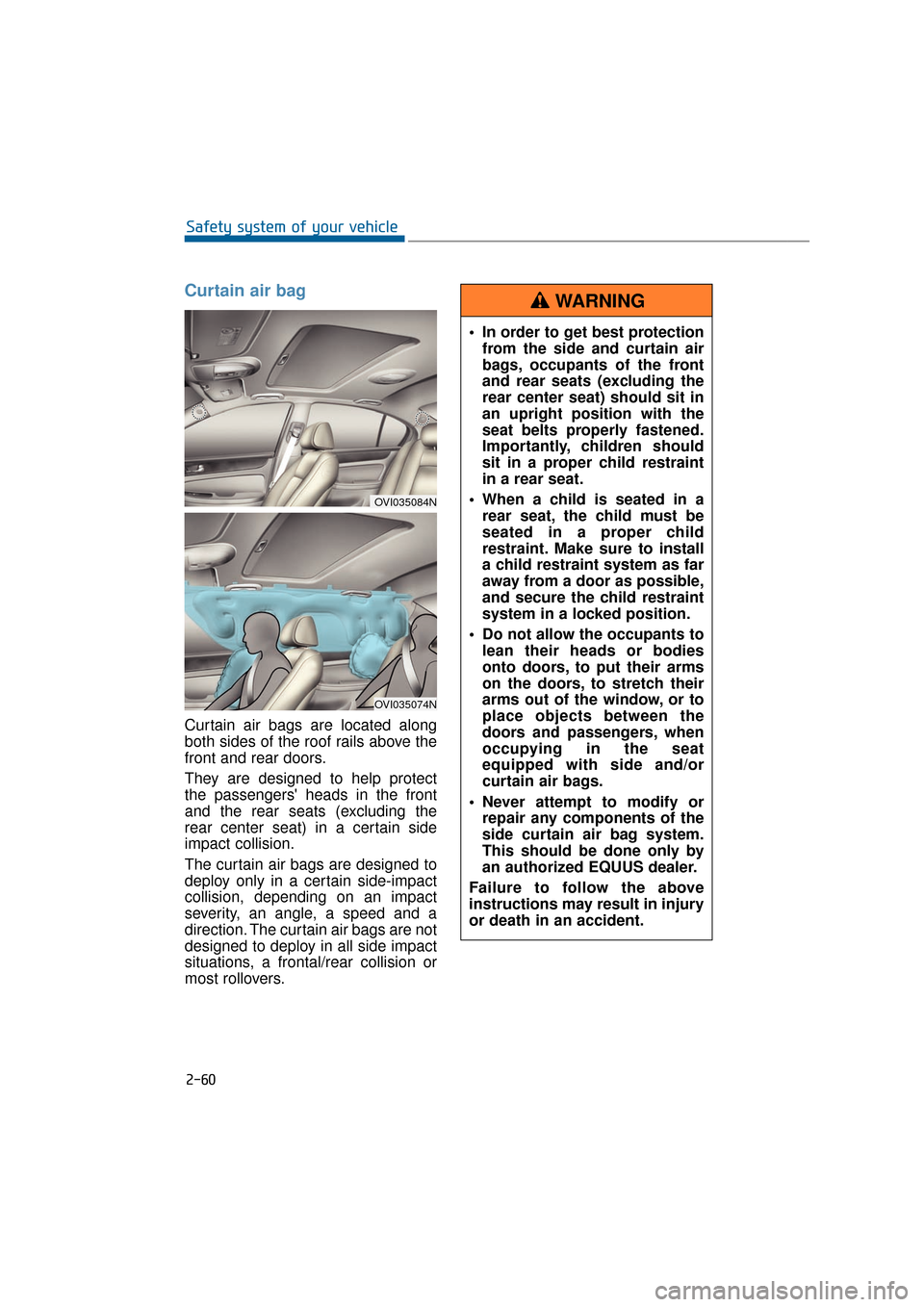
Curtain air bag
Curtain air bags are located along
both sides of the roof rails above the
front and rear doors.
They are designed to help protect
the passengers' heads in the front
and the rear seats (excluding the
rear center seat) in a certain side
impact collision.
The curtain air bags are designed to
deploy only in a certain side-impact
collision, depending on an impact
severity, an angle, a speed and a
direction. The curtain air bags are not
designed to deploy in all side impact
situations, a frontal/rear collision or
most rollovers.
2-60
Safety system of your vehicle
OVI035084N
OVI035074N
In order to get best protectionfrom the side and curtain air
bags, occupants of the front
and rear seats (excluding the
rear center seat) should sit in
an upright position with the
seat belts properly fastened.
Importantly, children should
sit in a proper child restraint
in a rear seat.
When a child is seated in a rear seat, the child must be
seated in a proper child
restraint. Make sure to install
a child restraint system as far
away from a door as possible,
and secure the child restraint
system in a locked position.
Do not allow the occupants to lean their heads or bodies
onto doors, to put their arms
on the doors, to stretch their
arms out of the window, or to
place objects between the
doors and passengers, when
occupying in the seat
equipped with side and/or
curtain air bags.
Never attempt to modify or repair any components of the
side curtain air bag system.
This should be done only by
an authorized EQUUS dealer.
Failure to follow the above
instructions may result in injury
or death in an accident.
WARNING
Page 103 of 477
(Continued)
• You can control the door unlockmode in the User Settings menu on
the LCD display, such as unlocking
all the doors by pressing the unlock
button one time.
Trunk Unlocking
To unlock:
1. Carry the Smart Key.
2. Press either the trunk handle but- ton or the Trunk Unlock button on
the Smart Key for one second or
over.
3. The hazard warning lights will flash two times.
After opening and closing the trunk,
the trunk will automatically lock.
Information
The power trunk (if equipped) can be
operated even when the engine is not
running. However, the power trunk
consumes large amounts of vehicle
electric power. To prevent the battery
from being discharged, do not operate
it consecutively (more than approxi-
mately 10 times).
Panic Button
Press the Panic button (4) for more
than one second. The horn sounds
and hazard warning lights flash for
about 30 seconds.
To cancel the panic mode, press any
button on the Smart Key.
Start-Up
You can start the engine without
inserting the key. For detailed infor-
mation, refer to the Engine
Start/Stop Button in the chapter 5.
To prevent the Smart Key from
being damaged:
• Keep the Smart Key away from water or any liquid and fire. If the
inside of the Smart Key gets
damp (due to drinks or mois-
ture), or is heated, internal cir-
cuit may malfunction, excluding
the vehicle from the warranty.
Avoid dropping or throwing the Smart Key.
Do not keep the Smart Key at an extreme temperature.
NOTICE
i
3-8
Convenient features of your vehicle
Page 108 of 477
This system helps to protect your
vehicle and valuables. The hazard
warning lights will continuously flash
with a warning alarm, when any of
the followings occurs:
- A door is opened without using theSmart Key.
- The trunk is opened without using the Smart Key.
- The engine hood is opened.
The alarm continues for 30 seconds.
This repeats once more, and then
the system resets. To turn OFF the
alarm, unlock the doors with the
Smart Key.
The Theft Alarm System automati-
cally sets ON 30 seconds, after lock-
ing the doors and the trunk. To acti-
vate the system, you must lock the
doors and the trunk from outside with
the Smart Key or by pressing the but-
ton on the door handles with the
Smart Key. The hazard warning lights
flash once with a chime sound to
indicate onset of the system.
Once the Theft Alarm System sets
ON, opening any door, the trunk, or
the hood without using the Smart
Key will activate the alarm. The Theft
Alarm System will not set ON, when
the hood, the trunk, or any door is
not securely closed. When the sys-
tem does not set ON, check the
hood, the trunk, or the doors are
securely closed.
Do not attempt to modify this system
or add other devices to it.Information
• Do not lock the doors until all pas- sengers leave the vehicle. When any
passenger remains in the vehicle, the
alarm will activate.
• When you cannot cancel the Theft Alarm System with the Smart Key,
open the doors by using the mechan-
ical key and turn ON the Engine
Start/Stop button.
i
T TH
H E
EF
FT
T -
-A
A L
LA
A R
RM
M
S
S Y
Y S
ST
T E
EM
M
3-13
Convenient features of your vehicle03
Page 109 of 477
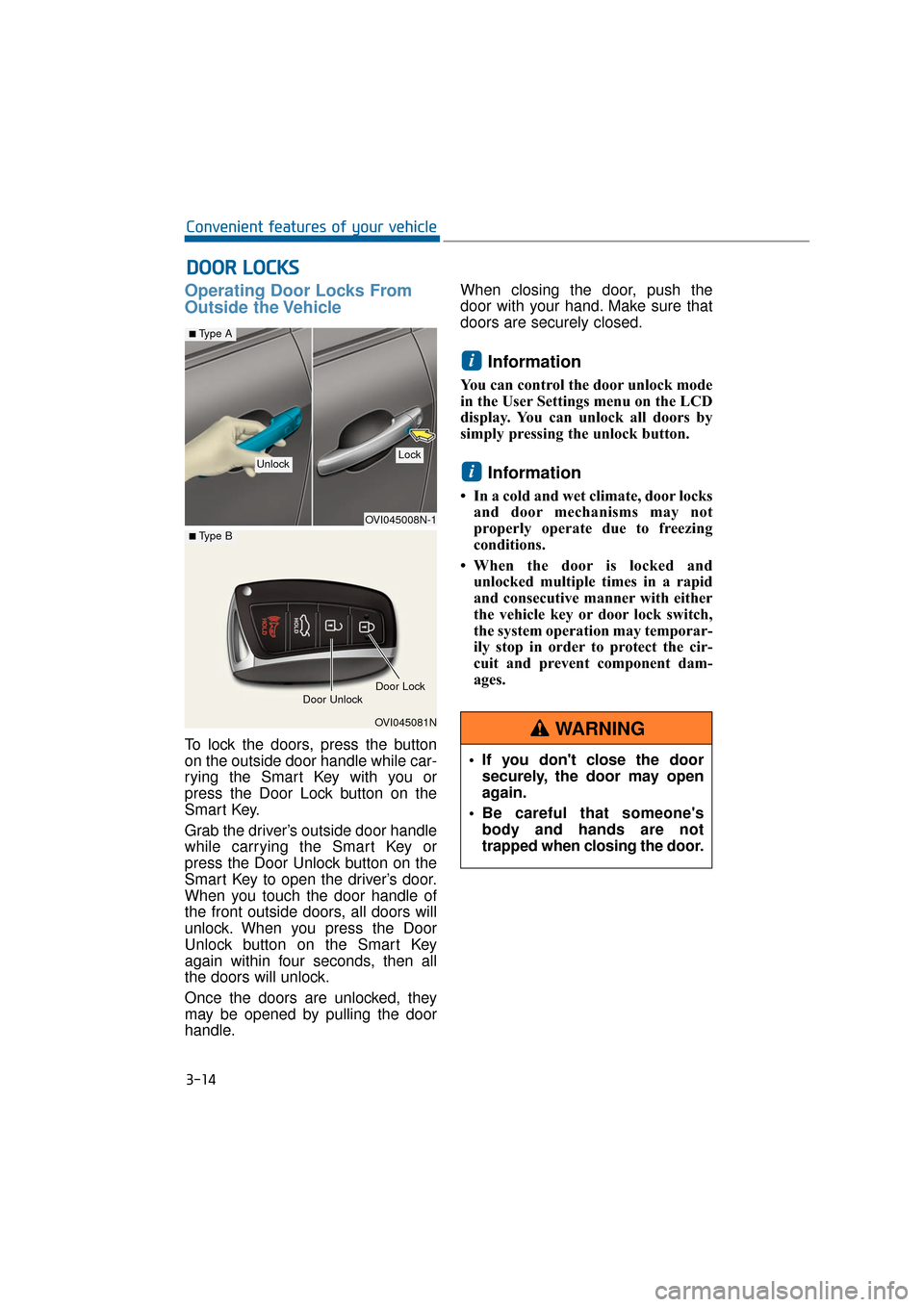
Operating Door Locks From
Outside the Vehicle
To lock the doors, press the button
on the outside door handle while car-
rying the Smart Key with you or
press the Door Lock button on the
Smart Key.
Grab the driver’s outside door handle
while carrying the Smart Key or
press the Door Unlock button on the
Smart Key to open the driver’s door.
When you touch the door handle of
the front outside doors, all doors will
unlock. When you press the Door
Unlock button on the Smart Key
again within four seconds, then all
the doors will unlock.
Once the doors are unlocked, they
may be opened by pulling the door
handle.When closing the door, push the
door with your hand. Make sure that
doors are securely closed.
Information
You can control the door unlock mode
in the User Settings menu on the LCD
display. You can unlock all doors by
simply pressing the unlock button.
Information
• In a cold and wet climate, door locks
and door mechanisms may not
properly operate due to freezing
conditions.
• When the door is locked and unlocked multiple times in a rapid
and consecutive manner with either
the vehicle key or door lock switch,
the system operation may temporar-
ily stop in order to protect the cir-
cuit and prevent component dam-
ages.
i
i
D DO
O O
OR
R
L
L O
O C
CK
K S
S
3-14
Convenient features of your vehicle
OVI045008N-1
■Type A
OVI045081N
■ Type B
Door Unlock
UnlockLock
Door Lock
If you don't close the door securely, the door may open
again.
Be careful that someone's body and hands are not
trapped when closing the door.
WARNING
Page 111 of 477
(Continued)
Repeatedly attempt to unlock a door
(both electronic and manual) while
simultaneously pulling out a door
handle.
Operate the locks and handles of
other front/rear doors.
Lower a front window and use the
mechanical key from outside to
unlock the door.
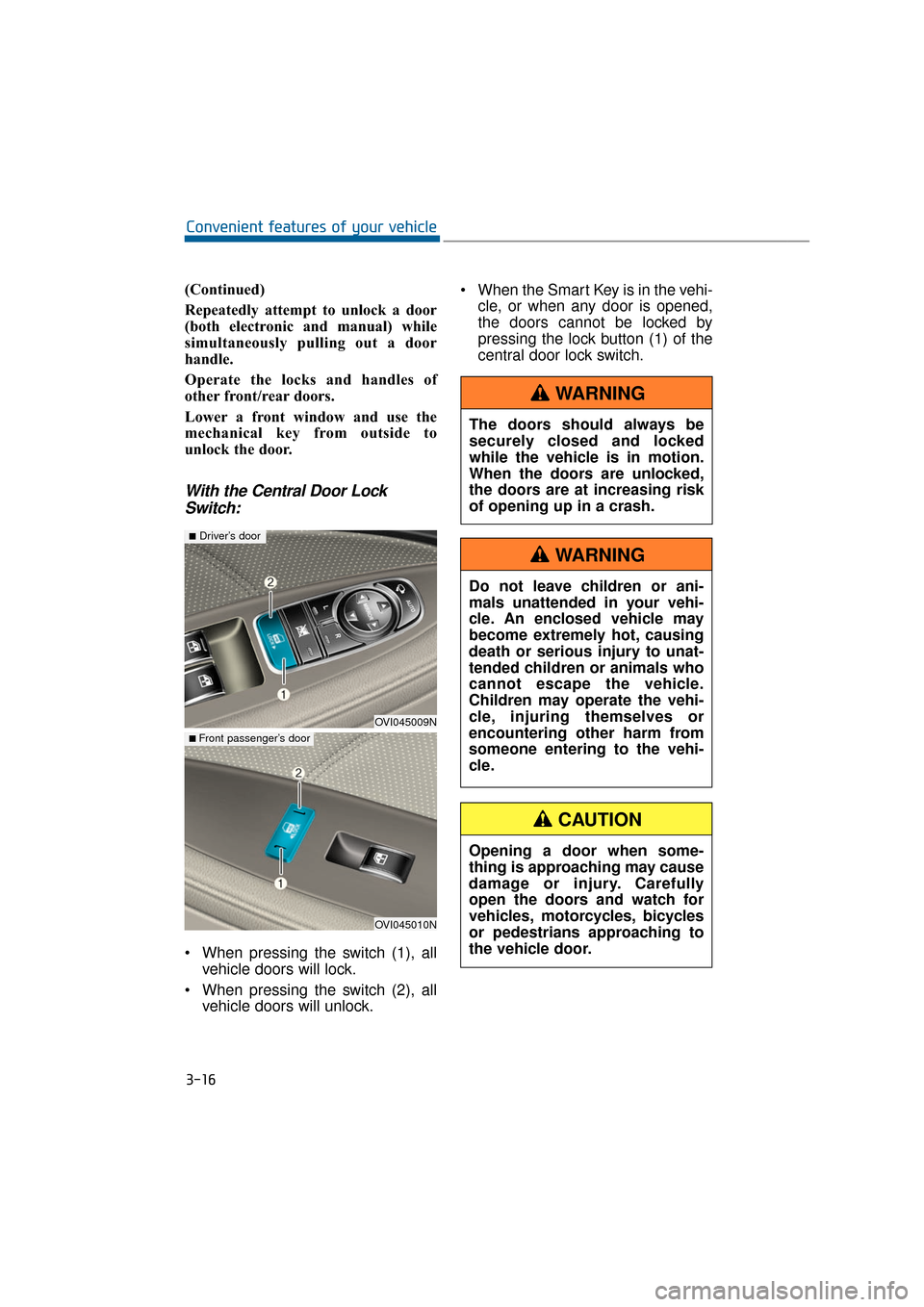
With the Central Door LockSwitch:
When pressing the switch (1), all
vehicle doors will lock.
When pressing the switch (2), all vehicle doors will unlock. When the Smart Key is in the vehi-
cle, or when any door is opened,
the doors cannot be locked by
pressing the lock button (1) of the
central door lock switch.
3-16
Convenient features of your vehicle
OVI045009N
■Driver’s door
OVI045010N
■ Front passenger’s door
The doors should always be
securely closed and locked
while the vehicle is in motion.
When the doors are unlocked,
the doors are at increasing risk
of opening up in a crash.
WARNING
Do not leave children or ani-
mals unattended in your vehi-
cle. An enclosed vehicle may
become extremely hot, causing
death or serious injury to unat-
tended children or animals who
cannot escape the vehicle.
Children may operate the vehi-
cle, injuring themselves or
encountering other harm from
someone entering to the vehi-
cle.
WARNING
Opening a door when some-
thing is approaching may cause
damage or injury. Carefully
open the doors and watch for
vehicles, motorcycles, bicycles
or pedestrians approaching to
the vehicle door.
CAUTION