check engine Hyundai Equus 2016 Owner's Guide
[x] Cancel search | Manufacturer: HYUNDAI, Model Year: 2016, Model line: Equus, Model: Hyundai Equus 2016Pages: 477, PDF Size: 16.25 MB
Page 203 of 477
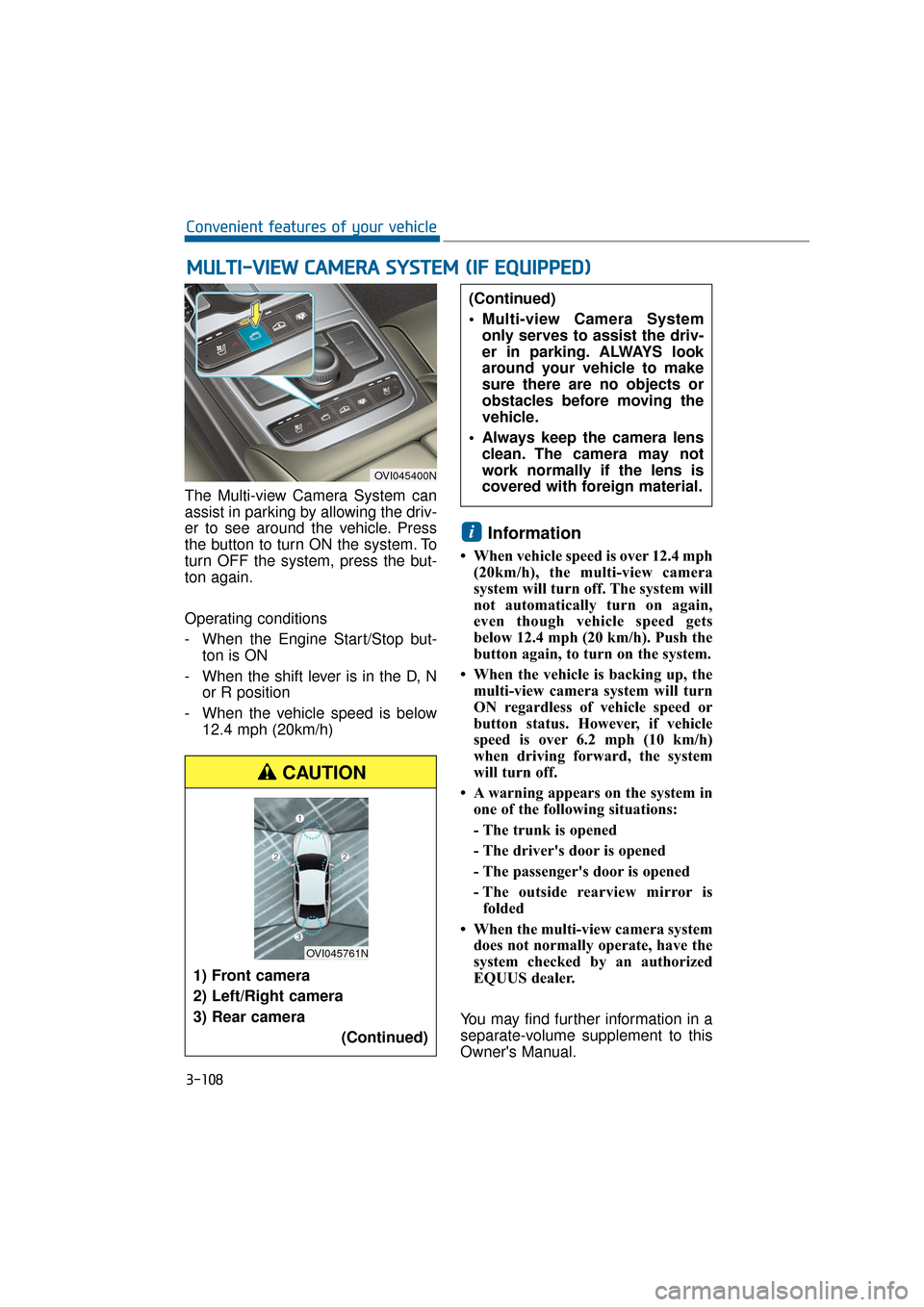
The Multi-view Camera System can
assist in parking by allowing the driv-
er to see around the vehicle. Press
the button to turn ON the system. To
turn OFF the system, press the but-
ton again.
Operating conditions
- When the Engine Start/Stop but-ton is ON
- When the shift lever is in the D, N or R position
- When the vehicle speed is below 12.4 mph (20km/h)
Information
• When vehicle speed is over 12.4 mph(20km/h), the multi-view camera
system will turn off. The system will
not automatically turn on again,
even though vehicle speed gets
below 12.4 mph (20 km/h). Push the
button again, to turn on the system.
• When the vehicle is backing up, the multi-view camera system will turn
ON regardless of vehicle speed or
button status. However, if vehicle
speed is over 6.2 mph (10 km/h)
when driving forward, the system
will turn off.
• A warning appears on the system in one of the following situations:
- The trunk is opened
- The driver's door is opened
- The passenger's door is opened
- The outside rearview mirror isfolded
• When the multi-view camera system does not normally operate, have the
system checked by an authorized
EQUUS dealer.
You may find further information in a
separate-volume supplement to this
Owner's Manual.
i
M M U
UL
LT
T I
I-
- V
V I
IE
E W
W
C
C A
A M
M E
ER
R A
A
S
S Y
Y S
ST
T E
EM
M
(
( I
IF
F
E
E Q
Q U
UI
IP
P P
PE
ED
D )
)
3-108
Convenient features of your vehicle
OVI045400N
1) Front camera
2) Left/Right camera
3) Rear camera
(Continued)
(Continued)
Multi-view Camera Systemonly serves to assist the driv-
er in parking. ALWAYS look
around your vehicle to make
sure there are no objects or
obstacles before moving the
vehicle.
Always keep the camera lens clean. The camera may not
work normally if the lens is
covered with foreign material.
CAUTION
OVI045761N
Page 210 of 477
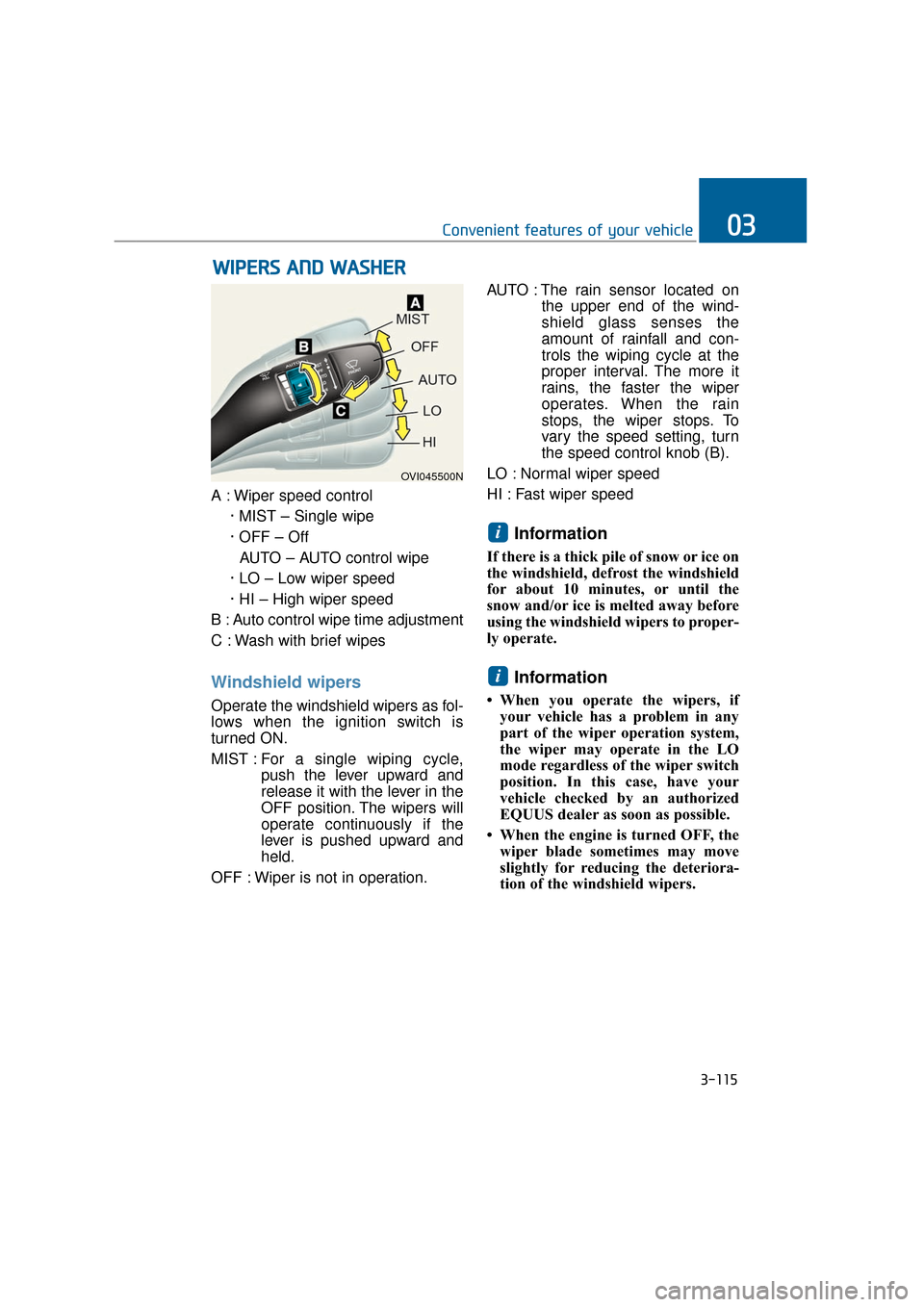
A : Wiper speed control· MIST – Single wipe
· OFF – OffAUTO – AUTO control wipe
· LO – Low wiper speed
· HI – High wiper speed
B : Auto control wipe time adjustment
C : Wash with brief wipes
Windshield wipers
Operate the windshield wipers as fol-
lows when the ignition switch is
turned ON.
MIST : For a single wiping cycle,
push the lever upward and
release it with the lever in the
OFF position. The wipers will
operate continuously if the
lever is pushed upward and
held.
OFF : Wiper is not in operation. AUTO : The rain sensor located on
the upper end of the wind-
shield glass senses the
amount of rainfall and con-
trols the wiping cycle at the
proper interval. The more it
rains, the faster the wiper
operates. When the rain
stops, the wiper stops. To
vary the speed setting, turn
the speed control knob (B).
LO : Normal wiper speed
HI : Fast wiper speed
Information
If there is a thick pile of snow or ice on
the windshield, defrost the windshield
for about 10 minutes, or until the
snow and/or ice is melted away before
using the windshield wipers to proper-
ly operate.
Information
• When you operate the wipers, if your vehicle has a problem in any
part of the wiper operation system,
the wiper may operate in the LO
mode regardless of the wiper switch
position. In this case, have your
vehicle checked by an authorized
EQUUS dealer as soon as possible.
• When the engine is turned OFF, the wiper blade sometimes may move
slightly for reducing the deteriora-
tion of the windshield wipers.
i
i
W W I
IP
P E
ER
R S
S
A
A N
N D
D
W
W A
AS
SH
H E
ER
R
3-115
Convenient features of your vehicle03
OVI045500N
Page 211 of 477
Auto control
The rain sensor located on the upper
end of the windshield glass senses
the amount of rainfall and controls the
wiping cycle at the proper interval.
The more it rains, the faster the wiper
operates. When the rain stops, the
wiper stops. To vary the speed set-
ting, turn the speed control knob (B).
If the wiper switch is set in AUTO
mode when the Engine Start/Stop
Button is ON, the wiper will operate
once to perform a self-check of the
system. Set the wiper to OFF position
when the wiper is not in use.
When the Engine Start/Stop
Button is ON and the windshield
wiper switch is placed in the AUTO
mode, use caution in the following
situations to avoid any injury to
the hands or other parts of the
body:
Do not touch the upper end ofthe windshield glass facing the
rain sensor.
Do not wipe the upper end of the windshield glass with a damp or
wet cloth.
Do not put pressure on the windshield glass. When washing the vehicle, set the
wiper switch in the OFF position
to stop the auto wiper operation.
The wiper may operate and be
damaged if the switch is set in the
AUTO mode while washing the
vehicle.
Do not remove the sensor cover
located on the upper end of the
passenger side windshield glass.
The system parts may be dam-
aged and may not be covered by
your vehicle warranty.
When starting the vehicle in win-
ter, set the wiper switch in the OFF
position. Otherwise, wipers may
operate and ice may damage the
windshield wiper blades. Always
remove all snow and ice and
defrost the windshield properly
prior to operating the windshield
wipers.
NOTICE
NOTICE
3-116
Convenient features of your vehicle
Page 212 of 477
Windshield washer
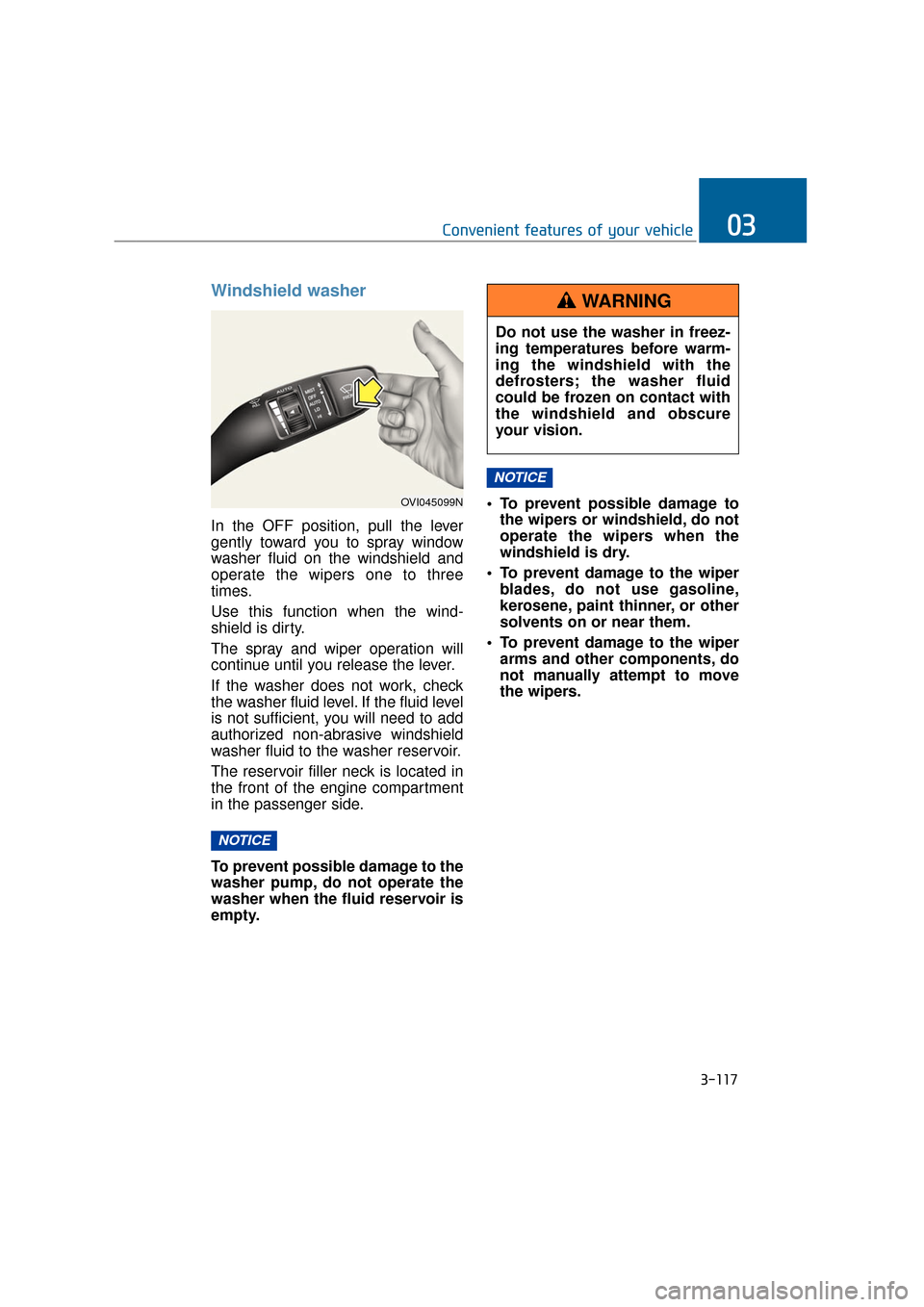
In the OFF position, pull the lever
gently toward you to spray window
washer fluid on the windshield and
operate the wipers one to three
times.
Use this function when the wind-
shield is dirty.
The spray and wiper operation will
continue until you release the lever.
If the washer does not work, check
the washer fluid level. If the fluid level
is not sufficient, you will need to add
authorized non-abrasive windshield
washer fluid to the washer reservoir.
The reservoir filler neck is located in
the front of the engine compartment
in the passenger side.
To prevent possible damage to the
washer pump, do not operate the
washer when the fluid reservoir is
empty. To prevent possible damage to
the wipers or windshield, do not
operate the wipers when the
windshield is dry.
To prevent damage to the wiper blades, do not use gasoline,
kerosene, paint thinner, or other
solvents on or near them.
To prevent damage to the wiper arms and other components, do
not manually attempt to move
the wipers.
NOTICE
NOTICE
3-117
Convenient features of your vehicle03
OVI045099N
Do not use the washer in freez-
ing temperatures before warm-
ing the windshield with the
defrosters; the washer fluid
could be frozen on contact with
the windshield and obscure
your vision.
WARNING
Page 231 of 477
3-136
Convenient features of your vehicle
Air conditioning system operation
tips
When the vehicle is parked underthe direct sunlight in hot weather,
open the windows for a short time
to expel the hot air inside from the
vehicle.
To reduce the dew condensation on the inside of the windows on
rainy or humid days, lower the
humidity inside the vehicle by
operating the A/C system.
During the A/C operation, you may occasionally notice a slight
change in the engine speed, as
the A/C compressor cycles. This is
a normal condition.
Test the A/C system every month only for a few minutes to maximize
the system performance.
After the inside temperature becomes sufficiently cool, change
the air intake control from the air
recirculation mode to the (fresh)
air intake mode.
When operating the A/C system, you may notice clear water drip-
ping (or even puddling) from the
passenger side of the vehicle. This
does not indicate a system failure.
The air recirculation mode of the A/C provides the maximum cool-
ing. However, a prolonged period
of the A/C operation in this mode
may make the air stale inside the
vehicle.
While operating the A/C system, you may occasionally notice the
dew condensation because of the
rapid cooling process and humid
air intake. This does not mean
there is not a system failure.
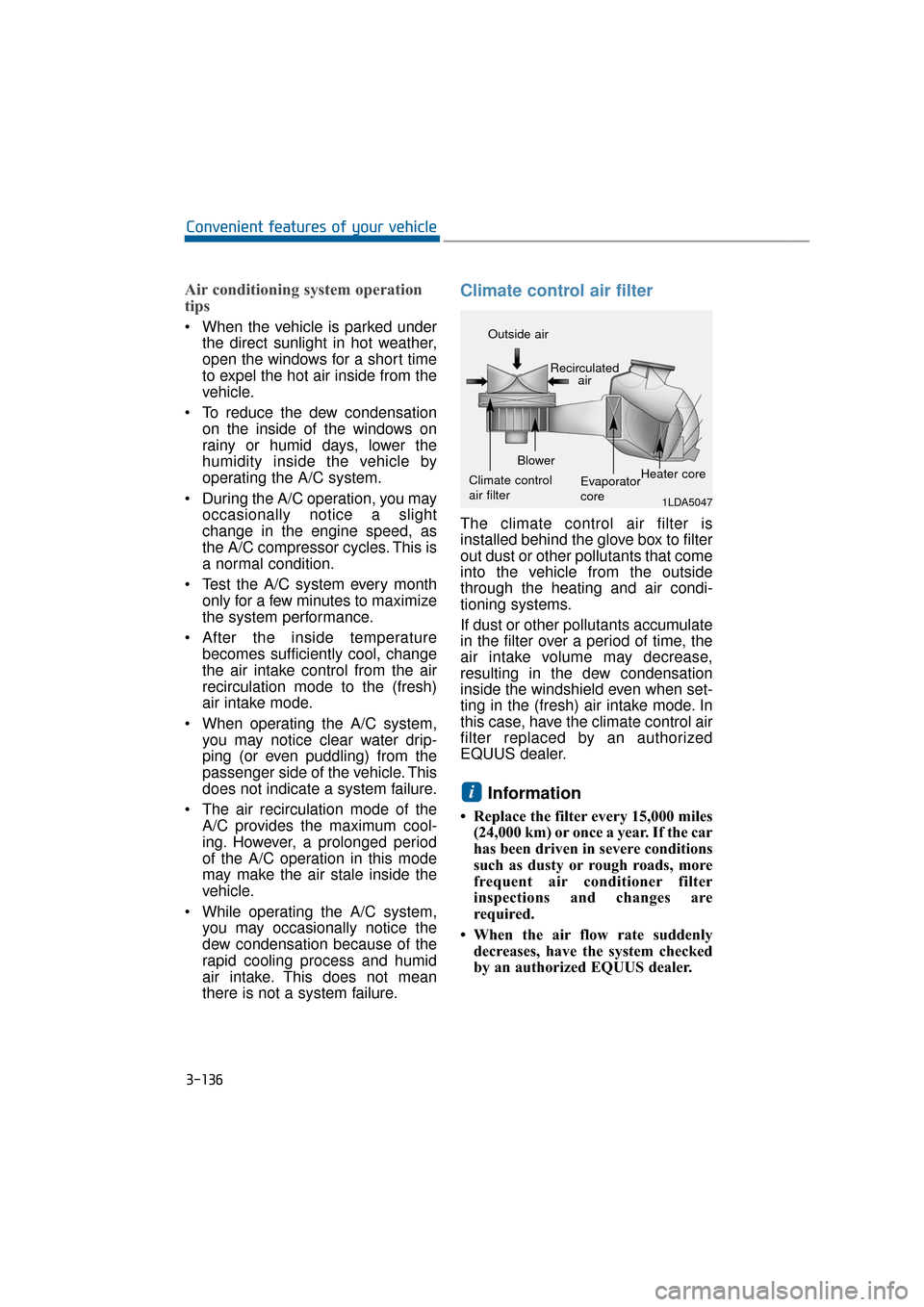
Climate control air filter
The climate control air filter is
installed behind the glove box to filter
out dust or other pollutants that come
into the vehicle from the outside
through the heating and air condi-
tioning systems.
If dust or other pollutants accumulate
in the filter over a period of time, the
air intake volume may decrease,
resulting in the dew condensation
inside the windshield even when set-
ting in the (fresh) air intake mode. In
this case, have the climate control air
filter replaced by an authorized
EQUUS dealer.
Information
• Replace the filter every 15,000 miles(24,000 km) or once a year. If the car
has been driven in severe conditions
such as dusty or rough roads, more
frequent air conditioner filter
inspections and changes are
required.
• When the air flow rate suddenly decreases, have the system checked
by an authorized EQUUS dealer.
i
1LDA5047
Outside air
Recirculatedair
Climate control
air filter Blower
Evaporator
coreHeater core
Page 254 of 477
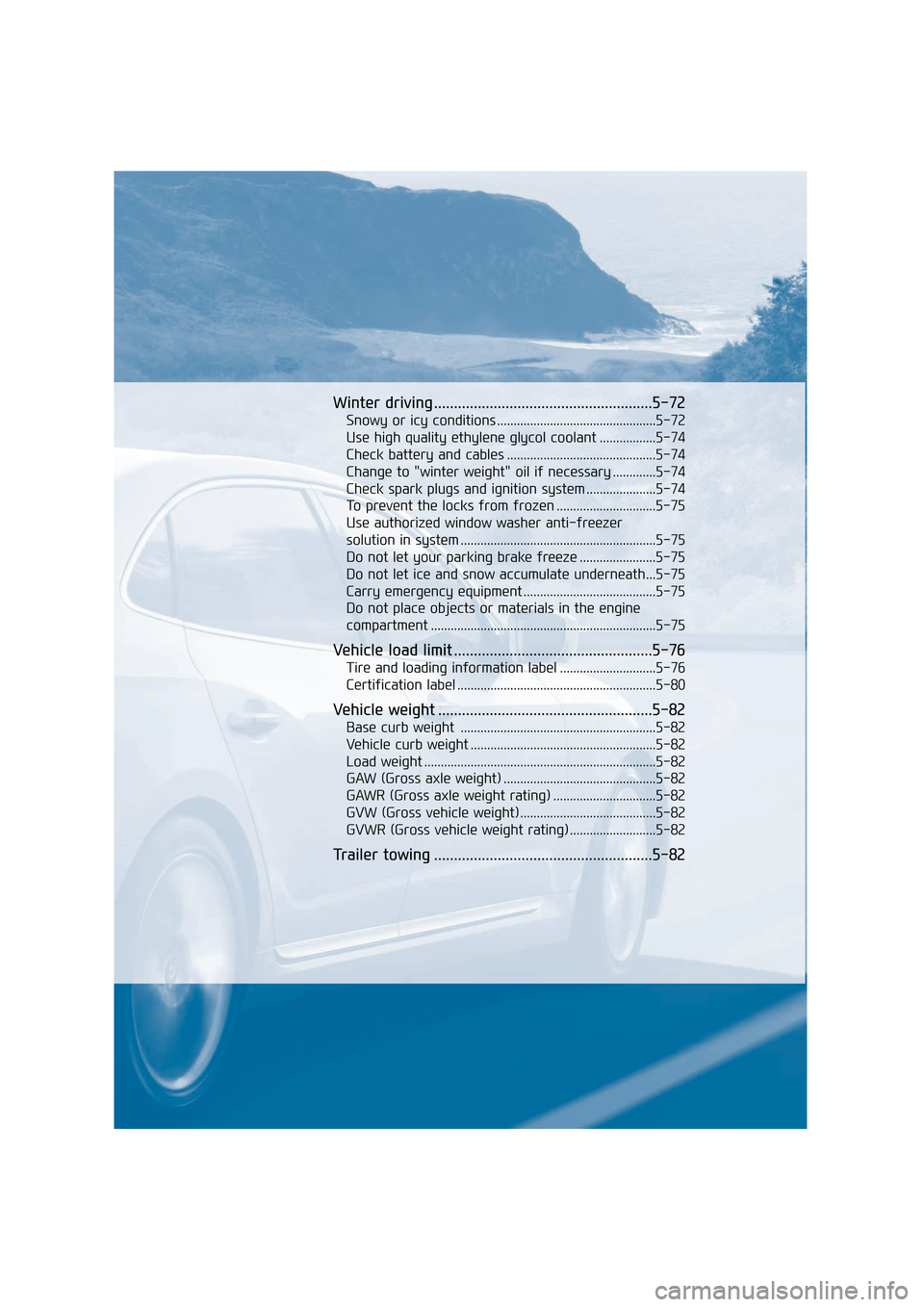
Winter driving .......................................................5-72
Snowy or icy conditions ................................................5-72
Use high quality ethylene glycol coolant .................5-74
Check battery and cables .............................................5-74
Change to "winter weight" oil if necessary .............5-74
Check spark plugs and ignition system .....................5-74
To prevent the locks from frozen ..............................5-75
Use authorized window washer anti-freezer
solution in system ...........................................................5-75
Do not let your parking brake freeze .......................5-75
Do not let ice and snow accumulate underneath...5-75
Carry emergency equipment ........................................5-75
Do not place objects or materials in the engine
compartment ....................................................................5-75\
Vehicle load limit ..................................................5-76
Tire and loading information label .............................5-76
Certification label ............................................................5-80
Vehicle weight ......................................................5-82
Base curb weight ...........................................................5-82
Vehicle curb weight ........................................................5-82
Load weight ......................................................................5-\
82
GAW (Gross axle weight) ..............................................5-82
GAWR (Gross axle weight rating) ...............................5-82
GVW (Gross vehicle weight) .........................................5-82
GVWR (Gross vehicle weight rating) ..........................5-82
Trailer towing .......................................................5-82
Page 255 of 477
5-4
Driving your vehicle
- ENGINE EXHAUST CAN BE DANGEROUS!
Engine exhaust fumes may be extremely dangerous. When, at any time, you
smell exhaust fumes inside the vehicle, immediately open the windows.
• Do not inhale exhaust fumes.Exhaust fumes contain carbon monoxide, the colorless, odorless gas that
may cause unconsciousness and death by asphyxiation.
The exhaust system should be checked whenever the vehicle is raised to
change the oil or for any other purpose. If you notice a change in the sound
of the exhaust system or if you drive over something that strikes the vehicle
underneath, have the exhaust system checked as soon as possible by an
authorized EQUUS dealer.
Letting the engine idle in a garage, even with the garage door open, is haz-
ardous. Never run the engine in your garage any longer than it takes to start
the engine and move out the vehicle.
Avoid idling the engine for a prolonged period of time with people inside the vehicle.
If it is necessary to idle the engine for a prolonged period of time with people
inside the vehicle, idle the engine in an open area with the air control in the
(fresh) air intake mode and the fan operating at a high speed. Thus, fresh air
can be taken into the interior.
When you need to drive with the trunk lid open because of the object you carry,
make sure the followings:
1. Close all windows.
2. Open side vents.
3. Set the air intake control in (fresh) air intake mode, the air flow directed toward "Floor" or "Face," and the fan at a high speed.
To assure proper ventilation, clear snow, ice, leaves or other substances from
the air inlet just in front of the windshield.
WARNING
Engine exhaust and a wide variety of automobile components and
parts, including components found in the interior furnishings in a
vehicle, contain or emit chemicals known to the State of California to
cause cancer and birth defects and reproductive harm. In addition,
certain fluids contained in vehicles and certain products of compo-
nent wear contain or emit chemicals known to the State of California
to cause cancer and birth defects or other reproductive harm.
California PROPOSITION 65 WARNING
Page 256 of 477
Before entering vehicle
• Be sure that all windows, outsidemirror(s), and outside lights are
clean.
Check the condition of the tires.
Check underneath the vehicle for any leakage sign.
Make sure there are no obstacles behind, when you intend to drive
backwards.
Necessary inspections
Fluid levels, such as engine oil,
engine coolant, brake fluid, and
washer fluid should be checked on a
regular basis, at exact intervals.
Further details are provided in the
chapter 7, "Maintenance".
Before starting
Close and lock all doors.
Check the seat position, so all con-trols are easily accessible.
Adjust the inside and outside rearview mirrors.
Make sure that all lights operate.
Check all gauges.
Check the operation of warning lights when the Engine Start/Stop
button is turned ON.
Release the parking brake and make sure the brake warning light
goes OFF.
For safe operation, make sure you
are familiar with your vehicle equip-
ment and operation.
B B E
EF
FO
O R
RE
E
D
D R
RI
IV
V I
IN
N G
G
5-5
Driving your vehicle05
Careless driving may result in a
loss of vehicle control, possibly
leading to an accident, severe
personal injury, and death. The
driver’s primary responsibility
is to drive in the safe and legal
manner. The use of any hand-
held devices, other equipment,
or vehicle systems, which take
the driver’s eyes, attention and
focus away from the safe opera-
tion of a vehicle or which are
not permissible by law, should
never be used in driving.
WARNINGAll passengers must be proper-
ly belted whenever the vehicle
is moving. Refer to "Seat belts"
in chapter 2 for more informa-
tion on the proper usage.
WARNING
Always take a look around your
vehicle for any passers-by,
especially children, before
changing the shift lever to D
(Drive) or R (Reverse).
WARNING
Page 258 of 477
E
EN
N G
GI
IN
N E
E
S
S T
T A
A R
RT
T/
/S
S T
T O
O P
P
B
B U
U T
TT
TO
O N
N
5-7
Driving your vehicle05
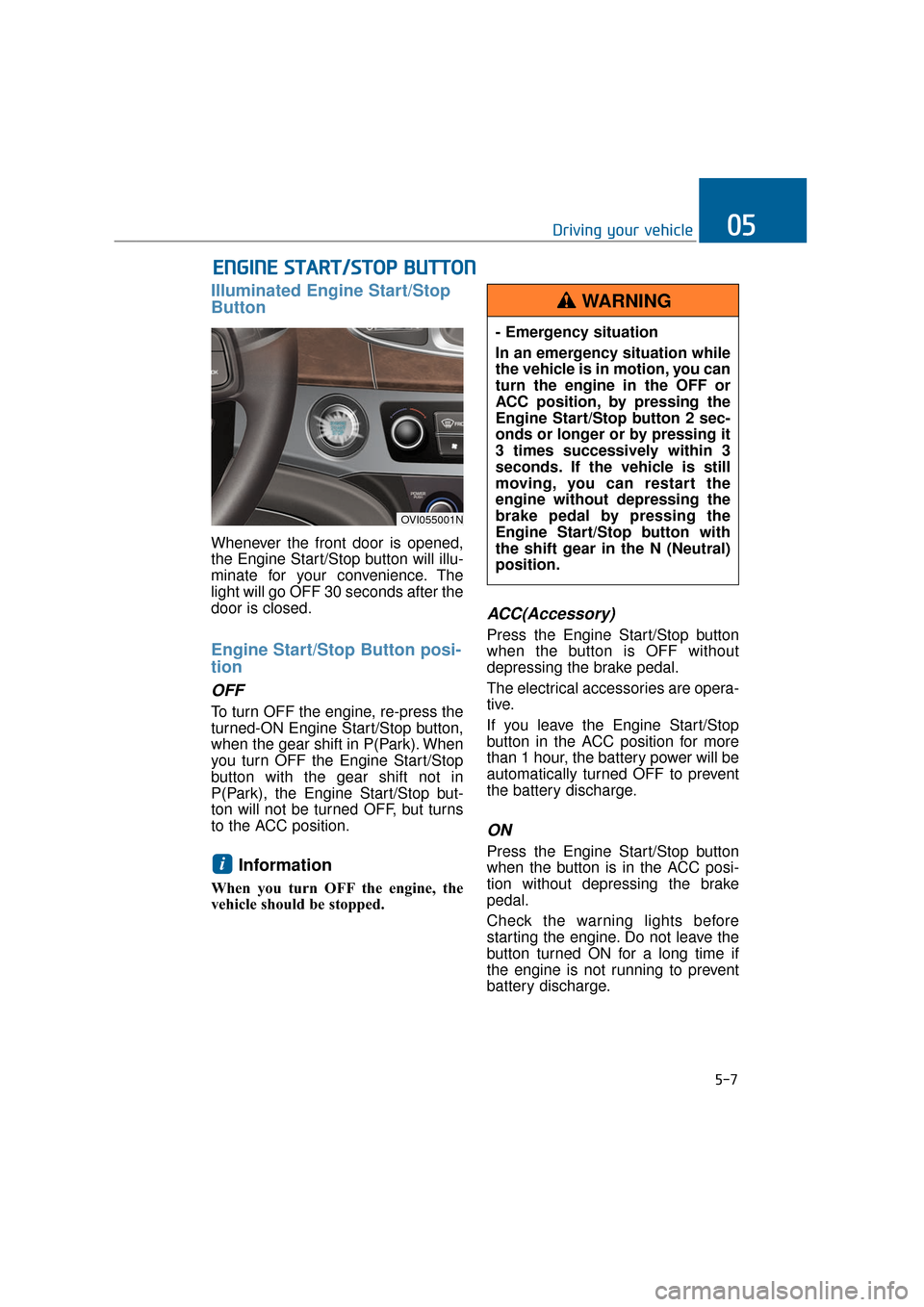
Illuminated Engine Start/Stop
Button
Whenever the front door is opened,
the Engine Start/Stop button will illu-
minate for your convenience. The
light will go OFF 30 seconds after the
door is closed.
Engine Start/Stop Button posi-
tion
OFF
To turn OFF the engine, re-press the
turned-ON Engine Start/Stop button,
when the gear shift in P(Park). When
you turn OFF the Engine Start/Stop
button with the gear shift not in
P(Park), the Engine Start/Stop but-
ton will not be turned OFF, but turns
to the ACC position.
Information
When you turn OFF the engine, the
vehicle should be stopped.
ACC(Accessory)
Press the Engine Start/Stop button
when the button is OFF without
depressing the brake pedal.
The electrical accessories are opera-
tive.
If you leave the Engine Start/Stop
button in the ACC position for more
than 1 hour, the battery power will be
automatically turned OFF to prevent
the battery discharge.
ON
Press the Engine Start/Stop button
when the button is in the ACC posi-
tion without depressing the brake
pedal.
Check the warning lights before
starting the engine. Do not leave the
button turned ON for a long time if
the engine is not running to prevent
battery discharge.i
OVI055001N
- Emergency situation
In an emergency situation while
the vehicle is in motion, you can
turn the engine in the OFF or
ACC position, by pressing the
Engine Start/Stop button 2 sec-
onds or longer or by pressing it
3 times successively within 3
seconds. If the vehicle is still
moving, you can restart the
engine without depressing the
brake pedal by pressing the
Engine Start/Stop button with
the shift gear in the N (Neutral)
position.
WARNING
Page 260 of 477
1.Carry the Smart Key inside thevehicle.
2.Check the parking brake is firmly applied.
3.Place the shift lever in P(Park).
4.Depress the brake pedal.
5.Press the Engine Start/Stop but- ton.
It should be started without
depressing the accelerator.
6.Do not wait for the engine to warm up while idling the engine.
Start driving at a moderate speed.
(Sudden accelerating and deceler-
ating should be avoided.)
If the engine stops while driving,
do not attempt to move the shift
lever to P (Park). When traffic and
road conditions permit, and while
the vehicle is still moving, you
may move the shift lever to
N(Neutral), and press the Engine
Start/Stop button to restart the
engine. Even though the Smart Key is
inside the vehicle, but when the
key is far away from the driver, the
engine may not start.
When the Engine Start/Stop button is in the ACC or ON position, and
when any door is open, the system
checks for the presence of the
Smart Key. If the Smart Key is not
inside the vehicle, the "Key not in
vehicle" indicator will illuminate.
When all doors are closed, the
chime will also sound for approxi-
mately 5 seconds. The indicator
will be turned OFF while the vehi-
cle is moving. Keep the Smart Key
inside the vehicle when the Engine
Start/Stop button is in the ACC or
ON position.
NOTICE
S ST
T A
A R
RT
TI
IN
N G
G
T
T H
H E
E
E
E N
N G
GI
IN
N E
E
5-9
Driving your vehicle05
Always wear proper shoes
when driving your vehicle.
Improper types of shoes (i.e.
high heels, slippers, ski boots,
etc.) may interfere with your
ability to control the brake and
accelerator pedal.
WARNING
Only when the Smart Key is
inside the vehicle, pressing the
Engine Start/Stop button will
start the engine. Never allow
children or any persons, who
are unfamiliar with the vehicle,
to touch the Engine Start/Stop
button or other related parts.
WARNING