check engine Hyundai Equus 2016 Workshop Manual
[x] Cancel search | Manufacturer: HYUNDAI, Model Year: 2016, Model line: Equus, Model: Hyundai Equus 2016Pages: 477, PDF Size: 16.25 MB
Page 358 of 477
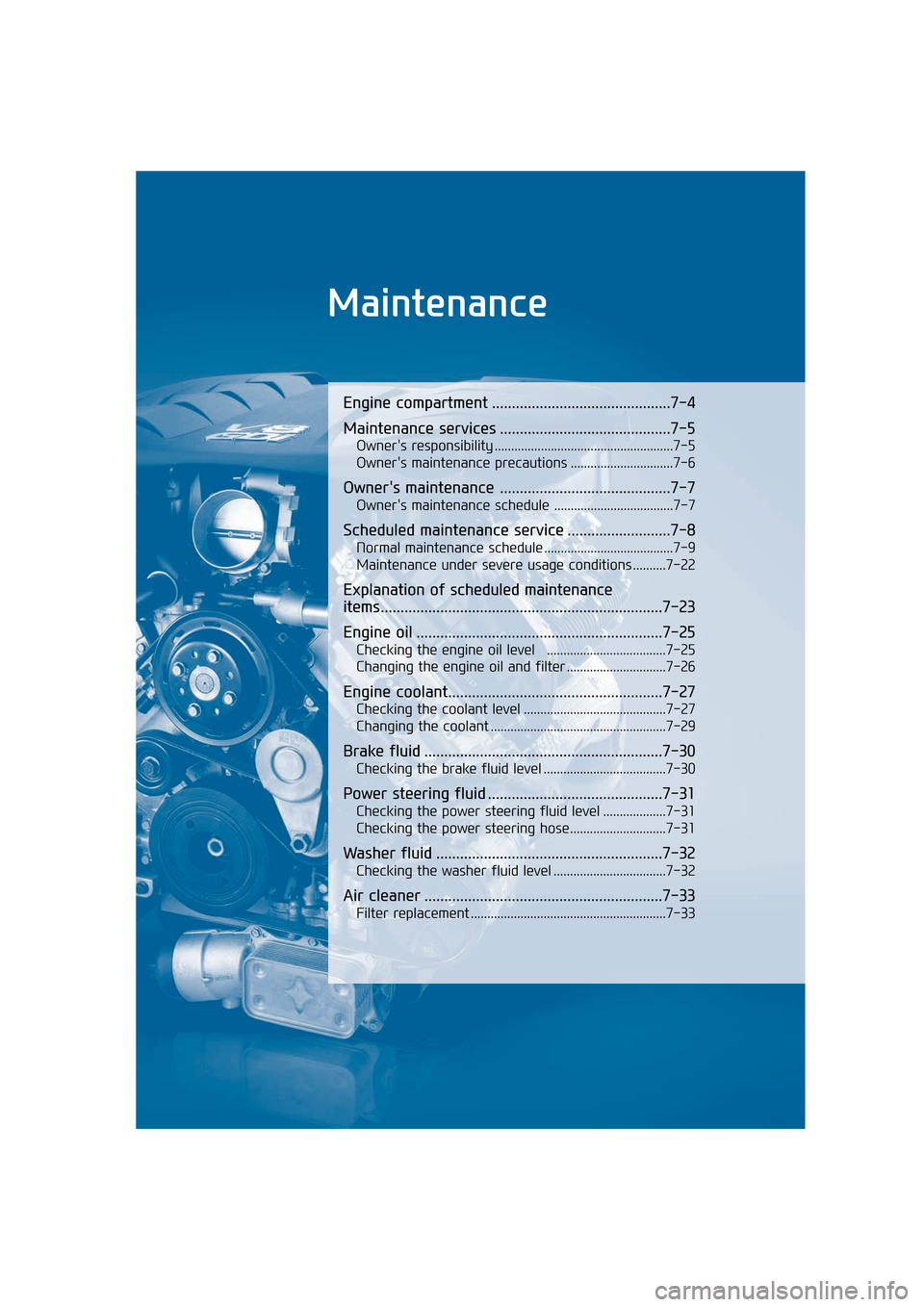
Maintenance
Engine compartment .............................................7-4
Maintenance services ...........................................7-5
Owner's responsibility ......................................................7-5
Owner's maintenance precautions ...............................7-6
Owner's maintenance ...........................................7-7
Owner's maintenance schedule ....................................7-7
Scheduled maintenance service ..........................7-8
Normal maintenance schedule .......................................7-9
Maintenance under severe usage conditions ..........7-22
Explanation of scheduled maintenance
items.......................................................................7\
-23
Engine oil ..............................................................7-25
Checking the engine oil level ....................................7-25
Changing the engine oil and filter ..............................7-26
Engine coolant......................................................7-27
Checking the coolant level ...........................................7-27
Changing the coolant .....................................................7-29
Brake fluid ............................................................7-30
Checking the brake fluid level .....................................7-30
Power steering fluid ............................................7-31
Checking the power steering fluid level ...................7-31
Checking the power steering hose.............................7-31
Washer fluid .........................................................7-32
Checking the washer fluid level ..................................7-32
Air cleaner ............................................................7-33
Filter replacement ...........................................................7-33
Page 364 of 477
The following lists are about the vehi-
cle inspection and maintenance that
should be performed by the owner or
an authorized EQUUS dealer, as
indicated. This will ensure your safety
and dependable driving.
Any adverse conditions should imme-
diately be checked by your EQUUS
dealer.
These Owner Maintenance Checklists
are mostly uncovered by your vehicle
warranties. Thus, you may charges
you for expenses of labor, parts or
lubricants.
Owner's maintenance sched-
ule
While refueling:
Check the engine oil level.
Check coolant level in coolantreservoir.
Check the windshield washer fluid level.
Check for any low or under-inflated tires.
While driving:
Check for any changes in theexhaust sounds or the smells.
Check for any steering wheel vibra- tion. Check whether you feel more
tightness or looseness of the steer-
ing wheel.
Check for any slight tilting, or “pulls” to one side, while driving on
a flat surface.
Check for any unusual sounds, tilt- ing, a braking distance, or “hard-to-
push” brake pedal while stopping.
Check the transmission fluid level upon experiencing a skid or a sud-
den transmission gear change.
Check the P(Park) function of the auto transmission.
Check the parking brake.
Check for any fluid leak (water dripping from the A/C while or after
the normal driving).
At least once a month:
Check the coolant level in theengine coolant reservoir.
Check the operation of all exterior lights, such as the stoplights, turn
signals and hazard warning flash-
ers.
Check the inflation pressures of all tires including the spare.
O OW
W N
NE
ER
R '
'S
S
M
M A
AI
IN
N T
TE
EN
N A
AN
N C
CE
E
7-7
Maintenance07
Carefully check your engine
coolant level, when the engine
is hot. The hot coolant or steam
may blow out under pressure.
This may cause a skin burn or
other serious injuries.
WARNING
Page 378 of 477
NORMAL MAINTENANCE SCHEDULE
7-21
Maintenance07
*5: Use only the authorized automatic transmission fluid. (Refer to "Recommended lubricants andcapacities" in the chapter 8 or the label in the engine room.)
No check, No service required
❑ Automatic transmission fluid *5
Page 380 of 477
7-23
Maintenance07
E
EX
X P
PL
LA
A N
N A
AT
TI
IO
O N
N
O
O F
F
S
S C
C H
H E
ED
D U
U L
LE
E D
D
M
M A
AI
IN
N T
TE
EN
N A
AN
N C
CE
E
I
IT
T E
EM
M S
S
Engine oil and filter
The engine oil and filter should be
changed at the interval, as specified
in the maintenance schedule. After
driving in severe conditions, you
should more frequently change oil
and filters.
Drive belts
Inspect all belts for any cut, crack,
excessive wear-out, or oil saturation.
If necessary, replace it.
Fuel filter
A clogged filter may limit the acceler-
ating function, damage the emission
system and cause other problems,
such as hard starting. When an
excessive amount of foreign sub-
stances accumulate in the fuel tank,
you should more frequently replace
the filter. After installing a new filter,
run the engine for several minutes,
and check for any leakage from the
connections. Fuel filters should be
installed by an authorized EQUUS
dealer.
Fuel lines, fuel hoses and con-
nections
Check the fuel lines, fuel hoses and
connections for any leakage and
damage. Immediately have an
authorized EQUUS dealer replace
any damaged or leaking parts.
Vapor hose and fuel filler cap
Check the fuel lines, fuel hoses and
connections for any leakage and
damage. Immediately have an
authorized EQUUS dealer replace
any damaged or leaking parts.
Air cleaner filter
An authorized HYUNDAI air cleaner
filter is recommended.
Spark plugs
Make sure to install new spark plugs
of the correct heat range.
Cooling system
Check the cooling system compo-
nents, such as radiator, coolant
reservoir, hoses and connections, for
any leakage and damage. If neces-
sary, replace any damaged parts.
Coolant
The coolant should be changed at
the interval, as specified in the main-
tenance schedule.
Automatic transmission fluid
You do not need to check the auto-
matic transmission fluid, when driv-
ing under normal conditions.
However, after driving in severe con-
ditions, the fluid should be changed
by an authorized EQUUS dealer in
accordance with the maintenance
schedule, as specified in the begin-
ning of this chapter.
Information
The original color of the automatic
transmission fluid is red. However, as
you drive the vehicle, the color will
become darker. This is normal, and
you do not need to change the fluid
due to the changed color.
i
Page 381 of 477
7-24
Maintenance
The use of an unauthorized fluid
may result in transmission mal-
function and failure. Use only the
authorized automatic transmis-
sion fluid. (Refer to “Recommended
lubricants and capacities” in the
chapter 8.)
Brake hoses and lines
Confirm the proper installation, and
check for any frictions, cracks, dete-
rioration and leakage. If necessary,
immediately replace any deteriorated
or damaged parts.
Brake fluid
Check the brake fluid level. The level
should be between “MIN” and “MAX”
marks on the reservoir. Use only the
hydraulic brake fluid, which meet the
requirements of the DOT3/DOT4
specifications.
Brake discs, pads, calipers
and rotors
Check the pads and the disc for any
excessive wear-out, and inspect
calipers for any fluid leakage.
Exhaust pipe and muffler
Inspect the exhaust pipes, muffler
and hangers for any cracks, deterio-
rations, or damages. Start the
engine, and listen carefully for any
gas leaking noise. If necessary, tight-
en connections or replace the dam-
aged parts.
Suspension mounting bolts
Check the suspension connections
for any looseness or damage. If nec-
essary, retighten the bolt to the spec-
ified torque.
Steering gear box, linkage &
boots/lower arm ball joint
After stopping the vehicle and turn-
ing off the engine, confirm the steer-
ing locking (tightening).
Check the bends for any linkage or
damage. Check the dust boots and
ball joints for any deterioration,
cracks, or damage. If necessary,
replace the damaged parts.
Power steering pump, belt and
hoses
Check the power steering pump and
hoses for any leakage or damage. If
necessary, immediately replace any
damaged or leaking parts. Inspect
the power steering belt (or drive belt)
for any cuts, cracks, excessive wear-
out, oil saturation or looseness. If
necessary, replace or adjust the
damaged part.
Drive shafts and boots
Check the drive shafts, boots and
clamps for any cracks, deterioration,
or damage. If necessary, replace or
grease the damaged part.
Air conditioning refrigerant
Check the air conditioning lines and
connections for any leakage or dam-
age.
NOTICE
Page 382 of 477
7-25
Maintenance07
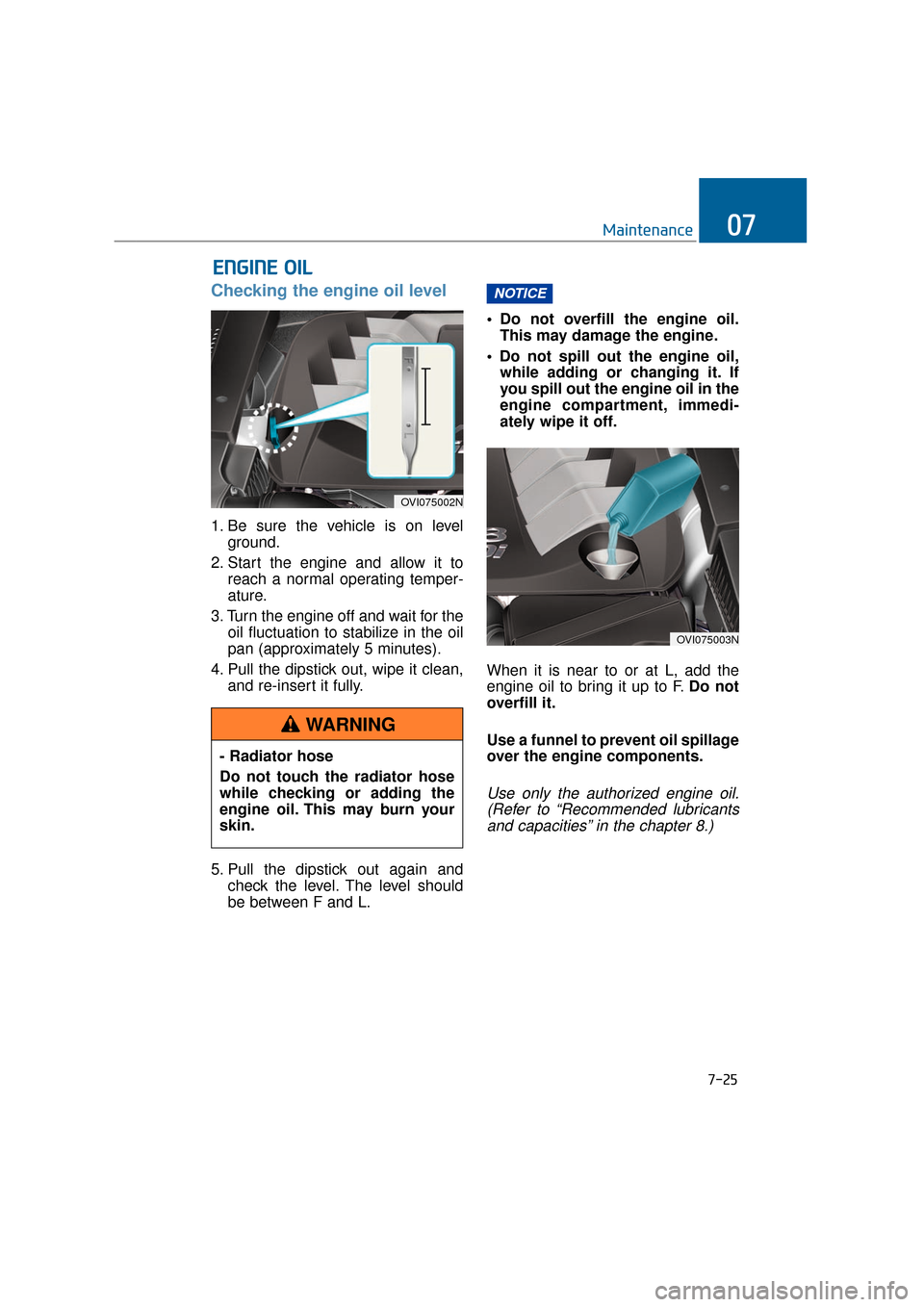
Checking the engine oil level
1. Be sure the vehicle is on levelground.
2. Start the engine and allow it to reach a normal operating temper-
ature.
3. Turn the engine off and wait for the oil fluctuation to stabilize in the oil
pan (approximately 5 minutes).
4. Pull the dipstick out, wipe it clean, and re-insert it fully.
5. Pull the dipstick out again and check the level. The level should
be between F and L. Do not overfill the engine oil.
This may damage the engine.
while adding or changing it. If
you spill out the engine oil in the
engine compartment, immedi-
ately wipe it off.
When it is near to or at L, add the
engine oil to bring it up to F. Do not
overfill it.
Use a funnel to prevent oil spillage
over the engine components.
Use only the authorized engine oil. (Refer to “Recommended lubricantsand capacities” in the chapter 8.)
NOTICE
E E N
N G
GI
IN
N E
E
O
O I
IL
L
OVI075002N
- Radiator hose
Do not touch the radiator hose
while checking or adding the
engine oil. This may burn your
skin.
WARNING
OVI075003N
Page 384 of 477
7-27
Maintenance07
The high-pressure cooling system
has a reservoir filled with the year-
round antifreeze coolant. The reser-
voir is already filled at the factory.
Check the antifreeze protection and
coolant level at least once a year, at
the beginning of the winter season,
and before traveling to a colder
region.
Checking the coolant level
E EN
N G
GI
IN
N E
E
C
C O
O O
OL
LA
A N
N T
T
(Continued)
operating, but when the
engine and radiator are hot,
do not remove the radiator
cap or the drain the plug. Hot
coolant and steam may blow
out under pressure, causing a
serious injury.
The electric motor (of
the cooling fan) is
controlled by the
engine coolant tem-
perature, refrigerant
pressure and driving speed. It
may operate, even when the
engine is not running. Use
extreme caution, when working
near the cooling fan blades. So,
you are not injured by the fan-
blade rotation. As the engine
coolant temperature decreases,
the electric motor will automati-
cally turn off. This is a normal.
When your vehicle is equipped
with GDI, the electric motor (of
the cooling fan) may operate
until the negative battery cable
is disconnected.
WARNING
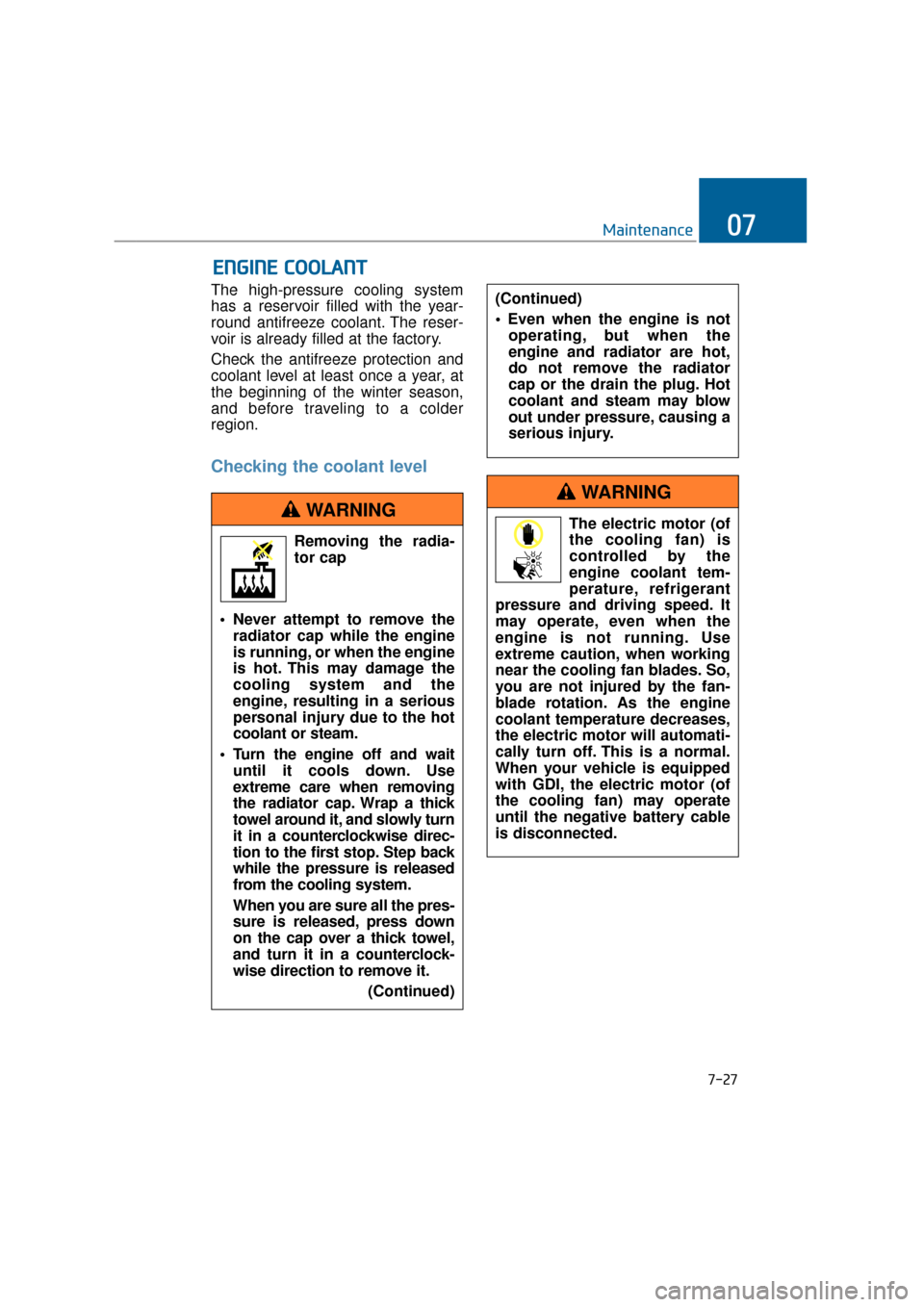
Removing the radia-
tor cap
Never attempt to remove the radiator cap while the engine
is running, or when the engine
is hot. This may damage the
cooling system and the
engine, resulting in a serious
personal injury due to the hot
coolant or steam.
Turn the engine off and wait until it cools down. Use
extreme care when removing
the radiator cap. Wrap a thick
towel around it, and slowly turn
it in a counterclockwise direc-
tion to the first stop. Step back
while the pressure is released
from the cooling system.
When you are sure all the pres-
sure is released, press down
on the cap over a thick towel,
and turn it in a counterclock-
wise direction to remove it.
(Continued)
WARNING
Page 385 of 477
7-28
Maintenance
Check all the cooling system hoses
and heater hoses. If necessary,
replace any swollen or deteriorated
one. The coolant level should
be between F and L marks
on the coolant reservoir,
when the engine is cool.
When the coolant level is low, add
distilled (deionized) water. Bring up
the level to F, but do not overfill.
When frequent additions are
required, have an authorized
EQUUS dealer inspect your cooling
system.
Recommended engine coolant
When adding coolant, use the deionized water, distilled water or
soft water. Never add hard water in
the coolant. An improper coolant
mixture may result in serious mal-
function or engine damage.
The engine parts are made of alu- minum and must be protected by
an ethyleneglycol-based coolant
from any corrosion and freezing.
DO NOT USE alcohol or methanol coolant, nor mix them with the
authorized coolant. Do not use the solution of which
the antifreeze portion is above
60% or below 35%. This may
reduce the solution effects.
Mix the water and antifreeze in the half-and-half ratio. This solution will
work in most situations.
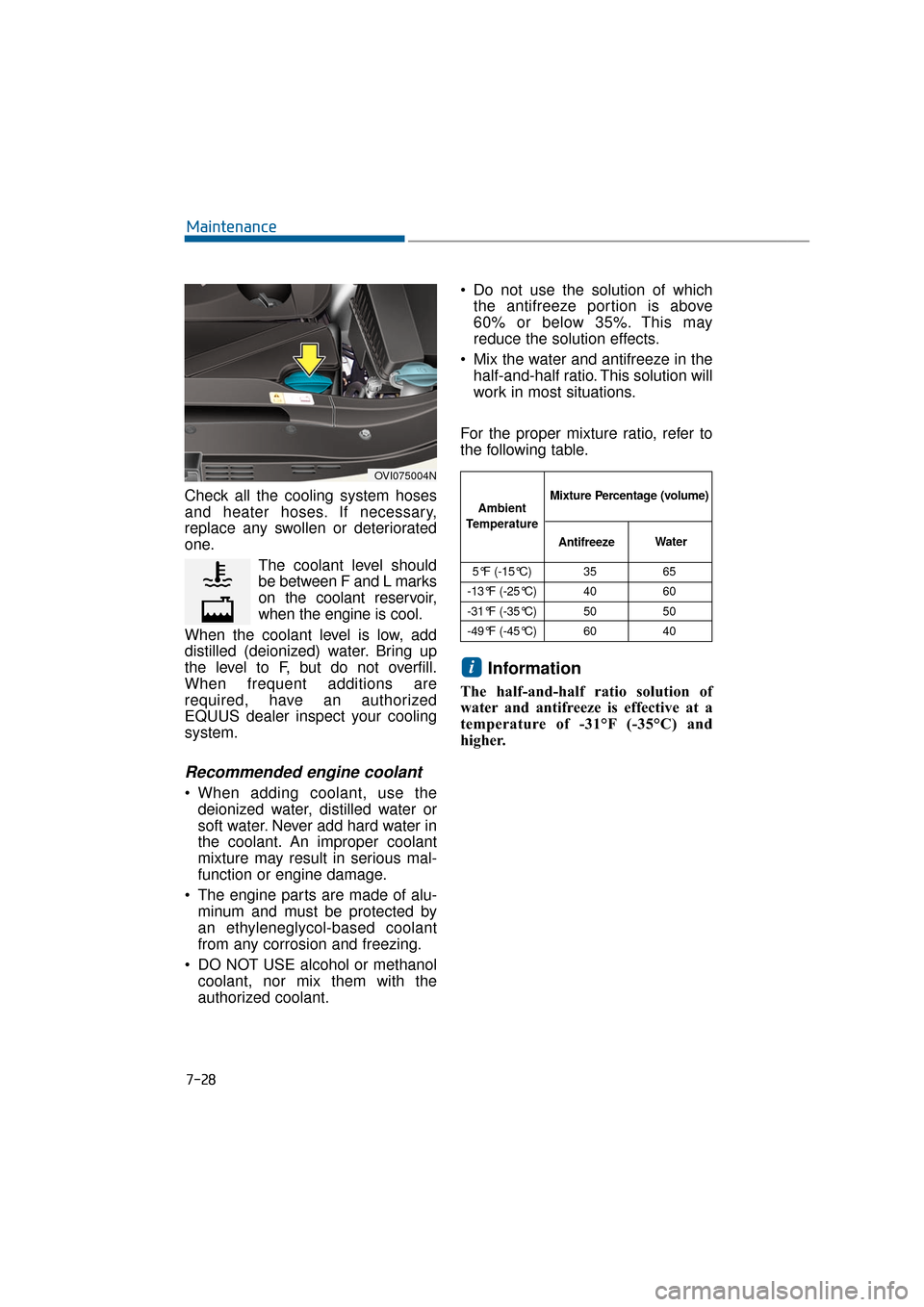
For the proper mixture ratio, refer to
the following table.
Information
The half-and-half ratio solution of
water and antifreeze is effective at a
temperature of -31°F (-35°C) and
higher.
i
OVI075004N
5°F (-15°C) 35 65
-13°F (-25°C) 40 60
-31°F (-35°C) 50 50
-49°F (-45°C) 60 40
Ambient
Temperature Mixture Percentage (volume)
Antifreeze Water
Page 387 of 477
7-30
Maintenance
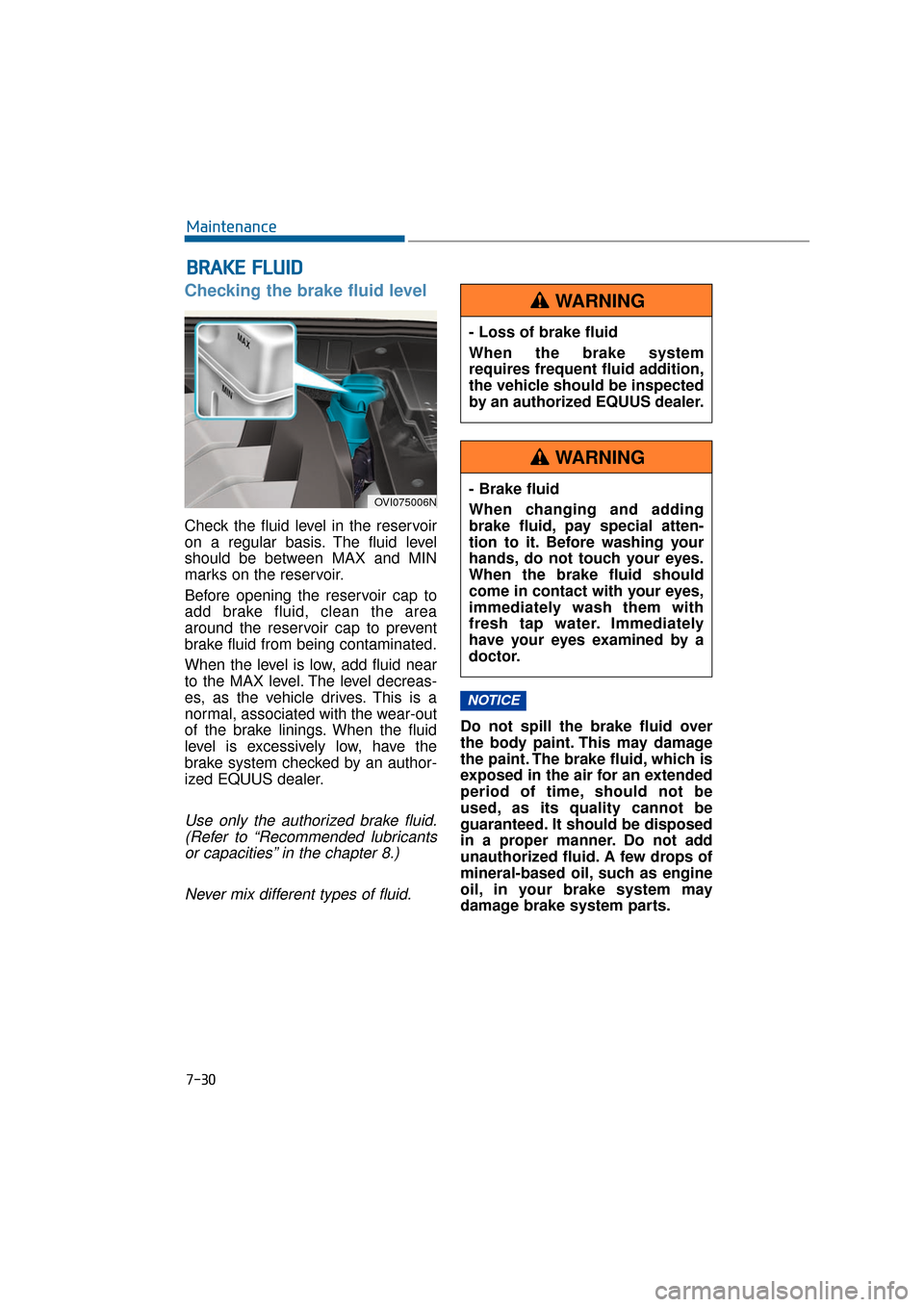
Checking the brake fluid level
Check the fluid level in the reservoir
on a regular basis. The fluid level
should be between MAX and MIN
marks on the reservoir.
Before opening the reservoir cap to
add brake fluid, clean the area
around the reservoir cap to prevent
brake fluid from being contaminated.
When the level is low, add fluid near
to the MAX level. The level decreas-
es, as the vehicle drives. This is a
normal, associated with the wear-out
of the brake linings. When the fluid
level is excessively low, have the
brake system checked by an author-
ized EQUUS dealer.
Use only the authorized brake fluid.(Refer to “Recommended lubricantsor capacities” in the chapter 8.)
Never mix different types of fluid.
Do not spill the brake fluid over
the body paint. This may damage
the paint. The brake fluid, which is
exposed in the air for an extended
period of time, should not be
used, as its quality cannot be
guaranteed. It should be disposed
in a proper manner. Do not add
unauthorized fluid. A few drops of
mineral-based oil, such as engine
oil, in your brake system may
damage brake system parts.
NOTICE
B B R
RA
A K
KE
E
F
F L
LU
U I
ID
D
- Loss of brake fluid
When the brake system
requires frequent fluid addition,
the vehicle should be inspected
by an authorized EQUUS dealer.
WARNING
- Brake fluid
When changing and adding
brake fluid, pay special atten-
tion to it. Before washing your
hands, do not touch your eyes.
When the brake fluid should
come in contact with your eyes,
immediately wash them with
fresh tap water. Immediately
have your eyes examined by a
doctor.
WARNING
OVI075006N
Page 388 of 477
7-31
Maintenance07
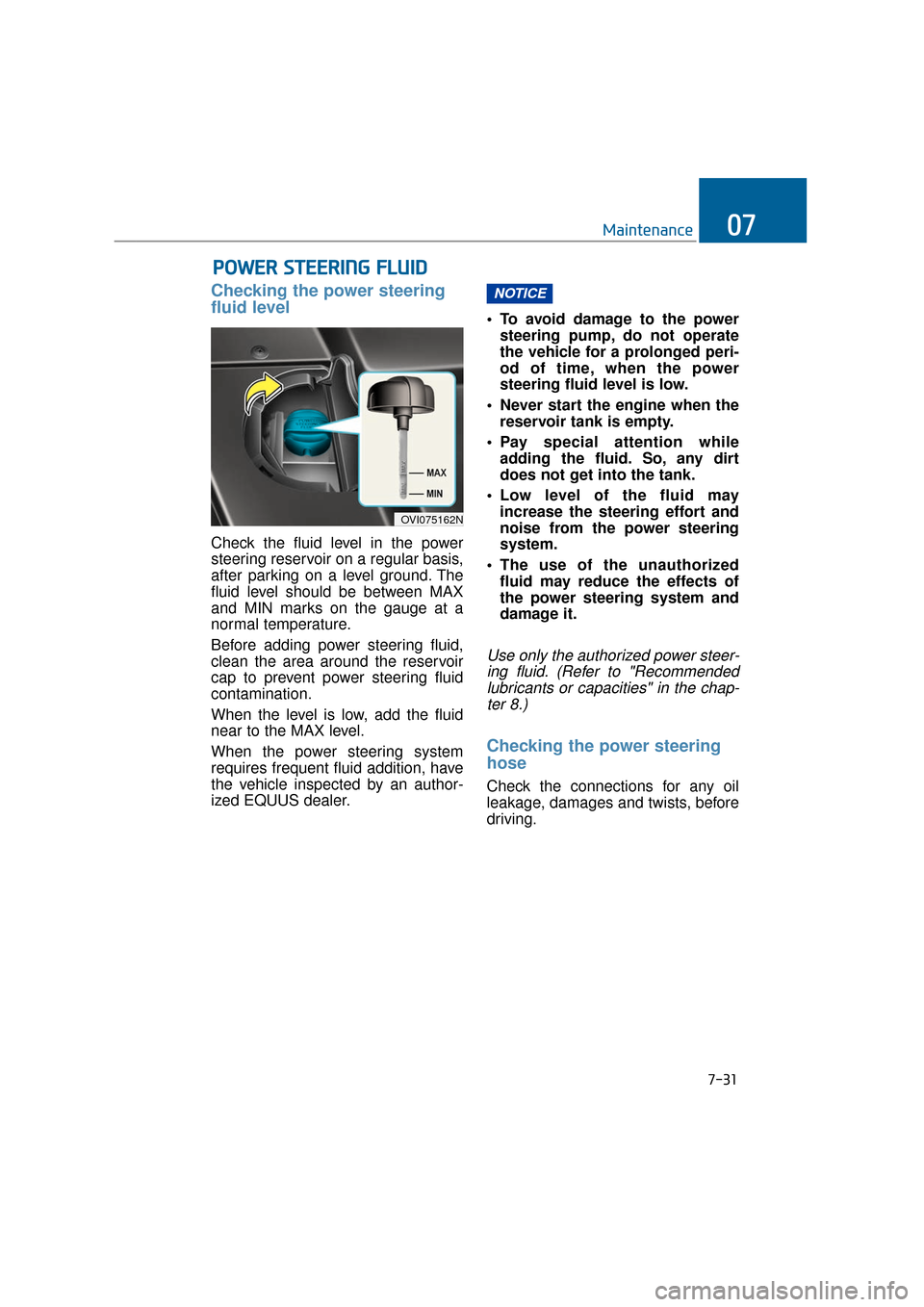
Checking the power steering
fluid level
Check the fluid level in the power
steering reservoir on a regular basis,
after parking on a level ground. The
fluid level should be between MAX
and MIN marks on the gauge at a
normal temperature.
Before adding power steering fluid,
clean the area around the reservoir
cap to prevent power steering fluid
contamination.
When the level is low, add the fluid
near to the MAX level.
When the power steering system
requires frequent fluid addition, have
the vehicle inspected by an author-
ized EQUUS dealer. To avoid damage to the power
steering pump, do not operate
the vehicle for a prolonged peri-
od of time, when the power
steering fluid level is low.
Never start the engine when the reservoir tank is empty.
Pay special attention while adding the fluid. So, any dirt
does not get into the tank.
Low level of the fluid may increase the steering effort and
noise from the power steering
system.
The use of the unauthorized fluid may reduce the effects of
the power steering system and
damage it.
Use only the authorized power steer-ing fluid. (Refer to "Recommendedlubricants or capacities" in the chap-ter 8.)
Checking the power steering
hose
Check the connections for any oil
leakage, damages and twists, before
driving.
NOTICE
P P O
O W
W E
ER
R
S
S T
T E
EE
ER
R I
IN
N G
G
F
F L
LU
U I
ID
D
OVI075162N