check engine Hyundai Equus 2016 Repair Manual
[x] Cancel search | Manufacturer: HYUNDAI, Model Year: 2016, Model line: Equus, Model: Hyundai Equus 2016Pages: 477, PDF Size: 16.25 MB
Page 413 of 477
7-56
Maintenance
A vehicle’s electrical system is pro-
tected from a possible electrical
overloading damage by fuses.
This vehicle has 4 fuse panels - two
on the driver’s side, another on the
panel bolster of the passenger's
side, and the other in the engine
compartment.
When any of your lights, acces-
sories, or controls does not operate,
check the appropriate circuit fuse.
When a fuse is out, some elements
may melt inside.
When the electrical system does not
operate, check the fuse panel on the
driver's side first.
Before replacing the fuse, disconnect
the negative battery cable. Always
replace it with a fuse of the same rat-
ing. When the newly-replaced fuse
blows, there may be an electrical
problem. Avoid using any pertinent
systems. Immediately consult an
authorized EQUUS dealer.
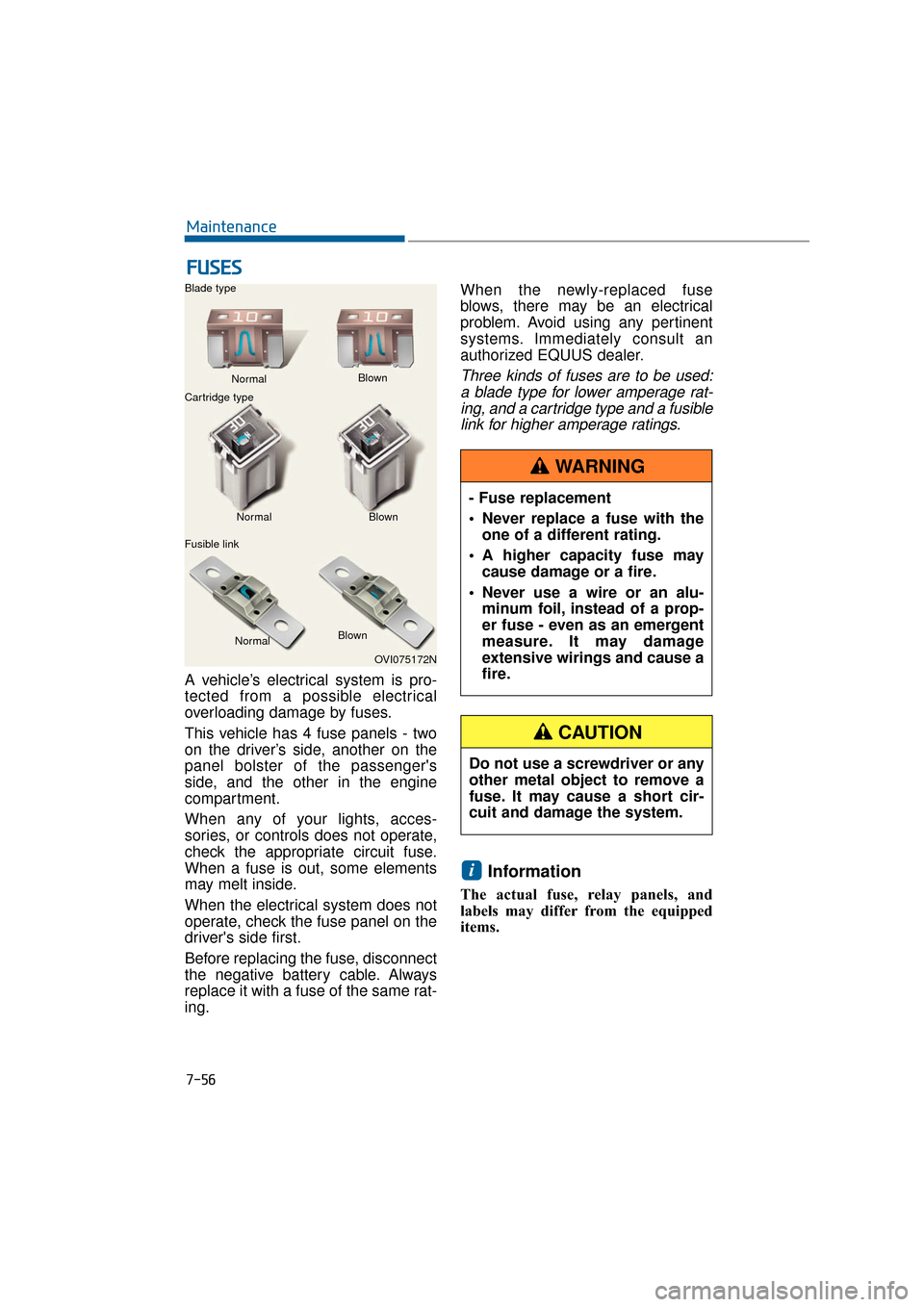
Three kinds of fuses are to be used:
a blade type for lower amperage rat-ing, and a cartridge type and a fusiblelink for higher amperage ratings.
Information
The actual fuse, relay panels, and
labels may differ from the equipped
items.
i
F F U
U S
SE
E S
S
OVI075172N
Normal
Normal
Blade type
Cartridge type
Fusible link Blown
Blown
Normal Blown
- Fuse replacement
Never replace a fuse with the
one of a different rating.
A higher capacity fuse may cause damage or a fire.
Never use a wire or an alu- minum foil, instead of a prop-
er fuse - even as an emergent
measure. It may damage
extensive wirings and cause a
fire.
WARNING
Do not use a screwdriver or any
other metal object to remove a
fuse. It may cause a short cir-
cuit and damage the system.
CAUTION
Page 415 of 477
7-58
Maintenance
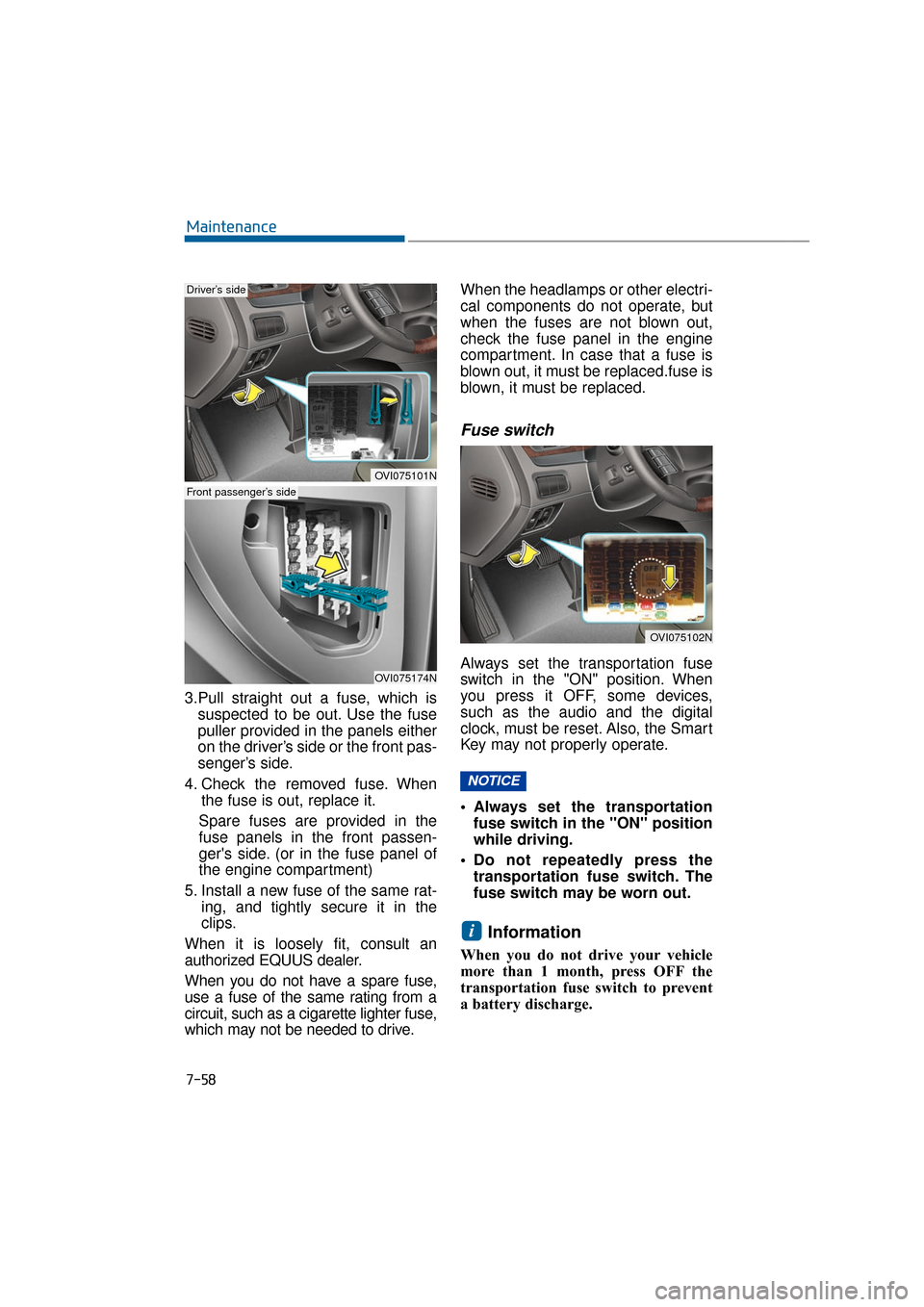
3.Pull straight out a fuse, which is suspected to be out. Use the fuse
puller provided in the panels either
on the driver’s side or the front pas-
senger’s side.
4. Check the removed fuse. When the fuse is out, replace it.
Spare fuses are provided in the
fuse panels in the front passen-
ger's side. (or in the fuse panel of
the engine compartment)
5. Install a new fuse of the same rat- ing, and tightly secure it in the
clips.
When it is loosely fit, consult an
authorized EQUUS dealer.
When you do not have a spare fuse,
use a fuse of the same rating from a
circuit, such as a cigarette lighter fuse,
which may not be needed to drive. When the headlamps or other electri-
cal components do not operate, but
when the fuses are not blown out,
check the fuse panel in the engine
compartment. In case that a fuse is
blown out, it must be replaced.fuse is
blown, it must be replaced.
Fuse switch
Always set the transportation fuse
switch in the "ON" position. When
you press it OFF, some devices,
such as the audio and the digital
clock, must be reset. Also, the Smart
Key may not properly operate.
Always set the transportation
fuse switch in the "ON" position
while driving.
Do not repeatedly press the transportation fuse switch. The
fuse switch may be worn out.
Information
When you do not drive your vehicle
more than 1 month, press OFF the
transportation fuse switch to prevent
a battery discharge.
i
NOTICE
OVI075101N
Driver’s side
OVI075174N
Front passenger’s side
OVI075102N
Page 416 of 477
7-59
Maintenance07
Engine compartment fuse
replacement
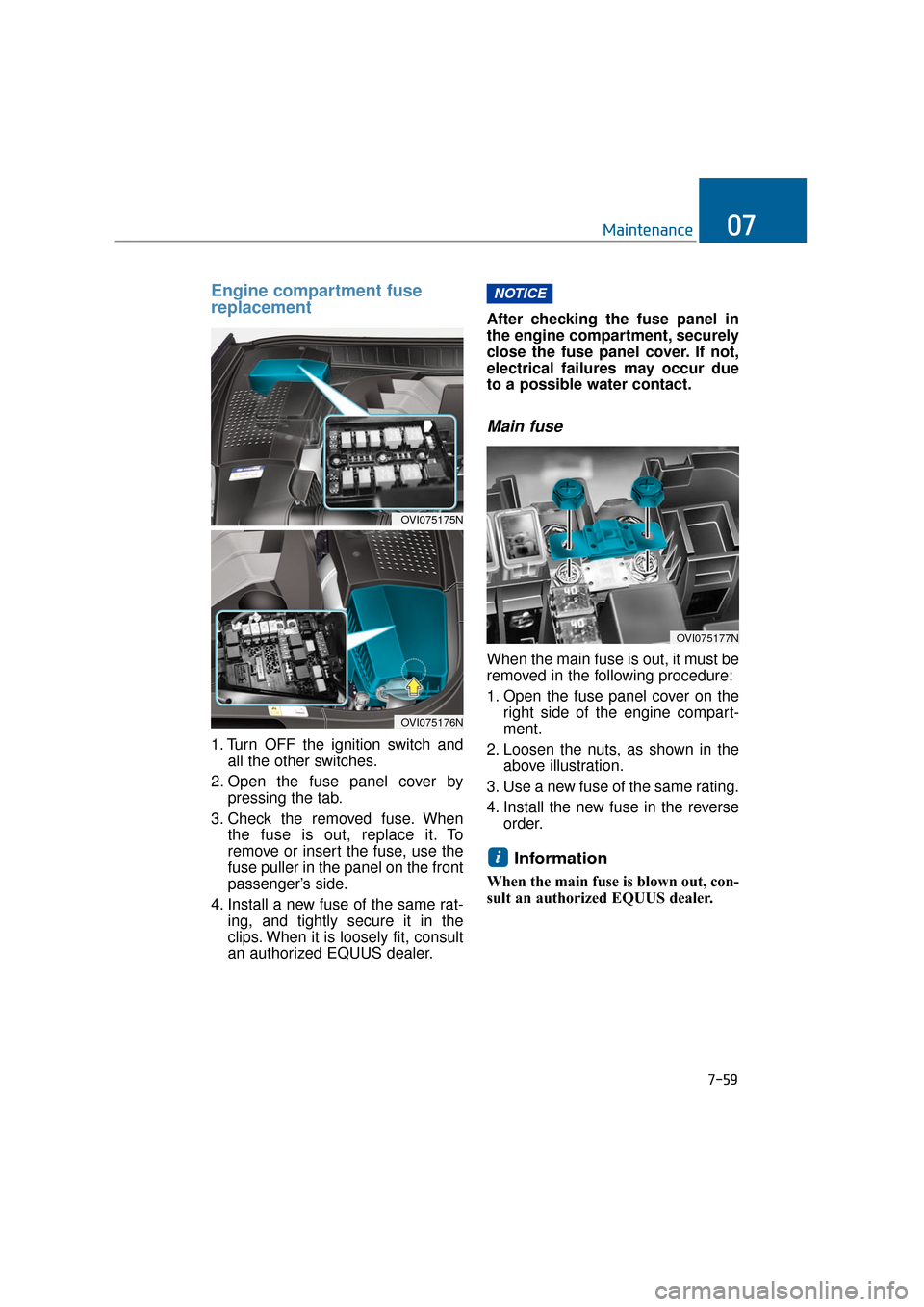
1. Turn OFF the ignition switch andall the other switches.
2. Open the fuse panel cover by pressing the tab.
3. Check the removed fuse. When the fuse is out, replace it. To
remove or insert the fuse, use the
fuse puller in the panel on the front
passenger’s side.
4. Install a new fuse of the same rat- ing, and tightly secure it in the
clips. When it is loosely fit, consult
an authorized EQUUS dealer. After checking the fuse panel in
the engine compartment, securely
close the fuse panel cover. If not,
electrical failures may occur due
to a possible water contact.
Main fuse
When the main fuse is out, it must be
removed in the following procedure:
1. Open the fuse panel cover on the
right side of the engine compart-
ment.
2. Loosen the nuts, as shown in the above illustration.
3. Use a new fuse of the same rating.
4. Install the new fuse in the reverse order.
Information
When the main fuse is blown out, con-
sult an authorized EQUUS dealer.
i
NOTICE
OVI075175N
OVI075176N
OVI075177N
Page 424 of 477
7-67
Maintenance07
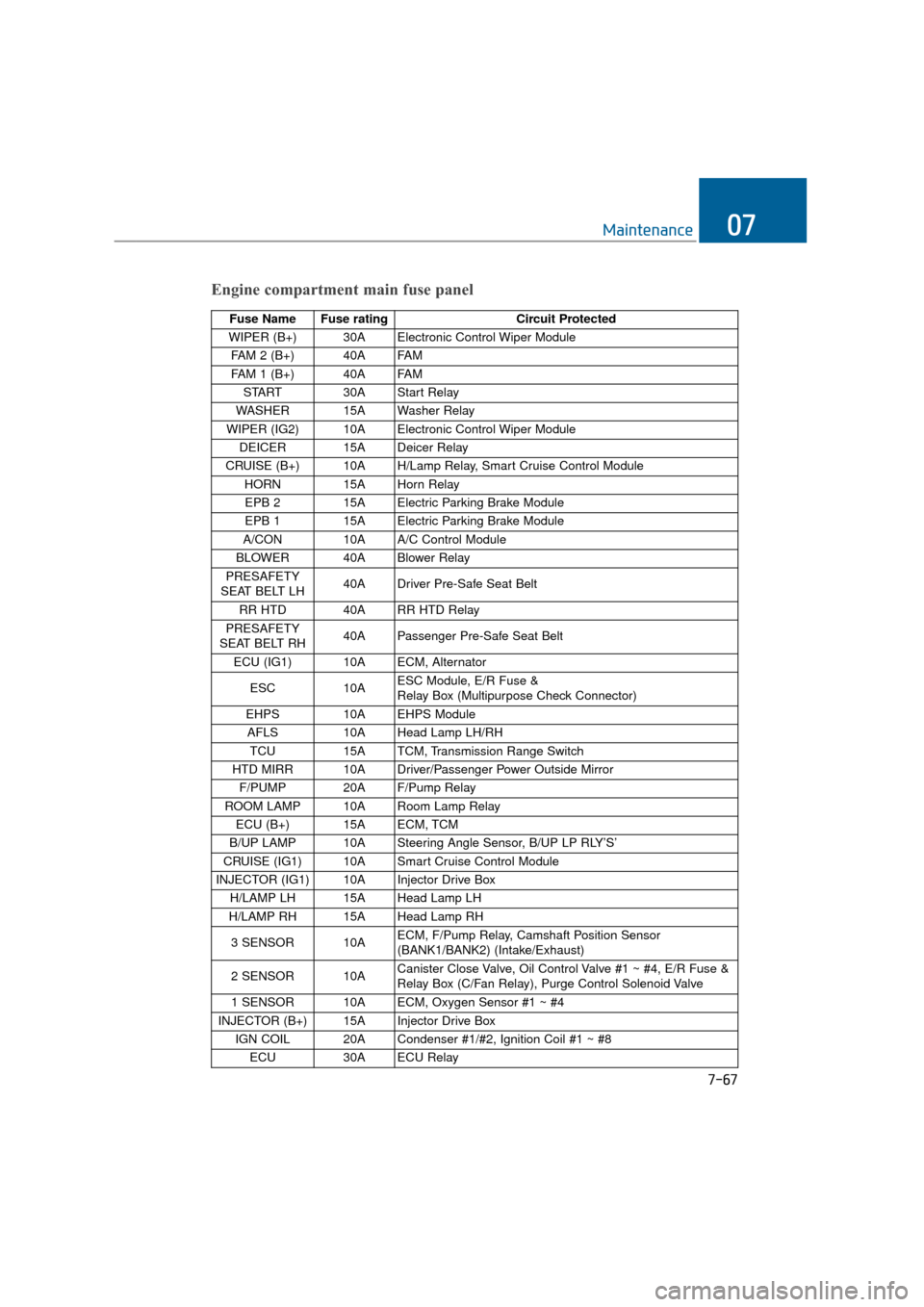
Engine compartment main fuse panel
Fuse Name Fuse ratingCircuit Protected
WIPER (B+) 30A Electronic Control Wiper Module FAM 2 (B+) 40A FAM
FAM 1 (B+) 40A FAM START 30A Start Relay
WASHER 15A Washer Relay
WIPER (IG2) 10A Electronic Control Wiper Module DEICER 15A Deicer Relay
CRUISE (B+) 10A H/Lamp Relay, Smart Cruise Control Module HORN 15A Horn Relay
EPB 2 15A Electric Parking Brake Module
EPB 1 15A Electric Parking Brake Module
A/CON 10A A/C Control Module
BLOWER 40A Blower Relay
PRESAFETY
SEAT BELT LH 40A Driver Pre-Safe Seat Belt
RR HTD 40A RR HTD Relay
PRESAFETY
SEAT BELT RH 40A Passenger Pre-Safe Seat Belt
ECU (IG1) 10A ECM, Alternator ESC 10AESC Module, E/R Fuse &
Relay Box (Multipurpose Check Connector)
EHPS 10A EHPS Module
AFLS 10A Head Lamp LH/RH
TCU 15A TCM, Transmission Range Switch
HTD MIRR 10A Driver/Passenger Power Outside Mirror F/PUMP 20A F/Pump Relay
ROOM LAMP 10A Room Lamp Relay ECU (B+) 15A ECM, TCM
B/UP LAMP 10A Steering Angle Sensor, B/UP LP RLY’S’
CRUISE (IG1) 10A Smart Cruise Control Module
INJECTOR (IG1) 10A Injector Drive Box H/LAMP LH 15A Head Lamp LH
H/LAMP RH 15A Head Lamp RH
3 SENSOR 10A ECM, F/Pump Relay, Camshaft Position Sensor
(BANK1/BANK2) (Intake/Exhaust)
2 SENSOR 10A Canister Close Valve, Oil Control Valve #1 ~ #4, E/R Fuse &
Relay Box (C/Fan Relay), Purge Control Solenoid Valve
1 SENSOR 10A ECM, Oxygen Sensor #1 ~ #4
INJECTOR (B+) 15A Injector Drive Box IGN COIL 20A Condenser #1/#2, Ignition Coil #1 ~ #8ECU 30A ECU Relay
Page 425 of 477
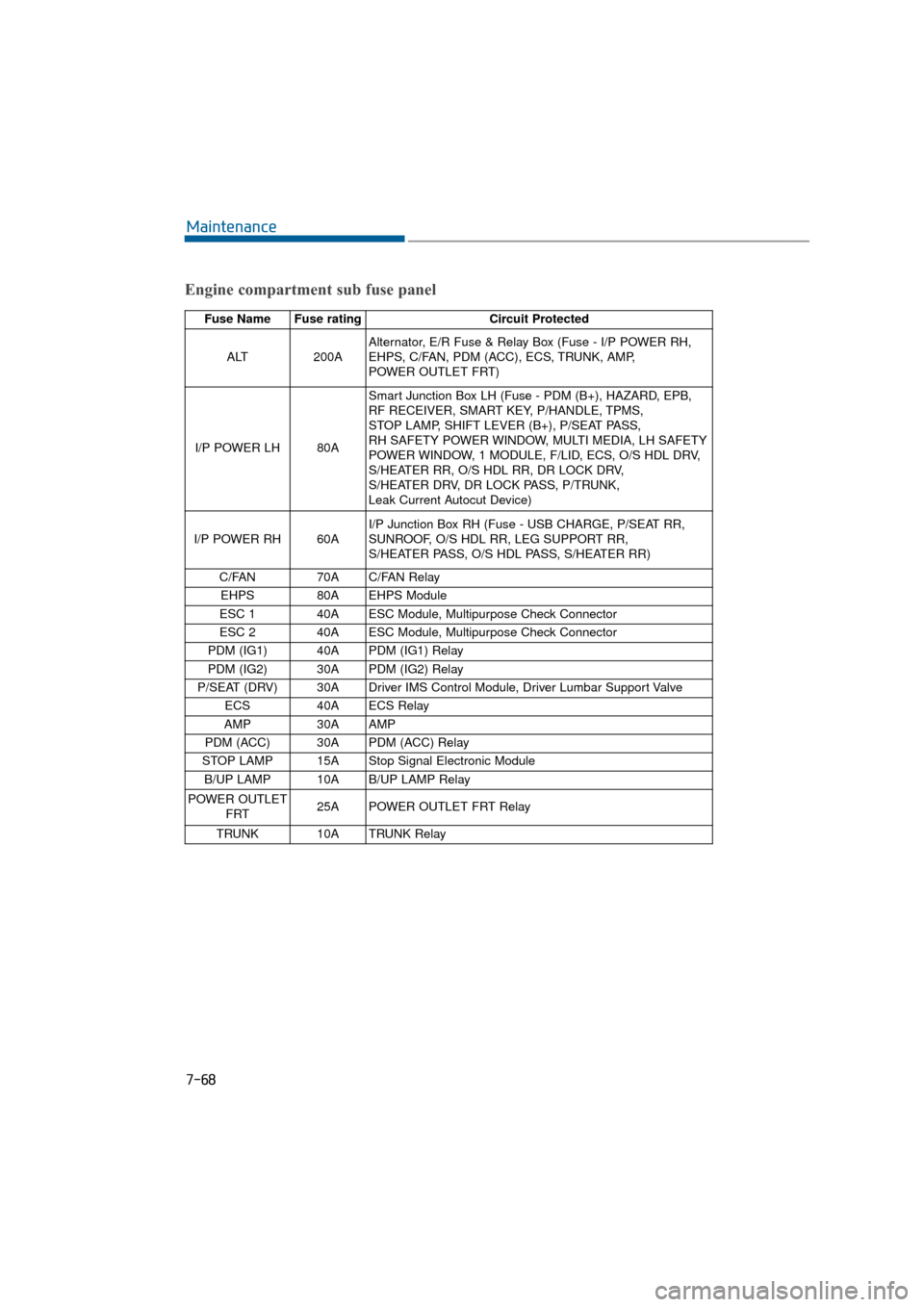
7-68
Maintenance
Engine compartment sub fuse panel
Fuse Name Fuse ratingCircuit Protected
ALT 200AAlternator, E/R Fuse & Relay Box (Fuse - I/P POWER RH,
EHPS, C/FAN, PDM (ACC), ECS, TRUNK, AMP,
POWER OUTLET FRT)
I/P POWER LH 80A Smart Junction Box LH (Fuse - PDM (B+), HAZARD, EPB,
RF RECEIVER, SMART KEY, P/HANDLE, TPMS,
STOP LAMP, SHIFT LEVER (B+), P/SEAT PASS,
RH SAFETY POWER WINDOW, MULTI MEDIA, LH SAFETY
POWER WINDOW, 1 MODULE, F/LID, ECS, O/S HDL DRV,
S/HEATER RR, O/S HDL RR, DR LOCK DRV,
S/HEATER DRV, DR LOCK PASS, P/TRUNK,
Leak Current Autocut Device)
I/P POWER RH 60A I/P Junction Box RH (Fuse - USB CHARGE, P/SEAT RR,
SUNROOF, O/S HDL RR, LEG SUPPORT RR,
S/HEATER PASS, O/S HDL PASS, S/HEATER RR)
C/FAN 70A C/FAN Relay EHPS 80A EHPS Module
ESC 1 40A ESC Module, Multipurpose Check Connector
ESC 2 40A ESC Module, Multipurpose Check Connector
PDM (IG1) 40A PDM (IG1) Relay
PDM (IG2) 30A PDM (IG2) Relay
P/SEAT (DRV) 30A Driver IMS Control Module, Driver Lumbar Support Valve ECS 40A ECS Relay
AMP 30A AMP
PDM (ACC) 30A PDM (ACC) Relay
STOP LAMP 15A Stop Signal Electronic Module B/UP LAMP 10A B/UP LAMP Relay
POWER OUTLET FRT 25A POWER OUTLET FRT Relay
TRUNK 10A TRUNK Relay
Page 447 of 477
7-90
Maintenance
Purge Control Solenoid Valve(PCSV)
The purge control solenoid valve is
controlled by the Engine Control
Module (ECM). When the engine
coolant temperature is low during
idling, the PCSV closes to prevent
the evaporated fuel from getting into
the engine. After warming up the
engine in a normal driving condition,
the PCSV opens to introduce evapo-
rated fuel to the engine.
3. Exhaust emission control system
The Exhaust Emission Control
System is highly effective in control-
ling exhaust emissions, while main-
taining good vehicle performance.
Vehicle modifications
This vehicle should not be modi-
fied. Modification of your vehicle
may affect its driving performance,
safety or durability. This even may
violate safety and emissions regu-
lations of the government.
In addition, damage or perform-
ance problems, which is resulted in
due to any modification, may not
be covered by a warranty.
Use of unauthorized electric devices may cause abnormal vehi-
cle operation, wire damage, bat-
tery discharge and a fire.
Be careful not to damage your
vehicle by using an unauthorized
electric device.
Engine exhaust gas precautions (carbon monoxide)
Carbon monoxide is present in
exhaust fumes. Therefore, when
you smell exhaust fumes of any
kinds, inside your vehicle, immedi-
ately have it inspected and
repaired. When you suspect
exhaust fume emission into your
vehicle, drive the vehicle only when
all windows are fully opened.
Immediately have your vehicle
checked and repaired immediately.
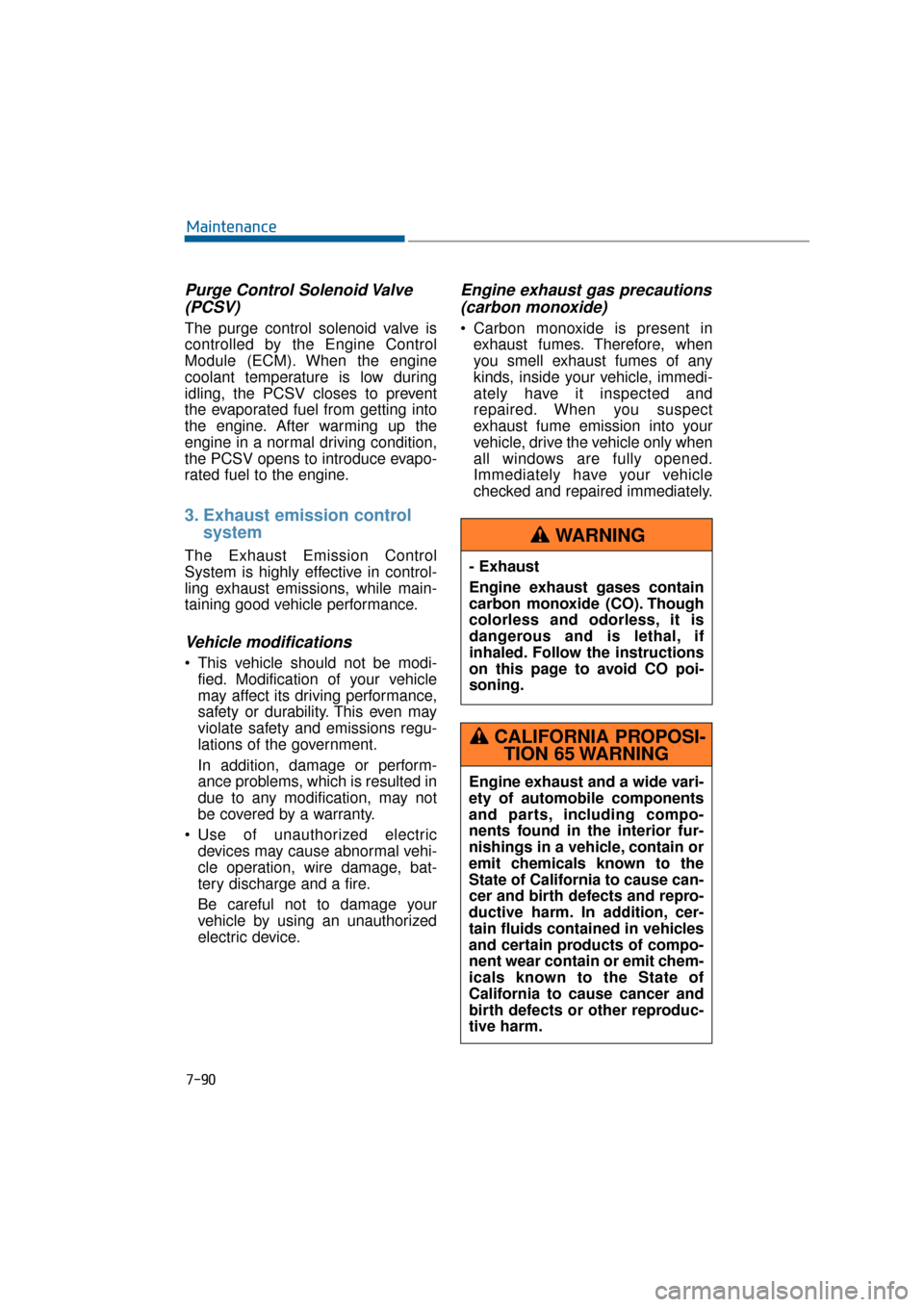
- Exhaust
Engine exhaust gases contain
carbon monoxide (CO). Though
colorless and odorless, it is
dangerous and is lethal, if
inhaled. Follow the instructions
on this page to avoid CO poi-
soning.
WARNING
Engine exhaust and a wide vari-
ety of automobile components
and parts, including compo-
nents found in the interior fur-
nishings in a vehicle, contain or
emit chemicals known to the
State of California to cause can-
cer and birth defects and repro-
ductive harm. In addition, cer-
tain fluids contained in vehicles
and certain products of compo-
nent wear contain or emit chem-
icals known to the State of
California to cause cancer and
birth defects or other reproduc-
tive harm.
CALIFORNIA PROPOSI- TION 65 WARNING
Page 454 of 477
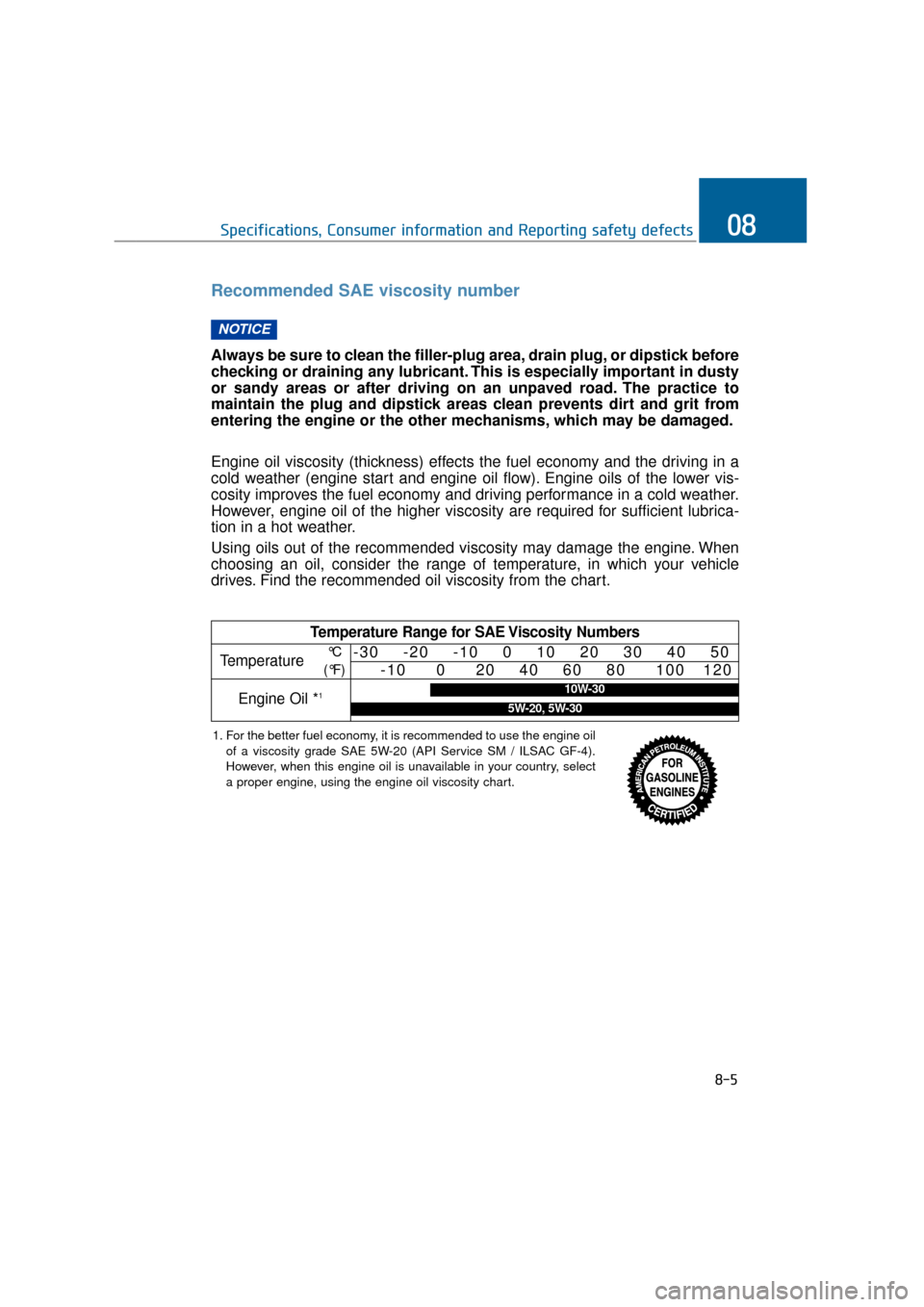
Recommended SAE viscosity number
Always be sure to clean the filler-plug area, drain plug, or dipstick before
checking or draining any lubricant. This is especially important in dusty
or sandy areas or after driving on an unpaved road. The practice to
maintain the plug and dipstick areas clean prevents dirt and grit from
entering the engine or the other mechanisms, which may be damaged.
Engine oil viscosity (thickness) effects the fuel economy and the driving in a
cold weather (engine start and engine oil flow). Engine oils of the lower vis-
cosity improves the fuel economy and driving performance in a cold weather.
However, engine oil of the higher viscosity are required for sufficient lubrica-
tion in a hot weather.
Using oils out of the recommended viscosity may damage the engine. When
choosing an oil, consider the range of temperature, in which your vehicle
drives. Find the recommended oil viscosity from the chart.
NOTICE
8-5
Specifications, Consumer information and Reporting safety defects08
Temperature Range for SAE Viscosity Numbers
TemperatureEngine Oil *
1
°C
(°F)-30 -20 -10 0 10 20 30 40 50 -10 0 20 40 60 80 100 120
1. For the better fuel economy, it is recommended to use the engine oil
of a viscosity grade SAE 5W-20 (API Service SM / ILSAC GF-4).
However, when this engine oil is unavailable in your country, select
a proper engine, using the engine oil viscosity chart.
10W-30
5W-20, 5W-30
Page 462 of 477
 ........................................................................\
..................3-107
Capacities (Lubricants) ...........................................................")
Camera (Rear view) ........................................................................\
..................3-107
Capacities (Lubricants) ........................................................................\
.................8-4
Card key ........................................................................\
........................................3-6
CareExterior care ........................................................................\
.........................7-83
Interior care ........................................................................\
..........................7-88
Tire care ........................................................................\
................................7-42
Center console storage ........................................................................\
..............3-141
Central door lock switch ........................................................................\
.............3-16
Certification label ........................................................................\
..........................8-6
Chains Tire chains ........................................................................\
............................5-73
Checking tire inflation pressure ........................................................................\
..7-44
Child restraint system........................................................................\
..................2-33 Lower anchor system ........................................................................\
...........2-40
Tether anchor system........................................................................\
............2-38
Child-protector rear door lock ........................................................................\
....3-17
Climate control air filter........................................................................\
..............7-35
Climate control system seat (front seat) ...............................................................2-9
Climate control system seat (rear seat) ...............................................................2-19
Clothes hanger........................................................................\
...........................3-150
Combined instrument, see instrument cluster .....................................................3-62
Compact spare tire ........................................................................\
......................6-17
Compact spare tire replacement ........................................................................\
..7-47
Consumer information ........................................................................\
..................8-8
Cool and warm box ........................................................................\
...................3-143
Coolant ........................................................................\
........................................7-27
Cooling fluid, see engine coolant .......................................................................7\
-27
Crankcase emission control system ....................................................................7-89\
Cruise control system, see advanced smart cruise control system .....................5-38
Cup holder ........................................................................\
.................................3-146
Curtain air bag........................................................................\
.............................2-60
I-4
Index
C