ESP Hyundai Equus 2016 Owner's Guide
[x] Cancel search | Manufacturer: HYUNDAI, Model Year: 2016, Model line: Equus, Model: Hyundai Equus 2016Pages: 477, PDF Size: 16.25 MB
Page 321 of 477
5-70
Driving your vehicle
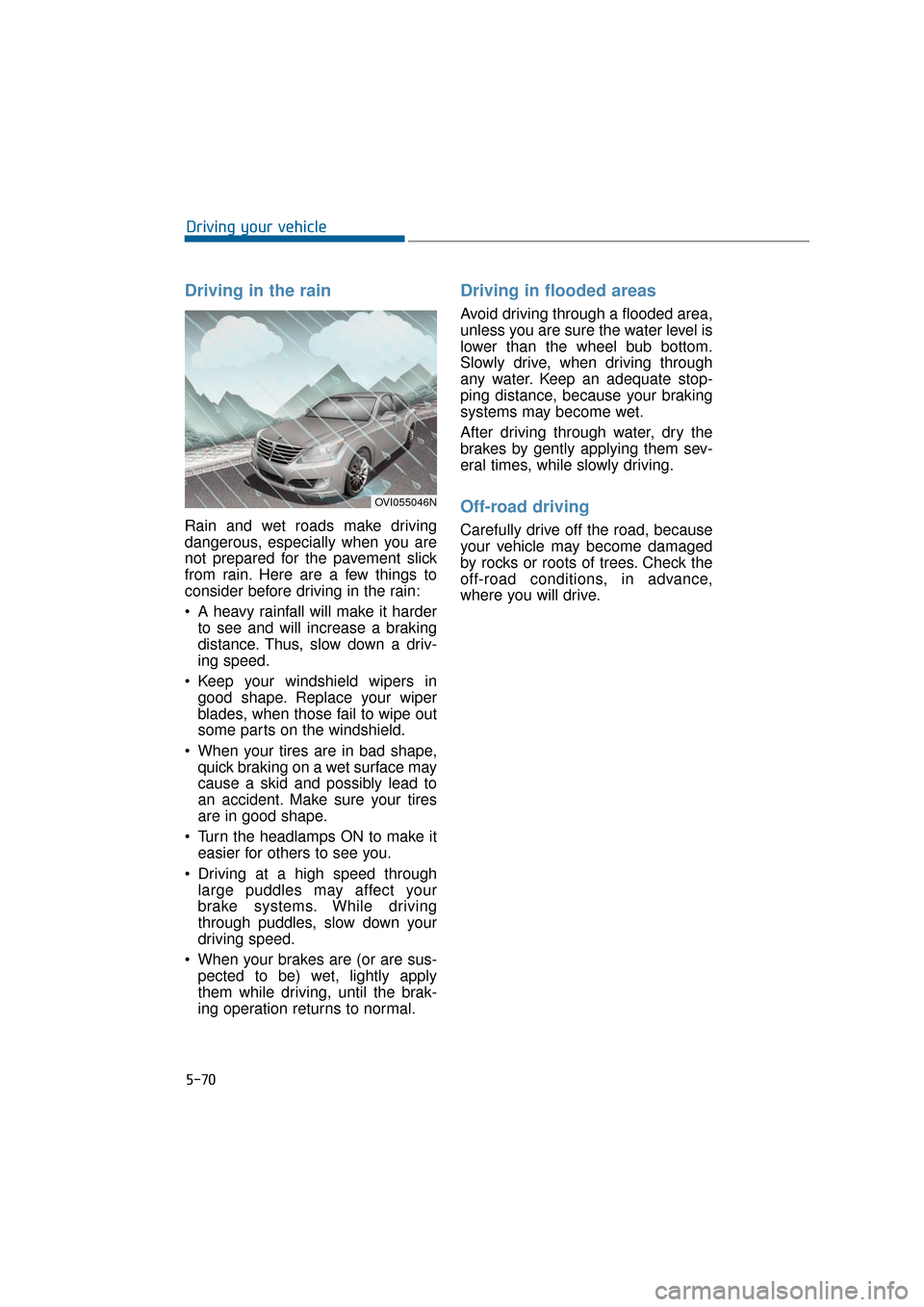
Driving in the rain
Rain and wet roads make driving
dangerous, especially when you are
not prepared for the pavement slick
from rain. Here are a few things to
consider before driving in the rain:
A heavy rainfall will make it harderto see and will increase a braking
distance. Thus, slow down a driv-
ing speed.
Keep your windshield wipers in good shape. Replace your wiper
blades, when those fail to wipe out
some parts on the windshield.
When your tires are in bad shape, quick braking on a wet surface may
cause a skid and possibly lead to
an accident. Make sure your tires
are in good shape.
Turn the headlamps ON to make it easier for others to see you.
Driving at a high speed through large puddles may affect your
brake systems. While driving
through puddles, slow down your
driving speed.
When your brakes are (or are sus- pected to be) wet, lightly apply
them while driving, until the brak-
ing operation returns to normal.
Driving in flooded areas
Avoid driving through a flooded area,
unless you are sure the water level is
lower than the wheel bub bottom.
Slowly drive, when driving through
any water. Keep an adequate stop-
ping distance, because your braking
systems may become wet.
After driving through water, dry the
brakes by gently applying them sev-
eral times, while slowly driving.
Off-road driving
Carefully drive off the road, because
your vehicle may become damaged
by rocks or roots of trees. Check the
off-road conditions, in advance,
where you will drive.
OVI055046N
Page 326 of 477
5-75
Driving your vehicle05
To prevent the locks from
frozen
To prevent the locks from being
frozen, spray authorized de-icing
fluid or glycerin into key openings.
When a lock opening is already cov-
ered with ice, spray authorized de-
icing fluid on the ice to remove it.
When an internal part of a lock
freezes, try to thaw it with a heated
key. Carefully use the heated key to
avoid an injury.
Use authorized window-wash-
er anti-freezer solution in sys-
tem
To prevent the window washer from
being frozen, add authorized win-
dow-washer anti-freeze solution, as
instructed on the window-washer
container. Window-washer anti-
freeze solution is available from an
authorized EQUUS dealer, and so
are the most auto parts outlets. Do
not use engine coolant or other types
of anti-freezer solution, because
these may damage the vehicle paint.
Do not let your parking brake
freeze
Under some conditions, your parking
brake may freeze in the engaged
position. This is most likely to hap-
pen, when there is an accumulation
of snow or ice around/near the rear
brakes, or when the brakes are wet.
When there is the risk that your park-
ing brake may freeze, temporarily
apply it after locating the shift lever in
P(Park). Also, block the rear wheels
in advance, so the vehicle may not
roll. Then, release the parking brake.
Do not let ice and snow accu-
mulate underneath
Under some conditions, snow and
ice may build up under the fenders
and interfere with the steering. When
driving in such conditions during the
severe winter, you should check
underneath the vehicle on a regular
basis to assure that moving the front
wheels and the steering components
is unobstructed.
Carry emergency equipment
In accordance with weather condi-
tions, you should carry appropriate
emergency equipment, while driving.
Some of the items you may want to
carry include tire chains, tow straps,
chains, flashlight, emergency flares,
sand, a shovel, jumper cables, a win-
dow scraper, gloves, ground cloth,
coveralls and a blanket.
Do not place objects or materi-
als in the engine compartment
Putting objects or materials in the
engine compartment may cause an
engine failure or combustion,
because those may block the engine
cooling. The manufacturer is not
responsible for the damage caused
by such placement.
Page 332 of 477
5-81
Driving your vehicle05
Overloading may damage yourvehicle. Repairs are not covered
by your warranty. Do not over-
load your vehicle.
Heavier suspension compo- nents for higher durability may
not change the weight capacity.
Ask your dealer to help you load
your vehicle the right way.
NOTICE
Overloading your vehicle mayoverheat the tires and cause
tire failure, possibly leading to
a crash.
Overloading your vehicle may increase a stopping distance,
possibly leading to a crash.
A crash, which is resulted from poor handling, vehicle
damage, tire failure, or a
longer stopping distance, may
result in a serious injury or
death.
WARNING
- Unsecured loads
Items you carry inside your
vehicle may hit and injure an
occupant in a sudden stop or
turn, or in a crash.
Put items in the trunk. Try toevenly spread the weight.
Never stack up items, like suitcases, inside the vehicle,
especially above the seat-
backs.
Do not leave an unsecured child restraint in your vehicle.
When you carry something inside the vehicle, secure it.
WARNING
Page 340 of 477
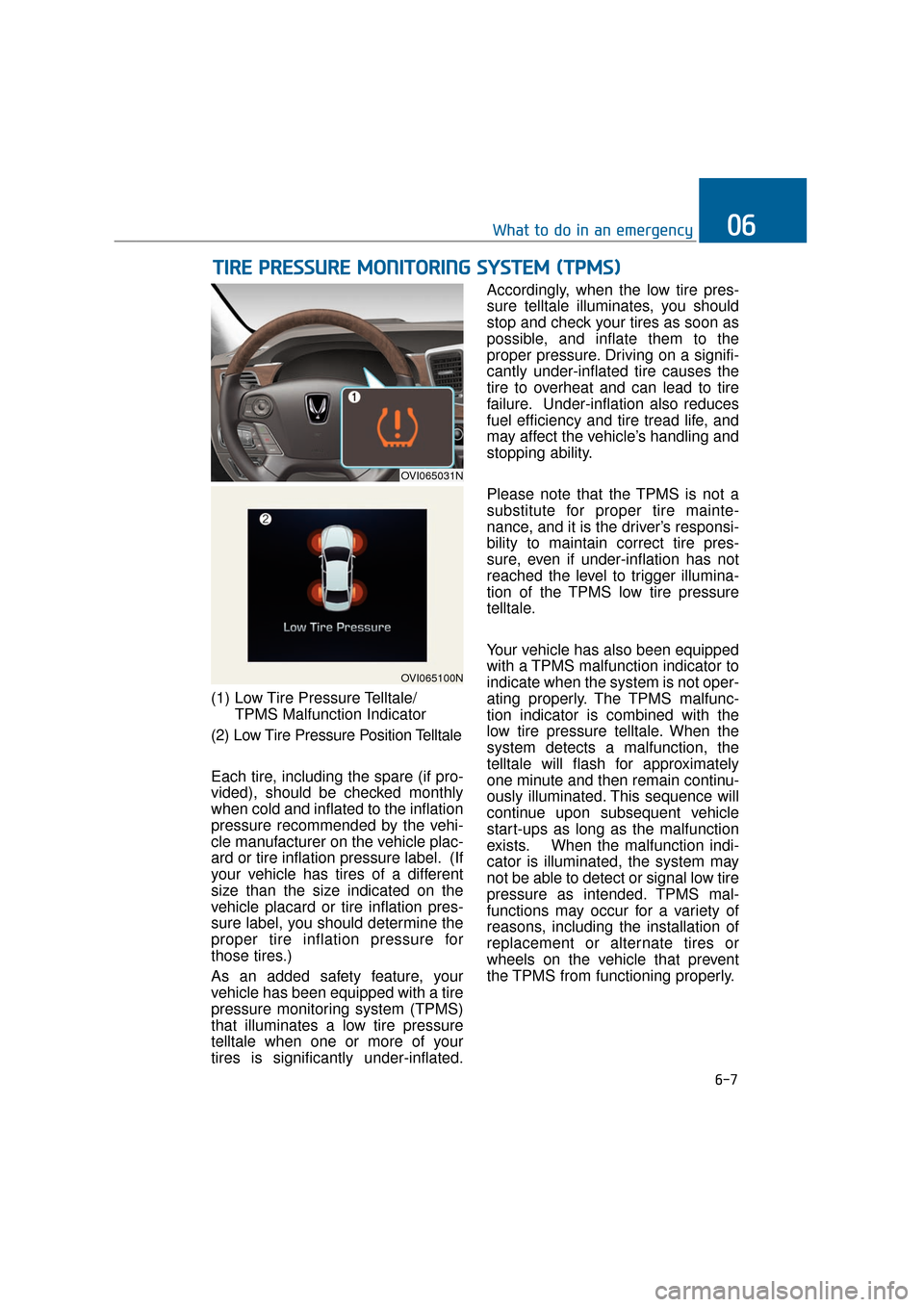
(1) Low Tire Pressure Telltale/TPMS Malfunction Indicator
(2) Low Tire Pressure Position Telltale
Each tire, including the spare (if pro-
vided), should be checked monthly
when cold and inflated to the inflation
pressure recommended by the vehi-
cle manufacturer on the vehicle plac-
ard or tire inflation pressure label. (If
your vehicle has tires of a different
size than the size indicated on the
vehicle placard or tire inflation pres-
sure label, you should determine the
proper tire inflation pressure for
those tires.)
As an added safety feature, your
vehicle has been equipped with a tire
pressure monitoring system (TPMS)
that illuminates a low tire pressure
telltale when one or more of your
tires is significantly under-inflated. Accordingly, when the low tire pres-
sure telltale illuminates, you should
stop and check your tires as soon as
possible, and inflate them to the
proper pressure. Driving on a signifi-
cantly under-inflated tire causes the
tire to overheat and can lead to tire
failure. Under-inflation also reduces
fuel efficiency and tire tread life, and
may affect the vehicle’s handling and
stopping ability.
Please note that the TPMS is not a
substitute for proper tire mainte-
nance, and it is the driver’s responsi-
bility to maintain correct tire pres-
sure, even if under-inflation has not
reached the level to trigger illumina-
tion of the TPMS low tire pressure
telltale.
Your vehicle has also been equipped
with a TPMS malfunction indicator to
indicate when the system is not oper-
ating properly. The TPMS malfunc-
tion indicator is combined with the
low tire pressure telltale. When the
system detects a malfunction, the
telltale will flash for approximately
one minute and then remain continu-
ously illuminated. This sequence will
continue upon subsequent vehicle
start-ups as long as the malfunction
exists. When the malfunction indi-
cator is illuminated, the system may
not be able to detect or signal low tire
pressure as intended. TPMS mal-
functions may occur for a variety of
reasons, including the installation of
replacement or alternate tires or
wheels on the vehicle that prevent
the TPMS from functioning properly.
T T
I
IR
R E
E
P
P R
R E
ES
SS
SU
U R
RE
E
M
M O
ON
NI
IT
T O
O R
RI
IN
N G
G
S
S Y
Y S
ST
T E
EM
M
(
( T
T P
P M
M S
S)
)
6-7
What to do in an emergency06
OVI065031N
OVI065100N
Page 341 of 477
Always check the TPMS malfunction
telltale after replacing one or more
tires or wheels on your vehicle to
ensure that the replacement or alter-
nate tires and wheels allow the TPMS
to continue to function properly.
Information
If any of the followings happens, we
recommend that the system be
checked by an authorized EQUUS
dealer.
1. The low tire pressure telltale/TPMSmalfunction indicator does not illu-
minate for 3 seconds when the igni-
tion switch is turned ON or engine is
running.
2. The TPMS malfunction indicator remains ON after flashing for
approximately 1 minute.
3. The Low tire pressure position tell- tale remains ON.
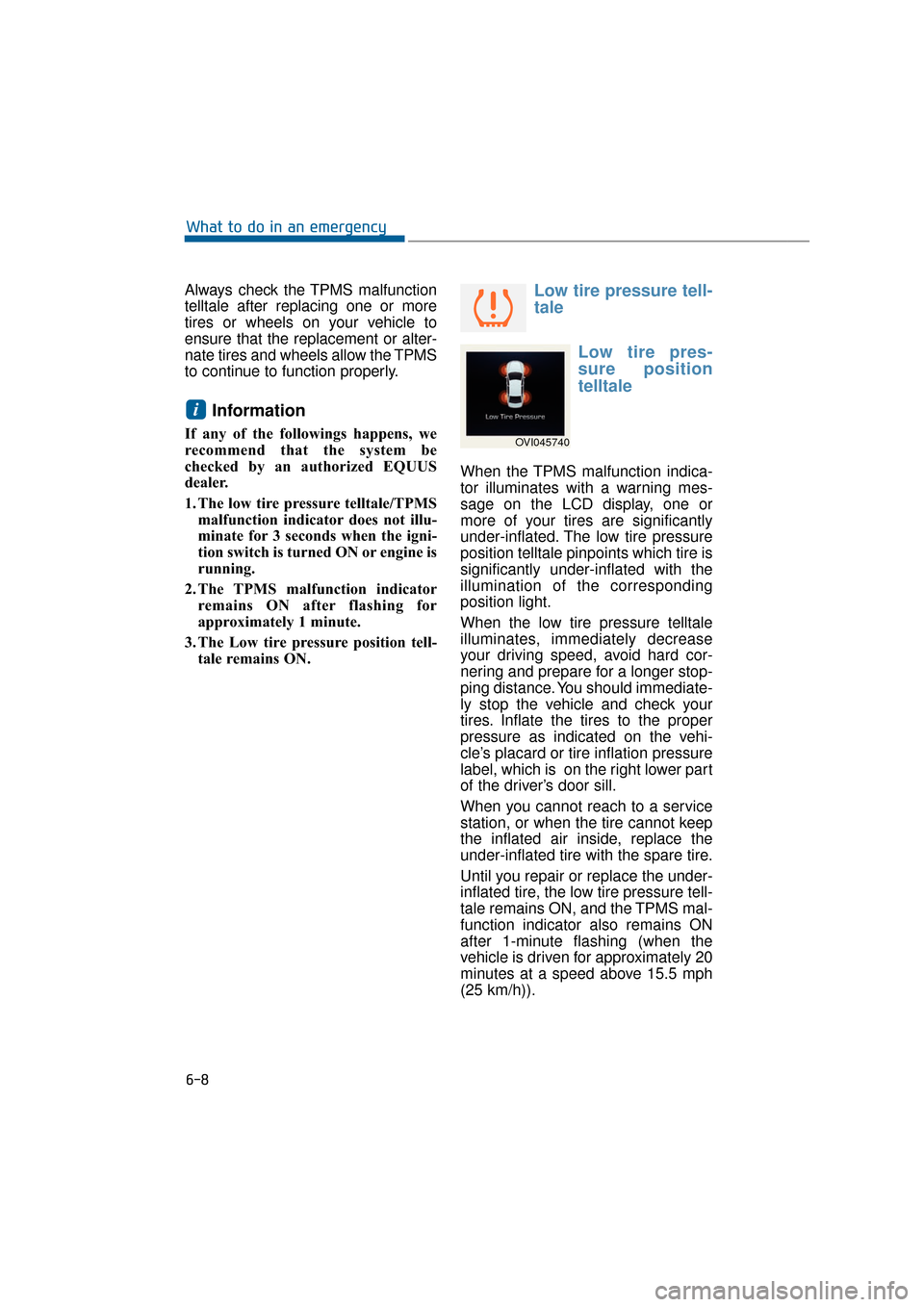
Low tire pressure tell-
tale
Low tire pres-
sure position
telltale
When the TPMS malfunction indica-
tor illuminates with a warning mes-
sage on the LCD display, one or
more of your tires are significantly
under-inflated. The low tire pressure
position telltale pinpoints which tire is
significantly under-inflated with the
illumination of the corresponding
position light.
When the low tire pressure telltale
illuminates, immediately decrease
your driving speed, avoid hard cor-
nering and prepare for a longer stop-
ping distance. You should immediate-
ly stop the vehicle and check your
tires. Inflate the tires to the proper
pressure as indicated on the vehi-
cle’s placard or tire inflation pressure
label, which is on the right lower part
of the driver’s door sill.
When you cannot reach to a service
station, or when the tire cannot keep
the inflated air inside, replace the
under-inflated tire with the spare tire.
Until you repair or replace the under-
inflated tire, the low tire pressure tell-
tale remains ON, and the TPMS mal-
function indicator also remains ON
after 1-minute flashing (when the
vehicle is driven for approximately 20
minutes at a speed above 15.5 mph
(25 km/h)).
i
6-8
What to do in an emergency
OVI045740
Page 344 of 477
This device complies with Part
15 of the FCC rules.
Operation is subject to the following
two conditions:
1. This device may not cause harmfulinterference, and
2. This device must accept any inter- ference received, including inter-
ference that may cause undesired
operation.
Changes or modifications not
expressly approved by the party
responsible for compliance could
void the user’s authority to oper-
ate the equipment.
NOTICE
6-11
What to do in an emergency06
- Protecting TPMS
Arbitral handling, modification
and disabling of the TPMS may
undermine the TPMS perform-
ance to warn the driver of the
low tire pressures or the TPMS
malfunction. Arbitral handling,
modification and disabling of
the TPMS components may
invalidate your warranty of that
part.
WARNING
Page 358 of 477
Maintenance
Engine compartment .............................................7-4
Maintenance services ...........................................7-5
Owner's responsibility ......................................................7-5
Owner's maintenance precautions ...............................7-6
Owner's maintenance ...........................................7-7
Owner's maintenance schedule ....................................7-7
Scheduled maintenance service ..........................7-8
Normal maintenance schedule .......................................7-9
Maintenance under severe usage conditions ..........7-22
Explanation of scheduled maintenance
items.......................................................................7\
-23
Engine oil ..............................................................7-25
Checking the engine oil level ....................................7-25
Changing the engine oil and filter ..............................7-26
Engine coolant......................................................7-27
Checking the coolant level ...........................................7-27
Changing the coolant .....................................................7-29
Brake fluid ............................................................7-30
Checking the brake fluid level .....................................7-30
Power steering fluid ............................................7-31
Checking the power steering fluid level ...................7-31
Checking the power steering hose.............................7-31
Washer fluid .........................................................7-32
Checking the washer fluid level ..................................7-32
Air cleaner ............................................................7-33
Filter replacement ...........................................................7-33
Page 362 of 477
You should give the utmost care and
attention to prevention of a vehicle
damage as well as a personal injury,
while maintaining or inspecting your
vehicle.
When you have any doubts concern-
ing the inspection or the vehicle
service, we strongly recommend that
you have an authorized EQUUS
dealer inspect or maintain your vehi-
cle. An authorized EQUUS dealer
has factory-trained technicians and
authorized HYUNDAI parts to prop-
erly maintain your vehicle. For the
quality advices and services, contact
an authorized EQUUS dealer.
Inadequate, incomplete or insuffi-
cient vehicle maintenance may result
in operational problems of your vehi-
cle, possibly leading to a vehicle
damage, an accident, or a personal
injury.Owner’s responsibility Information
Maintenance Service and Record
Retention are the owner's responsibil-
ity.
You should keep the records of your
proper maintenance history in accor-
dance with the maintenance service
schedule on the following pages. You
need to refer to the maintenance
schedule information of the following
pages in order to satisfy the warran-
ty requirements of your vehicle.
You can find more warranty informa-
tion in the Owner’s Handbook &
Warranty Information booklet.
Your vehicle warranty does not cover
the repair expenses, incurred by your
improper or insufficient maintenance.
We recommend having your vehicle
maintained and repaired by an
authorized EQUUS dealer.
An authorized EQUUS dealer meets
HYUNDAI’s high service quality stan-
dards and receives technical support
from HYUNDAI in order to provide
you with a high level of services.
i
M MA
AI
IN
N T
TE
EN
N A
AN
N C
CE
E
S
S E
E R
R V
V I
IC
C E
E S
S
7-5
Maintenance07
Page 400 of 477
7-43
Maintenance07
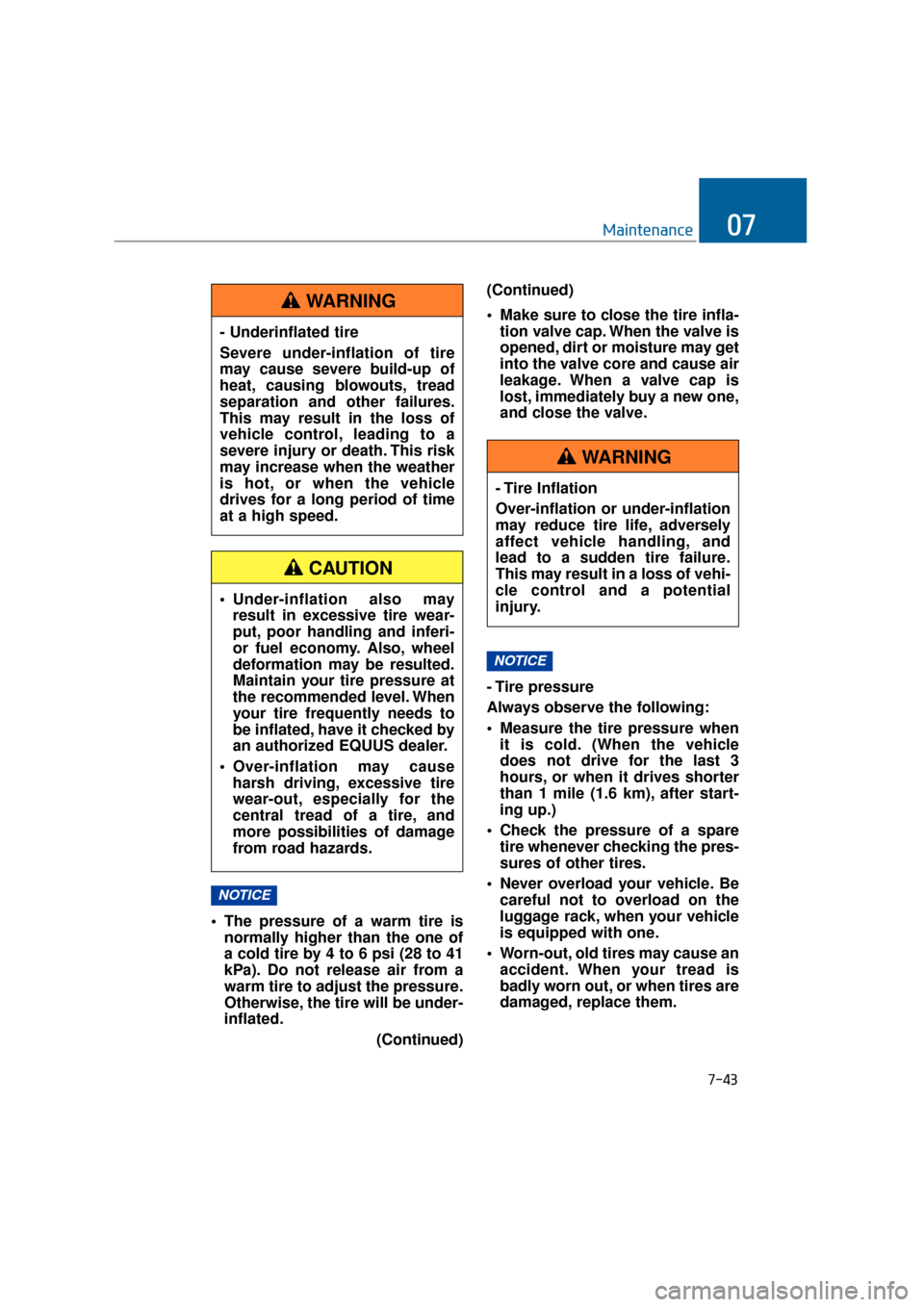
The pressure of a warm tire isnormally higher than the one of
a cold tire by 4 to 6 psi (28 to 41
kPa). Do not release air from a
warm tire to adjust the pressure.
Otherwise, the tire will be under-
inflated.
(Continued)(Continued)
Make sure to close the tire infla-
tion valve cap. When the valve is
opened, dirt or moisture may get
into the valve core and cause air
leakage. When a valve cap is
lost, immediately buy a new one,
and close the valve.
- Tire pressure
Always observe the following:
Measure the tire pressure when it is cold. (When the vehicle
does not drive for the last 3
hours, or when it drives shorter
than 1 mile (1.6 km), after start-
ing up.)
Check the pressure of a spare tire whenever checking the pres-
sures of other tires.
Never overload your vehicle. Be careful not to overload on the
luggage rack, when your vehicle
is equipped with one.
Worn-out, old tires may cause an accident. When your tread is
badly worn out, or when tires are
damaged, replace them.
NOTICE
NOTICE
- Underinflated tire
Severe under-inflation of tire
may cause severe build-up of
heat, causing blowouts, tread
separation and other failures.
This may result in the loss of
vehicle control, leading to a
severe injury or death. This risk
may increase when the weather
is hot, or when the vehicle
drives for a long period of time
at a high speed.
WARNING
- Tire Inflation
Over-inflation or under-inflation
may reduce tire life, adversely
affect vehicle handling, and
lead to a sudden tire failure.
This may result in a loss of vehi-
cle control and a potential
injury.
WARNING
Under-inflation also mayresult in excessive tire wear-
put, poor handling and inferi-
or fuel economy. Also, wheel
deformation may be resulted.
Maintain your tire pressure at
the recommended level. When
your tire frequently needs to
be inflated, have it checked by
an authorized EQUUS dealer.
Over-inflation may cause harsh driving, excessive tire
wear-out, especially for the
central tread of a tire, and
more possibilities of damage
from road hazards.
CAUTION
Page 401 of 477
7-44
Maintenance
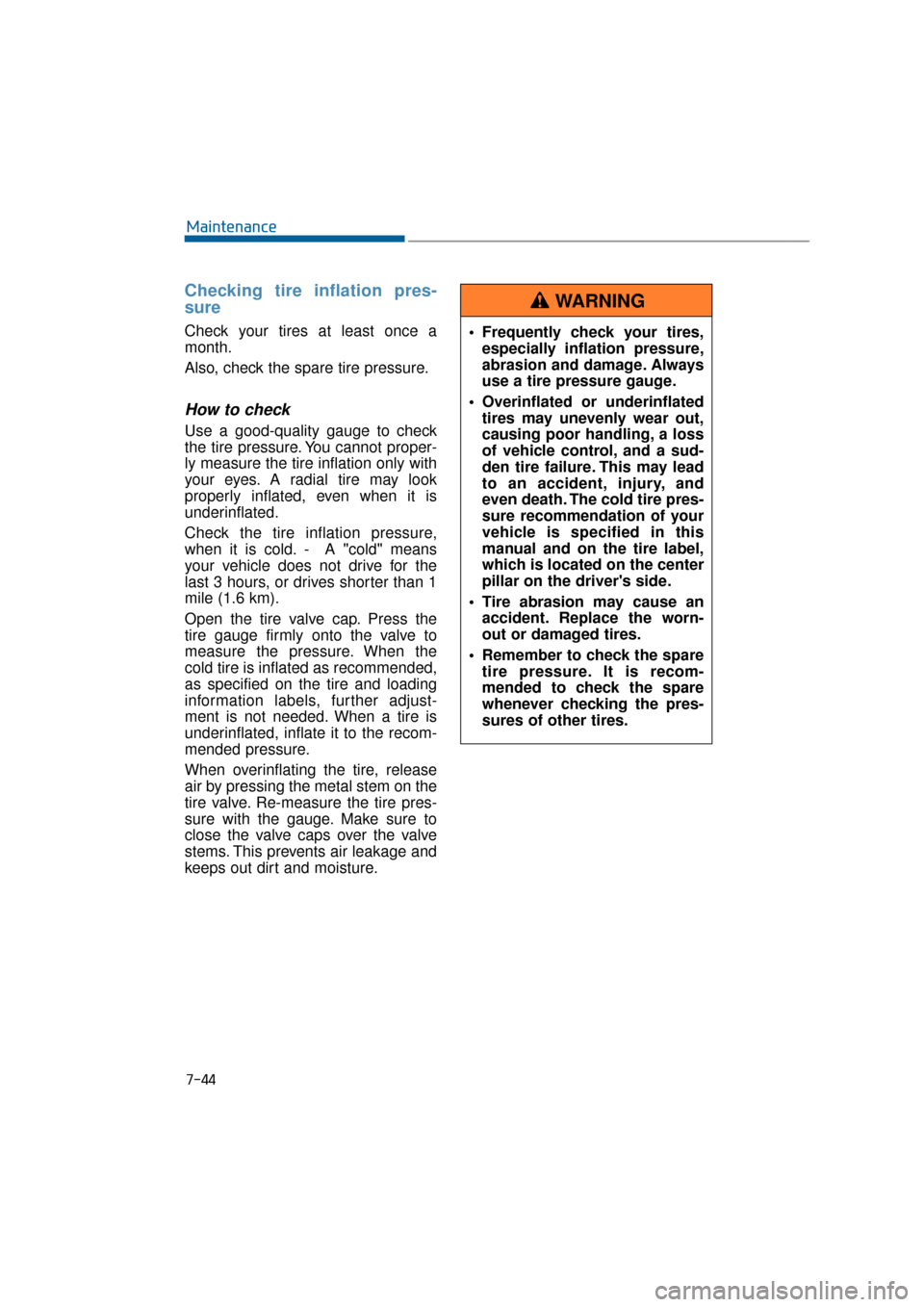
Checking tire inflation pres-
sure
Check your tires at least once a
month.
Also, check the spare tire pressure.
How to check
Use a good-quality gauge to check
the tire pressure. You cannot proper-
ly measure the tire inflation only with
your eyes. A radial tire may look
properly inflated, even when it is
underinflated.
Check the tire inflation pressure,
when it is cold. - A "cold" means
your vehicle does not drive for the
last 3 hours, or drives shorter than 1
mile (1.6 km).
Open the tire valve cap. Press the
tire gauge firmly onto the valve to
measure the pressure. When the
cold tire is inflated as recommended,
as specified on the tire and loading
information labels, further adjust-
ment is not needed. When a tire is
underinflated, inflate it to the recom-
mended pressure.
When overinflating the tire, release
air by pressing the metal stem on the
tire valve. Re-measure the tire pres-
sure with the gauge. Make sure to
close the valve caps over the valve
stems. This prevents air leakage and
keeps out dirt and moisture. Frequently check your tires,
especially inflation pressure,
abrasion and damage. Always
use a tire pressure gauge.
Overinflated or underinflated tires may unevenly wear out,
causing poor handling, a loss
of vehicle control, and a sud-
den tire failure. This may lead
to an accident, injury, and
even death. The cold tire pres-
sure recommendation of your
vehicle is specified in this
manual and on the tire label,
which is located on the center
pillar on the driver's side.
Tire abrasion may cause an accident. Replace the worn-
out or damaged tires.
Remember to check the spare tire pressure. It is recom-
mended to check the spare
whenever checking the pres-
sures of other tires.
WARNING