warning Hyundai Equus 2016 Workshop Manual
[x] Cancel search | Manufacturer: HYUNDAI, Model Year: 2016, Model line: Equus, Model: Hyundai Equus 2016Pages: 477, PDF Size: 16.25 MB
Page 80 of 477
2-53
Safety system of your vehicle02
Even though your vehicle isequipped with the occupant
classification system, never
install a child restraint system
in the front passenger's seat. A
deploying air bag may forcefully
strike a child, resulting in seri-
ous injury or death. Any child
age 12 and under should ride in
a rear seat. Children too big for
a child restraint should use the
available lap/shoulder belts. No
matter what type of a crash
occurs, children of all ages are
safer, when restrained in a rear
seat.
When the "PASSENGER AIR BAG OFF" indicator illumi-
nates with an adult's occupa-
tion in the front passenger's
seat, he/she sits properly (sit-
ting in an upright position,
and sitting on the center of
the seat cushion with their
seat belt fastened, legs com-
fortably extended and their
feet on the floor), have that
person sit in a rear seat.
Do not modify or replace the front passenger's seat. Do not
place or attach any items, such
as a blanket or seat heater, on
the front passenger's seat.
This may adversely affect the
occupant classification sys-
tem.
When the weight load is changed in the front passen-
ger's seat, the PASSENGER
"AIR BAG OFF" indicator may
flash ON and OFF for a few sec-
onds, enabling and disabling
the front passenger's air bag.
(Continued)
(Continued)
Do not sit over a sharp object,such as a tool, in the front
passenger's seat. This may
adversely affect the occupant
classification system.
Do not use an accessory seat cover over the front passen-
ger's seat.
Accident statistics show that children are safer, when
restrained in a rear than in the
front. It is recommended that
all child restraints be secured
in a rear seat, including a rear-
facing infant seat, a forward-
facing child seat and a boost-
er seat
Air bags can be used only once – have an authorized
EQUUS dealer replace the air
bag immediately after a
deployment.
A tiny adult's incorrect seat- ing (i.e. excessively reclining,
leaning toward the door or the
center console, or slanting
forward) may cause a condi-
tion where the advanced front
passenger's air bag system
senses less weight than occu-
pant's the actual weight (when
properly sitting in an upright
position, and sitting on the
center of the seat cushion
with their seat belt fastened,
legs comfortably extended
and their feet on the floor).
This condition may result in
misclassification of an occu-
pant and illumination of the
"PASSENGER AIR BAG OFF"
indicator.WARNING
Page 81 of 477
Driver's and front passenger's
air bag
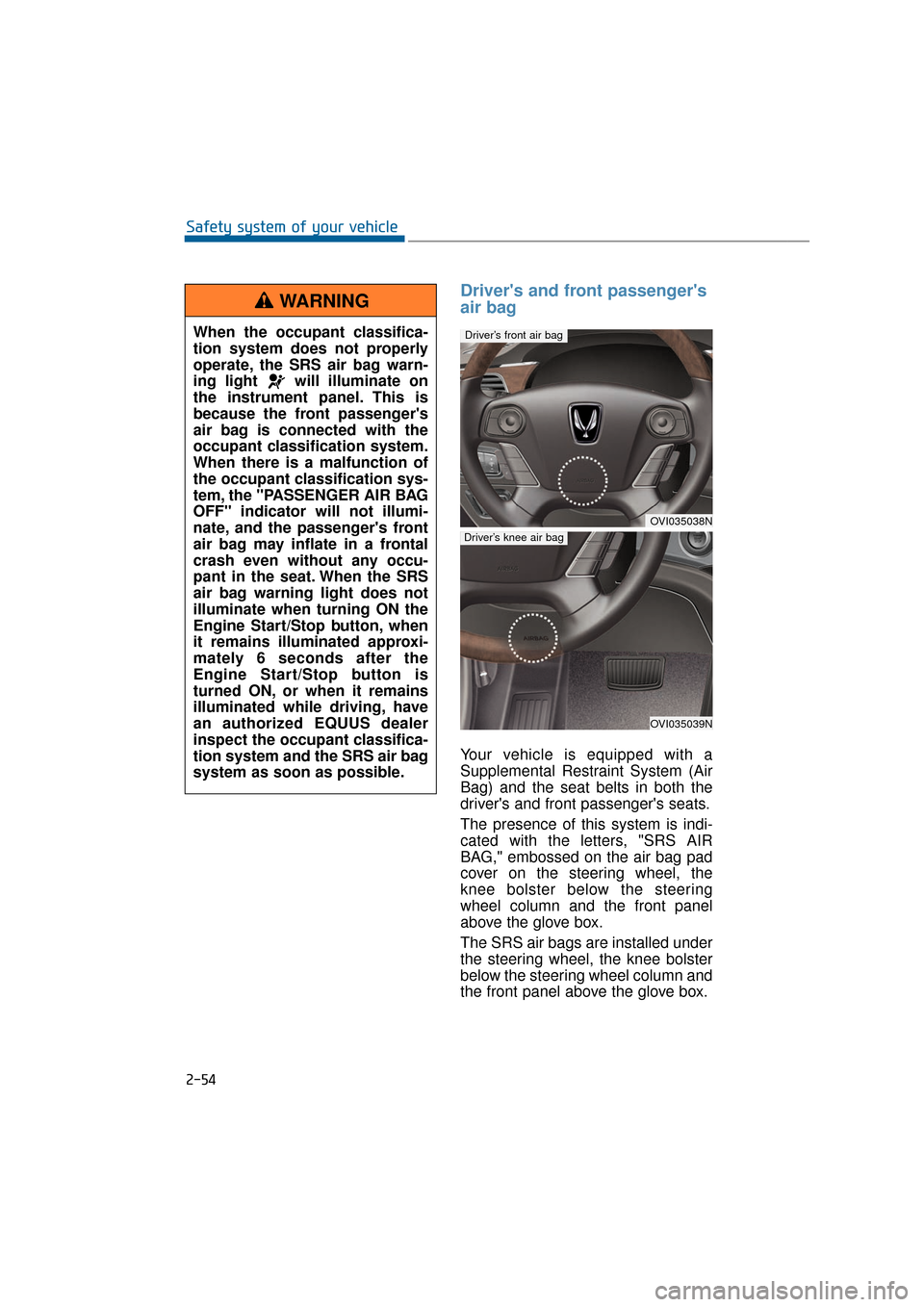
Your vehicle is equipped with a
Supplemental Restraint System (Air
Bag) and the seat belts in both the
driver's and front passenger's seats.
The presence of this system is indi-
cated with the letters, "SRS AIR
BAG," embossed on the air bag pad
cover on the steering wheel, the
knee bolster below the steering
wheel column and the front panel
above the glove box.
The SRS air bags are installed under
the steering wheel, the knee bolster
below the steering wheel column and
the front panel above the glove box.
2-54
Safety system of your vehicleWhen the occupant classifica-
tion system does not properly
operate, the SRS air bag warn-
ing light will illuminate on
the instrument panel. This is
because the front passenger's
air bag is connected with the
occupant classification system.
When there is a malfunction of
the occupant classification sys-
tem, the "PASSENGER AIR BAG
OFF" indicator will not illumi-
nate, and the passenger's front
air bag may inflate in a frontal
crash even without any occu-
pant in the seat. When the SRS
air bag warning light does not
illuminate when turning ON the
Engine Start/Stop button, when
it remains illuminated approxi-
mately 6 seconds after the
Engine Start/Stop button is
turned ON, or when it remains
illuminated while driving, have
an authorized EQUUS dealer
inspect the occupant classifica-
tion system and the SRS air bag
system as soon as possible.
WARNING
OVI035038N
Driver’s front air bag
OVI035039N
Driver’s knee air bag
Page 82 of 477
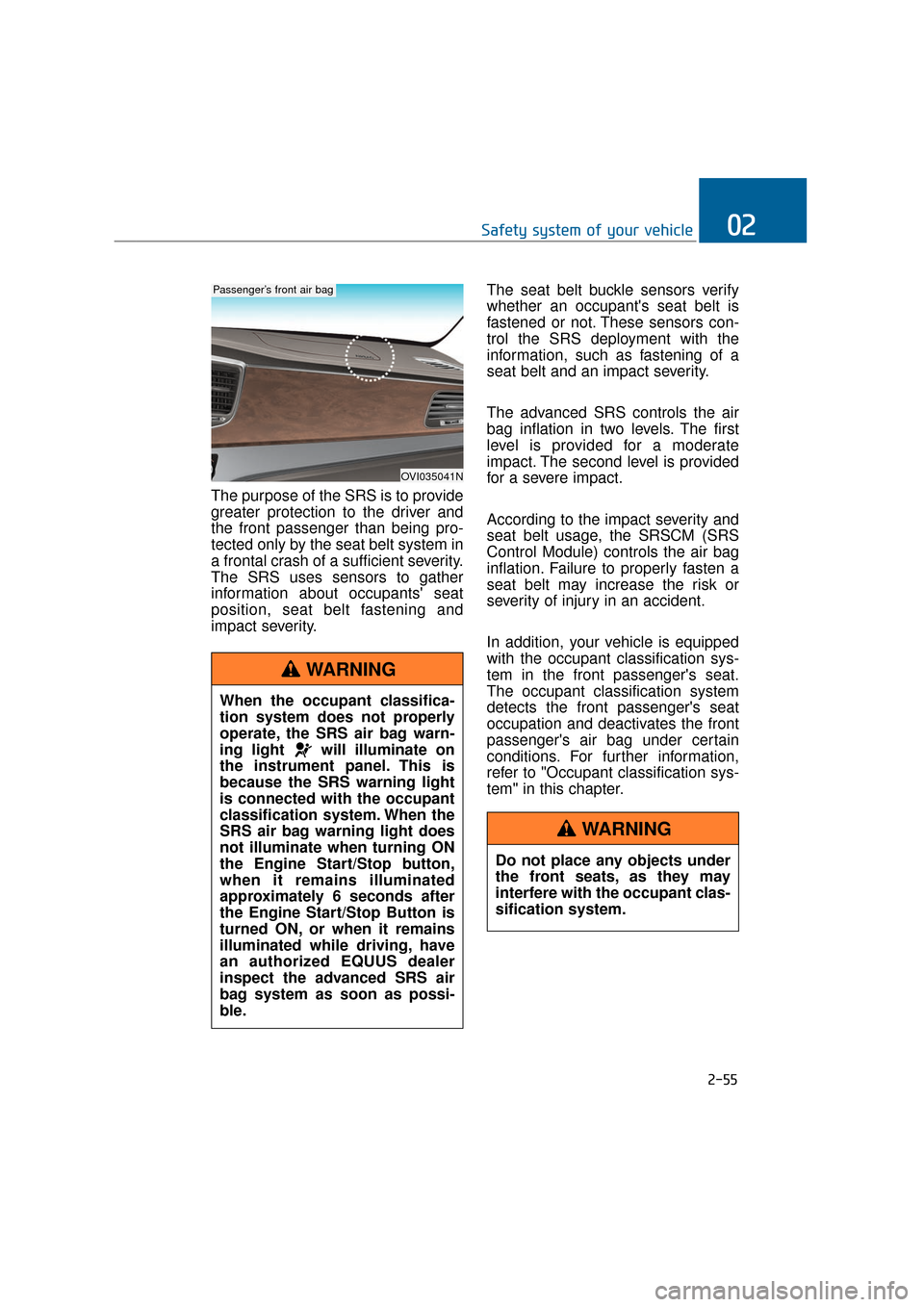
The purpose of the SRS is to provide
greater protection to the driver and
the front passenger than being pro-
tected only by the seat belt system in
a frontal crash of a sufficient severity.
The SRS uses sensors to gather
information about occupants' seat
position, seat belt fastening and
impact severity.The seat belt buckle sensors verify
whether an occupant's seat belt is
fastened or not. These sensors con-
trol the SRS deployment with the
information, such as fastening of a
seat belt and an impact severity.
The advanced SRS controls the air
bag inflation in two levels. The first
level is provided for a moderate
impact. The second level is provided
for a severe impact.
According to the impact severity and
seat belt usage, the SRSCM (SRS
Control Module) controls the air bag
inflation. Failure to properly fasten a
seat belt may increase the risk or
severity of injury in an accident.
In addition, your vehicle is equipped
with the occupant classification sys-
tem in the front passenger's seat.
The occupant classification system
detects the front passenger's seat
occupation and deactivates the front
passenger's air bag under certain
conditions. For further information,
refer to "Occupant classification sys-
tem" in this chapter.
2-55
Safety system of your vehicle02
OVI035041N
Passenger’s front air bag
When the occupant classifica-
tion system does not properly
operate, the SRS air bag warn-
ing light will illuminate on
the instrument panel. This is
because the SRS warning light
is connected with the occupant
classification system. When the
SRS air bag warning light does
not illuminate when turning ON
the Engine Start/Stop button,
when it remains illuminated
approximately 6 seconds after
the Engine Start/Stop Button is
turned ON, or when it remains
illuminated while driving, have
an authorized EQUUS dealer
inspect the advanced SRS air
bag system as soon as possi-
ble.
WARNING
Do not place any objects under
the front seats, as they may
interfere with the occupant clas-
sification system.
WARNING
Page 83 of 477
Information
• Must read the SRS information onthe sun visor.
• The combination of the advanced air bags and pre-tensioner seat belts
provides more enhanced protection
in a frontal crash. Front air bags are
not designed to inflate in a minor
collision in which enough protection
can be provided by the pre-tension-
er seat belt.
i
2-56
Safety system of your vehicle
Before modifying your vehicle
due to a disability, please con-
tact the EQUUS Customer
Connect Center at 1-877-378-
8727.
WARNING
Always use seat belts and child
restraints – every trip, every
time, everyone! Air bags
instantly inflate with consider-
able force. Seat belts help occu-
pants keep the proper position
for their maximum benefits of
an air bag. Even with advanced
air bags, improperly belted and
unbelted occupants may be
severely injured when an air
bag inflates. Always follow the
precautions about seat belts, air
bags and occupants' safety in
this manual. (Continued)
(Continued)
To reduce the possibilities of
serious or fatal injury and
receive the maximum safety
benefit from your restraint sys-
tem:
Never place a child in anychild restraint or booster seat
in the front seat.
ABC – Always Buckle Children in a rear seat. It is the
safest place for children of all
ages.
Front and side air bags may injure an occupant, who is
improperly positioned in the
front seats.
Move your seat as far back as possible from the front air
bags, while still maintaining
control of the vehicle.
You and occupants should never sit or lean unnecessari-
ly close to the air bags.
Improperly positioned driver
and occupants may be
severely injured by inflating
air bags.
Never lean against the door or the center console – always
sit in an upright position.
Do not allow an adult occu- pant to ride in the front seat,
when the "PASSENGER AIR
BAG OFF" indicator illumi-
nates. An air bag will not
deploy in the event of a mod-
erate or severe frontal crash.
(Continued)
WARNING
Page 84 of 477
2-57
Safety system of your vehicle02
(Continued)
No objects should be placedover or near the air bag mod-
ules on the steering wheel,
instrument panel, and the
front panel above the glove
box, because such an object
may cause harm in a crash
severe enough to cause the
air bags to deploy.
Never place covers, blankets or seat warmers on the pas-
senger's seat. These may
interfere with the occupant
classification system.
Do not modify or disconnect the SRS wirings or other SRS
components.
Doing so may result in injury,
due to an accidental air bag
deployment or the deactivated
SRS.
When the SRS air bag warning light remains illuminated
while driving, have an author-
ized EQUUS dealer inspect
the air bag system as soon as
possible.
Air bags can be used only once – have an authorized
EQUUS dealer replace the air
bag immediately after deploy-
ment.
The SRS is designed to deploy front air bags only
when an impact is sufficiently
severe, and when the impact
angle is smaller than 30° from
the forward longitudinal axis.
In addition, air bags will inflate
only once. Seat belts must be
fastened at all times.
(Continued)(Continued)
Front air bags are notdesigned to deploy in
side/rear impacts or a rollover.
In addition, front air bags will
not deploy in a frontal crash,
when an impact severity is
below the deployment thresh-
old.
Even though your vehicle is equipped with the occupant
classification system, do not
install a child restraint system
in the front passenger's seat.
A child restraint system must
never be installed in front. An
infant or child may be severe-
ly injured or killed by an air
bag deployment in case of an
accident.
Children age 12 and under must always be properly
restrained in a rear seat.
Never allow children to ride in
the front passenger's seat. In
case that a child over the age
of 12 is seated in the front
passenger's seat, the child
must be properly fastened
and the seat should be moved
to the rearmost position.
To maximize protection and to minimize the possibility of
serious injury or death in all
types of crashes, all occu-
pants including the driver
should always fasten a seat
belt regardless of the air bag
installment in their seats. Do
not sit or lean unnecessarily
close to an air bag while the
vehicle is in motion.
(Continued)
Page 86 of 477
The side air bags are designed to
deploy only in a certain side-impact
collision, depending on an impact
severity, an angle, a speed and a
direction. The side air bags are not
designed to deploy in all side-impact
crashes.
2-59
Safety system of your vehicle02
Do not allow occupants to lean
their heads or bodies toward
doors, to put their arms on the
doors, to stretch their arms out
of the window, or to place
objects between the doors and
the occupant, when they occu-
py the seat equipped with side
and/or curtain air bags.
WARNING
The side air bag is supplemen-tal to the seat belt system, not
a substitute. Therefore, your
seat belt must be fastened at
all times while the vehicle is in
motion. The air bags deploy
only in a certain side impact,
which is severe enough to
cause significant injury.
For the maximum protection from side air bags and to
avoid injury by a deploying
side air bag, all occupants
should sit in an upright posi-
tion with a seat belt properly
fastened. The driver's hands
should be placed on the steer-
ing wheel in the 9:00-o'clock
and 3:00-o'clock position. The
passenger' arms and hands
should be placed on their
laps.
(Continued)
(Continued)
Do not use any accessoryseat covers.
Use of a seat cover may reduce the system effects or
prevent the system operation.
Do not install any accessories over or near the side air bags.
Do not place any objects over the air bag or between the air
bag and yourself.
Do not place any objects (i.e. umbrella and bag) between a
door and a seat. Such objects
may become dangerous pro-
jectiles and may cause injury,
when a side air bag inflates.
To prevent inadvertent deployment of a side air bag,
which may result in personal
injury, avoid any impact on the
air bag sensor, when the igni-
tion switch is ON.
When a seat or a seat cover is damaged, have the vehicle
checked and repaired by an
authorized EQUUS dealer
because your vehicle is
equipped with side air bags
and an occupant classifica-
tion system.
WARNING
Page 87 of 477
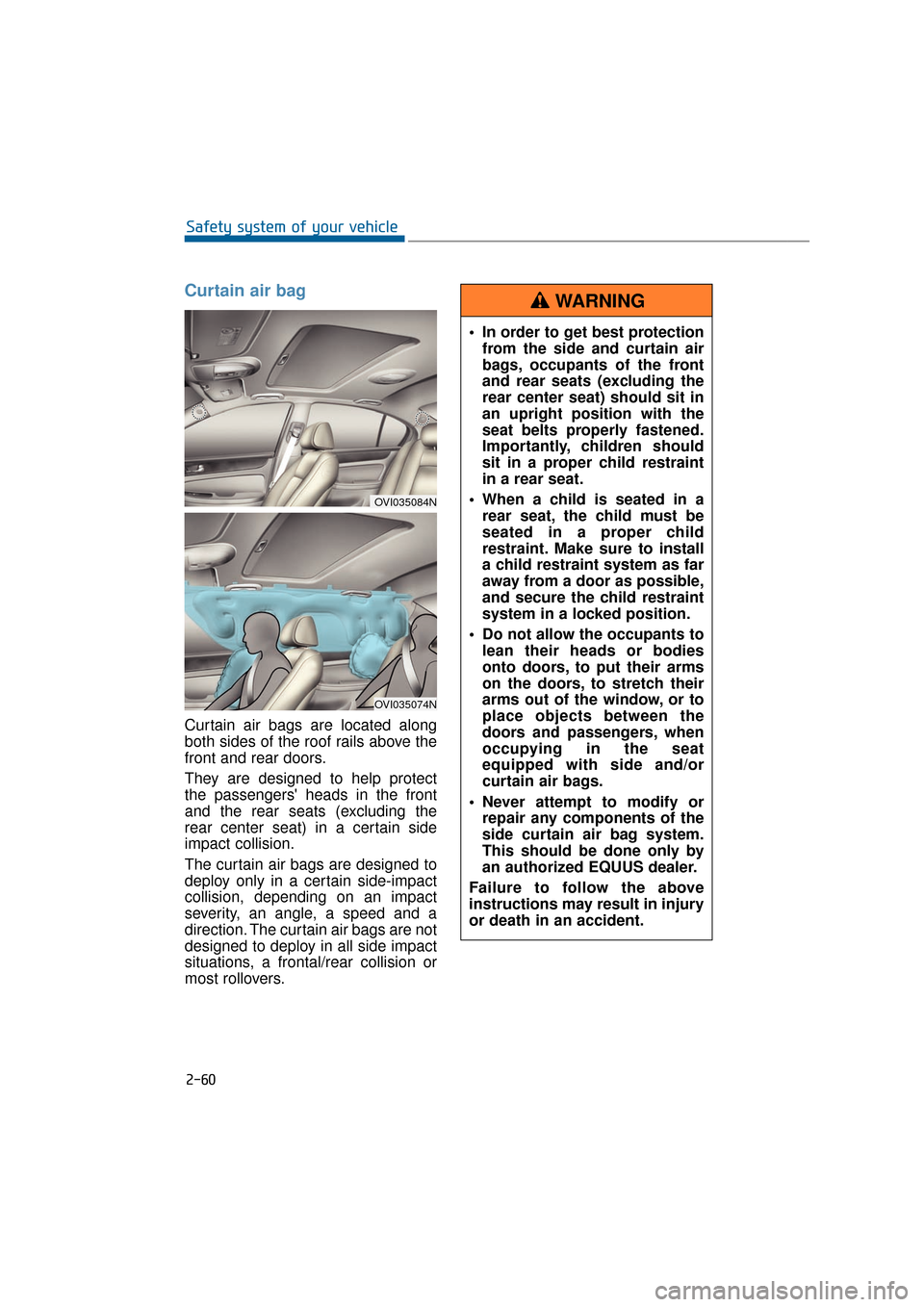
Curtain air bag
Curtain air bags are located along
both sides of the roof rails above the
front and rear doors.
They are designed to help protect
the passengers' heads in the front
and the rear seats (excluding the
rear center seat) in a certain side
impact collision.
The curtain air bags are designed to
deploy only in a certain side-impact
collision, depending on an impact
severity, an angle, a speed and a
direction. The curtain air bags are not
designed to deploy in all side impact
situations, a frontal/rear collision or
most rollovers.
2-60
Safety system of your vehicle
OVI035084N
OVI035074N
In order to get best protectionfrom the side and curtain air
bags, occupants of the front
and rear seats (excluding the
rear center seat) should sit in
an upright position with the
seat belts properly fastened.
Importantly, children should
sit in a proper child restraint
in a rear seat.
When a child is seated in a rear seat, the child must be
seated in a proper child
restraint. Make sure to install
a child restraint system as far
away from a door as possible,
and secure the child restraint
system in a locked position.
Do not allow the occupants to lean their heads or bodies
onto doors, to put their arms
on the doors, to stretch their
arms out of the window, or to
place objects between the
doors and passengers, when
occupying in the seat
equipped with side and/or
curtain air bags.
Never attempt to modify or repair any components of the
side curtain air bag system.
This should be done only by
an authorized EQUUS dealer.
Failure to follow the above
instructions may result in injury
or death in an accident.
WARNING
Page 89 of 477
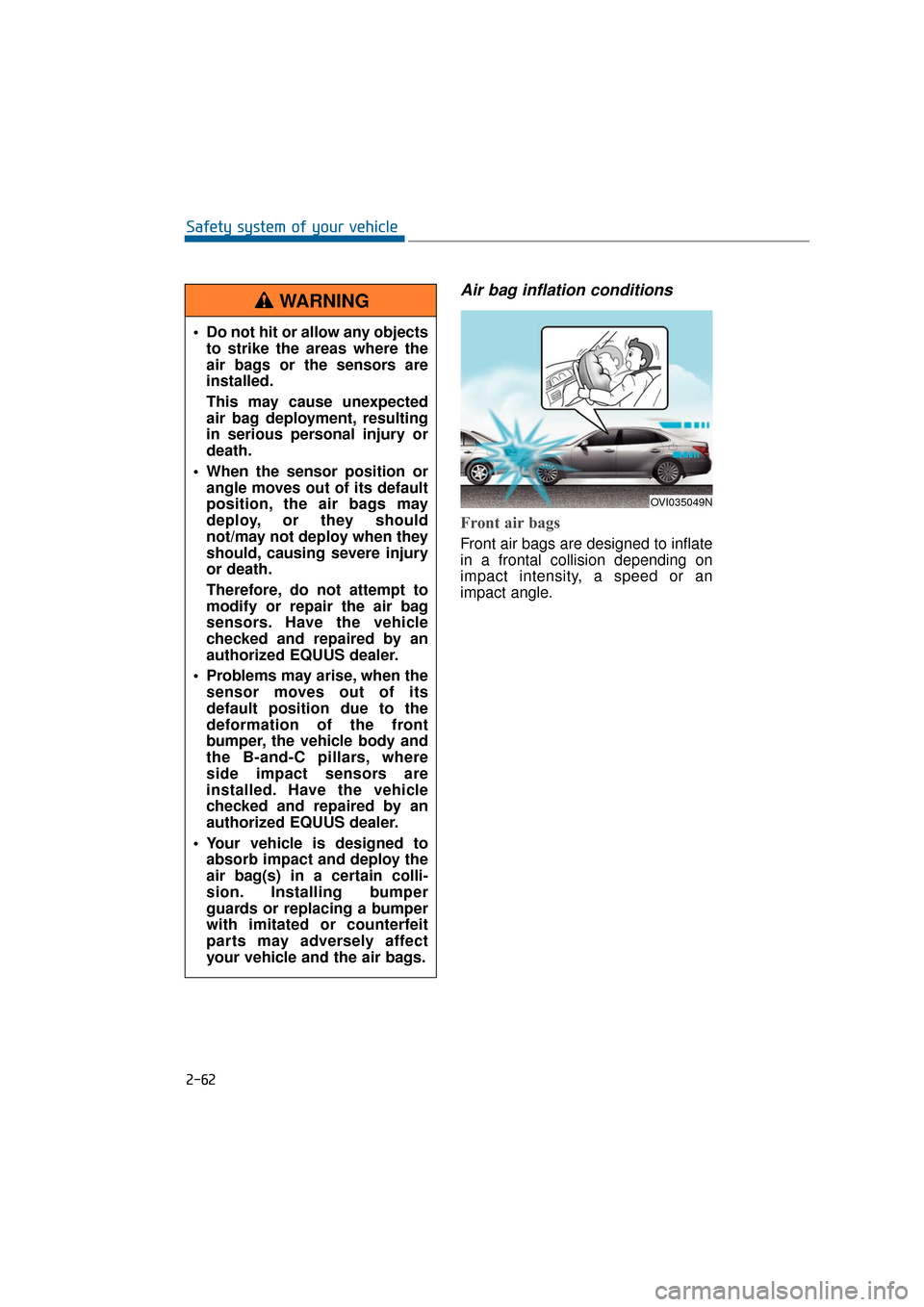
Air bag inflation conditions
Front air bags
Front air bags are designed to inflate
in a frontal collision depending on
impact intensity, a speed or an
impact angle.
2-62
Safety system of your vehicle Do not hit or allow any objects to strike the areas where the
air bags or the sensors are
installed.
This may cause unexpected
air bag deployment, resulting
in serious personal injury or
death.
When the sensor position or angle moves out of its default
position, the air bags may
deploy, or they should
not/may not deploy when they
should, causing severe injury
or death.
Therefore, do not attempt to
modify or repair the air bag
sensors. Have the vehicle
checked and repaired by an
authorized EQUUS dealer.
Problems may arise, when the sensor moves out of its
default position due to the
deformation of the front
bumper, the vehicle body and
the B-and-C pillars, where
side impact sensors are
installed. Have the vehicle
checked and repaired by an
authorized EQUUS dealer.
Your vehicle is designed to absorb impact and deploy the
air bag(s) in a certain colli-
sion. Installing bumper
guards or replacing a bumper
with imitated or counterfeit
parts may adversely affect
your vehicle and the air bags.
WARNING
OVI035049N
Page 92 of 477
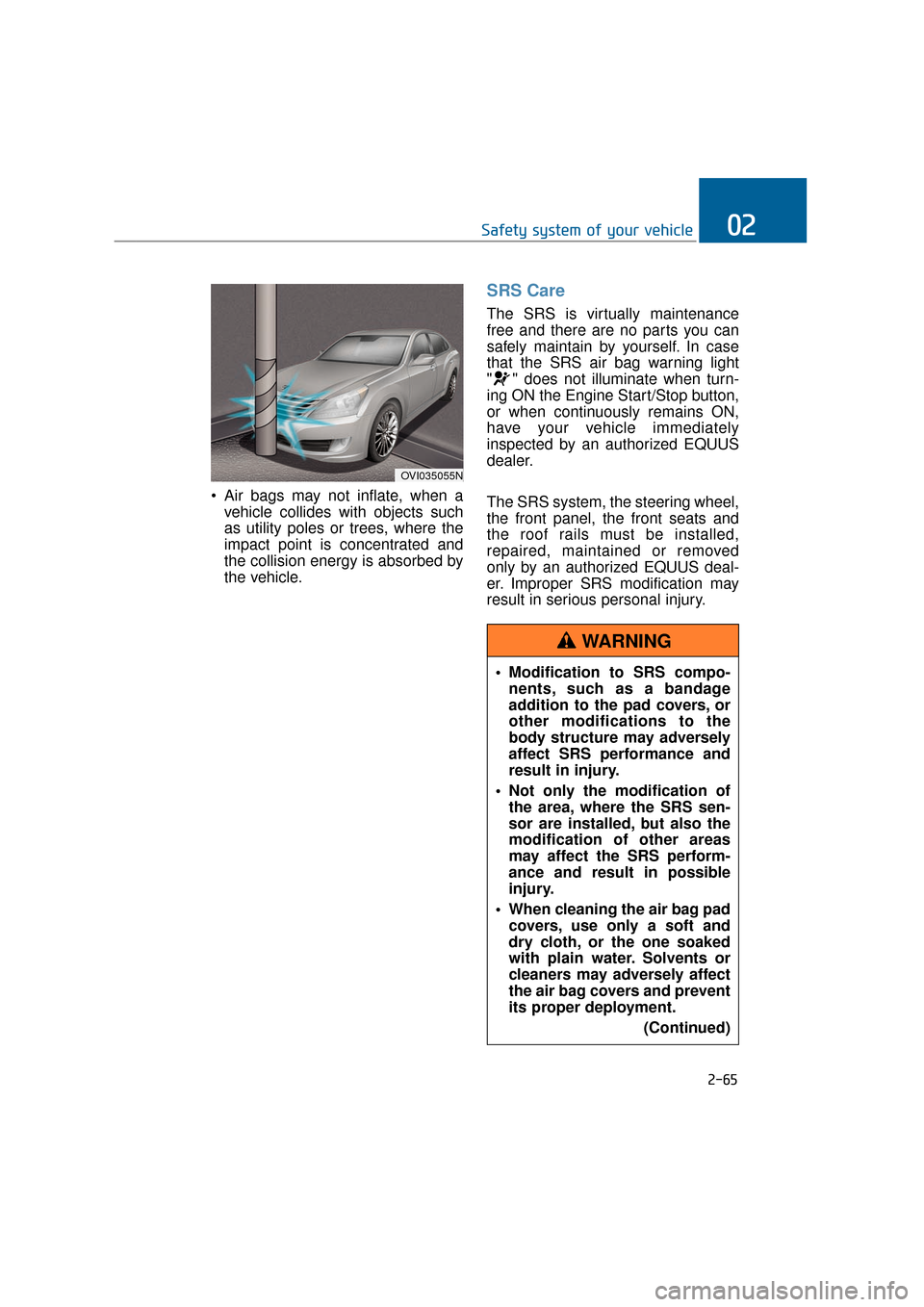
Air bags may not inflate, when avehicle collides with objects such
as utility poles or trees, where the
impact point is concentrated and
the collision energy is absorbed by
the vehicle.
SRS Care
The SRS is virtually maintenance
free and there are no parts you can
safely maintain by yourself. In case
that the SRS air bag warning light
" " does not illuminate when turn-
ing ON the Engine Start/Stop button,
or when continuously remains ON,
have your vehicle immediately
inspected by an authorized EQUUS
dealer.
The SRS system, the steering wheel,
the front panel, the front seats and
the roof rails must be installed,
repaired, maintained or removed
only by an authorized EQUUS deal-
er. Improper SRS modification may
result in serious personal injury.
2-65
Safety system of your vehicle02
OVI035055N
Modification to SRS compo-nents, such as a bandage
addition to the pad covers, or
other modifications to the
body structure may adversely
affect SRS performance and
result in injury.
Not only the modification of the area, where the SRS sen-
sor are installed, but also the
modification of other areas
may affect the SRS perform-
ance and result in possible
injury.
When cleaning the air bag pad covers, use only a soft and
dry cloth, or the one soaked
with plain water. Solvents or
cleaners may adversely affect
the air bag covers and prevent
its proper deployment.
(Continued)
WARNING
Page 94 of 477
Do not modify the front seats.
Modification of the front seats
could interfere with the operation of
the SRS sensing components or
side impact air bags.
Do not place items under the
front seats. Items under the front
seats could interfere with the oper-
ation of the SRS sensing compo-
nents or wiring harnesses.
Never hold an infant or child on
your laps. The infant or child may
be seriously injured or killed in the
event of a crash. All infants and
children should be properly
restrained in an appropriate child
restraint or in a rear seat with a
seat belt.Adding equipment to or modify- ing your air bag-equipped vehi-cle
When you modify your vehicle frame,
bumper system, front-end or side-
sheet metal or ride height, this may
adversely affect the operation of your
vehicle's air bag system.
2-67
Safety system of your vehicle02
Sitting improperly or out of
position may cause occu-
pants to slant too close
towards a deploying air bag,
strike the interior structure or
be thrown from the vehicle,
resulting in serious injury or
death.
Always put a seatback upright, and seat on the cen-
ter of the seat cushion with
your seat belt fastened, legs
comfortably extended and
your feet rested on the floor.
Be careful not to impact doors, when the Engine
Start/Stop Button is ON. The
impact may cause the air bags
to inflate.
WARNING