start stop button Hyundai Equus 2016 Repair Manual
[x] Cancel search | Manufacturer: HYUNDAI, Model Year: 2016, Model line: Equus, Model: Hyundai Equus 2016Pages: 477, PDF Size: 16.25 MB
Page 259 of 477
START
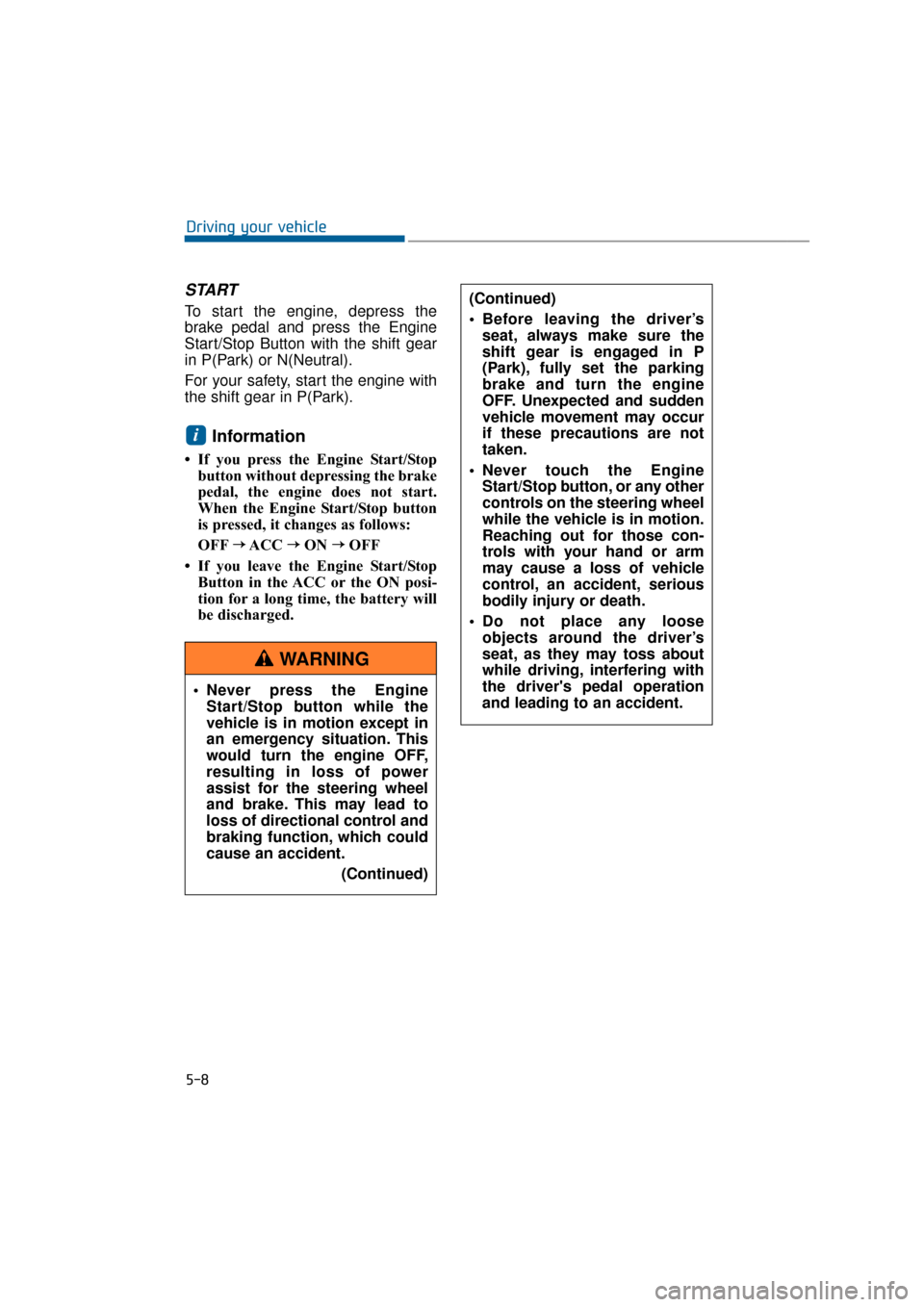
To start the engine, depress the
brake pedal and press the Engine
Start/Stop Button with the shift gear
in P(Park) or N(Neutral).
For your safety, start the engine with
the shift gear in P(Park).
Information
• If you press the Engine Start/Stopbutton without depressing the brake
pedal, the engine does not start.
When the Engine Start/Stop button
is pressed, it changes as follows:
OFF → →
ACC →
→
ON →
→
OFF
• If you leave the Engine Start/Stop Button in the ACC or the ON posi-
tion for a long time, the battery will
be discharged.
i
5-8
Driving your vehicle
Never press the Engine Start/Stop button while the
vehicle is in motion except in
an emergency situation. This
would turn the engine OFF,
resulting in loss of power
assist for the steering wheel
and brake. This may lead to
loss of directional control and
braking function, which could
cause an accident.
(Continued)
(Continued)
Before leaving the driver’sseat, always make sure the
shift gear is engaged in P
(Park), fully set the parking
brake and turn the engine
OFF. Unexpected and sudden
vehicle movement may occur
if these precautions are not
taken.
Never touch the Engine Start/Stop button, or any other
controls on the steering wheel
while the vehicle is in motion.
Reaching out for those con-
trols with your hand or arm
may cause a loss of vehicle
control, an accident, serious
bodily injury or death.
Do not place any loose objects around the driver’s
seat, as they may toss about
while driving, interfering with
the driver's pedal operation
and leading to an accident.
WARNING
Page 260 of 477
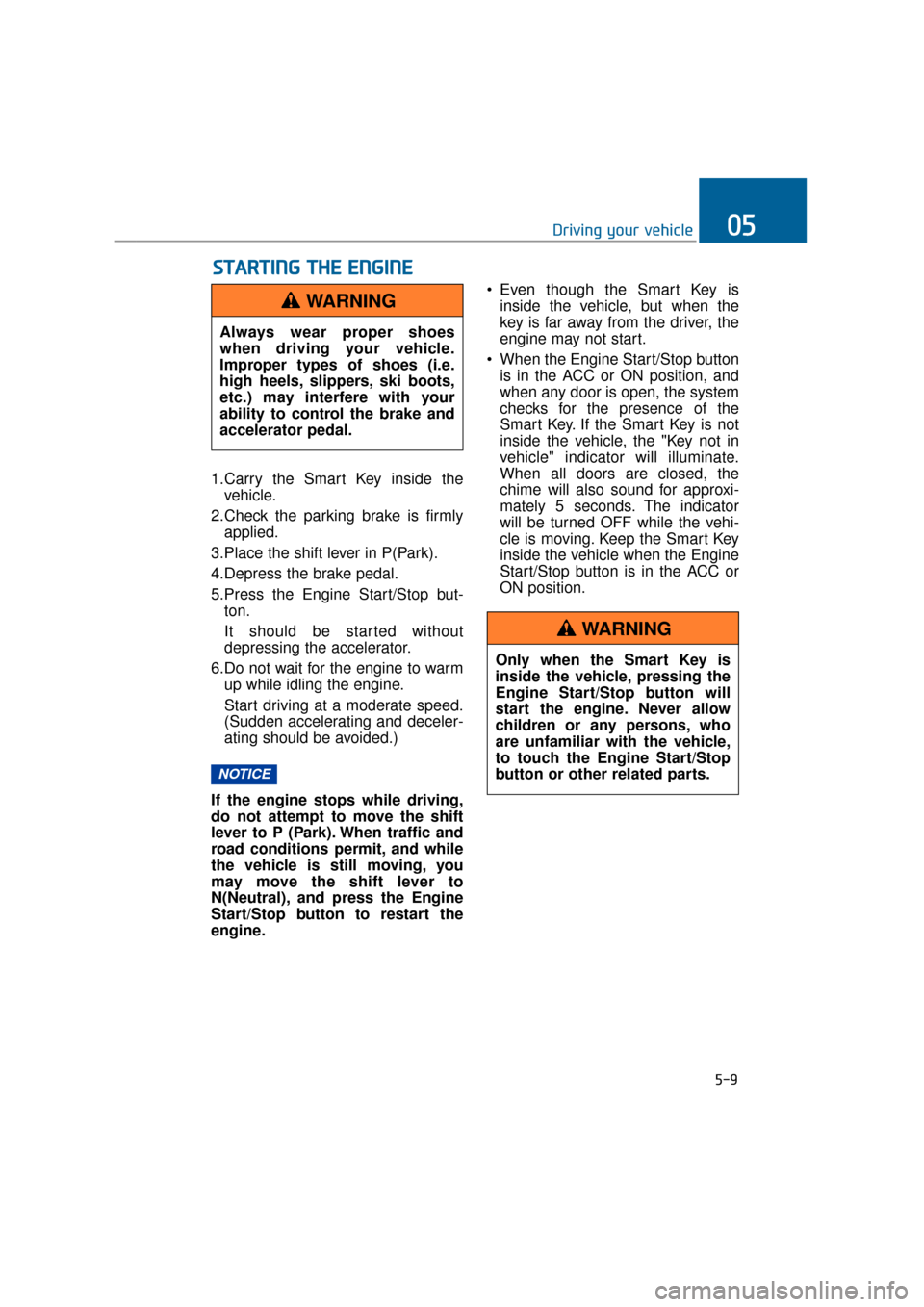
1.Carry the Smart Key inside thevehicle.
2.Check the parking brake is firmly applied.
3.Place the shift lever in P(Park).
4.Depress the brake pedal.
5.Press the Engine Start/Stop but- ton.
It should be started without
depressing the accelerator.
6.Do not wait for the engine to warm up while idling the engine.
Start driving at a moderate speed.
(Sudden accelerating and deceler-
ating should be avoided.)
If the engine stops while driving,
do not attempt to move the shift
lever to P (Park). When traffic and
road conditions permit, and while
the vehicle is still moving, you
may move the shift lever to
N(Neutral), and press the Engine
Start/Stop button to restart the
engine. Even though the Smart Key is
inside the vehicle, but when the
key is far away from the driver, the
engine may not start.
When the Engine Start/Stop button is in the ACC or ON position, and
when any door is open, the system
checks for the presence of the
Smart Key. If the Smart Key is not
inside the vehicle, the "Key not in
vehicle" indicator will illuminate.
When all doors are closed, the
chime will also sound for approxi-
mately 5 seconds. The indicator
will be turned OFF while the vehi-
cle is moving. Keep the Smart Key
inside the vehicle when the Engine
Start/Stop button is in the ACC or
ON position.
NOTICE
S ST
T A
A R
RT
TI
IN
N G
G
T
T H
H E
E
E
E N
N G
GI
IN
N E
E
5-9
Driving your vehicle05
Always wear proper shoes
when driving your vehicle.
Improper types of shoes (i.e.
high heels, slippers, ski boots,
etc.) may interfere with your
ability to control the brake and
accelerator pedal.
WARNING
Only when the Smart Key is
inside the vehicle, pressing the
Engine Start/Stop button will
start the engine. Never allow
children or any persons, who
are unfamiliar with the vehicle,
to touch the Engine Start/Stop
button or other related parts.
WARNING
Page 261 of 477
Information
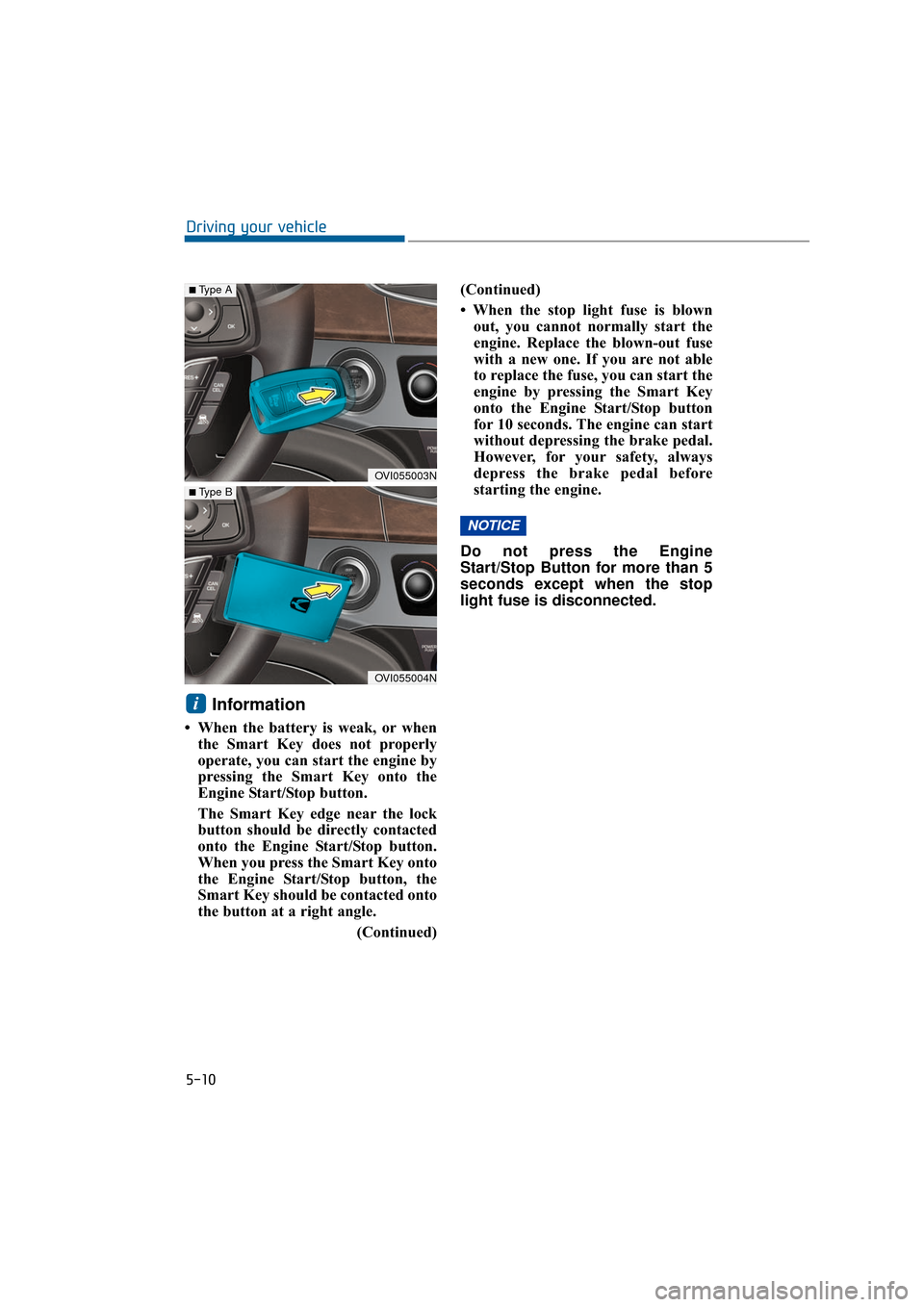
• When the battery is weak, or whenthe Smart Key does not properly
operate, you can start the engine by
pressing the Smart Key onto the
Engine Start/Stop button.
The Smart Key edge near the lock
button should be directly contacted
onto the Engine Start/Stop button.
When you press the Smart Key onto
the Engine Start/Stop button, the
Smart Key should be contacted onto
the button at a right angle.
(Continued)(Continued)
• When the stop light fuse is blown
out, you cannot normally start the
engine. Replace the blown-out fuse
with a new one. If you are not able
to replace the fuse, you can start the
engine by pressing the Smart Key
onto the Engine Start/Stop button
for 10 seconds. The engine can start
without depressing the brake pedal.
However, for your safety, always
depress the brake pedal before
starting the engine.
Do not press the Engine
Start/Stop Button for more than 5
seconds except when the stop
light fuse is disconnected.
NOTICE
i
5-10
Driving your vehicle
OVI055003N
■Type A
OVI055004N
■ Type B
Page 263 of 477
Automatic transmission opera-
tion
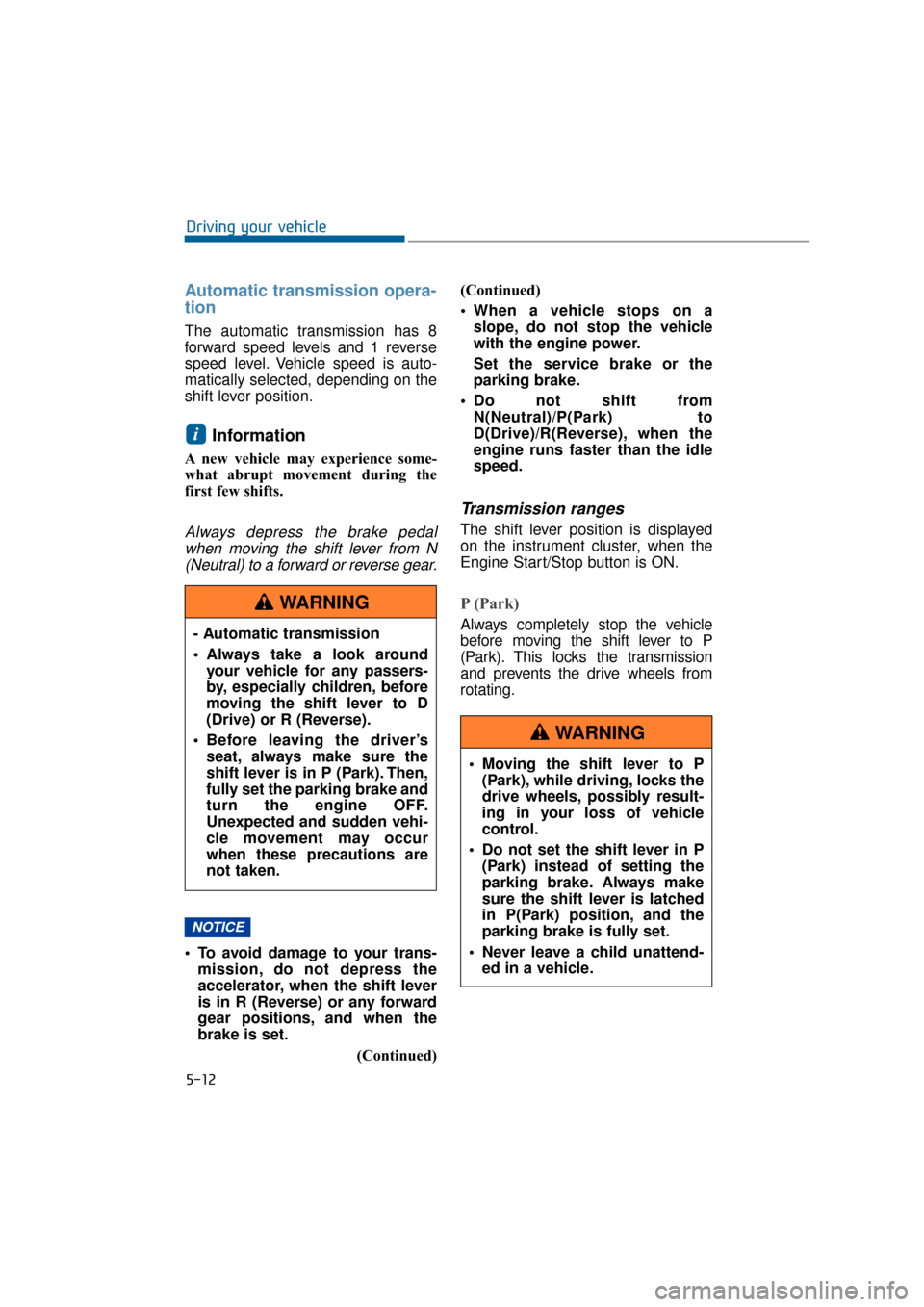
The automatic transmission has 8
forward speed levels and 1 reverse
speed level. Vehicle speed is auto-
matically selected, depending on the
shift lever position.
Information
A new vehicle may experience some-
what abrupt movement during the
first few shifts.
Always depress the brake pedalwhen moving the shift lever from N(Neutral) to a forward or reverse gear.
To avoid damage to your trans- mission, do not depress the
accelerator, when the shift lever
is in R (Reverse) or any forward
gear positions, and when the
brake is set.
(Continued)(Continued)
When a vehicle stops on a
slope, do not stop the vehicle
with the engine power.
Set the service brake or the
parking brake.
Do not shift from N(Neutral)/P(Park) to
D(Drive)/R(Reverse), when the
engine runs faster than the idle
speed.
Transmission ranges
The shift lever position is displayed
on the instrument cluster, when the
Engine Start/Stop button is ON.
P (Park)
Always completely stop the vehicle
before moving the shift lever to P
(Park). This locks the transmission
and prevents the drive wheels from
rotating.
NOTICE
i
5-12
Driving your vehicle
- Automatic transmission
Always take a look around your vehicle for any passers-
by, especially children, before
moving the shift lever to D
(Drive) or R (Reverse).
Before leaving the driver’s seat, always make sure the
shift lever is in P (Park). Then,
fully set the parking brake and
turn the engine OFF.
Unexpected and sudden vehi-
cle movement may occur
when these precautions are
not taken.
WARNING
Moving the shift lever to P(Park), while driving, locks the
drive wheels, possibly result-
ing in your loss of vehicle
control.
Do not set the shift lever in P (Park) instead of setting the
parking brake. Always make
sure the shift lever is latched
in P(Park) position, and the
parking brake is fully set.
Never leave a child unattend- ed in a vehicle.
WARNING
Page 265 of 477
(Continued)
• In sports mode, the transmissionwill automatically downshift, when
it slows down. When the vehicle
stops, the transmission automatical-
ly selects the 1st gear.
• In sports mode, the transmission will automatically upshift, when the
engine rpm approaches toward the
red zone.
• Even though the driver moves the shift lever to a +(up) or -(down)
position, the transmission may not
make the manually-requested gear
change, if the requested gear is out
of the allowable engine RPM range.
• When driving on a slippery road, set the shift lever in the 2nd gear, which
is better for smooth acceleration on
a slippery road.Shift lock system
For your safety, the automatic trans-
mission has a shift lock system to
prevent the transmission shifting
from P(Park) to R (Reverse), unless
the brake pedal is depressed.
To shift the transmission from
P(Park) into R(Reverse):
1. Depress the brake pedal.
2. Start the engine or turn the Engine Start/Stop button ON.
3. Move the shift lever.
When the brake pedal is repeatedly
depressed and released with the
shift lever in P(Park), you may expe-
rience chattering noises near the
shift lever. This is a normal condition.
5-14
Driving your vehicle
Always fully depress the brake
pedal before and while moving
the shift lever out of P (Park) to
another position to avoid inad-
vertent movement of the vehi-
cle. This may injure persons in
or around the car.
WARNING
Page 270 of 477
Electric parking brake (EPB)
Applying the parking brake
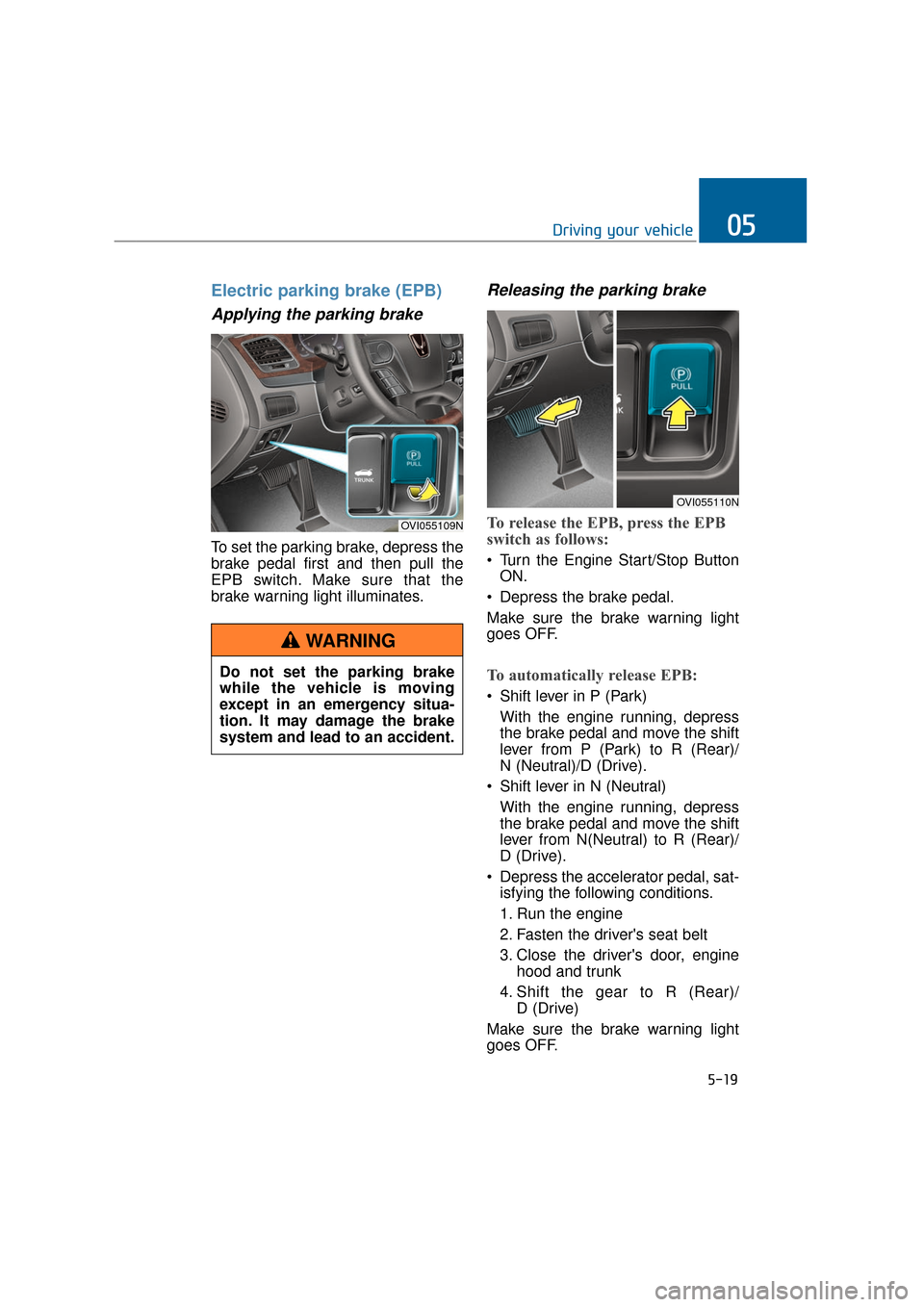
To set the parking brake, depress the
brake pedal first and then pull the
EPB switch. Make sure that the
brake warning light illuminates.
Releasing the parking brake
To release the EPB, press the EPB
switch as follows:
Turn the Engine Start/Stop ButtonON.
Depress the brake pedal.
Make sure the brake warning light
goes OFF.
To automatically release EPB:
Shift lever in P (Park) With the engine running, depress
the brake pedal and move the shift
lever from P (Park) to R (Rear)/
N (Neutral)/D (Drive).
Shift lever in N (Neutral) With the engine running, depress
the brake pedal and move the shift
lever from N(Neutral) to R (Rear)/
D (Drive).
Depress the accelerator pedal, sat- isfying the following conditions.
1. Run the engine
2. Fasten the driver's seat belt
3. Close the driver's door, engine hood and trunk
4. Shift the gear to R (Rear)/ D (Drive)
Make sure the brake warning light
goes OFF.
5-19
Driving your vehicle05
Do not set the parking brake
while the vehicle is moving
except in an emergency situa-
tion. It may damage the brake
system and lead to an accident.
WARNING
OVI055110N
OVI055109N
Page 271 of 477
Information
• You can set the EPB, even thoughthe Engine Start/Stop button is OFF.
However, for your safety, you can-
not release it.
• For your safety, depress the brake pedal and manually release the
parking brake by pressing the EPB
switch, when driving down on a
slope and driving back up.
When the parking brake warning light is still ON, even when the
EPB is released, have the sys-
tem be checked by an author-
ized EQUUS dealer.
Do not drive your vehicle with the EPB set. It may excessively
wear down the brake pad and
brake rotor.
EPB may automatically applies,
when:
It is requested by other systems.
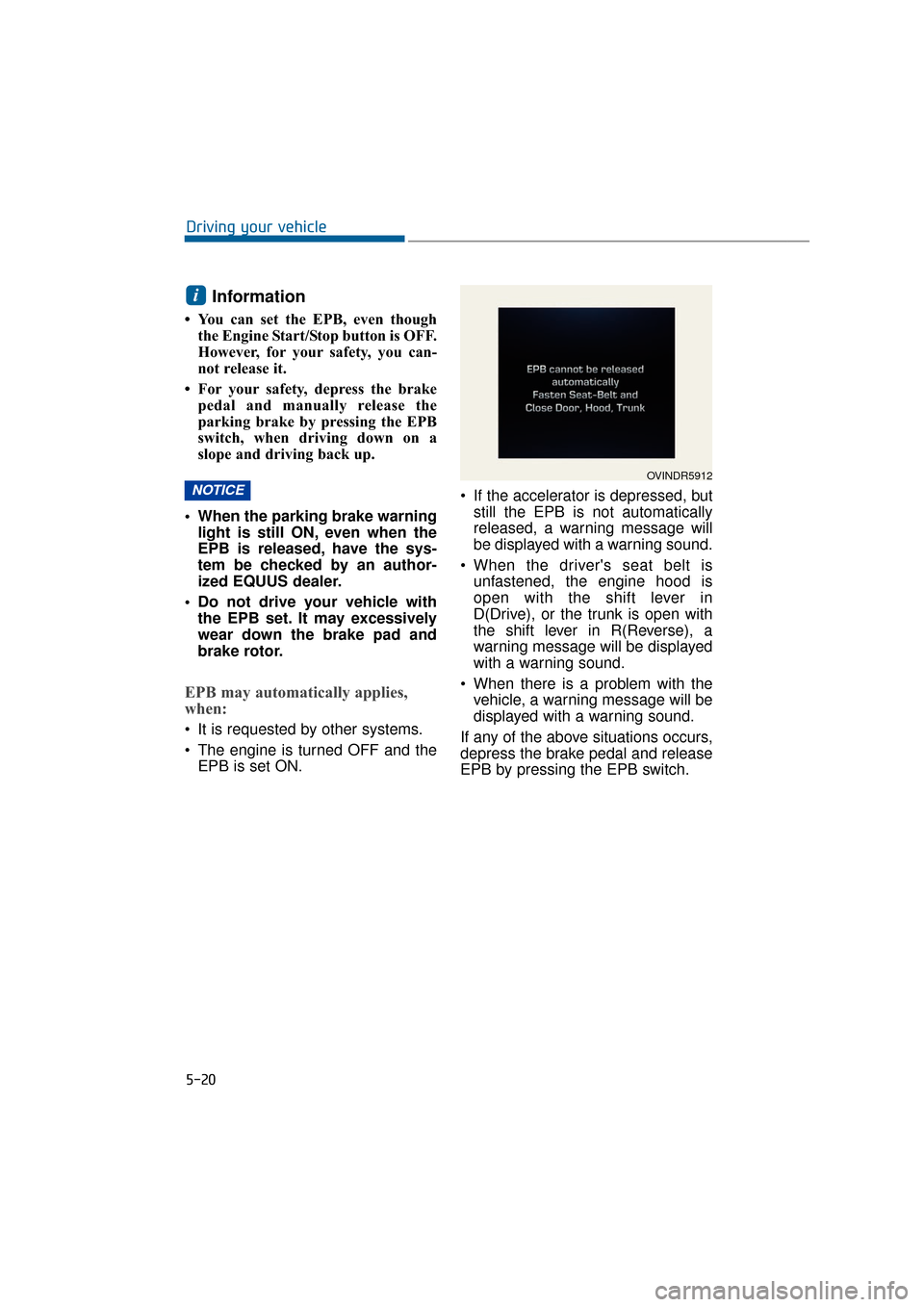
The engine is turned OFF and theEPB is set ON. If the accelerator is depressed, but
still the EPB is not automatically
released, a warning message will
be displayed with a warning sound.
When the driver's seat belt is unfastened, the engine hood is
open with the shift lever in
D(Drive), or the trunk is open with
the shift lever in R(Reverse), a
warning message will be displayed
with a warning sound.
When there is a problem with the vehicle, a warning message will be
displayed with a warning sound.
If any of the above situations occurs,
depress the brake pedal and release
EPB by pressing the EPB switch.
NOTICE
i
5-20
Driving your vehicle
OVINDR5912
Page 272 of 477
A clicking sound may be heardwhile setting or releasing the
EPB. This is a normal condition,
and indicates that the EPB prop-
erly functions.
When leaving your key with a parking lot attendant or valet
assistant, inform him/her of the
EPB operation.
The EPB may malfunction if you drive with the EPB set.
Gradually depress the accelera- tor, when you want to automati-
cally release EPB by depressing
it.
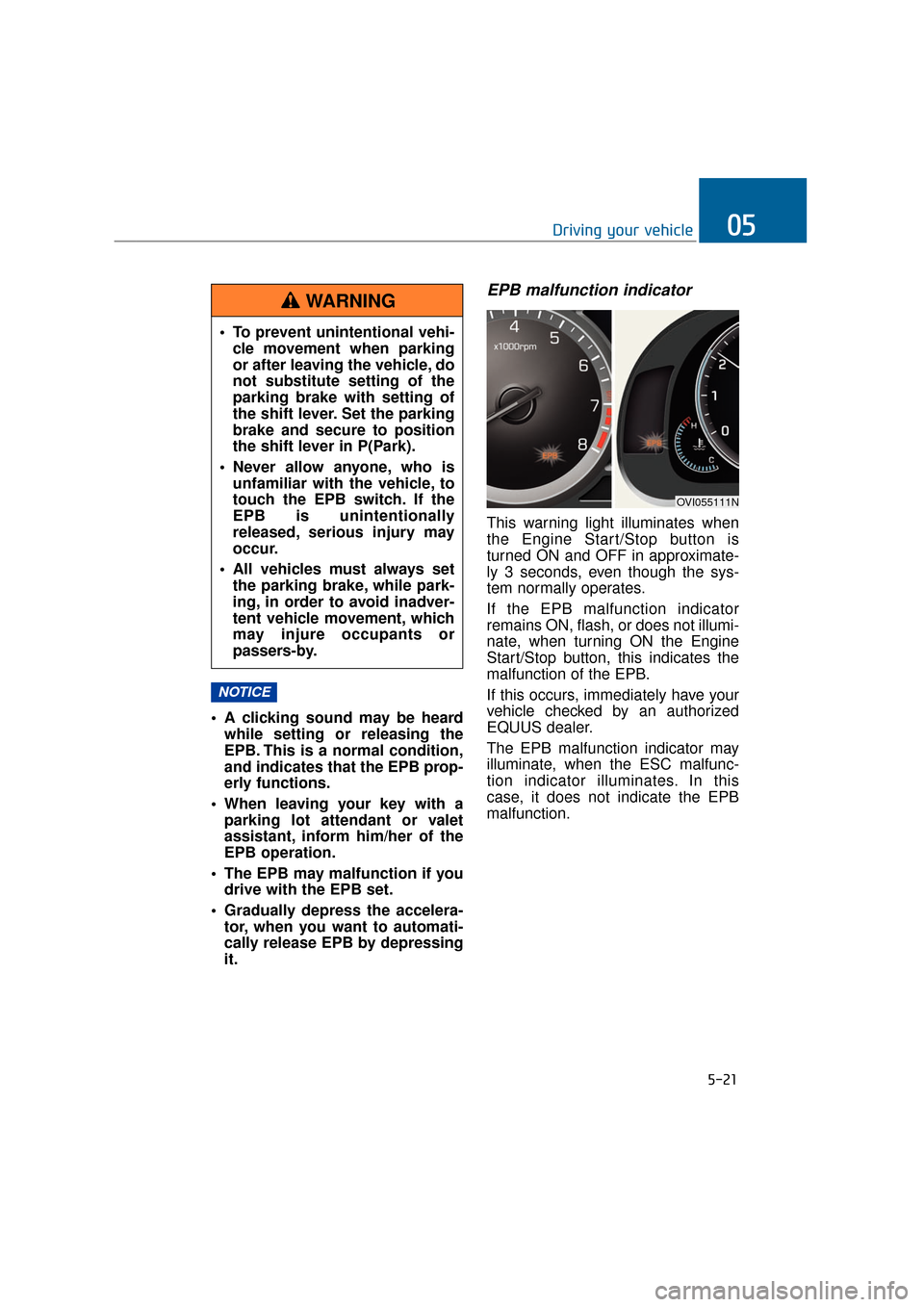
EPB malfunction indicator
This warning light illuminates when
the Engine Start/Stop button is
turned ON and OFF in approximate-
ly 3 seconds, even though the sys-
tem normally operates.
If the EPB malfunction indicator
remains ON, flash, or does not illumi-
nate, when turning ON the Engine
Start/Stop button, this indicates the
malfunction of the EPB.
If this occurs, immediately have your
vehicle checked by an authorized
EQUUS dealer.
The EPB malfunction indicator may
illuminate, when the ESC malfunc-
tion indicator illuminates. In this
case, it does not indicate the EPB
malfunction.
NOTICE
5-21
Driving your vehicle05
To prevent unintentional vehi-cle movement when parking
or after leaving the vehicle, do
not substitute setting of the
parking brake with setting of
the shift lever. Set the parking
brake and secure to position
the shift lever in P(Park).
Never allow anyone, who is unfamiliar with the vehicle, to
touch the EPB switch. If the
EPB is unintentionally
released, serious injury may
occur.
All vehicles must always set the parking brake, while park-
ing, in order to avoid inadver-
tent vehicle movement, which
may injure occupants or
passers-by.
WARNING
OVI055111N
Page 280 of 477
The ESC system is an electronic
system to help the driver maintain
vehicle control in adverse conditions.
It is not a substitute for safe driving
practices. Various factors, including
speed, road conditions and driver's
steering maneuver, affect the ESC
performance in preventing a loss of
control. It is still driver's responsibility
to drive and corner at a proper speed
and to keep a safe distance. When
depressing the brake under condi-
tions, which may lock the wheels,
you may hear a snapping sound and
feel like that from the brake pedal.
This is normal and indicates your
ESC actively operates.
Information
A clicking sound may be heard from
the engine compartment, when the
engine is started and the vehicle
begins to move. This is normal, indi-
cating that the ESC actively operates.
ESC operation
ESC ON condition
When the Engine Start/Stop button
is turned ON, the ESC and the ESC
OFF indicator lights illuminate for
approximately 3 seconds and goes
off, then the ESC is turned on.
When operating
When the ESC operates,
the ESC indicator will flash.
operates, you can feel a
slight pulsation from the
vehicle. This is because of
the brake control, and
does not indicate a prob-
lem.
mud or driving on a slip-
pery road, the engine rpm
may not be increased
even with the accelerator
deeply depressed. This is
to maintain the stability
and traction and does not
indicate a problem.
i
5-29
Driving your vehicle05
Page 281 of 477
ESC operation OFF
ESC OFF status
This vehicle has 2 types of
ESC OFF status.
When the engine stops, and
ESC is OFF, ESC remains
OFF.
Upon restarting the engine,
the ESC will be automatical-
ly turned ON again.
ESC OFF state 1
To cancel the ESC, press the ESC
OFF button shortly (ESC OFF
indicator (ESC OFF ) illuminates).
At this state, the engine control func-
tion does not operate. It signifies the
traction control function does not
operate, either. Only the brake con-
trol function operates.
ESC OFF state 2
To cancel ESC operation, press the
ESC OFF button (ESC OFF ) for
more than 3 seconds. ESC OFF indi-
cator (ESC OFF ) illuminates with
an ESC OFF warning alarm. At this
state, the engine control function and
brake control function do not oper-
ate. It signifies the vehicle stability
control function does not operate any
more.
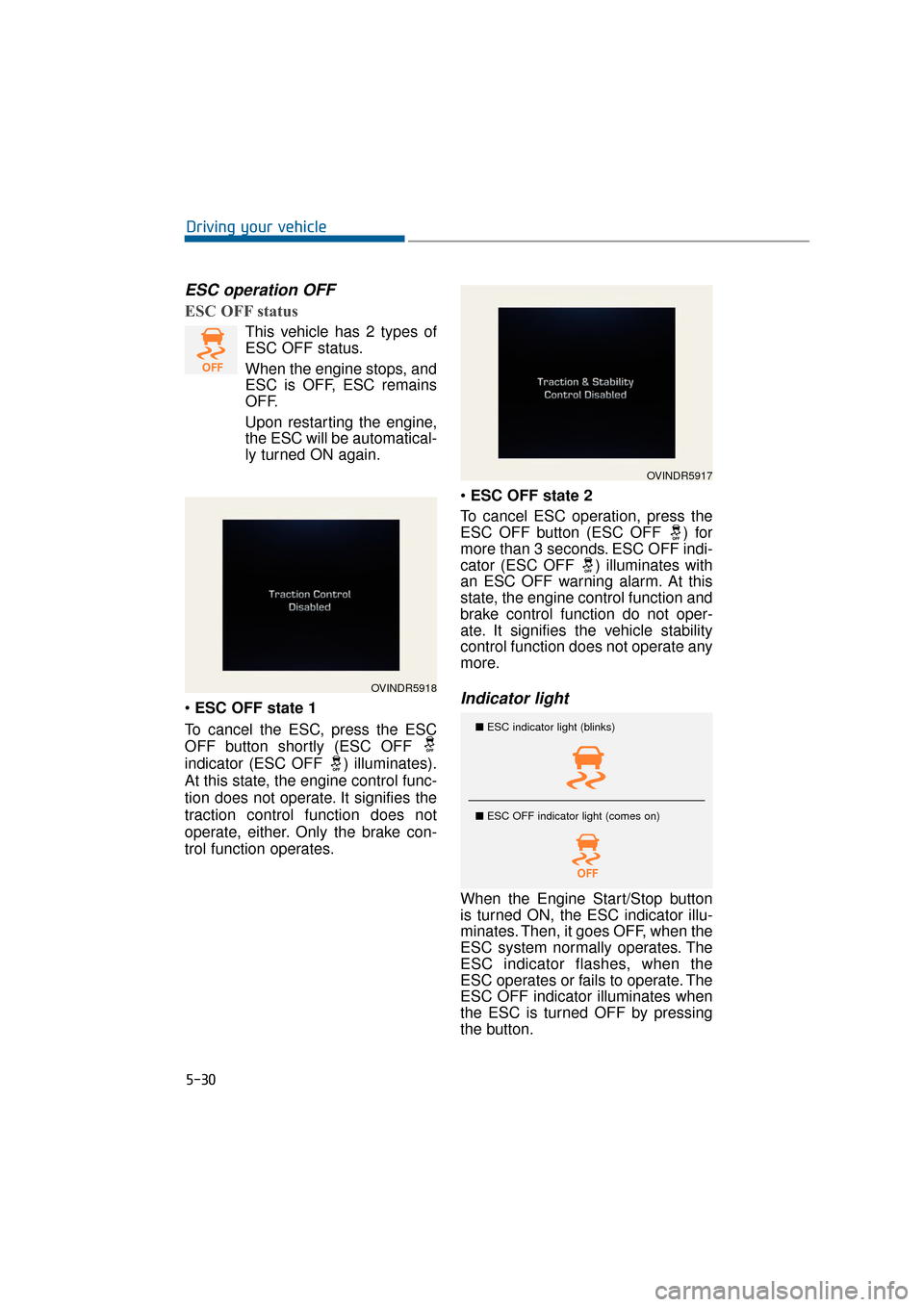
Indicator light
When the Engine Start/Stop button
is turned ON, the ESC indicator illu-
minates. Then, it goes OFF, when the
ESC system normally operates. The
ESC indicator flashes, when the
ESC operates or fails to operate. The
ESC OFF indicator illuminates when
the ESC is turned OFF by pressing
the button.
5-30
Driving your vehicle
OVINDR5917
OVINDR5918
■ ESC indicator light (blinks)
■ ESC OFF indicator light (comes on)