Starting Hyundai Genesis 2012 Owner's Guide
[x] Cancel search | Manufacturer: HYUNDAI, Model Year: 2012, Model line: Genesis, Model: Hyundai Genesis 2012Pages: 393, PDF Size: 8.81 MB
Page 296 of 393
What to do in an emergency
4 6
EMERGENCY STARTING
F040000ABH
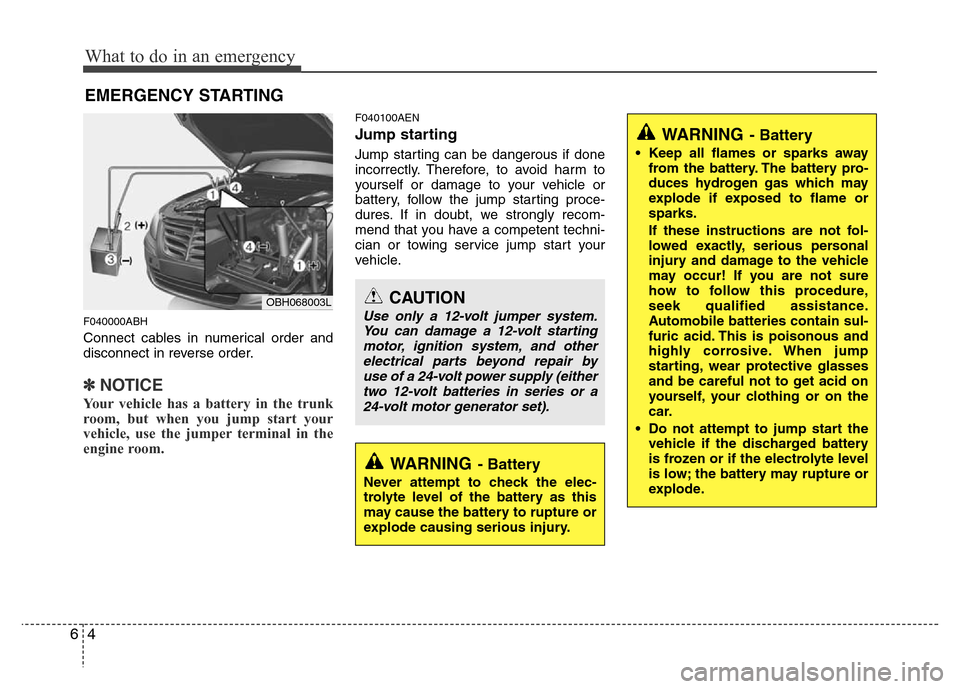
Connect cables in numerical order and
disconnect in reverse order.
✽NOTICE
Your vehicle has a battery in the trunk
room, but when you jump start your
vehicle, use the jumper terminal in the
engine room.
F040100AEN
Jump starting
Jump starting can be dangerous if done
incorrectly. Therefore, to avoid harm to
yourself or damage to your vehicle or
battery, follow the jump starting proce-
dures. If in doubt, we strongly recom-
mend that you have a competent techni-
cian or towing service jump start your
vehicle.
CAUTION
Use only a 12-volt jumper system.
You can damage a 12-volt starting
motor, ignition system, and other
electrical parts beyond repair by
use of a 24-volt power supply (either
two 12-volt batteries in series or a
24-volt motor generator set).
WARNING- Battery
• Keep all flames or sparks away
from the battery. The battery pro-
duces hydrogen gas which may
explode if exposed to flame or
sparks.
If these instructions are not fol-
lowed exactly, serious personal
injury and damage to the vehicle
may occur! If you are not sure
how to follow this procedure,
seek qualified assistance.
Automobile batteries contain sul-
furic acid. This is poisonous and
highly corrosive. When jump
starting, wear protective glasses
and be careful not to get acid on
yourself, your clothing or on the
car.
• Do not attempt to jump start the
vehicle if the discharged battery
is frozen or if the electrolyte level
is low; the battery may rupture or
explode.
WARNING- Battery
Never attempt to check the elec-
trolyte level of the battery as this
may cause the battery to rupture or
explode causing serious injury.
OBH068003L
Page 297 of 393
65
What to do in an emergency
F040101ABH
Jump starting procedure
✽NOTICE
Your vehicle has a battery in the trunk
room, but when you jump start your
vehicle, use the jumper terminal in the
engine room.
1. Make sure the booster battery is 12-
volt and that its negative terminal is
grounded.
2. If the booster battery is in another
vehicle, do not allow the vehicles to
touch.
3. Turn off all unnecessary electrical
loads.
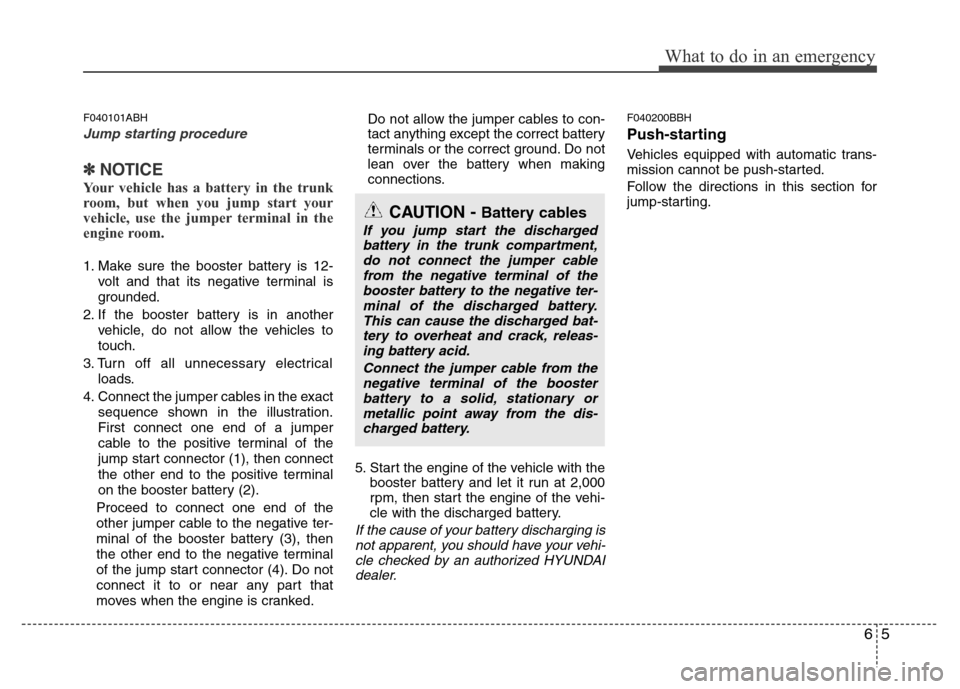
4. Connect the jumper cables in the exact
sequence shown in the illustration.
First connect one end of a jumper
cable to the positive terminal of the
jump start connector (1), then connect
the other end to the positive terminal
on the booster battery (2).
Proceed to connect one end of the
other jumper cable to the negative ter-
minal of the booster battery (3), then
the other end to the negative terminal
of the jump start connector (4). Do not
connect it to or near any part that
moves when the engine is cranked.Do not allow the jumper cables to con-
tact anything except the correct battery
terminals or the correct ground. Do not
lean over the battery when making
connections.
5. Start the engine of the vehicle with the
booster battery and let it run at 2,000
rpm, then start the engine of the vehi-
cle with the discharged battery.
If the cause of your battery discharging is
not apparent, you should have your vehi-
cle checked by an authorized HYUNDAI
dealer.
F040200BBH
Push-starting
Vehicles equipped with automatic trans-
mission cannot be push-started.
Follow the directions in this section for
jump-starting.
CAUTION - Battery cables
If you jump start the discharged
battery in the trunk compartment,
do not connect the jumper cable
from the negative terminal of the
booster battery to the negative ter-
minal of the discharged battery.
This can cause the discharged bat-
tery to overheat and crack, releas-
ing battery acid.
Connect the jumper cable from the
negative terminal of the booster
battery to a solid, stationary or
metallic point away from the dis-
charged battery.
Page 303 of 393
611
What to do in an emergency
The spare tire is not equipped with a
tire pressure monitoring sensor.
When the low pressure tire is
replaced with the spare tire, the low
tire pressure and the low tire pres-
sure position telltales may extinguish
and the TPMS malfunction indicator
may illuminate after restarting and
within 20 minutes continuous driving.
The TPMS malfunction indicator may
remain on until the original tire
equipped with a tire monitoring sen-
sor is reinflated to the recommended
pressure and reinstalled on the vehi-
cle then driving for a few minutes.
Once the low pressure tire is re-
inflated to the recommended pres-
sure and installed on the vehicle, the
TPMS malfunction indicator and the
low tire pressure and position tell-
tales will extinguish within a few min-
utes of driving.
If the indicators are not extinguished
after a few minutes, please visit an
authorized HYUNDAI dealer.You may not be able identify a low
tire by simply looking at it. Always
use a good quality tire pressure
gauge to measure the tire's inflation
pressure. Please note that a tire that
is hot (from being driven) will have a
higher pressure measurement than a
tire that is cold (from sitting station-
ary for at least 3 hours and driven
less than 1.6km (1 mile) during that 3
hour period).
Allow the tire to cool before measur-
ing the inflation pressure. Always be
sure the tire is cold before inflating to
the recommended pressure.
A cold tire means the vehicle has
been sitting for 3 hours and driven for
less than 1.6km (1 mile) in that 3
hour period.CAUTION
• Do not use any tire sealant if
your vehicle is equipped with
a Tire Pressure Monitoring
System. The liquid sealant can
damage the tire pressure sen-
sors.
• In order to correctly monitor
the tires with inflation, the 4
tire pressure monitoring sen-
sors should be exactly fitted
to each of the 4 driven wheel.
There should be no other sen-
sors in the vehicle include
spare tire, it may cause the
system couldn’t monitor the
tires with inflation correctly.
Page 326 of 393
Maintenance
8 7
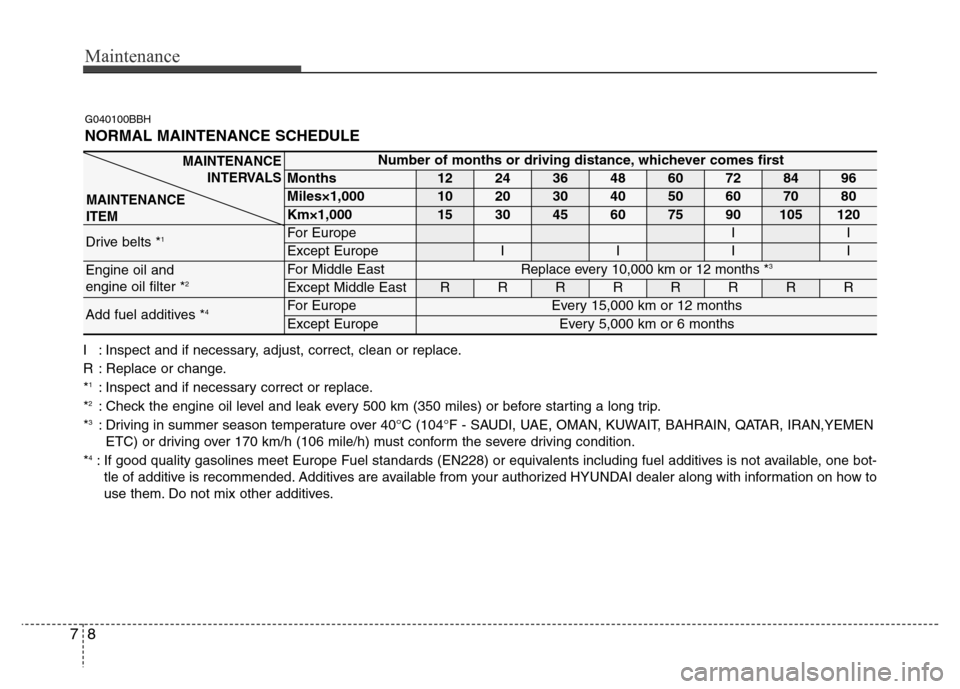
I : Inspect and if necessary, adjust, correct, clean or replace.
R : Replace or change.
*
1: Inspect and if necessary correct or replace.
*2: Check the engine oil level and leak every 500 km (350 miles) or before starting a long trip.
*3: Driving in summer season temperature over 40°C (104°F - SAUDI, UAE, OMAN, KUWAIT, BAHRAIN, QATAR, IRAN,YEMEN
ETC) or driving over 170 km/h (106 mile/h) must conform the severe driving condition.
*
4: If good quality gasolines meet Europe Fuel standards (EN228) or equivalents including fuel additives is not available, one bot-
tle of additive is recommended. Additives are available from your authorized HYUNDAI dealer along with information on how to
use them. Do not mix other additives.
G040100BBH
NORMAL MAINTENANCE SCHEDULE
Number of months or driving distance, whichever comes first
Months1224364860728496
Miles×1,0001020304050607080
Km×1,000153045607590105120
Drive belts *1For EuropeII
Except EuropeIIII
Engine oil and
engine oil filter *2For Middle EastReplace every 10,000 km or 12 months *3
Except Middle EastRRRRRRRR
Add fuel additives *4For EuropeEvery 15,000 km or 12 months
Except EuropeEvery 5,000 km or 6 months
MAINTENANCE
INTERVALS
MAINTENANCE
ITEM
Page 332 of 393
Maintenance
14 7
EXPLANATION OF SCHEDULED MAINTENANCE ITEMS
G050100AUN
Engine oil and filter
The engine oil and filter should be
changed at the intervals specified in the
maintenance schedule. If the car is being
driven in severe conditions, more fre-
quent oil and filter changes are required.
G050200AUN
Drive belts
Inspect all drive belts for evidence of
cuts, cracks, excessive wear or oil satu-
ration and replace if necessary.
G050300ABH
Fuel filter
A clogged filter can limit the speed at
which the vehicle may be driven, damage
the emission system and cause multiple
issues such as hard starting. If an exces-
sive amount of foreign matter accumu-
lates in the fuel tank, the filter may
require replacement more frequently.
After installing a new filter, run the engine
for several minutes, and check for leaks
at the connections. Fuel filters should be
installed by an authorized HYUNDAI
dealer.
G050400ABH
Fuel lines, fuel hoses and con-
nections
Check the fuel lines, fuel hoses and con-
nections for leakage and damage. Have
an authorized HYUNDAI dealer replace
any damaged or leaking parts immedi-
ately.
G050600AUN
Vapor hose and fuel filler cap
The vapor hose and fuel filler cap should
be inspected at those intervals specified
in the maintenance schedule. Make sure
that a new vapor hose or fuel filler cap is
correctly replaced.
G050700AUN
Vacuum crankcase ventilation
hoses (if equipped)
Inspect the surface of hoses for evidence
of heat and/or mechanical damage. Hard
and brittle rubber, cracking, tears, cuts,
abrasions, and excessive swelling indi-
cate deterioration. Particular attention
should be paid to examine those hose
surfaces nearest to high heat sources,
such as the exhaust manifold.
Inspect the hose routing to assure that
the hoses do not come in contact with
any heat source, sharp edges or moving
component which might cause heat dam-
age or mechanical wear. Inspect all hose
connections, such as clamps and cou-
plings, to make sure they are secure, and
that no leaks are present. Hoses should
be replaced immediately if there is any
evidence of deterioration or damage.