hold Hyundai Genesis 2012 Owner's Manual
[x] Cancel search | Manufacturer: HYUNDAI, Model Year: 2012, Model line: Genesis, Model: Hyundai Genesis 2012Pages: 393, PDF Size: 8.81 MB
Page 10 of 393
15
Introduction
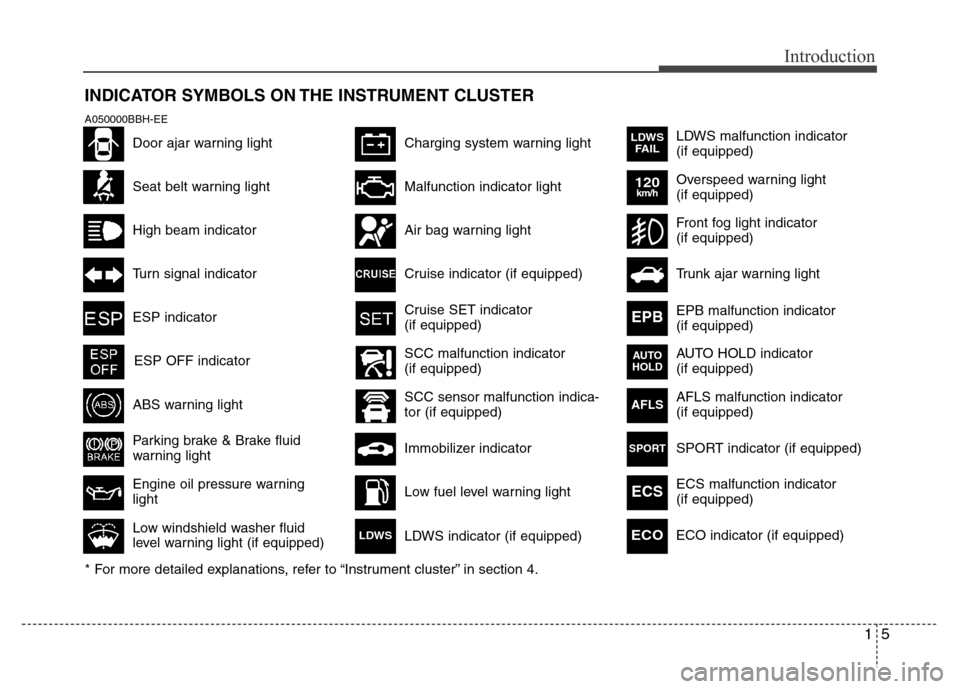
INDICATOR SYMBOLS ON THE INSTRUMENT CLUSTER
Seat belt warning light
High beam indicator
Turn signal indicator
ABS warning light
Parking brake & Brake fluid
warning light
Engine oil pressure warning
light
ESP indicator
ESP OFF indicator
Malfunction indicator light
Air bag warning light
Cruise indicator (if equipped)
Cruise SET indicator
(if equipped)
SCC malfunction indicator
(if equipped)
SCC sensor malfunction indica-
tor (if equipped)
Immobilizer indicator
Low fuel level warning light
Charging system warning light
Low windshield washer fluid
level warning light (if equipped)
A050000BBH-EE
Door ajar warning light
Overspeed warning light
(if equipped)
120km/h
AFLS malfunction indicator
(if equipped)
ECS malfunction indicator
(if equipped)
Trunk ajar warning light
Front fog light indicator
(if equipped)
AFLS
ECS
EPB malfunction indicator
(if equipped)
AUTO HOLD indicator
(if equipped)EPB
AUTO
HOLD
LDWS indicator (if equipped)LDWS
LDWS malfunction indicator
(if equipped)LDWS
FAIL
SPORT indicator (if equipped)SPORT
ECO indicator (if equipped)ECO
* For more detailed explanations, refer to “Instrument cluster” in section 4.
Page 13 of 393
Your vehicle at a glance
2 2
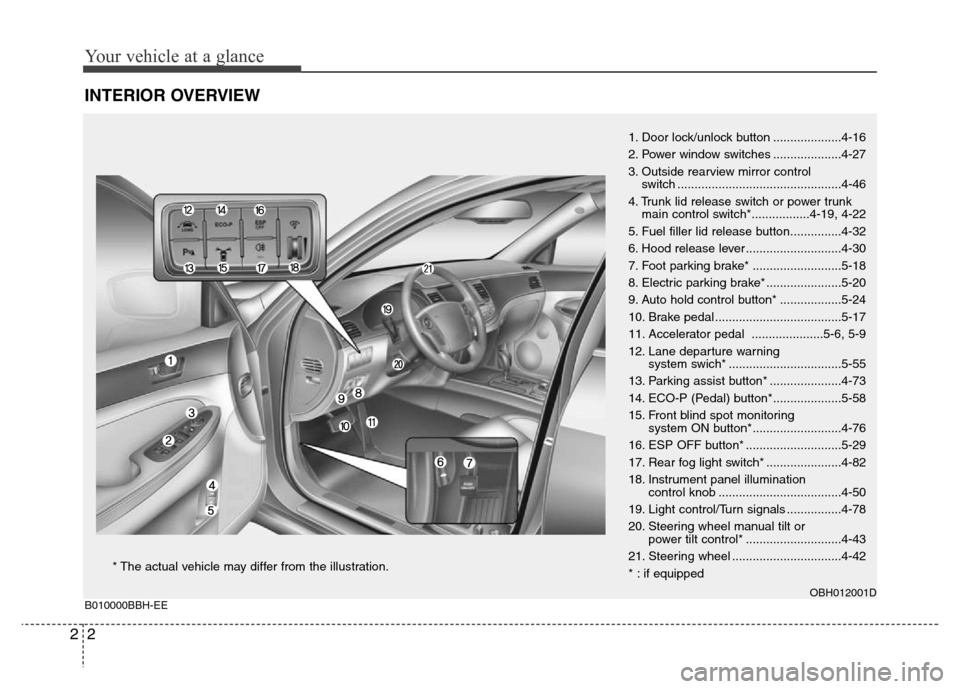
INTERIOR OVERVIEW
1. Door lock/unlock button ....................4-16
2. Power window switches ....................4-27
3. Outside rearview mirror control
switch ................................................4-46
4. Trunk lid release switch or power trunk
main control switch*.................4-19, 4-22
5. Fuel filler lid release button...............4-32
6. Hood release lever ............................4-30
7. Foot parking brake* ..........................5-18
8. Electric parking brake* ......................5-20
9. Auto hold control button* ..................5-24
10. Brake pedal .....................................5-17
11. Accelerator pedal .....................5-6, 5-9
12. Lane departure warning
system swich* .................................5-55
13. Parking assist button* .....................4-73
14. ECO-P (Pedal) button*....................5-58
15. Front blind spot monitoring
system ON button*..........................4-76
16. ESP OFF button* ............................5-29
17. Rear fog light switch* ......................4-82
18. Instrument panel illumination
control knob ....................................4-50
19. Light control/Turn signals ................4-78
20. Steering wheel manual tilt or
power tilt control* ............................4-43
21. Steering wheel ................................4-42
* : if equipped
OBH012001DB010000BBH-EE
* The actual vehicle may differ from the illustration.
Page 22 of 393
Safety features of your vehicle
6 3
C010104ABH
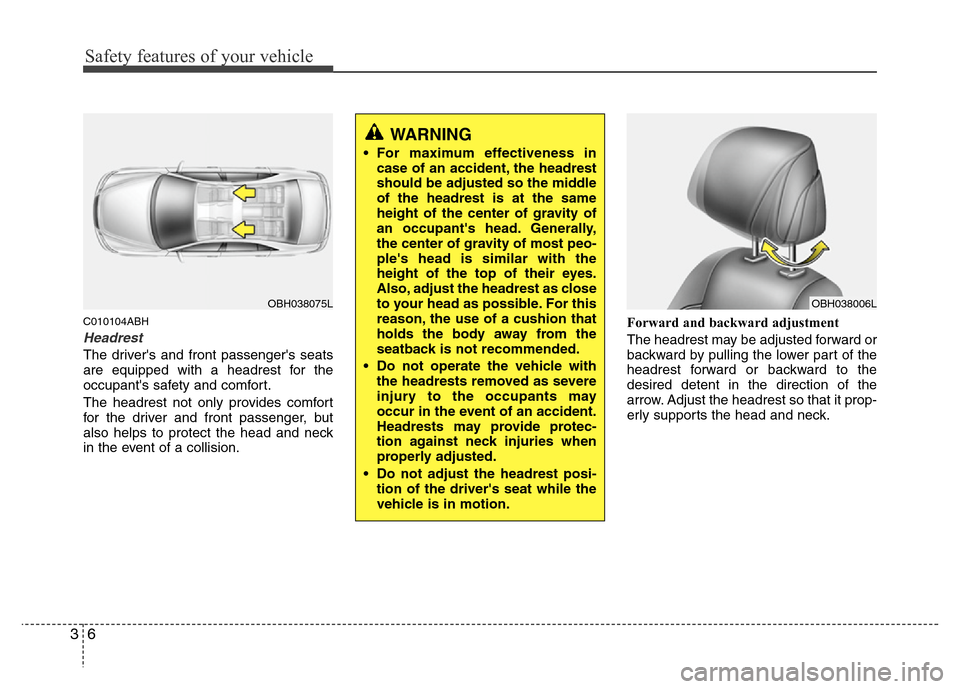
Headrest
The driver's and front passenger's seats
are equipped with a headrest for the
occupant's safety and comfort.
The headrest not only provides comfort
for the driver and front passenger, but
also helps to protect the head and neck
in the event of a collision.Forward and backward adjustment
The headrest may be adjusted forward or
backward by pulling the lower part of the
headrest forward or backward to the
desired detent in the direction of the
arrow. Adjust the headrest so that it prop-
erly supports the head and neck.
OBH038075LOBH038006L
WARNING
• For maximum effectiveness in
case of an accident, the headrest
should be adjusted so the middle
of the headrest is at the same
height of the center of gravity of
an occupant's head. Generally,
the center of gravity of most peo-
ple's head is similar with the
height of the top of their eyes.
Also, adjust the headrest as close
to your head as possible. For this
reason, the use of a cushion that
holds the body away from the
seatback is not recommended.
• Do not operate the vehicle with
the headrests removed as severe
injury to the occupants may
occur in the event of an accident.
Headrests may provide protec-
tion against neck injuries when
properly adjusted.
• Do not adjust the headrest posi-
tion of the driver's seat while the
vehicle is in motion.
Page 23 of 393
37
Safety features of your vehicle
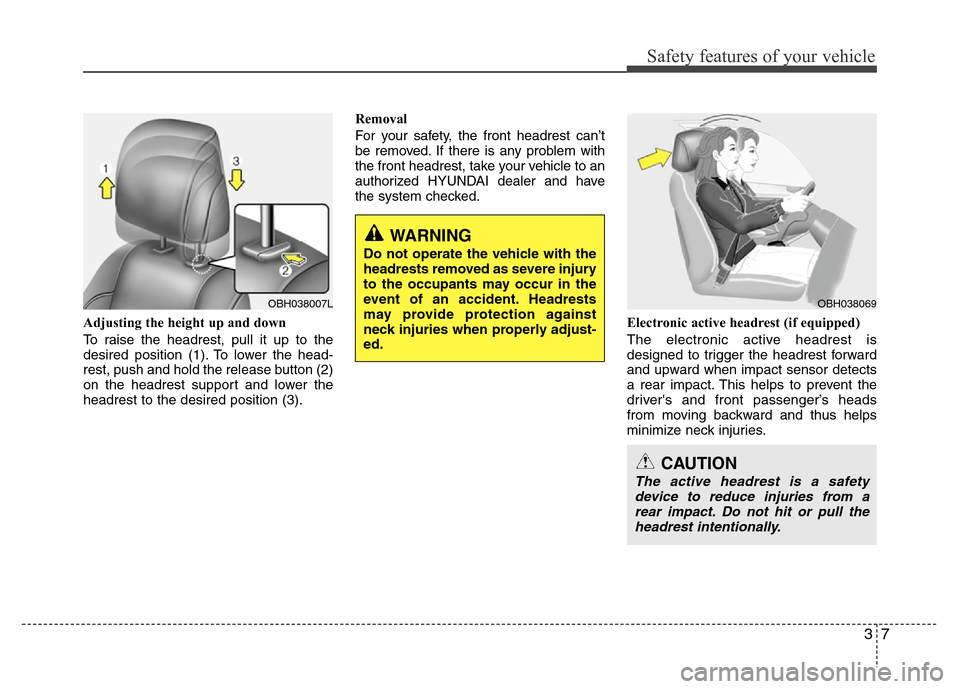
Adjusting the height up and down
To raise the headrest, pull it up to the
desired position (1). To lower the head-
rest, push and hold the release button (2)
on the headrest support and lower the
headrest to the desired position (3).Removal
For your safety, the front headrest can’t
be removed. If there is any problem with
the front headrest, take your vehicle to an
authorized HYUNDAI dealer and have
the system checked.
Electronic active headrest (if equipped)
The electronic active headrest is
designed to trigger the headrest forward
and upward when impact sensor detects
a rear impact. This helps to prevent the
driver's and front passenger’s heads
from moving backward and thus helps
minimize neck injuries.
OBH038007L
WARNING
Do not operate the vehicle with the
headrests removed as severe injury
to the occupants may occur in the
event of an accident. Headrests
may provide protection against
neck injuries when properly adjust-
ed.
OBH038069
CAUTION
The active headrest is a safety
device to reduce injuries from a
rear impact. Do not hit or pull the
headrest intentionally.
Page 28 of 393
Safety features of your vehicle
12 3
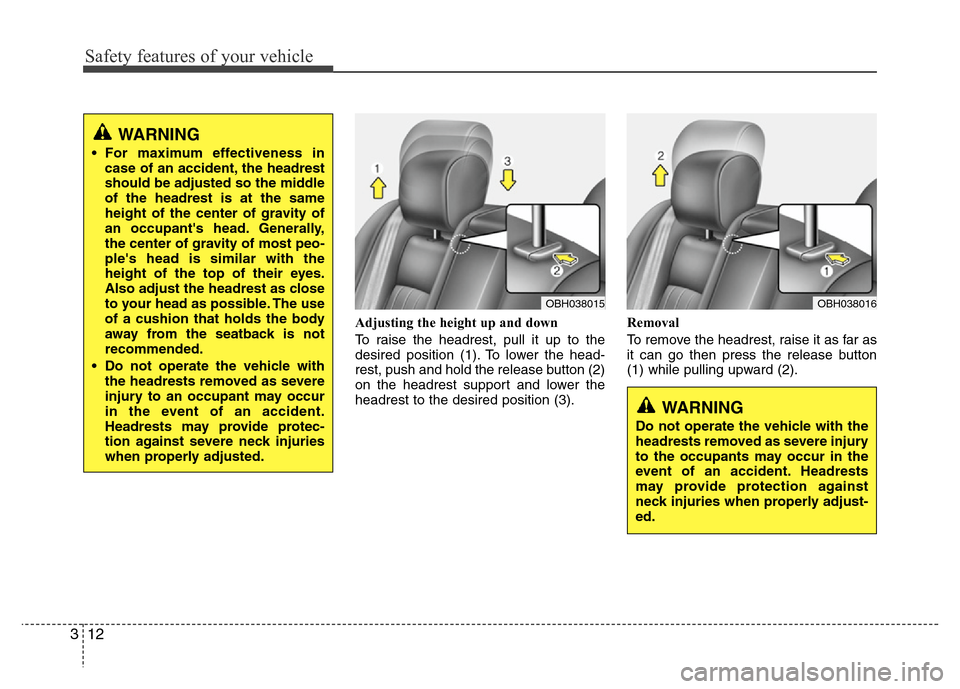
Adjusting the height up and down
To raise the headrest, pull it up to the
desired position (1). To lower the head-
rest, push and hold the release button (2)
on the headrest support and lower the
headrest to the desired position (3).Removal
To remove the headrest, raise it as far as
it can go then press the release button
(1) while pulling upward (2).
WARNING
• For maximum effectiveness in
case of an accident, the headrest
should be adjusted so the middle
of the headrest is at the same
height of the center of gravity of
an occupant's head. Generally,
the center of gravity of most peo-
ple's head is similar with the
height of the top of their eyes.
Also adjust the headrest as close
to your head as possible. The use
of a cushion that holds the body
away from the seatback is not
recommended.
• Do not operate the vehicle with
the headrests removed as severe
injury to an occupant may occur
in the event of an accident.
Headrests may provide protec-
tion against severe neck injuries
when properly adjusted.
OBH038015OBH038016
WARNING
Do not operate the vehicle with the
headrests removed as severe injury
to the occupants may occur in the
event of an accident. Headrests
may provide protection against
neck injuries when properly adjust-
ed.
Page 30 of 393
Safety features of your vehicle
14 3
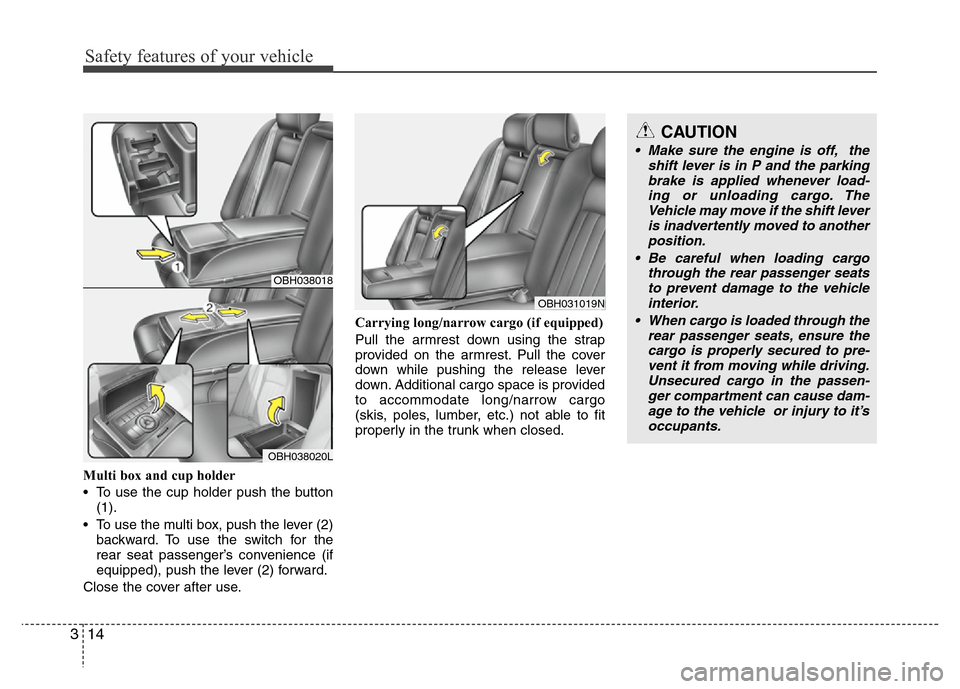
Multi box and cup holder
• To use the cup holder push the button
(1).
• To use the multi box, push the lever (2)
backward. To use the switch for the
rear seat passenger’s convenience (if
equipped), push the lever (2) forward.
Close the cover after use.Carrying long/narrow cargo (if equipped)
Pull the armrest down using the strap
provided on the armrest. Pull the cover
down while pushing the release lever
down. Additional cargo space is provided
to accommodate long/narrow cargo
(skis, poles, lumber, etc.) not able to fit
properly in the trunk when closed.
OBH038018
OBH038020L
OBH031019N
CAUTION
• Make sure the engine is off, the
shift lever is in P and the parking
brake is applied whenever load-
ing or unloading cargo. The
Vehicle may move if the shift lever
is inadvertently moved to another
position.
• Be careful when loading cargo
through the rear passenger seats
to prevent damage to the vehicle
interior.
• When cargo is loaded through the
rear passenger seats, ensure the
cargo is properly secured to pre-
vent it from moving while driving.
Unsecured cargo in the passen-
ger compartment can cause dam-
age to the vehicle or injury to it’s
occupants.
Page 41 of 393
325
Safety features of your vehicle
C020300AUN
Seat belt precautions
C020306AUN
Infant or small child
You should be aware of the specific
requirements in your country. Child
and/or infant seats must be properly
placed and installed in the rear seat. For
more information about the use of these
restraints, refer to “Child restraint sys-
tem” in this section.
WARNING
All occupants of the vehicle must
wear their seat belts at all times.
Seat belts and child restraints
reduce the risk of serious or fatal
injuries for all occupants in the
event of a collision or sudden stop.
Without a seat belt, occupants
could be shifted too close to a
deploying air bag, strike the interior
structure or be thrown from the
vehicle. Properly worn seat belts
greatly reduce these hazards.
Always follow the precautions
about seat belts, air bags and occu-
pant seating contained in this man-
ual.
(Continued)
• Improper handling of the pre-ten-
sioner seat belt assemblies, and
failure to heed the warnings not
to strike, modify, inspect, replace,
service or repair the pre-tension-
er seat belt assemblies may lead
to improper operation or inadver-
tent activation and serious injury.
• Always wear the seat belts when
driving or riding in a motor vehi-
cle.
• If the vehicle or pre-tensioner
seat belt must be discarded, con-
tact an authorized HYUNDAI deal-
er.
WARNING
Every person in your vehicle needs
to be properly restrained at all
times, including infants and chil-
dren. Never hold a child in your
arms or lap when riding in a vehi-
cle. The violent forces created dur-
ing a crash will tear the child from
your arms and throw the child
against the interior. Always use a
child restraint appropriate for your
child's height and weight.
Page 45 of 393
329
Safety features of your vehicle
CHILD RESTRAINT SYSTEM
C030000AEN
Children riding in the car should sit in the
rear seat and must always be properly
restrained to minimize the risk of injury in
an accident, sudden stop or sudden
maneuver. According to accident statis-
tics, children are safer when properly
restrained in the rear seats than in the
front seat. Larger children not in a child
restraint should use one of the seat belts
provided. You should be aware of the
specific requirements in your country.
Child and/or infant safety seats must be
properly placed and installed in the rear
seat. You must use a commercially avail-
able child restraint system that meets the
requirements of the Safety Standards of
your country.
Child restraint systems are designed to
be secured in vehicle seats by lap belts
or the lap belt portion of a lap/shoulder
belt, or by a tether anchor and/or ISOFIX
anchors (if equipped).
Children could be injured or killed in a
crash if their restraints are not properly
secured. For small children and babies, a
child seat or infant seat must be used.
Before buying a particular child restraint
system, make sure it fits your car seat
and seat belts, and fits your child. Follow
all the instructions provided by the man-
ufacturer when installing the child
restraint system.WARNING
• A child restraint system must be
placed in the rear seat. Never
install a child or infant seat on the
front passenger's seat. Should an
accident occur and cause the
passenger-side air bag to deploy,
it could severely injure or kill an
infant or child seated in an infant
or child seat. Thus only use a
child restraint in the rear seat of
your vehicle.
• A seat belt or child restraint sys-
tem can become very hot if it is
left in a closed vehicle on a sunny
day, even if the outside tempera-
ture does not feel hot. Be sure to
check the seat cover and buckles
before placing a child there.
• When the child restraint system
is not in use, store it in the lug-
gage area or fasten it with a seat
belt so that it will not be thrown
forward in the case of a sudden
stop or an accident.
• Children may be seriously injured
or killed by an inflating air bag.
All children, even those too large
for child restraints, must ride in
the rear seat.
WARNING
To reduce the chance of serious or
fatal injuries:
• Children of all ages are safer
when restrained in the rear seat.
A child riding in the front passen-
ger seat can be forcefully struck
by an inflating air bag resulting in
serious or fatal injuries.
• Always follow the child restraint
system manufacturer’s instruc-
tions for installation and use of
the child restraint.
• Always make sure the child seat
is secured properly in the car and
your child is securely restrained
in the child seat.
• Never hold a child in your arms or
lap when riding in a vehicle. The
violent forces created during a
crash will tear the child from your
arms and throw the child against
the car’s interior.
• Never put a seat belt over your-
self and a child. During a crash,
the belt could press deep into the
child causing serious internal
injuries.
(Continued)
Page 47 of 393
331
Safety features of your vehicle
For safety reasons, we recommend that
the child restraint system be used in the
rear seats.
C030101AUN
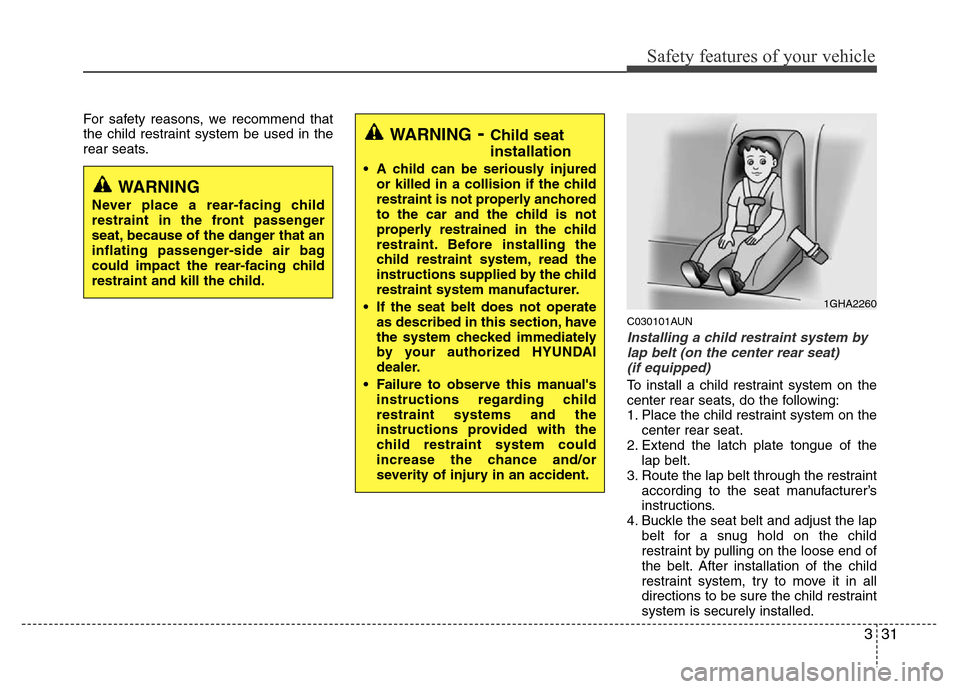
Installing a child restraint system by
lap belt (on the center rear seat)
(if equipped)
To install a child restraint system on the
center rear seats, do the following:
1. Place the child restraint system on the
center rear seat.
2. Extend the latch plate tongue of the
lap belt.
3. Route the lap belt through the restraint
according to the seat manufacturer’s
instructions.
4. Buckle the seat belt and adjust the lap
belt for a snug hold on the child
restraint by pulling on the loose end of
the belt. After installation of the child
restraint system, try to move it in all
directions to be sure the child restraint
system is securely installed.
WARNING
Never place a rear-facing child
restraint in the front passenger
seat, because of the danger that an
inflating passenger-side air bag
could impact the rear-facing child
restraint and kill the child.
WARNING- Child seat
installation
• A child can be seriously injured
or killed in a collision if the child
restraint is not properly anchored
to the car and the child is not
properly restrained in the child
restraint. Before installing the
child restraint system, read the
instructions supplied by the child
restraint system manufacturer.
• If the seat belt does not operate
as described in this section, have
the system checked immediately
by your authorized HYUNDAI
dealer.
• Failure to observe this manual's
instructions regarding child
restraint systems and the
instructions provided with the
child restraint system could
increase the chance and/or
severity of injury in an accident.
1GHA2260
Page 49 of 393
333
Safety features of your vehicle
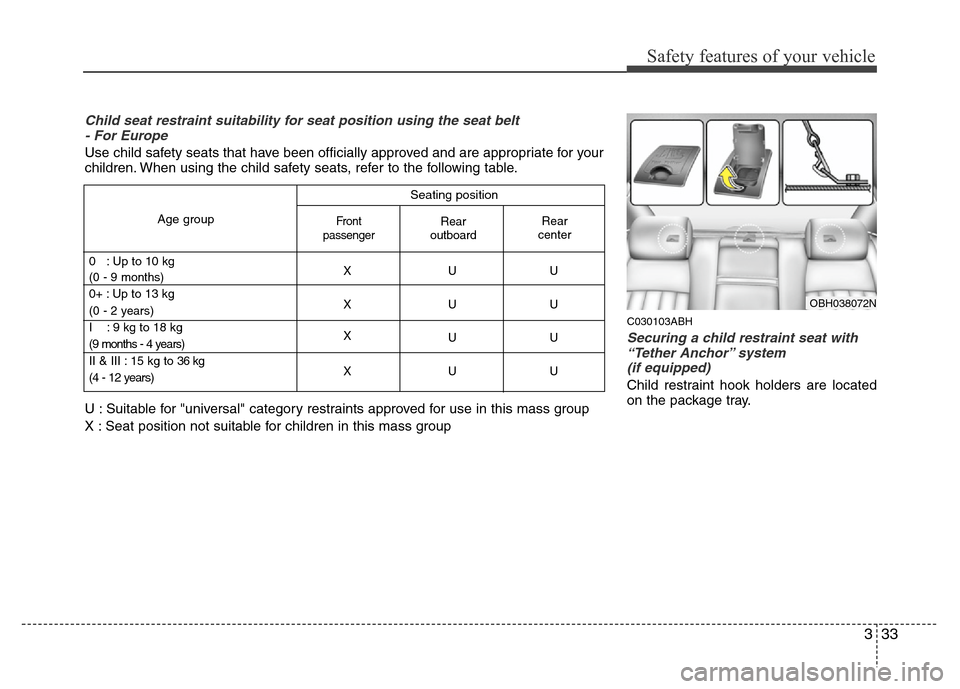
C030103ABH
Securing a child restraint seat with
“Tether Anchor” system
(if equipped)
Child restraint hook holders are located
on the package tray.
OBH038072N
Seating position
Age group
0 : Up to 10 kg
XUU
(0 - 9 months)
0+ : Up to 13 kg
XUU
(0 - 2 years)
I : 9 kg to 18 kg
X
UU
(9 months - 4 years)
II & III : 15 kg to 36 kg
XUU
(4 - 12 years)
Front
passengerRear
outboardRear
center
Child seat restraint suitability for seat position using the seat belt
- For Europe
Use child safety seats that have been officially approved and are appropriate for your
children. When using the child safety seats, refer to the following table.
U : Suitable for "universal" category restraints approved for use in this mass group
X : Seat position not suitable for children in this mass group