inter Hyundai Genesis Coupe 2013 Workshop Manual
[x] Cancel search | Manufacturer: HYUNDAI, Model Year: 2013, Model line: Genesis Coupe, Model: Hyundai Genesis Coupe 2013Pages: 414, PDF Size: 38.89 MB
Page 283 of 414
Driving your vehicle
48
5
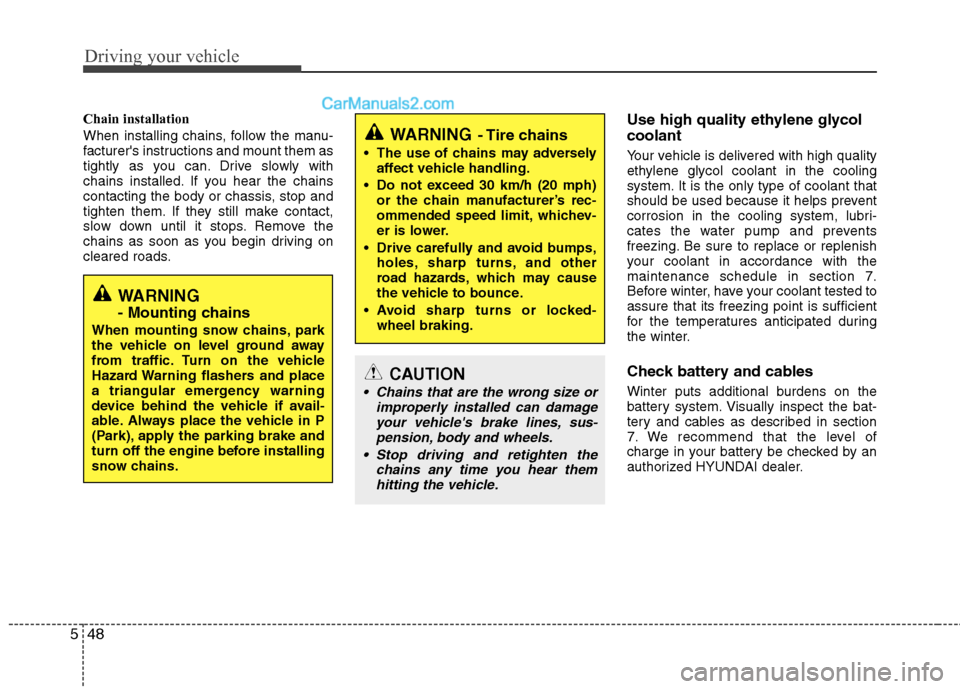
Chain installation
When installing chains, follow the manu-
facturer's instructions and mount them as
tightly as you can. Drive slowly with
chains installed. If you hear the chains
contacting the body or chassis, stop and
tighten them. If they still make contact,
slow down until it stops. Remove the
chains as soon as you begin driving on
cleared roads. Use high quality ethylene glycol coolant
Your vehicle is delivered with high quality
ethylene glycol coolant in the cooling
system. It is the only type of coolant that
should be used because it helps prevent
corrosion in the cooling system, lubri-
cates the water pump and prevents
freezing. Be sure to replace or replenish
your coolant in accordance with themaintenance schedule in section 7.
Before winter, have your coolant tested toassure that its freezing point is sufficient
for the temperatures anticipated during
the winter.
Check battery and cables
Winter puts additional burdens on the
battery system. Visually inspect the bat-
tery and cables as described in section
7. We recommend that the level of
charge in your battery be checked by an
authorized HYUNDAI dealer.
WARNING
- Mounting chains
When mounting snow chains, park
the vehicle on level ground away
from traffic. Turn on the vehicle
Hazard Warning flashers and place
a triangular emergency warning
device behind the vehicle if avail-
able. Always place the vehicle in P
(Park), apply the parking brake and
turn off the engine before installing
snow chains.
WARNING - Tire chains
The use of chains may adversely affect vehicle handling.
Do not exceed 30 km/h (20 mph) or the chain manufacturer’s rec-
ommended speed limit, whichev-
er is lower.
Drive carefully and avoid bumps, holes, sharp turns, and other
road hazards, which may cause
the vehicle to bounce.
Avoid sharp turns or locked- wheel braking.
CAUTION
Chains that are the wrong size or
improperly installed can damage
your vehicle's brake lines, sus-pension, body and wheels.
Stop driving and retighten the chains any time you hear themhitting the vehicle.
Page 284 of 414
549
Driving your vehicle
Change to "winter weight" oil if
necessary In some climates it is recommended that
a lower viscosity "winter weight" oil be
used during cold weather. See section 8
for recommendations. If you aren't sure
what weight oil you should use, we rec-
ommend that you consult an authorized
HYUNDAI dealer.
Check spark plugs and ignition system
Inspect your spark plugs as described in
section 7 and replace them if necessary.
Also check all ignition wiring and compo-
nents to be sure they are not cracked,
worn or damaged in any way.
To keep locks from freezing
To keep the locks from freezing, squirt an
approved de-icer fluid or glycerine into
the key opening. If a lock is covered with
ice, squirt it with an approved de-icing
fluid to remove the ice. If the lock is
frozen internally, you may be able to thaw
it out by using a heated key. Handle the
heated key with care to avoid injury.Use approved window washer
anti-freeze in system
To keep the water in the window washer
system from freezing, add an approved
window washer anti-freeze solution in
accordance with instructions on the con-
tainer. Window washer anti-freeze is
available from an authorized HYUNDAI
dealer and most auto parts outlets. Donot use engine coolant or other types of
anti-freeze as these may damage thepaint finish.
Don't let your parking brake
freeze
Under some conditions your parking
brake can freeze in the engaged position.
This is most likely to happen when there
is an accumulation of snow or ice around
or near the rear brakes or if the brakes
are wet. If there is a risk the parking
brake may freeze, apply it only temporar-
ily while you put the gear shift lever in P
and block the rear wheels so the car can-
not roll. Then release the parking brake.
Don't let ice and snow accumu- late underneath
Under some conditions, snow and ice
can build up under the fenders and inter-
fere with the steering. When driving in
severe winter conditions where this may
happen, you should periodically check
underneath the car to be sure the move-
ment of the front wheels and the steering
components is not obstructed.
Carry emergency equipment
Depending on the severity of the weath-
er where you drive your car, you should
carry appropriate emergency equipment.
Some of the items you may want to carry
include tire chains, tow straps or chains,
flashlight, emergency flares, sand, a
shovel, jumper cables, a window scraper,
gloves, ground cloth, coveralls, a blanket,etc.
Page 290 of 414
What to do in an emergency
4
6
IF THE ENGINE WILL NOT START
If engine doesn't turn over or
turns over slowly
1. If your vehicle has an automatic trans- mission, be sure the gear selector
lever is in N(Neutral) or P(Park) and
the emergency brake is set.
2. Check the battery connections to be sure they are clean and tight.
3. Turn on the interior light. If the light dims or goes out when you operate the
starter, the battery is discharged.
4. Check the starter connections to be sure they are securely tightened.
5. Do not push or pull the vehicle to start it. See instructions for "Jump starting". If the engine turns over normally
but does not start
1. Check fuel level.
2. With the ignition switch in the LOCK
position, check all connectors at the
ignition coils and spark plugs.
Reconnect any that may be discon-
nected or loose.
3. If the engine still does not start, we recommend that you call an author-
ized HYUNDAI dealer.
WARNING
If the engine will not start, do not
push or pull the car to start it. Thiscould result in a collision or cause
other damage.
Page 298 of 414
What to do in an emergency
12
6
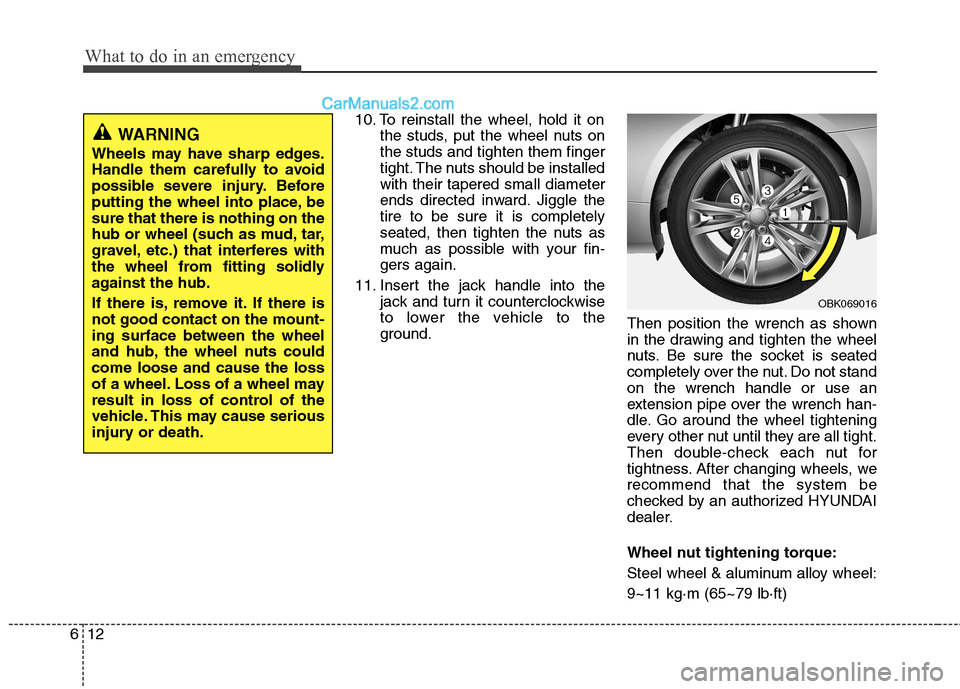
10. To reinstall the wheel, hold it on
the studs, put the wheel nuts on the studs and tighten them finger
tight. The nuts should be installedwith their tapered small diameter
ends directed inward. Jiggle thetire to be sure it is completely
seated, then tighten the nuts as
much as possible with your fin-gers again.
11. Insert the jack handle into the jack and turn it counterclockwise
to lower the vehicle to the
ground. Then position the wrench as shown
in the drawing and tighten the wheel
nuts. Be sure the socket is seated
completely over the nut. Do not standon the wrench handle or use an
extension pipe over the wrench han-
dle. Go around the wheel tightening
every other nut until they are all tight.
Then double-check each nut for
tightness. After changing wheels, werecommend that the system be
checked by an authorized HYUNDAI
dealer.
Wheel nut tightening torque:
Steel wheel & aluminum alloy wheel:9~11 kg·m (65~79 lb·ft)
WARNING
Wheels may have sharp edges.
Handle them carefully to avoid
possible severe injury. Before
putting the wheel into place, besure that there is nothing on the
hub or wheel (such as mud, tar,
gravel, etc.) that interferes with
the wheel from fitting solidly
against the hub.
If there is, remove it. If there is not good contact on the mount-ing surface between the wheel
and hub, the wheel nuts couldcome loose and cause the loss
of a wheel. Loss of a wheel may
result in loss of control of the
vehicle. This may cause serious
injury or death.
OBK069016
Page 303 of 414
617
What to do in an emergency
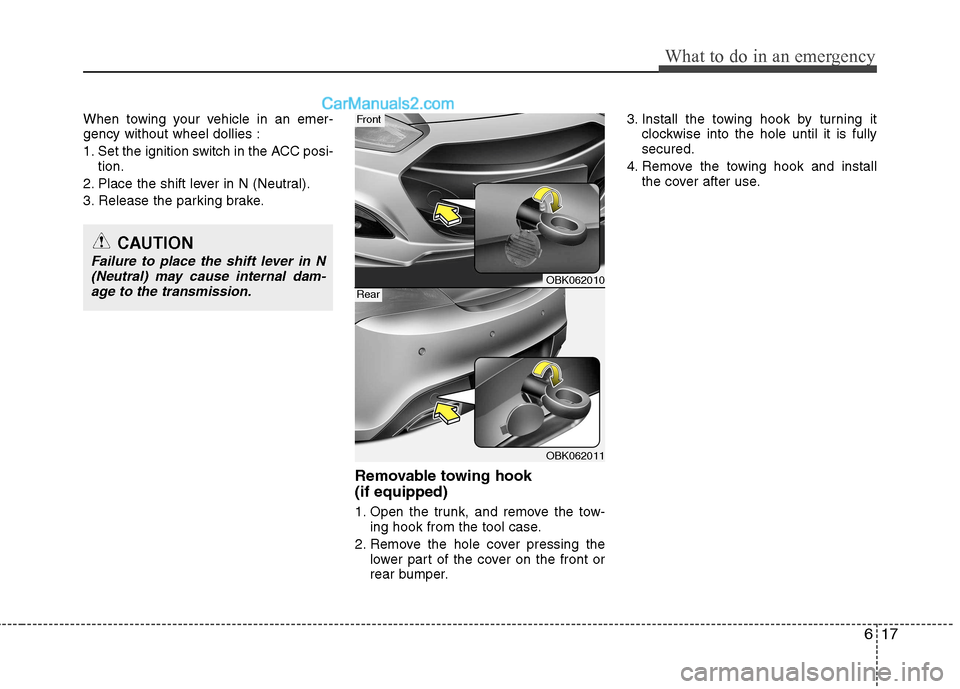
When towing your vehicle in an emer- gency without wheel dollies :
1. Set the ignition switch in the ACC posi-tion.
2. Place the shift lever in N (Neutral).
3. Release the parking brake.
Removable towing hook (if equipped)
1. Open the trunk, and remove the tow-ing hook from the tool case.
2. Remove the hole cover pressing the lower part of the cover on the front or
rear bumper. 3. Install the towing hook by turning it
clockwise into the hole until it is fullysecured.
4. Remove the towing hook and install the cover after use.
CAUTION
Failure to place the shift lever in N
(Neutral) may cause internal dam-age to the transmission.
OBK062010
OBK062011
Front
Rear
Page 315 of 414
Maintenance
8
7
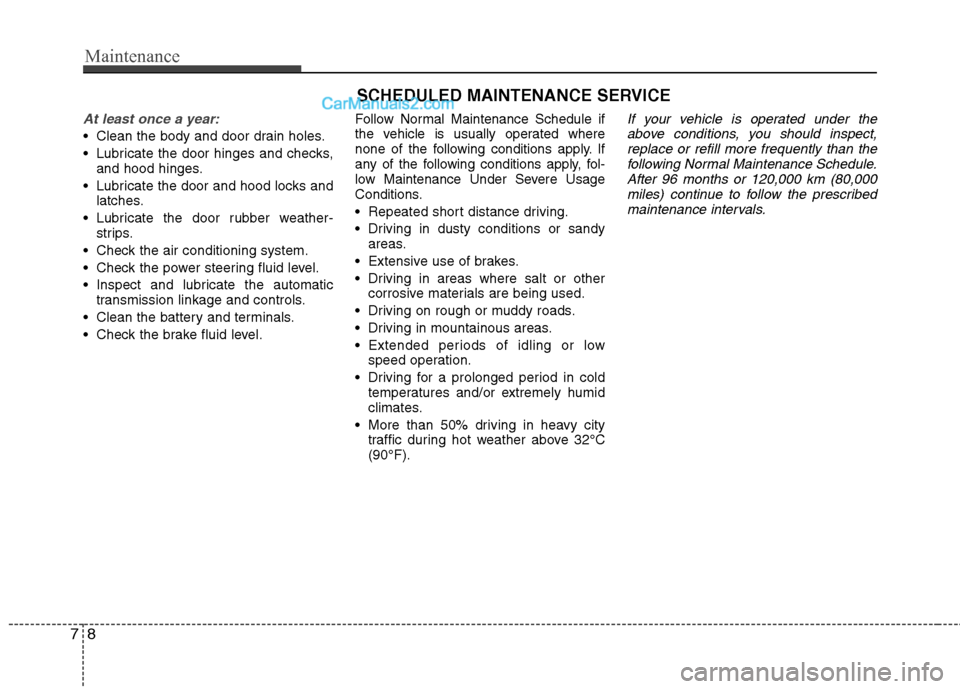
SCHEDULED MAINTENANCE SERVICE
At least once a year:
Clean the body and door drain holes.
Lubricate the door hinges and checks,
and hood hinges.
Lubricate the door and hood locks and latches.
Lubricate the door rubber weather- strips.
Check the air conditioning system.
Check the power steering fluid level.
Inspect and lubricate the automatic transmission linkage and controls.
Clean the battery and terminals.
Check the brake fluid level. Follow Normal Maintenance Schedule if
the vehicle is usually operated where
none of the following conditions apply. If
any of the following conditions apply, fol-
low Maintenance Under Severe Usage
Conditions.
Repeated short distance driving.
Driving in dusty conditions or sandy
areas.
Extensive use of brakes.
Driving in areas where salt or other corrosive materials are being used.
Driving on rough or muddy roads.
Driving in mountainous areas.
Extended periods of idling or low speed operation.
Driving for a prolonged period in cold temperatures and/or extremely humid
climates.
More than 50% driving in heavy city traffic during hot weather above 32°C(90°F).
If your vehicle is operated under the
above conditions, you should inspect, replace or refill more frequently than thefollowing Normal Maintenance Schedule.
After 96 months or 120,000 km (80,000miles) continue to follow the prescribedmaintenance intervals.
Page 316 of 414
79
Maintenance
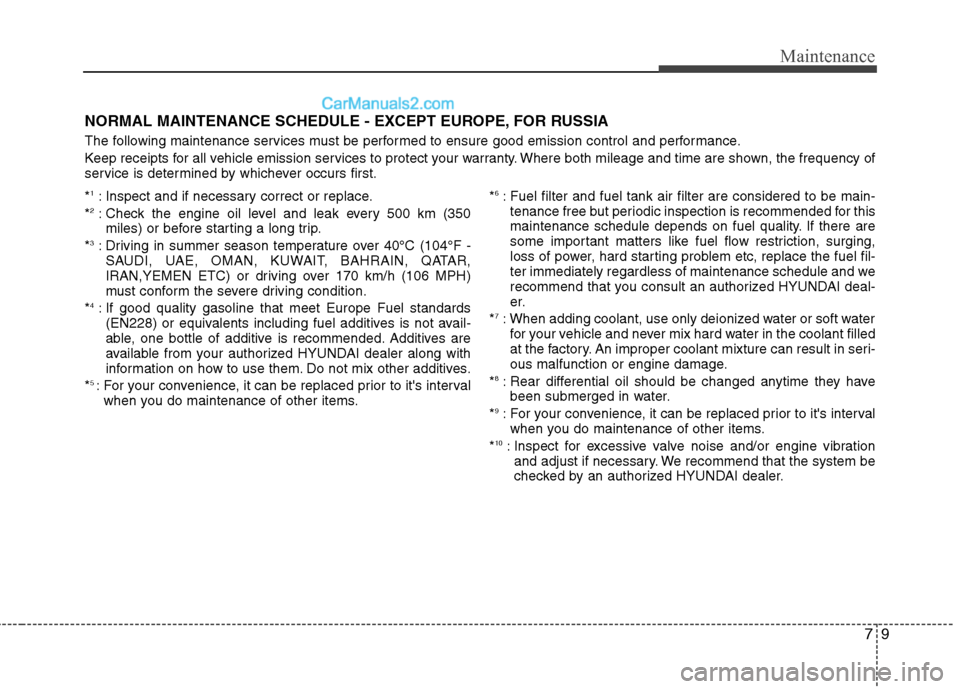
NORMAL MAINTENANCE SCHEDULE - EXCEPT EUROPE, FOR RUSSIA
The following maintenance services must be performed to ensure good emission control and performance.
Keep receipts for all vehicle emission services to protect your warranty. Where both mileage and time are shown, the frequency of
service is determined by whichever occurs first. * 1
: Inspect and if necessary correct or replace.
* 2
: Check the engine oil level and leak every 500 km (350
miles) or before starting a long trip.
* 3
: Driving in summer season temperature over 40°C (104°F -
SAUDI, UAE, OMAN, KUWAIT, BAHRAIN, QATAR,
IRAN,YEMEN ETC) or driving over 170 km/h (106 MPH)
must conform the severe driving condition.
* 4
: If good quality gasoline that meet Europe Fuel standards
(EN228) or equivalents including fuel additives is not avail-
able, one bottle of additive is recommended. Additives are
available from your authorized HYUNDAI dealer along with
information on how to use them. Do not mix other additives.
* 5
: For your convenience, it can be replaced prior to it's interval
when you do maintenance of other items. *
6
: Fuel filter and fuel tank air filter are considered to be main-
tenance free but periodic inspection is recommended for this
maintenance schedule depends on fuel quality. If there are
some important matters like fuel flow restriction, surging,
loss of power, hard starting problem etc, replace the fuel fil-
ter immediately regardless of maintenance schedule and we
recommend that you consult an authorized HYUNDAI deal-
er.
* 7
: When adding coolant, use only deionized water or soft water
for your vehicle and never mix hard water in the coolant filled
at the factory. An improper coolant mixture can result in seri-
ous malfunction or engine damage.
* 8
: Rear differential oil should be changed anytime they have
been submerged in water.
* 9
: For your convenience, it can be replaced prior to it's interval
when you do maintenance of other items.
* 10
: Inspect for excessive valve noise and/or engine vibration
and adjust if necessary. We recommend that the system be
checked by an authorized HYUNDAI dealer.
Page 325 of 414
Maintenance
18
7
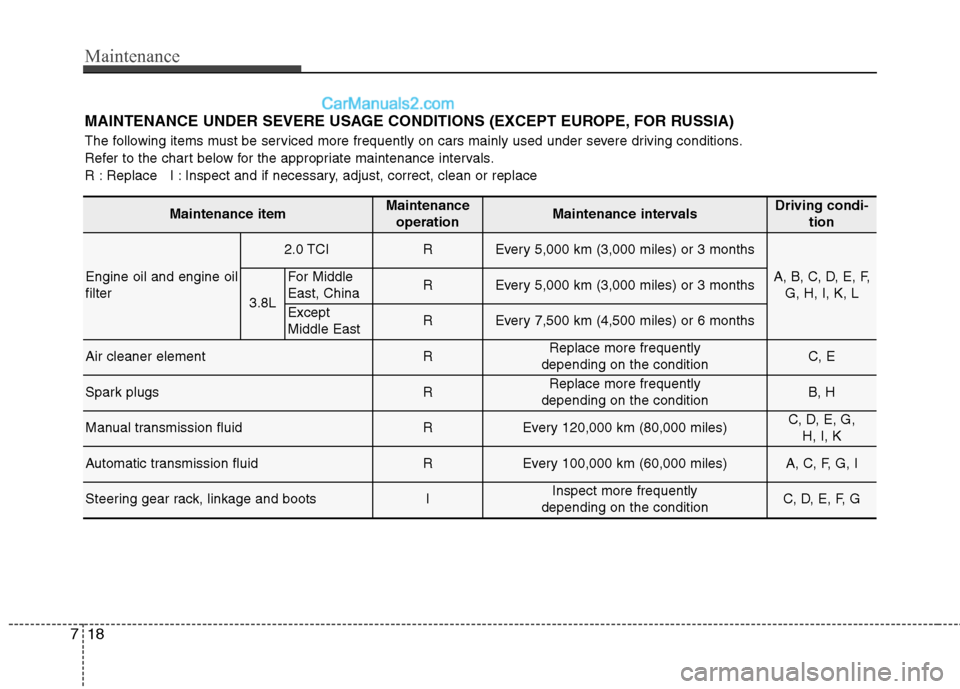
MAINTENANCE UNDER SEVERE USAGE CONDITIONS (EXCEPT EUROPE, FOR RUSSIA)
The following items must be serviced more frequently on cars mainly used under severe driving conditions.
Refer to the chart below for the appropriate maintenance intervals.
R : Replace I : Inspect and if necessary, adjust, correct, clean or replace
Maintenance itemMaintenance
operationMaintenance intervalsDriving condi- tion
Engine oil and engine oil filter
2.0 TCIREvery 5,000 km (3,000 miles) or 3 months
A, B, C, D, E, F,G, H, I, K, L
3.8L
For Middle East, ChinaREvery 5,000 km (3,000 miles) or 3 months
Except Middle EastREvery 7,500 km (4,500 miles) or 6 months
Air cleaner elementRReplace more frequently
depending on the conditionC, E
Spark plugs RReplace more frequently
depending on the conditionB, H
Manual transmission fluid REvery 120,000 km (80,000 miles)C, D, E, G, H, I, K
Automatic transmission fluidREvery 100,000 km (60,000 miles)A, C, F, G, I
Steering gear rack, linkage and bootsIInspect more frequently
depending on the conditionC, D, E, F, G
Page 326 of 414
719
Maintenance
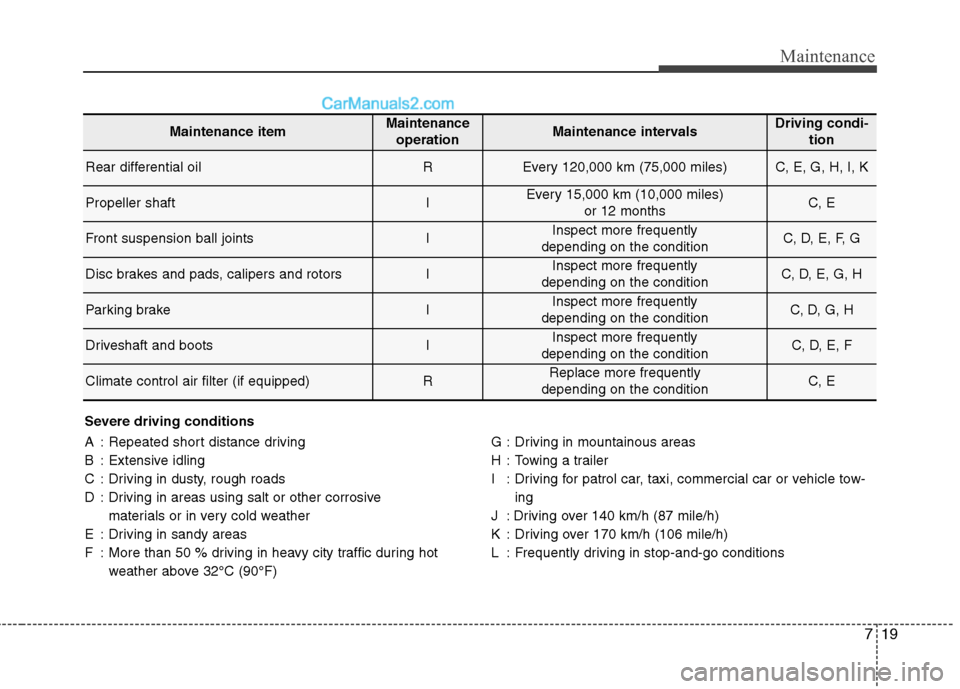
Severe driving conditions
A : Repeated short distance driving
B : Extensive idling
C : Driving in dusty, rough roads
D : Driving in areas using salt or other corrosive materials or in very cold weather
E : Driving in sandy areas
F : More than 50 % driving in heavy city traffic during hot weather above 32°C (90°F) G : Driving in mountainous areas
H : Towing a trailer
I : Driving for patrol car, taxi, commercial car or vehicle tow-
ing
J : Driving over 140 km/h (87 mile/h)
K : Driving over 170 km/h (106 mile/h)
L : Frequently driving in stop-and-go conditions
Maintenance itemMaintenance operationMaintenance intervalsDriving condi- tion
Rear differential oilREvery 120,000 km (75,000 miles)C, E, G, H, I, K
Propeller shaftIEvery 15,000 km (10,000 miles) or 12 monthsC, E
Front suspension ball jointsIInspect more frequently
depending on the conditionC, D, E, F, G
Disc brakes and pads, calipers and rotorsIInspect more frequently
depending on the conditionC, D, E, G, H
Parking brakeIInspect more frequently
depending on the conditionC, D, G, H
Driveshaft and bootsIInspect more frequently
depending on the conditionC, D, E, F
Climate control air filter (if equipped)RReplace more frequently
depending on the conditionC, E
Page 327 of 414
Maintenance
20
7
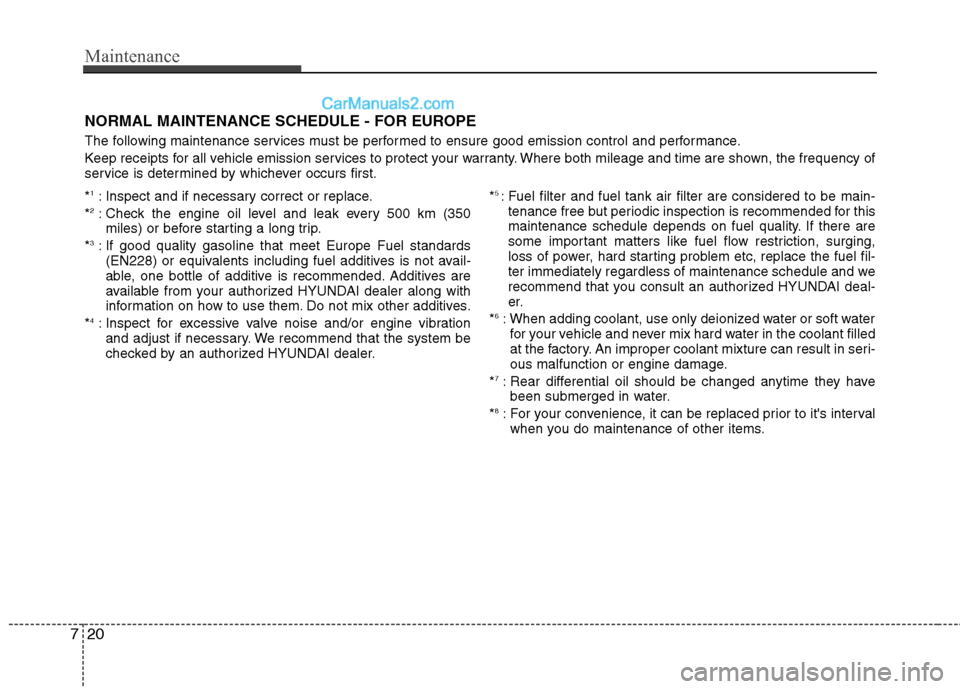
NORMAL MAINTENANCE SCHEDULE - FOR EUROPE
The following maintenance services must be performed to ensure good emission control and performance.
Keep receipts for all vehicle emission services to protect your warranty. Where both mileage and time are shown, the frequency o f
service is determined by whichever occurs first. * 1
: Inspect and if necessary correct or replace.
* 2
: Check the engine oil level and leak every 500 km (350
miles) or before starting a long trip.
* 3
: If good quality gasoline that meet Europe Fuel standards
(EN228) or equivalents including fuel additives is not avail-
able, one bottle of additive is recommended. Additives are
available from your authorized HYUNDAI dealer along with
information on how to use them. Do not mix other additives.
* 4
: Inspect for excessive valve noise and/or engine vibration
and adjust if necessary. We recommend that the system be
checked by an authorized HYUNDAI dealer. *
5
: Fuel filter and fuel tank air filter are considered to be main-
tenance free but periodic inspection is recommended for this
maintenance schedule depends on fuel quality. If there are
some important matters like fuel flow restriction, surging,
loss of power, hard starting problem etc, replace the fuel fil-
ter immediately regardless of maintenance schedule and we
recommend that you consult an authorized HYUNDAI deal-
er.
* 6
: When adding coolant, use only deionized water or soft water
for your vehicle and never mix hard water in the coolant filled
at the factory. An improper coolant mixture can result in seri-
ous malfunction or engine damage.
* 7
: Rear differential oil should be changed anytime they have
been submerged in water.
* 8
: For your convenience, it can be replaced prior to it's interval
when you do maintenance of other items.