lock Hyundai Getz 2007 Owner's Manual
[x] Cancel search | Manufacturer: HYUNDAI, Model Year: 2007, Model line: Getz, Model: Hyundai Getz 2007Pages: 463, PDF Size: 11.14 MB
Page 360 of 463
1- 94 FEATURES OF YOUR HYUNDAI
HTB2043
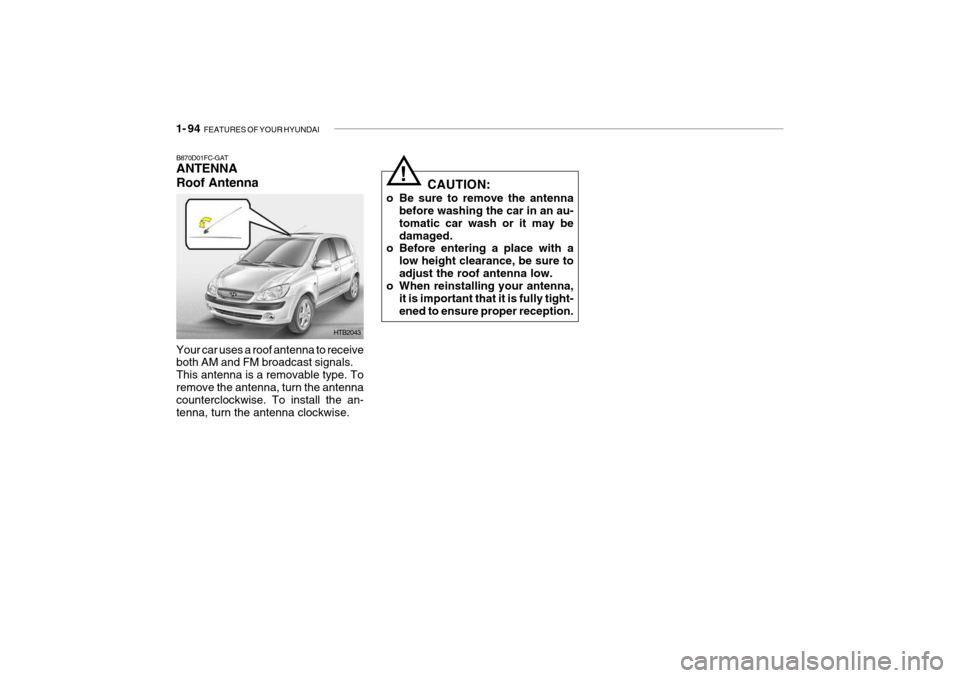
B870D01FC-GAT ANTENNA Roof Antenna Your car uses a roof antenna to receive both AM and FM broadcast signals. This antenna is a removable type. Toremove the antenna, turn the antenna counterclockwise. To install the an- tenna, turn the antenna clockwise. CAUTION:
o Be sure to remove the antenna before washing the car in an au-tomatic car wash or it may bedamaged.
o Before entering a place with a
low height clearance, be sure toadjust the roof antenna low.
o When reinstalling your antenna,
it is important that it is fully tight-ened to ensure proper reception.
!
Page 361 of 463

2. DRIVING YOUR HYUNDAI
Before starting the engine .............................................................. 2-3
Key positions .................................................................................... 2-4Starting ............................................................................................. 2-5
Operating the manual transaxle ....................................................... 2-8
Automatic transaxle ......................................................................... 2-9Effective Braking ............................................................................ 2-13
Anti-Lock brake system (ABS) ...................................................... 2-14
Electronic Stability Program (ESP) ................................................ 2-14
Driving for economy ....................................................................... 2-15
Winter Driving ................................................................................. 2-17
Trailer and Caravan Towing........................................................... 2-19
2
Page 363 of 463
DRIVING YOUR HYUNDAI 2- 3
!
C020A02O-EAT BEFORE STARTING THE EN- GINE Before you start the engine, you should always:
1. Look around the vehicle to be sure
there are no flat tyres, puddles of oil or water or other indications of pos-sible trouble.
2. After entering the car, check to be
sure the parking brake is engaged.
3. Check that all windows, and lights are clean.
4. Check that the interior and exterior mirrors are clean and in position.
5. Check your seat, seatback and
headrestraint to be sure they are intheir proper positions.
6. Close all the doors.
7. Fasten your seat belt and be sure
that all other occupants have fas- tened theirs.
8. Turn off all lights and accessories that are not needed.
9. When you turn the ignition switch to
"ON" check that all appropriate warn- ing lights are operating and that you have sufficient fuel. 10.Check the operation of warning
lights and all bulbs when key is in the "ON" position.
WARNING: (DIESEL ENGINE)
To ensure that sufficient vacuum exists within the brake system dur-ing cold weather start-up condi- tions, it is necessary to run the engine at idle for several secondsafter starting the engine. SC040A1-F COMBINATION IGNITION SWITCH AND STEERING LOCKTo Start the Engine
o If your Hyundai is equipped with a
manual transaxle, place the shift lever in neutral and depress theclutch pedal fully.
o If your Hyundai has an automatic
transaxle, place the shift lever in "P"(park).
o To start the engine, insert the igni-
tion key and turn it to the "START"position. Release it as soon as the engine starts. Do not hold the key in the "START" position for more than15 seconds.
NOTE: For safety, the engine will not start if the shift lever is not in "P" or "N"Position (automatic transaxle).
!WARNING:
Always wear appropriate shoes when operating your vehicle. Unsuitable shoes (high heels, ski boots, etc.) may interfere with yourability to use the brake and accelera- tor pedal, and the clutch (if installed).
Page 364 of 463
2- 4 DRIVING YOUR HYUNDAI
!
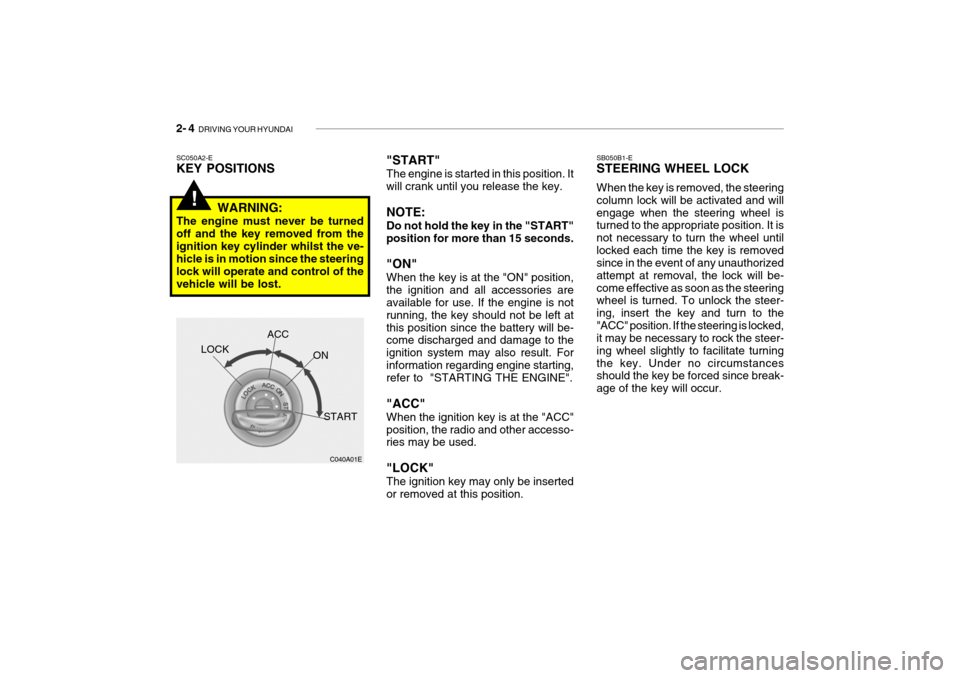
"START" The engine is started in this position. It will crank until you release the key. NOTE: Do not hold the key in the "START" position for more than 15 seconds. "ON" When the key is at the "ON" position, the ignition and all accessories are available for use. If the engine is not running, the key should not be left atthis position since the battery will be- come discharged and damage to the ignition system may also result. Forinformation regarding engine starting, refer to "STARTING THE ENGINE". "ACC" When the ignition key is at the "ACC" position, the radio and other accesso- ries may be used. "LOCK" The ignition key may only be inserted or removed at this position.SC050A2-E KEY POSITIONS
C040A01E
LOCK
ACC
ON
START
WARNING:
The engine must never be turned off and the key removed from theignition key cylinder whilst the ve- hicle is in motion since the steering lock will operate and control of thevehicle will be lost. SB050B1-E STEERING WHEEL LOCK When the key is removed, the steering column lock will be activated and willengage when the steering wheel is turned to the appropriate position. It is not necessary to turn the wheel untillocked each time the key is removed since in the event of any unauthorized attempt at removal, the lock will be-come effective as soon as the steering wheel is turned. To unlock the steer- ing, insert the key and turn to the"ACC" position. If the steering is locked, it may be necessary to rock the steer- ing wheel slightly to facilitate turningthe key. Under no circumstances should the key be forced since break- age of the key will occur.
Page 365 of 463
DRIVING YOUR HYUNDAI 2- 5
SC060A1-E STARTING THE PETROL ENGINE
C050A01E
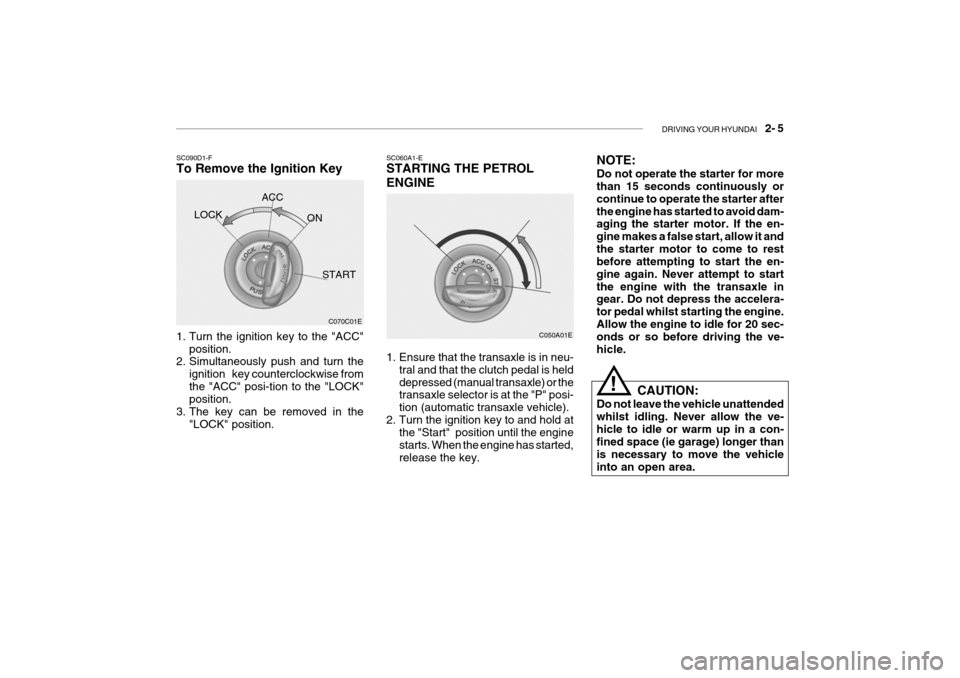
1. Ensure that the transaxle is in neu- tral and that the clutch pedal is held depressed (manual transaxle) or the transaxle selector is at the "P" posi- tion (automatic transaxle vehicle).
2. Turn the ignition key to and hold at the "Start" position until the enginestarts. When the engine has started,release the key.
C070C01E
SC090D1-F To Remove the Ignition Key
1. Turn the ignition key to the "ACC"
position.
2. Simultaneously push and turn the
ignition key counterclockwise from the "ACC" posi-tion to the "LOCK" position.
3. The key can be removed in the "LOCK" position.LOCK
ACC
ON
START NOTE: Do not operate the starter for more than 15 seconds continuously or continue to operate the starter afterthe engine has started to avoid dam- aging the starter motor. If the en- gine makes a false start, allow it andthe starter motor to come to rest before attempting to start the en- gine again. Never attempt to startthe engine with the transaxle in gear. Do not depress the accelera- tor pedal whilst starting the engine.Allow the engine to idle for 20 sec- onds or so before driving the ve- hicle.
CAUTION:
Do not leave the vehicle unattendedwhilst idling. Never allow the ve-hicle to idle or warm up in a con- fined space (ie garage) longer than is necessary to move the vehicleinto an open area.
!
Page 366 of 463

2- 6 DRIVING YOUR HYUNDAI
C050B01HP
NOTE: If the engine were not started 10 seconds after the preheating is com- pleted, turn the ignition key once more to the "LOCK" position, andthen to the "ON" position, in order to preheat again.
C051A01O-EAT STARTING THE DIESEL ENGINE ENGINE COLD
o Turn the ignition key to position
"ON" and wait for the pre-heat indi- cator light to go out.
o Operate the starter until the engine
runs.
ENGINE WARM Operate the starter. If the engine does not respond on the first attempt, wait several seconds and try again usingthe pre-heat. C050B02S-GAT NORMAL CONDITIONS The Starting Procedure:
1. Insert key, and fasten the seat belt.
2. Depress the clutch pedal fully and
place the gearshift lever (manualtransaxle) in neutral or the selectorlever (automatic transaxle) in "P" (park) position.
3. After turning the ignition key to the "ON" position, make certain all warn-ing lights and gauges are function- ing properly before starting the en-gine.
4. On vehicles equipped with the die-
sel preheat indicator light, turn theignition key to the "ON" position. The diesel pre-heat indicator light will first illuminate in amber, andthen after a short time, the amber illumination will go off, indicating that preheating is completed. Amber lamp ON Amber lamp OFF
Page 370 of 463

2- 10 DRIVING YOUR HYUNDAI
YC090A1-E SELECTOR POSITIONS o P (Park): With the selector in this position, no drive is transmitted from the engine and the transaxle output and thereforethe front wheels locked. The engine may be started with the selector in this position.
!
CAUTION:
The selector must NEVER be shifted to the "P" position whilst the ve-hicle is in motion, otherwise seri- ous transaxle damage will result. DC110C1-E o R (Reverse): With the selector in this position, re- verse gear will be engaged. The en-gine may not be started with the selec- tor in this position.
CAUTION:
The selector must NEVER be shifted to the "R" position whilst the ve- hicle is in motion.
! DC110D1-E o N (Neutral): With the selector in this position, no gear is selected and no drive is trans-mitted from the engine. The engine may be started with the selector in this position.
!
CAUTION:
Do not coast with the selector at the "N" position. DC110E2-E o D (Drive): Bring the car to a complete stop before shifting the selector lever to "D" posi-tion. With the selector in this position, first gear will be engaged from rest and thetransmission will automatically upshift to second, third and fourth depending upon the vehicle speed, throttle posi-tion and the position of the overdrive switch. The engine may not be started with the selector in this position. DC110F1-E o 2 (Second Gear): With the selector in this position, first gear will be engaged from rest. Thetransmission will upshift to second gear depending upon the vehicle speed and throttle position. No upshift to third orfourth will occur. The engine may not be started with the selector in this position. DC110G2-E o L (Low Gear): With the selector in this position, first gear will be engaged from rest. No upshift will occur regardless of vehiclespeed and throttle opening. The en- gine may not be started with the selec- tor in this position.
!
CAUTION:
Do not move the selector to the "L" position when the vehicle speed is in excess of 50 m.p.h.
Page 374 of 463
2- 14 DRIVING YOUR HYUNDAI
!WARNING:
ABS will not prevent accidents due to improper or dangerous driving maneuvers. Even though vehicle control is improved during emer-gency braking, always maintain a safe distance between you and ob- jects ahead. Vehicle speeds shouldalways be reduced during extreme road conditions. The braking distance for carsequipped with an anti-lock braking system may be longer than for those without it in the following road con- ditions.
o Driving on rough, gravel or snow- covered roads.
o Driving with tyre chains installed.
o Driving on roads where the road surface is pitted or has differentsurface height.
These roads should be driven atreduced speeds. The safety featuresof an ABS equipped vehicle should not be tested by high speed driving or cornering. This could endangerthe safety of yourself or others.
SC140B2-E ANTI-LOCK BRAKE SYSTEM (Not all models) The Anti-Lock Brake System (ABS) is designed to prevent wheel lock-up during sudden braking or on hazard-ous road surfaces. The ABS control module monitors the wheel speed and controls the pressure applied to eachbrake. Thus, in emergency situations or on slick roads, ABS will increase vehicle control during braking. NOTE:
o A click sound may be heard in the
engine compartment when the ve- hicle begins to move after the en- gine is started. These conditions are normal and indicate that theanti-lock brake system (Electronic Stability Program) is functioning properly.
o During ABS operation, a slight pulsation may be felt in the brakepedal when the brakes are ap-plied. Also, a noise may be heard in the engine compartment whilst braking. These conditions arenormal and indicate that the anti- lock brake system is functioning properly.
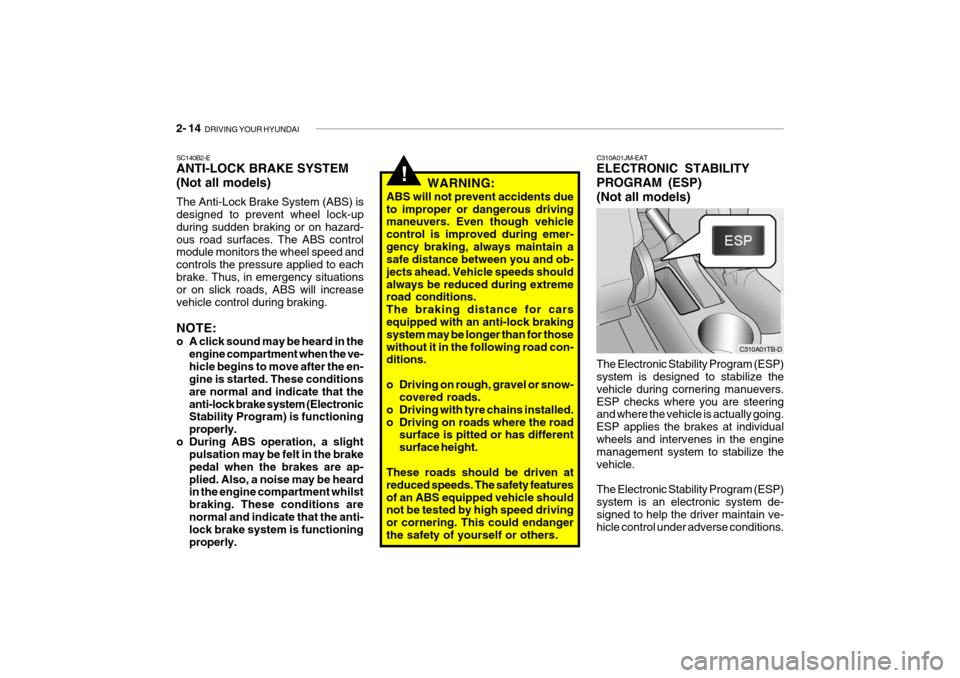
C310A01JM-EAT ELECTRONIC STABILITY PROGRAM (ESP)(Not all models) The Electronic Stability Program (ESP) system is designed to stabilize the vehicle during cornering manuevers.ESP checks where you are steering and where the vehicle is actually going. ESP applies the brakes at individualwheels and intervenes in the engine management system to stabilize the vehicle. The Electronic Stability Program (ESP) system is an electronic system de-signed to help the driver maintain ve- hicle control under adverse conditions. C310A01TB-D
Page 378 of 463

2- 18 DRIVING YOUR HYUNDAI
SC170E1-E Windscreen Washers and Wip- ers The windscreen washer bottle should be filled with a solution of water and a proprietary winter screen wash addi-tive. The windscreen wipers should not be used if the blades are frozen to the windscreen or if they are coveredwith snow, before this is removed. NOTE: Never allow undiluted screen washer fluid additive to spill upon the paintwork or use engine cool- ant anti-freeze since damage to thepaintwork may result.
o When driving in extreme conditions,
the windscreen wiper blades may fail to clear the screen properly due to the formation of ice upon theblade edge. It will therefore be nec- essary to periodically remove such ice to restore their efficiency.
o If the power operated door mirrors become frozen, attempts to adjustthese may damage the mechanism.
ZC170D1-E Door Locks Should the door lock mechanism be- come frozen, a proprietary lock de-icer should be used. Alternatively, warm- ing the door key may thaw the doorlock. However, the key should be handled carefully to avoid burning the fingers.Never attempt to thaw a frozen door lock using hot water, since the water will eventually freeze and compoundthe problem. NOTE: The proper temperature for using the immobilizer key is from -40°F to 176°F (-40°C to 80°C). If you heat the immobilizer key over 176°F (80°C)to open the frozen lock, it may cause damage to the transponder in its head.
o The formation of snow or ice built up
inside the wheel arches may inter-fere with the road wheels or steeringmechanism. In such instances, un- usual noises or an increase in steer- ing effort may result. Therefore,ensure that the wheel arches are checked periodically and any accu- mulated snow or ice removed.
o It is advisable to carry emergency equipment including, torch, shovel,tow rope, blankets etc., if a journeyis to be undertaken into areas of severe road conditions.
Page 388 of 463

3- 6 WHAT TO DO IN AN EMERGENCY
SD050A2-E SPARE WHEEL (Not all models) The spare wheel is stored under the luggage compartment floor and is ac-cessed from within the luggage com- partment by lifting the carpet and the floor panel.To remove the spare wheel, unscrew the retainer, rotating this in an counter- clockwise direction and lift out the wheel.To replace the wheel, screw the retainer by hand until tight having located the wheel in the luggage compartment floorwell. The inflation pressure of the spare wheel should be checked at least monthly and whenever the wheel isfitted to the vehicle.
Inflation Pressure
Tyre Size
Spare Tyre Pressure
Full Size 30 psi 210 kPa
CAUTION:
o Do not use snow chains with your temporary spare tyre.
o Do not use more than one tempo- rary spare tyre at a time.
!
5. The temporary spare tyre should
not be used on any other wheels, nor should standard tyre, snow tyre,wheel covers or trim rings be used with the temporary spare wheel. If such use is attempted, damage tothese items or other car compo- nents may occur.
6. The temporary spare tyre pressure should be checked once a monthwhile the tyre is stored. D040B01FC-EAT SPARE TYRE FOR FULL SIZE The following instructions for the FULL SIZE spare tyre should be observed: Check inflation pressure as soon as possible after installing the spare tyre,and adjust to the specified pressure. The tyre pressure should be periodi- cally checked and maintained at thespecified pressure while the tyre is stored. Spare Tyre Pressure
Tyre Size Inflation Pressure
Full size 30 psi (210 kPa)