engine overheat Hyundai Getz 2007 User Guide
[x] Cancel search | Manufacturer: HYUNDAI, Model Year: 2007, Model line: Getz, Model: Hyundai Getz 2007Pages: 463, PDF Size: 11.14 MB
Page 164 of 463

3. WHAT TO DO IN AN EMERGENCY
If the engine will not start ................................................................ 3-2
Jump starting .................................................................................. 3-3
If the engine overheats ................................................................... 3-4
Spare tire ........................................................................................ 3-5
If you have a flat tire ....................................................................... 3-6
If your vehicle must be towed........................................................ 3-11
Emergency towing ......................................................................... 3-13
If you lose your keys ...................................................................... 3-14
3
Page 167 of 463
3- 4 WHAT TO DO IN AN EMERGENCY
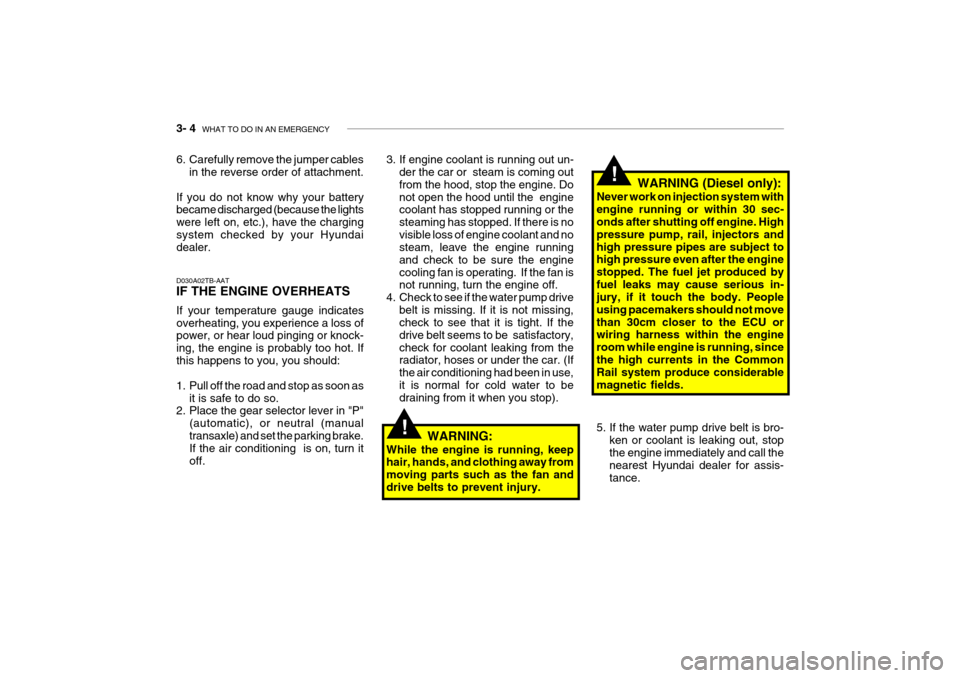
D030A02TB-AAT IF THE ENGINE OVERHEATS If your temperature gauge indicates overheating, you experience a loss of power, or hear loud pinging or knock- ing, the engine is probably too hot. Ifthis happens to you, you should:
1. Pull off the road and stop as soon as
it is safe to do so.
2. Place the gear selector lever in "P"
(automatic), or neutral (manual transaxle) and set the parking brake. If the air conditioning is on, turn it off.
6. Carefully remove the jumper cables
in the reverse order of attachment.
If you do not know why your battery became discharged (because the lights were left on, etc.), have the chargingsystem checked by your Hyundai dealer. 3. If engine coolant is running out un-
der the car or steam is coming out from the hood, stop the engine. Donot open the hood until the engine coolant has stopped running or the steaming has stopped. If there is novisible loss of engine coolant and no steam, leave the engine running and check to be sure the enginecooling fan is operating. If the fan is not running, turn the engine off.
4. Check to see if the water pump drive belt is missing. If it is not missing,check to see that it is tight. If the drive belt seems to be satisfactory,check for coolant leaking from the radiator, hoses or under the car. (If the air conditioning had been in use,it is normal for cold water to be draining from it when you stop). WARNING (Diesel only):
Never work on injection system with engine running or within 30 sec- onds after shutting off engine. High pressure pump, rail, injectors andhigh pressure pipes are subject to high pressure even after the engine stopped. The fuel jet produced byfuel leaks may cause serious in- jury, if it touch the body. People using pacemakers should not movethan 30cm closer to the ECU or wiring harness within the engine room while engine is running, sincethe high currents in the Common Rail system produce considerable magnetic fields.
WARNING:
While the engine is running, keep hair, hands, and clothing away from moving parts such as the fan anddrive belts to prevent injury.
!
!
5. If the water pump drive belt is bro- ken or coolant is leaking out, stop the engine immediately and call the nearest Hyundai dealer for assis-tance.
Page 168 of 463
WHAT TO DO IN AN EMERGENCY 3- 5
Inflation Pressure
Tire Size
T105/70D14 420 kPa (60 psi)
2. The spare tire should only be used temporarily and should be returned to the luggage compartment as soonas the original tire can be repaired or replaced.
3. Continuous use at speeds of over 80 km/h (50 mph) is not recom-mended.
4. As the temporary spare tire is spe-
cifically designed for your car, itshould not be used on any other vehicle.
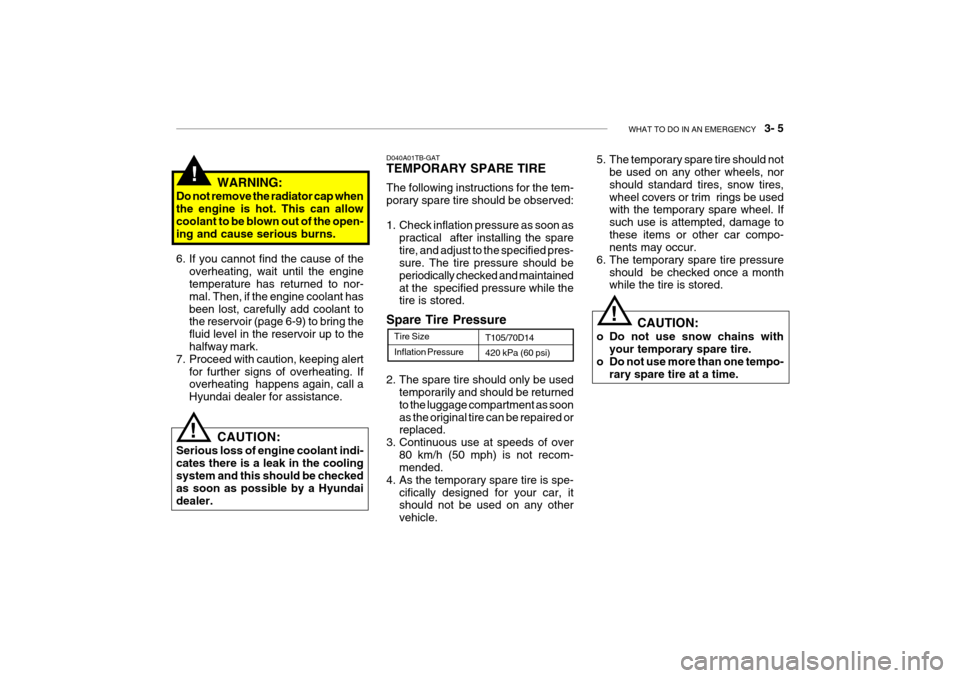
D040A01TB-GAT TEMPORARY SPARE TIRE The following instructions for the tem- porary spare tire should be observed:
1. Check inflation pressure as soon as
practical after installing the spare tire, and adjust to the specified pres- sure. The tire pressure should be periodically checked and maintainedat the specified pressure while the tire is stored.
Spare Tire Pressure
WARNING:
Do not remove the radiator cap whenthe engine is hot. This can allow coolant to be blown out of the open-ing and cause serious burns.
6. If you cannot find the cause of the overheating, wait until the engine temperature has returned to nor- mal. Then, if the engine coolant hasbeen lost, carefully add coolant to the reservoir (page 6-9) to bring the fluid level in the reservoir up to the halfway mark.
7. Proceed with caution, keeping alert for further signs of overheating. Ifoverheating happens again, call a Hyundai dealer for assistance.
!
!
!
CAUTION:
Serious loss of engine coolant indi- cates there is a leak in the cooling system and this should be checked as soon as possible by a Hyundaidealer. 5. The temporary spare tire should not
be used on any other wheels, norshould standard tires, snow tires,wheel covers or trim rings be used with the temporary spare wheel. If such use is attempted, damage tothese items or other car compo- nents may occur.
6. The temporary spare tire pressure should be checked once a monthwhile the tire is stored.
CAUTION:
o Do not use snow chains with your temporary spare tire.
o Do not use more than one tempo-
rary spare tire at a time.
Page 237 of 463
EMISSION CONTROL SYSTEMS 7- 3
H020A01A-GAT
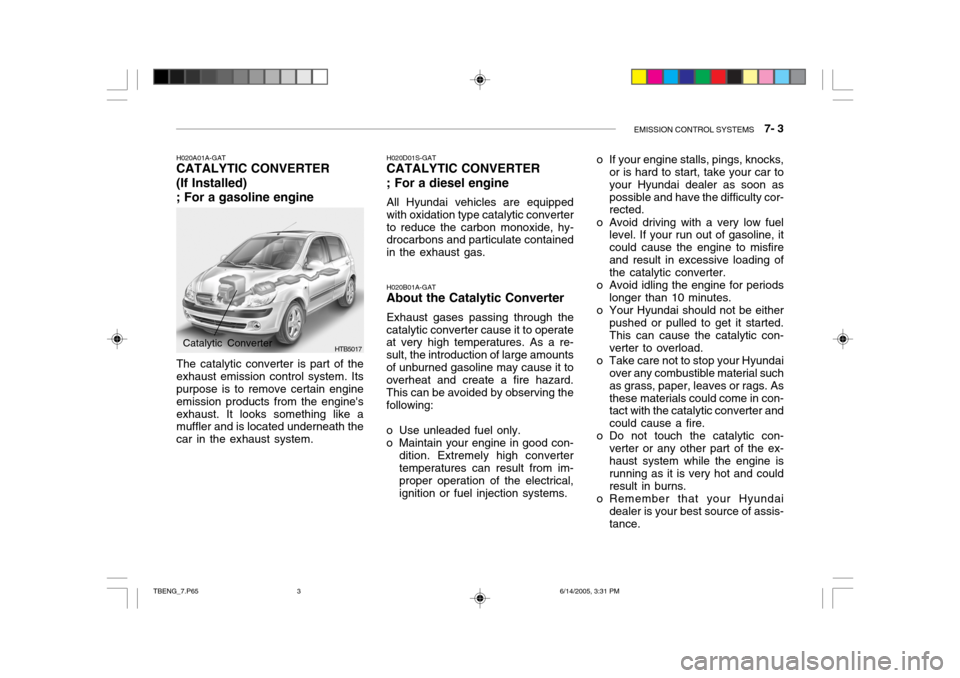
CATALYTIC CONVERTER (If Installed) ; For a gasoline engine
HTB5017
The catalytic converter is part of the exhaust emission control system. Its purpose is to remove certain engine emission products from the engine'sexhaust. It looks something like a muffler and is located underneath the car in the exhaust system.
Catalytic Converter H020B01A-GAT
About the Catalytic Converter
Exhaust gases passing through the
catalytic converter cause it to operate at very high temperatures. As a re- sult, the introduction of large amountsof unburned gasoline may cause it to overheat and create a fire hazard. This can be avoided by observing thefollowing:
o Use unleaded fuel only.
o Maintain your engine in good con-
dition. Extremely high converter temperatures can result from im- proper operation of the electrical,ignition or fuel injection systems.
H020D01S-GAT CATALYTIC CONVERTER ; For a diesel engine All Hyundai vehicles are equipped with oxidation type catalytic converterto reduce the carbon monoxide, hy- drocarbons and particulate contained in the exhaust gas.
o If your engine stalls, pings, knocks,
or is hard to start, take your car toyour Hyundai dealer as soon aspossible and have the difficulty cor- rected.
o Avoid driving with a very low fuel level. If your run out of gasoline, it could cause the engine to misfireand result in excessive loading of the catalytic converter.
o Avoid idling the engine for periods longer than 10 minutes.
o Your Hyundai should not be either pushed or pulled to get it started.This can cause the catalytic con- verter to overload.
o Take care not to stop your Hyundai over any combustible material suchas grass, paper, leaves or rags. Asthese materials could come in con- tact with the catalytic converter and could cause a fire.
o Do not touch the catalytic con-
verter or any other part of the ex-haust system while the engine is running as it is very hot and could result in burns.
o Remember that your Hyundai dealer is your best source of assis-tance.
TBENG_7.P65 6/14/2005, 3:31 PM
3
Page 251 of 463

INDEX 10- 3
D Day/Night inside rearview mirror ................................. 1-76
Defrosting / Defogging ................................................ 1-91
Digital clock ................................................................ 1-66
Door Door locks ................................................................ 1-7 Locking, unlocking front doors with a key ................ 1-7
Locking from the inside ............................................ 1-8
Locking from the outside .......................................... 1-8
Drink Holder ................................................................ 1-68
Drive Belts .................................................................. 6-22
Driving
Economical driving .................................................. 2-15
Smooth corneri ng ..................................................... 2-16
Winter driving ........................................................... 2-16
E Electronic stability program (ESP) ..............................2-14
Emission Contro l System ............................................ 7-2
Engine
Before starting the engine ........................................ 2-3Compartment ............................................................ 6-2
Coolant .................................................................... 6-10
Coolant temperature gauge ......................................1-54
If the engine overheats ............................................. 3-4
Number ..................................................................... 8-2
Oil ............................................................................. 6-7Starting ..................................................................... 2-3
Engine Exhaust Can Be Dangerous ............................ 2-2 FFog Light
Front ........................................................................ 1-65
Rear ......................................................................... 1-66
Folding the outside rearview mirror .............................1-75
Front Seats
Adjustable front seats .............................................. 1-13
Adjustable headrests ............................................... 1-14
Adjusting seat forward and rearward ........................1-13
Adjusting seatback angle .. ......................................1-13
Lumbar support control ............................................ 1-15
Seat cushion height adjustment .............................. 1-16
Seat warmer ............................................................ 1-20
Fuel
Capacity ................................................................... 9-2
Gauge ...................................................................... 1-55
recommendations ...................................................... 1-2
Fuel Filler Lid
Remote release ....................................................... 1-78
Fuses ......................................................................... 6-23
Fuse Panel description ............................................... 6-36
GGeneral Checks ........................................................... 6-5
Glove Box .................................................................. 1-73
Page 315 of 463

FEATURES OF YOUR HYUNDAI 1- 49
SB210M1-E
CHARGING SYSTEM WARNING LIGHT
The charging system warning light should illuminate when the ignition switch is turned to the "ON" positionand should be extinguished when the engine is started. If the light fails to illuminate when the ignition is turned"ON" or fails to extinguish after starting the engine, the nearest Hyundai authorised repairer should be contacted.If the light illuminates whilst the vehicle is being driven, stop the vehicle as soon as it is safe to do so and check thecondition of the alternator drive belt. If the belt is in place and the tension is satisfactory, the advice of a Hyundaiauthorised repairer should be sought. SB2100I-E
DOOR OPEN (AJAR) WARNING LIGHT
The door ajar warning light indicates that a door is not correctly closed. Ensure that the light is extinguished prior to driving the vehicle.
B260B01FC-EAT
TAIL GATE OPEN WARNING LIGHT
The tail gate warning light indicates when the tail gate is open or is not fully closed. Ensure that the light has extin-guished prior to driving the vehicle.
CAUTION:
If the drive belt (generator belt) is loose, broken, or missing while thevehicle is driving, there may be a serious malfunction, engine could overheat because this belt also drivesthe water pump.!
If failure of one of the circuits occurs, the required amount of pedal effort, pedal travel and stopping distance willbe increased. Use of the gearbox is recommended to assist in bringing the vehicle to rest. The vehicle must not bedriven once brake failure has occurred until the system has been repairered and is functioning normally.The braking system employs a vacuum servo in order that the pedal efforts are reduced. Power for the servo is derivedfrom the engine and therefore, in the event of the engine stopping or the vehicle being towed, pedal efforts willbe substantially increased.
Page 318 of 463
1- 52 FEATURES OF YOUR HYUNDAI
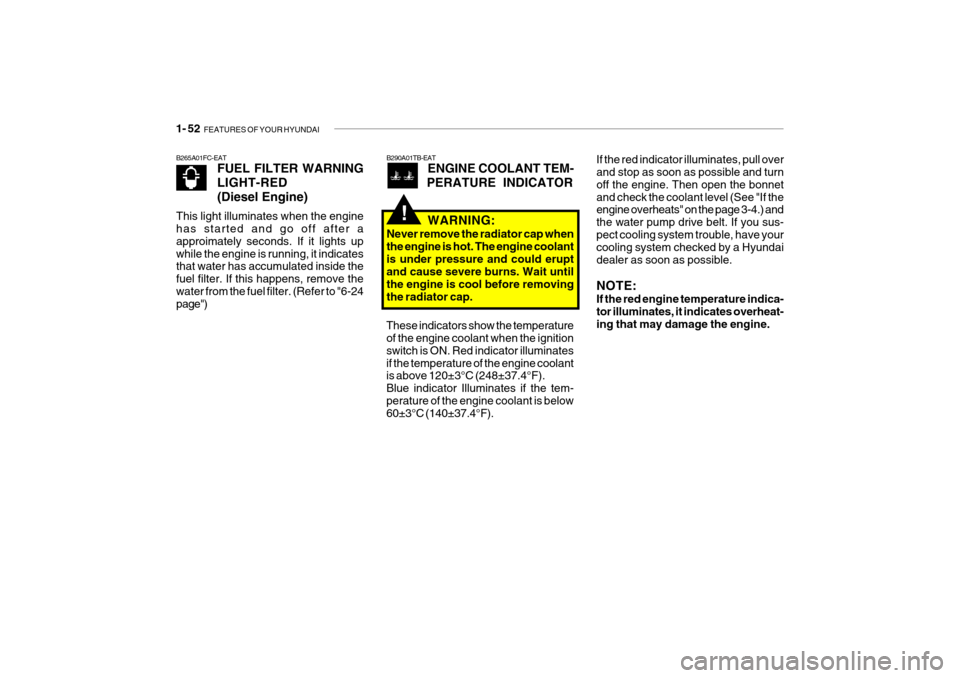
If the red indicator illuminates, pull over and stop as soon as possible and turn off the engine. Then open the bonnetand check the coolant level (See "If the engine overheats" on the page 3-4.) and the water pump drive belt. If you sus-pect cooling system trouble, have your cooling system checked by a Hyundai dealer as soon as possible. NOTE: If the red engine temperature indica- tor illuminates, it indicates overheat-ing that may damage the engine.
B265A01FC-EAT
FUEL FILTER WARNING LIGHT-RED(Diesel Engine)
This light illuminates when the engine has started and go off after a approimately seconds. If it lights upwhile the engine is running, it indicates that water has accumulated inside the fuel filter. If this happens, remove thewater from the fuel filter. (Refer to "6-24 page")B290A01TB-EAT ENGINE COOLANT TEM-
PERATURE INDICATOR
WARNING:
Never remove the radiator cap when the engine is hot. The engine coolantis under pressure and could erupt and cause severe burns. Wait until the engine is cool before removingthe radiator cap.
!
These indicators show the temperature of the engine coolant when the ignition switch is ON. Red indicator illuminatesif the temperature of the engine coolant is above 120±3°C (248±37.4°F). Blue indicator Illuminates if the tem-perature of the engine coolant is below 60±3°C (140±37.4°F).
Page 373 of 463
DRIVING YOUR HYUNDAI 2- 13
HTB217-D
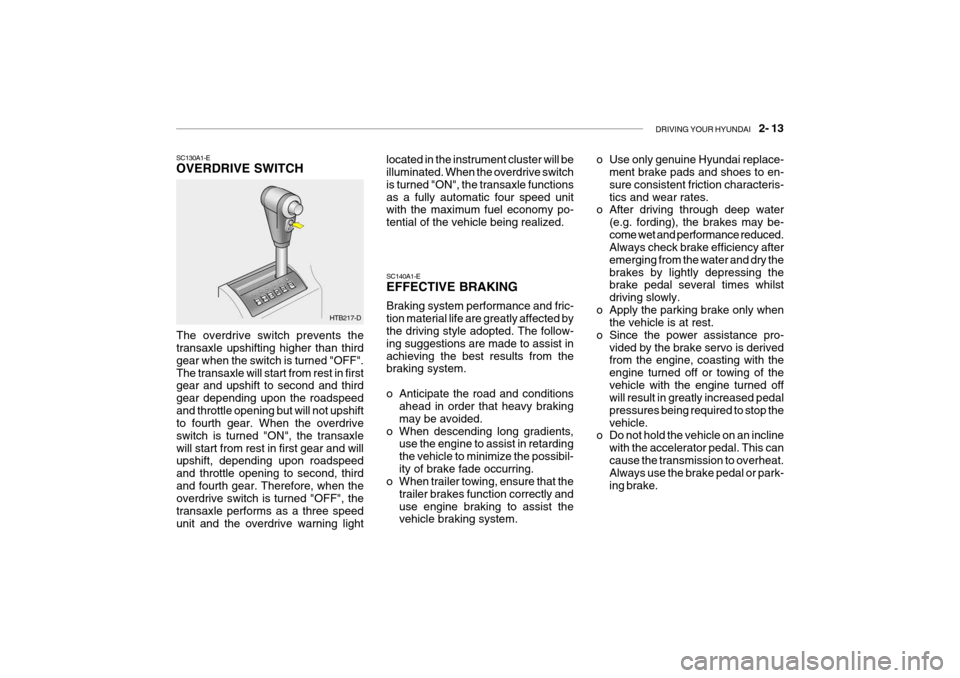
SC130A1-E OVERDRIVE SWITCH
The overdrive switch prevents the transaxle upshifting higher than third gear when the switch is turned "OFF".The transaxle will start from rest in first gear and upshift to second and third gear depending upon the roadspeedand throttle opening but will not upshift to fourth gear. When the overdrive switch is turned "ON", the transaxlewill start from rest in first gear and will upshift, depending upon roadspeed and throttle opening to second, thirdand fourth gear. Therefore, when the overdrive switch is turned "OFF", the transaxle performs as a three speedunit and the overdrive warning light located in the instrument cluster will be illuminated. When the overdrive switch is turned "ON", the transaxle functionsas a fully automatic four speed unit with the maximum fuel economy po- tential of the vehicle being realized. SC140A1-E EFFECTIVE BRAKING Braking system performance and fric- tion material life are greatly affected by the driving style adopted. The follow- ing suggestions are made to assist inachieving the best results from the braking system.
o Anticipate the road and conditions
ahead in order that heavy braking may be avoided.
o When descending long gradients, use the engine to assist in retardingthe vehicle to minimize the possibil-ity of brake fade occurring.
o When trailer towing, ensure that the
trailer brakes function correctly anduse engine braking to assist the vehicle braking system. o Use only genuine Hyundai replace-
ment brake pads and shoes to en- sure consistent friction characteris-tics and wear rates.
o After driving through deep water
(e.g. fording), the brakes may be-come wet and performance reduced. Always check brake efficiency after emerging from the water and dry thebrakes by lightly depressing the brake pedal several times whilst driving slowly.
o Apply the parking brake only when the vehicle is at rest.
o Since the power assistance pro- vided by the brake servo is derived from the engine, coasting with the engine turned off or towing of thevehicle with the engine turned off will result in greatly increased pedal pressures being required to stop thevehicle.
o Do not hold the vehicle on an incline
with the accelerator pedal. This cancause the transmission to overheat. Always use the brake pedal or park- ing brake.
Page 376 of 463

2- 16 DRIVING YOUR HYUNDAI
o Don't "ride" the brake or clutch pedal.
This can increase fuel consumption and also increase wear on thesecomponents. In addition, driving with your foot resting on the brake pedal may cause the brakes to overheat,which reduces their effectiveness and may lead to more serious con- sequences.
o Take care of your tyres. Keep them inflated to the recommended pres-sure. Incorrect infla-tion, either toomuch or too little, results in unnec- essary tyre wear. Check the tyre pressures at least once a month.
o Be sure that the wheels are aligned correctly. Improper alignment canresult from hitting curbs or drivingtoo fast over irregular surfaces. Poor alignment causes faster tyre wear and may also result in other prob-lems as well as greater fuel con- sumption. o Keep your car in good condition. For
better fuel economy and reduced maintenance costs, maintain yourcar in accordance with the mainte- nance schedule in Section 5. If you drive your car in severe conditions,more frequent maintenance is re- quired (see Section 5 for details).
o Keep your car clean. For maximum
service, your car should be keptclean and free of corrosive materi- als. It is especially important thatmud, dirt, ice, etc. not be allowed to accumulate on the underside of the car. This extra weight can result inincreased fuel consumption and also contribute to corrosion.
o Travel lightly. Don't carry unneces-
sary weight in your car. Weight is anenemy of good fuel economy.
o Don't let the engine idle longer than
necessary. If you are waiting (andnot in traffic), turn off your engine and restart only when you're readyto go.
SC150A1-F DRIVING FOR ECONOMY You can save fuel and get more miles from your car if you follow these sug-gestions:
o Drive smoothly. Accelerate at a
moderate rate. Don't make "jack- rabbit" starts or full-throttle shifts and maintain a steady cruisingspeed. Don't race between stop- lights. Try to adjust your speed to that of the other traffic so you don'thave to change speeds unneces- sarily. Avoid heavy traffic whenever pos-sible. Always maintain a safe dis- tance from other vehicles so you can avoid unnecessary braking. Thisalso reduces brake wear.
o Drive at a moderate speed. The faster
you drive, the more fuel your caruses. Driving at a moderate speed, especially on the highway, is one of the most effective ways to reducefuel consumption.
Page 382 of 463

2- 22 DRIVING YOUR HYUNDAI
When being passed by a large ve- hicle, keep a constant speed and steer straight ahead. If there is toomuch wind buffeting slow down to get out of the other vehicle's air turbulence.
8. When parking your car and trailer, especially on a hill, be sure to followall the normal precautions. Turn yourfront wheel into the curb, set the parking brake firmly, and put the transaxle in 1st or Reverse (manual)or Park (automatic). In addition, we advise the use of wheel chocks at each of the trailer's tyres.
9. If the trailer has electric brakes, start your vehicle and trailer mov-ing, and then apply the trailer brakecontroller by hand to be sure the brakes are working. This lets you check your electrical connection atthe same time.
10. During your trip, check occasion-
ally to be sure that the load issecure, and that the lights and any trailer brakes are still working.
11. Avoid jerky starts, sudden accel- eration or sudden stops.
12. Avoid sharp turns and rapid lane
changes. 13. Avoid holding the brake pedal down
too long or too frequently. This could cause the brakes to over-heat, resulting in reduced braking efficiency.
14. When going down a hill, shift into a lower gear and use the enginebraking effect.When climbing a long grade, down-
shift the transaxle to a lower gearand reduce speed to reduce chances of engine overloading and/or overheating.
15. If you have to stop while going
uphill, do not hold the vehicle inplace by pressing on the accelera- tor. This can cause the automatic transaxle to overheat. Use the park-ing brake or footbrake.
NOTE: When towing check transaxle fluid more frequently. CAUTION:
If overheating should occur when towing, (temperature gauge reads near red zone), taking the followingaction may reduce or eliminate the problem.
1. Turn off the air conditioner.
2. Reduce highway speed.
3. Select a lower gear when going uphill.
4. While in stop and go traffic, place
the gear selection in park or neu- tral and idle the engine at a higher speed.
!