ECU Hyundai Getz 2007 Owner's Guide
[x] Cancel search | Manufacturer: HYUNDAI, Model Year: 2007, Model line: Getz, Model: Hyundai Getz 2007Pages: 463, PDF Size: 11.14 MB
Page 222 of 463
DO-IT-YOURSELF MAINTENANCE 6- 27
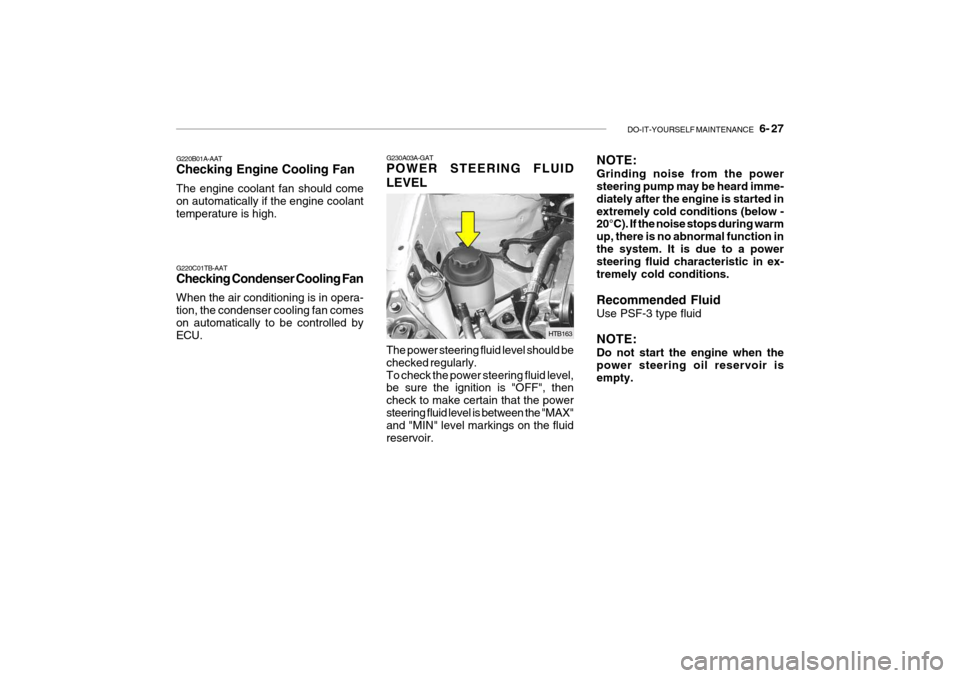
NOTE: Grinding noise from the power steering pump may be heard imme- diately after the engine is started inextremely cold conditions (below - 20°C). If the noise stops during warm up, there is no abnormal function inthe system. It is due to a power steering fluid characteristic in ex- tremely cold conditions. Recommended Fluid Use PSF-3 type fluid NOTE: Do not start the engine when the power steering oil reservoir is empty.G230A03A-GAT POWER STEERING FLUID LEVEL The power steering fluid level should be checked regularly.To check the power steering fluid level, be sure the ignition is "OFF", then check to make certain that the powersteering fluid level is between the "MAX" and "MIN" level markings on the fluid reservoir. HTB163
G220B01A-AAT Checking Engine Cooling Fan The engine coolant fan should come on automatically if the engine coolanttemperature is high. G220C01TB-AAT Checking Condenser Cooling Fan When the air conditioning is in opera- tion, the condenser cooling fan comes on automatically to be controlled by
ECU.
Page 231 of 463
6- 36 DO-IT-YOURSELF MAINTENANCE
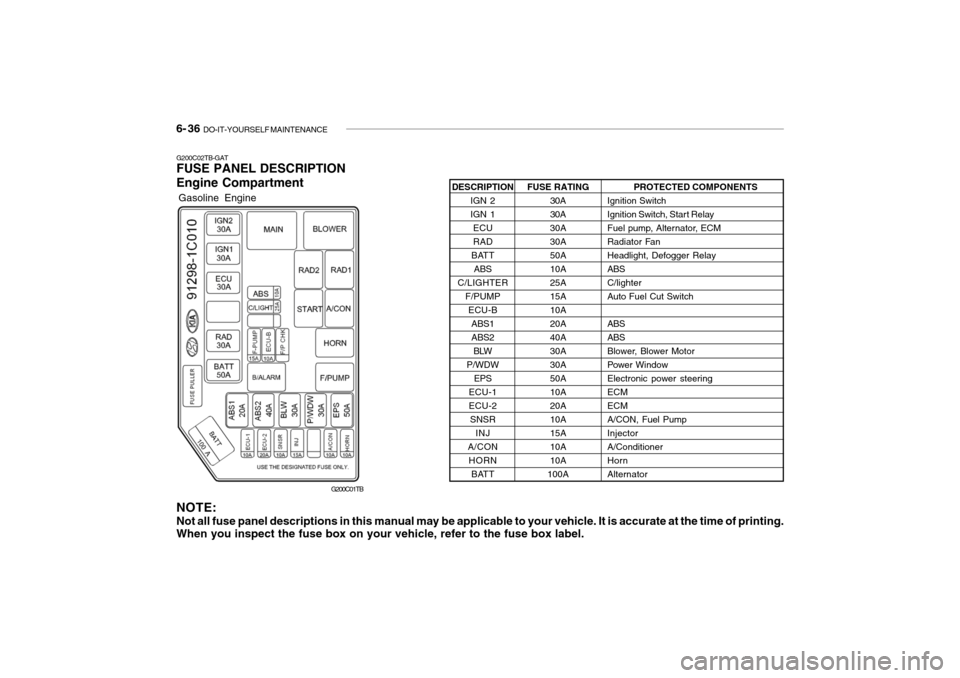
G200C02TB-GAT FUSE PANEL DESCRIPTION Engine Compartment
PROTECTED COMPONENTS
Ignition Switch
Ignition Switch, Start Relay
Fuel pump, Alternator, ECM
Radiator FanHeadlight, Defogger RelayABSC/lighterAuto Fuel Cut Switch ABS ABS
Blower, Blower Motor
Power WindowElectronic power steeringECMECMA/CON, Fuel PumpInjectorA/ConditionerHornAlternator
FUSE RATING
30A30A
30A30A50A10A25A15A10A20A40A30A30A50A10A20A10A15A10A10A
100A
DESCRIPTION
IGN 2IGN 1ECURAD
BATT ABS
C/LIGHTER F/PUMPECU-B ABS1ABS2BLW
P/WDW EPS
ECU-1ECU-2 SNSR INJ
A/CON HORN BATT
NOTE:
Not all fuse panel descriptions in this manual may be applicable to your vehicle. It is accurate at the time of printing. When you inspect the fuse box on your vehicle, refer to the fuse box label.
Gasoline Engine
G200C01TB
Page 232 of 463
DO-IT-YOURSELF MAINTENANCE 6- 37
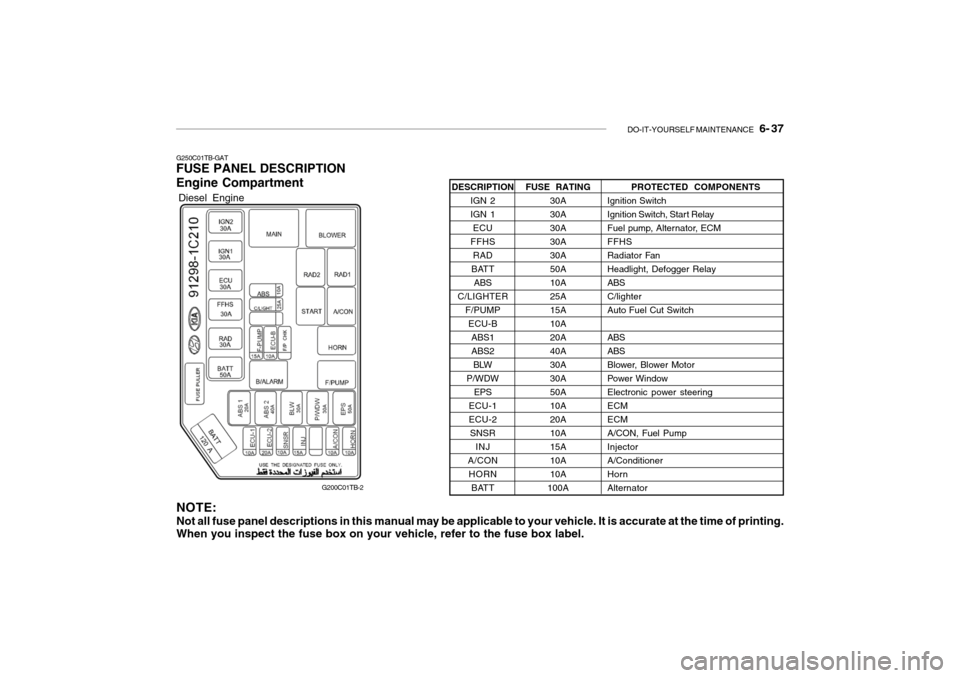
G250C01TB-GAT FUSE PANEL DESCRIPTION Engine Compartment
PROTECTED COMPONENTS
Ignition Switch
Ignition Switch, Start Relay
Fuel pump, Alternator, ECMFFHS
Radiator FanHeadlight, Defogger RelayABSC/lighterAuto Fuel Cut Switch ABS ABS
Blower, Blower Motor
Power WindowElectronic power steeringECMECMA/CON, Fuel PumpInjectorA/ConditionerHornAlternator
FUSE RATING
30A30A30A30A30A50A10A25A15A10A20A40A30A30A50A10A20A10A15A10A10A
100A
DESCRIPTION
IGN 2IGN 1ECU
FFHS RAD
BATT ABS
C/LIGHTER F/PUMPECU-BABS1ABS2BLW
P/WDW EPS
ECU-1ECU-2 SNSR INJ
A/CON HORN BATT
NOTE: Not all fuse panel descriptions in this manual may be applicable to your vehicle. It is accurate at the time of printing. When you inspect the fuse box on your vehicle, refer to the fuse box label.
Diesel Engine
G200C01TB-2
Page 233 of 463
6- 38 DO-IT-YOURSELF MAINTENANCE
PROTECTED COMPONENTS
Room Lamp, Audio, Cluster
High Beam Light Indicator, Headlight (LH)
Front Fog LightHeadlight (RH)
Rear window Defroster
Blower, Sunroof
Fog light, ETACM, Power Window,Headlight leveling Device
Rear Fog Light
Front Wiper Motor
Hazard Warning Light, ETACM
Stop Light, Power Window ECM
Rear window Defroster
Seat Warmer
Daytime Running Light
Start Relay, Theft alarm system
Rear Wiper Motor
Door Lock System, SunroofAir BagPCM, ABS control
Power outletCluster
STOP/Tail Light (RH)
Turn Signal Light, Back-up Light
Audio, Electronic Outside MirrorA/Bag, Indicator
Stop/Tail Light (LH)Air conditioner
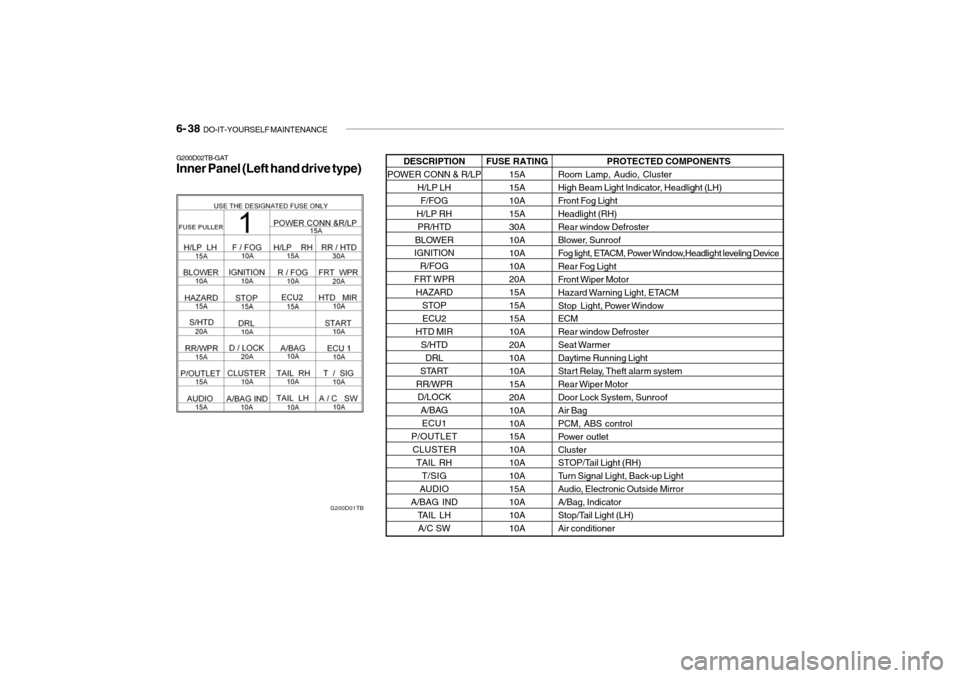
G200D02TB-GAT Inner Panel (Left hand drive type)
G200D01TBFUSE RATING15A 15A 10A 15A30A10A10A10A 20A 15A15A15A10A20A 10A 10A15A20A10A10A 15A 10A10A10A15A10A 10A 10A
DESCRIPTION
POWER CONN & R/LP
H/LP LH
F/FOG
H/LP RH PR/HTD
BLOWER
IGNITION
R/FOG
FRT WPR
HAZARD STOPECU2
HTD MIR
S/HTDDRL
START
RR/WPR D/LOCK
A/BAGECU1
P/OUTLET
CLUSTER TAIL RH T/SIG
AUDIO
A/BAG IND TAIL LH
A/C SW
Page 234 of 463
DO-IT-YOURSELF MAINTENANCE 6- 39
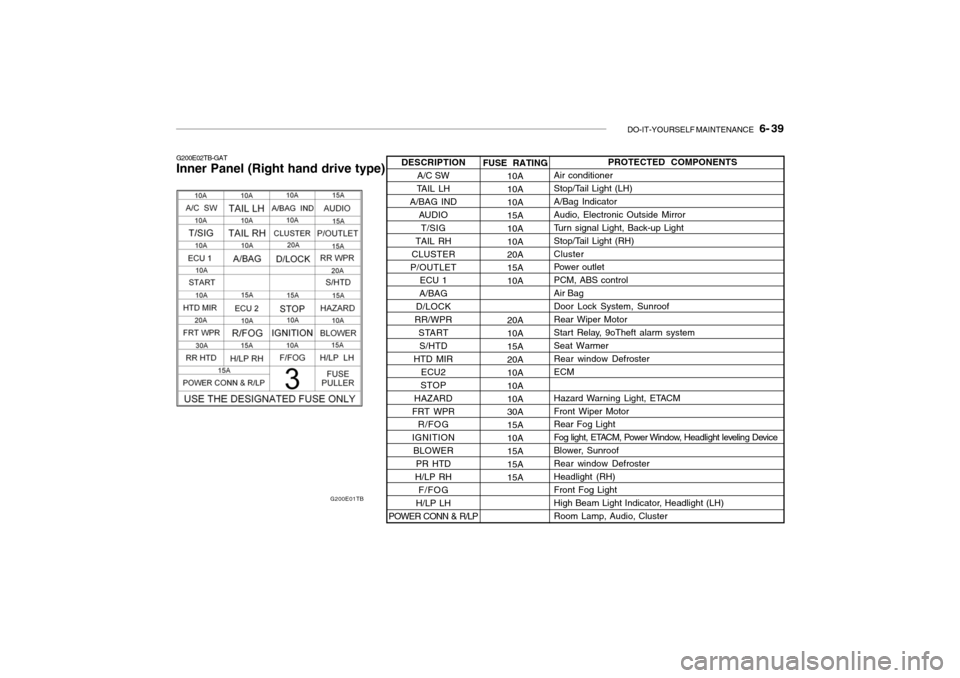
G200E02TB-GAT Inner Panel (Right hand drive type)
G200E01TBFUSE RATING10A 10A10A15A10A10A 20A 15A10A 20A 10A 15A20A10A10A10A 30A 15A10A15A15A15APROTECTED COMPONENTS
Air conditioner
Stop/Tail Light (LH) A/Bag IndicatorAudio, Electronic Outside Mirror
Turn signal Light, Back-up Light
Stop/Tail Light (RH)Cluster
Power outlet PCM, ABS controlAir BagDoor Lock System, SunroofRear Wiper Motor
Start Relay, 9oTheft alarm system Seat Warmer Rear window DefrosterECM
Hazard Warning Light, ETACM Front Wiper Motor Rear Fog Light
Fog light, ETACM, Power Window, Headlight leveling Device
Blower, SunroofRear window DefrosterHeadlight (RH)Front Fog Light
High Beam Light Indicator, Headlight (LH) Room Lamp, Audio, Cluster
DESCRIPTION
A/C SW
TAIL LH
A/BAG IND
AUDIO
T/SIG
TAIL RH
CLUSTER
P/OUTLET ECU 1
A/BAG
D/LOCK
RR/WPR STARTS/HTD
HTD MIR ECU2
STOP
HAZARD
FRT WPR R/FOG
IGNITION BLOWER PR HTD
H/LP RH F/FOG
H/LP LH
POWER CONN & R/LP
Page 272 of 463
1- 6 FEATURES OF YOUR HYUNDAI
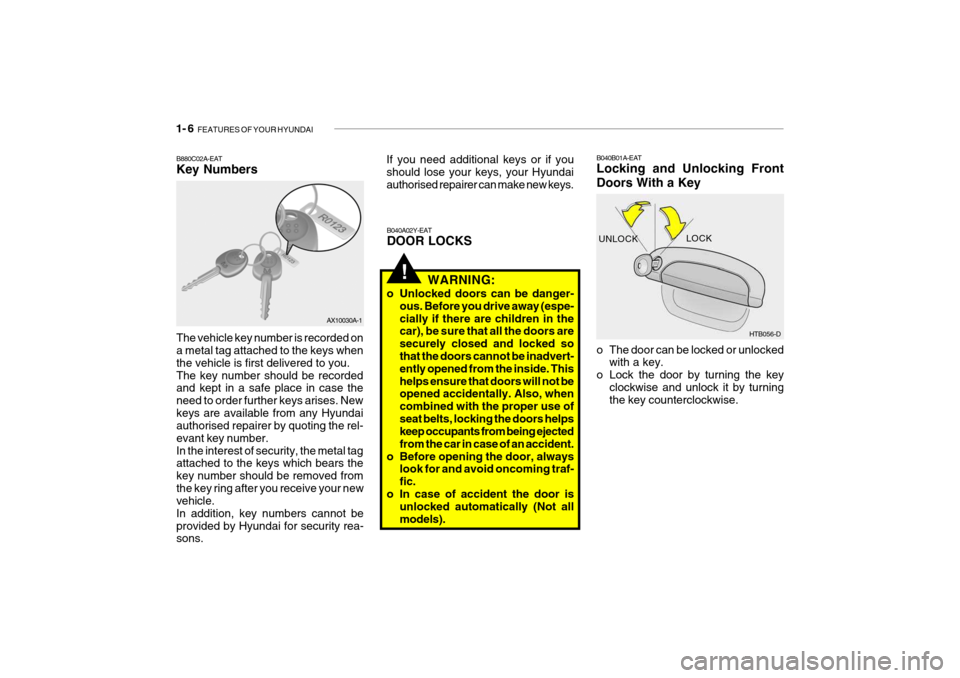
B040B01A-EAT Locking and Unlocking Front Doors With a Key
o The door can be locked or unlocked
with a key.
o Lock the door by turning the key clockwise and unlock it by turning the key counterclockwise. LOCK
HTB056-D
UNLOCK
B880C02A-EAT Key Numbers The vehicle key number is recorded on a metal tag attached to the keys when the vehicle is first delivered to you.The key number should be recorded and kept in a safe place in case the need to order further keys arises. Newkeys are available from any Hyundai authorised repairer by quoting the rel- evant key number.In the interest of security, the metal tag attached to the keys which bears the key number should be removed fromthe key ring after you receive your new vehicle. In addition, key numbers cannot beprovided by Hyundai for security rea- sons.
AX10030A-1 If you need additional keys or if you should lose your keys, your Hyundai authorised repairer can make new keys.
B040A02Y-EAT DOOR LOCKS
!WARNING:
o Unlocked doors can be danger- ous. Before you drive away (espe- cially if there are children in the car), be sure that all the doors are securely closed and locked so that the doors cannot be inadvert- ently opened from the inside. Thishelps ensure that doors will not be opened accidentally. Also, when combined with the proper use ofseat belts, locking the doors helps keep occupants from being ejected from the car in case of an accident.
o Before opening the door, always look for and avoid oncoming traf-fic.
o In case of accident the door is unlocked automatically (Not allmodels).
Page 284 of 463
1- 18 FEATURES OF YOUR HYUNDAI
and no seat belts are available for use when the seatback is folded down. Passengers who are notproperly seated and wearing seat belts could sustain serious inju- ries or death in case of an accidentor a sudden stop.
o Objects should not extend higher
than the top of the front seatbacks.This could allow cargo to slide forward and cause injury or dam- age during sudden stops.
o When you return the folded down seatback to its upright position,always be sure to install the head- rests in their proper positions. Head restraints are important tothe safety of occupants in a rear collision. If the headrests are not installed in their proper position,serious injury or death could re- sult if a rear end collision occurs.
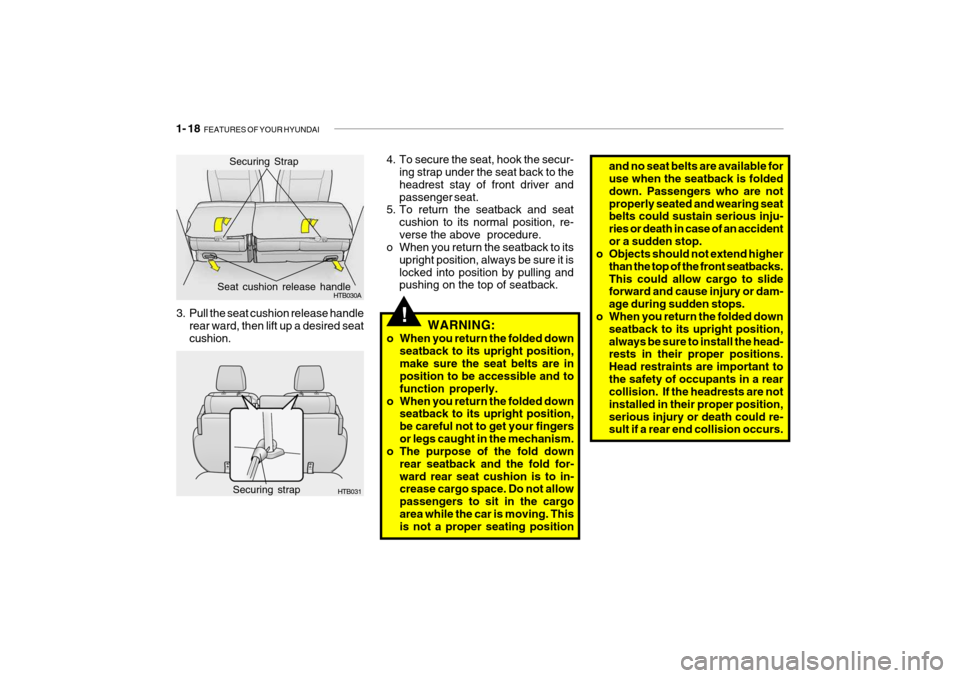
3. Pull the seat cushion release handle
rear ward, then lift up a desired seatcushion.
!WARNING:
o When you return the folded down seatback to its upright position, make sure the seat belts are in position to be accessible and to function properly.
o When you return the folded down seatback to its upright position,be careful not to get your fingersor legs caught in the mechanism.
o The purpose of the fold down
rear seatback and the fold for-ward rear seat cushion is to in- crease cargo space. Do not allow passengers to sit in the cargoarea while the car is moving. This is not a proper seating position
4. To secure the seat, hook the secur-
ing strap under the seat back to the headrest stay of front driver andpassenger seat.
5. To return the seatback and seat
cushion to its normal position, re-verse the above procedure.
o When you return the seatback to its
upright position, always be sure it islocked into position by pulling and pushing on the top of seatback.
HTB030A
Seat cushion release handle
HTB031Securing strap
Securing Strap
Page 291 of 463
FEATURES OF YOUR HYUNDAI 1- 25
B220D02TB
!
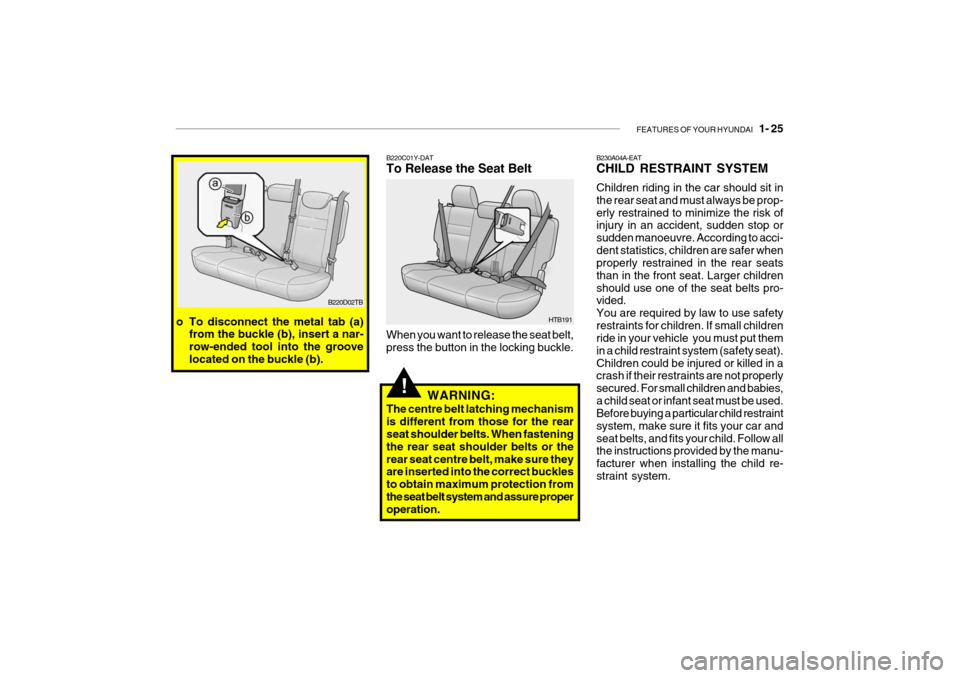
B220C01Y-DAT To Release the Seat Belt
When you want to release the seat belt, press the button in the locking buckle. HTB191
WARNING:
The centre belt latching mechanismis different from those for the rear seat shoulder belts. When fastening the rear seat shoulder belts or therear seat centre belt, make sure they are inserted into the correct buckles to obtain maximum protection fromthe seat belt system and assure proper operation. B230A04A-EAT CHILD RESTRAINT SYSTEM Children riding in the car should sit in the rear seat and must always be prop-erly restrained to minimize the risk of injury in an accident, sudden stop or sudden manoeuvre. According to acci-dent statistics, children are safer when properly restrained in the rear seats than in the front seat. Larger childrenshould use one of the seat belts pro- vided. You are required by law to use safetyrestraints for children. If small children ride in your vehicle you must put them in a child restraint system (safety seat).Children could be injured or killed in a crash if their restraints are not properly secured. For small children and babies,a child seat or infant seat must be used. Before buying a particular child restraint system, make sure it fits your car andseat belts, and fits your child. Follow all the instructions provided by the manu- facturer when installing the child re-straint system.
o To disconnect the metal tab (a)
from the buckle (b), insert a nar-row-ended tool into the groovelocated on the buckle (b).
Page 292 of 463
1- 26 FEATURES OF YOUR HYUNDAI
o Children who are too large to be in
a child restraint should sit in the rear seat and be restrained with the available lap/shoulder belts.Never allow children to ride in the front passenger seat.
o Always make sure that the shoul-
der belt portion of the outboardlap/shoulder belt is positioned midway over the shoulder, neveracross the neck or behind the back. Moving the child closer to the centre of the vehicle may helpprovide a good shoulder belt fit. The lap belt portion of the lap/ shoulder belt or the centre seat lapbelt must always be positioned as low as possible on the child's hips and as snug as possible.
o If the seat belt will not properly fit the child, Hyundai recommendsthe use of an approved boosterseat in the rear seat in order to raise the child's seating height so that the seat belt will properly fitthe child.
o Never allow a child to stand up or
kneel on the seat. o Never use an infant carrier or child
safety seat that "hooks" over a seatback; it may not provide ad- equate security in an accident.
o Never allow a child to be held in a person's arms while they are in amoving vehicle, as this could re-sult in serious injury to the child in the event of an accident or a sudden stop. Holding a child in amoving vehicle does not provide the child with any means of pro- tection during an accident, even ifthe person holding the child is wearing a seat belt.
o If the child restraint seat is not anchored properly, the risk of achild being seriously injured or killed in a collision greatly in-creases.
WARNING:
o This vehicle is equipped with air bags and you should never place a child or infant in the vehicle without the use of a Hyundai ap-proved child restraint system. Whenever possible always posi- tion the child restraint system inthe rear seat position. A Hyundai approved rear facing child seat may be positioned inthe front passenger seat when the air bag is deactivated. (Please read the appropriate section of thisOwners Handbook for a full expla- nation of its use).
o Since a safety belt or child re- straint system can become veryhot if it is left in a closed vehicle, be sure to check the seat coverand buckles before placing a child there.
o When the child restraint system is not in use, store it in the boot orfasten it with a safety belt so that it will not be thrown forward in thecase of a sudden stop or an acci- dent.!
Page 293 of 463
FEATURES OF YOUR HYUNDAI 1- 27
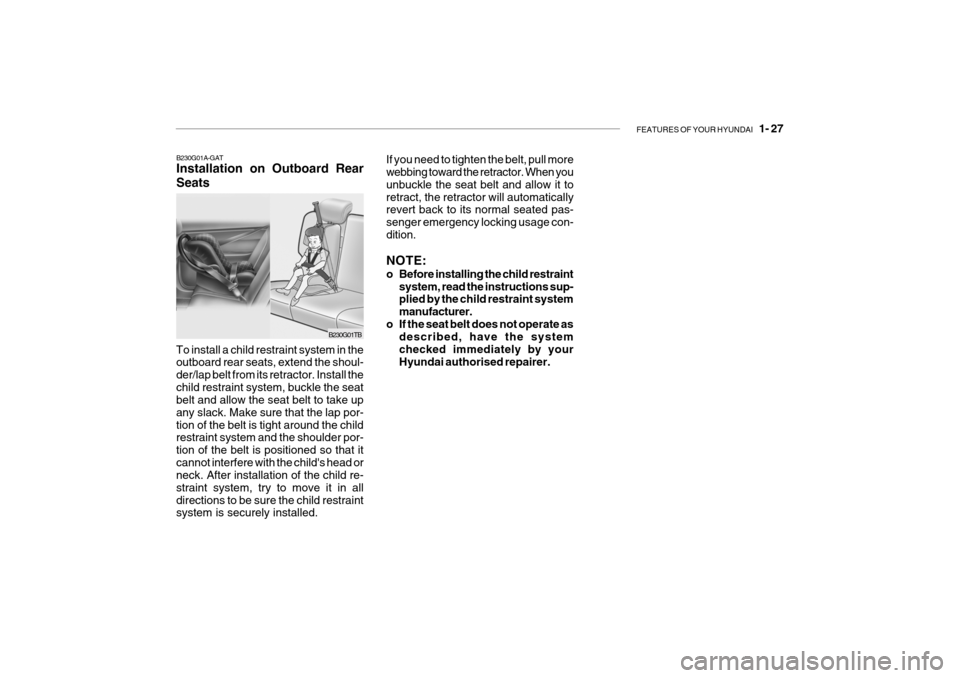
If you need to tighten the belt, pull more webbing toward the retractor. When you unbuckle the seat belt and allow it toretract, the retractor will automatically revert back to its normal seated pas- senger emergency locking usage con-dition. NOTE:
o Before installing the child restraint
system, read the instructions sup- plied by the child restraint system manufacturer.
o If the seat belt does not operate as described, have the systemchecked immediately by yourHyundai authorised repairer.
To install a child restraint system in the outboard rear seats, extend the shoul- der/lap belt from its retractor. Install thechild restraint system, buckle the seat belt and allow the seat belt to take up any slack. Make sure that the lap por-tion of the belt is tight around the child restraint system and the shoulder por- tion of the belt is positioned so that itcannot interfere with the child's head or neck. After installation of the child re- straint system, try to move it in alldirections to be sure the child restraint system is securely installed.B230G01A-GAT Installation on Outboard Rear Seats
B230G01TB