cooling Hyundai Getz 2007 Owner's Guide
[x] Cancel search | Manufacturer: HYUNDAI, Model Year: 2007, Model line: Getz, Model: Hyundai Getz 2007Pages: 463, PDF Size: 11.14 MB
Page 387 of 463
WHAT TO DO IN AN EMERGENCY 3- 5
!
D040A01TB-EAT TEMPORARY SPARE TYRE (Not all models) The following instructions for the tem- porary spare tyre should be observed:
1. Check inflation pressure as soon as
practical after installing the spare tyre, and adjust to the specifiedpressure. The tyre pressure should be periodically checked and main- tained at the specified pressurewhile the tyre is stored.
6. If the cause of the overheating can- not be found, wait until the enginetemperature has returned to normal. Then, if coolant has been lost, care- fully remove the radiator cap and addwater to bring the fluid level in the reservoir up to the base of the radia- tor fill opening. Fill the coolant ex-pansion tank to the halfway mark. To ensure the correct water to cool- ant mix is obtained after top up,testing by an authorised repairer is required. WARNING:
Do not remove the radiator cap whenthe engine is hot since steam and boiling water may be ejected fromthe radiator resulting in burns or scalding.
Inflation Pressure
Tyre Size
T105/70D14 420 kPa (60 psi)
2. The spare tyre should only be used temporarily and should be returned to the luggage compartment as soonas the original tyre can be repairered or replaced.
3. Continuous use at speeds of over 50 mph(80 km/h) is not recom-mended.
4. As the temporary spare tyre is spe- cifically designed for your car, itshould not be used on any other vehicle.
Spare Tyre Pressure
5. If the water pump drive belt is broken
or coolant is leaking out, stop theengine immediately and call the near-est Hyundai authorised repairer for assistance.
! CAUTION:
Serious loss of coolant indicates there is a leak in the cooling system and this should be checked as soonas possible by a Hyundai authorised repairer.
7. Proceed with caution until it is estab-
lished that the engine is operating normally. If the engine overheatsrepeatedly, the advice of a Hyundai authorised repairer should be sought.
Page 406 of 463

VEHICLE MAINTENANCE REQUIREMENTS 5- 5
F030C02TB-EAT R : Replace I : Inspect and, after inspection, clean, adjust, repairer or replace if necessary
GENERAL MAINTENANCE COOLING SYSTEMCOOLANTCOOLANT SPECIFIC GRAVITYMANUAL TRANSAXLE OILAUTOMATIC TRANSAXLE FLUIDBRAKE PIPES, HOSES, AND CONNECTIONSBRAKE FLUIDCLUTCH FLUIDREAR BRAKE LININGS AND CYLINDERSBRAKE PADSSUSPENSION AND STEERING SYSTEMFRONT SUSPENSION BALL JOINTSPOLLEN FILTER (FOR EVAPORATOR AND BLOWER UNIT)REAR WHEEL BEARINGSTYRE CONDITION AND PRESSURE (incl. Spare)LUBRICATE LOCKS AND HINGESCHECK ALL ELECTRICAL SYSTEMSROAD TESTCHECK ALL SYSTEMS WITH HI-SCAN
60 72
5060
4048
I I I
R
I
RR II I I
R III I II
I I I IIIII I II
R II I III
I I I II
RR I I II
R II I III
30 36
2024
I I I IIIII I II
R II I III
I I I II
RR I I II
R II I III
10 12
I I I IIIII I II
R II I III
MILES X 1000MONTHS
NO. DESCRIPTION
1 23456789
10111213141516171819
See Note (1)
Note :(1) FOR THE FIRST TIME, REPLACE THE COOLANT AT 60,000 MILES OR 60 MONTHS. AFTER THAT, REPLACE IT EVERY 30,000 MILES OR 24 MONTHS.
Page 410 of 463

VEHICLE MAINTENANCE REQUIREMENTS 5- 9
F070C01A-AAT
o Engine coolant
The coolant should be changed at
the intervals specified in the mainte- nance schedule. F070B01A-GAT
o Cooling system
Check the cooling system part, suchas radiator, coolant reservoir, hoses and connections for leakage and dam- age. Replace any damaged parts. F070D01A-AAT
o Manual transaxle oil
Inspect the manual transaxle oil ac- cording to the maintenance schedule.
NOTE: If the oil level is low, check forpossible leaks before adding oil. Do not overfill. F070F01A-AAT
o Brake hoses and lines
Visually check for proper installation,
chafing, cracks, deterioration and any leakage. Replace any deteriorated or damaged parts immediately. F070G02A-AAT o Brake fluid Check brake fluid level in the brake fluid reservoir. The level should be between "MIN" and "MAX" marks on the side of the reservoir. Use onlyhydraulic brake fluid conforming to DOT 3 or DOT 4. F070H01B-AAT o Rear brake drums and linings/ parking brake Check the rear brake drums and lin- ings for scoring, burning, leaking fluid, broken parts, and excessive wear. Inspect the parking brake system in-cluding the parking brake lever and cables. For detailed service proce- dures, refer to the Shop Manual.
F070E05A-AAT
o Automatic Transaxle Fluid
The fluid level should be in the "HOT"
range of the dipstick, after the engine and transaxle are at normal operating temperature. Check the automatictransaxle fluid level with the engine running and the transaxle in neutral, with the parking brake properly ap-plied. Use Hyundai Genuine ATF SP- III, DIAMOND ATF SP-III, SK ATF SP-III or other brands approved byHyundai Motor Co., when adding or changing fluid.
Page 416 of 463
DO-IT-YOURSELF MAINTENANCE 6- 5
!
G020D01TG-EAT MAINTENANCE PRECAUTIONS Improper or incomplete service may result in problems. This section givesinstructions only for the maintenance items that are easy to perform. Several procedures should be done byan authorised Hyundai dealer. NOTE: Improper owner maintenance dur- ing the warranty period may affectwarranty coverage. WARNING:
o Performing maintenance work on a vehicle can be dangerous. You can be seriously injured while performing some maintenanceprocedures. If you lack sufficient knowledge and experience or the proper tools and equipment to dothe work, have it done by an authorised Hyundai dealer.
o Working under the hood with the engine running is dangerous. Itbecomes even more dangerous when you wear jewelry or looseclothing. These can become en- tangled in moving parts and result in injury. Therefore, if you mustrun the engine while working un- der the hood, make certain that you remove all jewelry (especiallyrings, bracelets, watches, and necklaces) and all neckties, scarves, and similar loose cloth-ing before getting near the engine or cooling fans.
SG020B1-E DAILY OPERATING CHECKS The following items should be checked on a daily basis or whenever the vehicleis refuelled, whichever occurs sooner.
o Engine oil level.
o Engine coolant level.
o Power steering fluid level.
o Brake fluid level.
o Windscreen washer fluid level.
o Battery condition.
o Tyre condition and pressures.
o Operation and cleanliness of all light-
ing equipment.
o Windscreen wiper and washer opera- tion.
o Horn operation.
o Warning light operation.
o Adjustment and cleanliness of mir- rors.
o Seat and seat belt adjustment and operation.
o Fluid leakage. The vehicle must not be driven if the daily operating checks indicate that any item of equipment related to thesafety or roadworthiness of the vehicle is not functioning correctly.
Page 420 of 463
DO-IT-YOURSELF MAINTENANCE 6- 9
o The engine oil consumption is strongly
effected by the viscosity and quality of oil, engine rpm and driving condi-tion etc. More engine oil may be consumed under severe driving conditions suchas high speeds, frequent accelera- tion and deceleration, compared to normal driving.
ZG030E1-E ENGINE OIL CONSUMPTION Function of engine oil Engine oil has the primary function of lubricating and cooling the inside of the engine. Engine oil consumption It is normal that an engine should con- sume some engine oil while normal driving. The cause of oil consumption in a normal engine are as follows;
o Engine oil is used to lubricate pis-
tons, piston rings and cylinders. A thin film of oil is left on the cylinder wall when a piston moves down- wards in the cylinder. High negativepressure generated during engine operation sucks some of the oil into the combustion chamber.This oil with some oil of the cylinder wall is burned by the high tempera- ture combustion gases during thecombustion process.
!
SG050A2-E ENGINE COOLANT CHECKING
WARNING:
Do not remove the radiator cap when the engine is hot, since the system is pressurized and coolant may beejected from the radiator resulting in scalding. NOTE: It is recommended that the engine coolant should be changed by an authorised Hyundai dealer.
Page 421 of 463
6- 10 DO-IT-YOURSELF MAINTENANCE
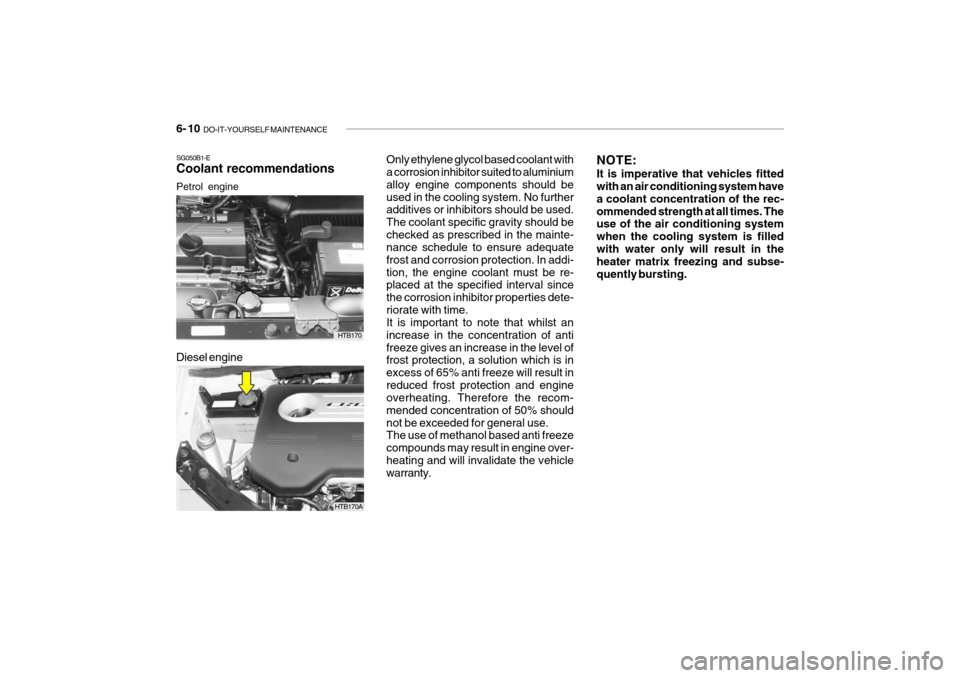
Diesel engine Only ethylene glycol based coolant with a corrosion inhibitor suited to aluminium alloy engine components should beused in the cooling system. No further additives or inhibitors should be used. The coolant specific gravity should bechecked as prescribed in the mainte- nance schedule to ensure adequate frost and corrosion protection. In addi-tion, the engine coolant must be re- placed at the specified interval since the corrosion inhibitor properties dete-riorate with time. It is important to note that whilst an increase in the concentration of antifreeze gives an increase in the level of frost protection, a solution which is in excess of 65% anti freeze will result inreduced frost protection and engine overheating. Therefore the recom- mended concentration of 50% shouldnot be exceeded for general use. The use of methanol based anti freeze compounds may result in engine over-heating and will invalidate the vehicle warranty.
Petrol engine
SG050B1-E Coolant recommendations
HTB170
HTB170A NOTE: It is imperative that vehicles fitted with an air conditioning system have a coolant concentration of the rec-ommended strength at all times. The use of the air conditioning system when the cooling system is filledwith water only will result in the heater matrix freezing and subse- quently bursting.
Page 422 of 463
DO-IT-YOURSELF MAINTENANCE 6- 11
SG050C2-E Engine Coolant Level The engine coolant level may be ob- served through the side of the plasticcoolant reservoir (expansion tank) when the engine is cold. If the level is below the "LOW" mark, add coolant of thecorrect concentration until the level is between the "LOW" and "Full" marks. If the level falls below the "LOW" mark ona regular basis despite being topped up, consult a Hyundai authorised repairer.
!WARNING:
The cooling fan is controlled by en- gine coolant temperature and may sometimes operate even when theengine is not running. Use extreme caution when working near the blades of the cooling fan so that youare not injured by a rotating fan blade. As the engine coolant tem- perature decreases, the fan will auto-matically shut off. This is a normal condition.
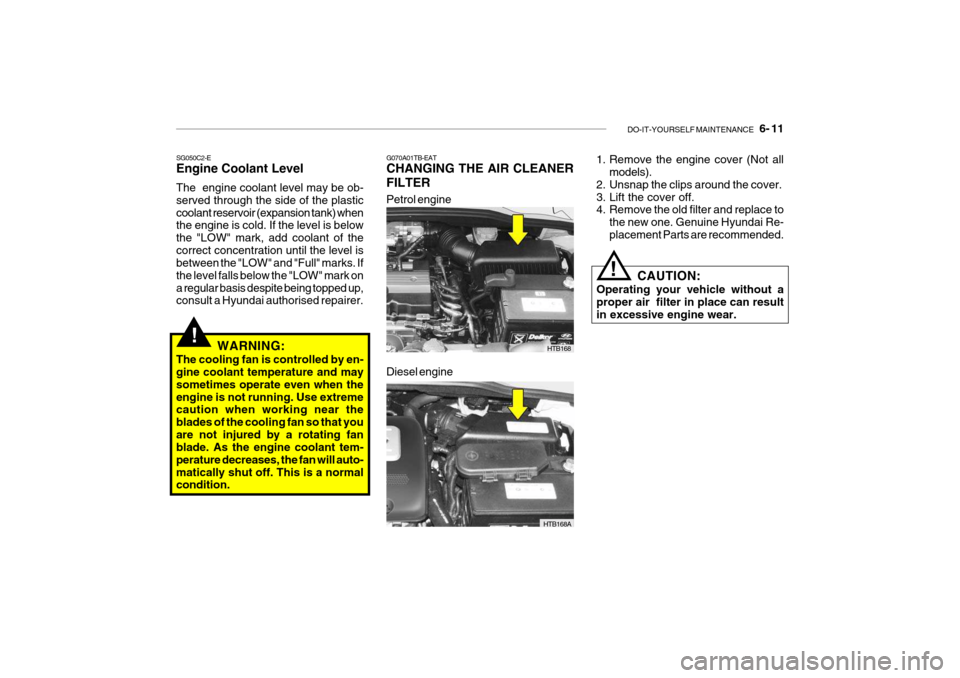
Petrol engine
HTB168
G070A01TB-EAT CHANGING THE AIR CLEANER FILTER
1. Remove the engine cover (Not all
models).
2. Unsnap the clips around the cover.
3. Lift the cover off.
4. Remove the old filter and replace to the new one. Genuine Hyundai Re- placement Parts are recommended.
CAUTION:
Operating your vehicle without aproper air filter in place can result in excessive engine wear.
!
Diesel engine
HTB168A
Page 427 of 463
6- 16 DO-IT-YOURSELF MAINTENANCE
if it touch the body. People using pacemakers should not move than 30cm closer to the ECU or wiringharness within the engine room while engine is running, since the high currents in the Common Rail systemproduce considerable magnetic fields.
!
CAUTION:
The automatic transaxle unit is a precision engineered assembly and correct operation is dependant uponthe exclusion of dirt and lint from the unit. Therefore, it is imperative that only lint free cloth (eg nylon) is usedfor wiping the dipstick and that the area around the dipstick is thor- oughly clean prior to level checkingor adding fluid. Fluid Capacity The total fluid capacity of the transaxle unit is 6.1 litres.
!
!
C090A03FC
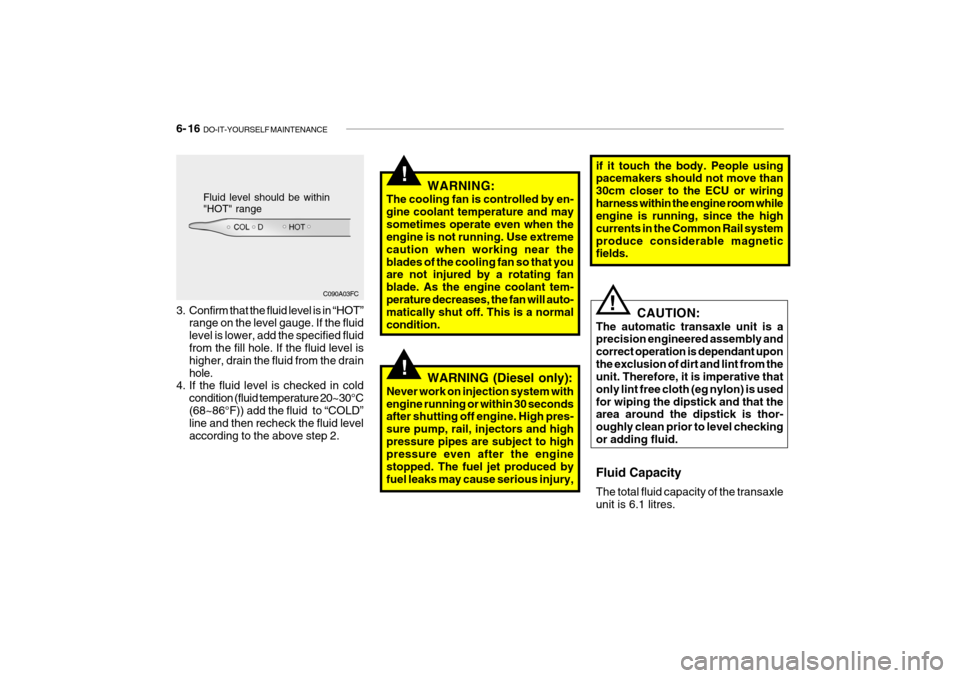
Fluid level should be within "HOT" range
3. Confirm that the fluid level is in “HOT” range on the level gauge. If the fluid level is lower, add the specified fluid from the fill hole. If the fluid level is higher, drain the fluid from the drainhole.
4. If the fluid level is checked in cold
condition (fluid temperature 20~30°C(68~86°F)) add the fluid to “COLD” line and then recheck the fluid level according to the above step 2. WARNING:
The cooling fan is controlled by en-gine coolant temperature and maysometimes operate even when the engine is not running. Use extreme caution when working near theblades of the cooling fan so that you are not injured by a rotating fan blade. As the engine coolant tem-perature decreases, the fan will auto- matically shut off. This is a normal condition.
WARNING (Diesel only):
Never work on injection system withengine running or within 30 seconds after shutting off engine. High pres- sure pump, rail, injectors and highpressure pipes are subject to high pressure even after the engine stopped. The fuel jet produced byfuel leaks may cause serious injury,
Page 434 of 463
DO-IT-YOURSELF MAINTENANCE 6- 23
!
SG220A1-E ELECTRIC COOLING FANS
WARNING:
The cooling fan is controlled by en- gine coolant temperature and maysometimes operate even when the engine is not running. Use extreme caution when working near theblades of the cooling fan so that you are not injured by a rotating fan blade. As the engine coolant tem-perature decreases, the fan will auto- matically shut off. This is a normal condition. The engine cooling fan should operate before the temperature gauge reachesthe upper portion of the scale and the condenser fan should operate when- ever the air conditioning is in use. SG230B1-E POWER STEERING HOSES Power steering hoses should be checked for damage, deterioration and leakage at each service.
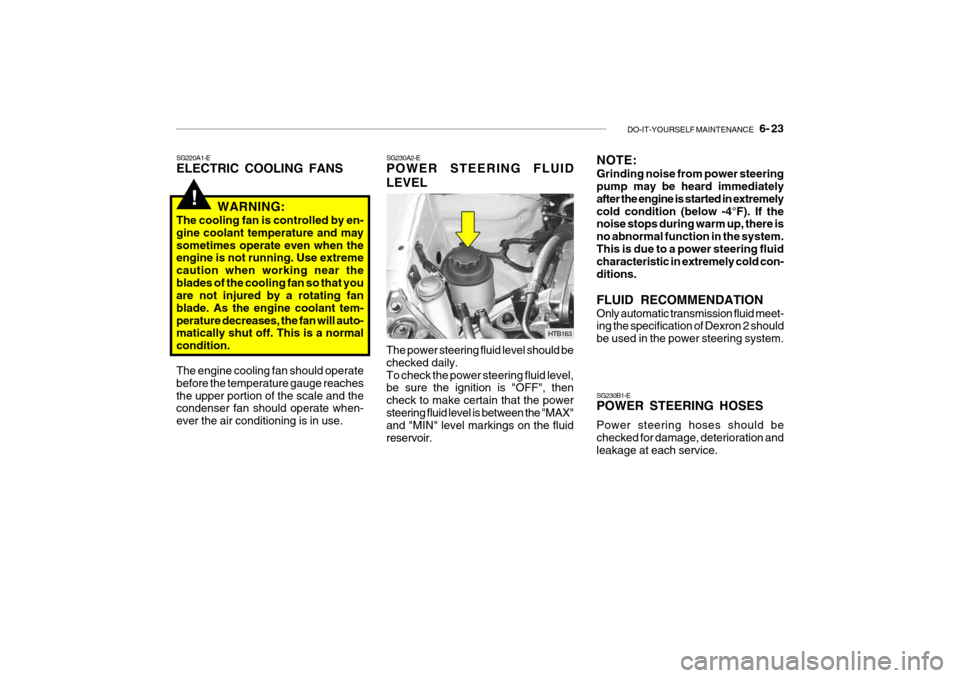
NOTE: Grinding noise from power steering pump may be heard immediately after the engine is started in extremelycold condition (below -4°F). If the noise stops during warm up, there is no abnormal function in the system.This is due to a power steering fluid characteristic in extremely cold con- ditions. FLUID RECOMMENDATION Only automatic transmission fluid meet- ing the specification of Dexron 2 should be used in the power steering system.SG230A2-E POWER STEERING FLUID LEVEL The power steering fluid level should be checked daily.To check the power steering fluid level, be sure the ignition is "OFF", then check to make certain that the powersteering fluid level is between the "MAX" and "MIN" level markings on the fluid reservoir.
HTB163
Page 460 of 463

10- 2 INDEX
A
ACTIVE HEADRESTS ................................................ 1-14
ADJUSTING ARMREST ............................................. 1-15
ADJUSTING HEAD RESTRAINTS............................. 1-13
AIR BAG ..................................................................... 1-34
AIR CONDITIONING SWI TCH .................................... 1-89
AIR CONDITIONI NG SYSTEM MAINTENANCE ........ 6-18
AIR CLEANER FILTER ............................................... 6-11
ANTENNA ................................................................... 1-94
ANTI-LOCK BRAKE SYSTEM .................................... 2-14
ANTI-THEFT ALARM SYSTEM ................................... 1-8
ASHTRAY ................................................................... 1-64
AUDIO REMOTE CONTROL SW ITCH ........................1-82
AUTOMATIC TRANSAXLE ......... ................................. 2-9
AUTOMATIC TRANSAXLE FLUID ..............................6-15
B
BATTERY MAINTENANCE ........................................ 6-22
BEFORE STARTING THE ENGINE ............................ 2-3
BONNET REL EASE ................................................... 1-73
BRAKE SYSTEM CHECKI NG .................................... 6-17
CCARE OF SEAT BELTS ............................................. 1-21
CARGO AREA COVER .............................................. 1-77CATALYTIC CONVERTOR OPERATING
PRECAUTIONS ....................................................... 7-3
CENTRAL DOOR LOCKS ............................................ 1-7
CHANGING A FLAT TYRE .......................................... 3-6
CHILD-PROOF REAR DOOR LOCK ............................ 1-8
CHILD RESTRAINT SYSTEM .................................... 1-25
CIGAR LIGHTER ........................................................ 1-62
COMBINATION IGNITION SWITCH AND STEERING LOCK ................................................... 2-3
CONSOLE TRAY ........................................................ 1-64
DDAILY OPERATING CHECKS ..................................... 6-5
DIGITAL CLOCK ......................................................... 1-62
DOOR LOCKS ............................................................. 1-6
DOOR WINDOWS ...................................................... 1-11
DRINK HOLDER ......................................................... 1-64
DRIVE BELTS ............................................................ 6-20
DRIVING FOR ECONOMY ......................................... 2-15
EEFFECTIVE BRA KING............................................. 2-13
ELECTRIC COOLING FANS ....................................... 6-23
ELECTRONIC STABILITY PROGRAM .......................2-14
EMERGENCY TOWING ............................................. 3-12
EMISSION CONTROL SYSTEM ................................. 7-2