wheel Hyundai Getz 2007 Repair Manual
[x] Cancel search | Manufacturer: HYUNDAI, Model Year: 2007, Model line: Getz, Model: Hyundai Getz 2007Pages: 463, PDF Size: 11.14 MB
Page 394 of 463
3- 12 WHAT TO DO IN AN EMERGENCY
!
!
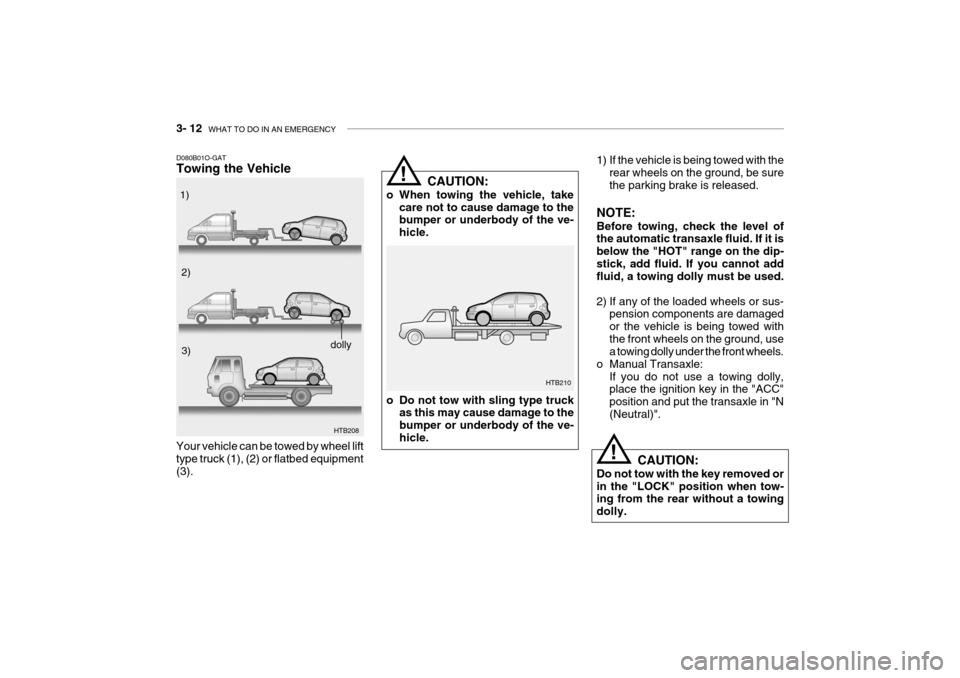
1) If the vehicle is being towed with the
rear wheels on the ground, be sure the parking brake is released.
NOTE: Before towing, check the level of the automatic transaxle fluid. If it is below the "HOT" range on the dip-stick, add fluid. If you cannot add fluid, a towing dolly must be used.
2) If any of the loaded wheels or sus- pension components are damaged or the vehicle is being towed withthe front wheels on the ground, use a towing dolly under the front wheels.
o Manual Transaxle:
If you do not use a towing dolly,place the ignition key in the "ACC" position and put the transaxle in "N(Neutral)".
CAUTION:
Do not tow with the key removed orin the "LOCK" position when tow- ing from the rear without a towing dolly.
CAUTION:
o When towing the vehicle, take care not to cause damage to the bumper or underbody of the ve- hicle.
o Do not tow with sling type truck as this may cause damage to thebumper or underbody of the ve-hicle. HTB210
D080B01O-GAT Towing the Vehicle
HTB208
Your vehicle can be towed by wheel lift type truck (1), (2) or flatbed equipment (3). 1)
2)
3)
dolly
Page 395 of 463
WHAT TO DO IN AN EMERGENCY 3- 13
HTB209
!
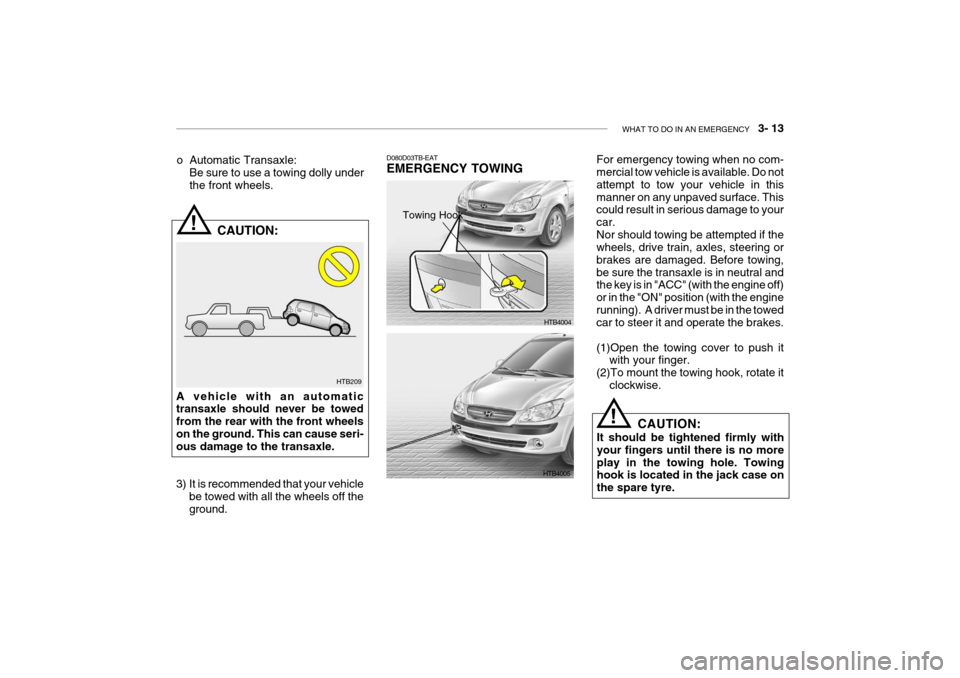
o Automatic Transaxle:
Be sure to use a towing dolly under the front wheels.
CAUTION:
A vehicle with an automatic transaxle should never be towed from the rear with the front wheelson the ground. This can cause seri- ous damage to the transaxle.
3) It is recommended that your vehicle be towed with all the wheels off the ground.
D080D03TB-EAT EMERGENCY TOWING For emergency towing when no com- mercial tow vehicle is available. Do not attempt to tow your vehicle in thismanner on any unpaved surface. This could result in serious damage to your car.Nor should towing be attempted if the wheels, drive train, axles, steering or brakes are damaged. Before towing,be sure the transaxle is in neutral and the key is in "ACC" (with the engine off) or in the "ON" position (with the enginerunning). A driver must be in the towed car to steer it and operate the brakes. (1)Open the towing cover to push it
with your finger.
(2)To mount the towing hook, rotate it clockwise.
HTB4004
HTB4005 CAUTION:
It should be tightened firmly with your fingers until there is no moreplay in the towing hole. Towing hook is located in the jack case on the spare tyre.
!
Towing Hook
Page 396 of 463

3- 14 WHAT TO DO IN AN EMERGENCY
D120A01A-EAT IF YOU LOSE YOUR KEYS Information about the key of immobiliser system will be found on page 1-4. CAUTION:
If the car is being towed with all four wheels on the ground, it can be towed only from the front. Be sure that the transaxle is in neu-tral. Do not tow at speeds greater
than 30 mph (50 km/h) and for more
than 15 miles(25 km).Be sure the steering is unlocked by placing the key in the "ACC" posi- tion.
!
(3)Attach a tow cable, chain or strap to
the towing hook on the front bumper.
Page 398 of 463

4- 2 CORROSION PREVENTION AND APPEARANCE CARE
SE020A1-E PROTECTING YOUR HYUNDAI FROM CORROSION By using the most advanced design and construction practices, every Hyundai is built to retain the originalfactory finish for many years. How- ever, long term durability is also greatly dependant upon maintaining the vari-ous protection systems and coatings used in manufacture since constant, exposure to the elements will result ina breakdown and loss of effective- ness. The following suggestions are made to assist in the maintenance ofthe vehicle bodywork. SE030A1-E UNDERBODY COATINGS Every Hyundai passenger car receives a full underbody and cavity injectiontreatment during production. In order that this treatment may retain maxi- mum effectiveness it is recommendedthat the underbody receives a power wash and a thorough inspection after each winter season. In doing so anyaccumulations of mud, which act as moisture traps and combine with road salts to accelerate corrosion will beremoved. In order to maintain the Anti Perforation Warranty, the requirements regarding the retreatment programmemust be observed in accordance with the Terms and Conditions outlined in the separate Anti Perforation WarrantyBooklet. NOTE: The underbody should never be steam cleaned since the underbody coating may be removed by thisprocess. During the interim period between power washing the underbody, themore vulnerable areas such as wheel arches should be hosed off particularly during the winter sea-son to prevent prolonged contact with road salts. Ensure that the various drain pointslocated at the bottom of the door panels and sills are kept clear to prevent water from becomingtrapped within the cavities. Wher- ever possible, the parking of the vehicle in a confined, poorly venti-lated location (a garage for example) should be avoided when the ve- hicle is wet or is covered with snowor ice. Under these conditions, the internal cavities of the vehicle will remain damp for prolonged peri-ods of time which will encourage corrosion. Parking the vehicle where good ventilation exists (out-side for example) is preferable.
Page 399 of 463
CORROSION PREVENTION AND APPEARANCE CARE 4- 3
SE040A2-E VALETING Regular cleaning of the exterior paintwork serves two important func-tions. Firstly, the removal of abrasive dirt and contaminants will maintain the lustre of the paintwork and will preventdiscolouration and dulling due to pro- longed contact. Secondly, the presence of damagethrough impact or abrasion will be ap- parent allowing early rectification to be made thus preventing corrosion frombecoming established and spreading beneath the paint film. To avoid "water spotting" the vehicle should not bewashed in direct sunlight particularly in the case of vehicles having dark body colours. The heat from the sun rays isabsorbed by the paint film increasing the surface temperature. This action causes water used for washing toevaporate quickly leaving behind the deposits from the water and the sham- poo used.Use only a shampoo intended for the purpose and ensure that the body work is thoroughly wet to soften the dirt filmprior to attempting to remove this. After removing the dirt film with a soft sponge, the body work should be thor- oughly rinsed and then dried with agood quality chamois leather to pre- vent streaking or spotting of the paint work.Household detergents, solvents and abrasive cleaning materials should not be used in order to avoid damaging thepaint film. Plastic wheel covers should be cleaned using a sponge and water. Cast alloywheels should be cleaned using a mild soap or neutral detergent. Abrasive compounds must not be used since inthe event of these damaging the lac- quer coating, oxidization of the alu- minium wheel will occur, spoiling theappearance. The use of a toothbrush will facilitate cleaning between the wheel "spokes".
CAUTION:
!
OJB037800
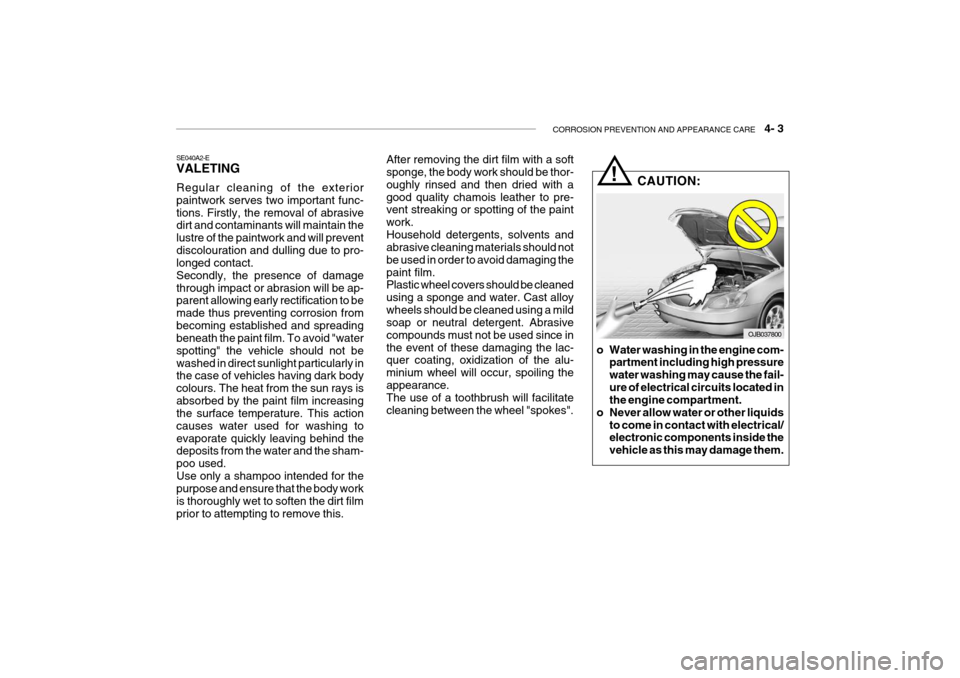
o Water washing in the engine com- partment including high pressure water washing may cause the fail-ure of electrical circuits located in the engine compartment.
o Never allow water or other liquids to come in contact with electrical/electronic components inside the vehicle as this may damage them.
Page 406 of 463

VEHICLE MAINTENANCE REQUIREMENTS 5- 5
F030C02TB-EAT R : Replace I : Inspect and, after inspection, clean, adjust, repairer or replace if necessary
GENERAL MAINTENANCE COOLING SYSTEMCOOLANTCOOLANT SPECIFIC GRAVITYMANUAL TRANSAXLE OILAUTOMATIC TRANSAXLE FLUIDBRAKE PIPES, HOSES, AND CONNECTIONSBRAKE FLUIDCLUTCH FLUIDREAR BRAKE LININGS AND CYLINDERSBRAKE PADSSUSPENSION AND STEERING SYSTEMFRONT SUSPENSION BALL JOINTSPOLLEN FILTER (FOR EVAPORATOR AND BLOWER UNIT)REAR WHEEL BEARINGSTYRE CONDITION AND PRESSURE (incl. Spare)LUBRICATE LOCKS AND HINGESCHECK ALL ELECTRICAL SYSTEMSROAD TESTCHECK ALL SYSTEMS WITH HI-SCAN
60 72
5060
4048
I I I
R
I
RR II I I
R III I II
I I I IIIII I II
R II I III
I I I II
RR I I II
R II I III
30 36
2024
I I I IIIII I II
R II I III
I I I II
RR I I II
R II I III
10 12
I I I IIIII I II
R II I III
MILES X 1000MONTHS
NO. DESCRIPTION
1 23456789
10111213141516171819
See Note (1)
Note :(1) FOR THE FIRST TIME, REPLACE THE COOLANT AT 60,000 MILES OR 60 MONTHS. AFTER THAT, REPLACE IT EVERY 30,000 MILES OR 24 MONTHS.
Page 411 of 463

5- 10 VEHICLE MAINTENANCE REQUIREMENTS
F070P01HP-AAT
o Driveshafts and boots
Check the drive shafts, boots and
clamps for cracks, deterioration, or damage. Replace any damaged parts and, if necessary, repack the grease.
F070Q01A-AAT
o Air conditioning refrigerant
Check the air conditioning lines and
connections for leakage and damage. Check air conditioning performance according to the relevant shop manualif necessary.
F070J01A-AAT
o Brake pads, calipers and
rotors
Check the pads for excessive wear,discs for run out and wear, and cali-pers for fluid leakage. F070K01A-AAT
o Exhaust pipe and muffler
Visually inspect the exhaust pipes, muffler and hangers for cracks, dete- rioration, or damage. Start the engine and listen carefully for any exhaust gas leakage. Tighten connections or replace parts as necessary. F070L01A-AAT o Suspension mounting bolts Check the suspension connections for looseness or damage. Retightento the specified torque. F070M01O-AAT
o Steering gear box, linkage &
boots/lower arm ball joint
With the vehicle stopped and engineoff, check for excessive freeplay inthe steering wheel.Check the linkage for bends or dam-age. Check the dust boots and ball joints for deterioration, cracks, or dam- age. Replace any damaged parts. F070N01A-AAT
o Power steering pump, belt and
hoses
Check the power steering pump and hoses for leakage and damage. Re- place any damaged or leaking partsimmediately. Inspect the power steer- ing belt for evidence of cuts, cracks, excessive wear, oiliness and propertension. Replace or adjust it if neces- sary.
Page 449 of 463

8. CONSUMER INFORMATION
Vehicle Identification Number (VIN) ............................................... 8-2
Engine number ................................................................................. 8-2
Tyre pressures ................................................................................. 8-3
Snow tyres ....................................................................................... 8-4
Tyre chains ...................................................................................... 8-4
Tyre rotation ..................................................................................... 8-4
Tyre balancing .................................................................................. 8-5
Tyre Replacement ............................................................................ 8-5
Wheel Replacement ......................................................................... 8-6
Spare tyre and tools ......................................................................... 8-6
8
Page 452 of 463
8- 4 CONSUMER INFORMATION
!
I050A01TB-EAT TYRE CHAINS Tyre chains, if necessary, should be installed on the front wheels. Be surethat the chains are the proper size and that they are installed in accordance with the manufacturer's instructions.To minimize tyre and chain wear, do not continue to use tyre chains when they are no longer needed.
SI030A2-E SNOW TYRES If it is desired to fit snow tyres to the vehicle, it must be ascertained that theoriginal size and load carrying capacity are met by the replacement tyres. When using snow tyres, the vehicle shouldnot be driven at speeds in excess of 60 MPH.
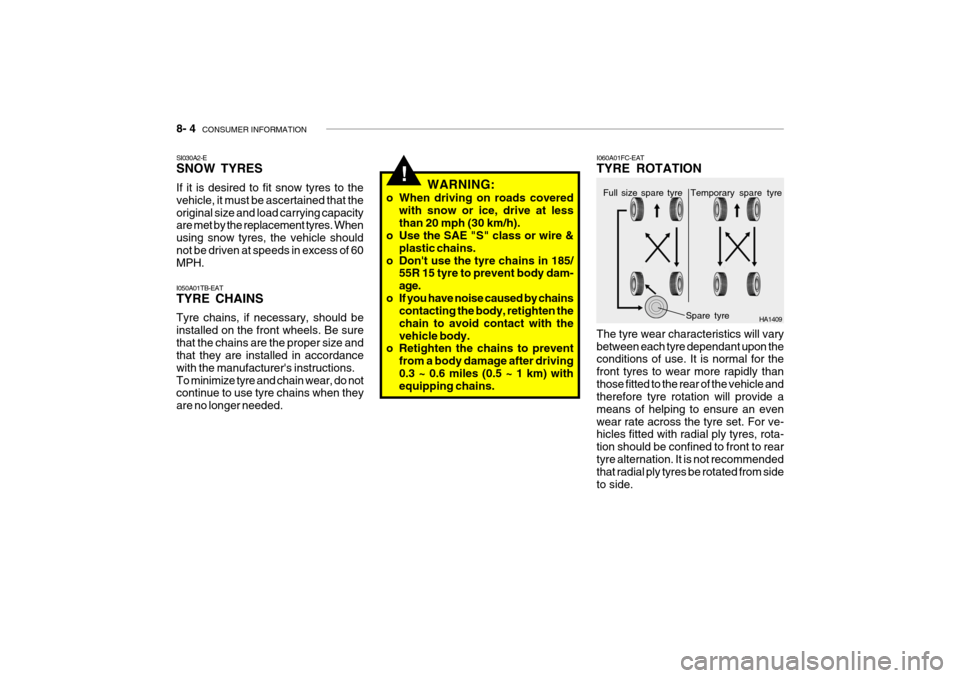
I060A01FC-EAT TYRE ROTATION The tyre wear characteristics will vary between each tyre dependant upon the conditions of use. It is normal for the front tyres to wear more rapidly thanthose fitted to the rear of the vehicle and therefore tyre rotation will provide a means of helping to ensure an evenwear rate across the tyre set. For ve- hicles fitted with radial ply tyres, rota- tion should be confined to front to reartyre alternation. It is not recommended that radial ply tyres be rotated from side to side.
WARNING:
o When driving on roads covered with snow or ice, drive at lessthan 20 mph (30 km/h).
o Use the SAE "S" class or wire &
plastic chains.
o Don't use the tyre chains in 185/ 55R 15 tyre to prevent body dam-age.
o If you have noise caused by chains contacting the body, retighten thechain to avoid contact with thevehicle body.
o Retighten the chains to prevent
from a body damage after driving0.3 ~ 0.6 miles (0.5 ~ 1 km) with equipping chains.
HA1409Spare tyre
Full size spare tyre Temporary spare tyre
Page 453 of 463
CONSUMER INFORMATION 8- 5
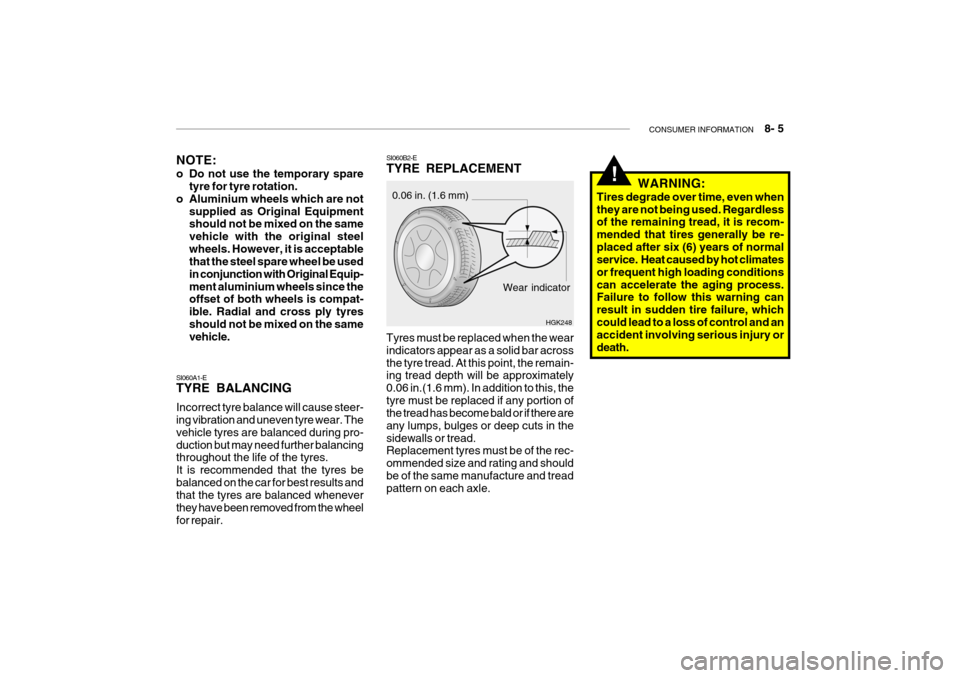
SI060B2-E TYRE REPLACEMENT
Wear indicator
0.06 in. (1.6 mm)
HGK248
NOTE:
o Do not use the temporary spare
tyre for tyre rotation.
o Aluminium wheels which are not
supplied as Original Equipment should not be mixed on the same vehicle with the original steelwheels. However, it is acceptable that the steel spare wheel be used in conjunction with Original Equip-ment aluminium wheels since the offset of both wheels is compat- ible. Radial and cross ply tyresshould not be mixed on the same vehicle.
SI060A1-E TYRE BALANCING Incorrect tyre balance will cause steer- ing vibration and uneven tyre wear. The vehicle tyres are balanced during pro-duction but may need further balancing throughout the life of the tyres. It is recommended that the tyres bebalanced on the car for best results and that the tyres are balanced whenever they have been removed from the wheelfor repair. Tyres must be replaced when the wearindicators appear as a solid bar acrossthe tyre tread. At this point, the remain- ing tread depth will be approximately 0.06 in.(1.6 mm). In addition to this, thetyre must be replaced if any portion of the tread has become bald or if there are any lumps, bulges or deep cuts in thesidewalls or tread. Replacement tyres must be of the rec- ommended size and rating and shouldbe of the same manufacture and tread pattern on each axle.
!WARNING:
Tires degrade over time, even when they are not being used. Regardless of the remaining tread, it is recom- mended that tires generally be re-placed after six (6) years of normal service. Heat caused by hot climates or frequent high loading conditionscan accelerate the aging process. Failure to follow this warning can result in sudden tire failure, whichcould lead to a loss of control and an accident involving serious injury or death.