engine overheat Hyundai Getz 2009 Owner's Manual - RHD (UK, Australia)
[x] Cancel search | Manufacturer: HYUNDAI, Model Year: 2009, Model line: Getz, Model: Hyundai Getz 2009Pages: 191, PDF Size: 6.3 MB
Page 50 of 191

FEATURES OF YOUR HYUNDAI 1- 39
B260J01S-DAT
Charging System Warning Light
The charging system warning light should come on when the ignition is turned on, then go out when theengine is running. If the light stays on while the engine is running, there is a malfunction in the electrical chargingsystem. If the light comes on while you are driving, stop, turn off the engine and check under the bonnet. First,make certain the alternator drive belt is in place. If it is, check the tension of the belt.If the belt is satisfactory, have the system checked by your Hyundai dealer. B260L01A-GAT
Door Ajar Warning Light
The door ajar warning light warns you that a door is not completely closed.
B260K01B-GAT
Tail Gate Open Warning Light
This light remains on unless the tail gate is completely closed. B260M01A-AAT Low Fuel Level Warning Light
The low fuel level warning light comes on when the fuel tank is approaching empty. When it comes on, you shouldadd fuel as soon as possible. Driving with the fuel level warning light on or with the fuel level below "E" can causethe engine to misfire and damage the catalytic converter.
!
B260N02FC-DAT Malfunction Indicator Light
This light illuminates when there is a malfunction of an engine electrical re- lated component, and the system isnot functioning properly. This light will illuminate when the ignition key is tuned to the "ON" position, and will go outafter the engine start. If it illuminates while driving, or does not illuminate when the ignition key is turned to the"ON" position, take your car to your nearest authorised Hyundai dealer and have the system checked.
CAUTION:
If the drive belt (alternator belt) isloose or breaks while the engine isrunning, engine could overheat be- cause this belt also drives the water pump.
Page 52 of 191
FEATURES OF YOUR HYUNDAI 1- 41
B270A01A-AAT BRAKE PAD WEAR WARNING SOUND The front disc brake pads have wear indicators that should make a high- pitched squealing or scraping noise when new pads are needed. The sound may come and go or be heard all the time when the vehicle is moving. It may also be heard when the brake pedal is pushed down firmly. Excessive rotor damage will result if the worn pads are not replaced. See your Hyundai dealer immediately.
B290A02TB-DAT
Engine Coolant Tempera-
ture Indicator
WARNING:
Never remove the radiator cap when the engine is hot. The engine coolantis under pressure and could erupt and cause severe burns. Wait until the engine is cool before removingthe radiator cap.
!
B900A01A-GAT ACOUSTIC WARNING SOUND (If Installed) The acoustic warning chime sounds when the tail lights are on and the door in driver side is open. This prevents the battery from discharging when the car is left with the tail lights on. The chime sounds until the tail lights are turned off.
The indicator shows the temperature of the engine coolant when the ignition switch is ON.The red indicator illuminates if the tem- perature of the engine coolant is above 120±3°C (248±5.5°F).Do not continue driving with an over- heated engine. If your vehicle over- heats, refer to “Overheating” in the In-dex. NOTE: If the red engine temperature indica- tor illuminates, it indicates overheat-ing that may damage the engine.
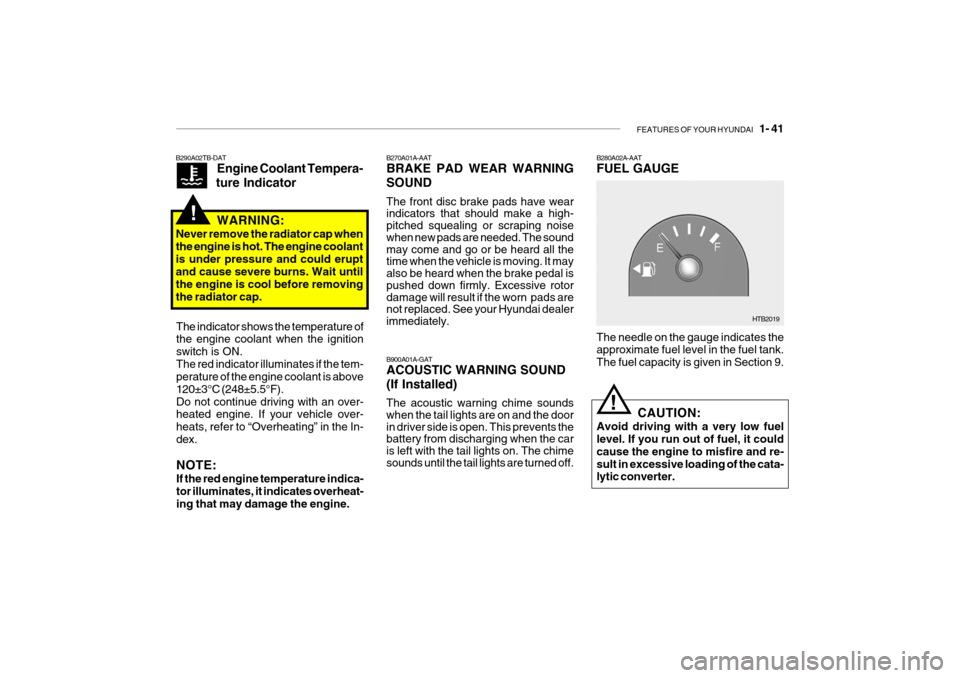
The needle on the gauge indicates the approximate fuel level in the fuel tank. The fuel capacity is given in Section 9.
B280A02A-AAT FUEL GAUGE
HTB2019
!CAUTION:
Avoid driving with a very low fuel level. If you run out of fuel, it could cause the engine to misfire and re-sult in excessive loading of the cata- lytic converter.
Page 98 of 191
DRIVING YOUR HYUNDAI 2- 3
!
C020A03S-DAT BEFORE STARTING THE EN- GINE Before you start the engine, you should always:
1. Look around the vehicle to be sure
there are no flat tyres, puddles of oil or water or other indications of pos- sible trouble.
2. After entering the car, check to be sure the parking brake is engaged.
3. Check that all windows, and lights are clean.
4. Check that the interior and exterior
mirrors are clean and in position.
5. Check your seat, seatback and headrest to be sure they are in theirproper positions.
6. Lock all the doors.
7. Fasten your seat belt and be sure
that all other occupants have fas- tened theirs.
8. Turn off all lights and accessories
that are not needed.
9. When you turn the ignition switch to "ON' check that all appropriatewarning lights are operating andthat you have sufficient fuel.
10.Check the operation of warning lights
and all bulbs when key is in the "ON"position. WARNING:
Always wear appropriate shoes whenoperating your vehicle. Unsuitable shoes (high heels, ski boots, etc.) may interfere with yourability to use the brake and accelera- tor pedal, and the clutch (if installed). C030A01A-GAT COMBINATION IGNITION SWITCHTo Start the Engine
o If your Hyundai is equipped with a
manual transaxle, place the shift lever in neutral and depress theclutch pedal fully.
o If your Hyundai has an automatic
transaxle, place the shift lever in "P"(park).
o To start the engine, insert the igni-
tion key and turn it to the "START"position. Release it as soon as the engine starts. Do not hold the key in the "START" position for more than15 seconds.
NOTE: For safety, the engine will not start if the shift lever is not in "P" or "N"Position (Automatic transaxle).
!WARNING:
When you intend to park or stop the vehicle with the engine on, be care- ful not to depress the accelerator pedal for a long period of time. It mayoverheat the engine or exhaust sys- tem and cause fire.
Page 100 of 191
DRIVING YOUR HYUNDAI 2- 5
!!
C050A01A-AAT STARTING
C050A01E
WARNING:
Never run the engine in a closed or poorly ventilated area any longerthan is needed to move your car in or out of the area. The carbon mon- oxide gas emitted is odorless andcan cause serious injury or death. C050B01A-AAT Normal Conditions: The Starting Procedure:
1. Insert key, and fasten the seat belt.
2. Depress the clutch pedal fully and
place the gearshift lever (manual transaxle) in neutral or the selector lever (automatic transaxle) in "P" (park) position.
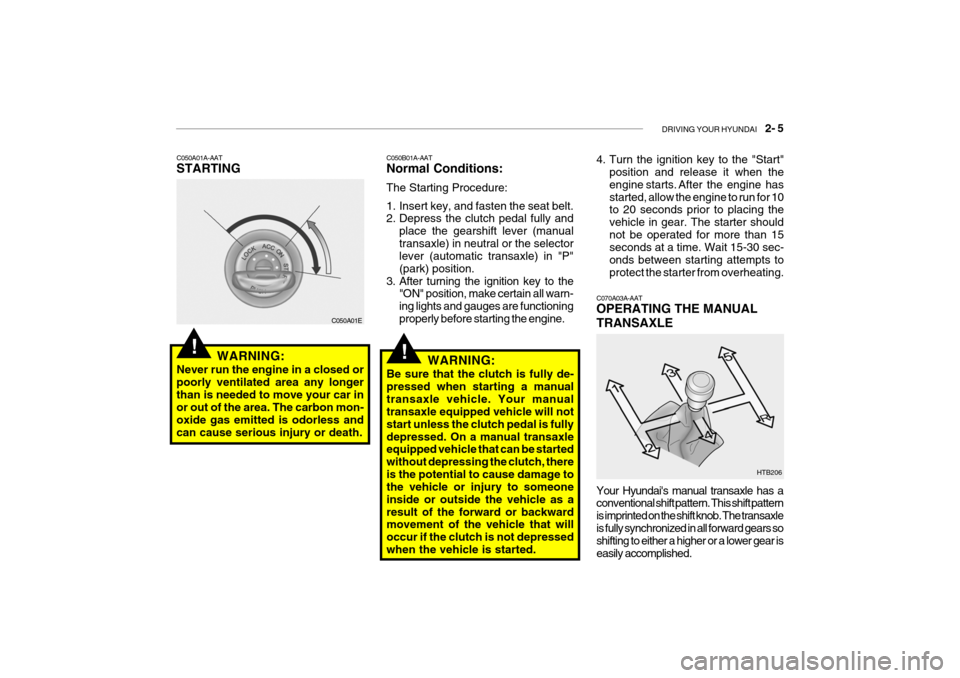
3. After turning the ignition key to the "ON" position, make certain all warn-ing lights and gauges are functioningproperly before starting the engine.
WARNING:
Be sure that the clutch is fully de-pressed when starting a manualtransaxle vehicle. Your manual transaxle equipped vehicle will not start unless the clutch pedal is fullydepressed. On a manual transaxle equipped vehicle that can be started without depressing the clutch, thereis the potential to cause damage to the vehicle or injury to someone inside or outside the vehicle as aresult of the forward or backward movement of the vehicle that will occur if the clutch is not depressedwhen the vehicle is started.
HTB206
C070A03A-AAT OPERATING THE MANUAL TRANSAXLE Your Hyundai's manual transaxle has a conventional shift pattern. This shift pattern is imprinted on the shift knob. The transaxleis fully synchronized in all forward gears so shifting to either a higher or a lower gear is easily accomplished.
4. Turn the ignition key to the "Start"
position and release it when the
engine starts. After the engine hasstarted, allow the engine to run for 10 to 20 seconds prior to placing the
vehicle in gear. The starter shouldnot be operated for more than 15 seconds at a time. Wait 15-30 sec- onds between starting attempts toprotect the starter from overheating.
Page 102 of 191
DRIVING YOUR HYUNDAI 2- 7
!
o Exercise extreme caution when driv-
ing on a slippery surface. Be espe- cially careful when braking, acceler-ating or shifting gears. On a slippery surface, an abrupt change in ve- hicle speed can cause the drivewheels to lose traction and the ve- hicle to go out of control.
C070D02O-AAT Good Driving Practices
o Never take the car out of gear and
coast down a hill. This is extremely hazardous. Always leave the car in gear.
o Don't "ride" the brakes. This can
cause them to overheat and mal-function. Instead, when you are driv- ing down a long hill, slow down andshift to a lower gear. When you do this, engine braking will help slow the car.
o Slow down before shifting to a lower gear. This will help avoid over-rev-ving the engine, which can causedamage.
o Slow down when you encounter
cross winds. This gives you muchbetter control of your car.
o Be sure the car is completely stopped
before you attempt to shift into re-verse. The transaxle can be dam- aged if you do not. To shift into reverse, depress the clutch, movethe shift lever to neutral, wait three seconds, then shift to the reverse position. HTB185-D
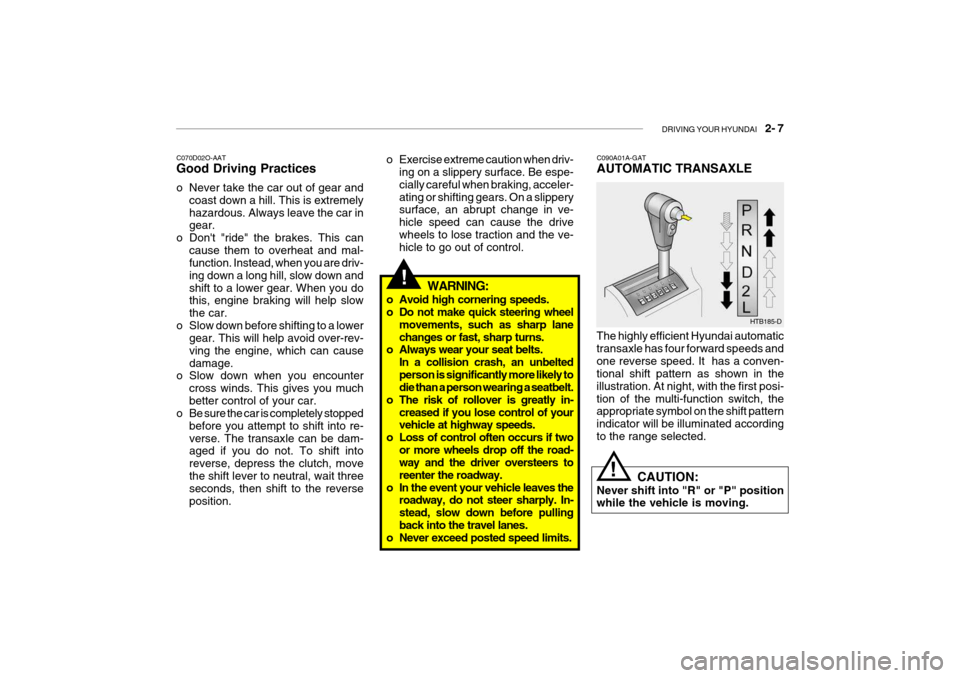
C090A01A-GAT AUTOMATIC TRANSAXLE
The highly efficient Hyundai automatic transaxle has four forward speeds andone reverse speed. It has a conven- tional shift pattern as shown in the illustration. At night, with the first posi-tion of the multi-function switch, the appropriate symbol on the shift pattern indicator will be illuminated accordingto the range selected. CAUTION:
Never shift into "R" or "P" position while the vehicle is moving.
!
WARNING:
o Avoid high cornering speeds.
o Do not make quick steering wheel movements, such as sharp lane changes or fast, sharp turns.
o Always wear your seat belts.
In a collision crash, an unbeltedperson is significantly more likely to die than a person wearing a seatbelt.
o The risk of rollover is greatly in-
creased if you lose control of yourvehicle at highway speeds.
o Loss of control often occurs if two
or more wheels drop off the road-way and the driver oversteers to reenter the roadway.
o In the event your vehicle leaves the roadway, do not steer sharply. In-stead, slow down before pullingback into the travel lanes.
o Never exceed posted speed limits.
Page 105 of 191
2- 10 DRIVING YOUR HYUNDAI
!
C090N04A-DAT Good Driving Practices
o Never move the gear selector lever
from "P" or "N" to any other position with the accelerator pedal de- pressed.
o Never move the gear selector lever
into "P" when the vehicle is in mo-tion.
o Be sure the car is completely stopped before you attempt to shift into "R"and "D".
o Never take the car out of gear and coast down a hill. This may be ex-tremely hazardous. Always leave the car in gear when moving.
o Do not "ride" the brakes. This can cause them to overheat and mal-function. Instead, when you are driv-ing down a long hill, slow down and shift to a lower gear. When you do this, engine braking will help slowthe car.
o Slow down before shifting to a lower
gear. Otherwise, the lower gear maynot be engaged.
o Always use the hand brake. Do not
depend on placing the transaxle in"P" to keep the car from moving. o Exercise extreme caution when driv-
ing on a slippery surface. Be espe-cially careful when braking, acceler-ating or shifting gears. On a slippery surface, an abrupt change in ve- hicle speed can cause the drivewheels to lose traction and the ve- hicle to go out of control.
o Turn the overdrive switch on for good fuel economy and smooth driv-ing. If engine braking is needed in the "D" range or if repeated upshift-ing and downshifting between the 3rd and 4th gear is needed when climbing a gentle slope, it is recom-mended that the overdrive switch be turned off. Turn the overdrive switch back on immediately after-ward. WARNING:
o Avoid high cornering speeds.
o Do not make quick steering wheel movements, such as sharp lane changes or fast, sharp turns.
o Always wear your seat belts.
In a collision crash, an unbeltedperson is significantly more likely to die than a person wearing a seatbelt.
o The risk of rollover is greatly in- creased if you lose control ofyour vehicle at highway speeds.
o Loss of control often occurs if two or more wheels drop off theroadway and the driver oversteersto reenter the roadway.
o In the event your vehicle leaves
the roadway, do not steer sharply.Instead, slow down before pull- ing back into the travel lanes.
o Never exceed posted speed lim- its.
Page 106 of 191
DRIVING YOUR HYUNDAI 2- 11
!WARNING:
Nothing should be carried on top of the shelf panel behind the rear seat. If there were an accident or a sud-den stop, such objects could move forward and cause damage to the vehicle or injure the occupants.
o After being parked, check to be sure the hand brake is not engaged and that the hand brake indicator light is out before driving away.
o Driving through water may get the brakes wet. They can also get wetwhen the car is washed. Wet brakes can be dangerous! Your car will notstop as quickly if the brakes are wet. Wet brakes may cause the car to pull to one side. To dry the brakes,apply the brakes lightly until the braking action returns to normal, taking care to keep the car undercontrol at all times. If the braking action does not return to normal, stop as soon as it is safe to do soand call your Hyundai dealer for assistance.
C130A01A-DAT GOOD BRAKING PRACTICES
HTB217-D
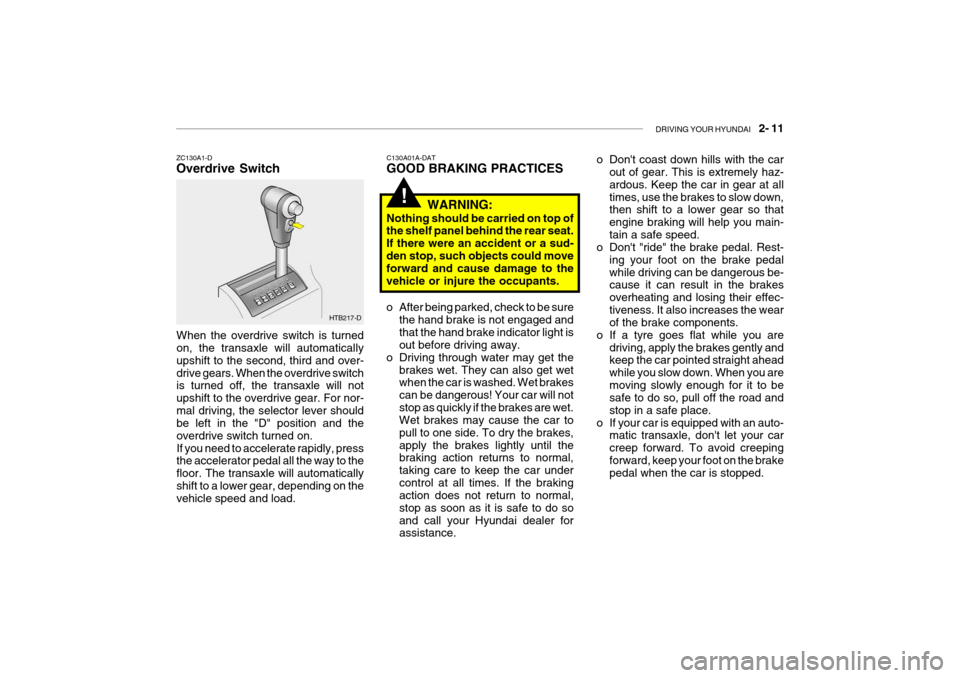
ZC130A1-DOverdrive Switch
When the overdrive switch is turned on, the transaxle will automatically upshift to the second, third and over-drive gears. When the overdrive switch is turned off, the transaxle will not upshift to the overdrive gear. For nor-mal driving, the selector lever should be left in the "D" position and the overdrive switch turned on.If you need to accelerate rapidly, press the accelerator pedal all the way to the floor. The transaxle will automaticallyshift to a lower gear, depending on the vehicle speed and load. o Don't coast down hills with the car
out of gear. This is extremely haz- ardous. Keep the car in gear at alltimes, use the brakes to slow down, then shift to a lower gear so that engine braking will help you main-tain a safe speed.
o Don't "ride" the brake pedal. Rest-
ing your foot on the brake pedalwhile driving can be dangerous be- cause it can result in the brakes overheating and losing their effec-tiveness. It also increases the wear of the brake components.
o If a tyre goes flat while you are driving, apply the brakes gently andkeep the car pointed straight ahead while you slow down. When you aremoving slowly enough for it to be safe to do so, pull off the road and stop in a safe place.
o If your car is equipped with an auto- matic transaxle, don't let your carcreep forward. To avoid creepingforward, keep your foot on the brake pedal when the car is stopped.
Page 109 of 191

2- 14 DRIVING YOUR HYUNDAI
C140A01A-DAT DRIVING FOR ECONOMY You can save fuel and get more kilo- meters from your car if you followthese suggestions:
o Drive smoothly. Accelerate at a
moderate rate. Don't make "kanga- roo" starts or full-throttle shifts. Maintain a steady cruising speed.Don't race between stoplights. Try to adjust your speed to that of the other traffic so you don't have tochange speeds unnecessarily. Avoid heavy traffic whenever possible. Always maintain a safe distancefrom other vehicles so you can avoid unnecessary braking. This also reduces brake wear.
o Drive at a moderate speed. The faster you drive, the more fuel yourcar uses. Driving at a moderatespeed, especially on the highway, is one of the most effective ways to reduce fuel consumption.
o Don't "ride" the brake. This can in- crease fuel consumption and alsoincrease wear on this components. o In addition, driving with your foot
resting on the brake pedal may causethe brakes to overheat, which re-duces their effectiveness and may
lead to more serious consequences.
o Take care of your tyres. Keep them inflated to the recommended pres-sure. Incorrect inflation, either too much or too little, results in unnec-essary tyre wear. Check the tyre pressures at least once a month.
o Be sure that the wheels are aligned correctly. Improper alignment canresult from hitting curbs or driving too fast over irregular surfaces Pooralignment causes faster tyre wear and may also result in other prob- lems as well as greater fuel con-sumption.
o Keep your car in good condition. For
better fuel economy and reducedmaintenance costs, maintain your car in accordance with the mainte- nance schedule in Section 5. If youdrive your car in severe conditions, more frequent maintenance is re- quired (see Section 5 for details).
C310D01JM-AAT Indicators and Warning The indicators should illuminate when the ignition key is turned to ON orSTART but should go out after three seconds. If the indicators do not illuminate, or theESP or ESP-OFF indicator does not go out after 3 seconds, have the vehicle checked by an authorized dealer. Should there be any unusual conditions in the device while driving, ESP-OFFindicator illuminates as a warning. If ESP-OFF indicator illuminates, pull your car to a safe place and stop theengine. Then, start the engine again to check if the ESP-OFF indicator goes out. If the indicator remains lit even after the engine has been started, have your carchecked by an authorized Hyundai dealer.
Page 112 of 191

DRIVING YOUR HYUNDAI 2- 17
C160K01A-DAT Carry Emergency Equipment Depending on the severity of the weather where you drive your car, youshould carry appropriate emergency equipment. Some of the items you may want to carry include tyre chains,tow straps or chains, flashlight, emer- gency flares, sand, a shovel, jumper cables, a window scraper, gloves,ground cloth, overalls, a blanket, etc.
C160J01A-AAT Don't Let Ice and Snow Accumu- late Underneath Under some conditions, snow and ice can build up under the fenders and interfere with the steering. When driv-ing in severe winter conditions where this may happen, you should periodi- cally check underneath the car to besure the movement of the front wheels and the steering components are not obstructed.
C170A01A-DAT HIGH SPEED MOTORING Pre-Trip Inspections
1. Tyres: Adjust the tyre inflation pressures to specification. Low tyre inflation pres-sures will result in overheating and possible failure of the tyres. Avoid using worn or damaged tyres whichmay result in reduced traction or tyre failure. NOTE: Never exceed the maximum tyre inflation pressure shown on the tyres.
2. Fuel, engine coolant and engine oil: High speed travel consumes 1.5 times more fuel than urban motoring. Do notforget to check both engine coolant and engine oil.
3. Drive belt: A loose or damaged drive belt may result in overheating of the engine.
C160H01A-DAT Use Approved Anti-Freeze in WindowWasher System To keep the water in the window washer system from freezing, add an approved anti-freeze solution in accordance withinstructions on the container. Window washer anti-freeze is available from Hyundai dealers and most auto partsoutlets. Do not use engine coolant or other types of anti-freeze as these may damage the paint finish.
C160I01L-DAT Don't Let Your Hand Brake Freeze Under some conditions your hand brake can freeze in the engaged posi-tion. This is most likely to happen when there is an accumulation of snow or ice around or near the rear brakes or if thebrakes are wet. If there is a risk the hand brake may freeze, apply it only temporarily while you put the gearselector lever in "P" and block the rear wheels so the car cannot roll. Then release the hand brake.
Page 113 of 191
2- 18 DRIVING YOUR HYUNDAI
!
C190C02S-DAT Trailer Brakes If your trailer is equipped with a braking system, make sure it conforms to fed-eral and/or local regulations and that it is properly installed and operating cor- rectly. NOTE: If you tow a trailer or vehicle, your car will require more frequent main- tenance due to the additional load.See "Maintenance Under Severe Usage Conditions" on page 5-4.
!
C190B01FC-DAT Trailer Tow Bars Select the proper tow bar and ball combination, making sure that its loca-tion is compatible with that of the trailer or vehicle being towed. We recom- mend only genuine Hyundai tow bars(the tow bars are made and tested in Australia for local conditions). Use a quality non-equalising hitch which dis-tributes the tongue load uniformly throughout the chassis. Maintain 4% of the trailer load on thetrailer tongue for dead weight hitches. Tongue loads can be increased or decreased by redistributing the load inthe trailer. This can be verified by checking the total weight of the loaded trailer and then checking the load onthe tongue.
WARNING:
Improperly loading your car andtrailer can serious affect its steer-ing and braking performance caus- ing a crash in which you may be seriously injured. CAUTION:
o Never connect a trailer brake sys- tem directly to the vehicle brake system.
o When towing a trailer on steep grades (in excess of 6%) pay closeattention to the engine coolant temperature gauge to ensure theengine does not overheat.
C180A01A-AAT USE OF LIGHTS Check your lights regularly for correct operation and always keep them clean.When driving during the day in condi- tions of poor visibility, it is helpful to drive with headlights on low beam.This enables you to be seen as well as to see. C190A01A-DAT TRAILER OR VEHICLE TOWING If you are considering towing with your car, you should first check with your State Department of Motor Vehicles to determine their legal requirements.Since laws vary from state to state the requirements for towing trailers, cars, or other types of vehicles or apparatusmay differ. Ask your Hyundai dealer for further details before towing.
!
CAUTION
Do not do any towing with your car during its first 2,000 km (1,200 miles) in order to allow the engine to prop- erly break in. Failure to heed thiscaution may result in serious en- gine or transaxle damage.