lock Hyundai H350 2016 Owners Manual
[x] Cancel search | Manufacturer: HYUNDAI, Model Year: 2016, Model line: H350, Model: Hyundai H350 2016Pages: 473, PDF Size: 26.4 MB
Page 349 of 473
6-14
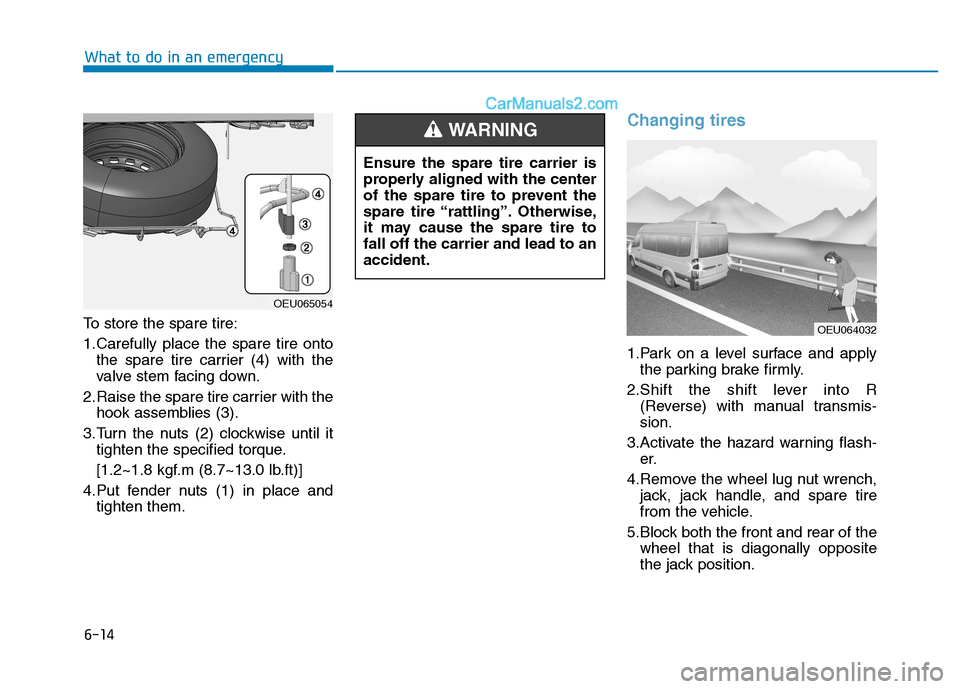
To store the spare tire:
1.Carefully place the spare tire onto
the spare tire carrier (4) with the
valve stem facing down.
2.Raise the spare tire carrier with the hook assemblies (3).
3.Turn the nuts (2) clockwise until it tighten the specified torque.
[1.2~1.8 kgf.m (8.7~13.0 lb.ft)]
4.Put fender nuts (1) in place and tighten them.
Changing tires
1.Park on a level surface and applythe parking brake firmly.
2.Shift the shift lever into R (Reverse) with manual transmis- sion.
3.Activate the hazard warning flash- er.
4.Remove the wheel lug nut wrench, jack, jack handle, and spare tire
from the vehicle.
5.Block both the front and rear of the wheel that is diagonally opposite
the jack position.
What to do in an emergency
OEU065054
OEU064032
Ensure the spare tire carrier is
properly aligned with the center
of the spare tire to prevent the
spare tire “rattling”. Otherwise,
it may cause the spare tire tofall off the carrier and lead to anaccident.
WARNING
Page 350 of 473
6-15
What to do in an emergency
6
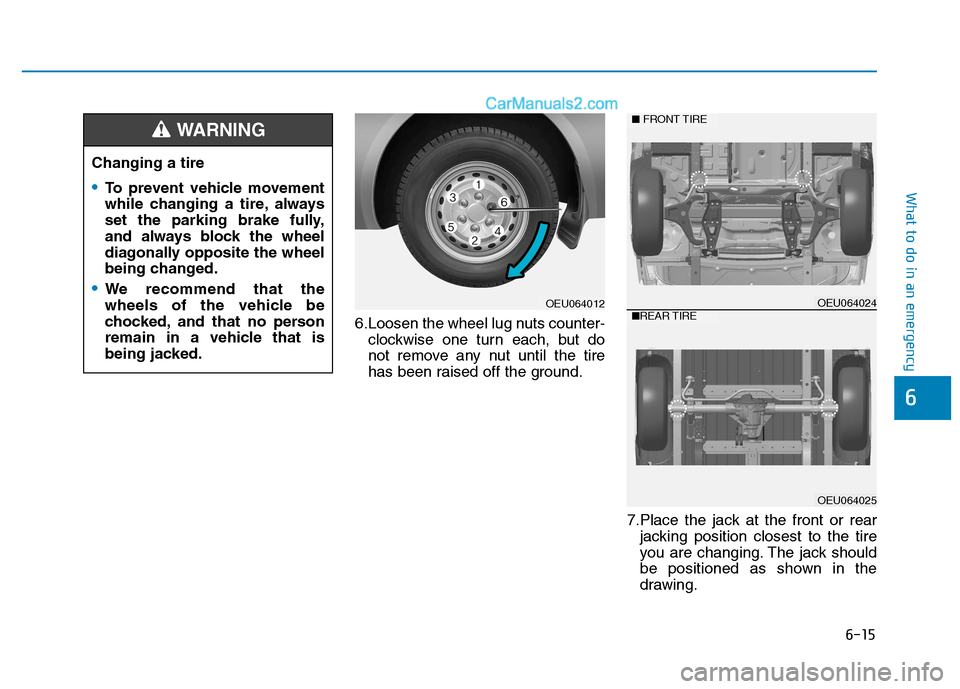
6.Loosen the wheel lug nuts counter-clockwise one turn each, but do
not remove any nut until the tire
has been raised off the ground.
7.Place the jack at the front or rearjacking position closest to the tire
you are changing. The jack should
be positioned as shown in the
drawing.
Changing a tire
To prevent vehicle movement
while changing a tire, always
set the parking brake fully,
and always block the wheel
diagonally opposite the wheel
being changed.
We recommend that the
wheels of the vehicle be
chocked, and that no person
remain in a vehicle that is
being jacked.
WARNING
OEU064012OEU064024
■
FRONT TIRE
OEU064025
■REAR TIRE
Page 351 of 473
6-16
What to do in an emergency
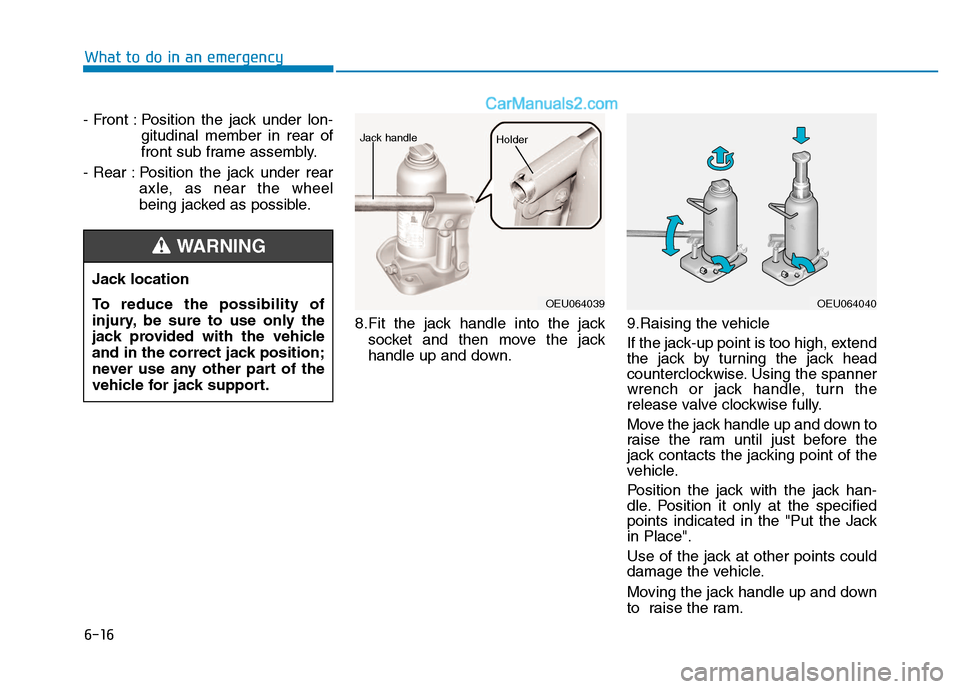
- Front : Position the jack under lon-gitudinal member in rear of
front sub frame assembly.
- Rear : Position the jack under rear axle, as near the wheel
being jacked as possible.
8.Fit the jack handle into the jacksocket and then move the jack
handle up and down. 9.Raising the vehicle
If the jack-up point is too high, extend
the jack by turning the jack head
counterclockwise. Using the spanner
wrench or jack handle, turn the
release valve clockwise fully.
Move the jack handle up and down to
raise the ram until just before the
jack contacts the jacking point of the
vehicle.
Position the jack with the jack han-
dle. Position it only at the specified
points indicated in the "Put the Jackin Place".
Use of the jack at other points could
damage the vehicle.
Moving the jack handle up and down
to raise the ram.
Jack location
To reduce the possibility of
injury, be sure to use only the
jack provided with the vehicle
and in the correct jack position;
never use any other part of the
vehicle for jack support.
WARNING
OEU064039
Jack handle
HolderOEU064040
Page 352 of 473
6-17
What to do in an emergency
6
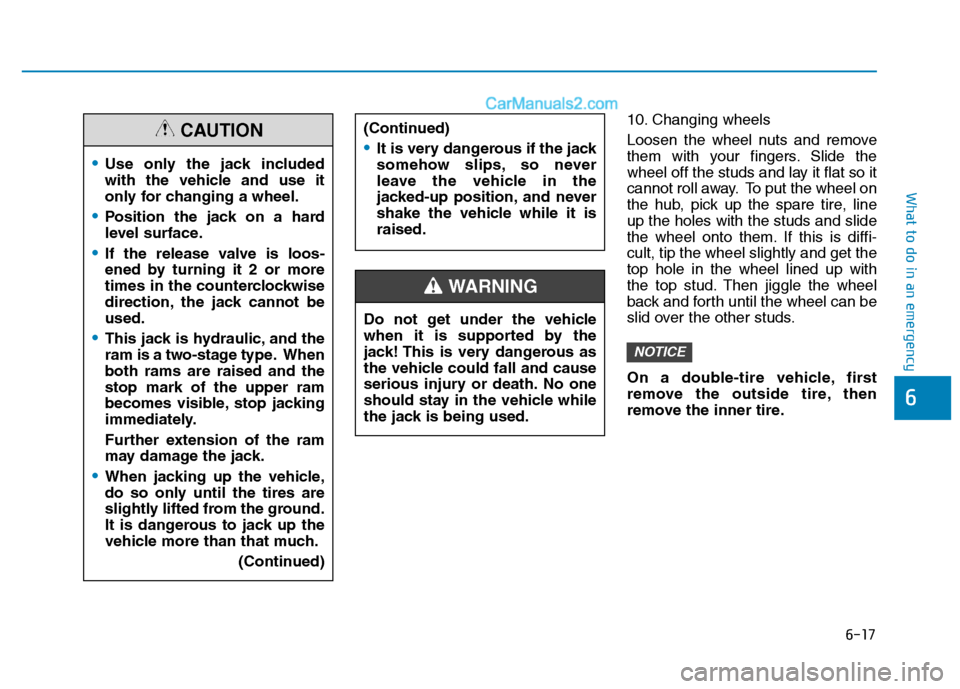
10. Changing wheels
Loosen the wheel nuts and remove
them with your fingers. Slide the
wheel off the studs and lay it flat so it
cannot roll away. To put the wheel on
the hub, pick up the spare tire, lineup the holes with the studs and slide
the wheel onto them. If this is diffi-cult, tip the wheel slightly and get thetop hole in the wheel lined up with
the top stud. Then jiggle the wheel
back and forth until the wheel can be
slid over the other studs.
On a double-tire vehicle, first
remove the outside tire, then
remove the inner tire.
NOTICE
Use only the jack included
with the vehicle and use it
only for changing a wheel.
Position the jack on a hard
level surface.
If the release valve is loos-
ened by turning it 2 or more
times in the counterclockwise
direction, the jack cannot beused.
This jack is hydraulic, and the
ram is a two-stage type. Whenboth rams are raised and thestop mark of the upper ram
becomes visible, stop jacking
immediately.
Further extension of the ram
may damage the jack.
When jacking up the vehicle,
do so only until the tires are
slightly lifted from the ground.
It is dangerous to jack up the
vehicle more than that much.(Continued)
CAUTION(Continued)
It is very dangerous if the jack
somehow slips, so never
leave the vehicle in the
jacked-up position, and never
shake the vehicle while it israised.
Do not get under the vehicle
when it is supported by the
jack! This is very dangerous as
the vehicle could fall and cause
serious injury or death. No one
should stay in the vehicle while
the jack is being used.
WARNING
Page 353 of 473
6-18
What to do in an emergency
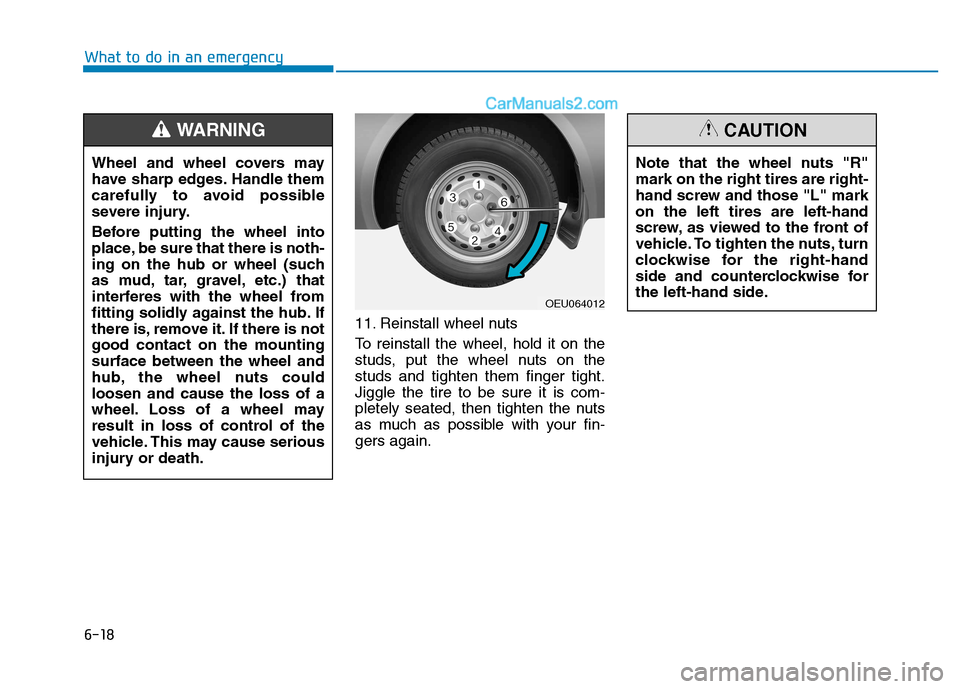
11. Reinstall wheel nuts
To reinstall the wheel, hold it on the
studs, put the wheel nuts on thestuds and tighten them finger tight.Jiggle the tire to be sure it is com-
pletely seated, then tighten the nuts
as much as possible with your fin-gers again.
Wheel and wheel covers may
have sharp edges. Handle them
carefully to avoid possible
severe injury.
Before putting the wheel into
place, be sure that there is noth-
ing on the hub or wheel (such
as mud, tar, gravel, etc.) that
interferes with the wheel from
fitting solidly against the hub. If
there is, remove it. If there is notgood contact on the mountingsurface between the wheel and
hub, the wheel nuts couldloosen and cause the loss of a
wheel. Loss of a wheel may
result in loss of control of the
vehicle. This may cause serious
injury or death.
WARNING
OEU064012
Note that the wheel nuts "R" mark on the right tires are right-
hand screw and those "L" markon the left tires are left-hand
screw, as viewed to the front of
vehicle. To tighten the nuts, turn
clockwise for the right-hand
side and counterclockwise for
the left-hand side.
CAUTION
Page 354 of 473
6-19
What to do in an emergency
6
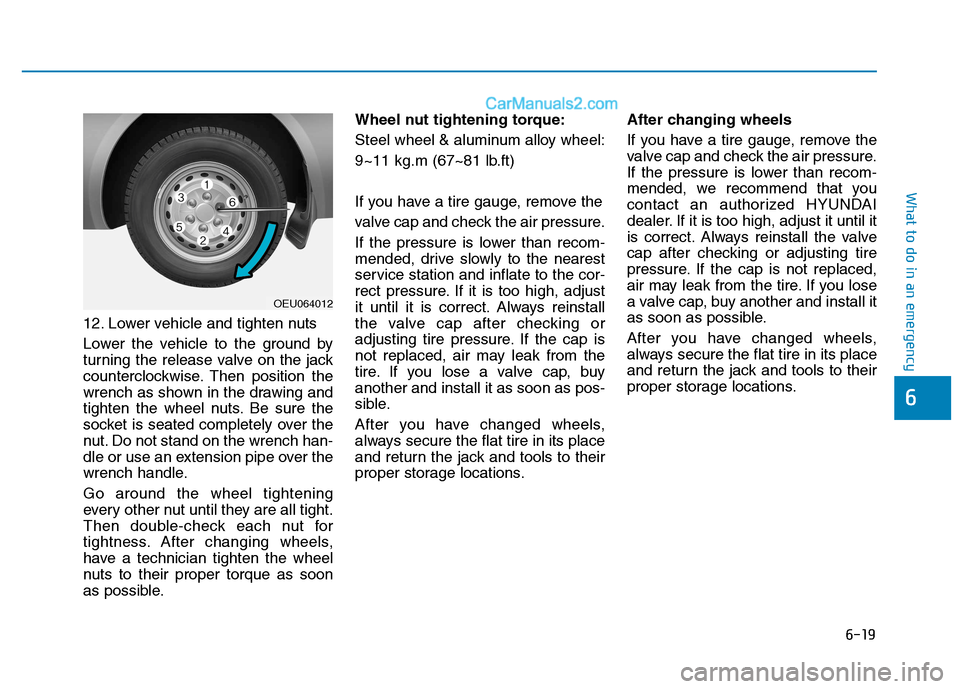
12. Lower vehicle and tighten nuts
Lower the vehicle to the ground by
turning the release valve on the jack
counterclockwise. Then position the
wrench as shown in the drawing and
tighten the wheel nuts. Be sure the
socket is seated completely over the
nut. Do not stand on the wrench han-
dle or use an extension pipe over the
wrench handle. Go around the wheel tightening
every other nut until they are all tight.
Then double-check each nut for
tightness. After changing wheels,
have a technician tighten the wheel
nuts to their proper torque as soon
as possible.Wheel nut tightening torque:
Steel wheel & aluminum alloy wheel:
9~11 kg.m (67~81 lb.ft)
If you have a tire gauge, remove the
valve cap and check the air pressure.
If the pressure is lower than recom-
mended, drive slowly to the nearest
service station and inflate to the cor-
rect pressure. If it is too high, adjust
it until it is correct. Always reinstall
the valve cap after checking or
adjusting tire pressure. If the cap is
not replaced, air may leak from the
tire. If you lose a valve cap, buyanother and install it as soon as pos-
sible.
After you have changed wheels,
always secure the flat tire in its place
and return the jack and tools to their
proper storage locations.
After changing wheels
If you have a tire gauge, remove the
valve cap and check the air pressure.
If the pressure is lower than recom-
mended, we recommend that you
contact an authorized HYUNDAI
dealer. If it is too high, adjust it until it
is correct. Always reinstall the valve
cap after checking or adjusting tire
pressure. If the cap is not replaced,
air may leak from the tire. If you lose
a valve cap, buy another and install it
as soon as possible.
After you have changed wheels,
always secure the flat tire in its place
and return the jack and tools to their
proper storage locations.
OEU064012
Page 358 of 473
6-23
What to do in an emergency
6
When towing your vehicle in an emergency without wheel dollies :
1.Set the ignition switch in the ACCposition.
2.Place the transmission shift lever in N (Neutral).
3.Release the parking brake.Removable towing hook (if equipped)
Front towing hook
1.Remove the towing hook from the tool store of front passenger’s door
step side.
2.Remove the hole cover pressing the upper part of the cover on the
front bumper.
3.Install the towing hook by turning it clockwise into the hole until it isfully secured.
4.Remove the towing hook and install the cover after use.
OEU064026
OEU064027
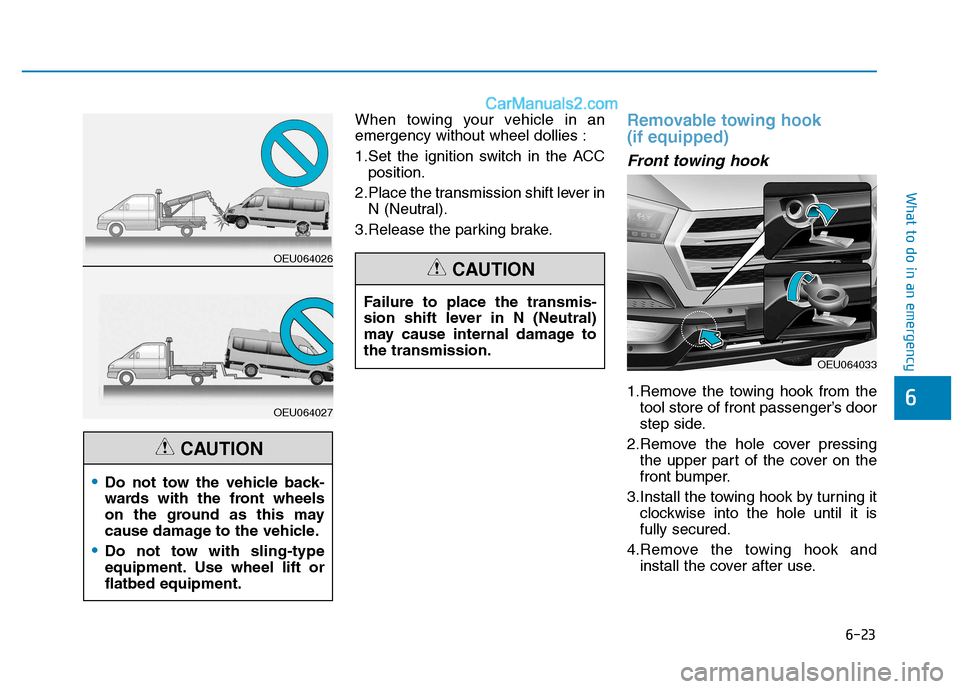
Do not tow the vehicle back-
wards with the front wheels
on the ground as this may
cause damage to the vehicle.
Do not tow with sling-type
equipment. Use wheel lift orflatbed equipment.
CAUTION
Failure to place the transmis-
sion shift lever in N (Neutral)
may cause internal damage tothe transmission.
CAUTION
OEU064033
Page 360 of 473
6-25
What to do in an emergency
6
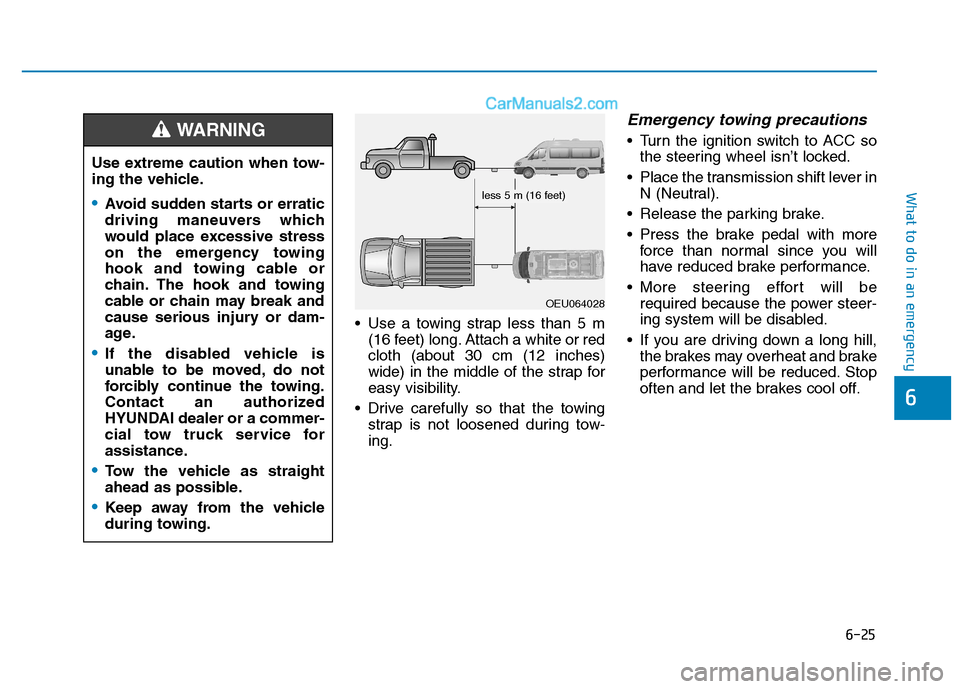
Use a towing strap less than 5 m(16 feet) long. Attach a white or red cloth (about 30 cm (12 inches)
wide) in the middle of the strap for
easy visibility.
Drive carefully so that the towing strap is not loosened during tow-ing.
Emergency towing precautions
Turn the ignition switch to ACC sothe steering wheel isn’t locked.
Place the transmission shift lever in N (Neutral).
Release the parking brake.
Press the brake pedal with more force than normal since you will
have reduced brake performance.
More steering effort will be required because the power steer-
ing system will be disabled.
If you are driving down a long hill, the brakes may overheat and brake
performance will be reduced. Stop
often and let the brakes cool off.
Use extreme caution when tow-
ing the vehicle.
Avoid sudden starts or erratic
driving maneuvers which
would place excessive stress
on the emergency towing
hook and towing cable or
chain. The hook and towing
cable or chain may break and
cause serious injury or dam-
age.
If the disabled vehicle is
unable to be moved, do not
forcibly continue the towing.
Contact an authorized
HYUNDAI dealer or a commer-
cial tow truck service for
assistance.
Tow the vehicle as straight
ahead as possible.
Keep away from the vehicle
during towing.
WARNING
OEU064028
less 5 m (16 feet)
Page 372 of 473
7-9
7
Maintenance
At least monthly:
Check coolant level in the enginecoolant reservoir.
Check the operation of all exterior lights, including the stoplights, turn
signals and hazard warning flash-
ers.
Check the inflation pressures of all tires including the spare.
At least twice a year
(i.e., every Spring and Fall) :
Check radiator, heater and air con- ditioning hoses for leaks or dam-
age.
Check windshield washer spray and wiper operation. Clean wiper
blades with clean cloth dampened
with washer fluid.
Check headlight alignment.
Check muffler, exhaust pipes, shields and clamps.
Check the lap/shoulder belts for wear and function.
Check for worn tires and loose wheel lug nuts.
At least once a year :
Clean body, door and hood drainholes.
Clean and lubricate door hinges and checks, and hood hinges.
Clean and lubricate door and hood locks and latches.
Clean and lubricate door rubber weatherstrips.
Check the air conditioning system.
Check the power steering fluid level.
Clean battery and terminals.
Check the brake and clutch fluid level.
Page 382 of 473
7-19
7
Maintenance
EEXX PPLLAA NN AATTIIOO NN OO FF SS CC HH EEDD UU LLEE DD MM AAIINN TTEENN AANN CCEE IITT EEMM SS
Engine oil and filter
The engine oil and filter should be
changed at the intervals specified in
the maintenance schedule. If the
vehicle is being driven in severe con-
ditions, more frequent oil and filterchanges are required.
Drive belts
Inspect all drive belts for evidence of
cuts, cracks, excessive wear or oil
saturation and replace if necessary.
Drive belts should be checked peri-
odically for proper tension and
adjusted as necessary.
Fuel filter (cartridge)
A clogged filter can limit the speed at
which the vehicle may be driven,damage the emission system and
cause multiple issues such as hard
starting. If an excessive amount of
foreign matter accumulates in the
fuel tank, the filter may require
replacement more frequently.
After installing a new filter, run the
engine for several minutes, and
check for leaks at the connections.
We recommend that the fuel filter be
replaced by an authorized HYUNDAI
dealer.
Fuel lines, fuel hoses and con- nections
Check the fuel lines, fuel hoses and
connections for leakage and dam-
age. We recommend that the fuel
lines, fuel hoses and connection be
replaced by an authorized HYUNDAI
dealer.
When you are inspecting the
belt, place the ignition switch in
the LOCK/OFF or ACC position.
CAUTION
In case the fuel filter is clogged
due to not conforming to the
maintenance period, the fuel
injection equipment may supply
the fuel insufficiently, which
may damage the fuel injectionequipment and cause the
engine to stall at worst cases.
CAUTION
Diesel only
Never work on injection system with engine running or within 30seconds after shutting off
engine. High pressure pump,
rail, injectors and high pressurepipes are subject to high pres-
sure even after the engine
stopped. The fuel jet produced
by fuel leaks may cause serious
injury, if it touch the body.
People using pacemakers
should not move than 30cm
closer to the ECU or wiring har-
ness within the engine room
while engine is running, sincethe high currents in the
Common Rail system produce
considerable magnetic fields.
WARNING