lock Hyundai H350 2016 Manual Online
[x] Cancel search | Manufacturer: HYUNDAI, Model Year: 2016, Model line: H350, Model: Hyundai H350 2016Pages: 473, PDF Size: 26.4 MB
Page 322 of 473
5-51
Driving your vehicle
5
To keep locks from freezing
To keep the locks from freezing,
squirt an approved de-icer fluid or
glycerin into the key opening. If a
lock is covered with ice, squirt it with
an approved de-icing fluid to remove
the ice. If the lock is frozen internally,
you may be able to thaw it out by
using a heated key. Handle the heat-
ed key with care to avoid injury.
Use approved window washeranti-freeze in system
To keep the water in the window
washer system from freezing, add an
approved window washer anti-freeze
solution in accordance with instruc-
tions on the container. Window wash-
er anti-freeze is available from an
authorized HYUNDAI dealer and
most auto parts outlets. Do not useengine coolant or other types of anti-
freeze as these may damage thepaint finish.
Don't let your parking brakefreeze
Under some conditions your parking
brake can freeze in the engaged
position. This is most likely to hap-
pen when there is an accumulation
of snow or ice around or near the
rear brakes or if the brakes are wet.
If there is a risk the parking brake
may freeze, apply it only temporarily
while you put the shift lever in first or
reverse gear and block the rear
wheels so the vehicle cannot roll.
Then release the parking brake.
Don't let ice and snow accumu-
late underneath
Under some conditions, snow and
ice can build up under the fenders
and interfere with the steering. When
driving in severe winter conditions
where this may happen, you should
periodically check underneath the
vehicle to be sure the movement of
the front wheels and the steering
components is not obstructed.
Carry emergency equipment
Depending on the severity of the
weather, you should carry appropri-
ate emergency equipment. Some of
the items you may want to carry
include tire chains, tow straps or
chains, flashlight, emergency flares,
sand, a shovel, jumper cables, a win-
dow scraper, gloves, ground cloth,
coveralls, a blanket, etc.
Page 323 of 473
5-52
Driving your vehicle
If you are considering to tow with
your vehicle, you should first check
with your country's Department of
Motor Vehicles to determine legal
requirements. Since laws vary the
requirements for towing trailers, vehi-
cles, or other types of vehicles or
apparatus may differ. Ask an author-
ized HYUNDAI dealer for further
details before towing.
Remember that trailering is different
than just driving your vehicle by itself.
Trailering means changes in han-
dling, durability, and fuel economy.
Successful, safe trailering requirescorrect equipment, and it has to be
used properly. Damage to your vehi-
cle caused by improper trailer towing
is not covered by your vehicle manu-
facturer’s warranty.
This section contains many time-
tested, important trailering tips and
safety rules. Many of these are
important for your safety and that of
your passengers. Please read this
section carefully before you pull a
trailer.Take the following precautions:
If you don't use the correct equipment and/or drive
improperly, you can lose con-
trol of the vehicle when you
are pulling a trailer. For exam-
ple, if the trailer is too heavy,
the braking performance may
be reduced. You and your pas-
sengers could be seriously or
fatally injured. Pull a trailer
only if you have followed allthe steps in this section.
Before towing, make sure the
total trailer weight, GCW
(Gross Combination Weight),
GVW (Gross Vehicle Weight),
GAW (Gross Axle Weight ) andtrailer tongue load are all with-in the limits.
WARNING
TT
RR AA IILL EE RR TT OO WW IINN GG
Pulling a trailer improperly
can damage your vehicle and
result in costly repairs not
covered by your warranty. To
pull a trailer correctly, follow
the advice in this section.
The driver should check the
rearview, which is blocked by
the load compartment, while
driving backward. If you are
not sure about the safety, you
should ask another person to
check the rearview and guide
your driving.
CAUTION
Page 334 of 473
5-63
Driving your vehicle
5
GVWR (Gross vehicle weight rating)
This is the maximum allowable
weight of the fully loaded vehicle
(including all options, equipment,
passengers and cargo). The GVWR
is shown on the certification label.
Overloading
A locking differential, if equipped, is
for the rear wheel differential only.
The features of this locking differen-
tial are described below:
Just as with a conventional differen-
tial, the wheel on one side is allowed
to turn at a different speed from thewheel on the other side when the
vehicle is cornering. The difference
between the locking differential and a
conventional differential is that if the
wheel on one side of the vehicle
loses traction, a greater amount oftorque is applied to the rear wheel on
the other side to improve traction.Information
In a stationary position, the LD
(Locking Differential) will operate
when the difference of the revolution
speed between the rear right wheel
and the rear left wheel occurs.
i
The gross axle weight rating
(GAWR) and the gross vehicle
weight rating (GVWR) for your
vehicle are on the certification
label attached to the driver's (or
front passenger’s) door.Exceeding these ratings can
cause an accident or vehicle
damage. You can calculate the
weight of your load by weighing
the items (and people) before
putting them in the vehicle. Be
careful not to overload your
vehicle.
WARNING
LL OO CCKK IINN GG DD IIFF FFEE RR EENN TTIIAA LL
(
( IIFF EE QQ UUIIPP PP EEDD ))
Page 335 of 473
5-64
Driving your vehicle
The following procedures can be
used to confirm that the locking dif-
ferential is functioning properly:
(1) Position the vehicle so that onewheel is on a dry paved surface
and the other on ice, snow, mud,
etc. Drive the vehicle, and
observe the operation of the lock-
ing differential. The vehicle
should not become stuck if the
differential is functioning properly.
(2) Depress the accelerator pedal
gradually, and then when traction
is good, depress it forcefully. If
the vehicle accelerates well, the
differential is functioning properly.
Information
Usually a locking differential will
operate and release automatically but
occasionally it may not release auto-
matically.
At this time you will feel the tire is
dragged when you are driving or cor-
nering. You can release it manually by
slightly turning the steering wheel
right and left while the vehicle is mov-
ing slowly.
i
Never start the engine with
the gearshift lever placed in
the forward or reverse whileone of the rear wheels is
jacked up and the other in
contact with the ground;
doing so may cause the vehi-
cle to jump forward.
If one of the rear wheels
begins to spin in mud, snow,
etc., the vehicle can some-
times be driven out bydepressing the accelerator
pedal further; however, avoid
running the engine continu-
ously at high rpm because
doing so could damage the
locking differential.
CAUTION
Page 337 of 473
6-2
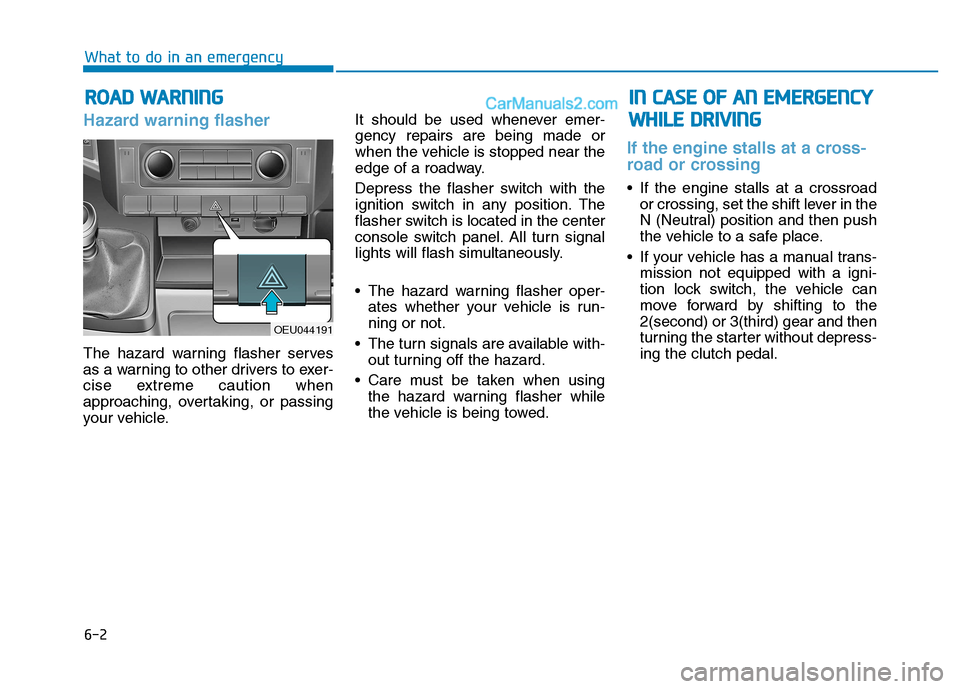
Hazard warning flasher
The hazard warning flasher serves
as a warning to other drivers to exer-
cise extreme caution when
approaching, overtaking, or passing
your vehicle.It should be used whenever emer-gency repairs are being made or
when the vehicle is stopped near the
edge of a roadway.
Depress the flasher switch with the
ignition switch in any position. The
flasher switch is located in the center
console switch panel. All turn signal
lights will flash simultaneously.
• The hazard warning flasher oper-
ates whether your vehicle is run- ning or not.
The turn signals are available with- out turning off the hazard.
Care must be taken when using the hazard warning flasher while
the vehicle is being towed.
If the engine stalls at a cross-
road or crossing
If the engine stalls at a crossroador crossing, set the shift lever in the
N (Neutral) position and then push
the vehicle to a safe place.
If your vehicle has a manual trans- mission not equipped with a igni-
tion lock switch, the vehicle can
move forward by shifting to the2(second) or 3(third) gear and then
turning the starter without depress-ing the clutch pedal.
RROO AADD WW AARRNN IINN GG
What to do in an emergency
I
INN CC AA SSEE OO FF AA NN EE MM EERR GG EENN CCYY
W
W HHIILL EE DD RRIIVV IINN GG
OEU044191
Page 339 of 473
6-4
If engine turns over normally
but does not start
1.Check fuel level.
2.With the ignition switch in theLOCK/ OFF position, check all connectors at ignition, coil and
spark plugs. Reconnect any that
may be disconnected or loose.
3.Check the fuel line in the engine compartment.
4.If the engine still does not start, we recommend that you call an
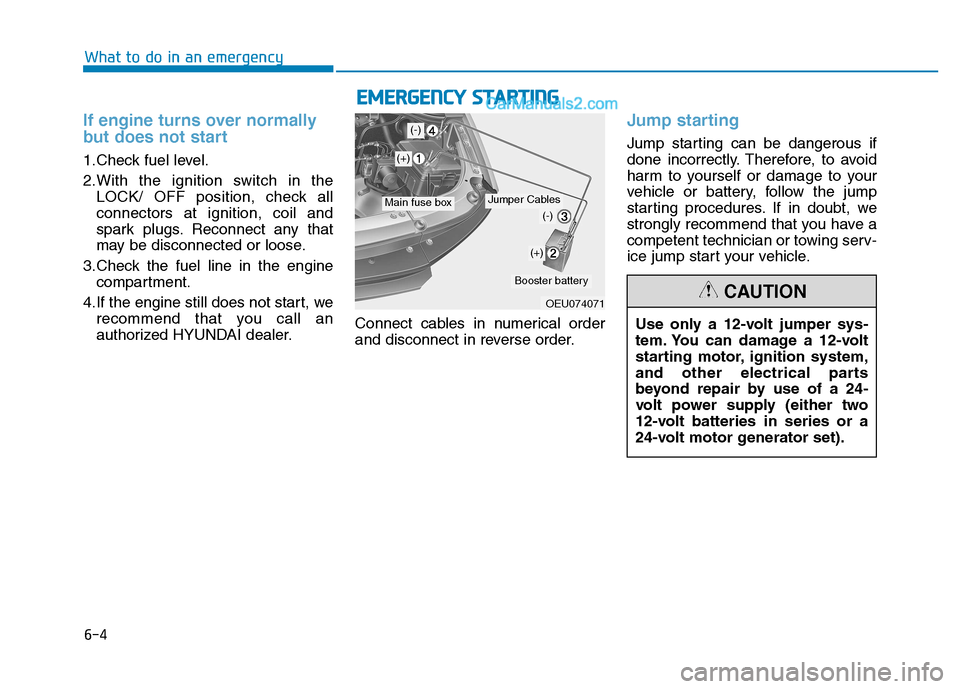
authorized HYUNDAI dealer. Connect cables in numerical order
and disconnect in reverse order.
Jump starting
Jump starting can be dangerous if
done incorrectly. Therefore, to avoid
harm to yourself or damage to your
vehicle or battery, follow the jump
starting procedures. If in doubt, we
strongly recommend that you have a
competent technician or towing serv-
ice jump start your vehicle.
What to do in an emergency
E
EMM EERR GG EENN CCYY SS TT AA RRTTIINN GG
OEU074071
Jumper CablesMain fuse box
Booster battery
Use only a 12-volt jumper sys-
tem. You can damage a 12-volt
starting motor, ignition system,
and other electrical parts
beyond repair by use of a 24-
volt power supply (either two
12-volt batteries in series or a
24-volt motor generator set).CAUTION
(+)
(+)
(-)
(-)
Page 345 of 473
6-10
What to do in an emergency
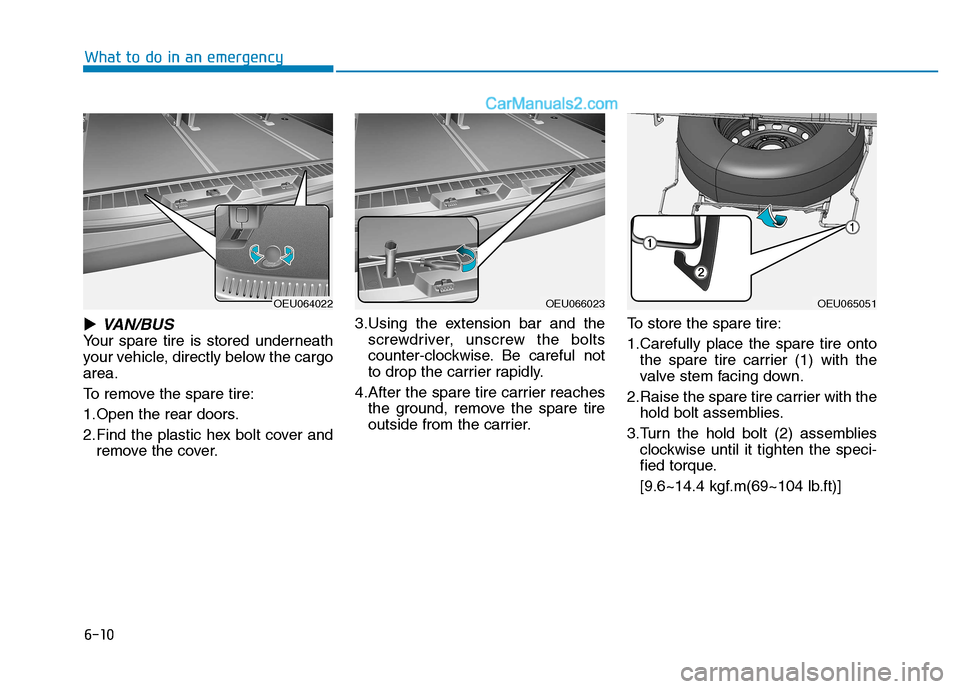
VAN/BUS
Your spare tire is stored underneath
your vehicle, directly below the cargoarea.
To remove the spare tire:
1.Open the rear doors.
2.Find the plastic hex bolt cover andremove the cover. 3.Using the extension bar and the
screwdriver, unscrew the bolts
counter-clockwise. Be careful not
to drop the carrier rapidly.
4.After the spare tire carrier reaches the ground, remove the spare tire
outside from the carrier. To store the spare tire:
1.Carefully place the spare tire onto
the spare tire carrier (1) with the
valve stem facing down.
2.Raise the spare tire carrier with the hold bolt assemblies.
3.Turn the hold bolt (2) assemblies clockwise until it tighten the speci-
fied torque.
[9.6~14.4 kgf.m(69~104 lb.ft)]
OEU064022OEU066023OEU065051
Page 346 of 473
6-11
What to do in an emergency
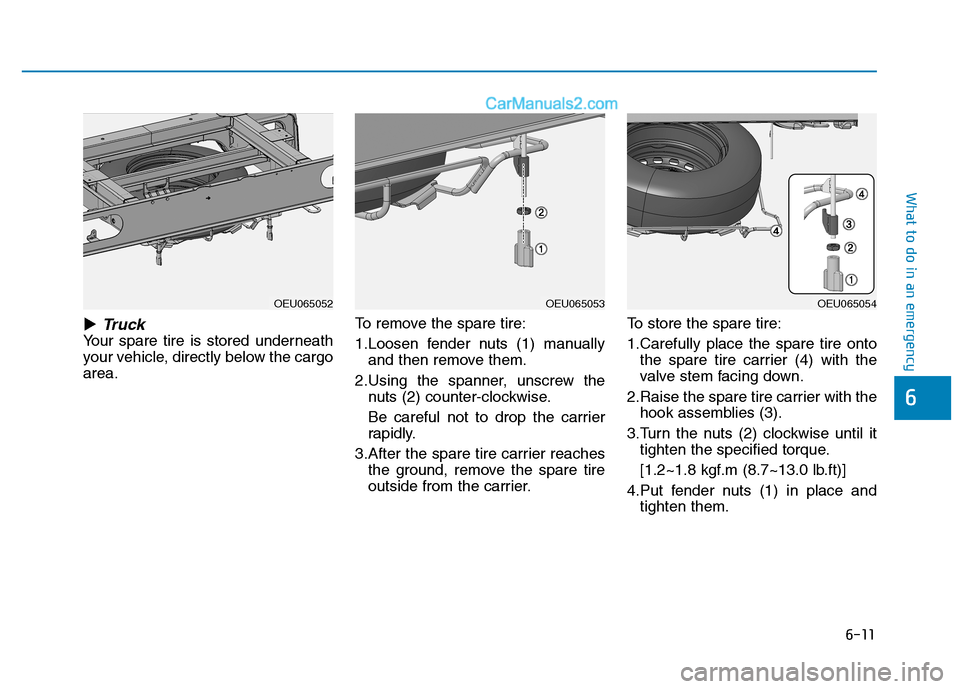
Truck
Your spare tire is stored underneath
your vehicle, directly below the cargoarea.To remove the spare tire:
1.Loosen fender nuts (1) manually
and then remove them.
2.Using the spanner, unscrew the nuts (2) counter-clockwise.
Be careful not to drop the carrier
rapidly.
3.After the spare tire carrier reaches the ground, remove the spare tire
outside from the carrier. To store the spare tire:
1.Carefully place the spare tire onto
the spare tire carrier (4) with the
valve stem facing down.
2.Raise the spare tire carrier with the hook assemblies (3).
3.Turn the nuts (2) clockwise until it tighten the specified torque.
[1.2~1.8 kgf.m (8.7~13.0 lb.ft)]
4.Put fender nuts (1) in place and tighten them.
6
OEU065052OEU065053OEU065054
Page 347 of 473
6-12
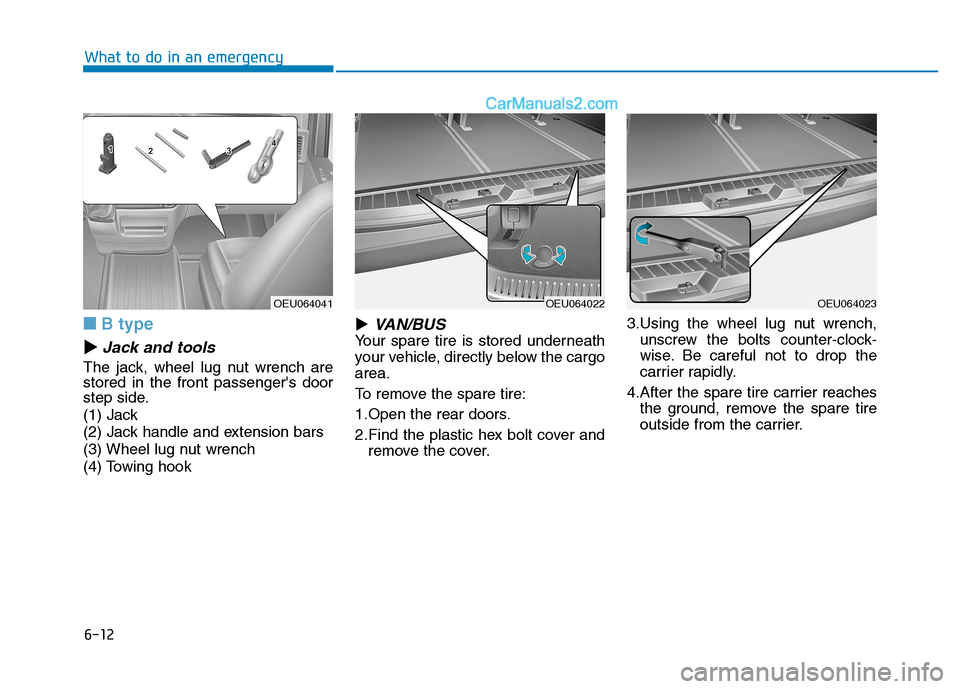
■■B type
Jack and tools
The jack, wheel lug nut wrench are stored in the front passenger's door
step side.
(1) Jack
(2) Jack handle and extension bars
(3) Wheel lug nut wrench
(4) Towing hook
VAN/BUS
Your spare tire is stored underneath
your vehicle, directly below the cargoarea.
To remove the spare tire:
1.Open the rear doors.
2.Find the plastic hex bolt cover and
remove the cover. 3.Using the wheel lug nut wrench,
unscrew the bolts counter-clock-
wise. Be careful not to drop the
carrier rapidly.
4.After the spare tire carrier reaches the ground, remove the spare tire
outside from the carrier.
What to do in an emergency
OEU064041OEU064022OEU064023
Page 348 of 473
6-13
What to do in an emergency
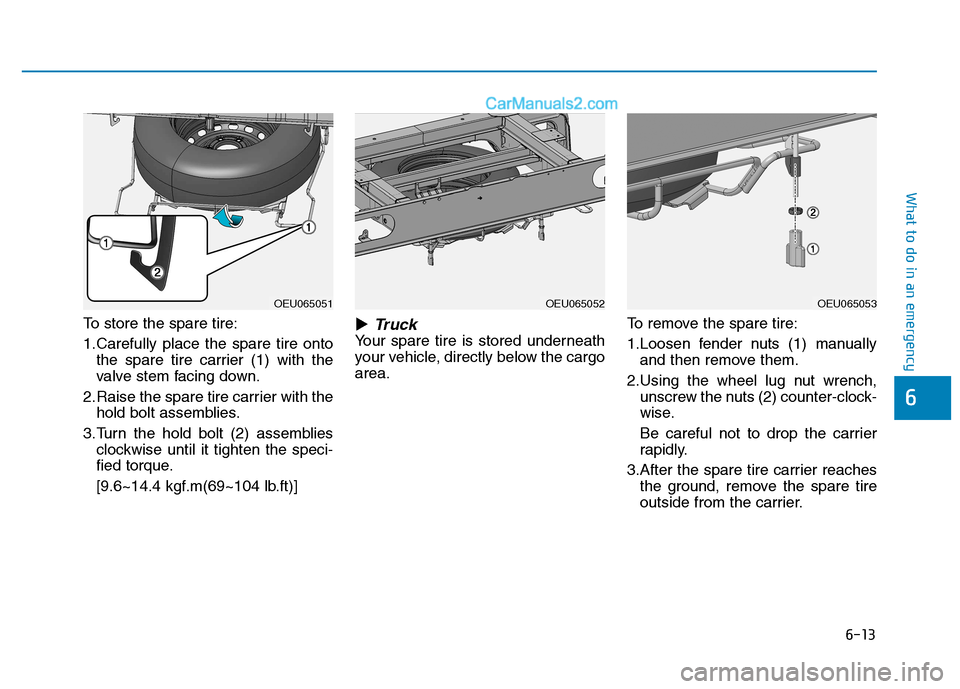
To store the spare tire:
1.Carefully place the spare tire ontothe spare tire carrier (1) with the
valve stem facing down.
2.Raise the spare tire carrier with the hold bolt assemblies.
3.Turn the hold bolt (2) assemblies clockwise until it tighten the speci-
fied torque.
[9.6~14.4 kgf.m(69~104 lb.ft)] Truck
Your spare tire is stored underneath
your vehicle, directly below the cargoarea.
To remove the spare tire:
1.Loosen fender nuts (1) manually
and then remove them.
2.Using the wheel lug nut wrench, unscrew the nuts (2) counter-clock-
wise.
Be careful not to drop the carrier
rapidly.
3.After the spare tire carrier reaches the ground, remove the spare tire
outside from the carrier.
6
OEU065051OEU065052OEU065053