Time Hyundai H350 2016 Owner's Manual
[x] Cancel search | Manufacturer: HYUNDAI, Model Year: 2016, Model line: H350, Model: Hyundai H350 2016Pages: 473, PDF Size: 26.4 MB
Page 386 of 473
7-23
7
Maintenance
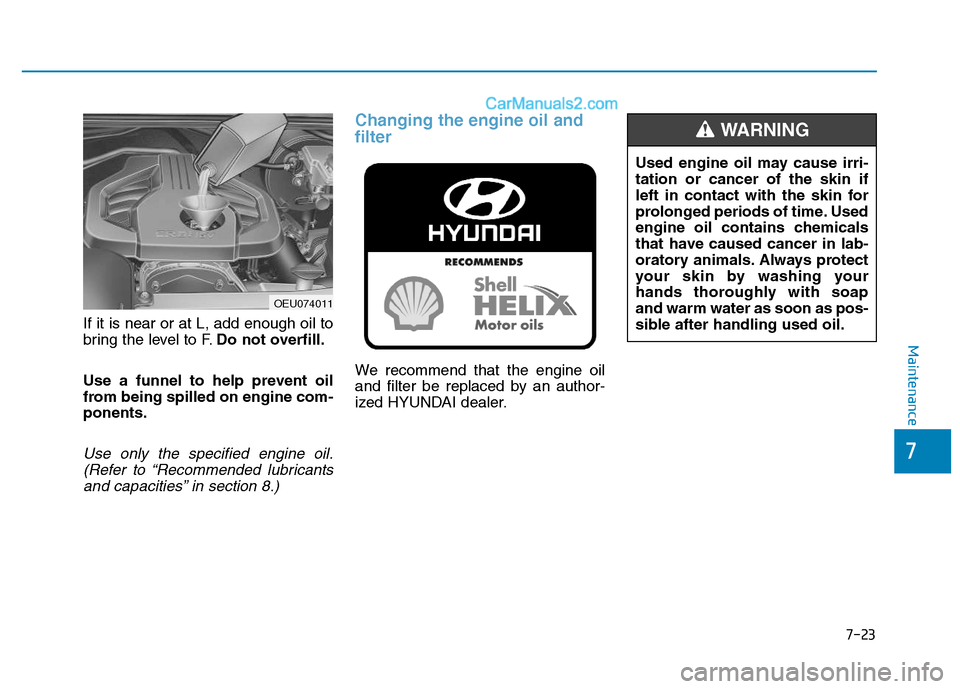
If it is near or at L, add enough oil to
bring the level to F.Do not overfill.
Use a funnel to help prevent oil
from being spilled on engine com-ponents.
Use only the specified engine oil. (Refer to “Recommended lubricantsand capacities” in section 8.)
Changing the engine oil and filter
We recommend that the engine oil
and filter be replaced by an author-
ized HYUNDAI dealer.
OEU074011
Used engine oil may cause irri- tation or cancer of the skin if
left in contact with the skin for
prolonged periods of time. Used
engine oil contains chemicals
that have caused cancer in lab-
oratory animals. Always protect
your skin by washing your
hands thoroughly with soapand warm water as soon as pos-
sible after handling used oil.
WARNING
Page 388 of 473
7-25
7
Maintenance
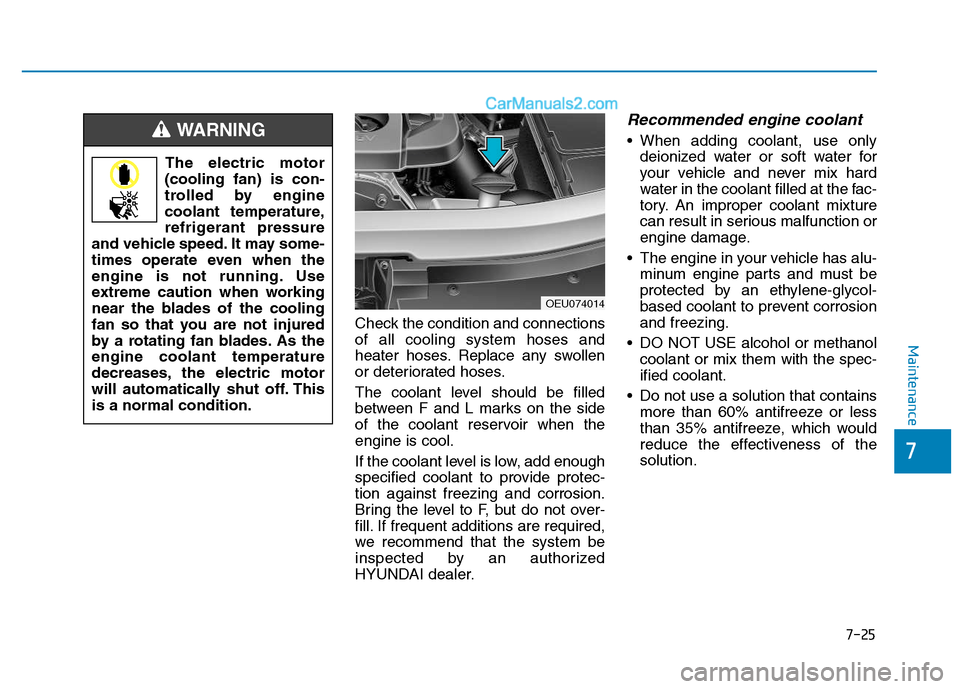
Check the condition and connections of all cooling system hoses and
heater hoses. Replace any swollen
or deteriorated hoses.
The coolant level should be filled
between F and L marks on the side
of the coolant reservoir when theengine is cool.
If the coolant level is low, add enough
specified coolant to provide protec-tion against freezing and corrosion.
Bring the level to F, but do not over-
fill. If frequent additions are required,
we recommend that the system be
inspected by an authorized
HYUNDAI dealer.
Recommended engine coolant
When adding coolant, use onlydeionized water or soft water for
your vehicle and never mix hard
water in the coolant filled at the fac-
tory. An improper coolant mixture
can result in serious malfunction or
engine damage.
The engine in your vehicle has alu- minum engine parts and must be
protected by an ethylene-glycol-
based coolant to prevent corrosionand freezing.
DO NOT USE alcohol or methanol coolant or mix them with the spec-ified coolant.
Do not use a solution that contains more than 60% antifreeze or less
than 35% antifreeze, which would
reduce the effectiveness of thesolution.
The electric motor
(cooling fan) is con-
trolled by engine
coolant temperature,
refrigerant pressure
and vehicle speed. It may some-
times operate even when the
engine is not running. Use
extreme caution when working
near the blades of the cooling
fan so that you are not injured
by a rotating fan blades. As theengine coolant temperature
decreases, the electric motor
will automatically shut off. Thisis a normal condition.WARNING
OEU074014
Page 391 of 473
7-28
Maintenance
Checking the power steering
fluid level
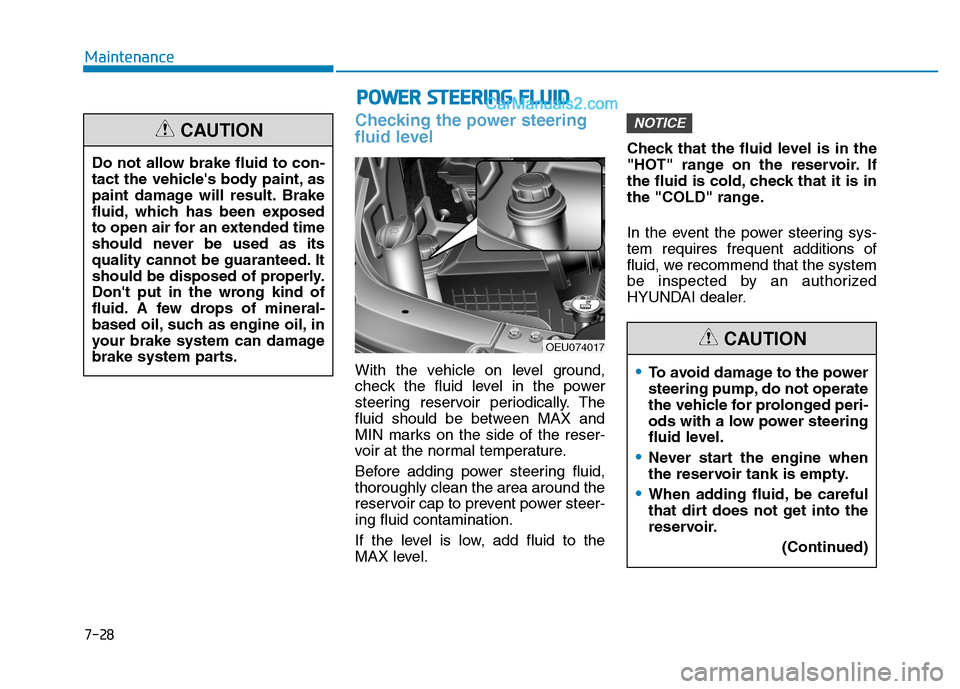
With the vehicle on level ground,
check the fluid level in the power
steering reservoir periodically. The
fluid should be between MAX and
MIN marks on the side of the reser-
voir at the normal temperature.
Before adding power steering fluid, thoroughly clean the area around the
reservoir cap to prevent power steer-ing fluid contamination.
If the level is low, add fluid to the
MAX level.Check that the fluid level is in the
"HOT" range on the reservoir. If
the fluid is cold, check that it is in
the "COLD" range.
In the event the power steering sys- tem requires frequent additions of
fluid, we recommend that the system
be inspected by an authorized
HYUNDAI dealer.
NOTICE
Do not allow brake fluid to con-
tact the vehicle's body paint, as
paint damage will result. Brake
fluid, which has been exposed
to open air for an extended time
should never be used as its
quality cannot be guaranteed. It
should be disposed of properly.
Don't put in the wrong kind of
fluid. A few drops of mineral-
based oil, such as engine oil, in
your brake system can damage
brake system parts.
CAUTION
PP
OO WW EERR SS TT EEEE RR IINN GG FF LLUU IIDD
OEU074017
To avoid damage to the power
steering pump, do not operate
the vehicle for prolonged peri-
ods with a low power steering
fluid level.
Never start the engine when
the reservoir tank is empty.
When adding fluid, be careful
that dirt does not get into the
reservoir.
(Continued)
CAUTION
Page 393 of 473
7-30
Maintenance
Checking the parking brake
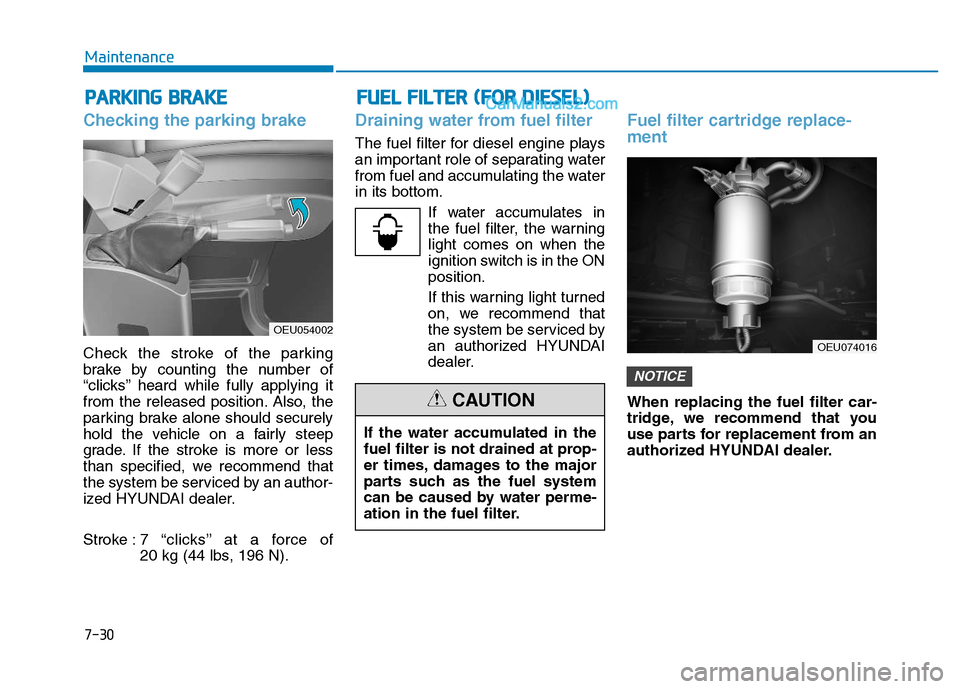
Check the stroke of the parking
brake by counting the number of
“clicks’’ heard while fully applying it
from the released position. Also, the
parking brake alone should securely
hold the vehicle on a fairly steep
grade. If the stroke is more or less
than specified, we recommend that
the system be serviced by an author-
ized HYUNDAI dealer.
Stroke : 7 “clicks’’ at a force of
20 kg (44 lbs, 196 N).
Draining water from fuel filter
The fuel filter for diesel engine plays
an important role of separating water
from fuel and accumulating the waterin its bottom.
If water accumulates inthe fuel filter, the warninglight comes on when the
ignition switch is in the ONposition.
If this warning light turned
on, we recommend that
the system be serviced by
an authorized HYUNDAI
dealer.
Fuel filter cartridge replace- ment
When replacing the fuel filter car-
tridge, we recommend that you
use parts for replacement from an
authorized HYUNDAI dealer.
NOTICE
PP AA RRKK IINN GG BB RRAA KKEE FFUU EELL FF IILL TT EERR (( FF OO RR DD IIEE SSEE LL))
OEU054002
If the water accumulated in the
fuel filter is not drained at prop-
er times, damages to the major
parts such as the fuel system
can be caused by water perme-
ation in the fuel filter.
CAUTION
OEU074016
Page 403 of 473
7-40
Maintenance
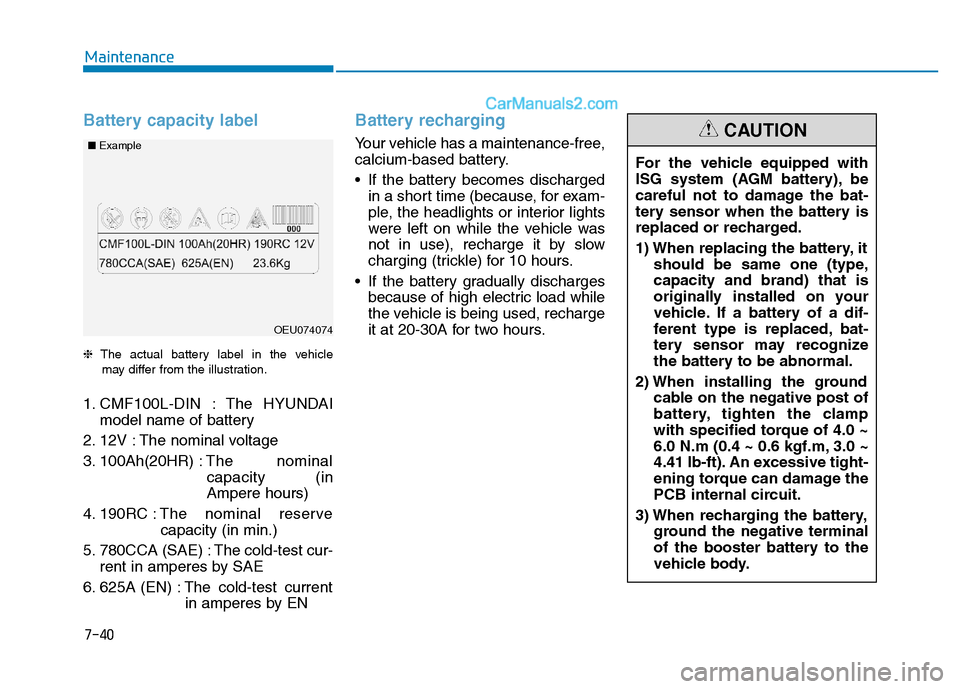
Battery capacity label
❈The actual battery label in the vehicle
may differ from the illustration.
1. CMF100L-DIN : The HYUNDAI model name of battery
2. 12V : The nominal voltage
3. 100Ah(20HR) : The nominal
capacity (in Ampere hours)
4. 190RC : The nominal reserve
capacity (in min.)
5. 780CCA (SAE) : The cold-test cur- rent in amperes by SAE
6. 625A (EN) : The cold-test current in amperes by EN
Battery recharging
Your vehicle has a maintenance-free,
calcium-based battery.
If the battery becomes dischargedin a short time (because, for exam-
ple, the headlights or interior lights
were left on while the vehicle was
not in use), recharge it by slow
charging (trickle) for 10 hours.
If the battery gradually discharges because of high electric load while
the vehicle is being used, recharge
it at 20-30A for two hours. For the vehicle equipped with
ISG system (AGM battery), be
careful not to damage the bat-
tery sensor when the battery is
replaced or recharged.
1) When replacing the battery, it
should be same one (type, capacity and brand) that is
originally installed on your
vehicle. If a battery of a dif-
ferent type is replaced, bat-
tery sensor may recognize
the battery to be abnormal.
2) When installing the ground cable on the negative post of
battery, tighten the clamp
with specified torque of 4.0 ~
6.0 N.m (0.4 ~ 0.6 kgf.m, 3.0 ~
4.41 lb-ft). An excessive tight-
ening torque can damage the
PCB internal circuit.
3) When recharging the battery, ground the negative terminal
of the booster battery to the
vehicle body.CAUTION
OEU074074
■
Example
Page 406 of 473
7-43
7
Maintenance
Checking tire inflation pres- sure
Check your tires once a month or
more.
Also, check the tire pressure of the
spare tire.
How to check
Use a good quality gage to check tire
pressure. You can not tell if your tires
are properly inflated simply by look-
ing at them. Radial tires may look
properly inflated even when they're
underinflated.
Check the tire's inflation pressure
when the tires are cold. - "Cold"
means your vehicle has been sitting
for at least three hours or driven nomore than 1.6 km (1 mile).
Tire pressure
Always observe the following:
Check tire pressure when the
tires are cold. (After vehicle
has been parked for at least
three hours or hasn't beendriven more than 1.6 km (1
mile) since startup.)
Check the pressure of your
spare tire each time you checkthe pressure of other tires.
Never overload your vehicle.
Be careful not to overload a
vehicle luggage rack if your
vehicle is equipped with one.
Worn, old tires can cause
accidents. If your tread is
badly worn, or if your tires
have been damaged, replacethem.
CAUTION
Tire inflation Overinflation or underinflation
can reduce tire life, adversely
affect vehicle handling, and
lead to sudden tire failure. This
could result in loss of vehicle
control and potential injury.
WARNING
Warm tires normally exceed recommended cold tire pres-
sures by 28 to 41 kPa (4 to 6
psi). Do not release air fromwarm tires to adjust the pres-sure or the tires will be under-inflated.
Be sure to reinstall the tire
inflation valve caps. Without
the valve cap, dirt or moisture
could get into the valve core
and cause air leakage. If a
valve cap is missing, install a
new one as soon as possible.
CAUTION
Page 407 of 473
7-44
Maintenance
Remove the valve cap from the tire
valve stem. Press the tire gage firm-
ly onto the valve to get a pressure
measurement. If the cold tire inflationpressure matches the recommendedpressure on the tire and loading
information label, no further adjust-
ment is necessary. If the pressure is
low, add air until you reach the rec-ommended amount.
If you overfill the tire, release air by pushing on the metal stem in the
center of the tire valve. Recheck the
tire pressure with the tire gage. Be
sure to put the valve caps back on
the valve stems. They help prevent
leaks by keeping out dirt and mois-
ture.Tire rotation
To equalize tread wear, it is recom- mended that the tires be rotated
every 12,000 km (7,500 miles) or
sooner if irregular wear develops.
During rotation, check the tires for
correct balance.
When rotating tires, check for uneven
wear and damage. Abnormal wear is
usually caused by incorrect tire pres-
sure, improper wheel alignment, out-
of-balance wheels, severe braking or
severe cornering. Look for bumps or
bulges in the tread or side of tire.
Replace the tire if you find either of
these conditions. Replace the tire if
fabric or cord is visible. After rotation,
be sure to bring the front and rear tire
pressures to specification and check
lug nut tightness.
Refer to “Tire and wheels” in section 8.
Inspect your tires frequently
for proper inflation as well as
wear and damage. Always use
a tire pressure gauge.
Tires with too much or too lit-
tle pressure wear unevenly
causing poor handling, loss of
vehicle control, and suddentire failure leading to acci-
dents, injuries, and even
death. The recommended cold
tire pressure for your vehicle
can be found in this manualand on the tire label locatedon the driver's side center pil-
lar.
Worn tires can cause acci-
dents. Replace tires that are
worn, show uneven wear, or
are damaged.
Remember to check the pres-
sure of your spare tire.
HYUNDAI recommends that
you check the spare every
time you check the pressure
of the other tires on your vehi-
cle.
WARNING
Page 410 of 473
7-47
7
Maintenance
Wheel replacement
When replacing the metal wheels for
any reason, make sure the new
wheels are equivalent to the original
factory units in diameter, rim widthand offset.
Tire traction
Tire traction can be reduced if you
drive on worn tires, tires that are
improperly inflated or on slippery
road surfaces. Tires should be
replaced when tread wear indicators
appear. To reduce the possibility of
losing control, slow down whenever
there is rain, snow or ice on the road.
Tire maintenance
In addition to proper inflation, correct wheel alignment helps to decrease
tire wear. If you find a tire is worn
unevenly, have your dealer or otherrepair shops that use qualified tech-
nicians check the wheel alignment.
When you have new tires installed,
make sure they are balanced. This
will increase vehicle ride comfort and
tire life. Additionally, a tire should
always be rebalanced if it is removedfrom the wheel.
A wheel that is not the correct
size may adversely affect wheel
and bearing life, braking and
stopping abilities, handling
characteristics, ground clear-
ance, body-to-tire clearance,
snow chain clearance,speedometer and odometer cal-
ibration, headlight aim and
bumper height.
WARNING
(Continued)
The use of any other tire size
or type may seriously affect
ride, handling, ground clear-
ance, stopping distance, body
to tire clearance, snow tire
clearance, and speedometer
reliability.
It is best to replace all four
tires at the same time. If that
is not possible, or necessary,
then replace the two front or
two rear tires as a pair.Replacing just one tire can
seriously affect your vehicle’shandling.
The ABS works by comparing
the speed of the wheels. Tire
size can affect wheel speed.
When replacing tires, all 4
tires must use the same size
originally supplied with the
vehicle. Using tires of a differ-
ent size can cause the ABS
(Anti-lock Brake System) and
ESP (Electronic Stability
Program) (if equipped) to
work irregularly.
Page 412 of 473
7-49
7
Maintenance
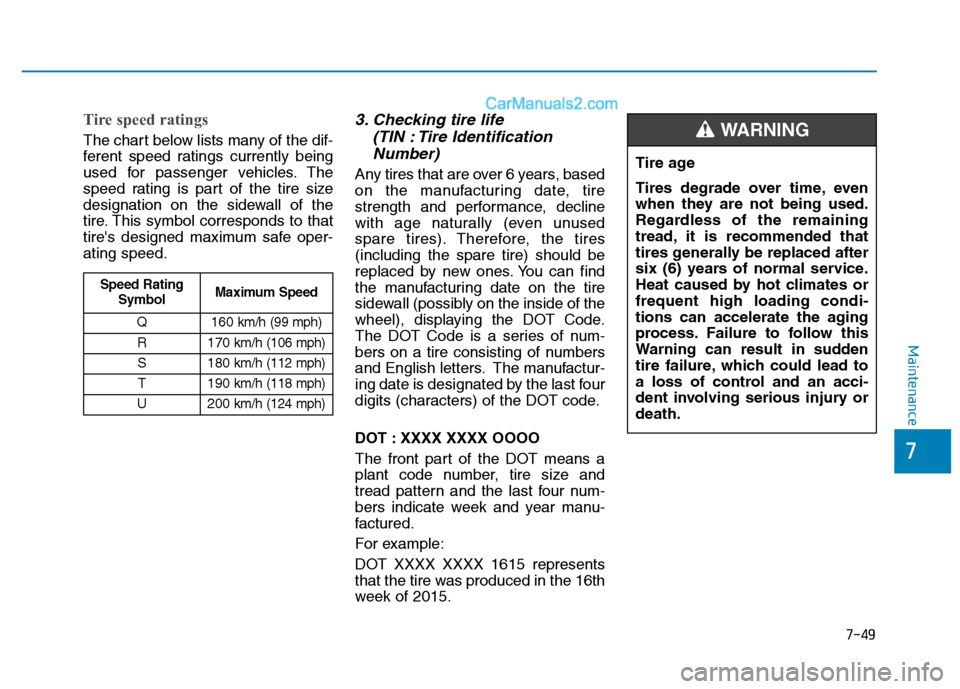
Tire speed ratings
The chart below lists many of the dif-
ferent speed ratings currently being
used for passenger vehicles. The
speed rating is part of the tire size
designation on the sidewall of the
tire. This symbol corresponds to that
tire's designed maximum safe oper-ating speed.
3. Checking tire life (TIN : Tire Identification
Number)
Any tires that are over 6 years, based
on the manufacturing date, tire
strength and performance, decline
with age naturally (even unused
spare tires). Therefore, the tires(including the spare tire) should be
replaced by new ones. You can find
the manufacturing date on the tire
sidewall (possibly on the inside of the
wheel), displaying the DOT Code.
The DOT Code is a series of num-
bers on a tire consisting of numbers
and English letters. The manufactur-
ing date is designated by the last four
digits (characters) of the DOT code.
DOT : XXXX XXXX OOOO
The front part of the DOT means a
plant code number, tire size and
tread pattern and the last four num-
bers indicate week and year manu-
factured.
For example:
DOT XXXX XXXX 1615 represents
that the tire was produced in the 16th
week of 2015. Tire age
Tires degrade over time, even
when they are not being used.
Regardless of the remaining
tread, it is recommended that
tires generally be replaced after
six (6) years of normal service.
Heat caused by hot climates orfrequent high loading condi-
tions can accelerate the aging
process. Failure to follow this
Warning can result in sudden
tire failure, which could lead to
a loss of control and an acci-
dent involving serious injury ordeath.
WARNING
Speed Rating
SymbolMaximum Speed
Q160km/h (99 mph)
R170km/h (106 mph)
S180km/h (112 mph)
T190km/h (118 mph)
U200km/h (124 mph)
Page 418 of 473
7-55
7
Maintenance
Not all fuse panel descriptions in
this manual may be applicable to
your vehicle. It is accurate at thetime of printing.
When you inspect the fuse box on
your vehicle, refer to the fuse boxlabel.
NOTICE
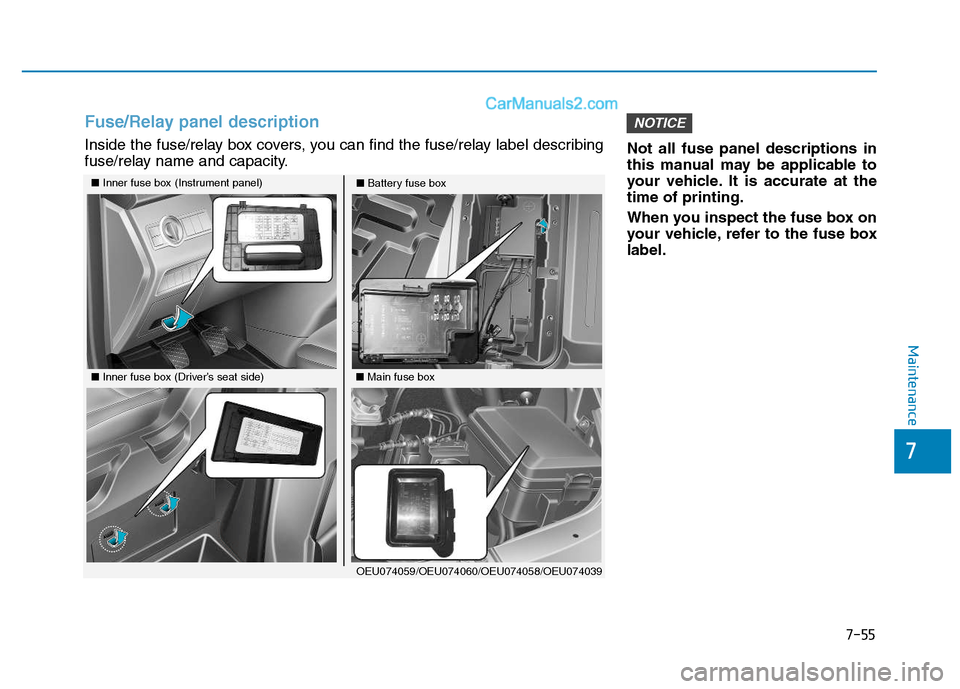
■Inner fuse box (Driver’s seat side)
OEU074059/OEU074060/OEU074058/OEU074039
■
Inner fuse box (Instrument panel)
■Main fuse box
■Battery fuse box
Fuse/Relay panel description
Inside the fuse/relay box covers, you can find the fuse/relay label describing
fuse/relay name and capacity.