service Hyundai H350 2016 Owner's Guide
[x] Cancel search | Manufacturer: HYUNDAI, Model Year: 2016, Model line: H350, Model: Hyundai H350 2016Pages: 473, PDF Size: 26.4 MB
Page 344 of 473
6-9
What to do in an emergency
6
■■Jacking instructions
The jack is provided for emergency
tire changing only.
To prevent the jack from “rattling”
while the vehicle is in motion, store it
properly and fasten the jack screw
fully.
Follow jacking instructions to reduce
the possibility of personal injury.
■■A type
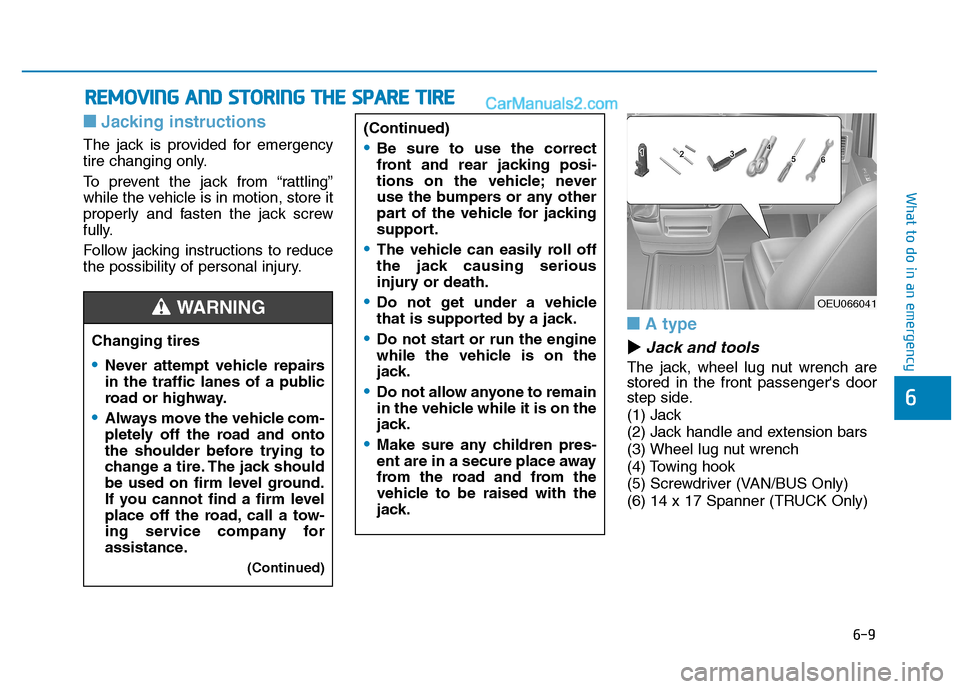
Jack and tools
The jack, wheel lug nut wrench are stored in the front passenger's door
step side.
(1) Jack
(2) Jack handle and extension bars
(3) Wheel lug nut wrench
(4) Towing hook
(5) Screwdriver (VAN/BUS Only)
(6) 14 x 17 Spanner (TRUCK Only)
RREEMM OOVVIINN GG AA NN DD SS TT OO RRIINN GG TT HH EE SS PP AA RREE TT IIRR EE
OEU066041
Changing tires
Never attempt vehicle repairs
in the traffic lanes of a public
road or highway.
Always move the vehicle com-
pletely off the road and onto
the shoulder before trying to
change a tire. The jack should
be used on firm level ground.
If you cannot find a firm level
place off the road, call a tow-
ing service company for
assistance. (Continued)
(Continued)
Be sure to use the correct
front and rear jacking posi-
tions on the vehicle; never
use the bumpers or any other
part of the vehicle for jacking
support.
The vehicle can easily roll off
the jack causing serious
injury or death.
Do not get under a vehicle
that is supported by a jack.
Do not start or run the engine
while the vehicle is on the
jack.
Do not allow anyone to remain
in the vehicle while it is on the
jack.
Make sure any children pres-
ent are in a secure place away
from the road and from the
vehicle to be raised with the
jack.
WARNING
Page 354 of 473
6-19
What to do in an emergency
6
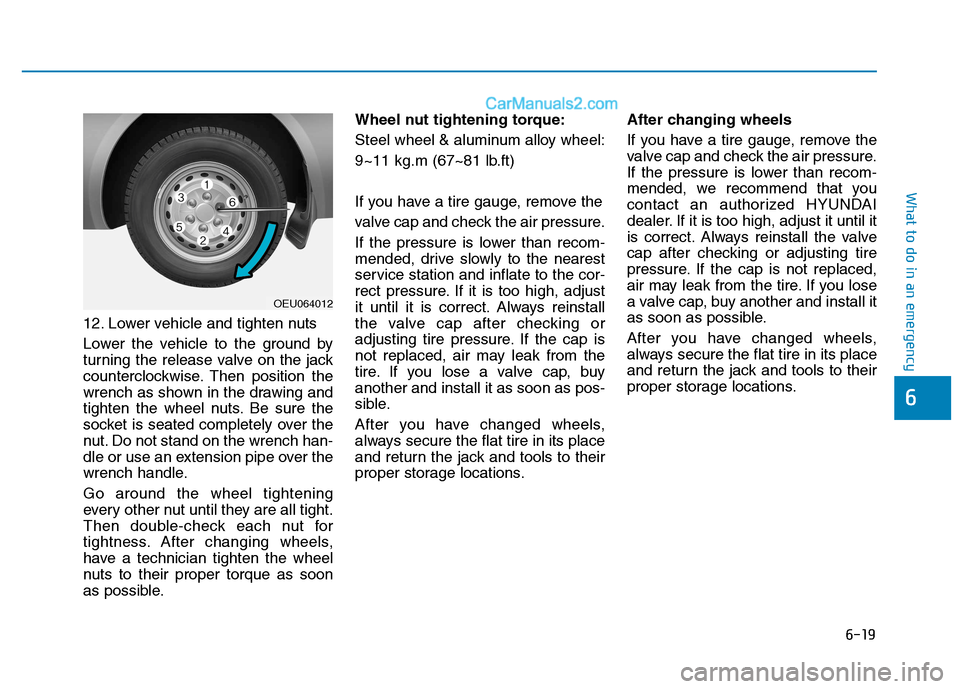
12. Lower vehicle and tighten nuts
Lower the vehicle to the ground by
turning the release valve on the jack
counterclockwise. Then position the
wrench as shown in the drawing and
tighten the wheel nuts. Be sure the
socket is seated completely over the
nut. Do not stand on the wrench han-
dle or use an extension pipe over the
wrench handle. Go around the wheel tightening
every other nut until they are all tight.
Then double-check each nut for
tightness. After changing wheels,
have a technician tighten the wheel
nuts to their proper torque as soon
as possible.Wheel nut tightening torque:
Steel wheel & aluminum alloy wheel:
9~11 kg.m (67~81 lb.ft)
If you have a tire gauge, remove the
valve cap and check the air pressure.
If the pressure is lower than recom-
mended, drive slowly to the nearest
service station and inflate to the cor-
rect pressure. If it is too high, adjust
it until it is correct. Always reinstall
the valve cap after checking or
adjusting tire pressure. If the cap is
not replaced, air may leak from the
tire. If you lose a valve cap, buyanother and install it as soon as pos-
sible.
After you have changed wheels,
always secure the flat tire in its place
and return the jack and tools to their
proper storage locations.
After changing wheels
If you have a tire gauge, remove the
valve cap and check the air pressure.
If the pressure is lower than recom-
mended, we recommend that you
contact an authorized HYUNDAI
dealer. If it is too high, adjust it until it
is correct. Always reinstall the valve
cap after checking or adjusting tire
pressure. If the cap is not replaced,
air may leak from the tire. If you lose
a valve cap, buy another and install it
as soon as possible.
After you have changed wheels,
always secure the flat tire in its place
and return the jack and tools to their
proper storage locations.
OEU064012
Page 357 of 473
6-22
What to do in an emergency
The compact spare tire should notbe used on any other wheels, nor
should standard tires, snow tires,
wheel covers or trim rings be used
with the compact spare wheel. Ifsuch use is attempted, damage tothese items or other car compo-
nents may occur.
Do not use more than one compact spare tire at a time.
Do not tow a trailer while the com- pact spare tire is installed.Towing service
If emergency towing is necessary,
we recommend having it done by an
authorized HYUNDAI dealer or a
commercial tow-truck service.
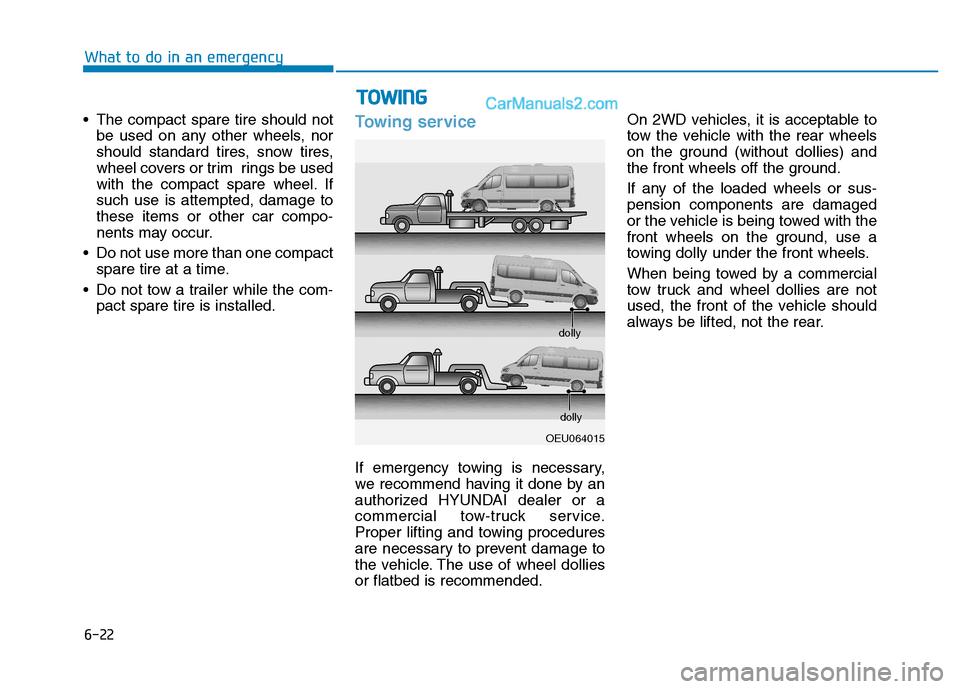
Proper lifting and towing procedures
are necessary to prevent damage to
the vehicle. The use of wheel dolliesor flatbed is recommended. On 2WD vehicles, it is acceptable to
tow the vehicle with the rear wheels
on the ground (without dollies) and
the front wheels off the ground.
If any of the loaded wheels or sus- pension components are damaged
or the vehicle is being towed with the
front wheels on the ground, use a
towing dolly under the front wheels.
When being towed by a commercial
tow truck and wheel dollies are not
used, the front of the vehicle should
always be lifted, not the rear.
TT
OO WW IINN GG
OEU064015 dolly
dolly
Page 359 of 473
6-24
What to do in an emergency
Emergency towing
If towing is necessary, we recom-
mend you to have it done by an
authorized HYUNDAI dealer or a
commercial tow truck service.If towing service is not available in an
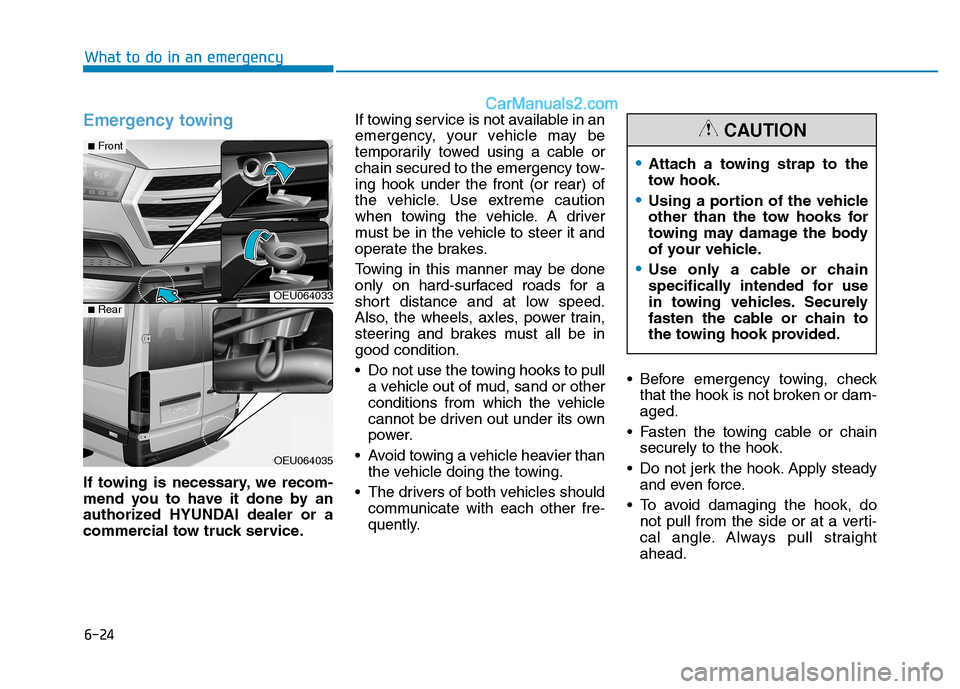
emergency, your vehicle may be
temporarily towed using a cable or
chain secured to the emergency tow-ing hook under the front (or rear) of
the vehicle. Use extreme caution
when towing the vehicle. A driver
must be in the vehicle to steer it and
operate the brakes.
Towing in this manner may be done
only on hard-surfaced roads for a
short distance and at low speed.
Also, the wheels, axles, power train,
steering and brakes must all be ingood condition.
Do not use the towing hooks to pull
a vehicle out of mud, sand or other
conditions from which the vehicle
cannot be driven out under its own
power.
Avoid towing a vehicle heavier than the vehicle doing the towing.
The drivers of both vehicles should communicate with each other fre-
quently. Before emergency towing, check
that the hook is not broken or dam-aged.
Fasten the towing cable or chain securely to the hook.
Do not jerk the hook. Apply steady and even force.
To avoid damaging the hook, do not pull from the side or at a verti-
cal angle. Always pull straightahead.
OEU064033
OEU064035
■Front
■Rear
Attach a towing strap to the
tow hook.
Using a portion of the vehicle
other than the tow hooks for
towing may damage the body
of your vehicle.
Use only a cable or chain
specifically intended for use
in towing vehicles. Securely
fasten the cable or chain to
the towing hook provided.
CAUTION
Page 360 of 473
6-25
What to do in an emergency
6
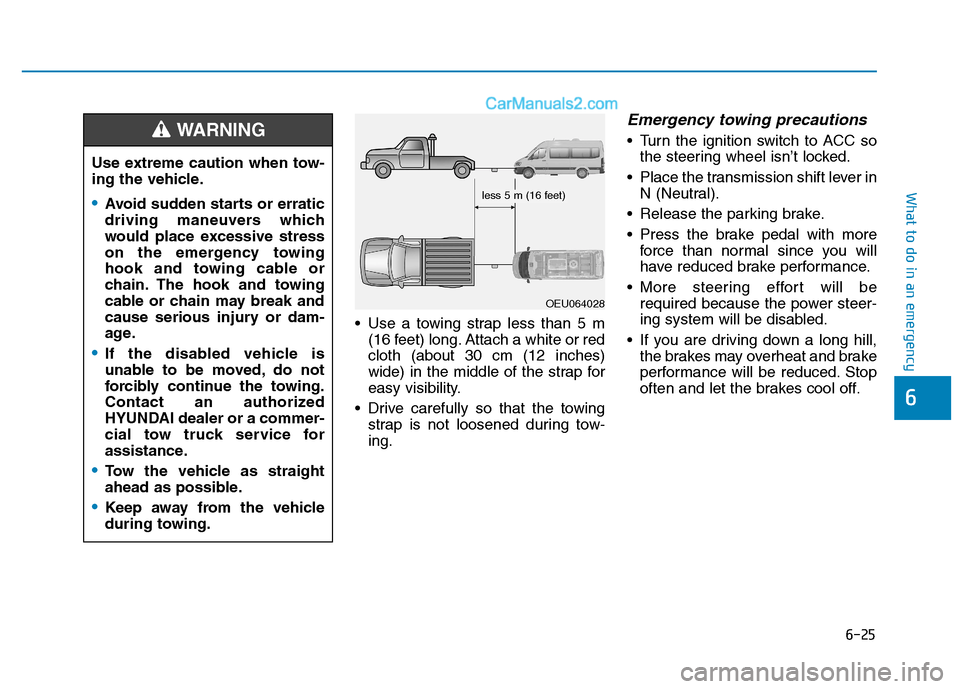
Use a towing strap less than 5 m(16 feet) long. Attach a white or red cloth (about 30 cm (12 inches)
wide) in the middle of the strap for
easy visibility.
Drive carefully so that the towing strap is not loosened during tow-ing.
Emergency towing precautions
Turn the ignition switch to ACC sothe steering wheel isn’t locked.
Place the transmission shift lever in N (Neutral).
Release the parking brake.
Press the brake pedal with more force than normal since you will
have reduced brake performance.
More steering effort will be required because the power steer-
ing system will be disabled.
If you are driving down a long hill, the brakes may overheat and brake
performance will be reduced. Stop
often and let the brakes cool off.
Use extreme caution when tow-
ing the vehicle.
Avoid sudden starts or erratic
driving maneuvers which
would place excessive stress
on the emergency towing
hook and towing cable or
chain. The hook and towing
cable or chain may break and
cause serious injury or dam-
age.
If the disabled vehicle is
unable to be moved, do not
forcibly continue the towing.
Contact an authorized
HYUNDAI dealer or a commer-
cial tow truck service for
assistance.
Tow the vehicle as straight
ahead as possible.
Keep away from the vehicle
during towing.
WARNING
OEU064028
less 5 m (16 feet)
Page 364 of 473
7
Maintenance
7
Maintenance
Engine compartment .............................................7-3
Maintenance services ...........................................7-5Owner's responsibility ......................................................7-5
Owner maintenance precautions ..................................7-5
Engine compartment precautions (Diesel engine) ....7-7
Owner maintenance ...............................................7-8 Owner maintenance schedule ........................................7-8
Scheduled maintenance services ......................7-10 Normal maintenance schedule (for Europe) ............7-11
Normal maintenance schedule (except Europe) .....7-14
Maintenance under severe usage conditions ..........7-17
Explanation of scheduled maintenance items ..7-19
Engine oil ..............................................................7-22 Checking the engine oil level ....................................7-22
Changing the engine oil and filter ..............................7-23
Engine coolant......................................................7-24 Checking the coolant level ...........................................7-24
Changing the coolant .....................................................7-26
Brake/Clutch fluid ..............................................7-27 Checking the brake/clutch fluid level ........................7-27
Power steering fluid ............................................7-28 Checking the power steering fluid level ...................2-28
Checking the power steering hose.............................2-29
Washer fluid .........................................................7-29 Checking the washer fluid level ...............................7-29 Parking brake .......................................................7-30
Checking the parking brake .........................................7-30
Fuel filter (For diesel).........................................7-30 Draining water from fuel filter ....................................7-30
Fuel filter cartridge replacement ................................7-30
Manual transmission and rearaxle oil ..............7-31 Check and adding oil ......................................................7-31
Change the gear oil ........................................................7-31
Air cleaner ............................................................7-31 Filter replacement ...........................................................7-31
Climate control air filter .....................................7-33 Filter inspection ...............................................................7-33
Filter replacement ...........................................................7-33
Wiper blades .........................................................7-34 Blade inspection ..............................................................7-34
Blade replacement ..........................................................7-35
Battery...................................................................7-37 For best battery service................................................7-37
Battery capacity label ...................................................7-40
Battery recharging .......................................................7-40
Reset items .......................................................................7-41
Tires and wheels ..................................................7-42 Tire care ............................................................................7-42
Recommended cold tire inflation pressures.............7-42
Checking tire inflation pressure ..................................7-43
7
Page 368 of 473
7-5
7
Maintenance
MMAAIINN TTEENN AANN CCEE SS EE RR VV IICC EE SS
You should exercise the utmost care
to prevent damage to your vehicle
and injury to yourself whenever per-
forming any maintenance or inspec-
tion procedures.
Inadequate, incomplete or insuffi-
cient servicing may result in opera-
tional problems with your vehicle that
could lead to vehicle damage, an
accident, or personal injury.Owner’s responsibility
Maintenance Service and Record
Retention are the owner's respon-
sibility.
We recommend in general that you
have your vehicle serviced by an
authorized HYUNDAI dealer. You
should retain documents that showproper maintenance has been per-
formed on your vehicle in accor-dance with the scheduled mainte-
nance service charts shown on the
following pages. You need this infor-
mation to establish your compliance
with the servicing and maintenance
requirements of your vehicle war-
ranties. Detailed warranty informa-
tion is provided in your Service
Passport. Repairs and adjustmentsrequired as a result of improper
maintenance or a lack of required
maintenance are not covered when
your vehicle is covered by warranty.
Owner maintenance precautions
Improper or incomplete service may
result in problems. This section gives
instructions only for the maintenance
items that are easy to perform.
Improper owner maintenance dur-
ing the warranty period may affect
warranty coverage. For details,
read the separate Service
Passport provided with the vehi-
cle. If you're unsure about any
servicing or maintenance proce-
dure, we recommend that the sys-
tem be serviced by an authorized
HYUNDAI dealer.
NOTICE
NOTICE
Page 369 of 473
7-6
Maintenance
Maintenance work
Performing maintenance work
on a vehicle can be danger-
ous. You can be seriously
injured while performing
some maintenance proce-
dures. If you lack sufficient
knowledge and experience or
the proper tools and equip-
ment to do the work, we rec-ommend that the system be
serviced by an authorized
HYUNDAI dealer.
Working under the hood with
the engine running is danger-
ous. It becomes even more
dangerous when you wear
jewelry or loose clothing.These can become entangled
in moving parts and result in
injury.(Continued)
WARNING Continued)
Therefore, if you must run the
engine while working under
the hood, make certain that
you remove all jewelry (espe-
cially rings, bracelets, watch-
es, and necklaces) and all
neckties, scarves, and similar
loose clothing before gettingnear the engine or coolingfans.
Do not put heavy objects or
apply excessive force on top
of the engine cover (ifequipped) or fuel related
parts.
When you inspect the fuel system (fuel lines and fuel
injection devices), we recom-
mend that you contact an
authorized HYUNDAI dealer.
Do not drive long time with
the engine cover (if equipped)
removed.
When checking the engine
room, do not go near fire.
Fuel, washer fluid, etc. are
flammable oils that may cause
fire.
Before touching the battery,
ignition cables and electrical
wiring, you should disconnect
the battery "-" terminal. You
may get an electric shock
from the electric current. (Continued)
CAUTION
Page 374 of 473
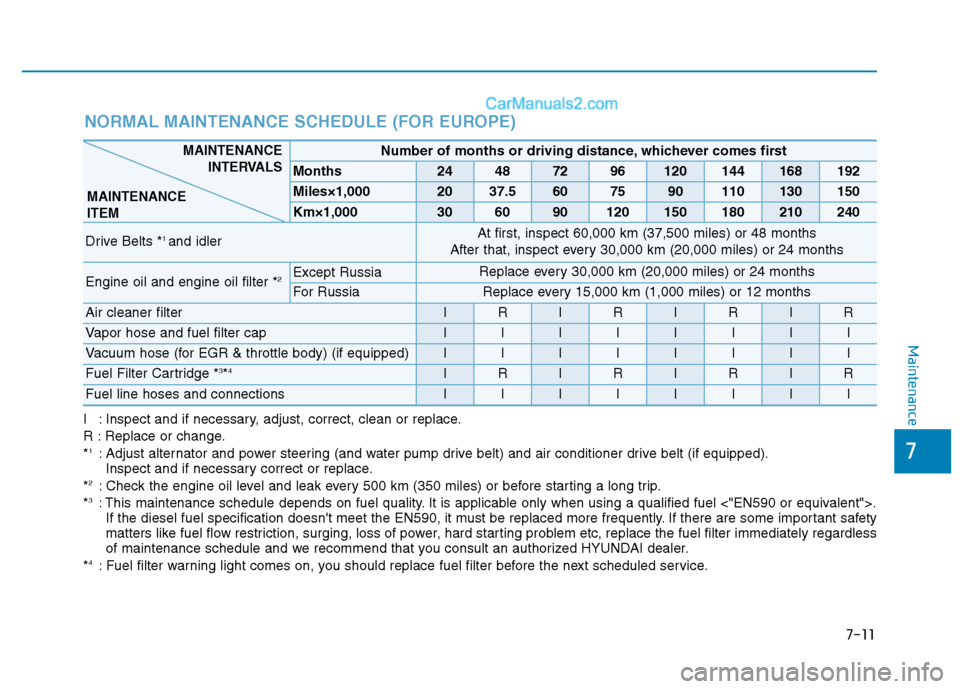
7-11
7
Maintenance
NORMAL MAINTENANCE SCHEDULE (FOR EUROPE)
I : Inspect and if necessary, adjust, correct, clean or replace.
R : Replace or change.*1
: Adjust alternator and power steering (and water pump drive belt) and air conditioner drive belt (if equipped).
Inspect and if necessary correct or replace.
* 2
: Check the engine oil level and leak every 500 km (350 miles) or before starting a long trip.
* 3
: This maintenance schedule depends on fuel quality. It is applicable only when using a qualified fuel <"EN590 or equivalent">.
If the diesel fuel specification doesn't meet the EN590, it must be replaced more frequently. If there are some important safety
matters like fuel flow restriction, surging, loss of power, hard starting problem etc, replace the fuel filter immediately rega rdless
of maintenance schedule and we recommend that you consult an authorized HYUNDAI dealer.
* 4
: Fuel filter warning light comes on, you should replace fuel filter before the next scheduled service.
Number of months or driving distance, whichever comes first
Months24487296120144168192
Miles×1,0002037.5607590110130150
Km×1,000306090120150180210240
Drive Belts * 1
and idlerAt first, inspect 60,000 km (37,500 miles) or 48 months
After that, inspect every 30,000 km (20,000 miles) or 24 months
Engine oil and engine oil filter * 2Except RussiaReplace every 30,000 km (20,000 miles) or 24 months
For RussiaReplace every 15,000 km (1,000 miles) or 12 months
Air cleaner filterIRIRIRIR
Vapor hose and fuel filter capIIIIIIII
Vacuum hose (for EGR & throttle body) (if equipped)IIIIIIII
Fuel Filter Cartridge *3
* 4IRIRIRIR
Fuel line hoses and connectionsIIIIIIII
MAINTENANCE
INTERVALS
MAINTENANCE ITEM
Page 377 of 473
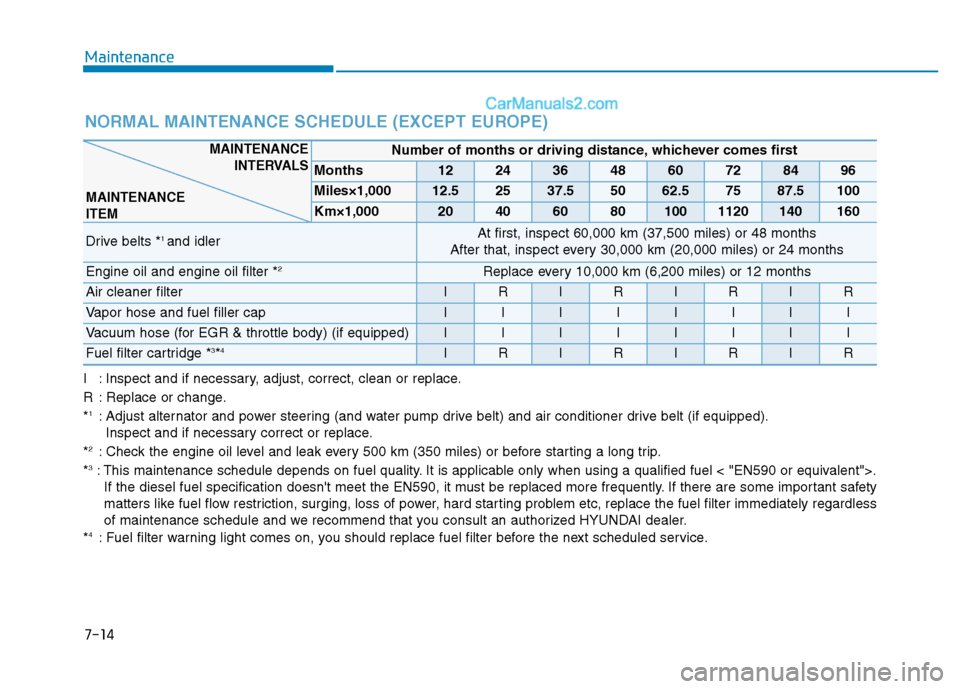
7-14
Maintenance
NORMAL MAINTENANCE SCHEDULE (EXCEPT EUROPE)
Number of months or driving distance, whichever comes first
Months1224364860728496
Miles×1,00012.52537.55062.57587.5100
Km×1,000204060801001120140160
Drive belts *1
and idlerAt first, inspect 60,000 km (37,500 miles) or 48 months
After that, inspect every 30,000 km (20,000 miles) or 24 months
Engine oil and engine oil filter * 2Replace every 10,000 km (6,200 miles) or 12 months
Air cleaner filterIRIRIRIR
Vapor hose and fuel filler capIIIIIIII
Vacuum hose (for EGR & throttle body) (if equipped)IIIIIIII
Fuel filter cartridge *3
* 4IRIRIRIR
MAINTENANCE
INTERVALS
MAINTENANCE ITEM
I : Inspect and if necessary, adjust, correct, clean or replace.
R : Replace or change.* 1
: Adjust alternator and power steering (and water pump drive belt) and air conditioner drive belt (if equipped).
Inspect and if necessary correct or replace.
* 2
: Check the engine oil level and leak every 500 km (350 miles) or before starting a long trip.
* 3
: This maintenance schedule depends on fuel quality. It is applicable only when using a qualified fuel < "EN590 or equivalent">.
If the diesel fuel specification doesn't meet the EN590, it must be replaced more frequently. If there are some important safety
matters like fuel flow restriction, surging, loss of power, hard starting problem etc, replace the fuel filter immediately rega rdless
of maintenance schedule and we recommend that you consult an authorized HYUNDAI dealer.
* 4
: Fuel filter warning light comes on, you should replace fuel filter before the next scheduled service.