steering Hyundai H350 2016 Owner's Guide
[x] Cancel search | Manufacturer: HYUNDAI, Model Year: 2016, Model line: H350, Model: Hyundai H350 2016Pages: 473, PDF Size: 26.4 MB
Page 308 of 473
5-37
Driving your vehicle
5
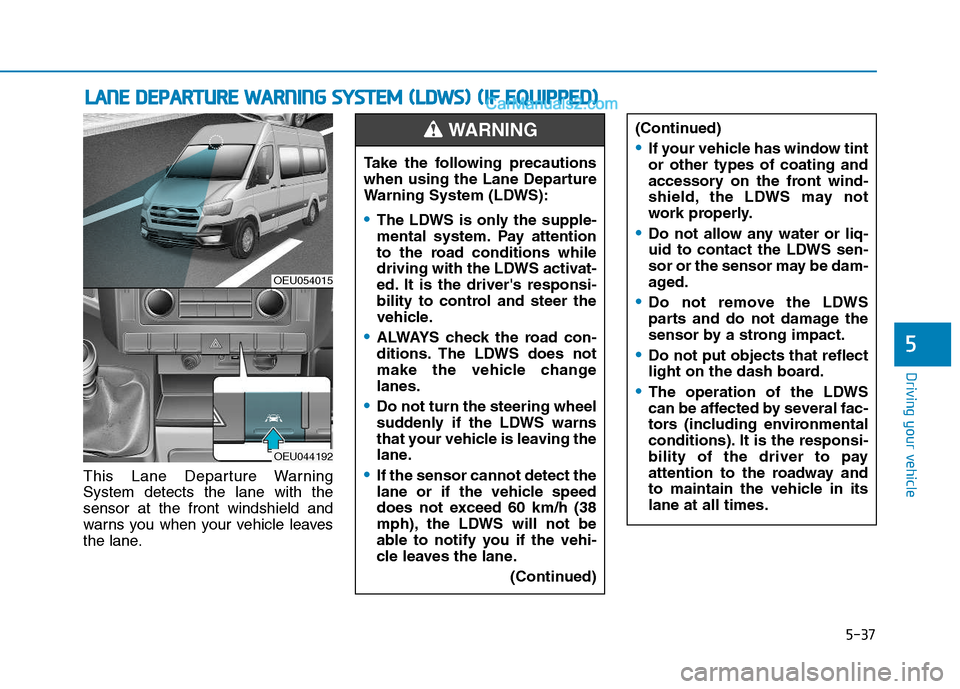
This Lane Departure Warning System detects the lane with thesensor at the front windshield and
warns you when your vehicle leaves
the lane.
LLAA NN EE DD EEPP AA RRTTUU RREE WW AARRNN IINN GG SS YY SSTT EEMM (( LL DD WW SS)) (( IIFF EE QQ UUIIPP PPEEDD ))
OEU054015
OEU044192
Take the following precautions
when using the Lane Departure
Warning System (LDWS):
The LDWS is only the supple-
mental system. Pay attention
to the road conditions while
driving with the LDWS activat-
ed. It is the driver's responsi-
bility to control and steer the
vehicle.
ALWAYS check the road con-
ditions. The LDWS does not
make the vehicle changelanes.
Do not turn the steering wheel
suddenly if the LDWS warns
that your vehicle is leaving the
lane.
If the sensor cannot detect the
lane or if the vehicle speed
does not exceed 60 km/h (38
mph), the LDWS will not be
able to notify you if the vehi-
cle leaves the lane.
(Continued)
WARNING (Continued)
If your vehicle has window tint or other types of coating and
accessory on the front wind-
shield, the LDWS may not
work properly.
Do not allow any water or liq-
uid to contact the LDWS sen-
sor or the sensor may be dam-
aged.
Do not remove the LDWS
parts and do not damage the
sensor by a strong impact.
Do not put objects that reflect
light on the dash board.
The operation of the LDWS
can be affected by several fac-
tors (including environmental
conditions). It is the responsi-
bility of the driver to pay
attention to the roadway and
to maintain the vehicle in itslane at all times.
Page 314 of 473
5-43
Driving your vehicle
5
Keep your vehicle in good condi-tion. For better fuel economy and
reduced maintenance costs, main-
tain your vehicle in accordancewith the maintenance schedule in
Section 7. If you drive your vehicle
in severe conditions, more frequentmaintenance is required (see
Section 7 for details).
Keep your vehicle clean. For maxi- mum service, your vehicle should
be kept clean and free of corrosive
materials. It is especially important
that mud, dirt, ice, etc. not be
allowed to accumulate on the
underside of the vehicle. This extra
weight can result in increased fuel
consumption and also contribute tocorrosion.
Travel lightly. Don't carry unneces- sary weight in your vehicle. Weight
reduces fuel economy.
Don't let the engine idle longer than necessary. If you are waiting
(and not in traffic), turn off your
engine and restart only when
you're ready to go. Remember, your vehicle does not
require extended warm-up. After
the engine has started, allow the
engine to run for 10 to 20 seconds
prior to placing the vehicle in gear.
In very cold weather, however, give
your engine a slightly longer warm-
up period.
Don't "lug" or "over-rev" the engine. Lugging is driving too slowly in too
high a gear resulting engine buck-
ing. If this happens, shift to a lower
gear. Over-revving is racing the
engine beyond its safe limit. This
can be avoided by shifting at the
recommended speeds.
Use your air conditioning sparingly. The air conditioning system is
operated by engine power so your
fuel economy is reduced when youuse it.
Open windows at high speeds can reduce fuel economy.
Fuel economy is less in crosswinds and headwinds. To help offset
some of this loss, slow down when
driving in these conditions. Keeping a vehicle in good operating
condition is important both for econ-
omy and safety. Therefore, we rec-
ommend that you contact an author-
ized HYUNDAI dealer to performscheduled inspections and mainte-
nance.
Engine off during motion
Never turn the engine off to
coast down hills or anytime the
vehicle is in motion. The power
steering and power brakes will
not function properly without
the engine running. Instead,
keep the engine on and down-
shift to an appropriate gear for
engine braking effect. In addi-
tion, turning off the ignition
while driving could engage the
steering wheel lock resulting in
loss of vehicle steering which
could cause serious injury ordeath.
WARNING
Page 315 of 473
5-44
Driving your vehicle
Hazardous driving conditions
When hazardous driving conditions
are encountered such as water,
snow, ice, mud, sand, or similar haz-
ards, follow these suggestions:
Drive cautiously and allow extradistance for braking.
Avoid sudden braking or steering.
When braking with non-ABS brakes pump the brake pedal with
a light up-and-down motion until
the vehicle is stopped.
If stalled in snow, mud, or sand, use second gear. Accelerate slow-
ly to avoid spinning the drive
wheels.
Use sand, rock salt, tire chains, or other non-slip material under the
drive wheels to provide traction
when stalled in ice, snow, or mud.
Rocking the vehicle
If it is necessary to rock the vehicle
to free it from snow, sand, or mud,
first turn the steering wheel right and
left to clear the area around your
front wheels. Then, shift back and
forth between 1st (First) and R
(Reverse) in vehicles equipped with
a manual transmission. Do not race
the engine, and spin the wheels as
little as possible. If you are still stuck
after a few tries, have the vehicle
pulled out by a tow vehicle to avoid
engine overheating and possible
damage to the transmission.
Prolonged rocking may cause
engine over-heating, transmission
damage or failure, and tire dam-
age. Information
The VDC system (if equipped) should
be turned OFF prior to rocking the
vehicle.
i
NOTICE
SS PP EECCIIAA LL DD RRIIVV IINN GG CC OO NNDDIITT IIOO NNSS
Spinning tires
Do not spin the wheels, espe-
cially at speeds more than 56
km/h (35 mph). Spinning thewheels at high speeds when the
vehicle is stationary could
cause a tire to overheat which
could result in tire damage that
may injure bystanders.
WARNING
Page 322 of 473
5-51
Driving your vehicle
5
To keep locks from freezing
To keep the locks from freezing,
squirt an approved de-icer fluid or
glycerin into the key opening. If a
lock is covered with ice, squirt it with
an approved de-icing fluid to remove
the ice. If the lock is frozen internally,
you may be able to thaw it out by
using a heated key. Handle the heat-
ed key with care to avoid injury.
Use approved window washeranti-freeze in system
To keep the water in the window
washer system from freezing, add an
approved window washer anti-freeze
solution in accordance with instruc-
tions on the container. Window wash-
er anti-freeze is available from an
authorized HYUNDAI dealer and
most auto parts outlets. Do not useengine coolant or other types of anti-
freeze as these may damage thepaint finish.
Don't let your parking brakefreeze
Under some conditions your parking
brake can freeze in the engaged
position. This is most likely to hap-
pen when there is an accumulation
of snow or ice around or near the
rear brakes or if the brakes are wet.
If there is a risk the parking brake
may freeze, apply it only temporarily
while you put the shift lever in first or
reverse gear and block the rear
wheels so the vehicle cannot roll.
Then release the parking brake.
Don't let ice and snow accumu-
late underneath
Under some conditions, snow and
ice can build up under the fenders
and interfere with the steering. When
driving in severe winter conditions
where this may happen, you should
periodically check underneath the
vehicle to be sure the movement of
the front wheels and the steering
components is not obstructed.
Carry emergency equipment
Depending on the severity of the
weather, you should carry appropri-
ate emergency equipment. Some of
the items you may want to carry
include tire chains, tow straps or
chains, flashlight, emergency flares,
sand, a shovel, jumper cables, a win-
dow scraper, gloves, ground cloth,
coveralls, a blanket, etc.
Page 326 of 473
5-55
Driving your vehicle
Driving with a trailer
Towing a trailer requires a certain
amount of experience. Before setting
out for the open road, you must get
to know your trailer. Acquaint your-
self with the feel of handling and
braking with the added weight of the
trailer. And always keep in mind that
the vehicle you are driving is now a
good deal longer and not nearly so
responsive as your vehicle is by
itself.
Before you start, check the trailer
hitch and platform, safety chains,
electrical connector(s), lights, tires
and mirror adjustment. If the trailer
has electric brakes, start your vehicle
and trailer moving and then apply the
trailer brake controller by hand to be
sure the brakes are working. This lets
you check your electrical connection
at the same time.
During your trip, check occasionally
to be sure that the load is secure,
and that the lights and any trailer
brakes are still working.
Following distance
Stay at least twice as far behind the
vehicle ahead as you would when
driving your vehicle without a trailer.
This can help you avoid situations
that require heavy braking and sud-
den turns.
Passing
You’ll need more passing distance
up ahead when you’re towing a trail-
er. And, because of the increased
vehicle length, you’ll need to go
much farther beyond the passed
vehicle before you can return to your
lane.
Backing up
Hold the bottom of the steering
wheel with one hand. Then, to move
the trailer to the left, just move your
hand to the left. To move the trailer to
the right, move your hand to the
right. Always back up slowly and, if
possible, have someone guide you.
Making turns
When you’re turning with a trailer,
make wider turns than normal. Do
this so your trailer won’t strike soft
shoulders, curbs, road signs, trees,
or other objects. Avoid jerky or sud-
den maneuvers. Signal well in
advance.
5
Page 328 of 473
5-57
Driving your vehicle
5
Parking on hills
Generally, if you have a trailer
attached to your vehicle, you should
not park your vehicle on a hill. People
can be seriously or fatally injured,
and both your vehicle and the trailer
can be damaged if unexpectedly roll
down hill.However, if you ever have to park
your trailer on a hill, here's how to doit:
1. Pull the vehicle into the parking
space. Turn the steering wheel in
the direction of the curb (right if
headed down hill, left if headed uphill).
2. If the vehicle has a manual trans- mission, place the vehicle in neu-
tral.
3. Set the parking brake and shut off the vehicle.
4. Place chocks under the trailer wheels on the down hill side of the
wheels.
5. Start the vehicle, hold the brakes, shift to neutral, release the parking
brake and slowly release the
brakes until the trailer chocksabsorb the load.
6. Reapply the brakes, reapply the parking brake and shift the vehicle
to R (Reverse) for manual trans-mission.
7. Shut off the vehicle and release the vehicle brakes but leave the
parking brake set.
When towing a trailer on steep
grades (in excess of 6%) pay
close attention to the engine
coolant temperature gauge toensure the engine does not
overheat. If the needle of the coolant
temperature gauge moves
across the dial towards “H”
(HOT), pull over and stop as
soon as it is safe to do so, and
allow the engine to idle until it
cools down. You may proceedonce the engine has cooled
sufficiently.
You must decide driving speed depending on trailerweight and uphill grade toreduce the possibility ofengine and transmission
overheating.
CAUTION
Parking on a hill
Parking your vehicle on a hill
with a trailer attached could
cause serious injury or death,
should the trailer break loose.
WARNING
Page 335 of 473
5-64
Driving your vehicle
The following procedures can be
used to confirm that the locking dif-
ferential is functioning properly:
(1) Position the vehicle so that onewheel is on a dry paved surface
and the other on ice, snow, mud,
etc. Drive the vehicle, and
observe the operation of the lock-
ing differential. The vehicle
should not become stuck if the
differential is functioning properly.
(2) Depress the accelerator pedal
gradually, and then when traction
is good, depress it forcefully. If
the vehicle accelerates well, the
differential is functioning properly.
Information
Usually a locking differential will
operate and release automatically but
occasionally it may not release auto-
matically.
At this time you will feel the tire is
dragged when you are driving or cor-
nering. You can release it manually by
slightly turning the steering wheel
right and left while the vehicle is mov-
ing slowly.
i
Never start the engine with
the gearshift lever placed in
the forward or reverse whileone of the rear wheels is
jacked up and the other in
contact with the ground;
doing so may cause the vehi-
cle to jump forward.
If one of the rear wheels
begins to spin in mud, snow,
etc., the vehicle can some-
times be driven out bydepressing the accelerator
pedal further; however, avoid
running the engine continu-
ously at high rpm because
doing so could damage the
locking differential.
CAUTION
Page 359 of 473
6-24
What to do in an emergency
Emergency towing
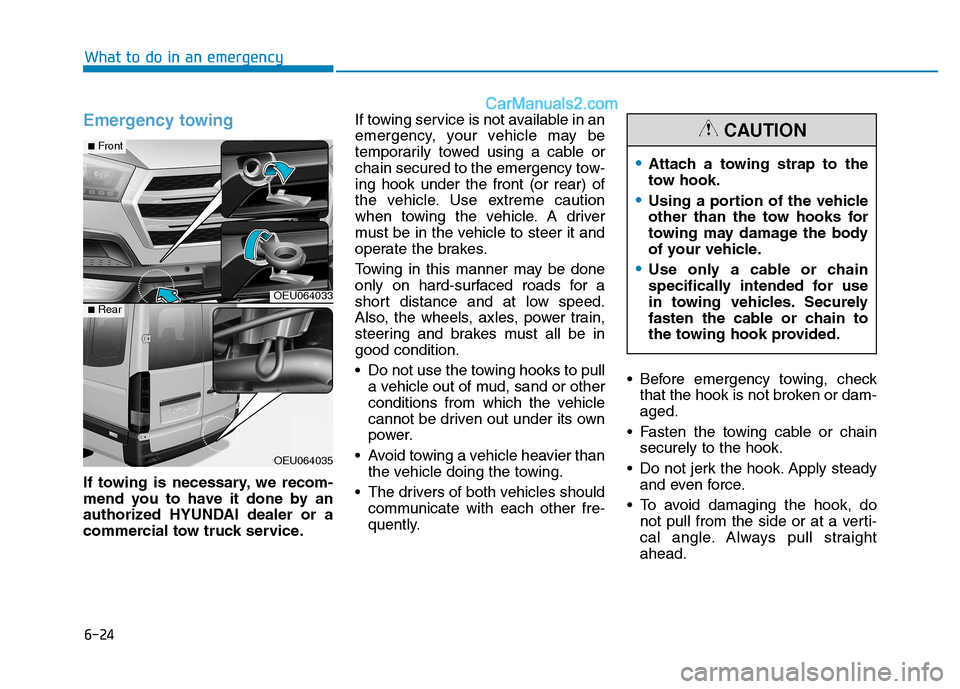
If towing is necessary, we recom-
mend you to have it done by an
authorized HYUNDAI dealer or a
commercial tow truck service.If towing service is not available in an
emergency, your vehicle may be
temporarily towed using a cable or
chain secured to the emergency tow-ing hook under the front (or rear) of
the vehicle. Use extreme caution
when towing the vehicle. A driver
must be in the vehicle to steer it and
operate the brakes.
Towing in this manner may be done
only on hard-surfaced roads for a
short distance and at low speed.
Also, the wheels, axles, power train,
steering and brakes must all be ingood condition.
Do not use the towing hooks to pull
a vehicle out of mud, sand or other
conditions from which the vehicle
cannot be driven out under its own
power.
Avoid towing a vehicle heavier than the vehicle doing the towing.
The drivers of both vehicles should communicate with each other fre-
quently. Before emergency towing, check
that the hook is not broken or dam-aged.
Fasten the towing cable or chain securely to the hook.
Do not jerk the hook. Apply steady and even force.
To avoid damaging the hook, do not pull from the side or at a verti-
cal angle. Always pull straightahead.
OEU064033
OEU064035
■Front
■Rear
Attach a towing strap to the
tow hook.
Using a portion of the vehicle
other than the tow hooks for
towing may damage the body
of your vehicle.
Use only a cable or chain
specifically intended for use
in towing vehicles. Securely
fasten the cable or chain to
the towing hook provided.
CAUTION
Page 360 of 473
6-25
What to do in an emergency
6
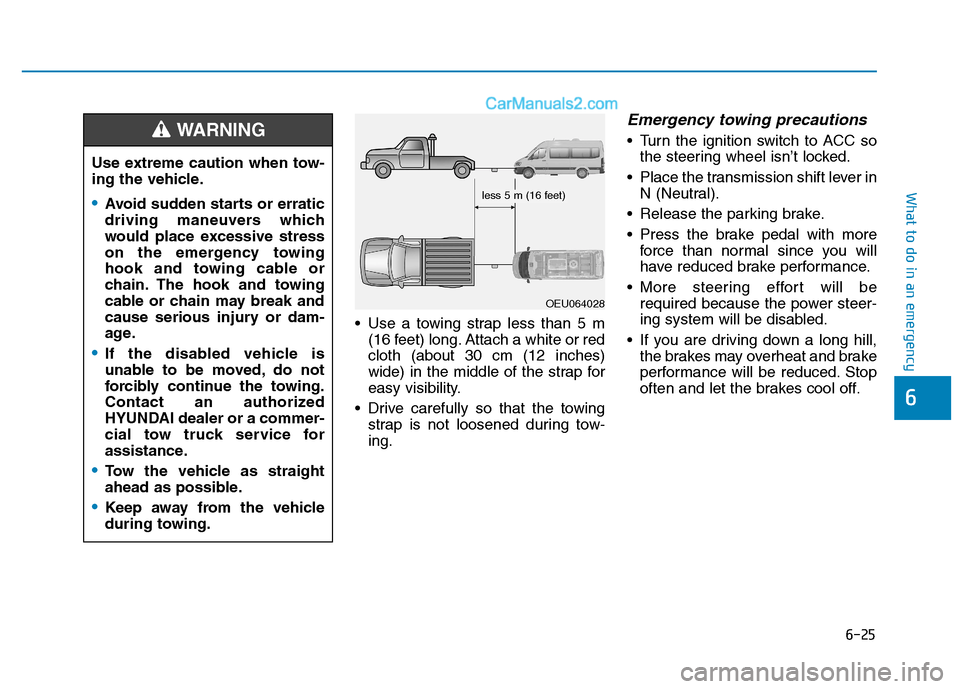
Use a towing strap less than 5 m(16 feet) long. Attach a white or red cloth (about 30 cm (12 inches)
wide) in the middle of the strap for
easy visibility.
Drive carefully so that the towing strap is not loosened during tow-ing.
Emergency towing precautions
Turn the ignition switch to ACC sothe steering wheel isn’t locked.
Place the transmission shift lever in N (Neutral).
Release the parking brake.
Press the brake pedal with more force than normal since you will
have reduced brake performance.
More steering effort will be required because the power steer-
ing system will be disabled.
If you are driving down a long hill, the brakes may overheat and brake
performance will be reduced. Stop
often and let the brakes cool off.
Use extreme caution when tow-
ing the vehicle.
Avoid sudden starts or erratic
driving maneuvers which
would place excessive stress
on the emergency towing
hook and towing cable or
chain. The hook and towing
cable or chain may break and
cause serious injury or dam-
age.
If the disabled vehicle is
unable to be moved, do not
forcibly continue the towing.
Contact an authorized
HYUNDAI dealer or a commer-
cial tow truck service for
assistance.
Tow the vehicle as straight
ahead as possible.
Keep away from the vehicle
during towing.
WARNING
OEU064028
less 5 m (16 feet)
Page 364 of 473
7
Maintenance
7
Maintenance
Engine compartment .............................................7-3
Maintenance services ...........................................7-5Owner's responsibility ......................................................7-5
Owner maintenance precautions ..................................7-5
Engine compartment precautions (Diesel engine) ....7-7
Owner maintenance ...............................................7-8 Owner maintenance schedule ........................................7-8
Scheduled maintenance services ......................7-10 Normal maintenance schedule (for Europe) ............7-11
Normal maintenance schedule (except Europe) .....7-14
Maintenance under severe usage conditions ..........7-17
Explanation of scheduled maintenance items ..7-19
Engine oil ..............................................................7-22 Checking the engine oil level ....................................7-22
Changing the engine oil and filter ..............................7-23
Engine coolant......................................................7-24 Checking the coolant level ...........................................7-24
Changing the coolant .....................................................7-26
Brake/Clutch fluid ..............................................7-27 Checking the brake/clutch fluid level ........................7-27
Power steering fluid ............................................7-28 Checking the power steering fluid level ...................2-28
Checking the power steering hose.............................2-29
Washer fluid .........................................................7-29 Checking the washer fluid level ...............................7-29 Parking brake .......................................................7-30
Checking the parking brake .........................................7-30
Fuel filter (For diesel).........................................7-30 Draining water from fuel filter ....................................7-30
Fuel filter cartridge replacement ................................7-30
Manual transmission and rearaxle oil ..............7-31 Check and adding oil ......................................................7-31
Change the gear oil ........................................................7-31
Air cleaner ............................................................7-31 Filter replacement ...........................................................7-31
Climate control air filter .....................................7-33 Filter inspection ...............................................................7-33
Filter replacement ...........................................................7-33
Wiper blades .........................................................7-34 Blade inspection ..............................................................7-34
Blade replacement ..........................................................7-35
Battery...................................................................7-37 For best battery service................................................7-37
Battery capacity label ...................................................7-40
Battery recharging .......................................................7-40
Reset items .......................................................................7-41
Tires and wheels ..................................................7-42 Tire care ............................................................................7-42
Recommended cold tire inflation pressures.............7-42
Checking tire inflation pressure ..................................7-43
7