steering Hyundai H350 2016 Workshop Manual
[x] Cancel search | Manufacturer: HYUNDAI, Model Year: 2016, Model line: H350, Model: Hyundai H350 2016Pages: 473, PDF Size: 26.4 MB
Page 380 of 473
7-17
7
Maintenance
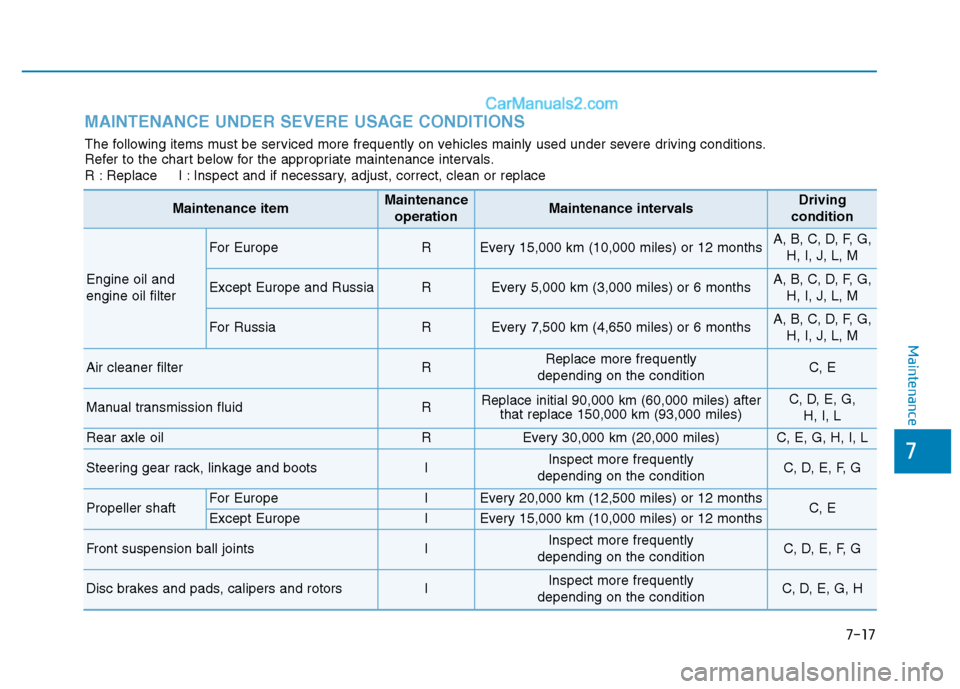
MAINTENANCE UNDER SEVERE USAGE CONDITIONS
The following items must be serviced more frequently on vehicles mainly used under severe driving conditions.
Refer to the chart below for the appropriate maintenance intervals.
R : Replace I : Inspect and if necessary, adjust, correct, clean or replace
Maintenance itemMaintenanceoperationMaintenance intervalsDriving
condition
Engine oil and engine oil filter
For EuropeREvery 15,000 km (10,000 miles) or 12 monthsA, B, C, D, F, G, H, I, J, L, M
Except Europe and RussiaREvery 5,000 km (3,000 miles) or 6 monthsA, B, C, D, F, G,H, I, J, L, M
For RussiaREvery 7,500 km (4,650 miles) or 6 monthsA, B, C, D, F, G,H, I, J, L, M
Air cleaner filterRReplace more frequently
depending on the conditionC, E
Manual transmission fluidRReplace initial 90,000 km (60,000 miles) after that replace 150,000 km (93,000 miles)C, D, E, G,
H, I, L
Rear axle oilREvery 30,000 km (20,000 miles)C, E, G, H, I, L
Steering gear rack, linkage and bootsIInspect more frequently
depending on the conditionC, D, E, F, G
Propeller shaftFor EuropeIEvery 20,000 km (12,500 miles) or 12 monthsC, EExcept EuropeIEvery 15,000 km (10,000 miles) or 12 months
Front suspension ball jointsIInspect more frequently
depending on the conditionC, D, E, F, G
Disc brakes and pads, calipers and rotorsIInspect more frequently
depending on the conditionC, D, E, G, H
Page 384 of 473
7-21
7
Maintenance
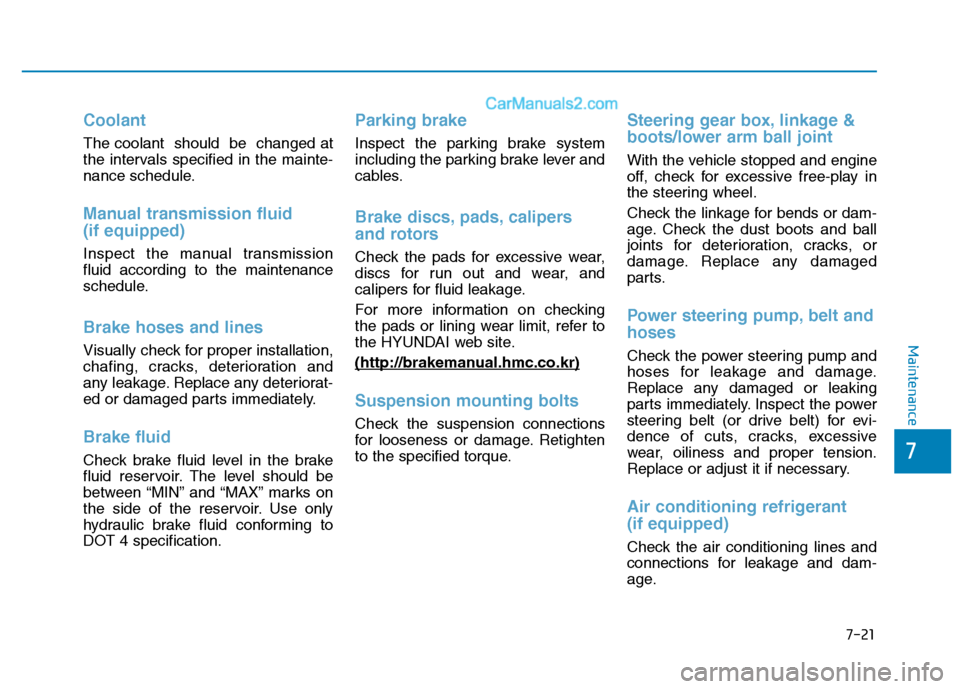
Coolant
The coolant should be changed at
the intervals specified in the mainte-
nance schedule.
Manual transmission fluid (if equipped)
Inspect the manual transmission fluid according to the maintenance
schedule.
Brake hoses and lines
Visually check for proper installation,
chafing, cracks, deterioration and
any leakage. Replace any deteriorat-
ed or damaged parts immediately.
Brake fluid
Check brake fluid level in the brake
fluid reservoir. The level should be
between “MIN” and “MAX” marks on
the side of the reservoir. Use only
hydraulic brake fluid conforming to
DOT 4 specification.
Parking brake
Inspect the parking brake system
including the parking brake lever and
cables.
Brake discs, pads, calipers
and rotors
Check the pads for excessive wear,
discs for run out and wear, and
calipers for fluid leakage.
For more information on checking
the pads or lining wear limit, refer to
the HYUNDAI web site. (http://brakeman
ual.hmc.co.kr)
Suspension mounting bolts
Check the suspension connections
for looseness or damage. Retighten
to the specified torque.
Steering gear box, linkage &
boots/lower arm ball joint
With the vehicle stopped and engine
off, check for excessive free-play in
the steering wheel.
Check the linkage for bends or dam-
age. Check the dust boots and ball
joints for deterioration, cracks, or
damage. Replace any damaged
parts.
Power steering pump, belt and hoses
Check the power steering pump and
hoses for leakage and damage.
Replace any damaged or leaking
parts immediately. Inspect the power
steering belt (or drive belt) for evi-
dence of cuts, cracks, excessive
wear, oiliness and proper tension.
Replace or adjust it if necessary.
Air conditioning refrigerant (if equipped)
Check the air conditioning lines and
connections for leakage and dam-
age.
Page 391 of 473
7-28
Maintenance
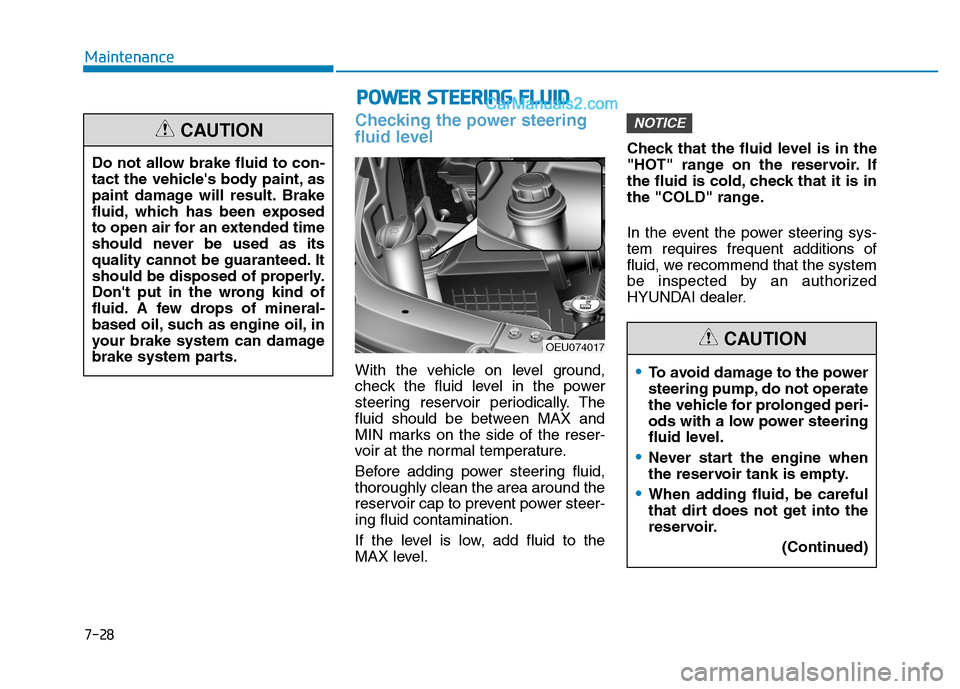
Checking the power steering
fluid level
With the vehicle on level ground,
check the fluid level in the power
steering reservoir periodically. The
fluid should be between MAX and
MIN marks on the side of the reser-
voir at the normal temperature.
Before adding power steering fluid, thoroughly clean the area around the
reservoir cap to prevent power steer-ing fluid contamination.
If the level is low, add fluid to the
MAX level.Check that the fluid level is in the
"HOT" range on the reservoir. If
the fluid is cold, check that it is in
the "COLD" range.
In the event the power steering sys- tem requires frequent additions of
fluid, we recommend that the system
be inspected by an authorized
HYUNDAI dealer.
NOTICE
Do not allow brake fluid to con-
tact the vehicle's body paint, as
paint damage will result. Brake
fluid, which has been exposed
to open air for an extended time
should never be used as its
quality cannot be guaranteed. It
should be disposed of properly.
Don't put in the wrong kind of
fluid. A few drops of mineral-
based oil, such as engine oil, in
your brake system can damage
brake system parts.
CAUTION
PP
OO WW EERR SS TT EEEE RR IINN GG FF LLUU IIDD
OEU074017
To avoid damage to the power
steering pump, do not operate
the vehicle for prolonged peri-
ods with a low power steering
fluid level.
Never start the engine when
the reservoir tank is empty.
When adding fluid, be careful
that dirt does not get into the
reservoir.
(Continued)
CAUTION
Page 392 of 473
7-29
7
MaintenanceUse only the specified power steer-ing fluid. (Refer to "Recommendedlubricants or capacities" in section 9.)
Checking the power steering hose
Check the connections for oil leaks,
damage and twists in the power
steering hose before driving.
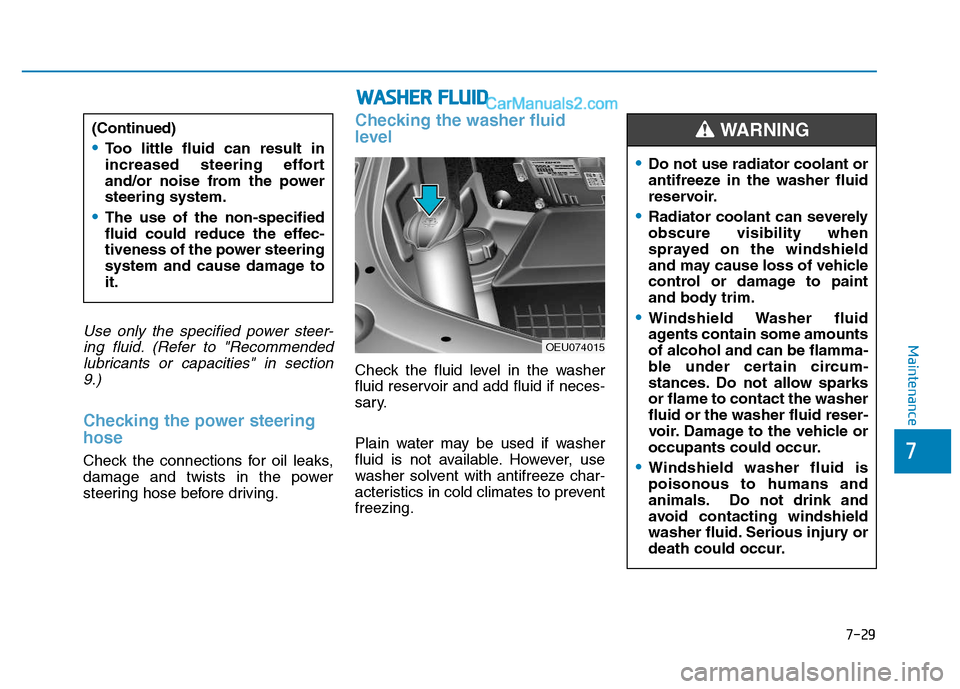
Checking the washer fluid
level
Check the fluid level in the washer
fluid reservoir and add fluid if neces-
sary.
Plain water may be used if washer
fluid is not available. However, use
washer solvent with antifreeze char-
acteristics in cold climates to preventfreezing.
(Continued)
Too little fluid can result in
increased steering effort
and/or noise from the powersteering system.
The use of the non-specified
fluid could reduce the effec-
tiveness of the power steering
system and cause damage toit.
WW
AASSHH EERR FF LLUU IIDD
OEU074015
Do not use radiator coolant or
antifreeze in the washer fluid
reservoir.
Radiator coolant can severely obscure visibility when
sprayed on the windshield
and may cause loss of vehicle
control or damage to paint
and body trim.
Windshield Washer fluid
agents contain some amountsof alcohol and can be flamma-
ble under certain circum-
stances. Do not allow sparksor flame to contact the washerfluid or the washer fluid reser-
voir. Damage to the vehicle or
occupants could occur.
Windshield washer fluid is poisonous to humans and
animals. Do not drink and
avoid contacting windshield
washer fluid. Serious injury or
death could occur.
WARNING
Page 409 of 473
7-46
Maintenance
Tire replacement
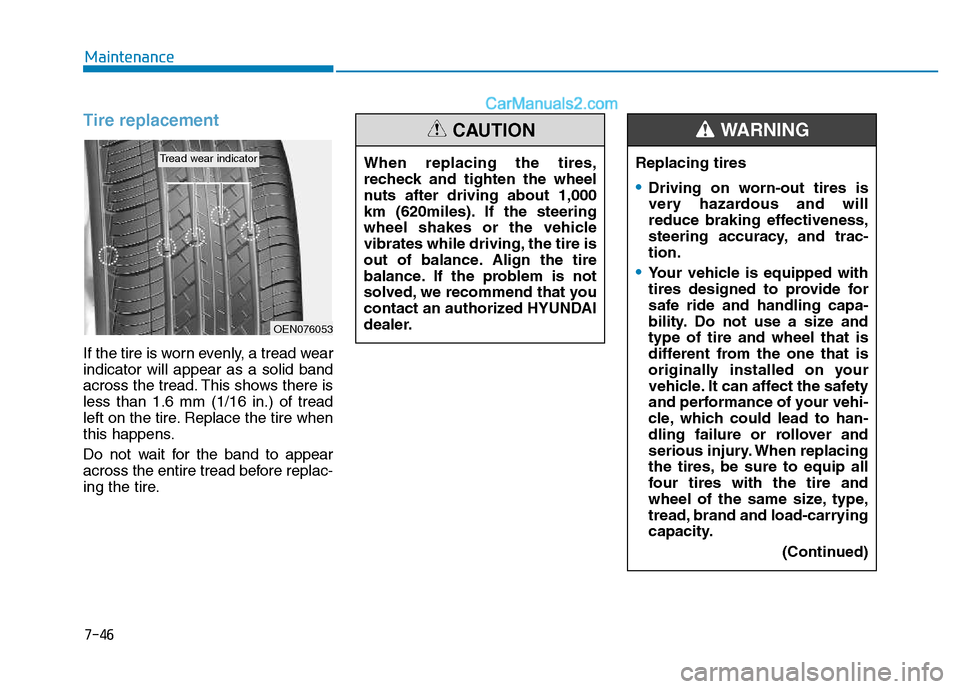
If the tire is worn evenly, a tread wear indicator will appear as a solid band
across the tread. This shows there isless than 1.6 mm (1/16 in.) of tread
left on the tire. Replace the tire when
this happens.
Do not wait for the band to appear
across the entire tread before replac-
ing the tire.When replacing the tires,
recheck and tighten the wheel
nuts after driving about 1,000
km (620miles). If the steering
wheel shakes or the vehicle
vibrates while driving, the tire is
out of balance. Align the tire
balance. If the problem is not
solved, we recommend that you
contact an authorized HYUNDAI
dealer.
CAUTION
Replacing tires
Driving on worn-out tires is
very hazardous and will
reduce braking effectiveness,
steering accuracy, and trac-tion.
Your vehicle is equipped with
tires designed to provide for
safe ride and handling capa-
bility. Do not use a size andtype of tire and wheel that is
different from the one that is
originally installed on your
vehicle. It can affect the safety
and performance of your vehi-
cle, which could lead to han-
dling failure or rollover and
serious injury. When replacing
the tires, be sure to equip all
four tires with the tire and
wheel of the same size, type,
tread, brand and load-carrying
capacity.
(Continued)
WARNING
OEN076053
Tread wear indicator
Page 425 of 473
7-62
Maintenance
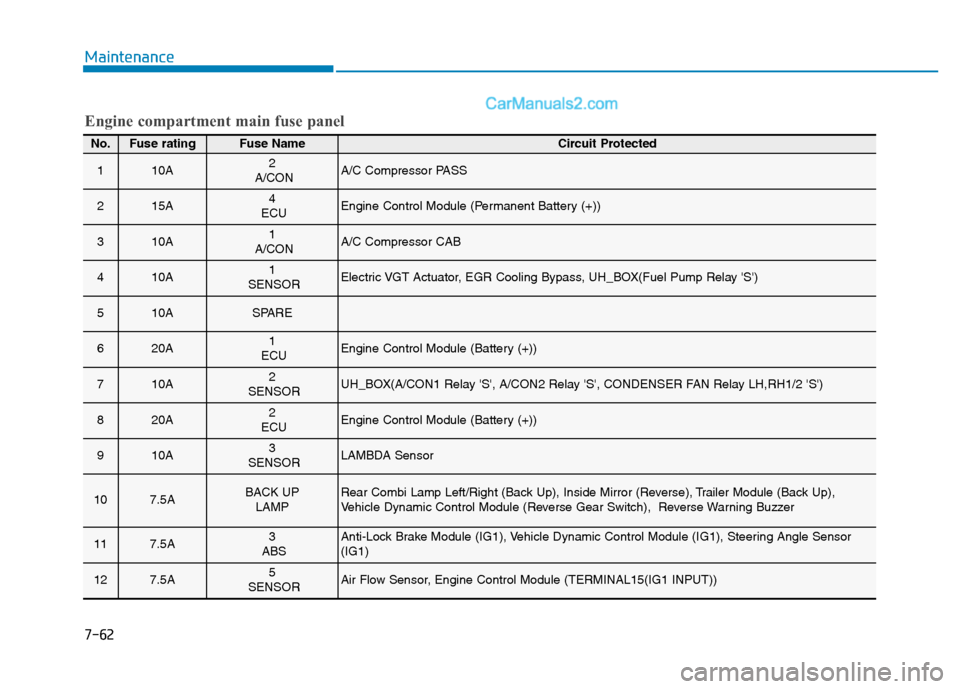
Engine compartment main fuse panel
No.Fuse ratingFuse Name Circuit Protected
110A2
A/CONA/C Compressor PASS
215A4
ECUEngine Control Module (Permanent Battery (+))
310A1
A/CONA/C Compressor CAB
410A1
SENSORElectric VGT Actuator, EGR Cooling Bypass, UH_BOX(Fuel Pump Relay 'S')
510ASPARE
620A1
ECUEngine Control Module (Battery (+))
710A2
SENSORUH_BOX(A/CON1 Relay 'S', A/CON2 Relay 'S', CONDENSER FAN Relay LH,RH1/2 'S')
820A2
ECUEngine Control Module (Battery (+))
910A3
SENSORLAMBDA Sensor
107.5ABACK UP LAMPRear Combi Lamp Left/Right (Back Up), Inside Mirror (Reverse), Trailer Module (Back Up),
Vehicle Dynamic Control Module (Reverse Gear Switch), Reverse Warning Buzzer
117.5A3
ABSAnti-Lock Brake Module (IG1), Vehicle Dynamic Control Module (IG1), Steering Angle Sensor (IG1)
127.5A5
SENSORAir Flow Sensor, Engine Control Module (TERMINAL15(IG1 INPUT))
Page 449 of 473
7-86
Maintenance
Cleaning the upholstery andinterior trim
Vinyl
Remove dust and loose dirt from
vinyl with a whisk broom or vacuum
cleaner. Clean vinyl surfaces with a
vinyl cleaner.
Fabric
Remove dust and loose dirt from fab-
ric with a whisk broom or vacuum
cleaner. Clean with a mild soap solu-
tion recommended for upholstery or
carpets. Remove fresh spots imme-
diately with a fabric spot cleaner. If
fresh spots do not receive immediate
attention, the fabric can be stained
and its color can be affected. Also, its
fire-resistant properties can be
reduced if the material is not proper-ly maintained.
Cleaning the lap/shoulder beltwebbing
Clean the belt webbing with any mild
soap solution recommended for
cleaning upholstery or carpet. Follow
the instructions provided with the
soap. Do not bleach or re-dye the
webbing because this may weakenit.
Cleaning the interior windowglass
If the interior glass surfaces of the
vehicle become fogged (that is, cov-
ered with an oily, greasy or waxy
film), they should be cleaned with
glass cleaner. Follow the directions
on the glass cleaner container.
Using anything but recom-
mended cleaners and proce-
dures may affect the fabric’sappearance and fire-resistant
properties.
CAUTION
When cleaning leather products
(steering wheel, seats etc.), use
neutral detergents or low alco-
hol content solutions. If you usehigh alcohol content solutions
or acid/alkaline detergents, the
color of the leather may fade or
the surface may get stripped
off.
CAUTION
Do not scrape or scratch the
inside of the rear window. This
may result in damage to the rear
window defroster grid.
CAUTION
Page 460 of 473
8-7
8
Specifications & Consumer information
RREECCOO MM MMEENN DDEEDD LL UU BBRRIICC AA NN TTSS AA NN DD CC AA PPAA CCIITT IIEE SS
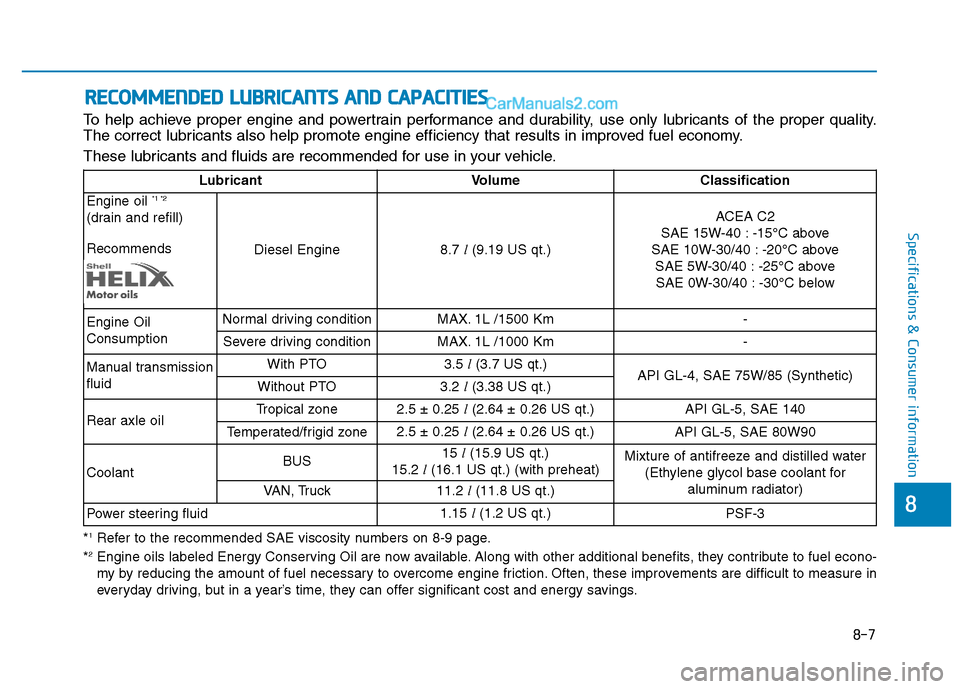
To help achieve proper engine and powertrain performance and durability, use only lubricants of the proper quality.
The correct lubricants also help promote engine efficiency that results in improved fuel economy.
These lubricants and fluids are recommended for use in your vehicle.
LubricantVolume Classification
Engine oil *1 *2
(drain and refill) Recommends
Diesel Engine8.7 l(9.19 US qt.)
ACEA C2
SAE 15W-40 : -15°C above
SAE 10W-30/40 : -20°C above SAE 5W-30/40 : -25°C aboveSAE 0W-30/40 : -30°C below
Engine Oil ConsumptionNormal driving conditionMAX. 1L /1500 Km-
Severe driving conditionMAX. 1L /1000 Km-
Manual transmission fluidWith PTO3.5 l(3.7 US qt.)API GL-4, SAE 75W/85 (Synthetic)Without PTO3.2 l(3.38 US qt.)
Rear axle oilTropical zone2.5 ± 0.25 l(2.64 ± 0.26 US qt.)API GL-5, SAE 140
Temperated/frigid zone2.5 ± 0.25 l(2.64 ± 0.26 US qt.)API GL-5, SAE 80W90
Coolant BUS15 l(15.9 US qt.)
15.2 l(16.1 US qt.) (with preheat)Mixture of antifreeze and distilled water
(Ethylene glycol base coolant for aluminum radiator)
VAN, Truck11.2 l(11.8 US qt.)
Power steering fluid1.15 l(1.2 US qt.)PSF-3
*1
Refer to the recommended SAE viscosity numbers on 8-9 page.
* 2
Engine oils labeled Energy Conserving Oil are now available. Along with other additional benefits, they contribute to fuel econo -
my by reducing the amount of fuel necessary to overcome engine friction. Often, these improvements are difficult to measure in
everyday driving, but in a year’s time, they can offer significant cost and energy savings.
Page 471 of 473
I-6Multi-display.................................................................3-50
AV information ..........................................................3-53
Drive info. mode ........................................................3-53
Function description ..................................................3-51
Information Mode ......................................................3-54
Main display ..............................................................3-50
Trip computer ............................................................3-53
Turn by turn navigation .............................................3-54
User Settings Mode ...................................................3-55
Warning Messages .....................................................3-57
Multimedia system .........................................................4-2
Owner maintenance ........................................................7-8
Parking assist system ....................................................3-88
Front/rear parking assist system type ........................3-92
Rear parking assist system type.................................3-89
Parking brake ................................................................7-30
Power steering fluid......................................................7-28 Checking the power steering fluid level ....................2-28
Checking the power steering hose .............................2-29
PTO switch ...................................................................5-41 RADIO 1 (RADIO,AUX) ...........................................4-45
RADIO 2 (RADIO,USB,AUX) (Except RDS Model)
..4-49
RADIO 2 (RADIO,USB,AUX) (For RDS Model) ......4-48
Rear door ......................................................................3-22 Child-protector rear door lock ...................................3-25
Closing the rear doors from the outside ....................3-25
Opening the left-hand rear door ................................3-24
Opening the rear doors to an angle of 180° or 270° ..3-24
Opening/closing from the inside ...............................3-23
Opening/closing from the outside .............................3-23
Rearview camera ..........................................................3-94
Recommended lubricants and capacities........................8-7
Remote keyless entry......................................................3-6
Battery replacement .....................................................3-8
Remote keyless entry system operations .....................3-6
Transmitter precautions ...............................................3-7
Removing and storing the spare tire...............................6-9
Jacking instructions .....................................................6-9
A type ...........................................................................6-9
B type .........................................................................6-11
Changing tires ............................................................6-14
Index
R
P
O
Page 472 of 473
I-7
Scheduled maintenance services ..................................7-10
Maintenance under severe usage conditions .............7-17
Normal maintenance schedule (except Europe) ........7-14
Normal maintenance schedule (for Europe) ..............7-11
Seat belts ......................................................................2-13 2 point static belt (for rear passengers.......................2-18
Lap/shoulder belt (for front passengers)....................2-16
Seat belt precautions ..................................................2-22
Seat belt restraint system ...........................................2-13
Seats ................................................................................2-4
Front passenger's seats .................................................2-5
Passenger seat capacity label .....................................2-13
Rear seats ...................................................................2-12
Safety precautions........................................................2-4
Special driving conditions ............................................5-44
Steering wheel ..............................................................3-37 Horn ...........................................................................3-38
Power steering ...........................................................3-37
Tilt & telescopic steering ...........................................3-37
Storage compartment ..................................................3-123
Console storage........................................................3-124
Glove box.................................................................3-125
Overhead storage .....................................................3-123
Storage space above the headliner...........................3-124
Sunglass holder ........................................................3-125 Theft-alarm system .........................................................3-9
Armed stage ...............................................................3-10
Disarmed stage ...........................................................3-11
Theft-alarm stage .......................................................3-10
Tire specification and pressure label ............................8-11
Tires and wheels ...........................................................7-42 Checking tire inflation pressure.................................7-43
Recommended cold tire inflation pressures ..............7-42
Tire care .....................................................................7-42
Tire maintenance........................................................7-47
Tire replacement ........................................................7-46
Tire rotation ...............................................................7-44
Tire sidewall labeling.................................................7-48
Tire traction................................................................7-47
Wheel alignment and tire balance .............................7-45
Wheel replacement ....................................................7-47
Tires and wheels .............................................................8-5
Towing ..........................................................................6-19 Emergency towing .....................................................6-20
Removable towing hook ............................................6-20
Towing service ...........................................................6-19
Trailer towing ...............................................................5-52
Driving with a trailer .................................................5-55
If you do decide to pull a trailer ................................5-59
Maintenance when trailer towing ..............................5-58
Safety chains .............................................................5-54
I
Index
TS