ignition Hyundai H350 2016 Manual Online
[x] Cancel search | Manufacturer: HYUNDAI, Model Year: 2016, Model line: H350, Model: Hyundai H350 2016Pages: 473, PDF Size: 26.4 MB
Page 341 of 473
6-6
What to do in an emergency
Jump starting procedure
1.Make sure the booster battery is12-volt and that its negative termi-
nal is grounded.
2.If the booster battery is in another vehicle, do not allow the vehicles totouch.
3.Turn off all unnecessary electrical loads.
4.Connect the jumper cables in the exact sequence shown in the illus-
tration. First connect one end of a
jumper cable to the positive termi-
nal of the main fuse box (1), thenconnect the other end to the posi-
tive terminal on the booster battery(2). Proceed to connect one end of the
other jumper cable to the negative
terminal of the booster battery (3),then the other end to a solid, sta-
tionary, metallic point (for example,
the engine lifting bracket) away
from the negative battery terminal
(4). Do not connect it to or near any
part that moves when the engine is
cranked.
Do not allow the jumper cables to contact anything except the correct
battery terminals or the correct
ground. Do not lean over the bat-
tery when making connections.
AGM battery (if equipped)
Absorbent Glass Matt (AGM) batteries are maintenance-free and we recommend that
the system be serviced by an
authorized HYUNDAI dealer.
For charging your AGM bat-
tery, use only fully automatic
battery chargers that are spe-
cially developed for AGM bat-teries.
When replacing the AGM bat-
tery, we recommend that you
use parts for replacement
from an authorized HYUNDAI
dealer.
Do not open or remove the
cap on top of the battery. This
may cause leaks of internal
electrolyte that could result in
severe injury.
(Continued)
(Continued)
If the AGM battery is recon-
nected or replaced, ISG func-tion will not operate immedi-
ately.
If you want to use the ISG
function, the battery sensor
needs to be calibrated for
approximately 4 hours with
the ignition off.
During the period, the dark
current must be under 100 mA.
CAUTION
Battery cables Do not connect the jumper
cable from the negative terminal
of the booster battery to thenegative terminal of the dis-
charged battery. This can cause
the discharged battery to over-
heat and crack, releasing bat-
tery acid.
CAUTION
Page 358 of 473
6-23
What to do in an emergency
6
When towing your vehicle in an emergency without wheel dollies :
1.Set the ignition switch in the ACCposition.
2.Place the transmission shift lever in N (Neutral).
3.Release the parking brake.Removable towing hook (if equipped)
Front towing hook
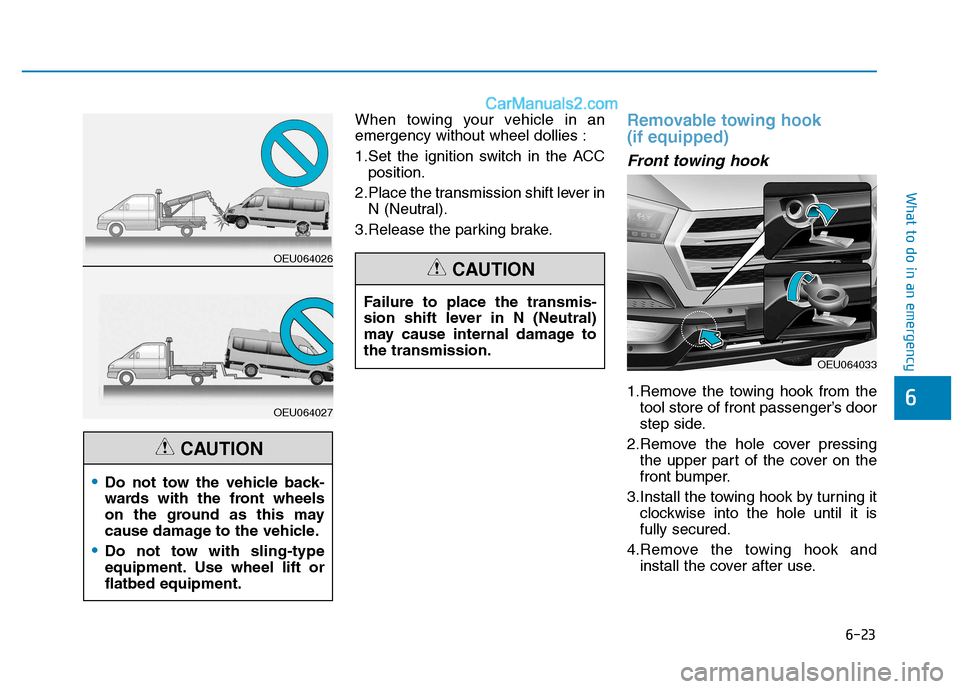
1.Remove the towing hook from the tool store of front passenger’s door
step side.
2.Remove the hole cover pressing the upper part of the cover on the
front bumper.
3.Install the towing hook by turning it clockwise into the hole until it isfully secured.
4.Remove the towing hook and install the cover after use.
OEU064026
OEU064027
Do not tow the vehicle back-
wards with the front wheels
on the ground as this may
cause damage to the vehicle.
Do not tow with sling-type
equipment. Use wheel lift orflatbed equipment.
CAUTION
Failure to place the transmis-
sion shift lever in N (Neutral)
may cause internal damage tothe transmission.
CAUTION
OEU064033
Page 360 of 473
6-25
What to do in an emergency
6
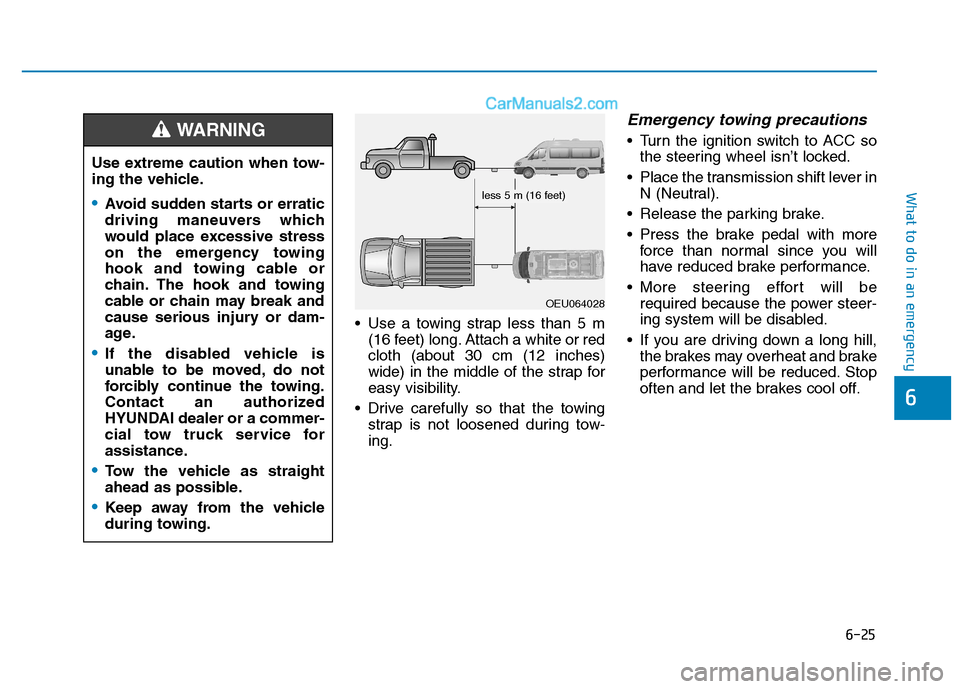
Use a towing strap less than 5 m(16 feet) long. Attach a white or red cloth (about 30 cm (12 inches)
wide) in the middle of the strap for
easy visibility.
Drive carefully so that the towing strap is not loosened during tow-ing.
Emergency towing precautions
Turn the ignition switch to ACC sothe steering wheel isn’t locked.
Place the transmission shift lever in N (Neutral).
Release the parking brake.
Press the brake pedal with more force than normal since you will
have reduced brake performance.
More steering effort will be required because the power steer-
ing system will be disabled.
If you are driving down a long hill, the brakes may overheat and brake
performance will be reduced. Stop
often and let the brakes cool off.
Use extreme caution when tow-
ing the vehicle.
Avoid sudden starts or erratic
driving maneuvers which
would place excessive stress
on the emergency towing
hook and towing cable or
chain. The hook and towing
cable or chain may break and
cause serious injury or dam-
age.
If the disabled vehicle is
unable to be moved, do not
forcibly continue the towing.
Contact an authorized
HYUNDAI dealer or a commer-
cial tow truck service for
assistance.
Tow the vehicle as straight
ahead as possible.
Keep away from the vehicle
during towing.
WARNING
OEU064028
less 5 m (16 feet)
Page 369 of 473
7-6
Maintenance
Maintenance work
Performing maintenance work
on a vehicle can be danger-
ous. You can be seriously
injured while performing
some maintenance proce-
dures. If you lack sufficient
knowledge and experience or
the proper tools and equip-
ment to do the work, we rec-ommend that the system be
serviced by an authorized
HYUNDAI dealer.
Working under the hood with
the engine running is danger-
ous. It becomes even more
dangerous when you wear
jewelry or loose clothing.These can become entangled
in moving parts and result in
injury.(Continued)
WARNING Continued)
Therefore, if you must run the
engine while working under
the hood, make certain that
you remove all jewelry (espe-
cially rings, bracelets, watch-
es, and necklaces) and all
neckties, scarves, and similar
loose clothing before gettingnear the engine or coolingfans.
Do not put heavy objects or
apply excessive force on top
of the engine cover (ifequipped) or fuel related
parts.
When you inspect the fuel system (fuel lines and fuel
injection devices), we recom-
mend that you contact an
authorized HYUNDAI dealer.
Do not drive long time with
the engine cover (if equipped)
removed.
When checking the engine
room, do not go near fire.
Fuel, washer fluid, etc. are
flammable oils that may cause
fire.
Before touching the battery,
ignition cables and electrical
wiring, you should disconnect
the battery "-" terminal. You
may get an electric shock
from the electric current. (Continued)
CAUTION
Page 382 of 473
7-19
7
Maintenance
EEXX PPLLAA NN AATTIIOO NN OO FF SS CC HH EEDD UU LLEE DD MM AAIINN TTEENN AANN CCEE IITT EEMM SS
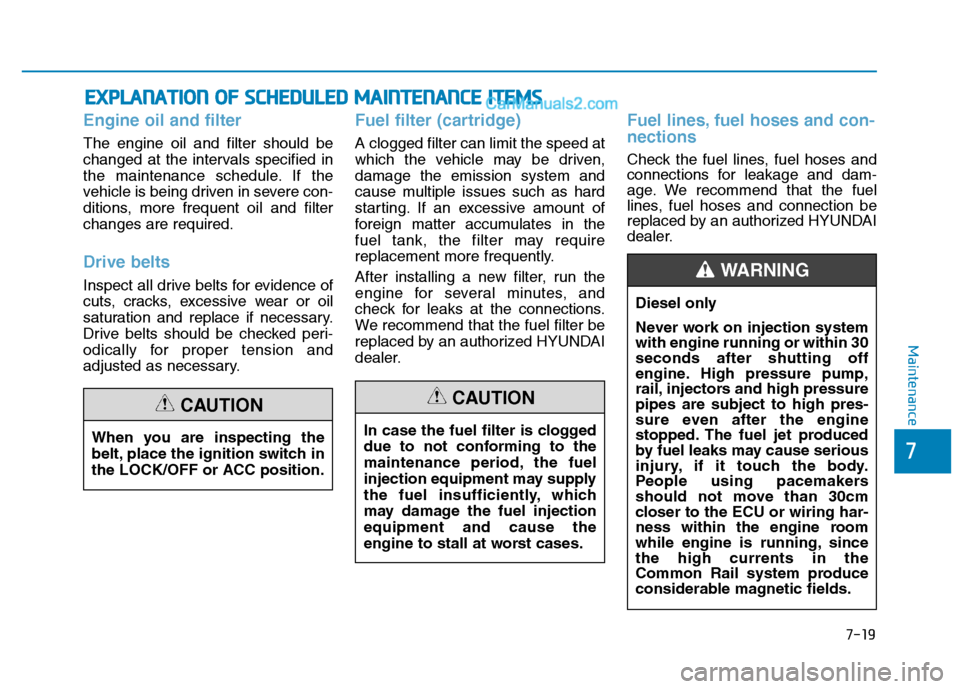
Engine oil and filter
The engine oil and filter should be
changed at the intervals specified in
the maintenance schedule. If the
vehicle is being driven in severe con-
ditions, more frequent oil and filterchanges are required.
Drive belts
Inspect all drive belts for evidence of
cuts, cracks, excessive wear or oil
saturation and replace if necessary.
Drive belts should be checked peri-
odically for proper tension and
adjusted as necessary.
Fuel filter (cartridge)
A clogged filter can limit the speed at
which the vehicle may be driven,damage the emission system and
cause multiple issues such as hard
starting. If an excessive amount of
foreign matter accumulates in the
fuel tank, the filter may require
replacement more frequently.
After installing a new filter, run the
engine for several minutes, and
check for leaks at the connections.
We recommend that the fuel filter be
replaced by an authorized HYUNDAI
dealer.
Fuel lines, fuel hoses and con- nections
Check the fuel lines, fuel hoses and
connections for leakage and dam-
age. We recommend that the fuel
lines, fuel hoses and connection be
replaced by an authorized HYUNDAI
dealer.
When you are inspecting the
belt, place the ignition switch in
the LOCK/OFF or ACC position.
CAUTION
In case the fuel filter is clogged
due to not conforming to the
maintenance period, the fuel
injection equipment may supply
the fuel insufficiently, which
may damage the fuel injectionequipment and cause the
engine to stall at worst cases.
CAUTION
Diesel only
Never work on injection system with engine running or within 30seconds after shutting off
engine. High pressure pump,
rail, injectors and high pressurepipes are subject to high pres-
sure even after the engine
stopped. The fuel jet produced
by fuel leaks may cause serious
injury, if it touch the body.
People using pacemakers
should not move than 30cm
closer to the ECU or wiring har-
ness within the engine room
while engine is running, sincethe high currents in the
Common Rail system produce
considerable magnetic fields.
WARNING
Page 393 of 473
7-30
Maintenance
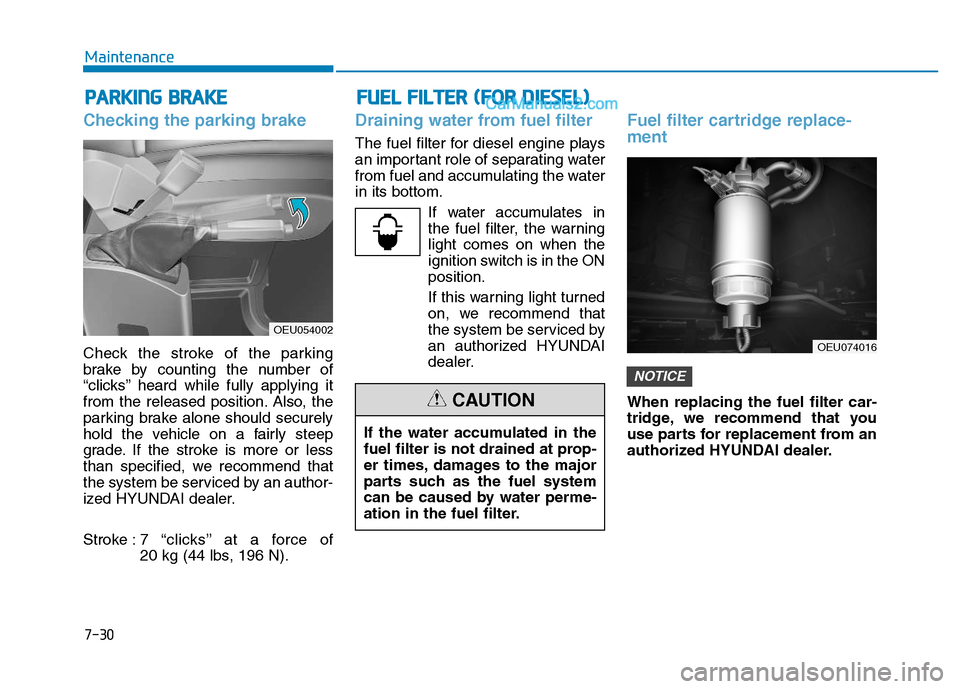
Checking the parking brake
Check the stroke of the parking
brake by counting the number of
“clicks’’ heard while fully applying it
from the released position. Also, the
parking brake alone should securely
hold the vehicle on a fairly steep
grade. If the stroke is more or less
than specified, we recommend that
the system be serviced by an author-
ized HYUNDAI dealer.
Stroke : 7 “clicks’’ at a force of
20 kg (44 lbs, 196 N).
Draining water from fuel filter
The fuel filter for diesel engine plays
an important role of separating water
from fuel and accumulating the waterin its bottom.
If water accumulates inthe fuel filter, the warninglight comes on when the
ignition switch is in the ONposition.
If this warning light turned
on, we recommend that
the system be serviced by
an authorized HYUNDAI
dealer.
Fuel filter cartridge replace- ment
When replacing the fuel filter car-
tridge, we recommend that you
use parts for replacement from an
authorized HYUNDAI dealer.
NOTICE
PP AA RRKK IINN GG BB RRAA KKEE FFUU EELL FF IILL TT EERR (( FF OO RR DD IIEE SSEE LL))
OEU054002
If the water accumulated in the
fuel filter is not drained at prop-
er times, damages to the major
parts such as the fuel system
can be caused by water perme-
ation in the fuel filter.
CAUTION
OEU074016
Page 402 of 473
7-39
7
Maintenance
(Continued)If any electrolyte getsinto your eyes, flush
your eyes with clean
water for at least 15 min-
utes and get immediatemedical attention.
If electrolyte gets on
your skin, thoroughlywash the contacted
area. If you feel a pain or
a burning sensation, getmedical attention imme-
diately.
Wear eye protection when charging or work-
ing near a battery.
Always provide ventila-
tion when working in an
enclosed space.
An inappropriately dis- posed battery can be
harmful to the environ-
ment and human health.
Dispose the battery
according to your local
law(s) or regulation.
(Continued)(Continued)
When lifting a plastic-cased
battery, excessive pressure
on the case may cause battery
acid to leak, resulting in per-
sonal injury. Lift with a battery
carrier or with your hands on
opposite corners.
Never attempt to recharge the
battery when the battery
cables are connected.
The electrical ignition system
works with high voltage.
Never touch these compo-nents with the engine running
or the ignition switched on.
Failure to follow the abovewarnings can result in serious
bodily injury or death.
If you connect unauthorized
electronic devices to the bat-
tery, the battery may be dis-
charged. Never use unautho-
rized devices.
CAUTION
Battery dangers
Always read the follow-
ing instructions carefully
when handling a battery.
Keep lighted cigarettes and all other flames or
sparks away from the
battery.
Hydrogen, a highly com- bustible gas, is always
present in battery cells
and may explode if ignit-ed.
Keep batteries out of the reach of children because batteries con-
tain highly corrosive
SULFURIC ACID. Do not
allow battery acid to
contact your skin, eyes,
clothing or paint finish.
(Continued)
WARNING
Page 415 of 473
7-52
Maintenance
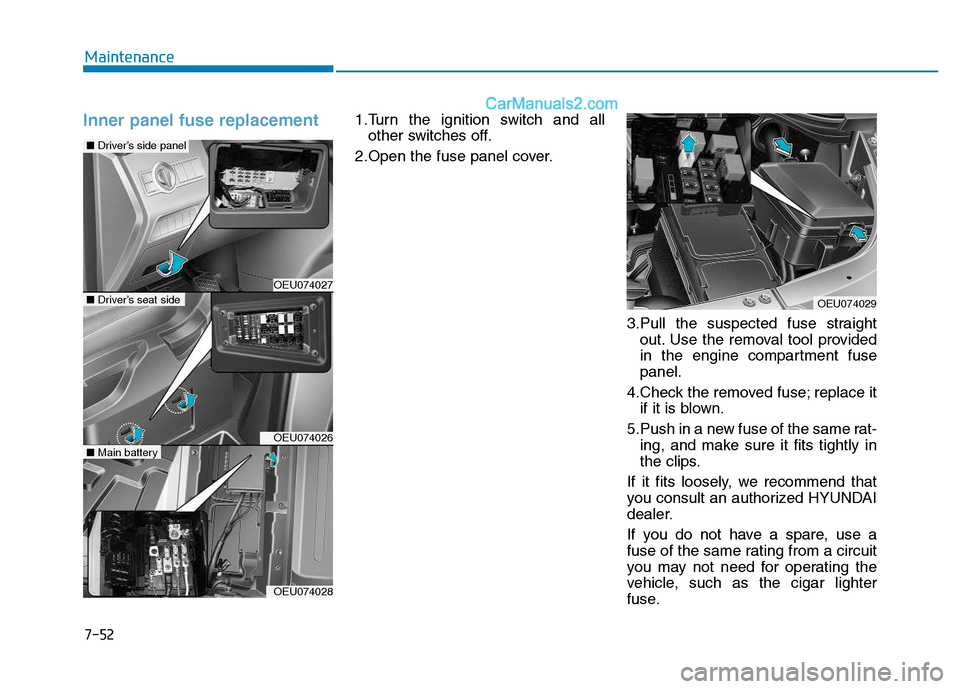
Inner panel fuse replacement1.Turn the ignition switch and allother switches off.
2.Open the fuse panel cover.
3.Pull the suspected fuse straightout. Use the removal tool provided
in the engine compartment fusepanel.
4.Check the removed fuse; replace it if it is blown.
5.Push in a new fuse of the same rat- ing, and make sure it fits tightly in
the clips.
If it fits loosely, we recommend that
you consult an authorized HYUNDAI
dealer.
If you do not have a spare, use a
fuse of the same rating from a circuit
you may not need for operating the
vehicle, such as the cigar lighter
fuse.
OEU074027
OEU074026
OEU074028
■ Driver’s seat side
■Driver’s side panel
■Main battery
OEU074029
Page 416 of 473
7-53
7
Maintenance
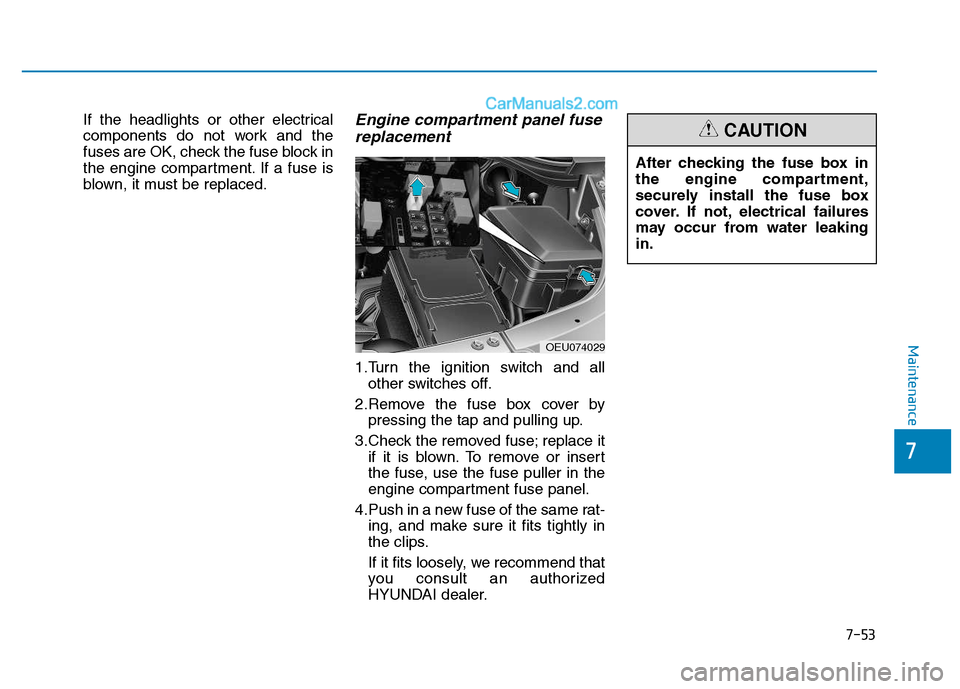
If the headlights or other electrical
components do not work and the
fuses are OK, check the fuse block in
the engine compartment. If a fuse is
blown, it must be replaced.Engine compartment panel fusereplacement
1.Turn the ignition switch and all other switches off.
2.Remove the fuse box cover by pressing the tap and pulling up.
3.Check the removed fuse; replace it if it is blown. To remove or insert
the fuse, use the fuse puller in the
engine compartment fuse panel.
4.Push in a new fuse of the same rat- ing, and make sure it fits tightly in
the clips.
If it fits loosely, we recommend that
you consult an authorized
HYUNDAI dealer.
OEU074029 After checking the fuse box in
the engine compartment,
securely install the fuse box
cover. If not, electrical failures
may occur from water leakingin.
CAUTION
Page 430 of 473
7-67
7
MaintenanceUse only the bulbs of the specifiedwattage.
After heavy, driving rain or wash-
ing, headlight and taillight lenses
could appear frosty. This condi-
tion is caused by the temperature
difference between the lamp
inside and outside. This is similar
to the condensation on your win-
dows inside your vehicle duringthe rain and doesn’t indicate a
problem with your vehicle. If
water leaks into the lamp bulb cir-
cuitry, we recommend that the
system be checked by an author-
ized HYUNDAI dealer.
NOTICE
LL IIGG HH TT BB UU LLBB SS
Working on the lights
Prior to working on the light,
firmly apply the parking brake,
ensure that the ignition switch
is turned to the “LOCK” position
and turn off the lights to avoid
sudden movement of the vehi-
cle and burning your fingers or
receiving an electric shock.
WARNING
Be sure to replace the burned-
out bulb with one of the same
wattage rating. Otherwise, it
may cause damage to the fuseor electric wiring system.
CAUTION
If you don’t have necessary
tools, the correct bulbs and the
expertise, we recommend that
you consult an authorized
HYUNDAI dealer. In many cases,
it is difficult to replace vehicle
light bulbs because other parts
of the vehicle must be removed
before you can get to the bulb.
This is especially true if you
have to remove the headlight
assembly to get to the bulb(s).
Removing/installing the head-
light assembly can result in
damage to the vehicle.
CAUTION