ignition Hyundai H350 2016 Repair Manual
[x] Cancel search | Manufacturer: HYUNDAI, Model Year: 2016, Model line: H350, Model: Hyundai H350 2016Pages: 473, PDF Size: 26.4 MB
Page 272 of 473
Driving your vehicle
Before driving.........................................................5-3Before entering the vehicle ...........................................5-3
Necessary inspections .....................................................5-3
Before starting...................................................................5-3
Key positions ..........................................................5-5 Illuminated ignition switch...............................................5-5
Ignition switch position ....................................................5-5
Starting the engine ...........................................................5-6
ISG (Idle stop and go) system..............................5-8 Auto stop .............................................................................5-9
Auto start ..........................................................................5-10
Condition of ISG system operation.............................5-11
ISG system deactivation ................................................5-12
ISG system malfunction .................................................5-13
Manual transmission............................................5-14 Manual transmission operation ...................................5-14
Using the clutch...............................................................5-16
Downshifting ....................................................................5-16
Good driving practices ...................................................5-17
Brake system ........................................................5-18 Power brakes ...................................................................5-18
Parking brake ...................................................................5-19
Anti-lock brake system (ABS) .....................................5-21
Vehicle dynamic control (VDC) ....................................5-24
Hill-start assist control (HAC) ......................................5-27
Emergency stop signal (ESS) .......................................5-28
Good braking practices..................................................5-29 Cruise control system..........................................5-30
Cruise control operation................................................5-31
Adjustable speed limit device (ASLD) ...............3-34 To set speed limit ............................................................5-34
To turn off the speed limit control, do one of
the following ....................................................................5-36
Lane departure warning system (LWDS) .........5-37 LDWS operation...............................................................5-38
Warning indicator ............................................................5-39
Active eco system ................................................5-40 Active eco operation ......................................................5-40
When active eco is activated: ......................................5-41
Limitation of active eco operation: ............................5-41
PTO switch ............................................................5-41 To activate the P.T.O system ........................................5-41
To deactivate the P.T.O system....................................5-41
Economical operation ..........................................5-42
Special driving conditions ...................................5-44
Winter driving .......................................................5-48
Trailer towing .......................................................5-52 Safety chains ...................................................................5-54
Trailer brakes ...................................................................5-54
Driving with a trailer ......................................................5-55
Maintenance when trailer towing ...............................5-58
If you do decide to pull a trailer .................................5-59
Vehicle weight ......................................................5-62
Locking differential .............................................5-63
5
Page 274 of 473
5-3
Driving your vehicle
BBEEFFOO RREE DD RRIIVV IINN GG
5
Before entering the vehicle
• Be sure that all windows, outside
mirror(s), and outside lights are clean.
Check the condition of the tires.
Check under the vehicle for any sign of leaks.
Be sure there are no obstacles behind you if you intend to back up.
Necessary inspections
Fluid levels, such as engine oil,
engine coolant, power steering fluid,
brake fluid, and washer fluid should
be checked on a regular basis, with
the exact interval depending on the
fluid. Further details are provided in
Section 7, “Maintenance”.
Before starting
Close and lock all doors.
Position the seat so that all con-trols are easily reached.
Adjust the inside and outside rearview mirrors.
Be sure that all lights work.
Check all gauges.
Check the operation of warning lights when the ignition switch is
turned to the ON position.
Release the parking brake and make sure the brake warning lightgoes out.
For safe operation, be sure you are
familiar with your vehicle and itsequipment.
Driving while distracted can
result in a loss of vehicle con-
trol, that may lead to an acci-
dent, severe personal injury,
and death. The driver’s primary
responsibility is in the safe and
legal operation of a vehicle, and
use of any handheld devices,
other equipment, or vehicle sys-
tems which take the driver’s
eyes, attention and focus away
from the safe operation of a
vehicle or which are not permis-
sible by law should never beused during operation of the
vehicle.
WARNING
Page 276 of 473
5-5
Driving your vehicle
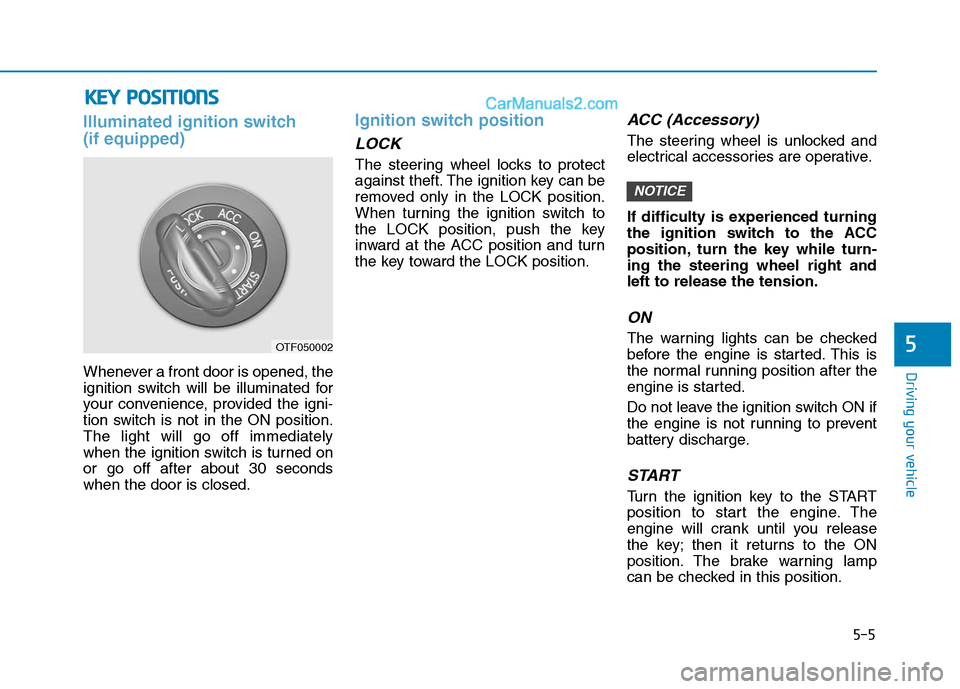
Illuminated ignition switch (if equipped)
Whenever a front door is opened, the
ignition switch will be illuminated for
your convenience, provided the igni-
tion switch is not in the ON position.The light will go off immediately
when the ignition switch is turned onor go off after about 30 secondswhen the door is closed.
Ignition switch position
LOCK
The steering wheel locks to protect
against theft. The ignition key can be
removed only in the LOCK position.
When turning the ignition switch to
the LOCK position, push the key
inward at the ACC position and turn
the key toward the LOCK position.
ACC (Accessory)
The steering wheel is unlocked and
electrical accessories are operative.
If difficulty is experienced turning
the ignition switch to the ACC
position, turn the key while turn-ing the steering wheel right andleft to release the tension.
ON
The warning lights can be checked
before the engine is started. This is
the normal running position after the
engine is started.
Do not leave the ignition switch ON if
the engine is not running to prevent
battery discharge.
START
Turn the ignition key to the START
position to start the engine. The
engine will crank until you release
the key; then it returns to the ON
position. The brake warning lamp
can be checked in this position.
NOTICE
5
KKEEYY PP OO SSIITT IIOO NNSS
OTF050002
Page 277 of 473
5-6
Starting the engine
Driving your vehicle
Ignition key
Never turn the ignition switch
to LOCK or ACC while the vehi-
cle is moving. This would result
in loss of directional control
and braking function, whichcould cause an accident.
The anti-theft steering column
lock is not a substitute for the
parking brake. Before leaving
the driver’s seat, always make
sure the shift lever is engaged
in 1st gear for the manual
transmission, set the parking
brake fully and shut the
engine off. Unexpected and
sudden vehicle movement
may occur if these precau-tions are not taken.(Continued)
WARNING (Continued)
Never reach for the ignition
switch, or any other controls
through the steering wheel
while the vehicle is in motion.
The presence of your hand orarm in this area could cause a
loss of vehicle control, an
accident and serious bodily
injury or death.
Do not place any movable
objects around the driver’s
seat as they may move while
driving, interfere with the driv-er and lead to an accident.
Always wear appropriate
shoes when operating your
vehicle. Unsuitable shoes
(high heels, ski boots,etc.)
may interfere with your abilityto use the brake and accelera-
tor pedal, and the clutch.
Do not start the vehicle with the accelerator pedal
depressed. The vehicle can
move and lead to an accident.
Wait until the engine rpm is
normal. The vehicle may sud-
denly move if the brake padelis released when the rpm ishigh.
WARNING
Page 278 of 473
5-7
Driving your vehicle
Kick down mechanism (if equipped)
If your vehicle is equipped with a
kick down mechanism in the
accelerator pedal, it prevents you
from driving at full throttle unin-
tentionally by making the driver
require increased effort todepress the accelerator pedal.
However, if you depress the pedal
more than approximately 80%, the
vehicle can be at full throttle andthe accelerator pedal will be easi-
er to depress. This is not a mal-
function but a normal condition.To start the diesel engine when theengine is cold, it has to be pre-heat-
ed before starting the engine and
then have to be warmed up before
starting to drive.
1. Make sure the parking brake is
applied.
2. Depress the clutch pedal fully and shift the transmission into Neutral.
Keep the clutch pedal and brake
pedal depressed while turning the
ignition switch to the start position.
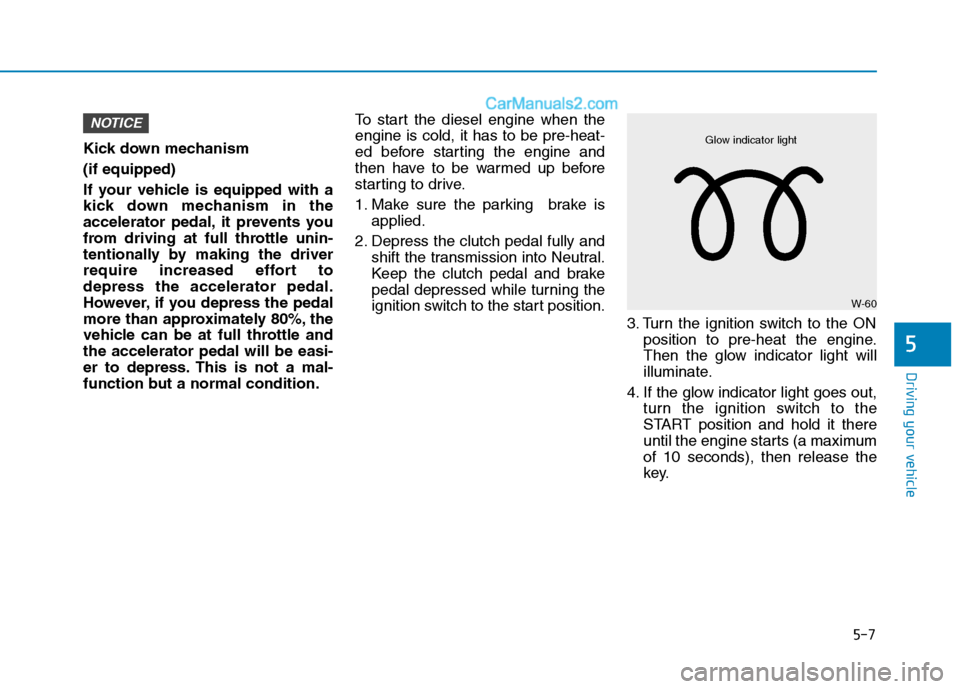
3. Turn the ignition switch to the ONposition to pre-heat the engine.
Then the glow indicator light will
illuminate.
4. If the glow indicator light goes out, turn the ignition switch to the
START position and hold it there
until the engine starts (a maximumof 10 seconds), then release the
key.
NOTICE
5
W-60
Glow indicator light
Page 279 of 473
5-8
If the engine were not started within 10 seconds after the pre-
heating is completed, turn the
ignition key once more to theLOCK position during 10 seconds,
and then to the ON position, in
order to preheat again.
Starting and stopping the engine
for turbocharger intercooler
1. Do not race or accelerate the
engine immediately after starting.
If the engine is cold, idle for sever-
al seconds before sufficient lubri-cation is ensured in the tur-bocharger unit.
2. After high speed or extended driv- ing, requiring a heavy engine load,
idle the engine about 1 minute
before turning it off.
This idle time will allow the tur-bocharger to cool prior to shutting
the engine off. Your vehicle may be equipped withthe ISG system, which reduces fuel
consumption by automatically shut-
ting down the engine, when the vehi-
cle is at a standstill. (For example :
red light, stop sign and traffic jam)
The engine starts automatically as
soon as the starting conditions aremet.
The ISG system is ON whenever the
engine is running.
When the engine automatically
starts by the ISG system, some
warning lights (ABS, VDC, VDC
OFF, EBD) may turn on for a fewseconds.
This happens because of low bat-
tery voltage. It does not mean thesystem is malfunctioning.
NOTICE
NOTICE
Driving your vehicle
Do not turn the engine off
immediately after it has been
subjected to a heavy load.
Doing so may cause severe
damage to the engine or turbo
charger unit.
CAUTION
II
SS GG (( IIDD LLEE SS TT OO PP AA NN DD GG OO ))
S
S YY SSTT EEMM (( IIFF EE QQ UUIIPP PPEEDD ))
Page 284 of 473
5-13
Driving your vehicle
5
ISG system malfunction
The system may not operatewhen:
- The ISG related sensors or system error occurs.
The yellow AUTO STOP indicator
( ) on the instrument cluster will
stay on after blinking for 5 seconds
and the light on the ISG OFF button
will illuminate.
If the ISG OFF button light is not turned off by pressing the ISG
OFF button again or if the ISG
system continuously does not
work correctly, we recommend
that you contact an authorized
HYUNDAI dealer.
(Continued)(Continued)
When the ISG OFF button light
comes on, it may stop illuminat-
ing after driving your vehicle at
approximately 80 km/h for a
maximum of two hours and set-
ting the fan speed control knob
below the 2nd position. If the
ISG OFF button light continuesto be illuminated in spite of the
procedure, we recommend that
you contact an authorized
HYUNDAI dealer.
NOTICE
When the engine is in Idle Stop
mode, it's possible to restart theengine without the driver taking
any action.
Before leaving the vehicle or
doing anything in the engine
room area, stop the engine by
turning the ignition switch tothe LOCK(OFF) position or
removing the ignition key.
WARNING
Page 285 of 473
5-14
Driving your vehicle
Manual transmission opera- tion
The manual transmission has 6 for-
ward gears.
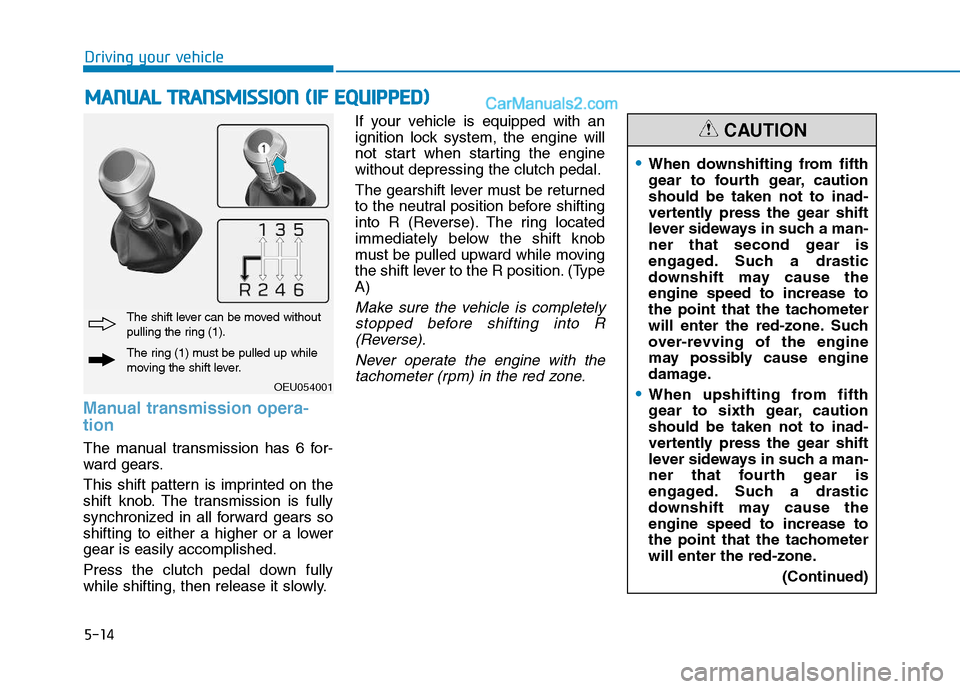
This shift pattern is imprinted on the
shift knob. The transmission is fully
synchronized in all forward gears so
shifting to either a higher or a lowergear is easily accomplished.
Press the clutch pedal down fully
while shifting, then release it slowly.If your vehicle is equipped with an
ignition lock system, the engine will
not start when starting the enginewithout depressing the clutch pedal.
The gearshift lever must be returned
to the neutral position before shifting
into R (Reverse). The ring located
immediately below the shift knob
must be pulled upward while moving
the shift lever to the R position. (TypeA)
Make sure the vehicle is completely
stopped before shifting into R(Reverse).
Never operate the engine with thetachometer (rpm) in the red zone.
MM AANN UU AALL TT RR AA NN SSMM IISS SSIIOO NN (( IIFF EE QQ UUIIPP PPEEDD ))
OEU054001
The ring (1) must be pulled up while
moving the shift lever.
The shift lever can be moved without
pulling the ring (1).
When downshifting from fifth
gear to fourth gear, cautionshould be taken not to inad-
vertently press the gear shift
lever sideways in such a man-
ner that second gear is
engaged. Such a drastic
downshift may cause theengine speed to increase to
the point that the tachometer
will enter the red-zone. Such
over-revving of the engine
may possibly cause engine
damage.
When upshifting from fifth
gear to sixth gear, cautionshould be taken not to inad-
vertently press the gear shift
lever sideways in such a man-
ner that fourth gear is
engaged. Such a drastic
downshift may cause theengine speed to increase to
the point that the tachometer
will enter the red-zone.
(Continued)
CAUTION
Page 286 of 473
5-15
Driving your vehicle
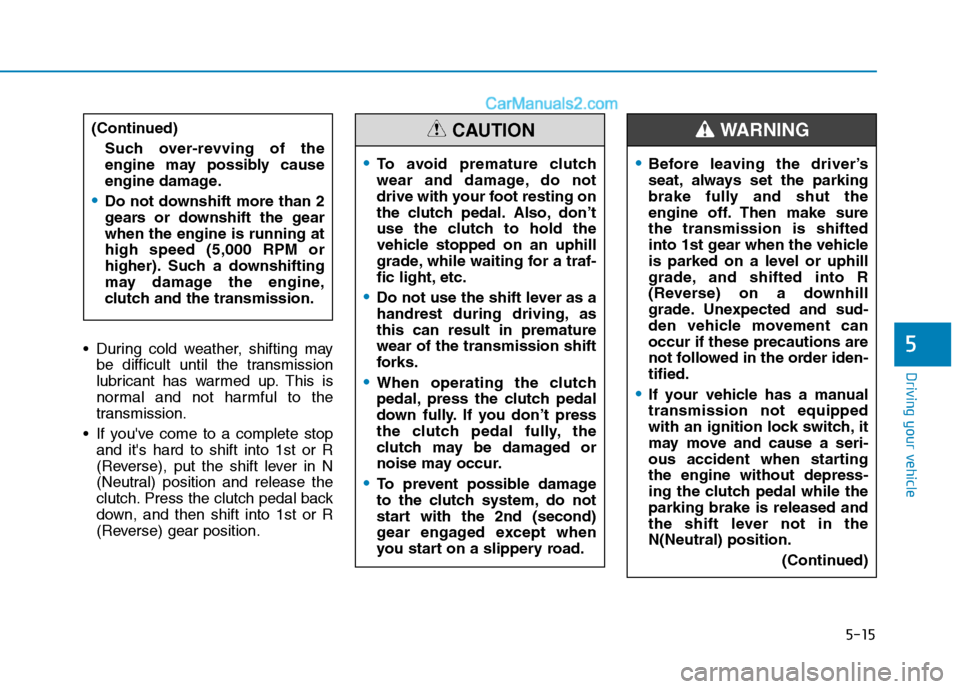
5 During cold weather, shifting maybe difficult until the transmission
lubricant has warmed up. This is
normal and not harmful to the
transmission.
If you've come to a complete stop and it's hard to shift into 1st or R
(Reverse), put the shift lever in N
(Neutral) position and release the
clutch. Press the clutch pedal back
down, and then shift into 1st or R
(Reverse) gear position.
To avoid premature clutch
wear and damage, do not
drive with your foot resting on
the clutch pedal. Also, don’t
use the clutch to hold the
vehicle stopped on an uphill
grade, while waiting for a traf-
fic light, etc.
Do not use the shift lever as a
handrest during driving, asthis can result in prematurewear of the transmission shift
forks.
When operating the clutch
pedal, press the clutch pedal
down fully. If you don’t press
the clutch pedal fully, the
clutch may be damaged or
noise may occur.
To prevent possible damage
to the clutch system, do not
start with the 2nd (second)
gear engaged except when
you start on a slippery road.
CAUTION
Before leaving the driver’s
seat, always set the parking
brake fully and shut the
engine off. Then make surethe transmission is shifted
into 1st gear when the vehicle
is parked on a level or uphill
grade, and shifted into R
(Reverse) on a downhill
grade. Unexpected and sud-
den vehicle movement canoccur if these precautions are
not followed in the order iden-tified.
If your vehicle has a manual transmission not equipped
with an ignition lock switch, it
may move and cause a seri-
ous accident when startingthe engine without depress-
ing the clutch pedal while theparking brake is released and
the shift lever not in theN(Neutral) position.
(Continued)
WARNING (Continued)Such over-revving of the
engine may possibly cause
engine damage.
Do not downshift more than 2
gears or downshift the gearwhen the engine is running athigh speed (5,000 RPM or
higher). Such a downshifting
may damage the engine,
clutch and the transmission.
Page 292 of 473
5-21
Driving your vehicle
5
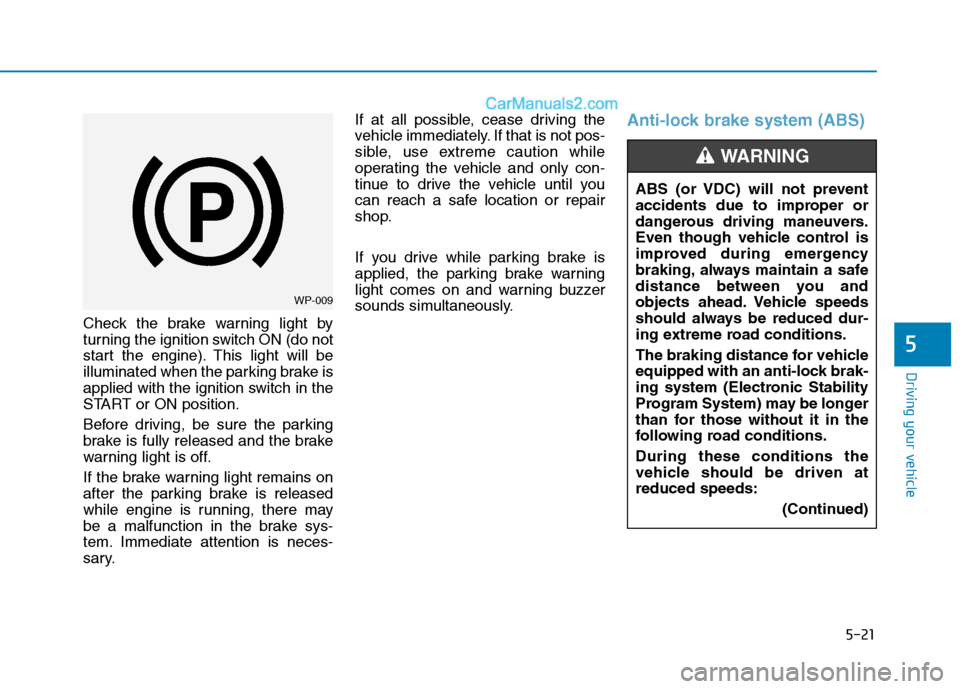
Check the brake warning light by
turning the ignition switch ON (do not
start the engine). This light will be
illuminated when the parking brake is
applied with the ignition switch in the
START or ON position.
Before driving, be sure the parking
brake is fully released and the brake
warning light is off.
If the brake warning light remains on
after the parking brake is released
while engine is running, there may
be a malfunction in the brake sys-
tem. Immediate attention is neces-
sary.If at all possible, cease driving the
vehicle immediately. If that is not pos-
sible, use extreme caution while
operating the vehicle and only con-
tinue to drive the vehicle until you
can reach a safe location or repair
shop.
If you drive while parking brake is
applied, the parking brake warning
light comes on and warning buzzer
sounds simultaneously.
Anti-lock brake system (ABS)
WP-009
ABS (or VDC) will not prevent
accidents due to improper or
dangerous driving maneuvers.
Even though vehicle control is
improved during emergency
braking, always maintain a safe
distance between you and
objects ahead. Vehicle speeds
should always be reduced dur-
ing extreme road conditions.
The braking distance for vehicle
equipped with an anti-lock brak-
ing system (Electronic Stability
Program System) may be longer
than for those without it in the
following road conditions. During these conditions the
vehicle should be driven atreduced speeds:
(Continued)
WARNING