Time Hyundai H350 2016 Owner's Manual
[x] Cancel search | Manufacturer: HYUNDAI, Model Year: 2016, Model line: H350, Model: Hyundai H350 2016Pages: 473, PDF Size: 26.4 MB
Page 1 of 473
OOWW NNEERR ''SS MM AANN UU AALL
OOppeerraa ttiioo nn
M
M aaiinn ttee nn aann ccee
S
S ppeecciiff iicc aa ttiioo nnss
All information in this Owner's Manual is current at the time of publica-
tion. However, HYUNDAI reserves the right to make changes at any
time so that our policy of continual product improvement may be car-ried out.
This manual applies to all models of this vehicle and includes descrip-
tions and explanations of optional as well as standard equipment.
As a result, you may find material in this manual that does not apply to
your specific vehicle.
Page 8 of 473
F8
Introduction
As with other vehicles of this type,
failure to operate this vehicle correct-
ly may result in loss of control, an
accident or vehicle rollover.
Specific design characteristics (high-
er ground clearance, track, etc.) give
this vehicle a higher center of gravity
than other types of vehicles. In other
words they are not designed for cor-
nering at the same speeds as con-
ventional 2-wheel drive vehicles.
Avoid sharp turns or abrupt maneu-
vers. Again, failure to operate this
vehicle correctly may result in loss of
control, an accident or vehicle
rollover.Be sure to read the
"Reducing the risk of a rollover"
driving guidelines, in section 5 of
this manual. No special break-in period is need-
ed. By following a few simple precau-
tions for the first 1,000 km (600
miles) you may add to the perform-
ance, economy and life of your vehi-
cle.
Do not race the engine.
While driving, keep your engine
speed (rpm, or revolutions per
minute) between 2,000 rpm and
4,000 rpm.
Do not maintain a single speed for long periods of time, either fast or
slow. Varying engine speed is
needed to properly break-in the
engine.
Avoid hard stops, except in emer- gencies, to allow the brakes to seat
properly.
Don't tow a trailer during the first 2,000 km (1,200 miles) of opera-tion. HYUNDAI promotes an environmen-
tally sound treatment of end of life
vehicles and offers to take back your
Hyundai end of life vehicles in accor-dance with the European Union (EU)
End of Life Vehicles Directive.
You can get the detailed information
from your national HYUNDAI home
page.
VV
EEHH IICC LLEE HH AANN DDLLIINN GG
I
I NN SSTT RR UU CCTT IIOO NNSS V
V
EEHH IICC LLEE BB RREEAA KK--IINN PP RR OO CCEE SSSS RREETT UU RRNN IINN GG UU SSEE DD VV EEHH IICC LLEE SS
(
( FF OO RR EE UU RROO PPEE))
Page 9 of 473
F9
1
2
3
4
5
6
7
8
I
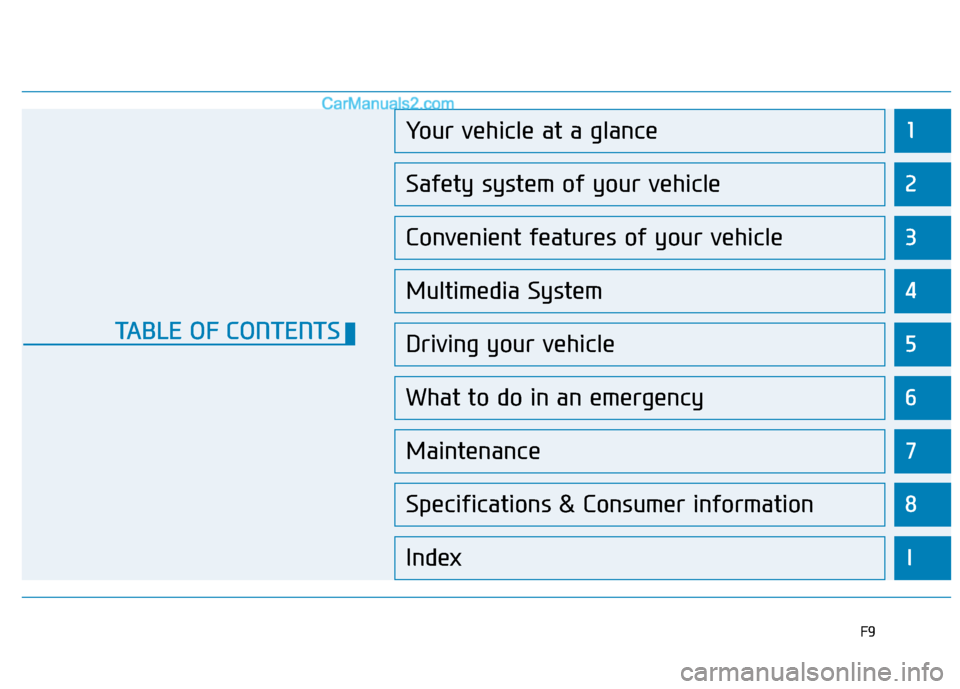
Your vehicle at a glance
Safety system of your vehicle
Convenient features of your vehicle
Multimedia System
Driving your vehicle
What to do in an emergency
Maintenance
Specifications & Consumer information
Index
TABLE OF CONTENTS
Page 24 of 473
2-4
Safety system of your vehicleS
S EE AA TTSS
Safety precautions
Adjust your seat, so that you can sit in
a safe, comfortable position. It plays
an important role in protecting the
driver and passengers, together withthe seat belts and air bags in an acci-dent.
Air bag
You can take steps to reduce the risk
of being injured by an inflating air
bag. Sitting too close to an air bag
greatly increases the risk of injury, as
the event the air bag inflates. Move
your seat as far back as possible
from front air bags, while still main-
taining control of the vehicle.
Seat belts
Always fasten your seat belt before
starting the vehicle.
At all times, passengers should sit
upright and be properly restrained.
Infants and small children must be
restrained in an appropriate child
restraint system. Children who out-
grow a booster seat and adults must
fasten their seat belts.
Do not use a cushion thatreduces friction between the
seat and the passenger. The
passenger's hips may slide
under the lap portion of the seatbelt during an accident or a
sudden stop. Serious or fatal
internal injuries may resultbecause the seat belt cannot
properly operate.
WARNING
To reduce the risk of serious
injury or death from an inflating
air bag, take the following pre-cautions:
•Adjust the driver’s seat in the
rearmost position, while main-
taining the ability to fully con-
trol the vehicle.
Hold the steering wheel with
both hands at the 9 o’clock
and 3 o’clock positions to
minimize the risk of injuries to
your hands and arms.
NEVER place anything or any-
one on the air bags.
WARNING
Take the following precautions
to adjust your seat belt:
NEVER use one seat belt to fasten more than one occu-pant.
Always sit in an upright posi-
tion with the lap portion of the
seat belt snug and low acrossthe hips.
NEVER allow children or small infants to ride on a pas-
senger's laps.
(Continued)
WARNING
Page 31 of 473
2-11
Safety system of your vehicle
Front passenger seat (VAN, Truck)
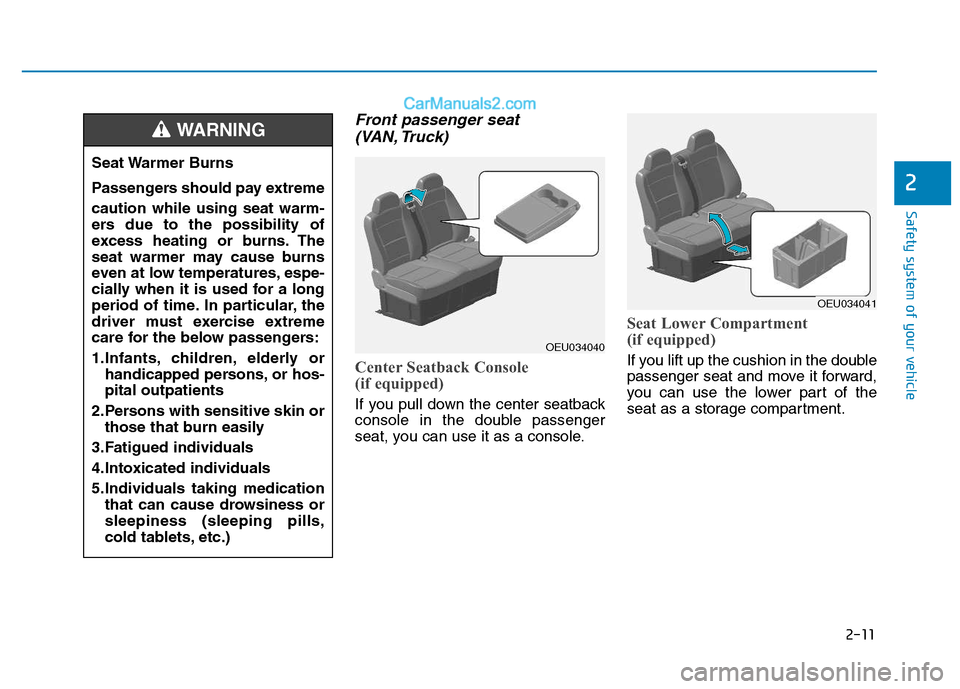
Center Seatback Console
(if equipped)
If you pull down the center seatback
console in the double passenger
seat, you can use it as a console.
Seat Lower Compartment
(if equipped)
If you lift up the cushion in the double
passenger seat and move it forward,
you can use the lower part of the
seat as a storage compartment.
2
Seat Warmer Burns
Passengers should pay extreme caution while using seat warm-
ers due to the possibility of
excess heating or burns. The
seat warmer may cause burns
even at low temperatures, espe-
cially when it is used for a long
period of time. In particular, the
driver must exercise extreme
care for the below passengers:
1.Infants, children, elderly or handicapped persons, or hos- pital outpatients
2.Persons with sensitive skin or those that burn easily
3.Fatigued individuals
4.Intoxicated individuals
5.Individuals taking medication that can cause drowsiness or sleepiness (sleeping pills,
cold tablets, etc.)
WARNING
OEU034040
OEU034041
Page 35 of 473
2-15
Safety system of your vehicle
2
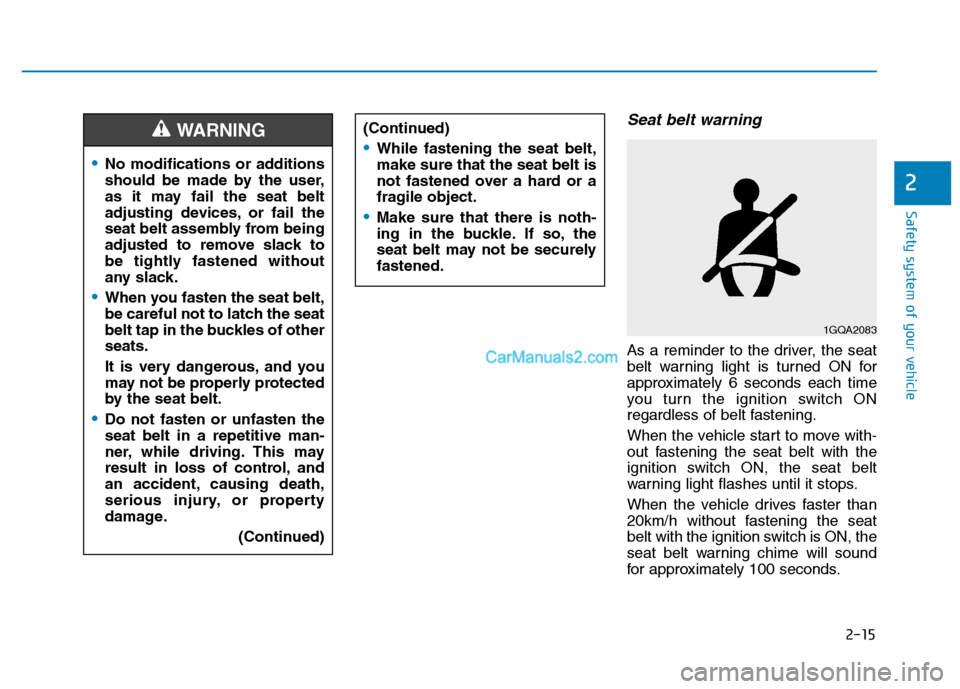
Seat belt warning
As a reminder to the driver, the seat
belt warning light is turned ON for
approximately 6 seconds each time
you turn the ignition switch ON
regardless of belt fastening.
When the vehicle start to move with-
out fastening the seat belt with the
ignition switch ON, the seat belt
warning light flashes until it stops.
When the vehicle drives faster than
20km/h without fastening the seat
belt with the ignition switch is ON, the
seat belt warning chime will sound
for approximately 100 seconds.
No modifications or additions
should be made by the user,
as it may fail the seat belt
adjusting devices, or fail the
seat belt assembly from being
adjusted to remove slack to
be tightly fastened without
any slack.
When you fasten the seat belt,
be careful not to latch the seat
belt tap in the buckles of otherseats.
It is very dangerous, and you
may not be properly protected
by the seat belt.
Do not fasten or unfasten the seat belt in a repetitive man-
ner, while driving. This may
result in loss of control, and
an accident, causing death,
serious injury, or property
damage.(Continued)
WARNING (Continued)
While fastening the seat belt, make sure that the seat belt is
not fastened over a hard or a
fragile object.
Make sure that there is noth-
ing in the buckle. If so, the
seat belt may not be securelyfastened.
1GQA2083
Page 40 of 473
2-20
Safety system of your vehicle
When the pre-tensioner seat beltis activated, there will be a loud
noise and fine dusts. These may
appear to be smoke, and be vis-
ible in the passenger compart-
ment. These are normal operat-
ing conditions, and does not
indicate a problem.
Although they are harmless sub- stances, the fine dusts may
cause skin irritation. These
should not be inhaled for a pro-
longed period of time.
Thoroughly wash all the
exposed skin areas after an
accident, when the pre-tension-
er seat belt was activated.
Because the sensor that acti- vates the SRS air bag is con-nected with the pre-tensioner
seat belt, the SRS air bag warn-
ing light on the instrument clus-
ter will illuminate for approxi-
mately 6 seconds after turning
ON the ignition switch, and then
it goes OFF.
NOTICE
To obtain maximum benefit
from a pre-tensioner seat belt:
1.The seat belt must be proper-ly fastened and adjusted.
Please read and follow all of
the important safety informa-tion and precautions about
your vehicle's occupant safe-
ty features - including seat
belts and air bags - that are
provided in this manual.
2.Make sure you and your pas- sengers always and properlyfasten the seat belts.
WARNING
When the pre-tensioner seat
belt does not properly operate,
the SRS air bag warning light
illuminates even without a mal-
function of the SRS air bag.
When the SRS air bag warninglight does not illuminate after
turning ON the ignition switch,
when it remains ON longer than
6 seconds, or when it remains
ON while driving the vehicle, werecommend that the system be
inspected by an authorized
HYUNDAI dealer.
CAUTION
Page 41 of 473

2-21
Safety system of your vehicle
2
Pre-tensioners are designed
to operate only one time. After
an activation, pre-tensioner
seat belts must be replaced.
All seat belts of any type must
be replaced, when they werefastened during a collision.
The pre-tensioner seat belt
assembly mechanisms beco
-
me hot while being activated.
Do not touch the pre-tension-
er seat belt assembly for sev-
eral minutes, after it is activat-ed.
Do not attempt to inspect or replace the pre-tensioner seat
belts by yourself. We recom-
mend that the system be serv-
iced by an authorized
HYUNDAI dealer.
Do not strike the pre-tension-
er seat belt assemblies with a
strong impact.(Continued)
WARNING (Continued)
Do not attempt to maintain or repair the pre-tensioner seat
belt by yourself in any man-
ner.
Improper handling of the pre- tensioner seat belt assem-
blies, and failure to heed the
warnings not to strike, modify,
inspect, replace, maintain orrepair the pre-tensioner seat
belt assemblies may lead to
improper operation or inad-
vertent activation, or even
serious injury.
Always fasten the seat belts while driving or riding in vehi-
cle.
Before scrapping your vehicle or the pre-tensioner seat belt,
we recommend that you con-
tact an authorized HYUNDAI
dealer.
Repair works on the front area
of the vehicle may damage thepre-tensioner seat belt system.
Therefore, we recommend that the system be maintained and
repaired by an authorized
HYUNDAI dealer.
CAUTION
Page 46 of 473
2-26
Safety system of your vehicle
How does the air bag operate?
Air bags are activated (able toinflate if necessary) only when the
ignition switch is turned to the ON
or START position.
Air bags instantly inflate in the event of a serious frontal collisionin order to help protect the occu-
pants from serious physical injury.
There is no single speed at which the air bags will inflate.
Generally, air bags are designed to inflate in accordance with the
severity of a collision and its direc-
tion. These two factors determinewhether the sensors produce an
electronic deployment/inflation sig-nal.
Air bag deployment depends on a number of factors, including a driv-
ing speed, an impact angle, a vehi-cle density/stiffness or a colliding
object, which your vehicle strikes
with in a collision. Those factorsare not limited to those mentioned
above. The front air bags will completely
inflate and deflate in an instant.
It is virtually impossible for you to
observe the inflation of the air bags
during an accident.
It is more likely that you will simply see the deflated air bags hanging
out of the air-bag storage compart-ments after a collision.
In order to protect occupants in a severe collision, the air bags must
rapidly inflate. The speed of air baginflation is a consequence of the
extremely short colliding time as
well as the necessity to inflate the
air bag between the occupant and
the vehicle structure before the
occupant strikes with the vehicle
structure. This fast inflating speed
reduces the risk of serious or life-
threatening injury in a severe colli-
sion. This is the core part indesigning an air bag.
However, air bag inflation may also
cause injury, such as a facial abra-
sion, a bruise and a broken bones,
because the air bags expand with
a great deal of force.
There are certain circumstances
under which the air bag installed
in the steering wheel may cause
fatal injury, especially when the
occupant is positioned exces-
sively close to the steeringwheel.
To avoid severe personal
injury or death caused by
deploying air bags in a colli-
sion, the driver should sit in
the rearmost position from
the air bag installed in thesteering wheel (at least 250
mm (10 inches) away). The
front passengers should
always move their seats as far
back as possible and sit backin their seats.
Air bags instantly inflate in
the event of a collision. Thus,
passengers may be injured by
the inflating air bag, when
they are in an improper posi-tion.
Air bag inflation may cause
injury, such as facial/bodily
abrasions, injuries by broken
glasses, or skin burns.
WARNING
Page 52 of 473
2-32
Safety system of your vehicle
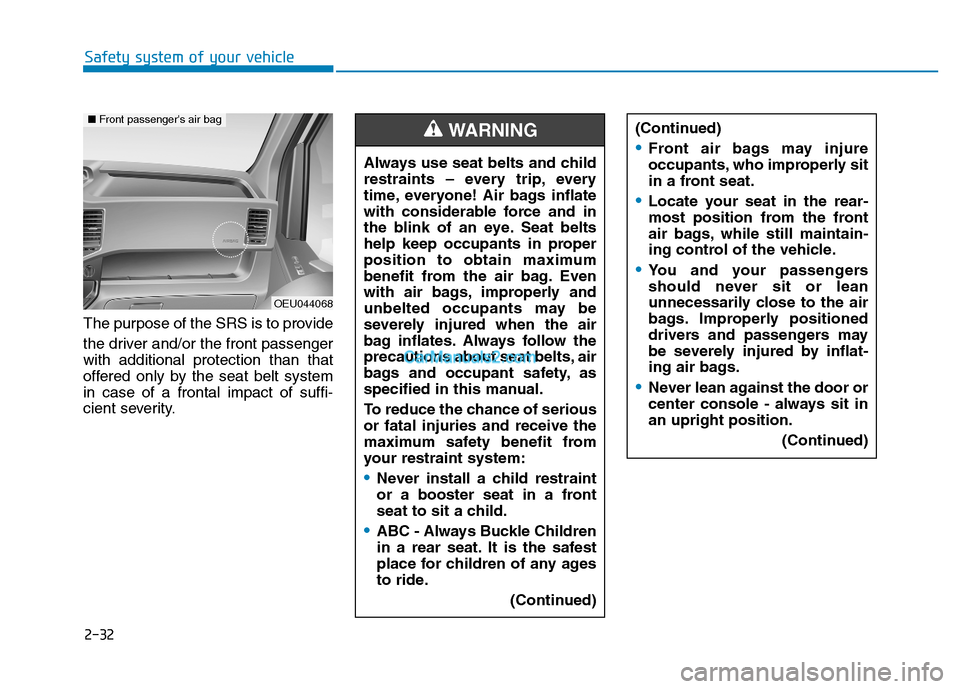
The purpose of the SRS is to provide
the driver and/or the front passenger with additional protection than that
offered only by the seat belt systemin case of a frontal impact of suffi-
cient severity.Always use seat belts and child
restraints – every trip, every
time, everyone! Air bags inflate
with considerable force and in
the blink of an eye. Seat belts
help keep occupants in proper
position to obtain maximum
benefit from the air bag. Even
with air bags, improperly and
unbelted occupants may be
severely injured when the air
bag inflates. Always follow the
precautions about seat belts, air
bags and occupant safety, as
specified in this manual.
To reduce the chance of serious or fatal injuries and receive the
maximum safety benefit from
your restraint system:
Never install a child restraint
or a booster seat in a front
seat to sit a child.
ABC - Always Buckle Children
in a rear seat. It is the safest
place for children of any ages
to ride.
(Continued)
WARNING
OEU044068
■Front passenger's air bag
(Continued)
Front air bags may injure
occupants, who improperly sit
in a front seat.
Locate your seat in the rear-
most position from the front
air bags, while still maintain-
ing control of the vehicle.
You and your passengers
should never sit or lean
unnecessarily close to the air
bags. Improperly positioned
drivers and passengers may
be severely injured by inflat-
ing air bags.
Never lean against the door or
center console - always sit inan upright position.
(Continued)