fuel HYUNDAI I20 2020 Owner's Guide
[x] Cancel search | Manufacturer: HYUNDAI, Model Year: 2020, Model line: I20, Model: HYUNDAI I20 2020Pages: 444, PDF Size: 8.93 MB
Page 151 of 444
6-23
06
Inside rearview mirror
Before you start driving, adjust the
rearview mirror to the center on the view
through the rear window.
WARNING
Make sure your line of sight is not
obstructed. Do not place objects in the
rear seat, cargo area, or behind the rear
headrests which could interfere with
your vision through the rear window.
WARNING
To prevent serious injury during an
accident or deployment of the air bag,
do not modify the rearview mirror and
do not install a wide mirror.
WARNING
NEVER adjust the mirror while driving.
This may cause loss of vehicle control
resulting in an accident.
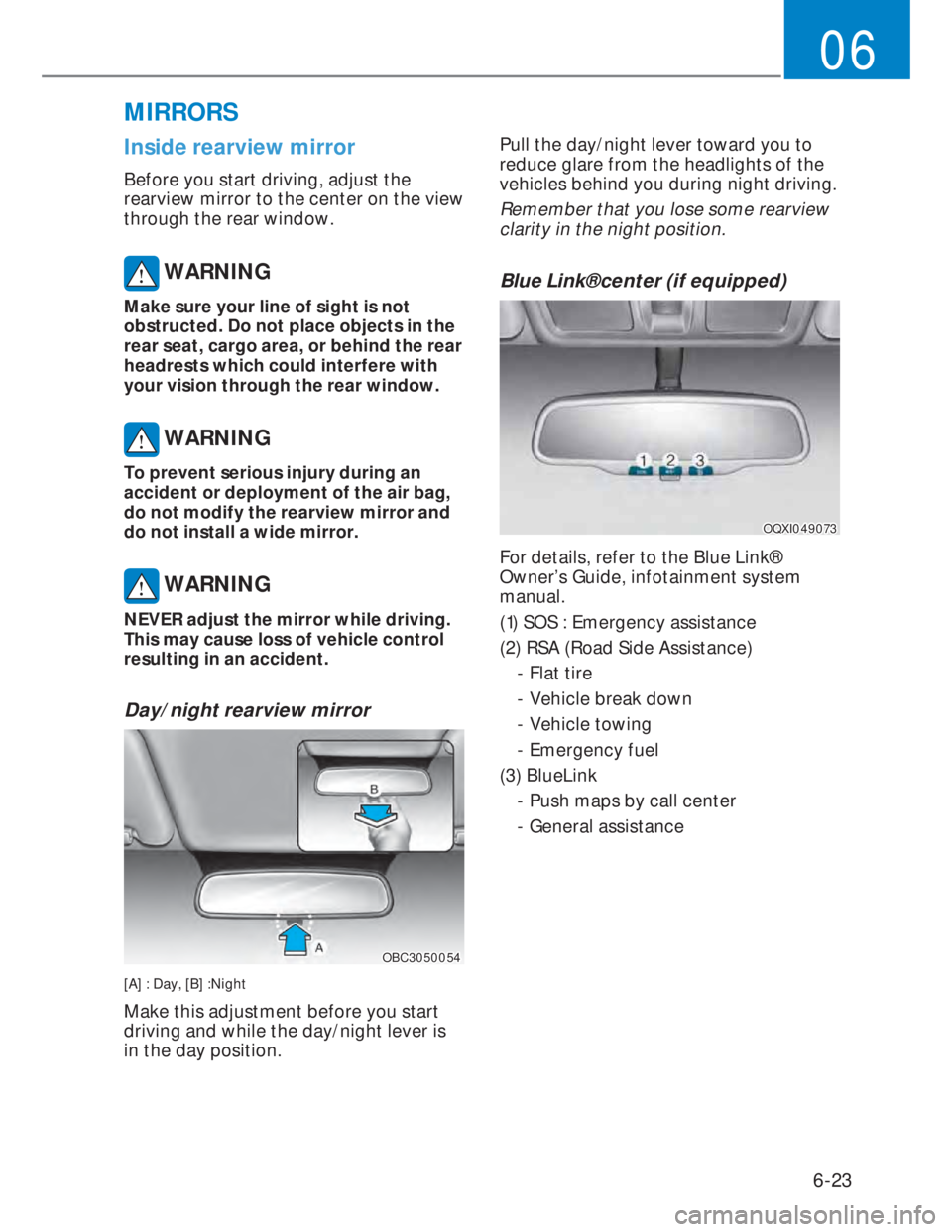
Day/night rearview mirror
OBC3050054OBC3050054
[A] : Day, [B] :Night
Make this adjustment before you start
driving and while the day/night lever is
in the day position.Pull the day/night lever toward you to
reduce glare from the headlights of the
vehicles behind you during night driving.
Remember that you lose some rearview
clarity in the night position.
Blue Link® center (if equipped)
OQXI049073OQXI049073
For details, refer to the Blue Link®
Owner’s Guide, infotainment system
manual.
(1) SOS : Emergency assistance
(2) RSA (Road Side Assistance)
- Flat tire
- Vehicle break down
- Vehicle towing
- Emergency fuel
(3) BlueLink
- Push maps by call center
- General assistance
MIRRORS
Page 167 of 444
6-39
06
Fuel filler door
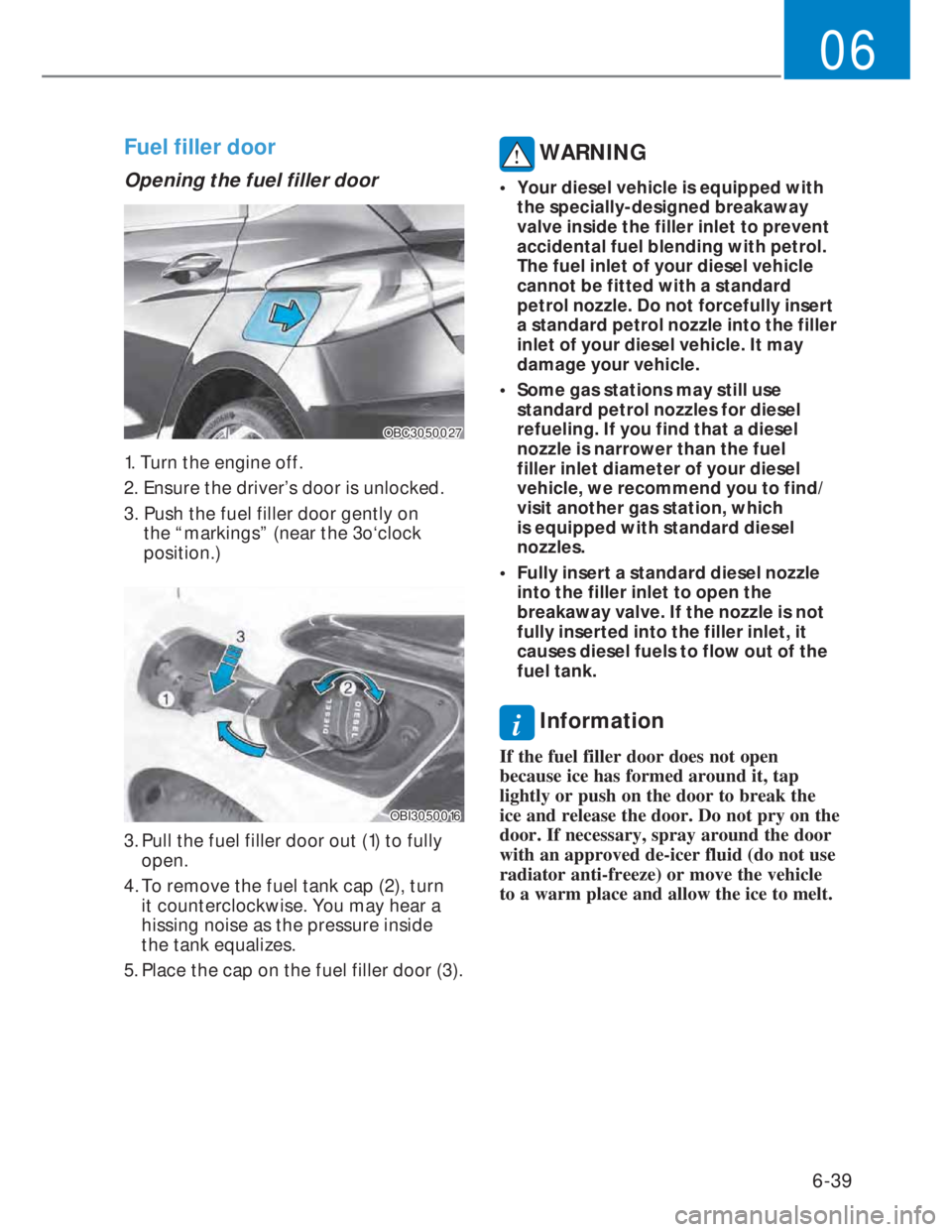
Opening the fuel filler door
OBC3050027OBC3050027
1. Turn the engine off.
2. Ensure the driver’s door is unlocked.
3. Push the fuel filler door gently on
the “markings” (near the 3o‘clock
position.)
OBI3050016OBI3050016
3. Pull the fuel filler door out (1) to fully
open.
4. To remove the fuel tank cap (2), turn
it counterclockwise. You may hear a
hissing noise as the pressure inside
the tank equalizes.
5. Place the cap on the fuel filler door (3).
WARNING
• Your diesel vehicle is equipped with
the specially-designed breakaway
valve inside the filler inlet to prevent
accidental fuel blending with petrol.
The fuel inlet of your diesel vehicle
cannot be fitted with a standard
petrol nozzle. Do not forcefully insert
a standard petrol nozzle into the filler
inlet of your diesel vehicle. It may
damage your vehicle.
• Some gas stations may still use
standard petrol nozzles for diesel
refueling. If you find that a diesel
nozzle is narrower than the fuel
filler inlet diameter of your diesel
vehicle, we recommend you to find/
visit another gas station, which
is equipped with standard diesel
nozzles.
• Fully insert a standard diesel nozzle
into the filler inlet to open the
breakaway valve. If the nozzle is not
fully inserted into the filler inlet, it
causes diesel fuels to flow out of the
fuel tank.
i Information
If the fuel filler door does not open
because ice has formed around it, tap
lightly or push on the door to break the
ice and release the door. Do not pry on the
door. If necessary, spray around the door
with an approved de-icer fluid (do not use
radiator anti-freeze) or move the vehicle
to a warm place and allow the ice to melt.
Page 168 of 444
6-40
Convenient features
Closing the fuel filler door
1. To install the fuel tank cap (2), turn it
clockwise until it “clicks” once. This
indicates that the cap is securely
tightened.
2. Close the fuel filler door (1) and push it
lightly and make sure that it is securely
closed.
WARNING
Petrol is highly flammable and
explosive. Failure to follow these
guidelines may result in SERIOUS
INJURY or DEATH:
• Read and follow all warnings posted
at the gas station.
• Before refueling, note the location
of the Emergency Petrol Shut-Off,if
available, at the gas station.
• Before touching the fuel nozzle, you
should eliminate the potential build-
up of static electricity by touching
a metal part of the vehicle, a safe
distance away from the fuel filler
neck, nozzle, or other gas source,
with your bare hand.
• Do not use cellular phones while
refueling. Electric current and/or
electronic interference from cellular
phones can potentially ignite fuel
vapors and cause a fire. • Do not get back into a vehicle
once you have begun refueling.
You can generate a buildup of
static electricity by touching,
rubbing or sliding against any item
or fabric capable of producing
static electricity. Static electricity
discharge can ignite fuel vapors
causing a fire. If you must re-enter
the vehicle, you should once again
eliminate potentially dangerous
static electricity discharge by
touching a metal part of the vehicle,
away from the fuel filler neck, nozzle
or other petrol source, with your bare
hand.
• When using an approved portable
fuel container, be sure to place the
container on the ground prior to
refueling. Static electricity discharge
from the container can ignite fuel
vapors causing a fire. Once refueling
has begun, contact between your
bare hand and the vehicle should
be maintained until the filling is
complete.
• Use only approved portable plastic
fuel containers designed to carry and
store petrol.
Page 169 of 444
6-41
06
• When refueling, always move the
shift lever to the P (Park) position (for
Intelligent Manual Transmission) or
first gear or R (Reverse, for manual
transmission), set the parking brake,
and place the ignition switch to the
LOCK/OFF position. Sparks produced
by electrical components related
to the engine can ignite fuel vapors
causing a fire.
• Do not use matches or a lighter and
do not smoke or leave a lit cigarette
in your vehicle while at a gas station,
especially during refueling.
• Do not over-fill or top-off your
vehicle tank, which can cause petrol
spillage.
• If a fire breaks out during refueling,
leave the vicinity of the vehicle, and
immediately contact the manager
of the gas station and then contact
the local fire department. Follow any
safety instructions they provide.
• If pressurized fuel sprays out, it can
cover your clothes or skin and thus
subject you to the risk of fire and
burns. Always remove the fuel cap
carefully and slowly. If the cap is
venting fuel or if you hear a hissing
sound, wait until the condition stops
before completely removing the cap.
• Always check that the fuel cap is
installed securely to prevent fuel
spillage in the event of an accident.i Information
• Make sure to refuel your vehicle
according to the “Fuel Requirements”
suggested in the 1 chapter.
• Do not spill fuel on the exterior surfaces
of the vehicle. Any type of fuel spilled
on painted surfaces may damage the
paint.
NOTICE
If the fuel filler cap requires
replacement, use only a genuine
HYUNDAI cap or the equivalent
specified for your vehicle. An incorrect
fuel filler cap can result in a serious
malfunction of the fuel system or
emission control system.
Page 269 of 444
7-22
Driving your vehicle
• The dual clutch transmission
incorporates a dry-type dual clutch
mechanism, which allows for better
acceleration performance and
increased fuel efficiency while driving.
But it differs from a conventional
automatic transmission because
it does not incorporate a torque
converter. Instead, the transition from
one gear to the next is managed by
clutch slip, especially at lower speeds.
As a result, shifts are sometimes more
noticeable, and a light vibration can be
felt as the transmission shaft speed is
matched with the engine shaft speed.
This is a normal condition of the dual
clutch transmission.
• The dry-type clutch transfers torque
more directly and provides a direct-
drive feeling which may feel different
from a conventional automatic
transmission. This may be more
noticeable when launching the vehicle
from a stop or when traveling at low,
stop-and-go vehicle speeds.
• When rapidly accelerating from a
lower vehicle speed, the engine
rpm may increase dramatically as a
result of clutch slip as the dual clutch
transmission selects the correct gear.
This is a normal condition.
• When accelerating from a stop on an
incline, press the accelerator smoothly
and gradually to avoid any shudder
feeling or jerkiness.
• When traveling at a lower vehicle
speed, if you release the accelerator
pedal quickly, you may feel engine
braking before the transmission
changes gears. This engine braking
feeling is similar to operating a manual
transmission at low speed.
• When driving downhill, you may
wish to move the gear shift lever to
Manual Shift mode and downshift to
a lower gear in order to control your
speed without using the brake pedal
excessively.• When you turn the engine on and off,
you may hear clicking sounds as the
system goes through a self-test. This
is a normal sound for the dual clutch
transmission.
• During the first 1,500 km (1000 miles),
you may feel that the vehicle may not
be smooth when accelerating at low
speed. During this break-in period, the
shift quality and performance of your
new vehicle is continuously optimized.
WARNING
To reduce the risk of serious injury or
death:
• ALWAYS check the surrounding
areas near your vehicle for people,
especially children, before shifting a
vehicle into D (Drive) or R (Reverse).
• Before leaving the driver’s seat,
always make sure the shift lever
is in the P (Park) position, then set
the parking brake, and place the
ignition switch in the LOCK/OFF
position. Unexpected and sudden
vehicle movement can occur if these
precautions are not followed.
• Do not use aggressive engine braking
(shifting from a higher gear to a lower
gear) on slippery roads. This could
cause the tires to slip and may result
in an accident.
Page 273 of 444

7-26
Driving your vehicle
R (Reverse)
Use this position to drive the vehicle
backward.
NOTICE
Always come to a complete stop before
shifting into or out of R (Reverse); you
may damage the transmission if you
shift into R (Reverse) while the vehicle
is in motion.
N (Neutral)
The wheels and transmission are not
engaged.
Use N (Neutral) if you need to restart
a stalled engine, or if it is necessary to
stop with the engine ON. Shift into P
(Park) if you need to leave your vehicle
for any reason.
Always depress the brake pedal when
you are shifting from N (Neutral) to
another gear.
D (Drive)
This is the normal driving position. The
transmission will automatically shift
through a 7-gear sequence, providing
the best fuel economy and power.
For extra power when passing another
vehicle or driving uphill, depress the
accelerator fully. The transmission will
automatically downshift to the next
lower gear (or gears, as appropriate).
OBI3060004LOBI3060004L
+ (UP)+ (UP)
- (DOWN)- (DOWN)
Manual shift mode
Whether the vehicle is stationary or in
motion, manual shift mode is selected
by pushing the shift lever from the D
(Drive) position into the manual gate. To
return to D (Drive) range operation, push
the shift lever back into the main gate.
In manual shift mode, moving the shift
lever backwards and forwards will allow
you to make gearshifts rapidly.
Up (+) : Push the lever forward once to
shift up one gear.
Down (-) : Pull the lever backwards once
to shift down one gear.
Page 280 of 444

7-33
07
R (Reverse)
Use this position to drive the vehicle
backward.
NOTICE
Always come to a complete stop before
shifting into or out of R (Reverse); you
may damage the transmission if you
shift into R (Reverse) while the vehicle
is in motion.
N (Neutral)
The wheels and transmission are not
engaged.
Use N (Neutral) if you need to restart
a stalled engine, or if it is necessary to
stop with the engine ON. Shift into P
(Park) if you need to leave your vehicle
for any reason.
Always depress the brake pedal when
you are shifting from N (Neutral) to
another gear.
WARNING
Do not shift into gear unless your foot is
firmly on the brake pedal. Shifting into
gear when the engine is running at high
speed can cause the vehicle to move
very rapidly. You could lose control of
the vehicle and hit people or objects.
D (Drive)
This is the normal driving position. The
transmission will automatically shift
through a 6-gear sequence, providing
the best fuel economy and power.
For extra power when passing another
vehicle or driving uphill, depress the
accelerator fully. The transmission will
automatically downshift to the next
lower gear (or gears, as appropriate).
OBI3060004OBI3060004
+ (UP)+ (UP)
- (DOWN)- (DOWN)
Manual shift mode
Whether the vehicle is stationary or in
motion, manual shift mode is selected
by pushing the shift lever from the D
(Drive) position into the manual gate. To
return to D (Drive) range operation, push
the shift lever back into the main gate.
In manual shift mode, moving the shift
lever backwards and forwards will allow
you to select the desired range of gears
for the current driving conditions.
+ (Up) : Push the lever forward once to
shift up one gear.
- (Down) : Pull the lever backwards once
to shift down one gear.
Page 302 of 444
7-55
07
Two labels on your driver’s door sill show
how much weight your vehicle was
designed to carry: the Tire and Loading
Information Label and the Certification
Label.
Before loading your vehicle, familiarize
yourself with the following terms for
determining your vehicle’s weight
ratings, from the vehicle’s specifications
and the Certification Label:
Base Curb Weight
This is the weight of the vehicle
including a full tank of fuel and all
standard equipment. It does not
include passengers, cargo, or optional
equipment.
Vehicle Curb Weight
This is the weight of your new vehicle
when you picked it up from your dealer
plus any aftermarket equipment.
Cargo Weight
This figure includes all weight added to
the Base Curb Weight, including cargo
and optional equipment.
GAW (Gross Axle Weight)
This is the total weight placed on each
axle (front and rear) - including vehicle
curb weight and all payload.
GAWR (Gross Axle Weight Rating)
This is the maximum allowable weight
that can be carried by a single axle (front
or rear). These numbers are shown on
the Certification Label. The total load on
each axle must never exceed its GAWR.GVW (Gross Vehicle Weight)
This is the Base Curb Weight plus actual
Cargo Weight plus passengers.
GVWR (Gross Vehicle Weight Rating)
This is the maximum allowable weight
of the fully loaded vehicle (including
all options, equipment, passengers
and cargo). The GVWR is shown on
the Certification Label located on the
driver’s door sill.
Overloading
WARNING
The Gross Axle Weight Rating (GAWR)
and the Gross Vehicle Weight Rating
(GVWR) for your vehicle are on the
Certification Label attached to the
driver’s (or front passenger’s) door.
Exceeding these ratings can cause an
accident or vehicle damage. You can
calculate the weight of your load by
weighing the items (and people) before
putting them in the vehicle. Be careful
not to overload your vehicle.
VEHICLE WEIGHT
Page 317 of 444

9-3
09
If you have a flat tire while
driving
If a tire goes flat while you are driving:
• Take your foot off the accelerator
pedal and let the vehicle slow down
while driving straight ahead. Do not
apply the brakes immediately or
attempt to pull off the road as this
may cause loss of vehicle control
resulting in an accident. When the
vehicle has slowed to such a speed
that it is safe to do so, brake carefully
and pull off the road. Drive off the
road as far as possible and park on
firm, level ground. If you are on a
divided highway, do not park in the
median area between the two traffic
lanes.
• When the vehicle is stopped, press
the hazard warning flasher button,
move the shift lever into N (Neutral,
for Automated manual transmission)
or neutral (for manual transmission
vehicle), apply the parking brake, and
place the ignition switch in the LOCK/
OFF position.
• Have all passengers get out of the
vehicle. Be sure they all get out on the
side of the vehicle that is away from
traffic.
• When changing a flat tire, follow the
instructions provided later in this
chapter.
IF THE ENGINE WILL NOT
START
If the engine doesn’t turn over
or turns over slowly
• Be sure the for Automated manual
transmission or N (Neutral) if it is a
vehicle. The engine starts only when
the shift lever is in N (Neutral).
• Check the battery connections to be
sure they are clean and tight.
• Turn on the interior light. If the light
dims or goes out when you operate
the starter, the battery is drained.
Do not push or pull the vehicle to start
it. This could cause damage to your
vehicle.
See instructions for “Jump Starting”
provided in this chapter.
WARNING
Push or pull starting the vehicle may
cause the catalytic converter to
overload which can lead to damage to
the emission control system.
If the engine turns over normally
but doesn’t start
• Check the fuel level and add fuel if
necessary.
If the engine still does not start, we
recommend that you call an authorized
HYUNDAI dealer for assistance.
Page 324 of 444

9-10
Emergency situations
Tire pressure monitoring system
WARNING
Over-inflation or under-inflation can
reduce tire life, adversely affect vehicle
handling, and lead to sudden tire
failure that may cause loss of vehicle
control resulting in an accident.
Each tire, including the spare (if
provided), should be checked monthly
when cold and inflated to the inflation
pressure recommended by the vehicle
manufacturer on the vehicle placard
or tire inflation pressure label. (If your
vehicle has tires of a different size
than the size indicated on the vehicle
placard or tire inflation pressure label,
you should determine the proper tire
inflation pressure for those tires.)
As an added safety feature, your
vehicle has been equipped with a tire
pressure monitoring system (TPMS)
that illuminates a low tire pressure
telltale when one or more of your tires is
significantly under-inflated.
Accordingly, when the low tire pressure
telltale illuminates, you should stop and
check your tires as soon as possible,
and inflate them to the proper pressure.
Driving on a significantly under-inflated
tire causes the tire to overheat and can
lead to tire failure. Under-inflation also
reduces fuel efficiency and tire tread life,
and may affect the vehicle’s handling
and stopping ability.
Please note that the TPMS is not a
substitute for proper tire maintenance,
and it is the driver’s responsibility to
maintain correct tire pressure, even if
under-inflation has not reached the level
to trigger illumination of the TPMS low
tire pressure telltale.Your vehicle has also been equipped
with a TPMS malfunction indicator
to indicate when the system is
not operating properly. The TPMS
malfunction indicator is combined with
the low tire pressure telltale. When
the system detects a malfunction, the
telltale will flash for approximately one
minute and then remain continuously
illuminated. This sequence will continue
upon subsequent vehicle start-ups as
long as the malfunction exists. When
the malfunction indicator is illuminated,
the system may not be able to detect
or signal low tire pressure as intended.
TPMS malfunctions may occur for
a variety of reasons, including the
installation of replacement or alternate
tires or wheels on the vehicle that
prevent the TPMS from functioning
properly. Always check the TPMS
malfunction telltale after replacing
one or more tires or wheels on your
vehicle to ensure that the replacement
or alternate tires and wheels allow the
TPMS to continue to function properly.
i Information
If the TPMS indicator does not illuminate
for 3 seconds when the ignition switch
is turned to the ON position or engine
is running, or if it comes on after
blinking for approximately one minute,
we recommend that you contact an
authorized HYUNDAI dealer.