steering HYUNDAI I20 2020 Workshop Manual
[x] Cancel search | Manufacturer: HYUNDAI, Model Year: 2020, Model line: I20, Model: HYUNDAI I20 2020Pages: 444, PDF Size: 8.93 MB
Page 352 of 444
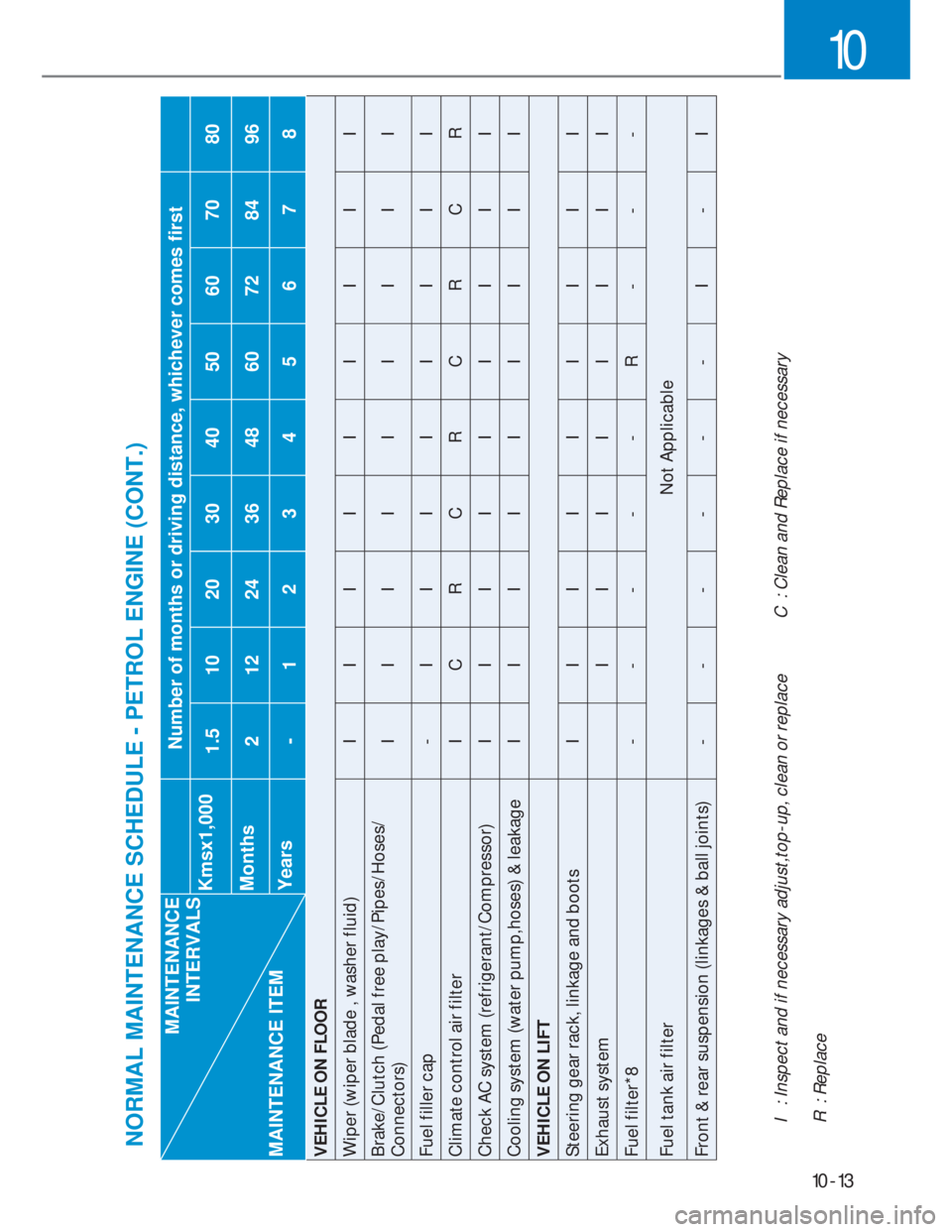
10-13
10
MAINTENANCE
INTERVALS
MAINTENANCE ITEMNumber of months or driving distance, whichever comes first
Kmsx1,000
1.51020304050607080
Months
2 1224364860728496
Years
- 12345678
VEHICLE ON FLOOR
Wiper (wiper blade , washer fluid) I IIIIIIII
Brake/Clutch (Pedal free play/Pipes/Hoses/
Connectors)IIIIIIIII
Fuel filler cap -IIIIIIII
Climate control air filter I C R C R C R C R
Check AC system (refrigerant/Compressor) I IIIIIIII
Cooling system (water pump,hoses) & leakage I I IIIIIII
VEHICLE ON LIFT
Steering gear rack, linkage and bootsIIIIIIIII
Exhaust systemIIIIIIII
Fuel filter*8-----R---
Fuel tank air filter Not Applicable
Front & rear suspension (linkages & ball joints)------
I-I
I : Inspect and if necessary adjust,top-up, clean or replace
R : ReplaceC : Clean and Replace if necessaryNORMAL MAINTENANCE SCHEDULE - PETROL ENGINE (CONT.)
Page 355 of 444

10-16
Maintenance
MAINTENANCE UNDER SEVERE USAGE CONDITIONS - PETROL ENGINEThe following items must be serviced more frequently on cars mainly used under severe driving conditions.
Refer to the chart below for the appropriate maintenance intervals.I : Inspect and if necessary, adjust, correct, clean or replace R:Replace or change
Maintenance itemMaintenance
operationMaintenance intervalsDriving
condition
Engine oil and engine oil filter R1.0 T-GDi every 5,000km (3,000miles) or 6 months
A, B, C, D, E, F,
G, H, I, J , K, L
Smartstream
G1.2every 7,500km (5,000miles) or 6 months
Air cleaner filter R Replace more frequently depending on the condition C, E
Spark plugs R Replace more frequently depending on the condition B, H
Manual transmission fluid
(Intelligent manual transmission fluid)
(if equipped)R Every 120,000 km (80,000 miles)C, D, E, F, G,
H, I, J
Dual clutch transmission fluid
(if equipped)R Every 120,000 km (80,000miles)C, D, E, F, G,
H, I, J
Steering gear rack, linkage and boots I Inspect more frequently depending on the condition C, D, E, F, G
Page 358 of 444
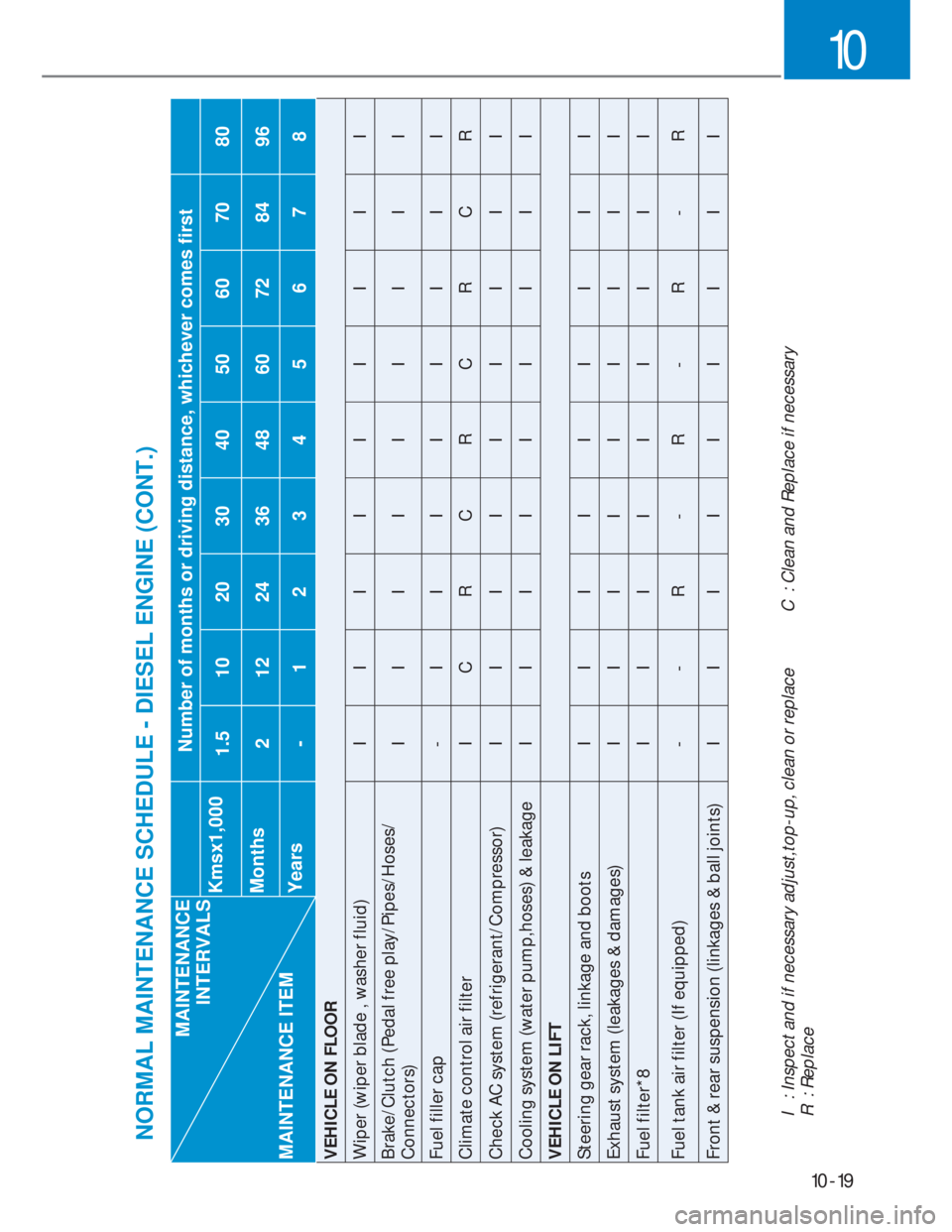
10-19
10
MAINTENANCE
INTERVALS
MAINTENANCE ITEMNumber of months or driving distance, whichever comes first
Kmsx1,000
1.51020304050607080
Months
2 1224364860728496
Years
- 12345678
VEHICLE ON FLOOR
Wiper (wiper blade , washer fluid)IIIIIIIII
Brake/Clutch (Pedal free play/Pipes/Hoses/
Connectors)IIIIIIIII
Fuel filler cap - I IIIIIII
Climate control air filter I C R C R C R C R
Check AC system (refrigerant/Compressor)IIIIIIIII
Cooling system (water pump,hoses) & leakage IIIIIIIII
VEHICLE ON LIFT
Steering gear rack, linkage and boots I I IIIIIII
Exhaust system (leakages & damages)IIIIIIIII
Fuel filter*8IIIIIIIII
Fuel tank air filter (If equipped) - -R-R-R
-R
Front & rear suspension (linkages & ball joints)IIIIIIIII
I : Inspect and if necessary adjust,top-up, clean or replace
R : ReplaceC : Clean and Replace if necessary
NORMAL MAINTENANCE SCHEDULE - DIESEL ENGINE (CONT.)
Page 361 of 444
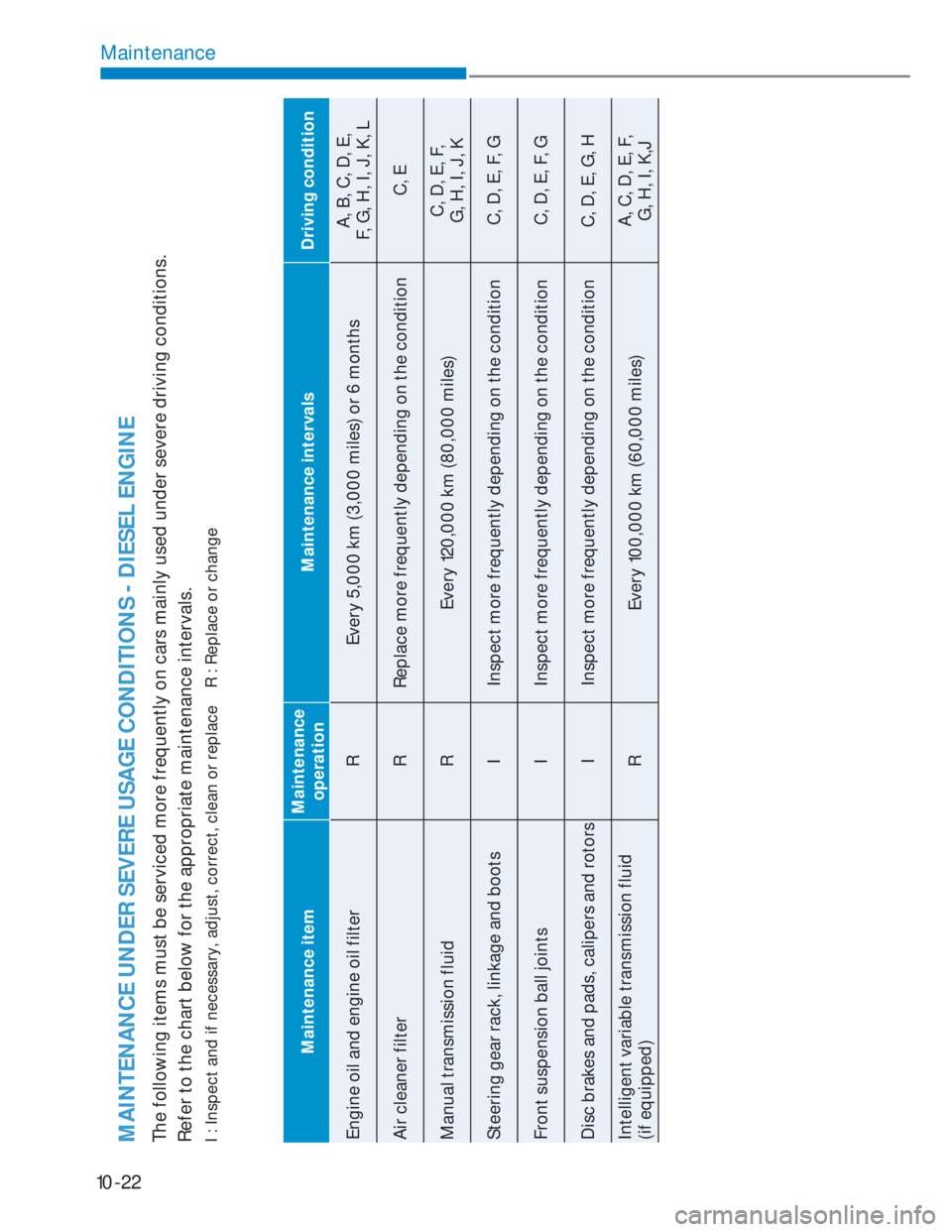
10-22
Maintenance
Maintenance itemMaintenance
operationMaintenance intervals Driving condition
Engine oil and engine oil filter R Every 5,000 km (3,000 miles) or 6 monthsA, B, C, D, E,
F, G, H, I, J, K, L
Air cleaner filter R Replace more frequently depending on the condition C, E
Manual transmission fluid R Every 120,000 km (80,000 miles)C, D, E, F,
G, H, I, J, K
Steering gear rack, linkage and boots I Inspect more frequently depending on the condition C, D, E, F, G
Front suspension ball joints I Inspect more frequently depending on the condition C, D, E, F, G
Disc brakes and pads, calipers and rotors I Inspect more frequently depending on the condition C, D, E, G, H
Intelligent variable transmission fluid
(if equipped)R Every 100,000 km (60,000 miles)A, C, D, E, F,
G, H, I, K,JMAINTENANCE UNDER SEVERE USAGE CONDITIONS - DIESEL ENGINEThe following items must be serviced more frequently on cars mainly used under severe driving conditions.
Refer to the chart below for the appropriate maintenance intervals.I : Inspect and if necessary, adjust, correct, clean or replace R : Replace or change
Page 366 of 444
10-27
10
Brake hoses and lines
Visually check for proper installation,
chafing, cracks, deterioration and any
leakage. Replace any deteriorated or
damaged parts immediately.
Brake/clutch fluid (if equipped)
Check brake/clutch fluid level in the
brake fluid reservoir. The level should
be between “MIN” (Minimum) and
“MAX” (Maximum) marks on the side of
the reservoir. Use only hydraulic brake/
clutch fluid conforming to DOT 3 or 4
specification.
Parking brake
Inspect the parking brake system
including the parking brake lever and
cables.
Rear brake drums and linings
(if equipped)
Check the rear brake drums and linings
for scoring, burning, leaking fluid,
broken parts, and excessive wear.
Brake pads, calipers and discs
Check the pads for excessive wear, discs
for run out and wear, and calipers for
fluid leakage.
Suspension mounting bolts
Check the suspension connections for
looseness or damage. Retighten to the
specified torque.
Steering gear box, linkage &
boots/lower arm ball joint
With the vehicle stopped and engine
off, check for excessive free-play in the
steering wheel.
Check the linkage for bends or damage.
Check the dust boots and ball joints
for deterioration, cracks, or damage.
Replace any damaged parts.
Drive shafts and boots
Check the drive shafts, boots and
clamps for cracks, deterioration, or
damage. Replace any damaged parts
and, if necessary, repack the grease.
Air conditioning refrigerant
(if equipped)
Check the air conditioning lines and
connections for leakage and damage.
Page 395 of 444
10-56
Maintenance
Tire replacement
OEN076053OEN076053
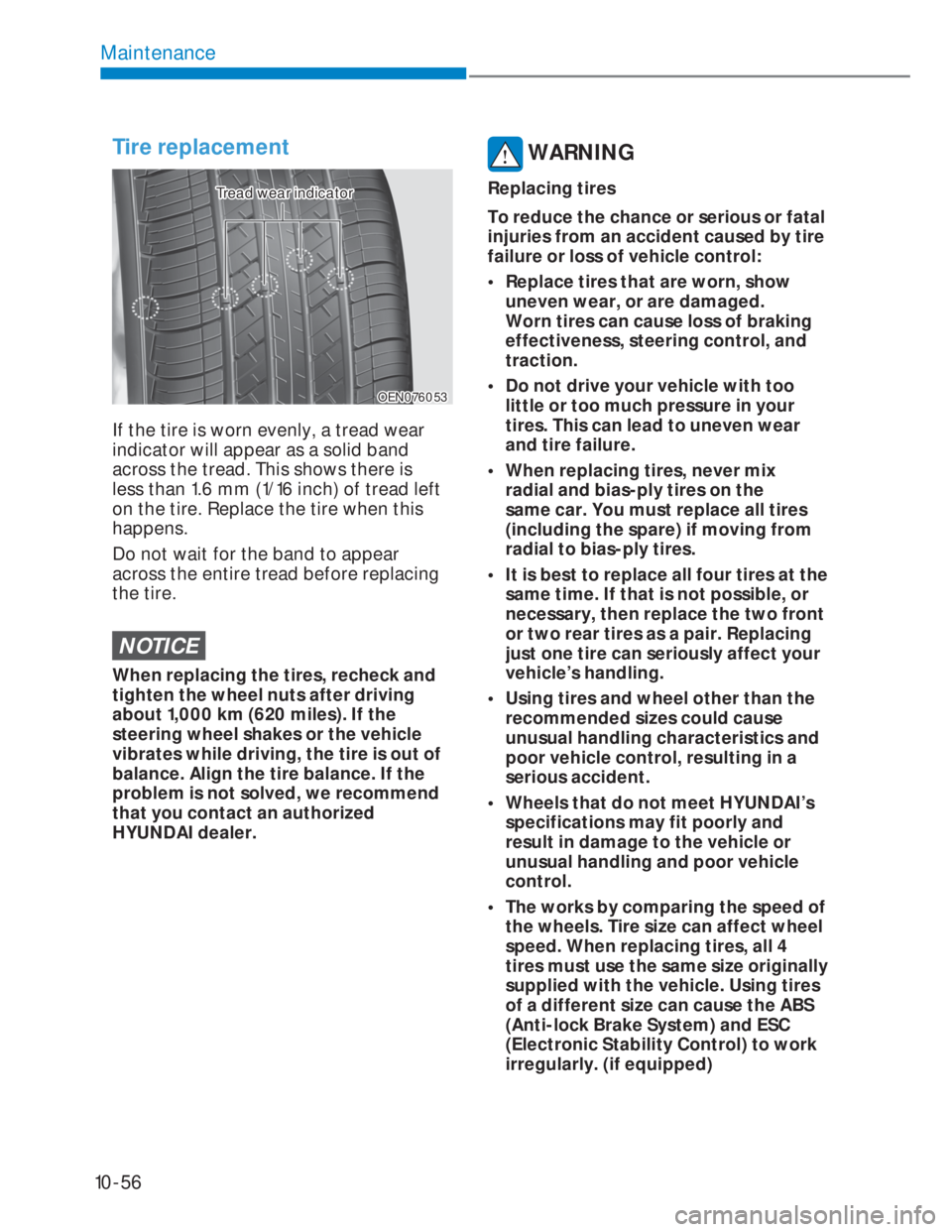
Tread wear indicatorTread wear indicator
If the tire is worn evenly, a tread wear
indicator will appear as a solid band
across the tread. This shows there is
less than 1.6 mm (1/16 inch) of tread left
on the tire. Replace the tire when this
happens.
Do not wait for the band to appear
across the entire tread before replacing
the tire.
NOTICE
When replacing the tires, recheck and
tighten the wheel nuts after driving
about 1,000 km (620 miles). If the
steering wheel shakes or the vehicle
vibrates while driving, the tire is out of
balance. Align the tire balance. If the
problem is not solved, we recommend
that you contact an authorized
HYUNDAI dealer.
WARNING
Replacing tires
To reduce the chance or serious or fatal
injuries from an accident caused by tire
failure or loss of vehicle control:
• Replace tires that are worn, show
uneven wear, or are damaged.
Worn tires can cause loss of braking
effectiveness, steering control, and
traction.
• Do not drive your vehicle with too
little or too much pressure in your
tires. This can lead to uneven wear
and tire failure.
• When replacing tires, never mix
radial and bias-ply tires on the
same car. You must replace all tires
(including the spare) if moving from
radial to bias-ply tires.
• It is best to replace all four tires at the
same time. If that is not possible, or
necessary, then replace the two front
or two rear tires as a pair. Replacing
just one tire can seriously affect your
vehicle’s handling.
• Using tires and wheel other than the
recommended sizes could cause
unusual handling characteristics and
poor vehicle control, resulting in a
serious accident.
• Wheels that do not meet HYUNDAI’s
specifications may fit poorly and
result in damage to the vehicle or
unusual handling and poor vehicle
control.
• The works by comparing the speed of
the wheels. Tire size can affect wheel
speed. When replacing tires, all 4
tires must use the same size originally
supplied with the vehicle. Using tires
of a different size can cause the ABS
(Anti-lock Brake System) and ESC
(Electronic Stability Control) to work
irregularly. (if equipped)
Page 434 of 444
10-95
10
Interior care
Interior general precautions
Prevent chemicals such as perfume,
cosmetic oil, sun cream, hand cleaner,
and air freshener from contacting the
interior parts because they may cause
damage or discoloration. If they do
contact the interior parts, wipe them off
immediately. See the instructions that
follow for the proper way to clean vinyl.
NOTICE
Never allow water or other liquids
to come in contact with electrical/
electronic components inside the
vehicle as this may damage them.
NOTICE
When cleaning leather products
(steering wheel, seats etc.), use neutral
detergents or low alcohol content
solutions. If you use high alcohol
content solutions or acid/alkaline
detergents, the color of the leather may
fade or the surface may get stripped
off.
Cleaning the upholstery and interior
trim
Vinyl (if equipped)
Remove dust and loose dirt from vinyl
with a whisk broom or vacuum cleaner.
Clean vinyl surfaces with a vinyl cleaner.
Fabric (if equipped)
Remove dust and loose dirt from
fabric with a whisk broom or vacuum
cleaner. Clean with a mild soap solution
recommended for upholstery or carpets.
Remove fresh spots immediately with
a fabric spot cleaner. If fresh spots
do not receive immediate attention,
the fabric can be stained and its color
can be affected. Also, its fire-resistant
properties can be reduced if the material
is not properly maintained.
NOTICE
Using anything but recommended
cleaners and procedures may affect the
fabric’s appearance and fire-resistant
properties.