Automatic HYUNDAI I30 2023 Owners Manual
[x] Cancel search | Manufacturer: HYUNDAI, Model Year: 2023, Model line: I30, Model: HYUNDAI I30 2023Pages: 533, PDF Size: 59.13 MB
Page 509 of 533
7-78
Maintenance
High-pressure washing
When using high-pressure washers,
make sure to maintain sufficient dis-
tance from the vehicle.
Insufficient clearance or excessive
pressure can lead to component
damage or water penetration.
Do not spray the camera, sensors or
its surrounding area directly with a
high pressure washer. Shock
applied from high pressure water
may cause the device to not operate
normally.
Do not bring the nozzle tip close to
boots (rubber or plastic covers) or
connectors as they may be dam-
aged if they come into contact with
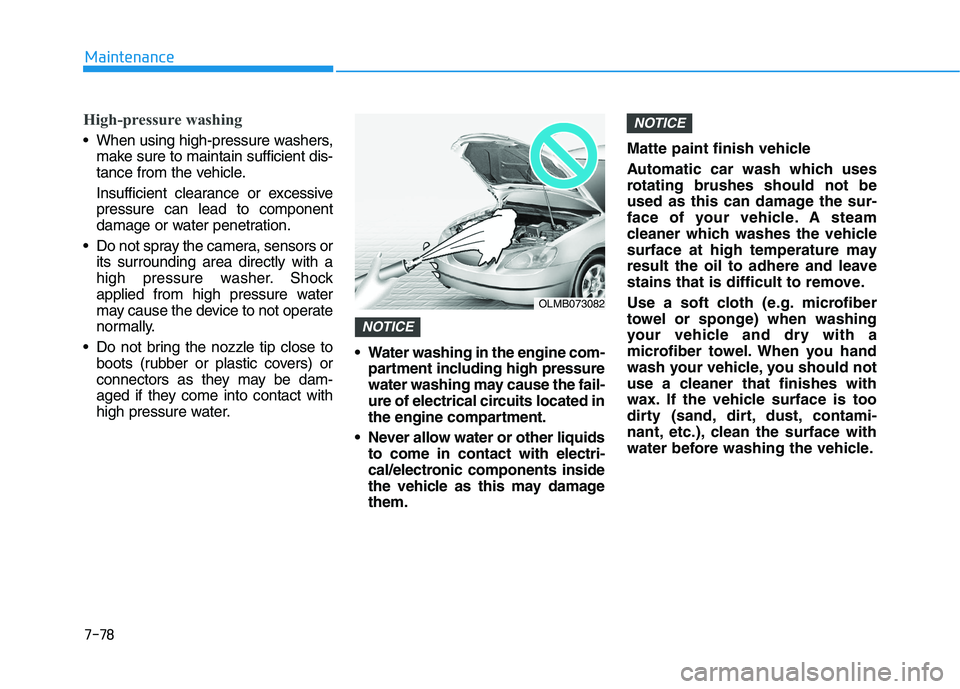
high pressure water. Water washing in the engine com-
partment including high pressure
water washing may cause the fail-
ure of electrical circuits located in
the engine compartment.
Never allow water or other liquids
to come in contact with electri-
cal/electronic components inside
the vehicle as this may damage
them.Matte paint finish vehicle
Automatic car wash which uses
rotating brushes should not be
used as this can damage the sur-
face of your vehicle. A steam
cleaner which washes the vehicle
surface at high temperature may
result the oil to adhere and leave
stains that is difficult to remove.
Use a soft cloth (e.g. microfiber
towel or sponge) when washing
your vehicle and dry with a
microfiber towel. When you hand
wash your vehicle, you should not
use a cleaner that finishes with
wax. If the vehicle surface is too
dirty (sand, dirt, dust, contami-
nant, etc.), clean the surface with
water before washing the vehicle.
NOTICE
NOTICE
OLMB073082
Page 520 of 533
7-89
7
Maintenance
Diesel particulate filter (DPF)
(if equipped)
The Diesel Particulate Filter (DPF)
system removes the soot in the
exhaust gas.
The DPF system automatically burns
(or oxidises) the accumulated soot in
accordance with driving situations,
unlike a disposable air filter.
In other words, the accumulated soot
is automatically purged out by the
engine control system and by the high
exhaust-gas temperature at normal/
high driving speeds.
However, when the vehicle is continu-
ally driven at repeated short distances
or driven at low speed for a long time,
the accumulated soot may not be
automatically removed because of low
exhaust gas temperature. In this case,
the accumulated soot is out of the
detection range, the soot oxidisation
process does not occur, and the
Diesel Particulate Filter (DPF) Lamp
( ) Illuminates.The DPF Lamp stops illuminating,
when the driving speed exceeds 60
km/h, or when the engine rpm is
between 1,500 and 2,500 with the
gear in the 2nd position or above for
approximately 25 minutes.
When the DPF Lamp continuously
blinks or the warning message “Check
exhaust system” illuminates in the
above cases, we recommend that you
have the DPF system checked by an
authorised HYUNDAI dealer.
When the vehicle is continuously driv-
en with the DPF Lamp flashing for an
extended period of time, it may dam-
age the DPF system and lower the
fuel economy.Diesel Fuel
(if equipped with DPF)
We recommend you to use only
the regulated diesel fuels, when
your vehicle is equipped with
the DPF system.
When you use other diesel fuels,
which are high in sulfurs (above
50 ppm) or that contain unspeci-
fied additives, they may damage
the DPF system and cause white
smoke emissions.
CAUTION
Page 527 of 533
8-6
Specifications & Consumer information
A AI
IR
R
C
CO
ON
ND
DI
IT
TI
IO
ON
NI
IN
NG
G
S
SY
YS
ST
TE
EM
M
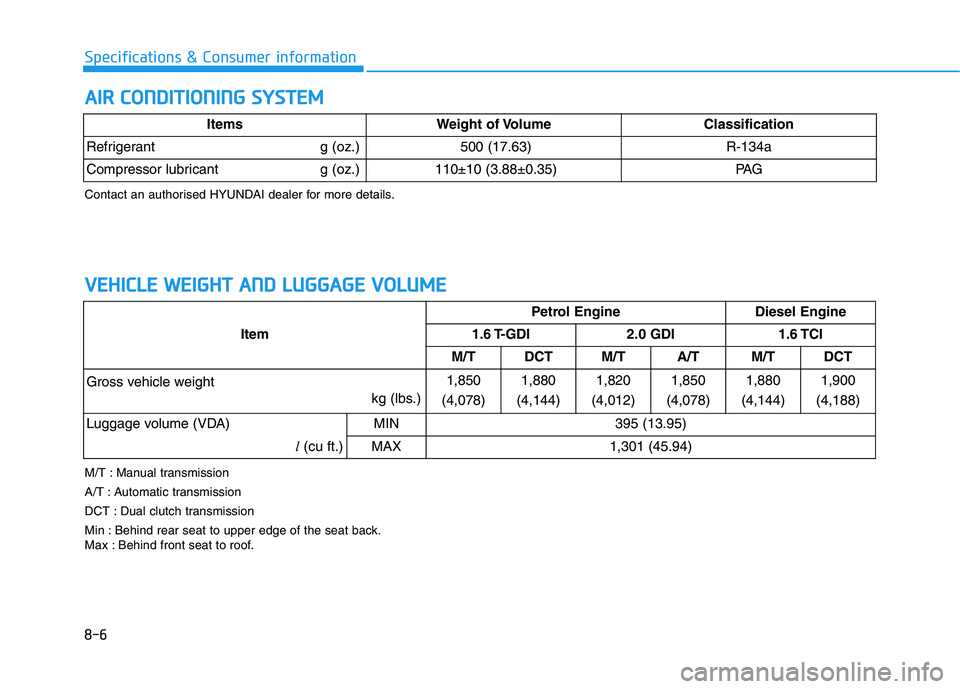
ItemPetrol Engine Diesel Engine
1.6 T-GDI 2.0 GDI 1.6 TCI
M/T DCT M/T A/T M/T DCT
Gross vehicle weight
kg (lbs.)1,850
(4,078)1,880
(4,144)1,820
(4,012)1,850
(4,078)1,880
(4,144)1,900
(4,188)
Luggage volume (VDA)
l(cu ft.)MIN 395 (13.95)
MAX 1,301 (45.94)
V VE
EH
HI
IC
CL
LE
E
W
WE
EI
IG
GH
HT
T
A
AN
ND
D
L
LU
UG
GG
GA
AG
GE
E
V
VO
OL
LU
UM
ME
E
ItemsWeight of Volume Classification
Refrigerant g (oz.)500 (17.63)R-134a
Compressor lubricant g (oz.)110±10 (3.88±0.35)PA G
Contact an authorised HYUNDAI dealer for more details.
M/T : Manual transmission
A/T : Automatic transmission
DCT : Dual clutch transmission
Min : Behind rear seat to upper edge of the seat back.
Max : Behind front seat to roof.
Page 528 of 533
8-7
Specifications & Consumer information
R RE
EC
CO
OM
MM
ME
EN
ND
DE
ED
D
L
LU
UB
BR
RI
IC
CA
AN
NT
TS
S
A
AN
ND
D
C
CA
AP
PA
AC
CI
IT
TI
IE
ES
S
To help achieve proper engine and powertrain performance and durability, use only lubricants of the proper quality.
The correct lubricants also help promote engine efficiency that results in improved fuel economy.
These lubricants and fluids are recommended for use in your vehicle.
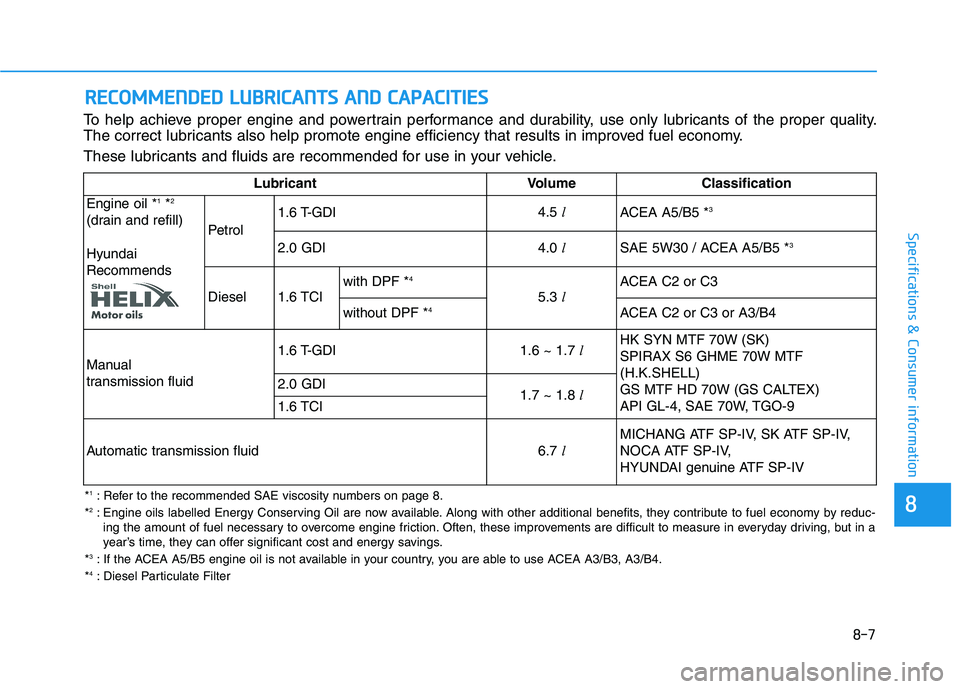
Lubricant Volume Classification
Engine oil *
1*2
(drain and refill)
Hyundai
RecommendsPetrol1.6 T-GDI4.5 l
ACEA A5/B5 *3
2.0 GDI4.0 l
SAE 5W30 / ACEA A5/B5 *3
Diesel 1.6 TCIwith DPF *
4
5.3 lACEA C2 or C3
without DPF *4ACEA C2 or C3 or A3/B4
Manual
transmission fluid1.6 T-GDI1.6 ~ 1.7 lHK SYN MTF 70W (SK)
SPIRAX S6 GHME 70W MTF
(H.K.SHELL)
GS MTF HD 70W (GS CALTEX)
API GL-4, SAE 70W, TGO-9 2.0 GDI
1.7 ~ 1.8 l
1.6 TCI
Automatic transmission fluid6.7 lMICHANG ATF SP-IV, SK ATF SP-IV,
NOCA ATF SP-IV,
HYUNDAI genuine ATF SP-IV
8*1: Refer to the recommended SAE viscosity numbers on page 8.
*2: Engine oils labelled Energy Conserving Oil are now available. Along with other additional benefits, they contribute to fuel economy by reduc-
ing the amount of fuel necessary to overcome engine friction. Often, these improvements are difficult to measure in everyday driving, but in a
year’s time, they can offer significant cost and energy savings.
*
3: If the ACEA A5/B5 engine oil is not available in your country, you are able to use ACEA A3/B3, A3/B4.
*4: Diesel Particulate Filter