climate control HYUNDAI IONIQ 5 2023 Owner's Guide
[x] Cancel search | Manufacturer: HYUNDAI, Model Year: 2023, Model line: IONIQ 5, Model: HYUNDAI IONIQ 5 2023Pages: 680, PDF Size: 48.22 MB
Page 622 of 680
09
9-21
WARNING
Always follow these instructions when
recharging your vehicle’s battery to
avoid the risk of SERIOUS INJURY or
DEATH from explosions or acid burns: • Before performing maintenance or
recharging the battery, turn off all
accessories and stop the vehicle.
• Keep all flames, sparks, or smoking
materials away from the battery.
• Always work outdoors or in an area
with plenty of ventilation.
• Wear eye protection when checking
the battery during charging.
• The battery must be removed from
the vehicle and placed in a well
ventilated area.
• Watch the battery during charging,
and stop or reduce the charging
rate if the battery cells begin boiling
violently.
• The negative battery cable must
be removed first and installed last
when the battery is disconnected.
Disconnect the battery charger in the
following order:
1. Turn off the battery charger main
switch.
2. Unhook the negative clamp from the negative battery terminal.
3. Unhook the positive clamp from the positive battery terminal.
• Use batteries for replacement from
an authorized HYUNDAI dealer. By jump starting
After a jump start from a good battery,
drive the vehicle for 20-30 minutes
before it is shutoff. The vehicle may
not restart if you shut it off before the
battery had a chance to adequately
recharge. See “Jump Starting” in chapter
8 for more information on jump starting
procedures.
Information
An inappropriately disposed battery can be harmful to the
environment and human health. Dispose of the battery according
to your local law(s) or regulation.
Reset Items
The following items may need to be reset
after the battery has been discharged or
the battery has been disconnected. •
Driving info/After recharging/
Accumulated info (items in Utility
view) (see chapter 4)
• Integrated memory system (see
chapter 5)
• Power window (see chapter 5)
• Vision roof (see chapter 5)
• Power liftgate (see chapter 5)
• Climate control system (see chapter 5)
• Clock (see Infotainment system manual)
• Infotainment system (see
Infotainment system manual)
Page 626 of 680
09
9-25
Wheel Alignment and Tire
Balance
The wheels on your vehicle were aligned
and balanced carefully at the factory to
give you the longest tire life and best
overall performance.
In most cases, you will not need to have
your wheels aligned again. However,
if you notice unusual tire wear or your
vehicle pulling one way or the other, the
alignment may need to be reset.
If you notice your vehicle vibrating when
driving on a smooth road, your wheels
may need to be rebalanced.
NOTICE
Incorrect wheel weights can damage
your vehicle’s aluminum wheels. Use
only approved wheel weights.
Tire Replacement
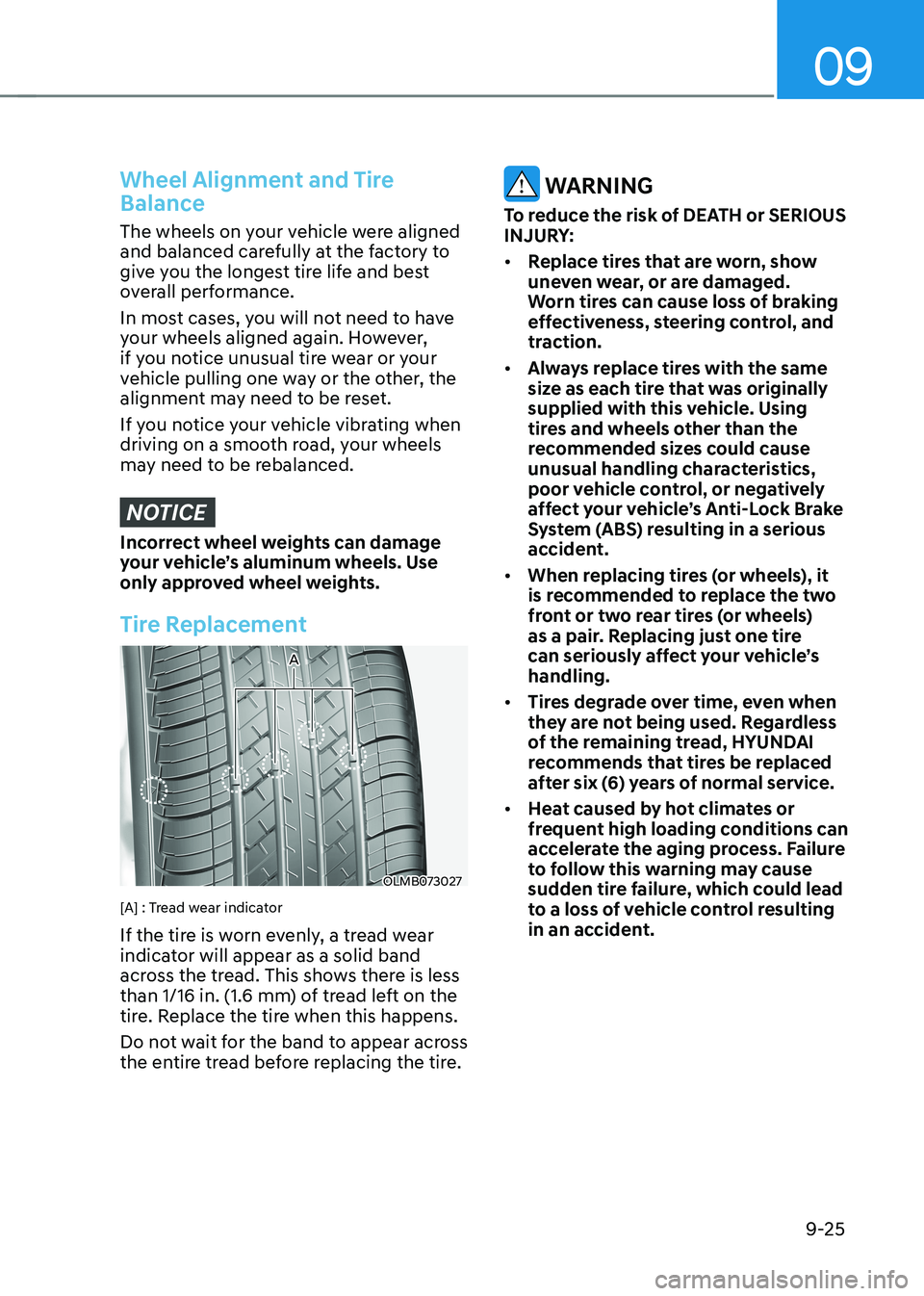
OLMB073027
A
[A] : Tread wear indicator
If the tire is worn evenly, a tread wear
indicator will appear as a solid band
across the tread. This shows there is less
than 1/16 in. (1.6 mm) of tread left on the
tire. Replace the tire when this happens.
Do not wait for the band to appear across
the entire tread before replacing the tire.
WARNING
To reduce the risk of DEATH or SERIOUS
INJURY: • Replace tires that are worn, show
uneven wear, or are damaged.
Worn tires can cause loss of braking
effectiveness, steering control, and
traction.
• Always replace tires with the same
size as each tire that was originally
supplied with this vehicle. Using
tires and wheels other than the
recommended sizes could cause
unusual handling characteristics,
poor vehicle control, or negatively
affect your vehicle’s Anti-Lock Brake
System (ABS) resulting in a serious
accident.
• When replacing tires (or wheels), it
is recommended to replace the two
front or two rear tires (or wheels)
as a pair. Replacing just one tire
can seriously affect your vehicle’s handling.
• Tires degrade over time, even when
they are not being used. Regardless
of the remaining tread, HYUNDAI
recommends that tires be replaced
after six (6) years of normal service.
• Heat caused by hot climates or
frequent high loading conditions can
accelerate the aging process. Failure
to follow this warning may cause
sudden tire failure, which could lead
to a loss of vehicle control resulting
in an accident.
Page 629 of 680
Maintenance
9-28
4. Tire ply composition and material
The number of layers or plies of
rubber-coated fabric in the tire. Tire
manufacturers also must indicate the
materials in the tire, which include steel,
nylon, polyester, and others. The letter
“R” means radial ply construction; the
letter “D“ means diagonal or bias ply
construction; and the letter “B” means
belted-bias ply construction.
5. Maximum permissible inflation
pressure
This number is the greatest amount
of air pressure that should be put in
the tire. Do not exceed the maximum
permissible inflation pressure. Refer to
the Tire and Loading Information label
for recommended inflation pressure.
6. Maximum load rating
This number indicates the maximum
load in kilograms and pounds that can be
carried by the tire. When replacing the
tires on the vehicle, always use a tire that
has the same load rating as the factory
installed tire.
7. Uniform tire quality grading
Quality grades can be found where
applicable on the tire sidewall between
tread shoulder and maximum section width.
For example:
TREADWEAR 200
TRACTION AA
TEMPERATURE A
Tread wear
The tread wear grade is a comparative
rating based on the wear rate of the tire
when tested under controlled conditions
on a specified government test course.
For example, a tire graded 150 would
wear one-and-a-half times (1½) as well
on the government course as a tire
graded 100.
The relative performance of tires depends upon the actual conditions
of their use, however, and may depart
significantly from the norm due to
variations in driving habits, service
practices and differences in road
characteristics and climate.
These grades are molded on the
sidewalls of passenger vehicle tires. The
tires available as standard or optional
equipment on your vehicle may vary with
respect to grade.
Traction - AA, A, B & C
The traction grades, from highest to
lowest, are AA, A, B and C. Those grades
represent the tire’s ability to stop on wet
pavement as measured under controlled
conditions on specified government
test surfaces of asphalt and concrete.
A tire marked C may have poor traction
performance.
WARNING
The traction grade assigned to this
tire is based on straight ahead braking
traction tests, and does not include
acceleration, cornering, hydroplaning,
or peak traction characteristics.
Page 667 of 680
Index
I-2
A
Accessing Your Vehicle ......................................................................................... 5-4
Hyundai Digital Key ....................................................................................... 5-15
Immobilizer System ......................................................................................... 5-14
Smart Key ........................................................................................................... 5-4
Active Air Flap .................................................................................................... 6-52
Malfunction ...................................................................................................... 6-52
Air Bag - Supplemental Restraint System ...........................................................3-49
Additional Safety Precautions .......................................................................... 3-71
Air Bag Warning Labels ................................................................................... 3-71
How does the Air Bags System Operate? .........................................................3-54
Occupant Classification System (OCS) ...........................................................3-59
SRS Care .......................................................................................................... 3-70
What to Expect After an Air Bag Inflates ........................................................3-58
Where are the Air Bags? ................................................................................... 3-51
Why didn’t my air bag go off in a collision? ...................................................3-65
Air Conditioner Compressor Label ..................................................................... 2-15
Air Conditioning System ..................................................................................... 2-11
All Wheel Drive (AWD) ..................................................................................... 6-43
Emergency Precautions .................................................................................... 6-45
Appearance care................................................................................................... 9-56
Exterior Care .................................................................................................... 9-56
Interior Care ..................................................................................................... 9-61
Augmented Reality HUD .................................................................................... 5-82
Head-up display Information ........................................................................... 5-83
Head-up display Settings .................................................................................. 5-82
Precautions while Using the Head-up display ..................................................5-84
Automatic Climate Control System ..................................................................... 5-99
Automatic Temperature Control Mode ..........................................................5-100
Climate ........................................................................................................... 5-100
Manual Temperature Control Mode ............................................................... 5-102
System Maintenance ...................................................................................... 5-111
System Operation ........................................................................................... 5-110
Available Front Trunk Weight ............................................................................. 2-11
Page 669 of 680
Index
I-4
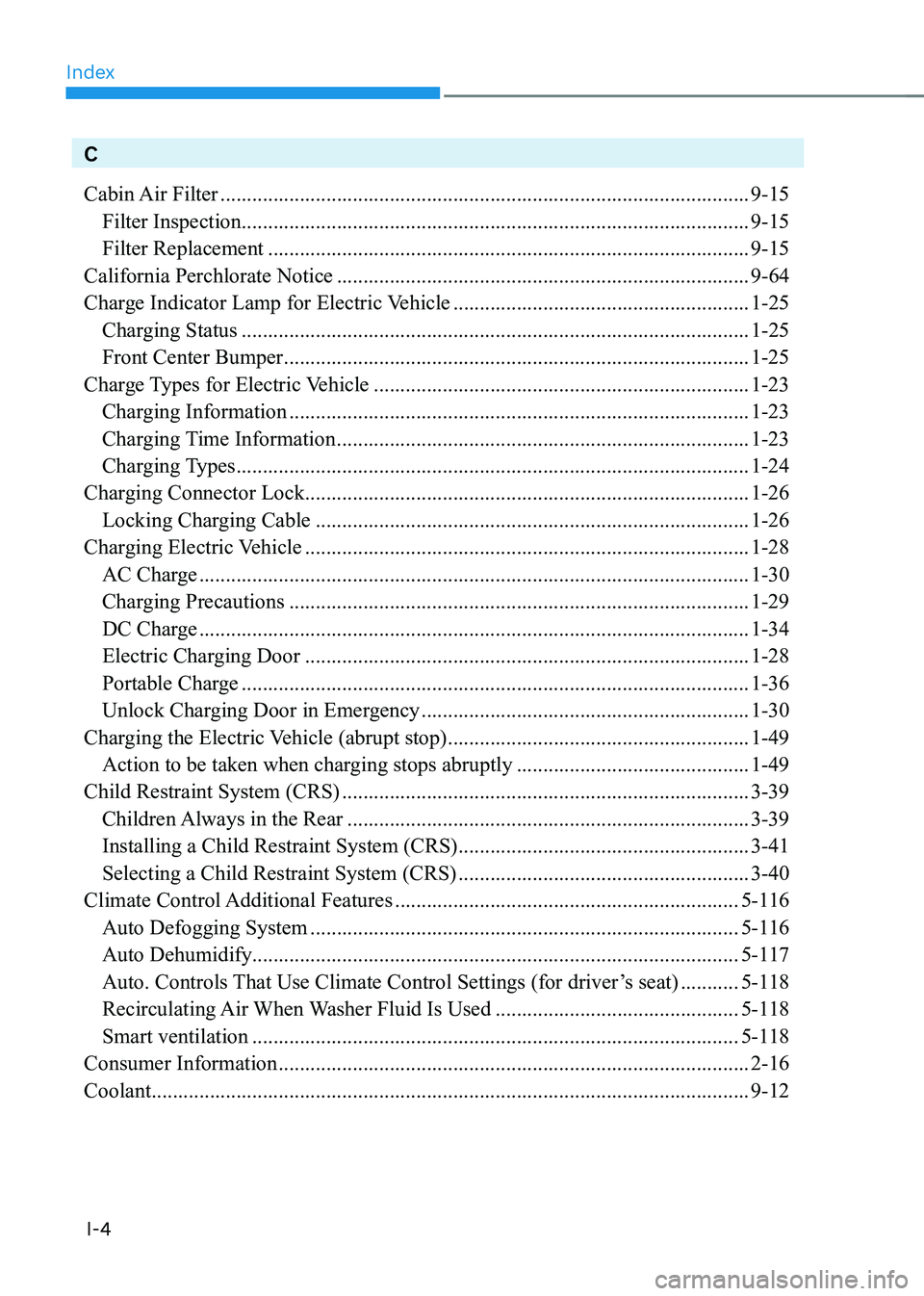
C
Cabin Air Filter .................................................................................................... 9-15
Filter Inspection ................................................................................................ 9-15
Filter Replacement ........................................................................................... 9-15
California Perchlorate Notice .............................................................................. 9-64
Charge Indicator Lamp for Electric Vehicle ........................................................1-25
Charging Status ................................................................................................ 1-25
Front Center Bumper ........................................................................................ 1-25
Charge Types for Electric Vehicle ....................................................................... 1-23
Charging Information ....................................................................................... 1-23
Charging Time Information .............................................................................. 1-23
Charging Types ................................................................................................. 1-24
Charging Connector Lock .................................................................................... 1-26
Locking Charging Cable .................................................................................. 1-26
Charging Electric Vehicle .................................................................................... 1-28
AC Charge ........................................................................................................ 1-30
Charging Precautions ....................................................................................... 1-29
DC Charge ........................................................................................................ 1-34
Electric Charging Door .................................................................................... 1-28
Portable Charge ................................................................................................ 1-36
Unlock Charging Door in Emergency ..............................................................1-30
Charging the Electric Vehicle (abrupt stop) .........................................................1-49
Action to be taken when charging stops abruptly ............................................1-49
Child Restraint System (CRS) ............................................................................. 3-39
Children Always in the Rear ............................................................................ 3-39
Installing a Child Restraint System (CRS) .......................................................3-41
Selecting a Child Restraint System (CRS) .......................................................3-40
Climate Control Additional Features ................................................................. 5-116
Auto Defogging System ................................................................................. 5-116
Auto Dehumidify ............................................................................................ 5-117
Auto. Controls That Use Climate Control Settings (for driver’s seat) ...........5-118
Recirculating Air When Washer Fluid Is Used ..............................................5-118
Smart ventilation ............................................................................................ 5-118
Consumer Information ......................................................................................... 2-16
Coolant ................................................................................................................. 9-12