Hev Hyundai Ioniq Hybrid 2017 Owner's Manual
[x] Cancel search | Manufacturer: HYUNDAI, Model Year: 2017, Model line: Ioniq Hybrid, Model: Hyundai Ioniq Hybrid 2017Pages: 553, PDF Size: 59.51 MB
Page 16 of 553
HEV (Hybrid electric vehicle) system ....................2
IONIQ HEV energy flow.............................................3Energy flow ...........................................................................3
Driving the hybrid vehicle .......................................7 Starting the vehicle ...............................................................7
Special features of hybrid vehicle ....................................8
Safety precautions for hybrid system .................10 Hybrid vehicle components safety precautions .........10
Safety Plug............................................................................13
Hybrid battery air intake ..................................................13
If an accident occurs ..........................................................14
When the hybrid vehicle shuts off .................................15
HH yybbrriidd ss yy ssttee mm oo vvee rrvv iiee ww
Page 17 of 553
H2
HHEEVV (( HH YY BBRRIIDD EE LLEE CCTT RR IICC VV EEHH IICC LLEE )) SS YY SSTT EEMM
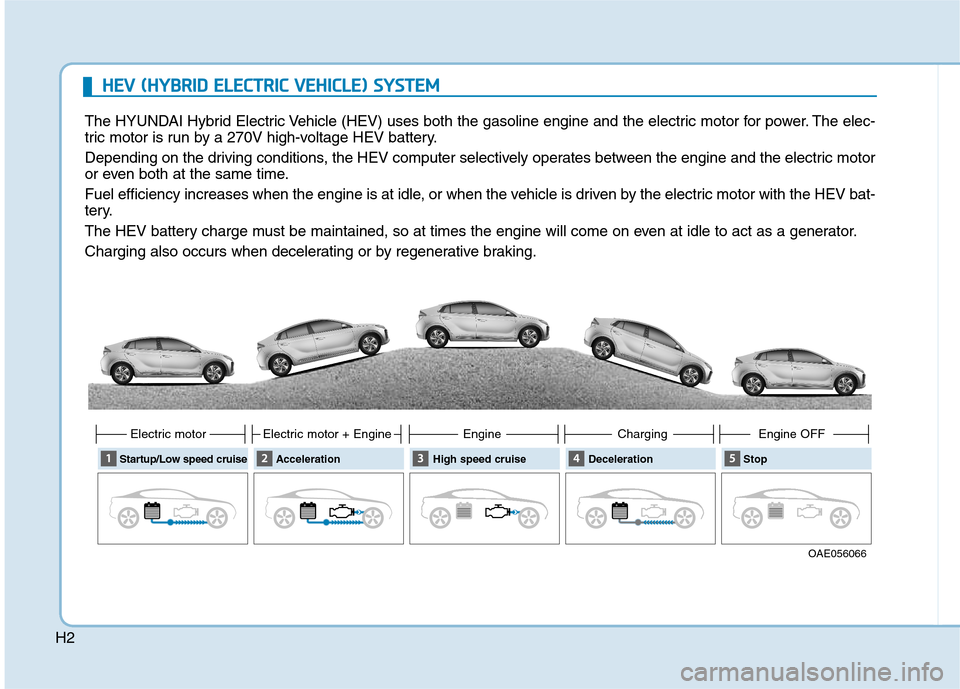
The HYUNDAI Hybrid Electric Vehicle (HEV) uses both the gasoline engine and the electric motor for power. The elec-
tric motor is run by a 270V high-voltage HEV battery.
Depending on the driving conditions, the HEV computer selectively operates between the engine and the electric motor
or even both at the same time.
Fuel efficiency increases when the engine is at idle, or when the vehicle is driven by the electric motor with the HEV bat-
tery.
The HEV battery charge must be maintained, so at times the engine will come on even at idle to act as a generator.
Charging also occurs when decelerating or by regenerative braking.
OAE056066
Startup/Low speed cruise
Electric motor
AccelerationElectric motor + Engine High speed cruiseEngineDecelerationCharging Stop Engine OFF
Page 192 of 553
3-90
Convenient features of your vehicle
Driving style
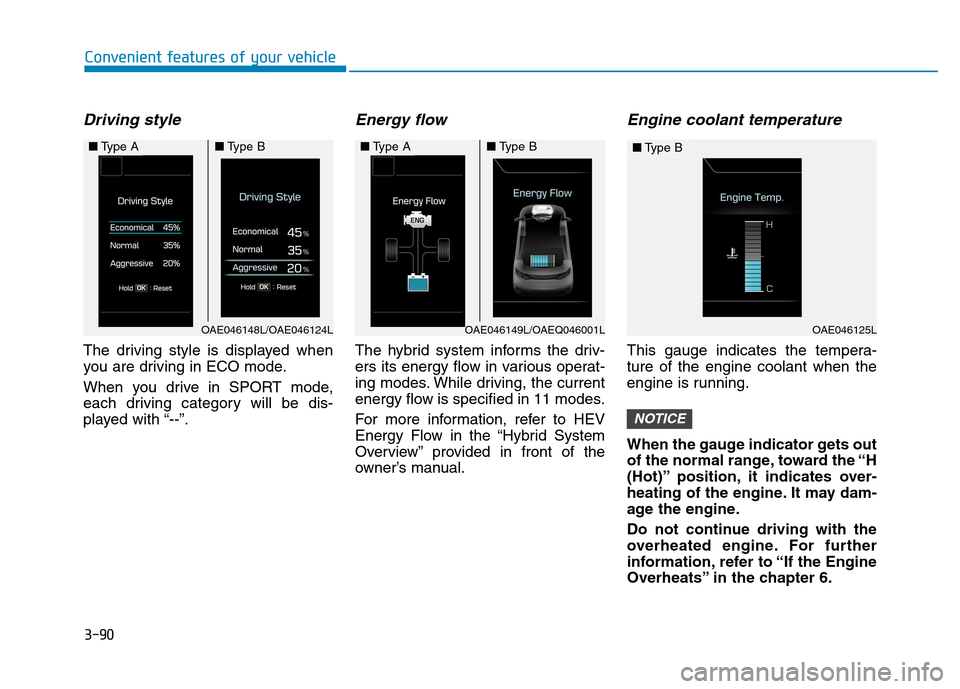
The driving style is displayed when
you are driving in ECO mode.
When you drive in SPORT mode,
each driving category will be dis-
played with “--”.
Energy flow
The hybrid system informs the driv-
ers its energy flow in various operat-
ing modes. While driving, the current
energy flow is specified in 11 modes.
For more information, refer to HEV
Energy Flow in the “Hybrid System
Overview” provided in front of the
owner’s manual.
Engine coolant temperature
This gauge indicates the tempera-ture of the engine coolant when the
engine is running.
When the gauge indicator gets out
of the normal range, toward the “H
(Hot)” position, it indicates over-
heating of the engine. It may dam-
age the engine.
Do not continue driving with the
overheated engine. For further
information, refer to “If the Engine
Overheats” in the chapter 6.
NOTICE
OAE046148L/OAE046124L
■Type A■Type B■Type A■Type B
OAE046125L
■Type B
OAE046149L/OAEQ046001L
Page 380 of 553
5-96
Driving your vehicle
Tire chains
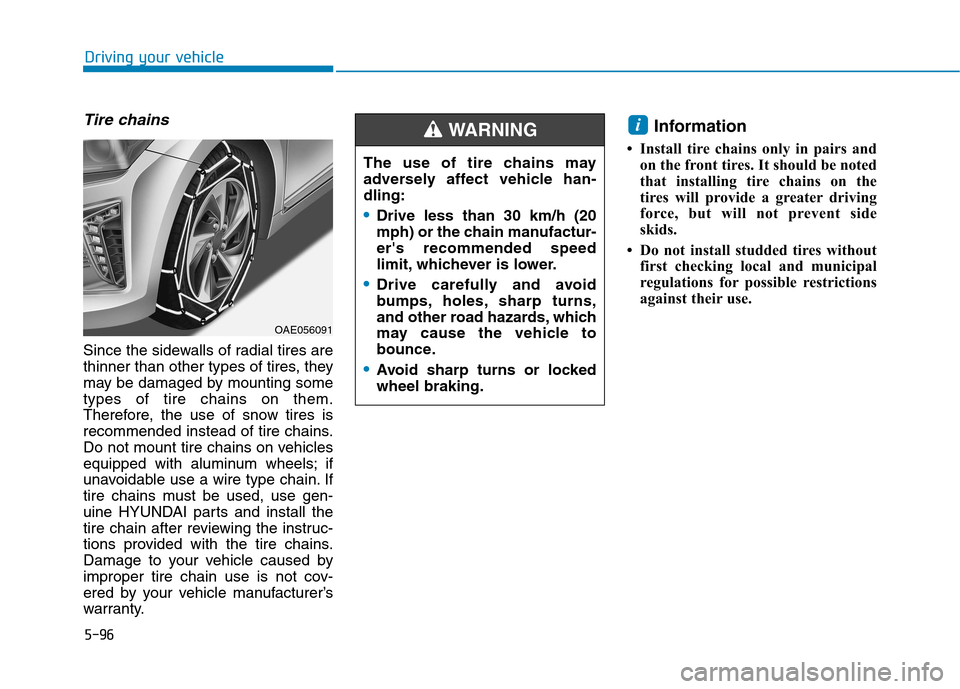
Since the sidewalls of radial tires are
thinner than other types of tires, they
may be damaged by mounting sometypes of tire chains on them.
Therefore, the use of snow tires is
recommended instead of tire chains.
Do not mount tire chains on vehicles
equipped with aluminum wheels; if
unavoidable use a wire type chain. If
tire chains must be used, use gen-
uine HYUNDAI parts and install the
tire chain after reviewing the instruc-
tions provided with the tire chains.
Damage to your vehicle caused by
improper tire chain use is not cov-
ered by your vehicle manufacturer’s
warranty.Information
Install tire chains only in pairs and on the front tires. It should be noted
that installing tire chains on the
tires will provide a greater driving
force, but will not prevent side
skids.
Do not install studded tires without first checking local and municipal
regulations for possible restrictions
against their use.
i
OAE056091 The use of tire chains may
adversely affect vehicle han-dling:
Drive less than 30 km/h (20
mph) or the chain manufactur-er's recommended speed
limit, whichever is lower.
Drive carefully and avoid
bumps, holes, sharp turns,
and other road hazards, which
may cause the vehicle to
bounce.
Avoid sharp turns or locked wheel braking.
WARNING
Page 429 of 553
7-8
Maintenance
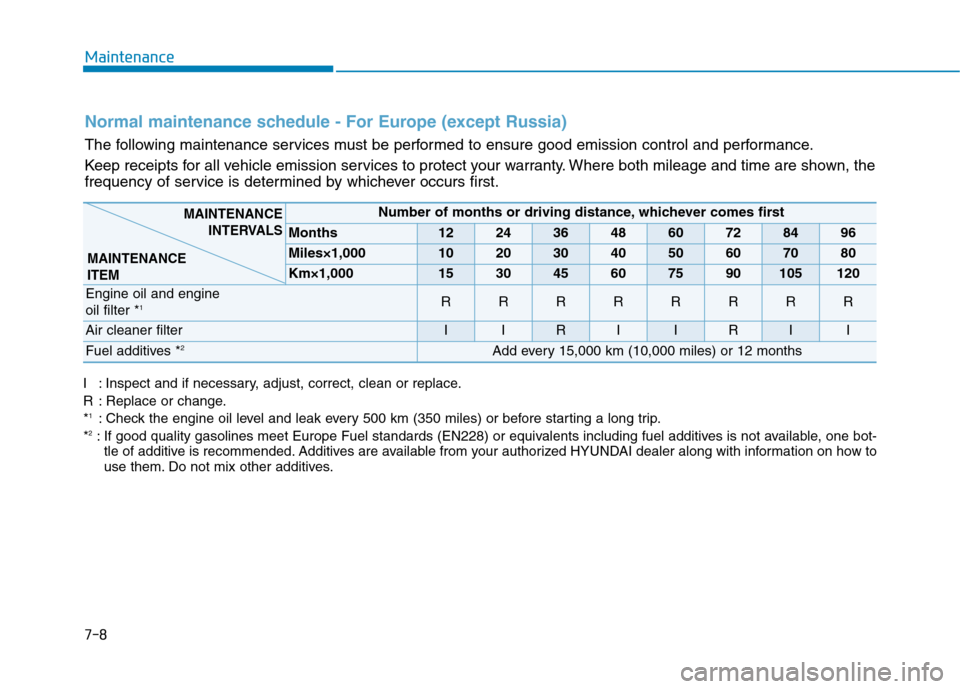
I : Inspect and if necessary, adjust, correct, clean or replace.
R : Replace or change.*1
: Check the engine oil level and leak every 500 km (350 miles) or before starting a long trip.
* 2
: If good quality gasolines meet Europe Fuel standards (EN228) or equivalents including fuel additives is not available, one bot -
tle of additive is recommended. Additives are available from your authorized HYUNDAI dealer along with information on how to
use them. Do not mix other additives.
Normal maintenance schedule - For Europe (except Russia)
The following maintenance services must be performed to ensure good emission control and performance.
Keep receipts for all vehicle emission services to protect your warranty. Where both mileage and time are shown, the
frequency of service is determined by whichever occurs first.
Number of months or driving distance, whichever comes first
Months1224364860728496
Miles×1,0001020304050607080
Km×1,000153045607590105120
Engine oil and engine oil filter * 1RRRRRRRR
Air cleaner filterIIRIIRII
Fuel additives * 2Add every 15,000 km (10,000 miles) or 12 months
MAINTENANCE
INTERVALS
MAINTENANCE ITEM
Page 430 of 553
7-9
7
Maintenance
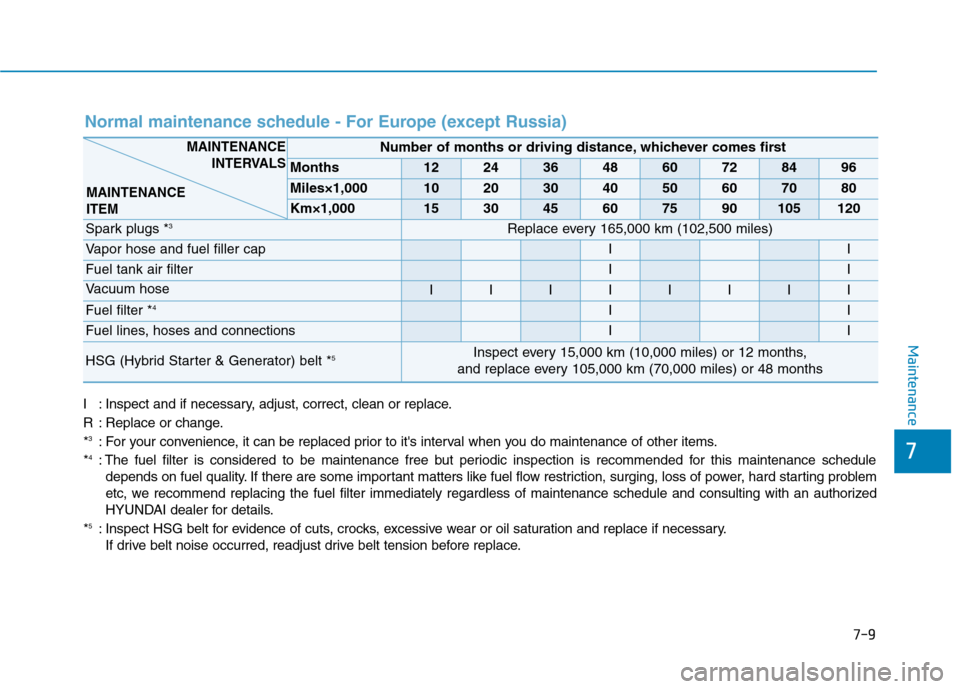
Normal maintenance schedule - For Europe (except Russia)
I : Inspect and if necessary, adjust, correct, clean or replace.
R : Replace or change.*3
: For your convenience, it can be replaced prior to it's interval when you do maintenance of other items.
* 4
: The fuel filter is considered to be maintenance free but periodic inspection is recommended for this maintenance schedule
depends on fuel quality. If there are some important matters like fuel flow restriction, surging, loss of power, hard starting p roblem
etc, we recommend replacing the fuel filter immediately regardless of maintenance schedule and consulting with an authorized
HYUNDAI dealer for details.
* 5
: Inspect HSG belt for evidence of cuts, crocks, excessive wear or oil saturation and replace if necessary.
If drive belt noise occurred, readjust drive belt tension before replace.
Number of months or driving distance, whichever comes first
Months1224364860728496
Miles×1,0001020304050607080
Km×1,000153045607590105120
Spark plugs * 3Replace every 165,000 km (102,500 miles)
Vapor hose and fuel filler capII
Fuel tank air filterII
Vacuum hoseIIIIIIII
Fuel filter *4II
Fuel lines, hoses and connectionsII
HSG (Hybrid Starter & Generator) belt * 5Inspect every 15,000 km (10,000 miles) or 12 months,
and replace every 105,000 km (70,000 miles) or 48 months
MAINTENANCE INTERVALS
MAINTENANCE ITEM
Page 431 of 553
7-10
Maintenance
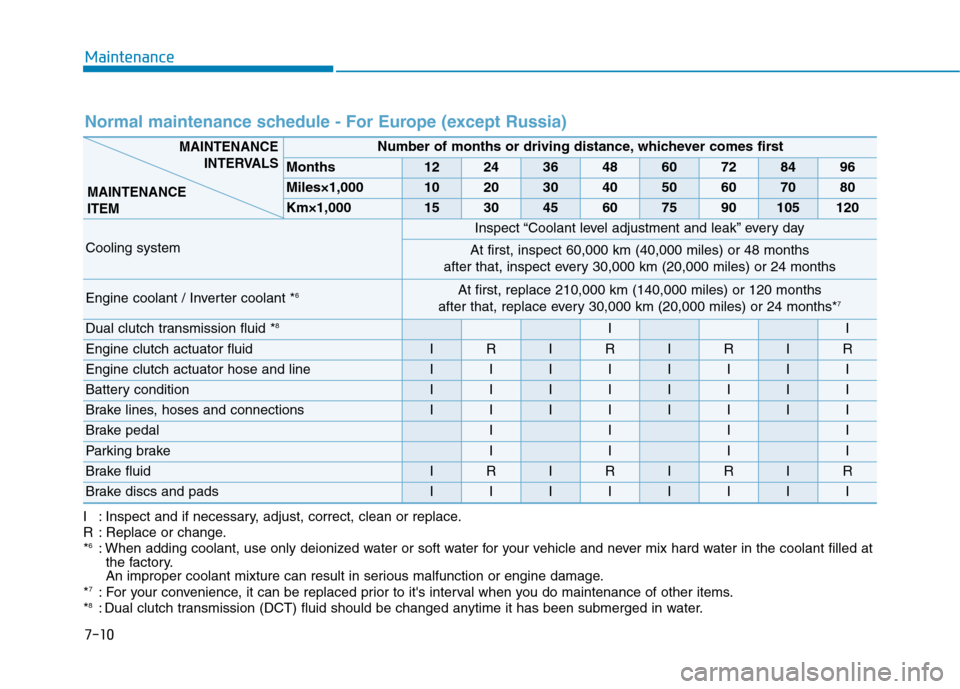
Normal maintenance schedule - For Europe (except Russia)
I : Inspect and if necessary, adjust, correct, clean or replace.
R : Replace or change.*6
: When adding coolant, use only deionized water or soft water for your vehicle and never mix hard water in the coolant filled at
the factory.
An improper coolant mixture can result in serious malfunction or engine damage.
* 7
: For your convenience, it can be replaced prior to it's interval when you do maintenance of other items.
* 8
: Dual clutch transmission (DCT) fluid should be changed anytime it has been submerged in water.
Number of months or driving distance, whichever comes first
Months1224364860728496
Miles×1,0001020304050607080
Km×1,000153045607590105120
Cooling system
Inspect “Coolant level adjustment and leak” every day
At first, inspect 60,000 km (40,000 miles) or 48 months
after that, inspect every 30,000 km (20,000 miles) or 24 months
Engine coolant / Inverter coolant * 6 At first, replace 210,000 km (140,000 miles) or 120 months
after that, replace every 30,000 km (20,000 miles) or 24 months* 7
Dual clutch transmission fluid *8II
Engine clutch actuator fluidIRIRIRIR
Engine clutch actuator hose and lineIIIIIIII
Battery conditionIIIIIIII
Brake lines, hoses and connectionsIIIIIIII
Brake pedalIIII
Parking brakeIIII
Brake fluidIRIRIRIR
Brake discs and padsIIIIIIII
MAINTENANCE
INTERVALS
MAINTENANCE ITEM
Page 432 of 553
7-11
7
Maintenance
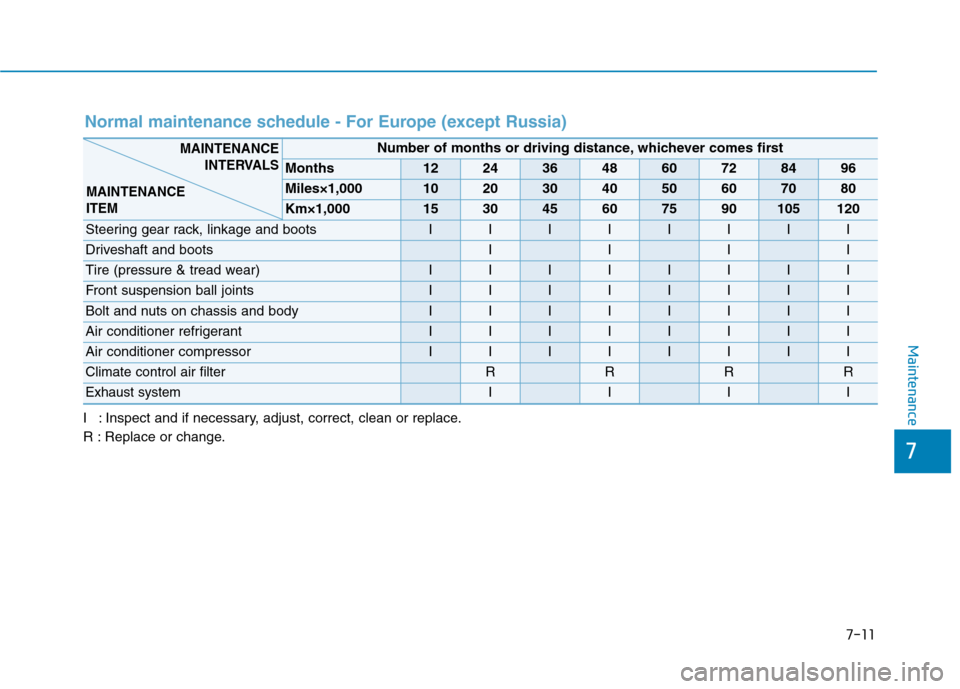
Normal maintenance schedule - For Europe (except Russia)
I : Inspect and if necessary, adjust, correct, clean or replace.
R : Replace or change.
Number of months or driving distance, whichever comes first
Months1224364860728496
Miles×1,0001020304050607080
Km×1,000153045607590105120
Steering gear rack, linkage and bootsIIIIIIII
Driveshaft and bootsIIII
Tire (pressure & tread wear) IIIIIIII
Front suspension ball jointsIIIIIIII
Bolt and nuts on chassis and bodyIIIIIIII
Air conditioner refrigerant IIIIIIII
Air conditioner compressorIIIIIIII
Climate control air filterRRRR
Exhaust systemIIII
MAINTENANCEINTERVALS
MAINTENANCE ITEM
Page 435 of 553
7-14
Maintenance
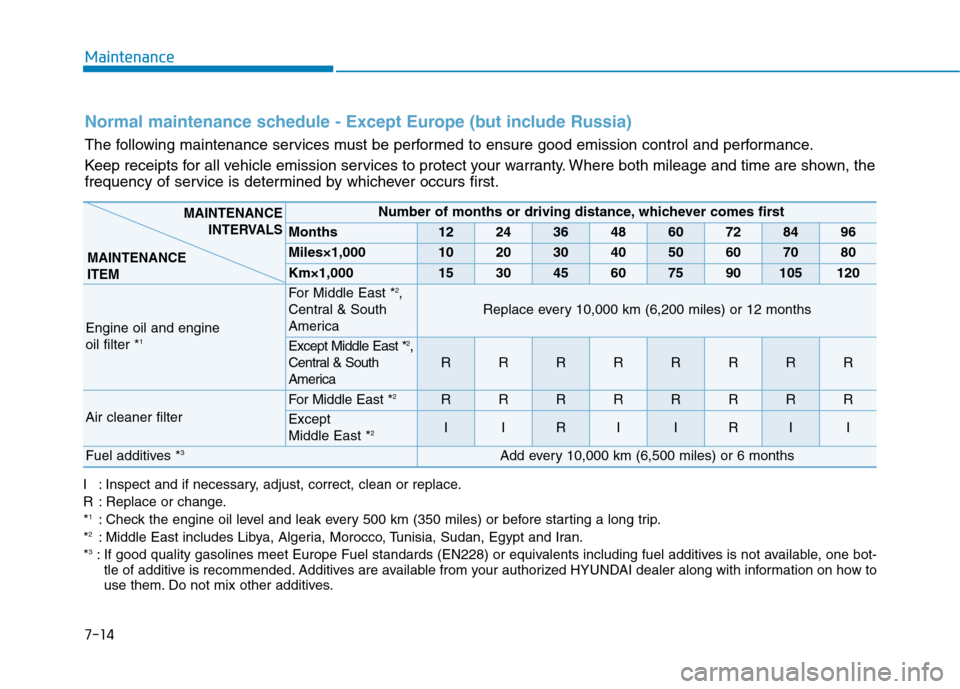
Normal maintenance schedule - Except Europe (but include Russia)
The following maintenance services must be performed to ensure good emission control and performance.
Keep receipts for all vehicle emission services to protect your warranty. Where both mileage and time are shown, the
frequency of service is determined by whichever occurs first.
Number of months or driving distance, whichever comes first
Months1224364860728496
Miles×1,0001020304050607080
Km×1,000153045607590105120
Engine oil and engine oil filter *1
For Middle East * 2
,
Central & South
America
Replace every 10,000 km (6,200 miles) or 12 months
Except Middle East * 2
,
Central & South
America
RRRRRRRR
Air cleaner filter
For Middle East * 2RRRRRRRR
Except Middle East *2IIRIIRII
Fuel additives * 3Add every 10,000 km (6,500 miles) or 6 months
MAINTENANCE
INTERVALS
MAINTENANCE ITEM
I : Inspect and if necessary, adjust, correct, clean or replace.
R : Replace or change.* 1
: Check the engine oil level and leak every 500 km (350 miles) or before starting a long trip.
* 2
: Middle East includes Libya, Algeria, Morocco, Tunisia, Sudan, Egypt and Iran.
* 3
: If good quality gasolines meet Europe Fuel standards (EN228) or equivalents including fuel additives is not available, one bot -
tle of additive is recommended. Additives are available from your authorized HYUNDAI dealer along with information on how to
use them. Do not mix other additives.
Page 436 of 553
7-15
7
Maintenance
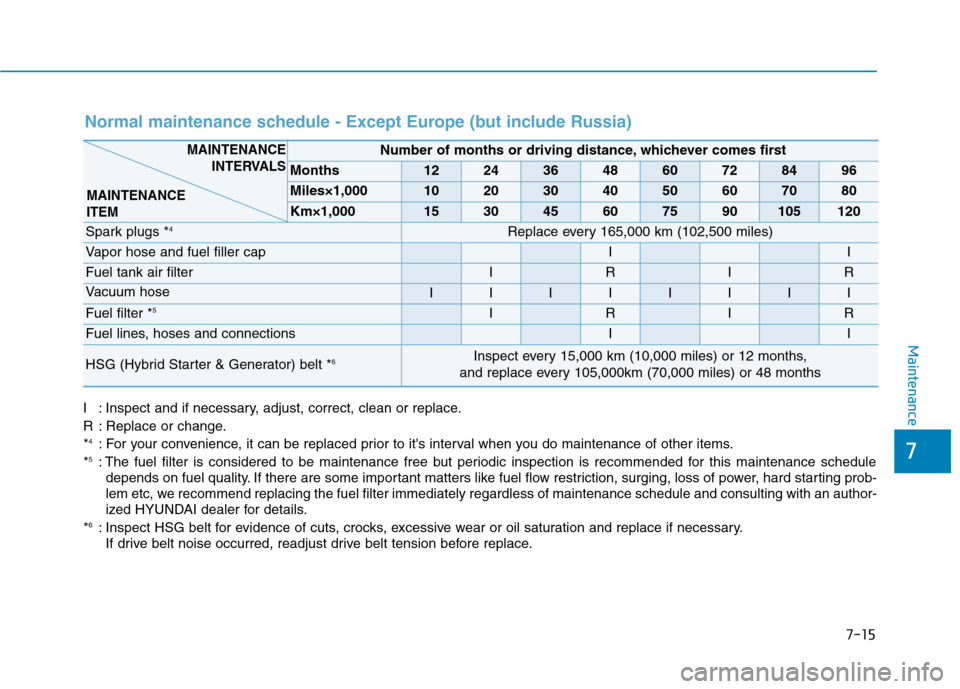
Normal maintenance schedule - Except Europe (but include Russia)
Number of months or driving distance, whichever comes first
Months1224364860728496
Miles×1,0001020304050607080
Km×1,000153045607590105120
Spark plugs *4Replace every 165,000 km (102,500 miles)
Vapor hose and fuel filler capII
Fuel tank air filterIRIR
Vacuum hoseIIIIIIII
Fuel filter *5IRIR
Fuel lines, hoses and connectionsII
HSG (Hybrid Starter & Generator) belt * 6Inspect every 15,000 km (10,000 miles) or 12 months,
and replace every 105,000km (70,000 miles) or 48 months
MAINTENANCE INTERVALS
MAINTENANCE ITEM
I : Inspect and if necessary, adjust, correct, clean or replace.
R : Replace or change.* 4
: For your convenience, it can be replaced prior to it's interval when you do maintenance of other items.
* 5
: The fuel filter is considered to be maintenance free but periodic inspection is recommended for this maintenance schedule
depends on fuel quality. If there are some important matters like fuel flow restriction, surging, loss of power, hard starting p rob-
lem etc, we recommend replacing the fuel filter immediately regardless of maintenance schedule and consulting with an author-
ized HYUNDAI dealer for details.
* 6
: Inspect HSG belt for evidence of cuts, crocks, excessive wear or oil saturation and replace if necessary.
If drive belt noise occurred, readjust drive belt tension before replace.