display HYUNDAI IX20 2011 Owner's Guide
[x] Cancel search | Manufacturer: HYUNDAI, Model Year: 2011, Model line: IX20, Model: HYUNDAI IX20 2011Pages: 420, PDF Size: 20.53 MB
Page 218 of 420
Features of your vehicle
140
4
■
Receiving a Phone Call
When receiving a phone call, a ringtone
is audible from speakers and the audio
system changes into telephone mode.
When receiving a phone call, “Incoming
call” message and incoming phone num-
ber (if available) are displayed on the
audio.
To Answer a Call:
- Press button on the steering wheel.
To Reject a Call:
- Press button on the steering wheel.
To Adjust Ring Volume:
- Use VOLUME buttons on the steering wheel.
To Transfer a Call to the Phone (Secret Call):
- Press button on the steering wheel until the audio system transfers a
call to the phone. ■
Talking on the Phone
When talking on the phone, “Active Call”
message and the other party’s phone
number (if available) are displayed on the
audio.
To Mute the Microphone
- Press button on the steering wheel.
To Finish a Call
- Press button on the steering wheel.
✽✽ NOTICE
In the following situations, you or the
other party may have difficulty hearingeach other:
1. Speaking at the same time, your voice may not reach each other parties.(This is not a malfunction.) Speak
alternately with the other party on thephone.
2. Keep the Bluetooth ®
volume to a low
level. High-level volume may result indistortion and echo.
3. When driving on a rough road.
4. When driving at high speeds.
5. When the window is open.
6. When the air conditioning vents are facing the microphone.
7. When the sound of the air condition-
ing fan is loud.
■ Bluetooth ®
Audio Music
Streaming
The audio system supports Bluetooth ®
A2DP (Audio Advanced Distribution
Profile) and AVRCP (Audio Video
Remote Control Profile) technologies.
Both profiles provide steaming of music
via compatible “PAIRED” Bluetooth ®
Cellular phone.
To stream music from the Bluetooth ®
cel-
lular phone, play your music files on your
cellular phone according to your cellular
phone user’s manual and press the button on the audio system until
“MP3 play” is displayed on the LCD.
The audio system head unit displays ‘MP3 MODE’.
CD/AUX
MUTE
JC ENG 4B AUDIO.QXP 9/7/2010 11:48 AM Page 140
procarmanuals.com
Page 234 of 420
Driving your vehicle
14
5
Your vehicle may be equipped with the ISG system, which reduces fuel con-
sumption by automatically shutting down
the engine, when the vehicle is at a
standstill. (For example : red light, stop
sign and traffic jam)
The engine starts automatically as soon
as the starting conditions are met.
The ISG system is ON whenever the
engine is running.
✽✽
NOTICE
When the engine automatically starts by
the ISG system, some warning lights
(ABS, ESP, ESP OFF, EPS or Parking
brake warning light) may turn on for afew seconds.This happens because of low batteryvoltage. It does not mean the system ismalfunctioning.
Auto stop
To stop the engine in idle stop mode
1. Decrease the vehicle speed to less than 5 km/h.
2. Shift into N (Neutral) position.
3. Release the clutch pedal.
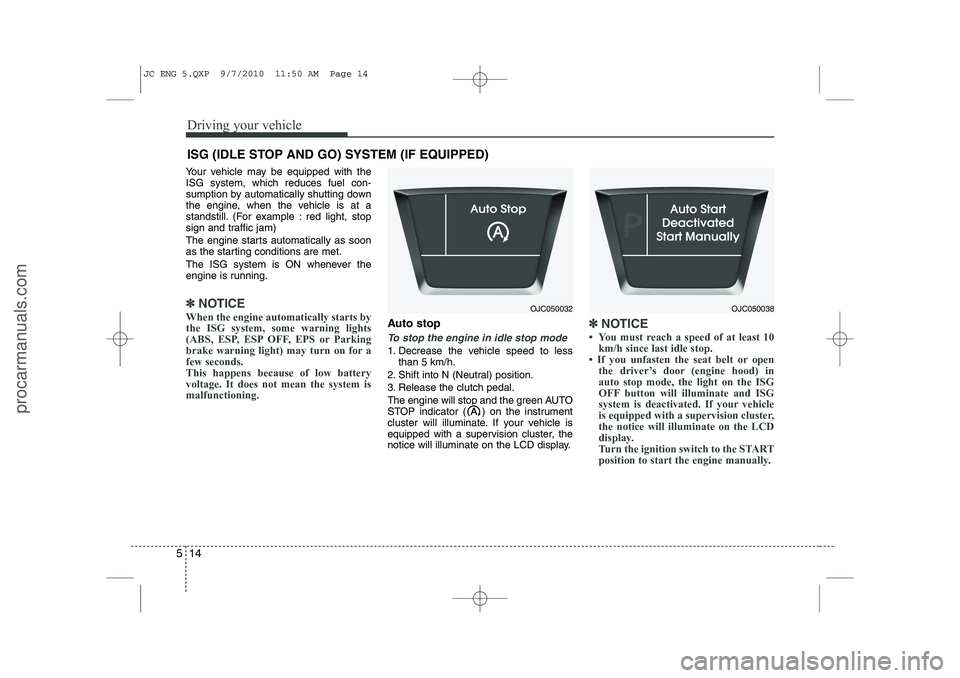
The engine will stop and the green AUTO
STOP indicator ( ) on the instrument
cluster will illuminate. If your vehicle is
equipped with a supervision cluster, the
notice will illuminate on the LCD display.
✽✽ NOTICE
Page 235 of 420
515
Driving your vehicle
Auto start
To restart the engine from idle stopmode
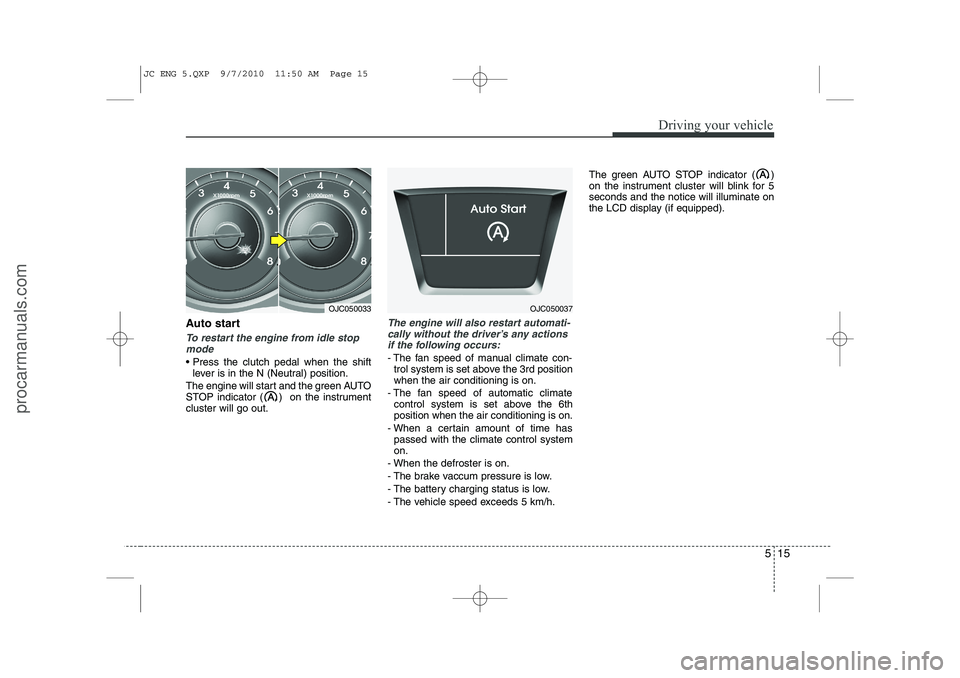
Press the clutch pedal when the shift lever is in the N (Neutral) position.
The engine will start and the green AUTO
STOP indicator ( ) on the instrumentcluster will go out.
The engine will also restart automati- cally without the driver’s any actions
if the following occurs:
- The fan speed of manual climate con- trol system is set above the 3rd position when the air conditioning is on.
- The fan speed of automatic climate control system is set above the 6thposition when the air conditioning is on.
- When a certain amount of time has passed with the climate control systemon.
- When the defroster is on.
- The brake vaccum pressure is low.
- The battery charging status is low.
- The vehicle speed exceeds 5 km/h. The green AUTO STOP indicator ( )
on the instrument cluster will blink for 5seconds and the notice will illuminate on
the LCD display (if equipped).
OJC050033OJC050037
JC ENG 5.QXP 9/7/2010 11:50 AM Page 15
procarmanuals.com
Page 237 of 420
517
Driving your vehicle
ISG system malfunction
The system may not operate when:
- The ISG related sensors or systemerror occurs.
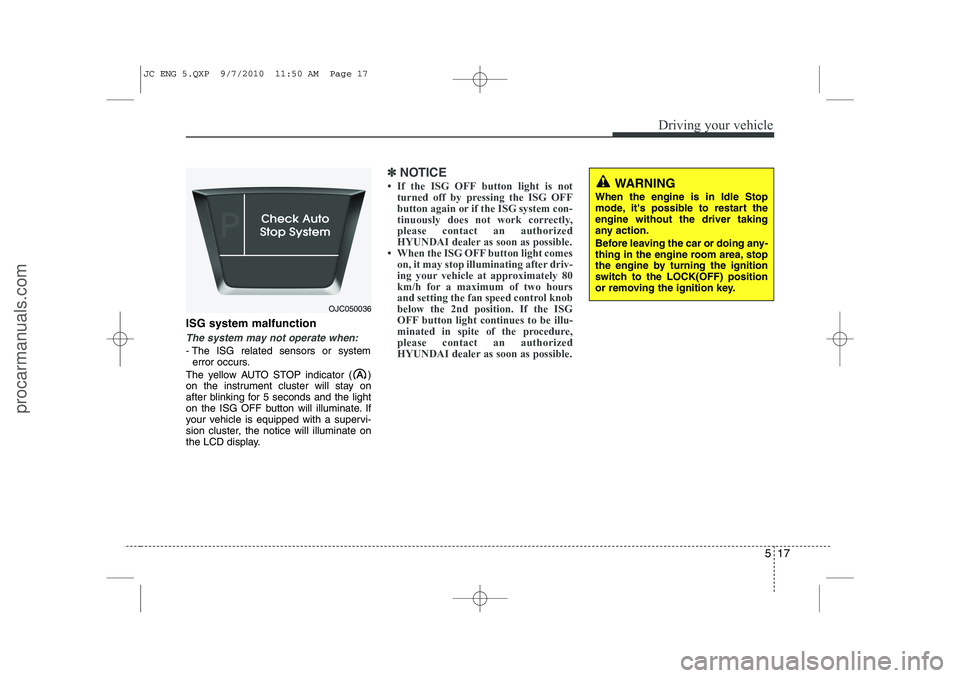
The yellow AUTO STOP indicator ( )
on the instrument cluster will stay on
after blinking for 5 seconds and the light
on the ISG OFF button will illuminate. If
your vehicle is equipped with a supervi-
sion cluster, the notice will illuminate on
the LCD display.
✽✽ NOTICE
Page 262 of 420
Driving your vehicle
42
5
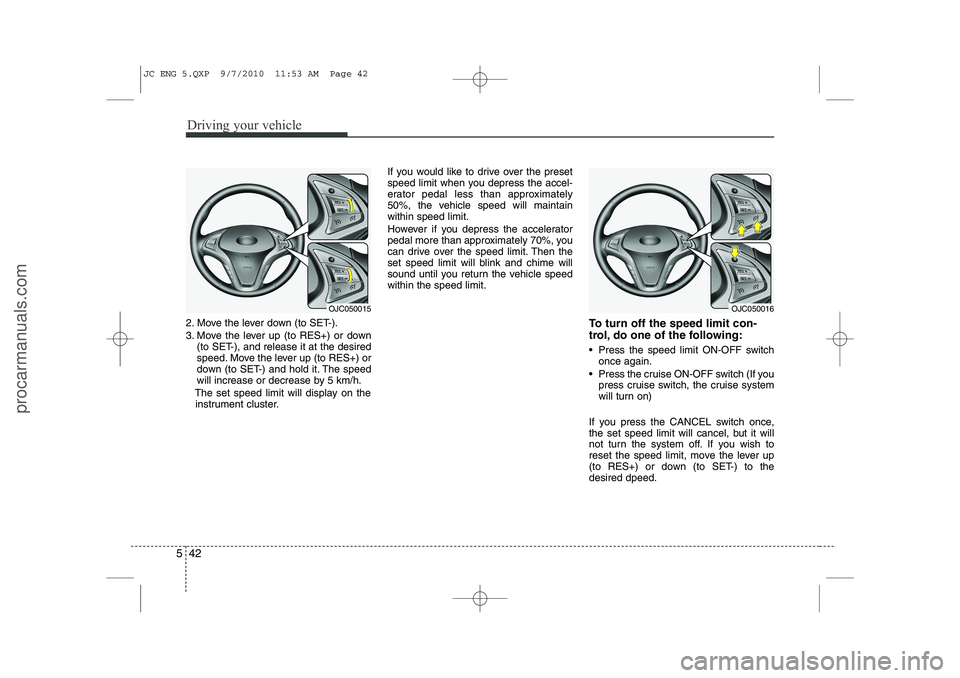
2. Move the lever down (to SET-).
3. Move the lever up (to RES+) or down
(to SET-), and release it at the desired
speed. Move the lever up (to RES+) or
down (to SET-) and hold it. The speed
will increase or decrease by 5 km/h.
The set speed limit will display on the instrument cluster. If you would like to drive over the preset
speed limit when you depress the accel-
erator pedal less than approximately
50%, the vehicle speed will maintainwithin speed limit.
However if you depress the accelerator
pedal more than approximately 70%, you
can drive over the speed limit. Then the
set speed limit will blink and chime will
sound until you return the vehicle speedwithin the speed limit.
To turn off the speed limit con-
trol, do one of the following:
Press the speed limit ON-OFF switchonce again.
Press the cruise ON-OFF switch (If you press cruise switch, the cruise system
will turn on)
If you press the CANCEL switch once,
the set speed limit will cancel, but it will
not turn the system off. If you wish to
reset the speed limit, move the lever up
(to RES+) or down (to SET-) to thedesired dpeed.
OJC050016OJC050015
JC ENG 5.QXP 9/7/2010 11:53 AM Page 42
procarmanuals.com
Page 300 of 420
What to do in an emergency
18
6
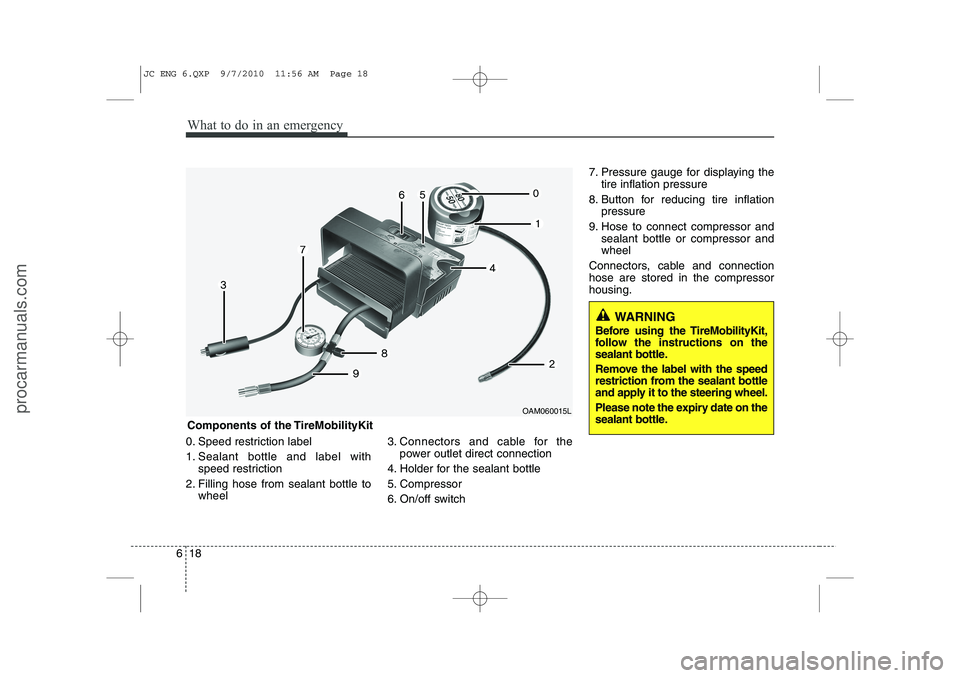
0. Speed restriction label
1. Sealant bottle and label with
speed restriction
2. Filling hose from sealant bottle to wheel 3. Connectors and cable for the
power outlet direct connection
4. Holder for the sealant bottle
5. Compressor
6. On/off switch 7. Pressure gauge for displaying the
tire inflation pressure
8. Button for reducing tire inflation pressure
9. Hose to connect compressor and sealant bottle or compressor and wheel
Connectors, cable and connectionhose are stored in the compressorhousing.
WARNING
Before using the TireMobilityKit,
follow the instructions on the
sealant bottle.
Remove the label with the speed
restriction from the sealant bottle
and apply it to the steering wheel.
Please note the expiry date on the
sealant bottle.
Components of the TireMobilityKit
OAM060015L
JC ENG 6.QXP 9/7/2010 11:56 AM Page 18
procarmanuals.com
Page 304 of 420
What to do in an emergency
22
6
TIRE PRESSURE MONITORING SYSTEM (TPMS) (IF EQUIPPED)
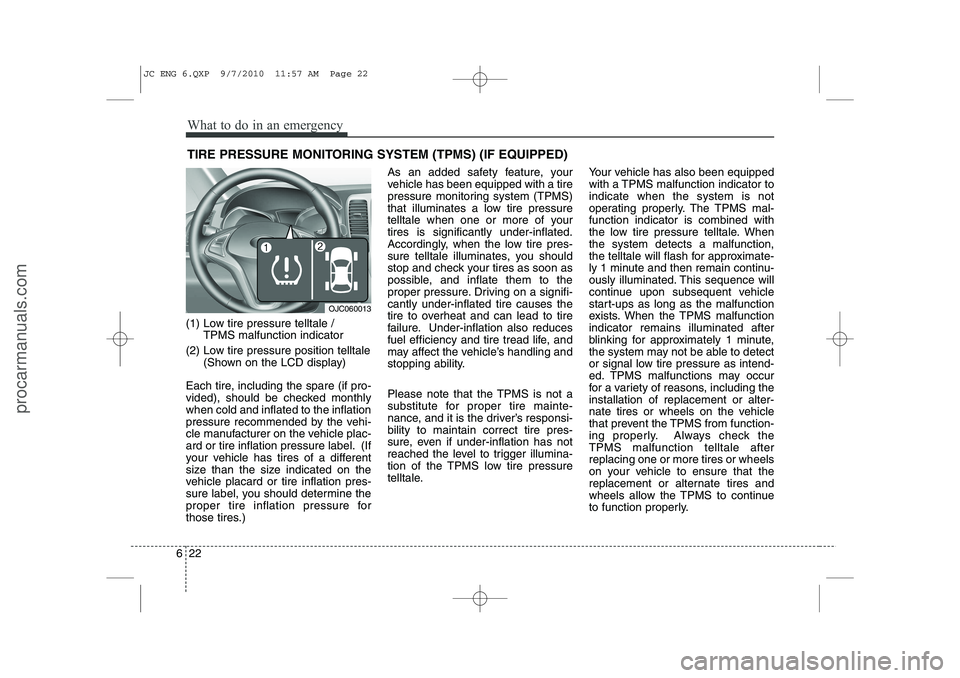
(1) Low tire pressure telltale / TPMS malfunction indicator
(2) Low tire pressure position telltale (Shown on the LCD display)
Each tire, including the spare (if pro-
vided), should be checked monthlywhen cold and inflated to the inflation
pressure recommended by the vehi-
cle manufacturer on the vehicle plac-
ard or tire inflation pressure label. (If
your vehicle has tires of a different
size than the size indicated on the
vehicle placard or tire inflation pres-
sure label, you should determine the
proper tire inflation pressure for
those tires.) As an added safety feature, your
vehicle has been equipped with a tire
pressure monitoring system (TPMS)
that illuminates a low tire pressure
telltale when one or more of yourtires is significantly under-inflated.
Accordingly, when the low tire pres-
sure telltale illuminates, you should
stop and check your tires as soon as
possible, and inflate them to the
proper pressure. Driving on a signifi-cantly under-inflated tire causes the
tire to overheat and can lead to tire
failure. Under-inflation also reduces
fuel efficiency and tire tread life, and
may affect the vehicle’s handling and
stopping ability.
Please note that the TPMS is not a
substitute for proper tire mainte-
nance, and it is the driver’s responsi-bility to maintain correct tire pres-
sure, even if under-inflation has not
reached the level to trigger illumina-
tion of the TPMS low tire pressure
telltale.
Your vehicle has also been equipped
with a TPMS malfunction indicator toindicate when the system is not
operating properly. The TPMS mal-function indicator is combined with
the low tire pressure telltale. Whenthe system detects a malfunction,
the telltale will flash for approximate-
ly 1 minute and then remain continu-
ously illuminated. This sequence will
continue upon subsequent vehicle
start-ups as long as the malfunction
exists. When the TPMS malfunctionindicator remains illuminated after
blinking for approximately 1 minute,
the system may not be able to detect
or signal low tire pressure as intend-
ed. TPMS malfunctions may occur
for a variety of reasons, including theinstallation of replacement or alter-
nate tires or wheels on the vehicle
that prevent the TPMS from function-
ing properly. Always check theTPMS malfunction telltale afterreplacing one or more tires or wheels
on your vehicle to ensure that the
replacement or alternate tires and
wheels allow the TPMS to continue
to function properly.
OJC060013
JC ENG 6.QXP 9/7/2010 11:57 AM Page 22
procarmanuals.com
Page 370 of 420
757
Maintenance
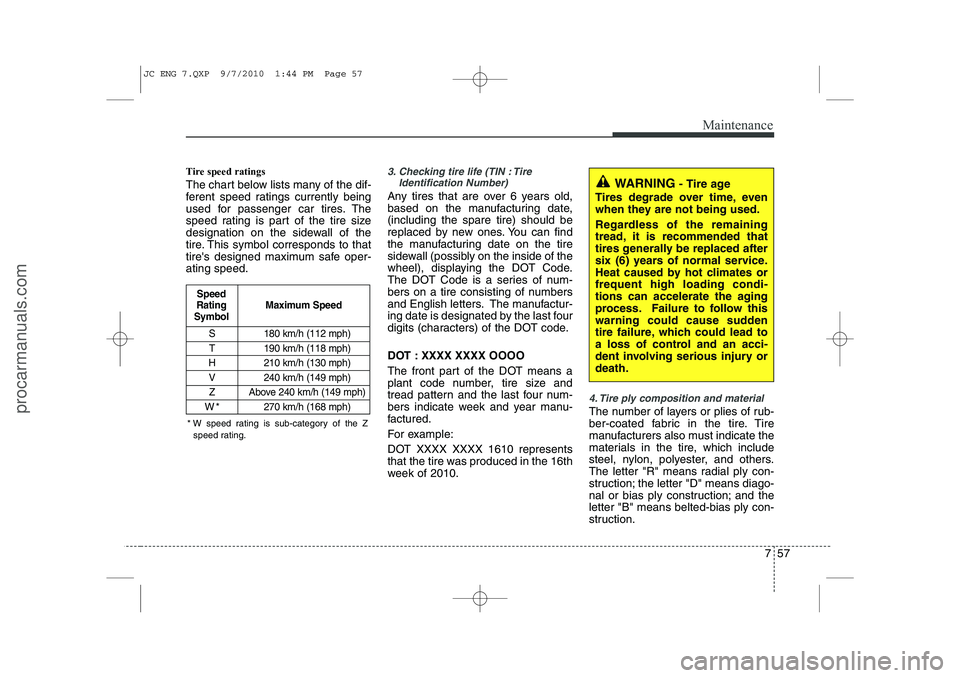
Tire speed ratings
The chart below lists many of the dif-
ferent speed ratings currently being
used for passenger car tires. The
speed rating is part of the tire size
designation on the sidewall of the
tire. This symbol corresponds to that
tire's designed maximum safe oper-ating speed.3. Checking tire life (TIN : TireIdentification Number)
Any tires that are over 6 years old,
based on the manufacturing date,(including the spare tire) should be
replaced by new ones. You can find
the manufacturing date on the tire
sidewall (possibly on the inside of the
wheel), displaying the DOT Code.
The DOT Code is a series of num-
bers on a tire consisting of numbers
and English letters. The manufactur-
ing date is designated by the last four
digits (characters) of the DOT code.
DOT : XXXX XXXX OOOO
The front part of the DOT means a
plant code number, tire size and
tread pattern and the last four num-
bers indicate week and year manu-
factured.
For example:
DOT XXXX XXXX 1610 represents
that the tire was produced in the 16th
week of 2010.
4. Tire ply composition and material
The number of layers or plies of rub-
ber-coated fabric in the tire. Tire
manufacturers also must indicate the
materials in the tire, which include
steel, nylon, polyester, and others.
The letter "R" means radial ply con-
struction; the letter "D" means diago-
nal or bias ply construction; and theletter "B" means belted-bias ply con-
struction.
S 180 km/h (112 mph)
T 190 km/h (118 mph)
H 210 km/h (130 mph) V 240 km/h (149 mph)
Z Above 240 km/h (149 mph)
W*270 km/h (168 mph)
Maximum Speed
Speed
Rating
Symbol
WARNING - Tire age
Tires degrade over time, even
when they are not being used.
Regardless of the remaining
tread, it is recommended that
tires generally be replaced after
six (6) years of normal service.
Heat caused by hot climates orfrequent high loading condi-
tions can accelerate the aging
process. Failure to follow this
warning could cause sudden
tire failure, which could lead to
a loss of control and an acci-
dent involving serious injury ordeath.
* W speed rating is sub-category of the Z speed rating.
JC ENG 7.QXP 9/7/2010 1:44 PM Page 57
procarmanuals.com
Page 413 of 420
Index
4
I
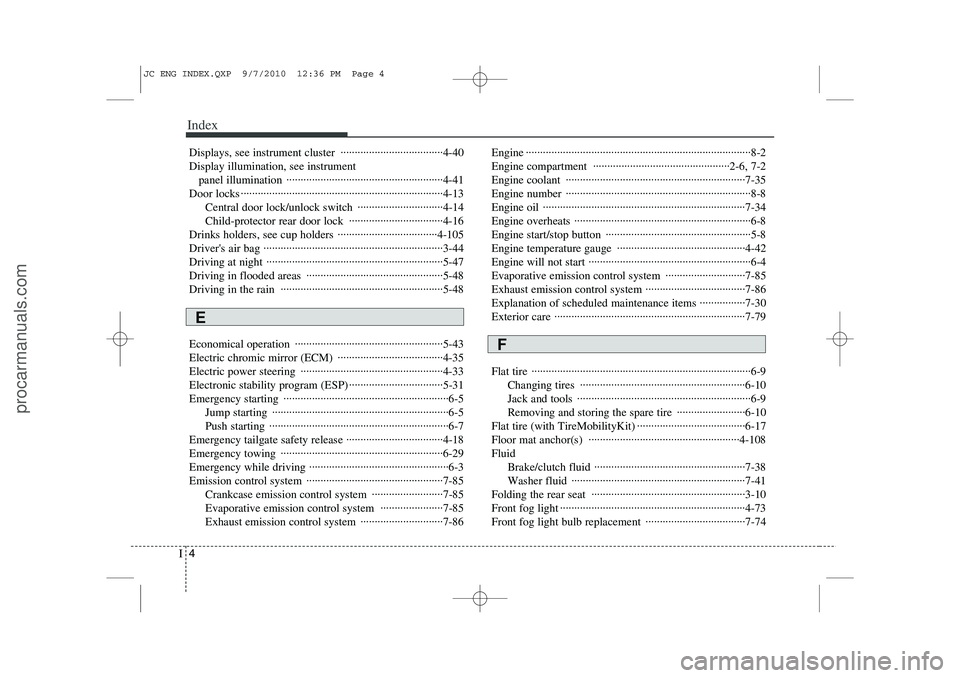
Displays, see instrument cluster ····································4-40 Display illumination, see instrument
panel illumination ·······················································4-41
Door locks ·······································································4-13 Central door lock/unlock switch ······························4-14
Child-protector rear door lock ·································4-16
Drinks holders, see cup holders ···································4-105
Driver's air bag ·······························································3-44
Driving at night ······························································5-47
Driving in flooded areas ················································5-48
Driving in the rain ·························································5-48
Economical operation ····················································5-43
Electric chromic mirror (ECM) ·····································4-35
Electric power steering ··················································4-33
Electronic stability program (ESP) ·································5-31
Emergency starting ··························································6-5 Jump starting ······························································6-5
Push starting ·······························································6-7
Emergency tailgate safety release ··································4-18
Emergency towing ·························································6-29
Emergency while driving ·················································6-3
Emission control system ················································7-85 Crankcase emission control system ·························7-85
Evaporative emission control system ······················7-85
Exhaust emission control system ·····························7-86 Engine ···············································································8-2
Engine compartment ················································2-6, 7-2
Engine coolant ·······························································7-35
Engine number ·································································8-8
Engine oil ·······································································7-34
Engine overheats ······························································6-8
Engine start/stop button ···················································5-8
Engine temperature gauge ·············································4-42
Engine will not start ·························································6-4
Evaporative emission control system ····························7-85
Exhaust emission control system ···································7-86Explanation of scheduled maintenance items ················7-30
Exterior care ···································································7-79
Flat tire ·············································································6-9
Changing tires ··························································6-10
Jack and tools ·····························································6-9
Removing and storing the spare tire ························6-10
Flat tire (with TireMobilityKit) ······································6-17
Floor mat anchor(s) ·····················································4-108Fluid Brake/clutch fluid ·····················································7-38
Washer fluid ·····························································7-41
Folding the rear seat ······················································3-10
Front fog light ·································································4-73
Front fog light bulb replacement ···································7-74
E
F
JC ENG INDEX.QXP 9/7/2010 12:36 PM Page 4
procarmanuals.com
Page 414 of 420
I5
Index
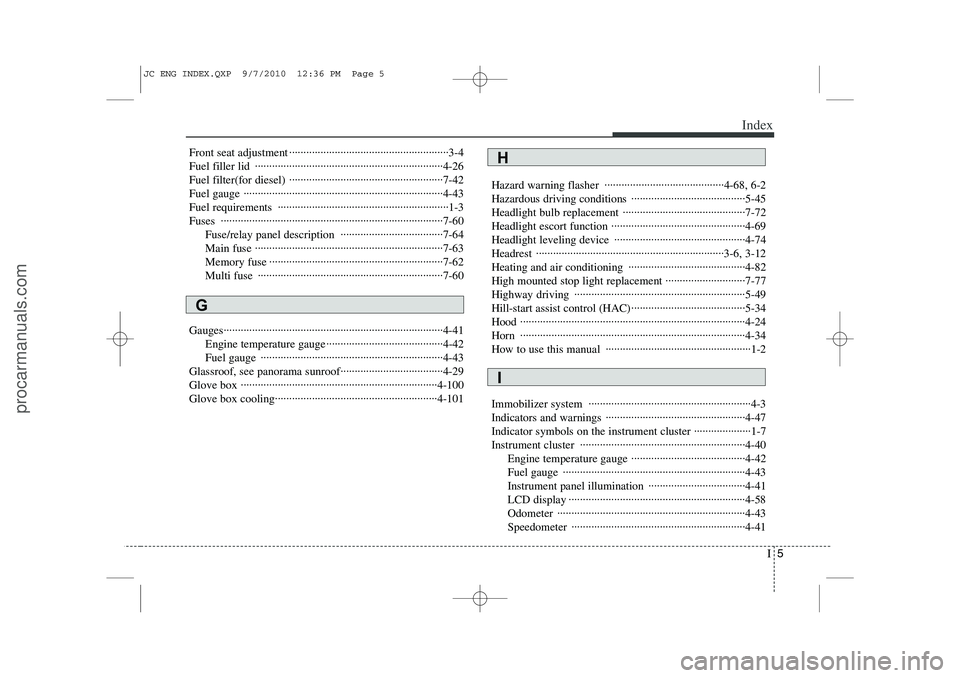
Front seat adjustment ························································3-4
Fuel filler lid ··································································4-26
Fuel filter(for diesel) ······················································7-42
Fuel gauge ······································································4-43
Fuel requirements ····························································1-3Fuses ··············································································7-60
Fuse/relay panel description ····································7-64
Main fuse ··································································7-63
Memory fuse ·····························································7-62
Multi fuse ·································································7-60
Gauges·············································································4-41 Engine temperature gauge·········································4-42
Fuel gauge ································································4-43
Glassroof, see panorama sunroof····································4-29
Glove box ·····································································4-100
Glove box cooling·························································4-101 Hazard warning flasher ··········································4-68, 6-2
Hazardous driving conditions ········································5-45
Headlight bulb replacement ···········································7-72
Headlight escort function ···············································4-69
Headlight leveling device ··············································4-74
Headrest ··································································3-6, 3-12
Heating and air conditioning ·········································4-82High mounted stop light replacement ····························7-77
Highway driving ····························································5-49
Hill-start assist control (HAC)········································5-34Hood ···············································································4-24Horn ···············································································4-34
How to use this manual ···················································1-2
Immobilizer system ·························································4-3
Indicators and warnings ·················································4-47Indicator symbols on the instrument cluster ····················1-7
Instrument cluster ··························································4-40
Engine temperature gauge ········································4-42
Fuel gauge ································································4-43
Instrument panel illumination ··································4-41
LCD display ······························································4-58Odometer ··································································4-43Speedometer ·····························································4-41
G
H
I
JC ENG INDEX.QXP 9/7/2010 12:36 PM Page 5
procarmanuals.com