air condition HYUNDAI IX35 2014 Owners Manual
[x] Cancel search | Manufacturer: HYUNDAI, Model Year: 2014, Model line: IX35, Model: HYUNDAI IX35 2014Pages: 1534, PDF Size: 39.76 MB
Page 983 of 1534
Specifications & Consumer information
2
8
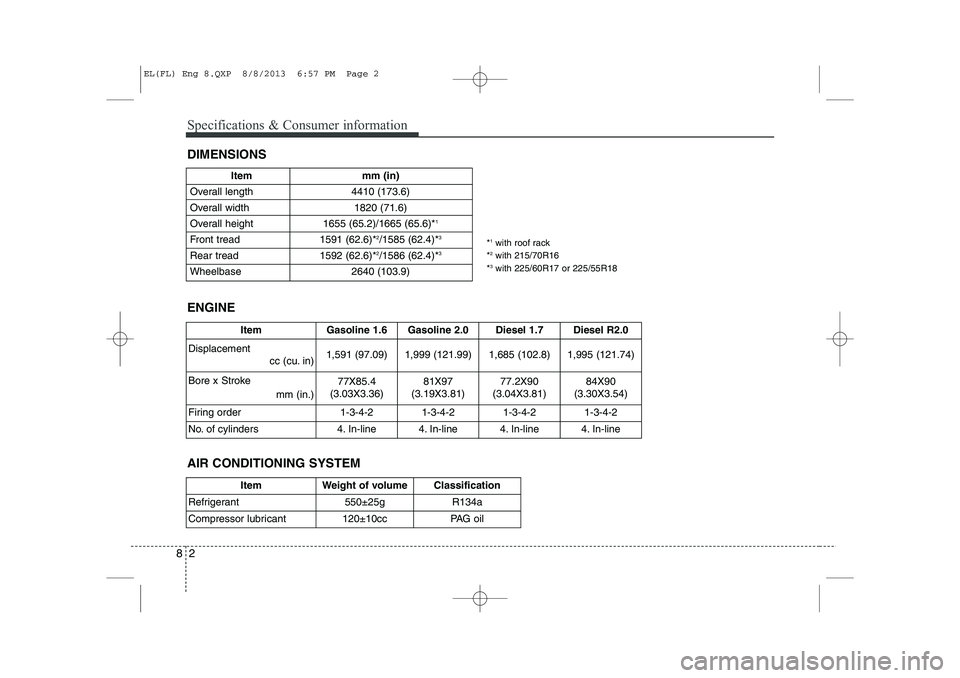
DIMENSIONS
Item mm (in)
Overall length 4410 (173.6)
Overall width 1820 (71.6)
Overall height 1655 (65.2)/1665 (65.6)* 1
Front tread 1591 (62.6)* 2
/1585 (62.4)* 3
Rear tread 1592 (62.6)* 2
/1586 (62.4)* 3
Wheelbase 2640 (103.9)
* 1
with roof rack
* 2
with 215/70R16
* 3
with 225/60R17 or 225/55R18
ENGINE Item
Gasoline 1.6 Gasoline 2.0Diesel 1.7Diesel R2.0
Displacement cc (cu. in)
1,591 (97.09) 1,999 (121.99)1,685 (102.8)1,995 (121.74)
Bore x Stroke mm (in.)
77X85.4
(3.03X3.36) 81X97
(3.19X3.81)77.2X90
(3.04X3.81)84X90
(3.30X3.54)
Firing order
1-3-4-2 1-3-4-21-3-4-21-3-4-2
No. of cylinders
4. In-line 4. In-line4. In-line4. In-line
ItemWeight of volume Classification
Refrigerant
550±25g R134a
Compressor lubricant
120±10cc PAG oil
AIR CONDITIONING SYSTEM
EL(FL) Eng 8.QXP 8/8/2013 6:57 PM Page 2
Page 992 of 1534
811
Specifications & Consumer information
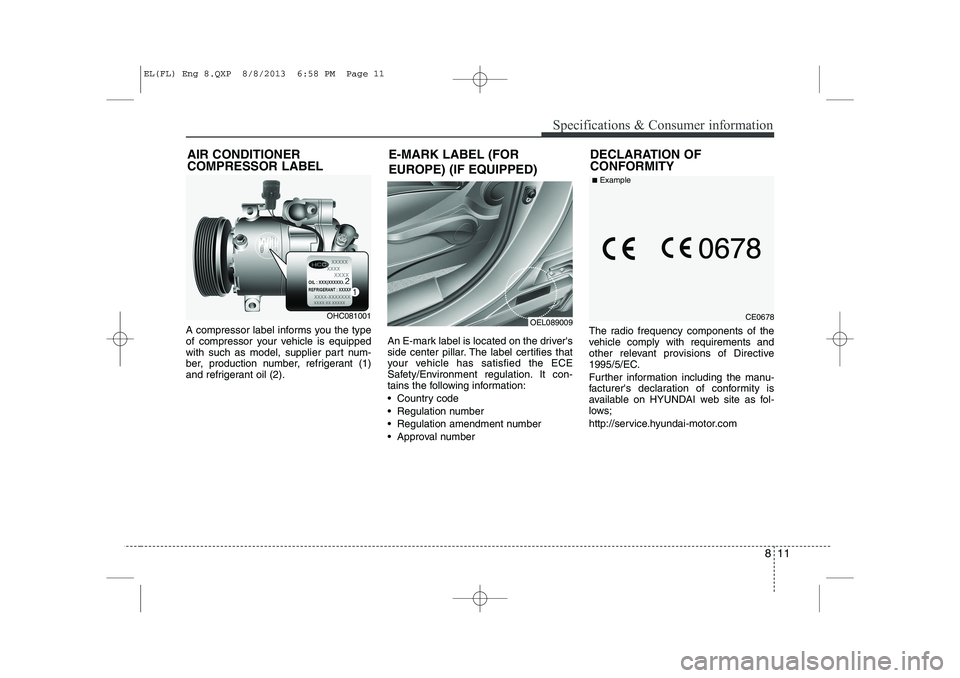
A compressor label informs you the type
of compressor your vehicle is equipped
with such as model, supplier part num-
ber, production number, refrigerant (1)
and refrigerant oil (2).An E-mark label is located on the driver's
side center pillar. The label certifies that
your vehicle has satisfied the ECE
Safety/Environment regulation. It con-
tains the following information:
Country code
Regulation number
Regulation amendment number
Approval numberThe radio frequency components of the
vehicle comply with requirements and
other relevant provisions of Directive
1995/5/EC.
Further information including the manu-
facturer's declaration of conformity is
available on HYUNDAI web site as fol-
lows;
http://service.hyundai-motor.comOEL089009
AIR CONDITIONER COMPRESSOR LABELOHC081001
E-MARK LABEL (FOR
EUROPE) (IF EQUIPPED)
DECLARATION OF CONFORMITYCE0678
■
Example
EL(FL) Eng 8.QXP 8/8/2013 6:58 PM Page 11
Page 996 of 1534
Introduction
4
1
Fuel Additives
HYUNDAI recommends that you use good quality petrols that meet European
Fuel standards (EN228) or equivalents.
For customers who do not use good
quality petrols including fuel additives
regularly, and have problems starting or
the engine does not run smoothly, one
bottle of additives added to the fuel tank
at every 10,000 miles (15,000 km).
Additives are available from your
HYUNDAI authorised repairer along with
information on how to use them. Do not
mix other additives.
Operation in foreign countries
Drivers of vehicles which are to be oper-
ated in foreign countries must satisfy
themselves that:
The vehicle meets all local regulations
with respect to insurance, specifica- tions etc..
The correct types and grades of fuel are available for satisfactory operation
of the vehicle. Diesel engine
Diesel fuel
Diesel engine must be operated only on
commercially available diesel fuel that
complies with EN 590 or comparable
standard (EN stands for "European
Norm"). Do not use marine diesel fuel,
heating oils, or non-approved fuel addi-
tives, as this will increase wear andcause damage to the engine and fuel
system. The use of non-approved fuels
and / or fuel additives will result in a limi-
tation of your warranty rights.
Diesel fuel of above cetane 51 is used in
your vehicle. If two types of diesel fuel
are available, use summer or winter fuel
properly according to the following tem-
perature conditions.
Above -5°C(23°F) ... Summer type
diesel fuel.
Below -5°C(23°F) ... Winter type diesel fuel.
Watch the fuel level in the tank very care-
fully : If the engine stops through fuel fail-
ure, the circuits must be completely
purged to permit restarting.
CAUTION
Do not allow petrol or water to enter the fuel tank. If this happens, the
tank should be completely drainedand the fuel lines must all becleaned out to prevent the fuel pump from becoming contaminat-
ed.
CAUTION - Diesel Fuel
It is recommended to use the regu-
lated automotive diesel fuel for
diesel vehicle equipped with the DPF system.
If you use diesel fuel including highsulfur (more than 50 ppm sulfur)
and unspecified additives, it cancause the DPF system to be dam- aged and white smoke can be emit-ted.
EL(FL) UK 1.QXP 8/5/2013 6:21 PM Page 4
Page 1053 of 1534
347
Safety features of your vehicle
SRS components and functions
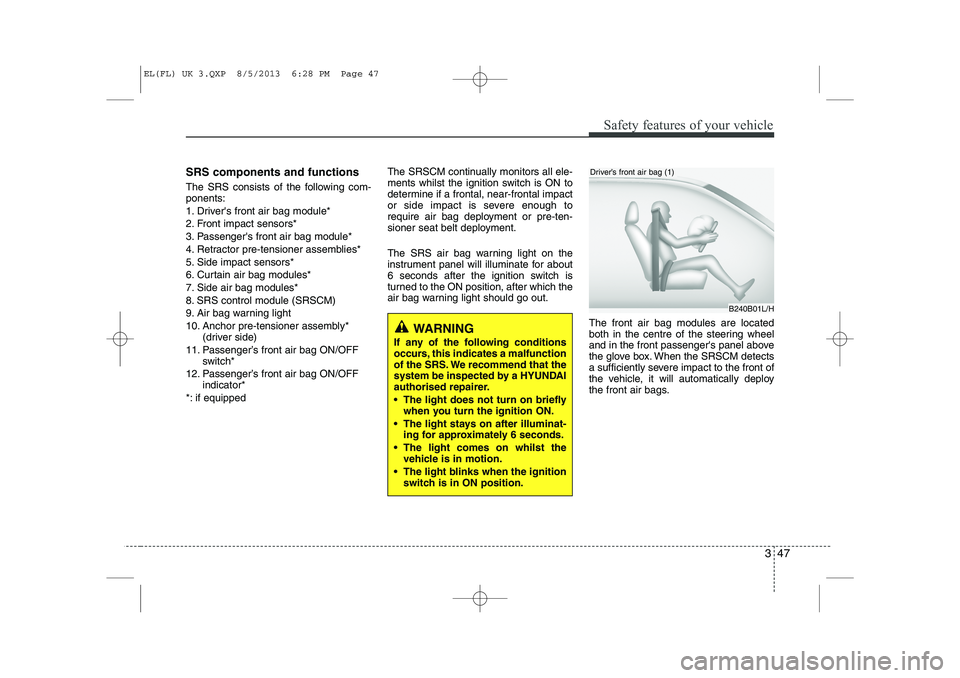
The SRS consists of the following com- ponents:
1. Driver's front air bag module*
2. Front impact sensors*
3. Passenger's front air bag module*
4. Retractor pre-tensioner assemblies*
5. Side impact sensors*
6. Curtain air bag modules*
7. Side air bag modules*
8. SRS control module (SRSCM)
9. Air bag warning light
10. Anchor pre-tensioner assembly* (driver side)
11. Passenger’s front air bag ON/OFF switch*
12. Passenger’s front air bag ON/OFF indicator*
*: if equipped The SRSCM continually monitors all ele-
ments whilst the ignition switch is ON to
determine if a frontal, near-frontal impact
or side impact is severe enough to
require air bag deployment or pre-ten-
sioner seat belt deployment.
The SRS air bag warning light on the
instrument panel will illuminate for about
6 seconds after the ignition switch is
turned to the ON position, after which the
air bag warning light should go out.
The front air bag modules are located
both in the centre of the steering wheel
and in the front passenger's panel above
the glove box. When the SRSCM detects
a sufficiently severe impact to the front of
the vehicle, it will automatically deploy
the front air bags.
WARNING
If any of the following conditions
occurs, this indicates a malfunction
of the SRS. We recommend that the
system be inspected by a HYUNDAI
authorised repairer.
The light does not turn on briefly when you turn the ignition ON.
The light stays on after illuminat- ing for approximately 6 seconds.
The light comes on whilst the vehicle is in motion.
The light blinks when the ignition switch is in ON position.
B240B01L/H
Driver’s front air bag (1)
EL(FL) UK 3.QXP 8/5/2013 6:28 PM Page 47
Page 1055 of 1534
349
Safety features of your vehicle
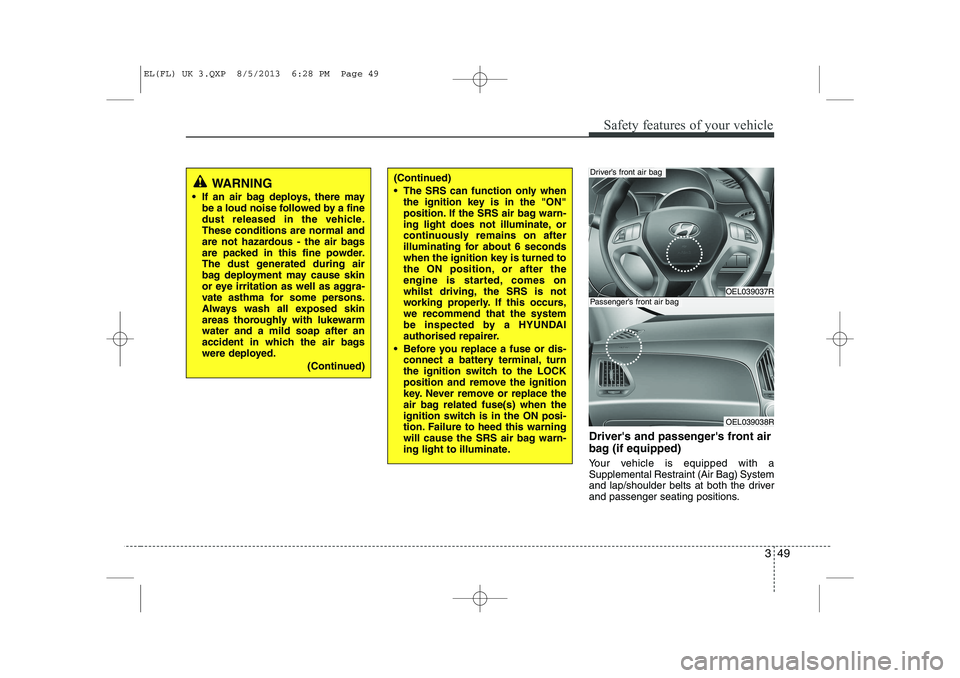
Driver's and passenger's front air
bag (if equipped)
Your vehicle is equipped with a
Supplemental Restraint (Air Bag) System
and lap/shoulder belts at both the driver
and passenger seating positions.
WARNING
If an air bag deploys, there may be a loud noise followed by a fine
dust released in the vehicle.These conditions are normal and
are not hazardous - the air bags
are packed in this fine powder.
The dust generated during air
bag deployment may cause skin
or eye irritation as well as aggra-
vate asthma for some persons.
Always wash all exposed skin
areas thoroughly with lukewarmwater and a mild soap after an
accident in which the air bags
were deployed.
(Continued)(Continued)
The SRS can function only whenthe ignition key is in the "ON"
position. If the SRS air bag warn-
ing light does not illuminate, or
continuously remains on after
illuminating for about 6 seconds
when the ignition key is turned to
the ON position, or after the
engine is started, comes on
whilst driving, the SRS is not
working properly. If this occurs,we recommend that the system
be inspected by a HYUNDAI
authorised repairer.
Before you replace a fuse or dis- connect a battery terminal, turn
the ignition switch to the LOCK
position and remove the ignition
key. Never remove or replace the
air bag related fuse(s) when the
ignition switch is in the ON posi-
tion. Failure to heed this warning
will cause the SRS air bag warn-
ing light to illuminate.
OEL039037R
OEL039038R
Driver’s front air bag
Passenger’s front air bag
EL(FL) UK 3.QXP 8/5/2013 6:28 PM Page 49
Page 1061 of 1534
355
Safety features of your vehicle
• The side air bags are designed todeploy only during certain side-impact
collisions, depending on the crash
severity, angle, speed and point ofimpact.
The side air bags do not only deploy on the side of the impact but also on the
opposite side.(Continued)
• Use of seat covers could reduceor prevent the effectiveness of the system.
Do not install any accessories on the side or near the side air bag.
Do not place any objects over the air bag or between the air bag
and yourself.
Do not place any objects (an umbrella, bag, etc.) between the
front door and the front seat.
Such objects may become dan-
gerous projectiles and cause
injury if the supplemental side air
bag inflates.
To prevent unexpected deploy- ment of the side air bag that may
result in personal injury, avoidimpact to the side impact sensor
when the ignition key is on.
If seat or seat cover is damaged, we recommend that the system
be serviced by a HYUNDAI autho-
rised repairer. Inform that your
vehicle is equipped with side air
bags.WARNING
The side air bag is supplemental to the driver's and the passen-
ger's seat belt systems and is not
a substitute for them. Therefore
your seat belts must be worn at
all times whilst the vehicle is in
motion. The air bags deploy only
in certain side impact conditions
severe enough to cause signifi-
cant injury to the vehicle occu-pants.
For best protection from the side air bag system and to avoid being
injured by the deploying side air
bag, both front seat occupantsshould sit in an upright position
with the seat belt properly fas-
tened. The driver's hands shouldbe placed on the steering wheelat the 9:00 and 3:00 positions.
The passenger's arms and handsshould be placed on their laps.
Do not use any accessory seat covers.
(Continued)
WARNING
Do not allow the passengers to lean
their heads or bodies onto doors,
put their arms on the doors, stretch
their arms out of the window, or
place objects between the doors
and passengers when they areseated on seats equipped with side
and/or curtain air bags.
EL(FL) UK 3.QXP 8/5/2013 6:37 PM Page 55
Page 1065 of 1534
359
Safety features of your vehicle
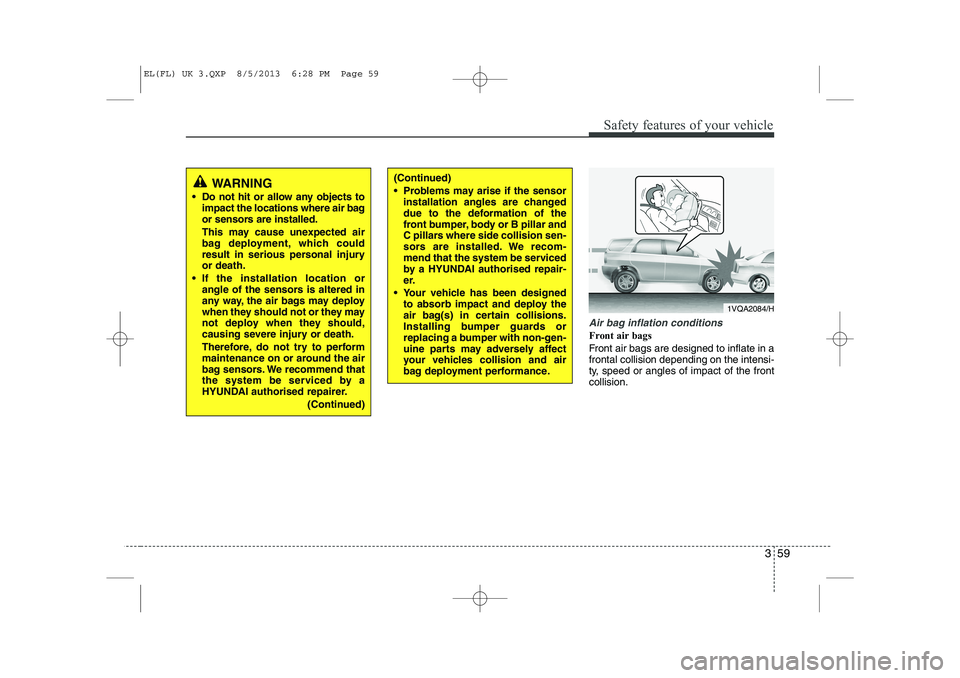
Air bag inflation conditions
Front air bags
Front air bags are designed to inflate in a frontal collision depending on the intensi-
ty, speed or angles of impact of the frontcollision.
WARNING
Do not hit or allow any objects to impact the locations where air bag
or sensors are installed.
This may cause unexpected air
bag deployment, which could
result in serious personal injuryor death.
If the installation location or angle of the sensors is altered in
any way, the air bags may deploy
when they should not or they may
not deploy when they should,
causing severe injury or death.
Therefore, do not try to perform
maintenance on or around the air
bag sensors. We recommend that
the system be serviced by a
HYUNDAI authorised repairer.
(Continued)(Continued)
Problems may arise if the sensorinstallation angles are changed
due to the deformation of the
front bumper, body or B pillar and
C pillars where side collision sen-
sors are installed. We recom-
mend that the system be serviced
by a HYUNDAI authorised repair-
er.
Your vehicle has been designed to absorb impact and deploy the
air bag(s) in certain collisions.
Installing bumper guards or
replacing a bumper with non-gen-
uine parts may adversely affect
your vehicles collision and air
bag deployment performance.
1VQA2084/H
EL(FL) UK 3.QXP 8/5/2013 6:28 PM Page 59
Page 1066 of 1534
Safety features of your vehicle
60
3
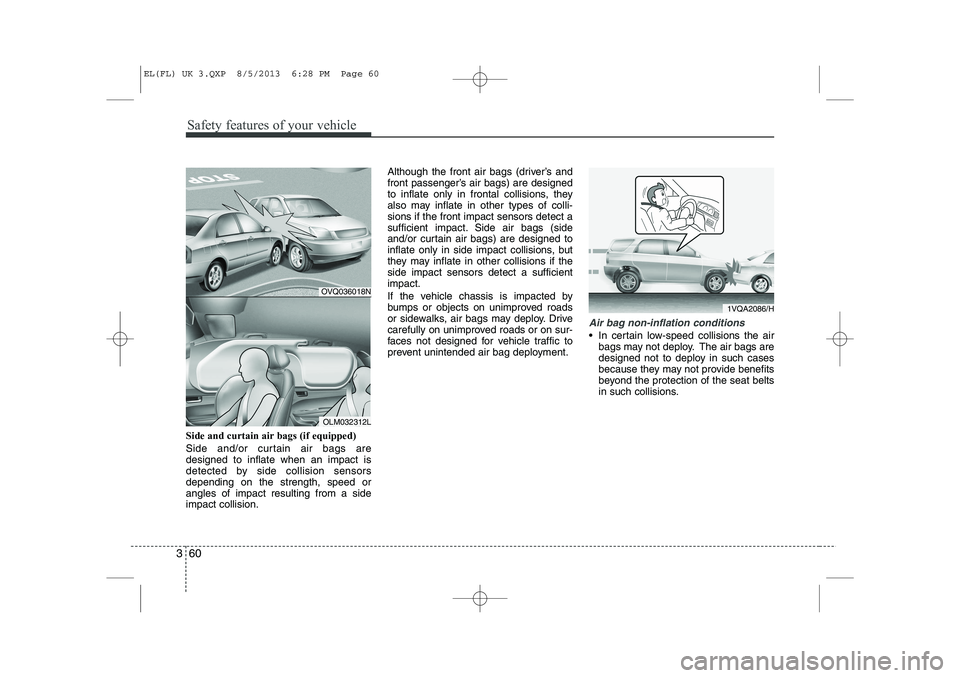
Side and curtain air bags (if equipped)
Side and/or curtain air bags are designed to inflate when an impact is
detected by side collision sensorsdepending on the strength, speed orangles of impact resulting from a sideimpact collision. Although the front air bags (driver’s and
front passenger’s air bags) are designed
to inflate only in frontal collisions, they
also may inflate in other types of colli-sions if the front impact sensors detect a
sufficient impact. Side air bags (side
and/or curtain air bags) are designed to
inflate only in side impact collisions, but
they may inflate in other collisions if theside impact sensors detect a sufficientimpact.
If the vehicle chassis is impacted by
bumps or objects on unimproved roads
or sidewalks, air bags may deploy. Drive
carefully on unimproved roads or on sur-
faces not designed for vehicle traffic to
prevent unintended air bag deployment.
Air bag non-inflation conditions
In certain low-speed collisions the air
bags may not deploy. The air bags are
designed not to deploy in such cases
because they may not provide benefits
beyond the protection of the seat belts
in such collisions.
1VQA2086/H
OVQ036018N
OLM032312L
EL(FL) UK 3.QXP 8/5/2013 6:28 PM Page 60
Page 1110 of 1534
439
Features of your vehicle
Inside rearview mirror
Adjust the rearview mirror to centre on
the view through the rear window. Make
this adjustment before you start driving.
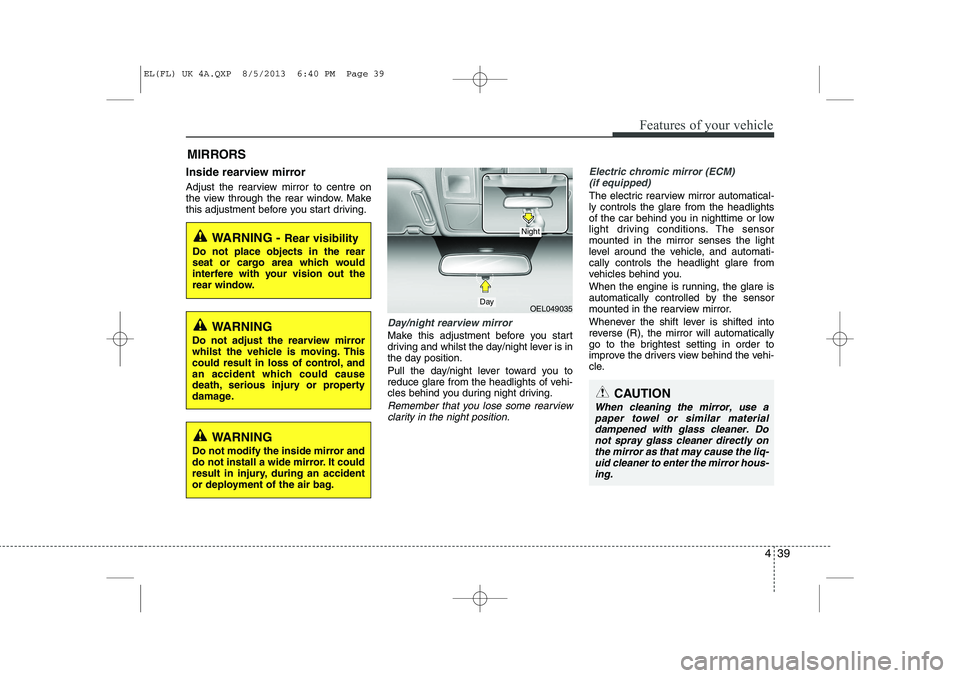
Day/night rearview mirror
Make this adjustment before you start
driving and whilst the day/night lever is in
the day position.
Pull the day/night lever toward you to
reduce glare from the headlights of vehi-
cles behind you during night driving.
Remember that you lose some rearviewclarity in the night position.
Electric chromic mirror (ECM) (if equipped)
The electric rearview mirror automatical- ly controls the glare from the headlights
of the car behind you in nighttime or low
light driving conditions. The sensormounted in the mirror senses the light
level around the vehicle, and automati-cally controls the headlight glare from
vehicles behind you.
When the engine is running, the glare is
automatically controlled by the sensor
mounted in the rearview mirror.
Whenever the shift lever is shifted into
reverse (R), the mirror will automatically
go to the brightest setting in order to
improve the drivers view behind the vehi-
cle.
MIRRORS
WARNING -
Rear visibility
Do not place objects in the rear
seat or cargo area which would
interfere with your vision out the
rear window.
OEL049035
CAUTION
When cleaning the mirror, use a paper towel or similar materialdampened with glass cleaner. Do not spray glass cleaner directly on
the mirror as that may cause the liq- uid cleaner to enter the mirror hous-ing.
Day
Night
WARNING
Do not adjust the rearview mirror
whilst the vehicle is moving. This
could result in loss of control, and
an accident which could cause
death, serious injury or property
damage.
WARNING
Do not modify the inside mirror and
do not install a wide mirror. It could
result in injury, during an accident
or deployment of the air bag.
EL(FL) UK 4A.QXP 8/5/2013 6:40 PM Page 39
Page 1122 of 1534
451
Features of your vehicle
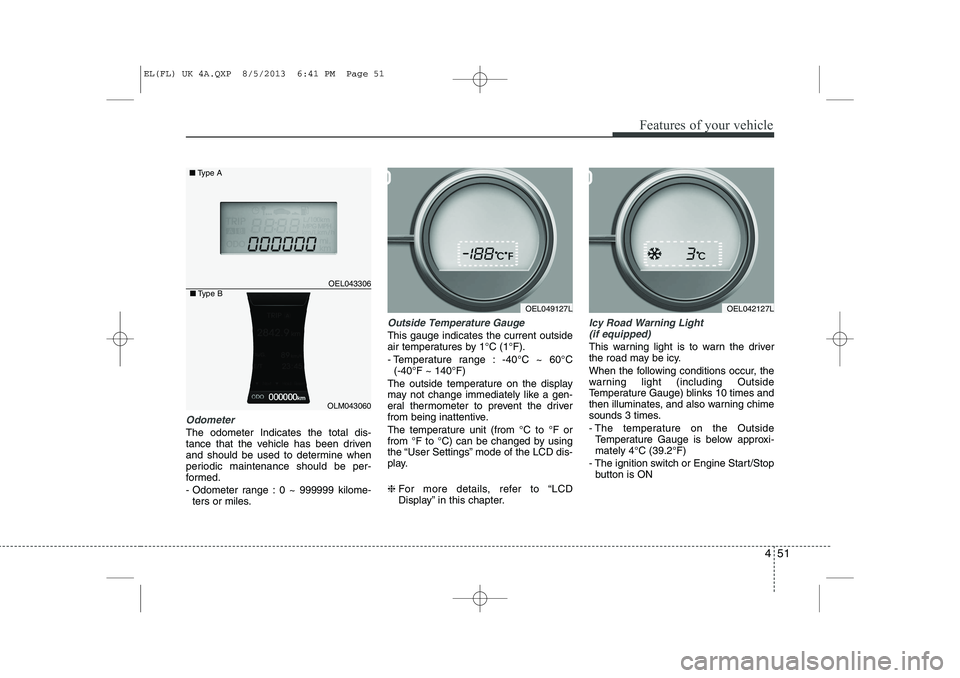
Odometer
The odometer Indicates the total dis-
tance that the vehicle has been driven
and should be used to determine when
periodic maintenance should be per-
formed.
- Odometer range : 0 ~ 999999 kilome-ters or miles.
Outside Temperature Gauge
This gauge indicates the current outside
air temperatures by 1°C (1°F).
- Temperature range : -40°C ~ 60°C (-40°F ~ 140°F)
The outside temperature on the display
may not change immediately like a gen-
eral thermometer to prevent the driver
from being inattentive.
The temperature unit (from °C to °F or
from °F to °C) can be changed by using
the “User Settings” mode of the LCD dis-
play. ❈ For more details, refer to “LCD
Display” in this chapter.
Icy Road Warning Light
(if equipped)
This warning light is to warn the driver
the road may be icy.
When the following conditions occur, the
warning light (including Outside
Temperature Gauge) blinks 10 times and
then illuminates, and also warning chime
sounds 3 times.
- The temperature on the Outside Temperature Gauge is below approxi- mately 4°C (39.2°F)
- The ignition switch or Engine Start/Stop button is ON
OEL049127L
OEL043306
■ Type A
OEL042127L
OLM043060
■Type B
EL(FL) UK 4A.QXP 8/5/2013 6:41 PM Page 51