seats HYUNDAI IX35 2014 Workshop Manual
[x] Cancel search | Manufacturer: HYUNDAI, Model Year: 2014, Model line: IX35, Model: HYUNDAI IX35 2014Pages: 1534, PDF Size: 39.76 MB
Page 1016 of 1534
Safety features of your vehicle
10
3
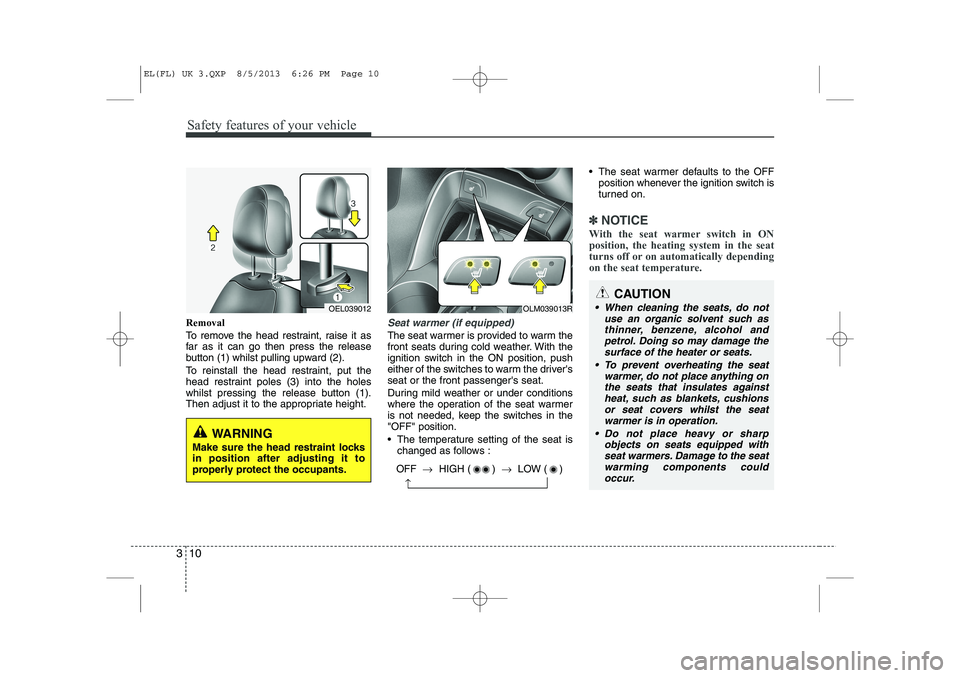
Removal
To remove the head restraint, raise it as
far as it can go then press the release
button (1) whilst pulling upward (2).
To reinstall the head restraint, put the
head restraint poles (3) into the holes
whilst pressing the release button (1).
Then adjust it to the appropriate height.Seat warmer (if equipped)
The seat warmer is provided to warm the
front seats during cold weather. With the
ignition switch in the ON position, push
either of the switches to warm the driver'sseat or the front passenger's seat.
During mild weather or under conditions
where the operation of the seat warmer
is not needed, keep the switches in the"OFF" position.
The temperature setting of the seat is
changed as follows : The seat warmer defaults to the OFF
position whenever the ignition switch is
turned on.
✽✽ NOTICE
With the seat warmer switch in ON position, the heating system in the seat
turns off or on automatically depending
on the seat temperature.
OEL039012
WARNING
Make sure the head restraint locks in position after adjusting it to
properly protect the occupants.
OLM039013R
OFF →HIGH ( ) →LOW ( )
→
CAUTION
When cleaning the seats, do not
use an organic solvent such as
thinner, benzene, alcohol andpetrol. Doing so may damage the surface of the heater or seats.
To prevent overheating the seat warmer, do not place anything on
the seats that insulates against heat, such as blankets, cushionsor seat covers whilst the seat warmer is in operation.
Do not place heavy or sharp objects on seats equipped withseat warmers. Damage to the seatwarming components couldoccur.
EL(FL) UK 3.QXP 8/5/2013 6:26 PM Page 10
Page 1019 of 1534
313
Safety features of your vehicle
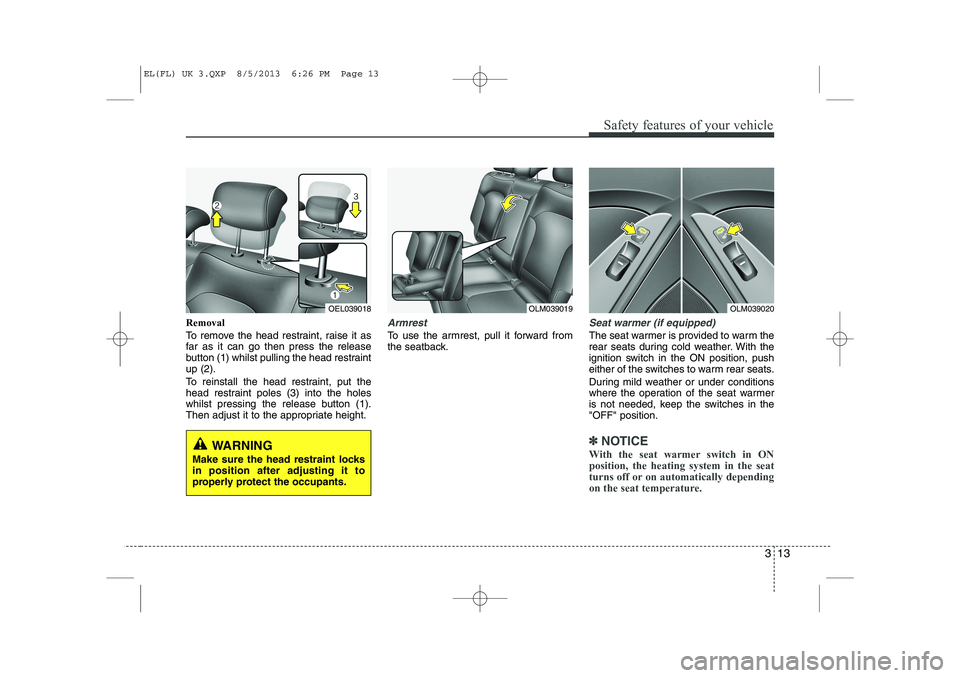
Removal
To remove the head restraint, raise it as
far as it can go then press the release
button (1) whilst pulling the head restraintup (2).
To reinstall the head restraint, put the
head restraint poles (3) into the holes
whilst pressing the release button (1).
Then adjust it to the appropriate height.Armrest
To use the armrest, pull it forward from
the seatback.
Seat warmer (if equipped)
The seat warmer is provided to warm the
rear seats during cold weather. With the
ignition switch in the ON position, push
either of the switches to warm rear seats.
During mild weather or under conditions
where the operation of the seat warmer
is not needed, keep the switches in the"OFF" position.
✽✽NOTICE
With the seat warmer switch in ON position, the heating system in the seat
turns off or on automatically depending
on the seat temperature.
OEL039018
WARNING
Make sure the head restraint locks in position after adjusting it to
properly protect the occupants.
OLM039019OLM039020
EL(FL) UK 3.QXP 8/5/2013 6:26 PM Page 13
Page 1020 of 1534
Safety features of your vehicle
14
3
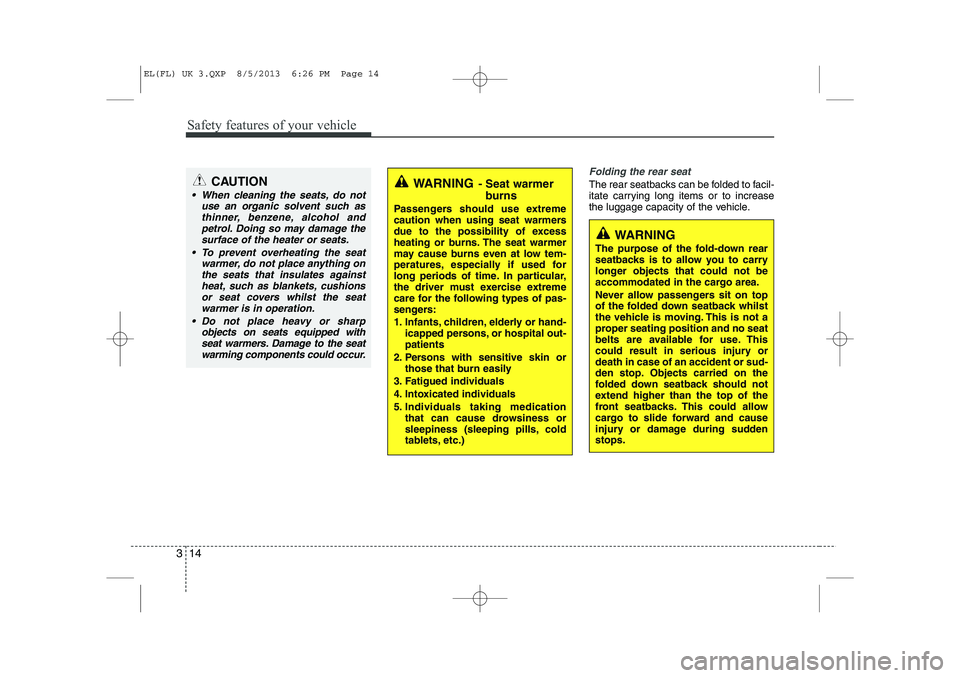
Folding the rear seat
The rear seatbacks can be folded to facil-
itate carrying long items or to increase
the luggage capacity of the vehicle.CAUTION
When cleaning the seats, do not
use an organic solvent such as
thinner, benzene, alcohol andpetrol. Doing so may damage thesurface of the heater or seats.
To prevent overheating the seat warmer, do not place anything onthe seats that insulates againstheat, such as blankets, cushionsor seat covers whilst the seat
warmer is in operation.
Do not place heavy or sharp objects on seats equipped withseat warmers. Damage to the seat
warming components could occur.WARNING - Seat warmer
burns
Passengers should use extreme
caution when using seat warmers
due to the possibility of excess
heating or burns. The seat warmer
may cause burns even at low tem-
peratures, especially if used for
long periods of time. In particular,
the driver must exercise extreme
care for the following types of pas-
sengers:
1. Infants, children, elderly or hand- icapped persons, or hospital out- patients
2. Persons with sensitive skin or those that burn easily
3. Fatigued individuals
4. Intoxicated individuals
5. Individuals taking medication that can cause drowsiness or
sleepiness (sleeping pills, cold
tablets, etc.)
WARNING
The purpose of the fold-down rear
seatbacks is to allow you to carry
longer objects that could not be
accommodated in the cargo area.
Never allow passengers sit on top
of the folded down seatback whilst
the vehicle is moving. This is not a
proper seating position and no seat
belts are available for use. This
could result in serious injury ordeath in case of an accident or sud-
den stop. Objects carried on the
folded down seatback should not
extend higher than the top of the
front seatbacks. This could allow
cargo to slide forward and cause
injury or damage during suddenstops.
EL(FL) UK 3.QXP 8/5/2013 6:26 PM Page 14
Page 1022 of 1534
Safety features of your vehicle
16
3
WARNING
When you return the rear seatback to its upright position after being
folded down:
Be careful not to damage the seat
belt webbing or buckle. Do not
allow the seat belt webbing or
buckle to get caught or pinched in
the rear seat. Ensure that the seat-
back is completely locked into its
upright position by pushing on the
top of the seatback. Otherwise, in
an accident or sudden stop, the
seat could fold down and allow
cargo to enter the passenger com-
partment, which could result in
serious injury or death.
WARNING - Uprighting seat
When you return the seatback to its
upright position, hold the seatback
and return it slowly. If the seatback
is returned without holding it, the
back of the seat could spring for-
ward resulting in injury caused by
being struck by the seatback.
WARNING - Cargo loading
Make sure the engine is off, the
automatic transaxle is in P (Park)
or the manual transaxle is in R
(Reverse) or 1st, and the parking
brake is securely applied whenever
loading or unloading cargo. Failure
to take these steps may allow the
vehicle to move if shift lever is inad-
vertently moved to another posi-tion.
WARNING - Cargo
Cargo should always be secured to
prevent it from being thrown about
the vehicle in a collision and caus-
ing injury to the vehicle occupants.Special care of objects should betaken when placing them in the rear
seats, since those may hit the front
seat occupants in a frontal colli-sion.
CAUTION - Rear seat belts
When returning the rear seatbacks
to the upright position, remember to return the rear shoulder belts totheir proper position. Routing the
seat belt webbing through the rearseat belt guides will help keep the belts from being trapped behind orunder the seats.
CAUTION - Damaging rear
seat belt buckles
When you fold the rear seatback or put luggage on the rear seat cush-
ion, insert the buckle in the pocket between the rear seatback andcushion. Doing so can prevent the buckle from being damaged by the
rear seatback or luggage.
EL(FL) UK 3.QXP 8/5/2013 6:27 PM Page 16
Page 1030 of 1534
Safety features of your vehicle
24
3
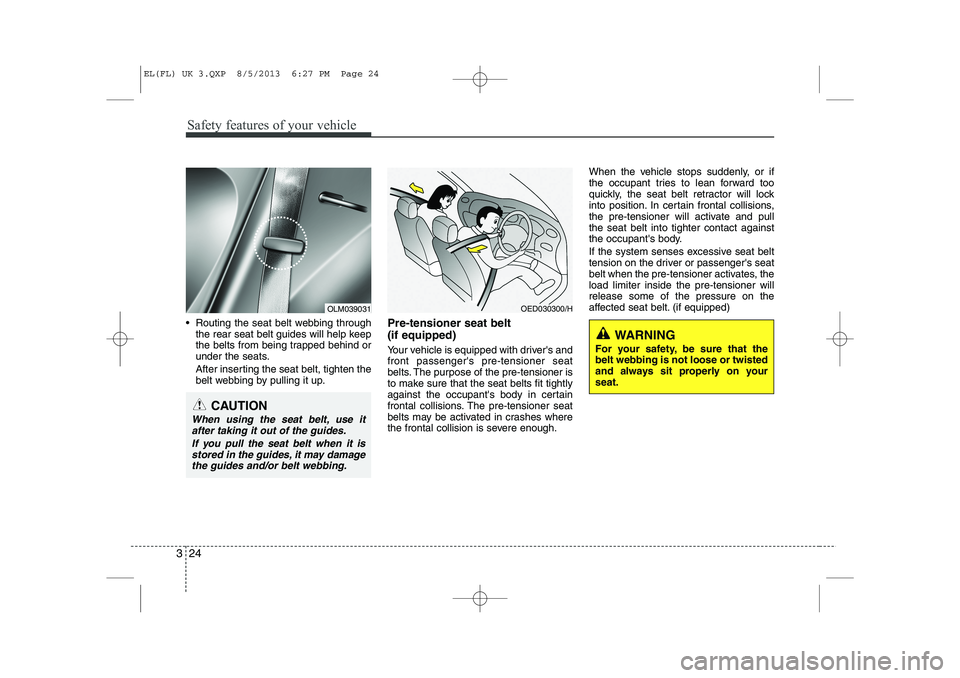
Routing the seat belt webbing through
the rear seat belt guides will help keep
the belts from being trapped behind or
under the seats.
After inserting the seat belt, tighten the
belt webbing by pulling it up. Pre-tensioner seat belt (if equipped)
Your vehicle is equipped with driver's and front passenger's pre-tensioner seat
belts. The purpose of the pre-tensioner is
to make sure that the seat belts fit tightly
against the occupant's body in certain
frontal collisions. The pre-tensioner seat
belts may be activated in crashes where
the frontal collision is severe enough. When the vehicle stops suddenly, or if
the occupant tries to lean forward too
quickly, the seat belt retractor will lock
into position. In certain frontal collisions,
the pre-tensioner will activate and pullthe seat belt into tighter contact against
the occupant's body.
If the system senses excessive seat belt
tension on the driver or passenger's seat
belt when the pre-tensioner activates, theload limiter inside the pre-tensioner willrelease some of the pressure on the
affected seat belt. (if equipped)
CAUTION
When using the seat belt, use it
after taking it out of the guides.
If you pull the seat belt when it isstored in the guides, it may damage
the guides and/or belt webbing.
OED030300/HOLM039031
WARNING
For your safety, be sure that the belt webbing is not loose or twisted
and always sit properly on yourseat.
EL(FL) UK 3.QXP 8/5/2013 6:27 PM Page 24
Page 1033 of 1534
327
Safety features of your vehicle
Seat belt precautionsInfant or small child
You should be aware of the specific
requirements in your country. Child
and/or infant seats must be properly
placed and installed in the rear seat. For
more information about the use of these
restraints, refer to “Child restraint sys-
tem” in this section.✽✽NOTICE
Small children are best protected from
injury in an accident when properly
restrained in the rear seat by a child
restraint system that meets the require-
ments of the Safety Standards of your
country. Before buying any child
restraint system, make sure that it has alabel certifying that it meets Safety
Standards of your country. The restraint
must be appropriate for your child'sheight and weight. Check the label on
the child restraint for this information.
Refer to “Child restraint system” in thissection.
WARNING
All occupants of the vehicle must wear their seat belts at all times.
Seat belts and child restraintsreduce the risk of serious or fatal
injuries for all occupants in the
event of a collision or sudden stop.
Without a seat belt, occupants
could be shifted too close to a
deploying air bag, strike the interior
structure or be thrown from the
vehicle. Properly worn seat belts
greatly reduce these hazards.
Always follow the precautions
about seat belts, air bags and occu-
pant seat contained in this manual.
WARNING
Every person in your vehicle needs
to be properly restrained at all
times, including infants and chil-
dren. Never hold a child in yourarms or lap when riding in a vehi-
cle. The violent forces created dur-
ing a crash will tear the child from
your arms and throw the child
against the interior. Always use a
child restraint appropriate for your
child's height and weight.
EL(FL) UK 3.QXP 8/5/2013 6:27 PM Page 27
Page 1035 of 1534
329
Safety features of your vehicle
Injured person
A seat belt should be used when an
injured person is being transported. For
specific recommendations, the advice of
a qualified Medical Practioner should besought.
One person per belt
The seat belts are designed to be used
by one seat occupant only. The use of a
seat belt by more than one person
increases the levels of injury which may
be sustained in the event of an accident.
Do not lie down
To reduce the chance of injuries in the
event of an accident and to achieve max-
imum effectiveness of the restraint sys-tem, all passengers should be sitting upand the front seats should be in an
upright position when the car is moving.
A seat belt cannot provide proper protec-
tion if the person is lying down in the rearseat or if the front seat is in a reclinedposition.Care of seat belts
Seat belt assemblies must never be dis-
assembled or modified in any way. In
addition, care should be exercised to
ensure that the belt assemblies do not
become damaged by being trapped in
seat mechanisms, door shuts etc.
WARNING
Riding with a reclined seatback
increases your chance of serious
or fatal injuries in the event of a col-
lision or sudden stop. The protec-
tion of your restraint system (seat
belts and air bags) is greatly
reduced by reclining your seat.
Seat belts must be snug against
your hips and chest to work proper-
ly. The more the seatback is
reclined, the greater the chancethat an occupant's hips will slideunder the lap belt causing seriousinternal injuries or the occupant's
neck could strike the shoulder belt.
Drivers and passengers should
always sit well back in their seats,
properly belted, and with the seat-
backs upright.
WARNING
When you return the rear seatback to its upright position after the rear
seatback was folded down, be care-
ful not to damage the seat belt web-
bing or buckle. Be sure that the
webbing or buckle does not get
caught or pinched in the rear seat.
A seat belt with damaged webbing
or buckle will not be as strong and
could possibly fail during a colli-
sion or sudden stop, resulting in
serious injury. If the webbing or
buckles are damaged, get them
replaced immediately.
EL(FL) UK 3.QXP 8/5/2013 6:27 PM Page 29
Page 1037 of 1534
331
Safety features of your vehicle
CHILD RESTRAINT SYSTEM (IF EQUIPPED)
Children riding in the car should sit in the
rear seat and must always be properly
restrained to minimise the risk of injury inan accident, sudden stop or sudden
manoeuvre. According to accident statis-
tics, children are safer when properly
restrained in the rear seats than in the
front seat. Larger children not in a child
restraint should use one of the seat belts
provided.
You should be aware of the specific
requirements in your country. Child
and/or infant safety seats must be prop-
erly placed and installed in the rear seat.
You must use a commercially available
child restraint system that meets the
requirements of the Safety Standards of
your country. Child restraint systems are
designed to be secured in vehicle seats
by lap belts or the lap belt portion of a
lap/shoulder belt, or by a tether anchorand/or ISOFIX anchors (if equipped).Children could be injured or killed in a
crash if their restraints are not properly
secured. For small children and babies, a
child seat or infant seat must be used.
Before buying a particular child restraint
system, make sure it fits your car seat
and seat belts, and fits your child. Follow
all the instructions provided by the man-
ufacturer when installing the child
restraint system.
WARNING
A child restraint system must be placed in the rear seat. Never
install a child or infant seat on the
front passenger's seat. Should anaccident occur and cause the
passenger side air bag to deploy,
it could severely injure or kill an
infant or child seated in an infant
or child seat. Thus only use a
child restraint in the rear seat of
your vehicle.
A seat belt or child restraint sys- tem can become very hot if it is
left in a closed vehicle on a sunny
day, even if the outside tempera-
ture does not feel hot. Be sure to
check the seat cover and buckles
before placing a child there.
When the child restraint system is not in use, store it in the lug-
gage area or fasten it with a seat
belt so that it will not be thrown
forward in case of a sudden stopor an accident.
Children may be seriously injured or killed by an inflating air bag.
All children, even those too large
for child restraints, must ride inthe rear seat.WARNING
To reduce the chance or serious or fatal injuries:
Children of all ages are safer when restrained in the rear seat.
A child riding in the front passen-
ger seat can be forcefully struck
by an inflating air bag resulting inserious or fatal injuries.
Always follow the instructions for installation and use of the child
restraint maker.
Always make sure the child seat is secured properly in the car and
your child is securely restrained
in the child seat.
Never hold a child in your arms or lap when riding in a vehicle. The
violent forces created during a
crash will tear the child from your
arms and throw the child against
the car’s interior.
Never put a seat belt over your- self and a child. During a crash,the belt could press deep into the
child causing serious internalinjuries.
(Continued)
EL(FL) UK 3.QXP 8/5/2013 6:27 PM Page 31
Page 1038 of 1534
Safety features of your vehicle
32
3
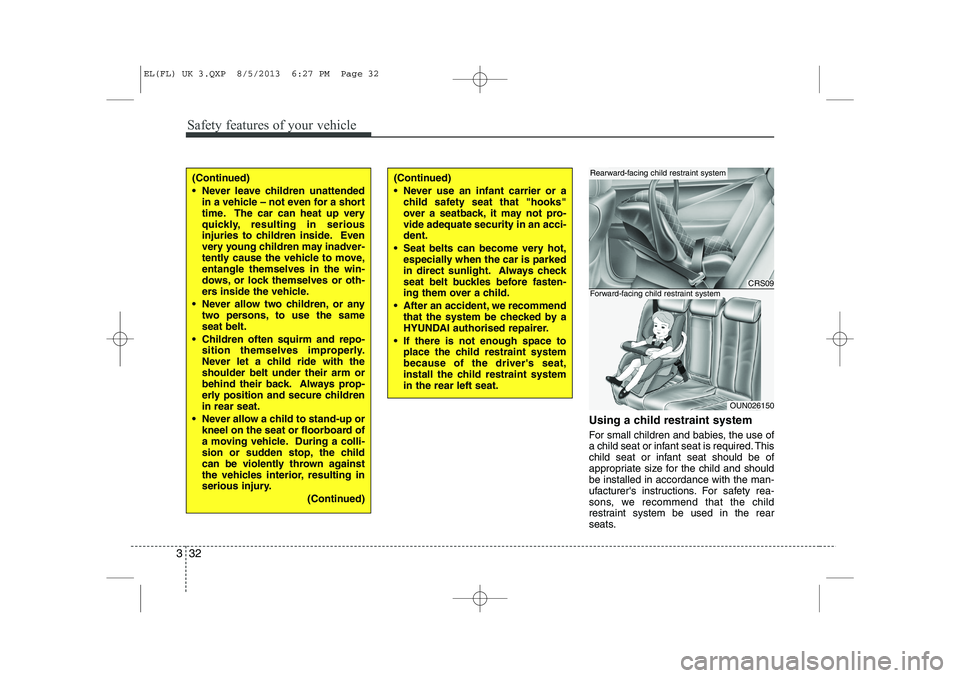
Using a child restraint system
For small children and babies, the use of
a child seat or infant seat is required. This
child seat or infant seat should be of
appropriate size for the child and shouldbe installed in accordance with the man-
ufacturer's instructions. For safety rea-
sons, we recommend that the child
restraint system be used in the rear
seats.
(Continued)
Never leave children unattended
in a vehicle – not even for a short
time. The car can heat up very
quickly, resulting in serious
injuries to children inside. Even
very young children may inadver-
tently cause the vehicle to move,entangle themselves in the win-
dows, or lock themselves or oth-
ers inside the vehicle.
Never allow two children, or any two persons, to use the sameseat belt.
Children often squirm and repo- sition themselves improperly.
Never let a child ride with theshoulder belt under their arm or
behind their back. Always prop-
erly position and secure childrenin rear seat.
Never allow a child to stand-up or kneel on the seat or floorboard of
a moving vehicle. During a colli-
sion or sudden stop, the child
can be violently thrown against
the vehicles interior, resulting in
serious injury.
(Continued)(Continued)
Never use an infant carrier or achild safety seat that "hooks"
over a seatback, it may not pro-vide adequate security in an acci-dent.
Seat belts can become very hot, especially when the car is parked
in direct sunlight. Always check
seat belt buckles before fasten-
ing them over a child.
After an accident, we recommend that the system be checked by a
HYUNDAI authorised repairer.
If there is not enough space to place the child restraint systembecause of the driver's seat,
install the child restraint systemin the rear left seat.
CRS09
OUN026150
Rearward-facing child restraint system
Forward-facing child restraint system
EL(FL) UK 3.QXP 8/5/2013 6:27 PM Page 32
Page 1039 of 1534
333
Safety features of your vehicle
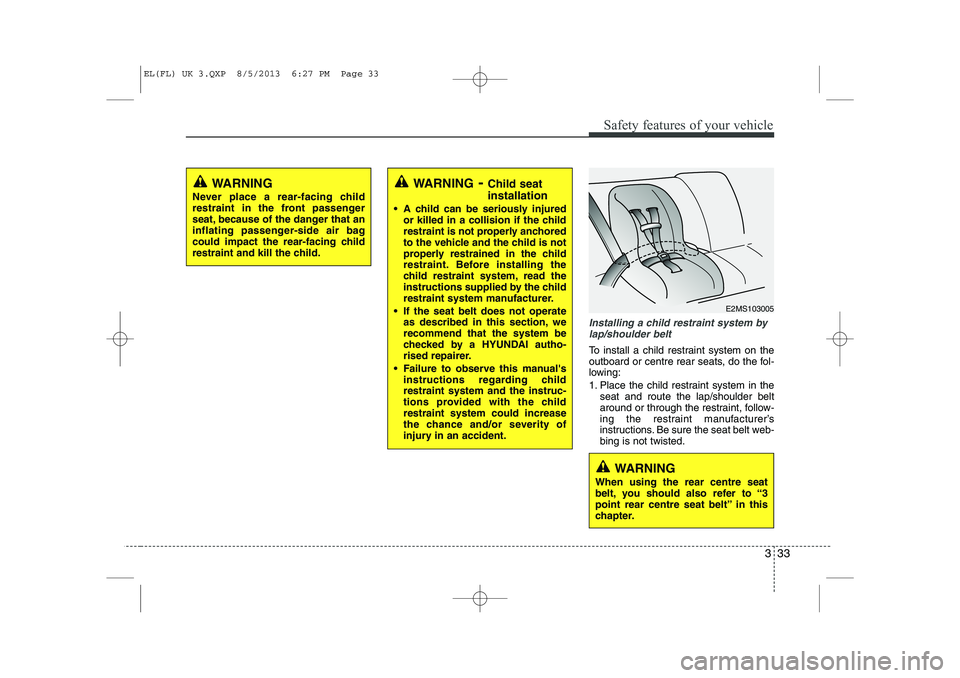
Installing a child restraint system bylap/shoulder belt
To install a child restraint system on the
outboard or centre rear seats, do the fol-
lowing:
1. Place the child restraint system in the seat and route the lap/shoulder belt
around or through the restraint, follow-
ing the restraint manufacturer’s
instructions. Be sure the seat belt web-bing is not twisted.
WARNING - Child seat installation
A child can be seriously injured or killed in a collision if the child
restraint is not properly anchored
to the vehicle and the child is not
properly restrained in the child
restraint. Before installing the
child restraint system, read the
instructions supplied by the child
restraint system manufacturer.
If the seat belt does not operate as described in this section, werecommend that the system be
checked by a HYUNDAI autho-
rised repairer.
Failure to observe this manual's instructions regarding childrestraint system and the instruc-
tions provided with the childrestraint system could increase
the chance and/or severity of
injury in an accident.WARNING
Never place a rear-facing child
restraint in the front passenger
seat, because of the danger that an
inflating passenger-side air bag
could impact the rear-facing child
restraint and kill the child.
E2MS103005
WARNING
When using the rear centre seat
belt, you should also refer to “3
point rear centre seat belt” in this
chapter.
EL(FL) UK 3.QXP 8/5/2013 6:27 PM Page 33