reduction HYUNDAI KONA EV 2022 User Guide
[x] Cancel search | Manufacturer: HYUNDAI, Model Year: 2022, Model line: KONA EV, Model: HYUNDAI KONA EV 2022Pages: 548, PDF Size: 49.14 MB
Page 318 of 548
Driving your vehicle
6-38
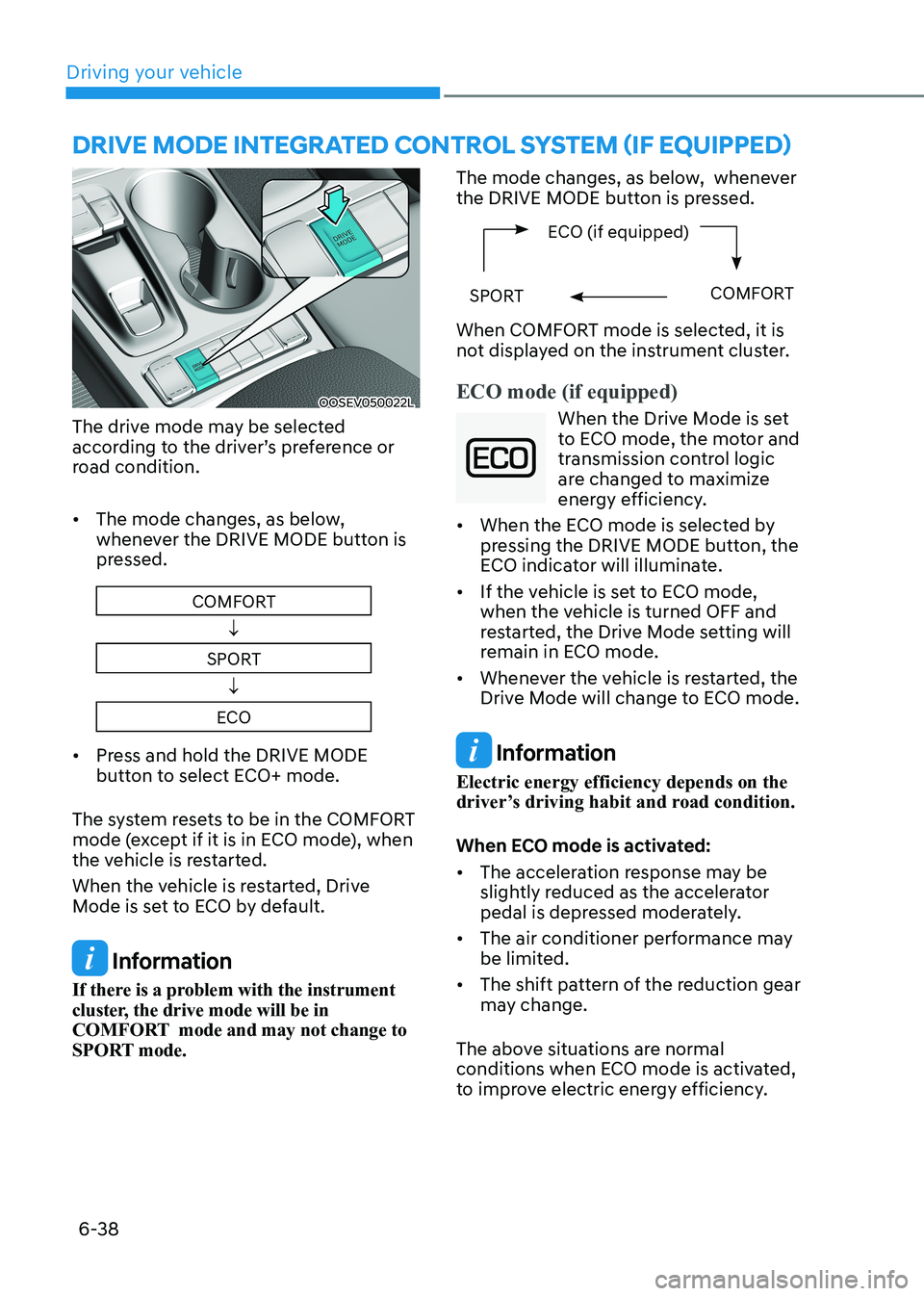
OOSEV050022L
The drive mode may be selected
according to the driver’s preference or
road condition. • The mode changes, as below,
whenever the DRIVE MODE button is
pressed.
COMFORT
↓
SPORT ↓
ECO
• Press and hold the DRIVE MODE
button to select ECO+ mode.
The system resets to be in the COMFORT
mode (except if it is in ECO mode), when
the vehicle is restarted.
When the vehicle is restarted, Drive
Mode is set to ECO by default.
Information
If there is a problem with the instrument
cluster, the drive mode will be in
COMFORT mode and may not change to
SPORT mode. The mode changes, as below, whenever
the DRIVE MODE button is pressed.
ECO (if equipped)
SPORTCOMFORT
When COMFORT mode is selected, it is
not displayed on the instrument cluster.
ECO mode (if equipped)
When the Drive Mode is set
to ECO mode, the motor and
transmission control logic
are changed to maximize
energy efficiency.
• When the ECO mode is selected by
pressing the DRIVE MODE button, the
ECO indicator will illuminate.
• If the vehicle is set to ECO mode,
when the vehicle is turned OFF and
restarted, the Drive Mode setting will
remain in ECO mode.
• Whenever the vehicle is restarted, the
Drive Mode will change to ECO mode.
Information
Electric energy efficiency depends on the
driver’s driving habit and road condition.
When ECO mode is activated: • The acceleration response may be
slightly reduced as the accelerator
pedal is depressed moderately.
• The air conditioner performance may
be limited.
• The shift pattern of the reduction gear
may change.
The above situations are normal
conditions when ECO mode is activated,
to improve electric energy efficiency.
dRIvE MOdE INTEgRATEd CONTROl SYSTEM (If EqUIPPEd)
Page 320 of 548
Driving your vehicle
6-40
SPECIAL DRIVING CONDITIONS
Hazardous driving conditions
When hazardous driving elements
are encountered such as water, snow,
ice, mud and sand, take the following
precautions: • Drive cautiously and maintain a longer
braking distance.
• Avoid abrupt braking or steering.
• When your vehicle is stuck in snow,
mud, or sand, accelerate slowly to
avoid unnecessary wheel spinning.
• Put sand, rock salt, tire chains or other
non-slip materials under the wheels
to provide additional traction while
being stuck in ice, snow, or mud.
Rocking the vehicle
If it is necessary to rock the vehicle to
free it from snow, sand, or mud, first turn
the steering wheel right and left to clear
the area around your front wheels. Then,
shift back and forth between R (Reverse)
and a forward gear.
Try to avoid spinning the wheels, and do
not race the vehicle.
To prevent reduction gear wear, wait
until the wheels stop spinning before
shifting gears. Release the accelerator
pedal while shifting, and press lightly on
the accelerator pedal while the reduction
gear wear is in gear. Slowly spinning the
wheels in forward and reverse directions
causes a rocking motion that may free
the vehicle.
WARNING
If the vehicle is stuck and excessive
wheel spin occurs, the temperature
in the tires can increase very quickly.
If the tires become damaged, a tire
blow out or tire explosion can occur.
This condition is dangerous - you and
others may be injured. Do not attempt
this procedure if people or objects are
anywhere near the vehicle.
If you attempt to free the vehicle, the
vehicle can overheat quickly, possibly
causing a motor compartment fire or
other damage. Try to avoid spinning the
wheels as much as possible to prevent
overheating of either the tires or the
vehicle. DO NOT allow the vehicle to
spin the wheels above 56 km/h (35
mph).
Information
The ESC system must be turned OFF
before rocking the vehicle.
NOTICE
If you are still stuck after rocking the
vehicle a few times, have the vehicle
pulled out by a tow vehicle to avoid
vehicle overheating, possible damage
to the reduction gear, and tire damage.
See “Towing” in chapter 8.
Page 476 of 548
08
8-21
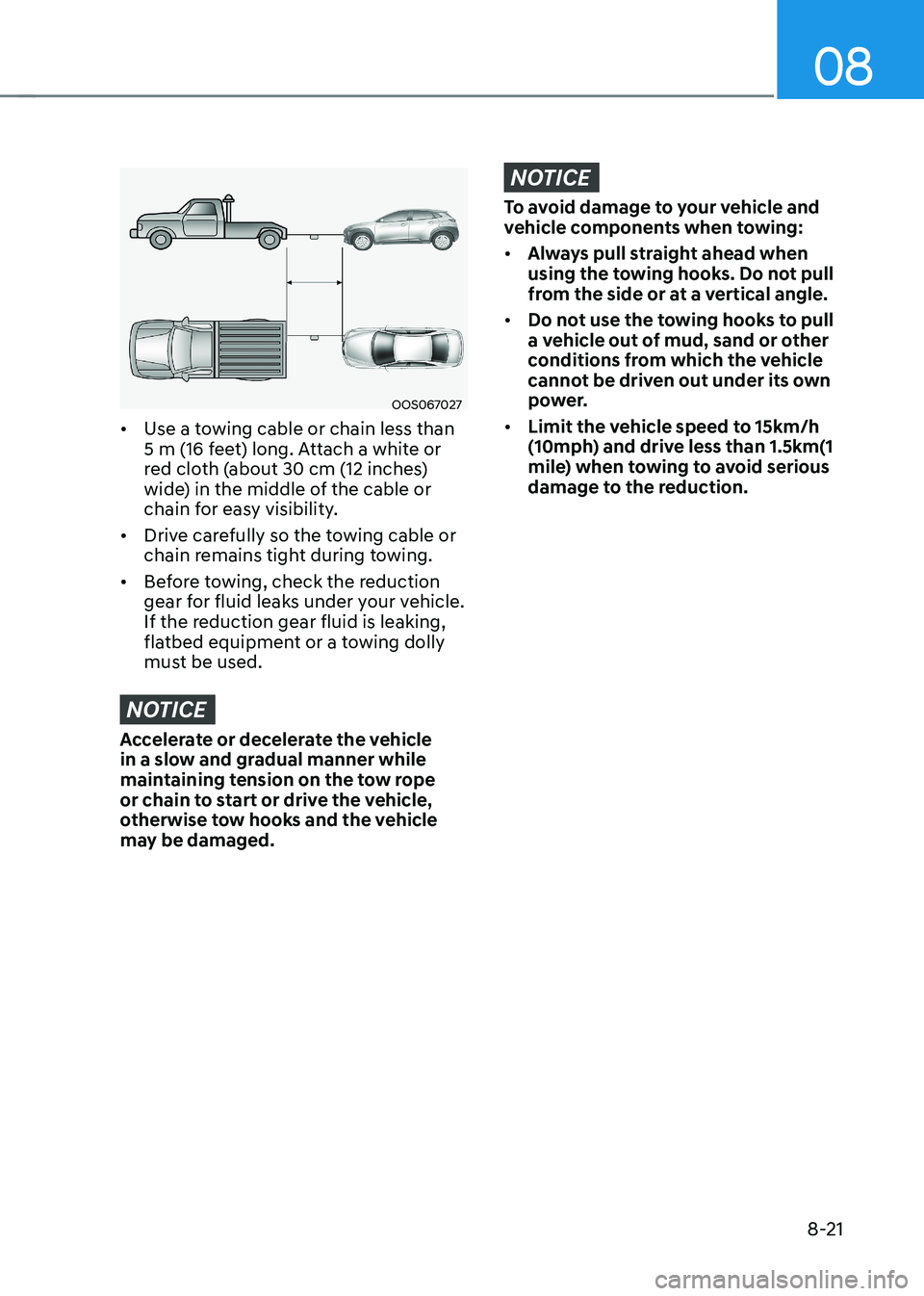
OOS067027
• Use a towing cable or chain less than
5 m (16 feet) long. Attach a white or
red cloth (about 30 cm (12 inches)
wide) in the middle of the cable or
chain for easy visibility.
• Drive carefully so the towing cable or
chain remains tight during towing.
• Before towing, check the reduction
gear for fluid leaks under your vehicle.
If the reduction gear fluid is leaking,
flatbed equipment or a towing dolly
must be used.
NOTICE
Accelerate or decelerate the vehicle
in a slow and gradual manner while
maintaining tension on the tow rope
or chain to start or drive the vehicle,
otherwise tow hooks and the vehicle
may be damaged.
NOTICE
To avoid damage to your vehicle and
vehicle components when towing: • Always pull straight ahead when
using the towing hooks. Do not pull
from the side or at a vertical angle.
• Do not use the towing hooks to pull
a vehicle out of mud, sand or other
conditions from which the vehicle
cannot be driven out under its own
power.
• Limit the vehicle speed to 15km/h
(10mph) and drive less than 1.5km(1
mile) when towing to avoid serious
damage to the reduction.
Page 477 of 548
9
9. Maintenance
Motor compartment ......................................................................................... 9-3
Maintenance services ....................................................................................... 9-4
Owner’s responsibility ................................................................................................ 9-4
Owner maintenance precautions............................................................................... 9-4
Owner maintenance ......................................................................................... 9-5
Owner maintenance schedule .................................................................................... 9-5
Scheduled maintenance services ..................................................................... 9 -7
Maintenance Schedule ................................................................................................ 9 -7
Explanation of scheduled maintenance items ...............................................9-9
Cooling system ............................................................................................................ 9-9
Coolant ......................................................................................................................... 9-9
Reduction gear fluid.................................................................................................... 9-9
Brake hoses and lines.................................................................................................. 9-9Brake fluid ................................................................................................................... 9-9
Brake pads, calipers and rotors .................................................................................. 9-9
Suspension mounting bolts ........................................................................................ 9-9
Drive shafts and boots ................................................................................................ 9-9
Air conditioning refrigerant/compressor................................................................... 9-9
Coolant ............................................................................................................. 9-10
Brake fluid ......................................................................................................... 9-11
Checking the brake fluid level .................................................................................... 9-11
Washer fluid ..................................................................................................... 9-12
Checking the washer fluid level ................................................................................ 9-12
Climate control air filter................................................................................... 9-13
Filter inspection ............................................................................................... 9-13
Filter replacement ...................................................................................................... 9-13
Wiper blades .................................................................................................... 9-14
Blade inspection ......................................................................................................... 9-14
Blade replacement ................................................................................................... 9-14
Battery (12 Volt) ................................................................................................ 9-17
Battery usage.............................................................................................................. 9-18 Battery capacity label ................................................................................................ 9-18
Battery recharging ..................................................................................................... 9-18
Reset items ................................................................................................................. 9-19
Page 482 of 548
Maintenance
9-6
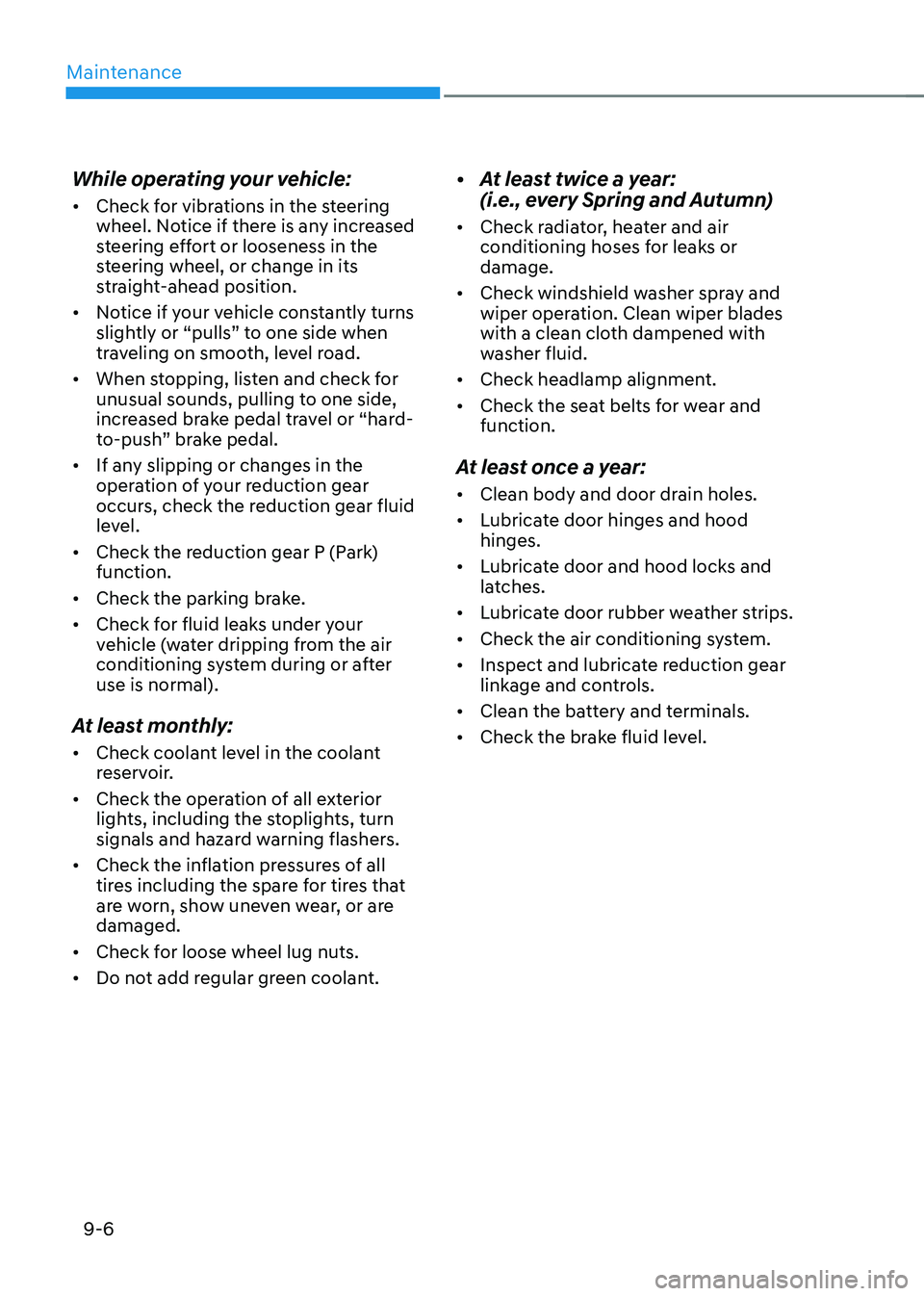
While operating your vehicle: •
Check for vibrations in the steering
wheel. Notice if there is any increased
steering effort or looseness in the
steering wheel, or change in its
straight-ahead position.
• Notice if your vehicle constantly turns
slightly or “pulls” to one side when
traveling on smooth, level road.
• When stopping, listen and check for
unusual sounds, pulling to one side,
increased brake pedal travel or “hard-
to-push” brake pedal.
• If any slipping or changes in the
operation of your reduction gear
occurs, check the reduction gear fluid
level.
• Check the reduction gear p (park) function.
• Check the parking brake.
• Check for fluid leaks under your
vehicle (water dripping from the air
conditioning system during or after use is normal).
At least monthly: • Check coolant level in the coolant
reservoir.
• Check the operation of all exterior
lights, including the stoplights, turn
signals and hazard warning flashers.
• Check the inflation pressures of all
tires including the spare for tires that
are worn, show uneven wear, or are damaged.
• Check for loose wheel lug nuts.
• Do not add regular green coolant. •
At least twice a year:
(i.e., every Spring and Autumn)
• Check radiator, heater and air
conditioning hoses for leaks or damage.
• Check windshield washer spray and
wiper operation. Clean wiper blades
with a clean cloth dampened with
washer fluid.
• Check headlamp alignment.
• Check the seat belts for wear and function.
At least once a year: • Clean body and door drain holes.
• Lubricate door hinges and hood hinges.
• Lubricate door and hood locks and
latches.
• Lubricate door rubber weather strips.
• Check the air conditioning system.
• Inspect and lubricate reduction gear
linkage and controls.
• Clean the battery and terminals.
• Check the brake fluid level.
Page 485 of 548
09
9-9
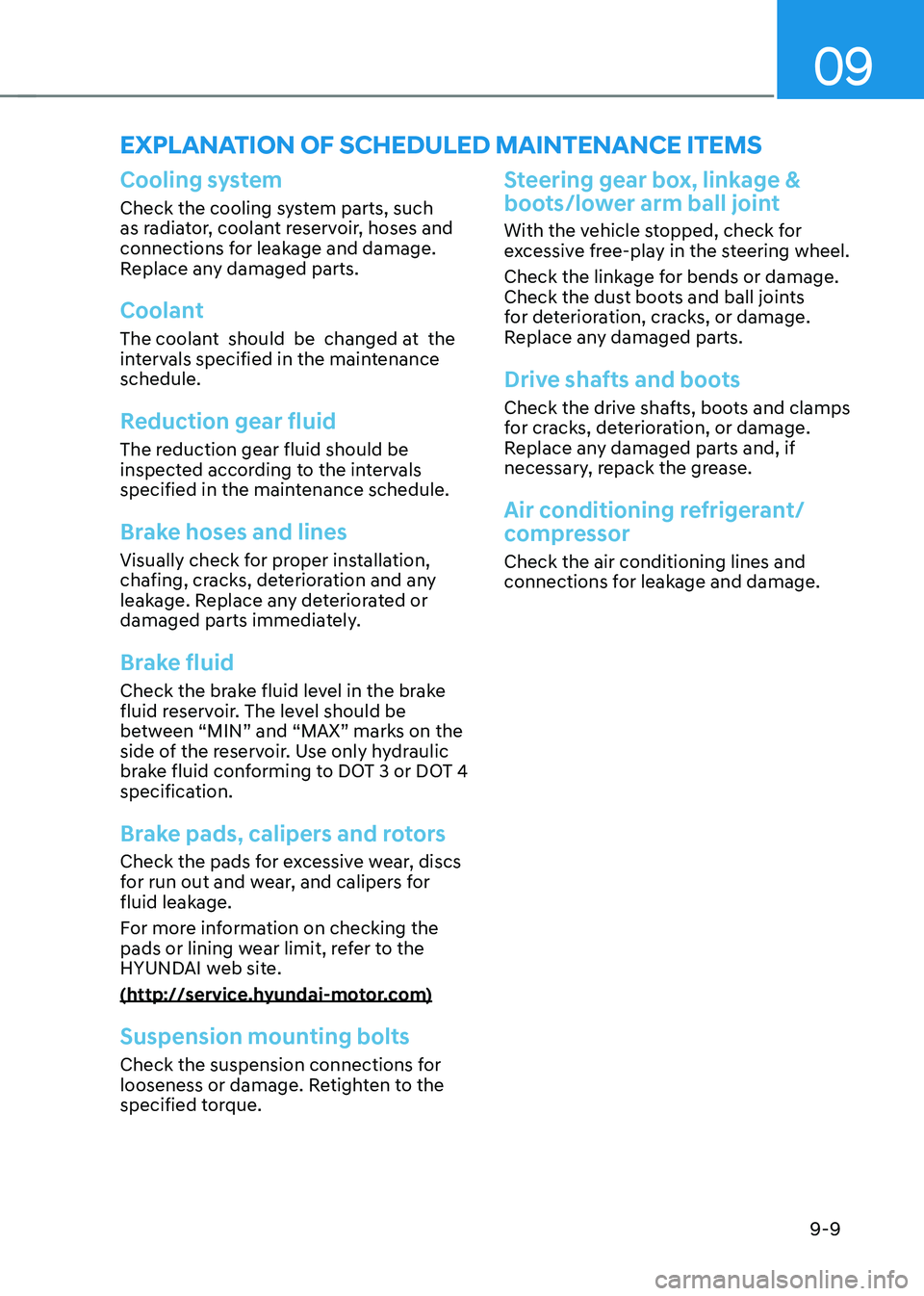
EXPLANATION OF SCHEDULED MAINTENANCE ITEMS
Cooling system
Check the cooling system parts, such
as radiator, coolant reservoir, hoses and
connections for leakage and damage.
Replace any damaged parts.
Coolant
The coolant should be changed at the
intervals specified in the maintenance schedule.
Reduction gear fluid
The reduction gear fluid should be
inspected according to the intervals
specified in the maintenance schedule.
Brake hoses and lines
Visually check for proper installation,
chafing, cracks, deterioration and any
leakage. Replace any deteriorated or
damaged parts immediately.
Brake fluid
Check the brake fluid level in the brake
fluid reservoir. The level should be
between “MIN” and “MAX” marks on the
side of the reservoir. Use only hydraulic
brake fluid conforming to DOT 3 or DOT 4
specification.
Brake pads, calipers and rotors
Check the pads for excessive wear, discs
for run out and wear, and calipers for
fluid leakage.
For more information on checking the
pads or lining wear limit, refer to the
HYUNDAI web site.
(http://service.hyundai-motor.com)
Suspension mounting bolts
Check the suspension connections for
looseness or damage. Retighten to the
specified torque.
Steering gear box, linkage &
boots/lower arm ball joint
With the vehicle stopped, check for
excessive free-play in the steering wheel.
Check the linkage for bends or damage.
Check the dust boots and ball joints
for deterioration, cracks, or damage.
Replace any damaged parts.
Drive shafts and boots
Check the drive shafts, boots and clamps
for cracks, deterioration, or damage.
Replace any damaged parts and, if
necessary, repack the grease.
Air conditioning refrigerant/
compressor
Check the air conditioning lines and
connections for leakage and damage.
Page 539 of 548
Index
I-4
D
Declaration of conformity......................................................................... 2-13/7-120
Front radar ...................................................................................................... 7-120
Rear corner radar ............................................................................................ 7-122
Dimensions ............................................................................................................ 2-7
Drive mode integrated control system ................................................................. 6-38
Initial setting for each drive mode .................................................................... 6-39
Driver Attention Warning (DAW) ....................................................................... 7-54
Driver Attention Warning malfunction and limitations ....................................7-57
Driver Attention Warning operation ................................................................. 7-55
Driver Attention Warning settings ................................................................... 7-54
E Electric vehicle specifications ............................................................................... 2-7
Explanation of scheduled maintenance items ........................................................9-9
Air conditioning refrigerant/compressor ............................................................9-9
Brake fluid ......................................................................................................... 9-9
Brake hoses and lines ......................................................................................... 9-9
Brake pads, calipers and rotors .......................................................................... 9-9
Coolant ............................................................................................................... 9-9
Cooling system ................................................................................................... 9-9
Drive shafts and boots ........................................................................................ 9-9
Reduction gear fluid ........................................................................................... 9-9
Suspension mounting bolts................................................................................. 9-9
Exterior features.......................................................................................... 5-41/5-92
Charging door ................................................................................................... 5-45
Hood ................................................................................................................. 5-41
Roof rack .......................................................................................................... 5-92
Tailgate ............................................................................................................. 5-43
Exterior overview (I) ............................................................................................. 2-2
Exterior overview (II) ............................................................................................ 2-3
Page 544 of 548
I
I-9
R
Rear Cross-Traffic Collision-Avoidance Assist (RCCA) ..................................7-101
Rear Cross-Traffic Collision-Avoidance Assist malfunction
and limitations .............................................................................................. 7-107
Rear Cross-Traffic Collision-Avoidance Assist operation .............................7-103
Rear Cross-Traffic Collision-Avoidance Assist settings ................................7-102
Rear View Monitor (RVM) .................................................................................. 7-98
Rear View Monitor malfunction and limitations ............................................7-100
Rear View Monitor operation ........................................................................... 7-99
Rear View Monitor settings .............................................................................. 7-98
Recommended lubricants and capacities .............................................................2-11
Reduction gear ....................................................................................................... 6-8
Good driving practices ..................................................................................... 6-13
LCD display messages ..................................................................................... 6-10
Reduction gear operation .................................................................................. 6-8
Regenerative braking system ............................................................................... 6-14
One pedal driving ............................................................................................. 6-15
Regenerative braking (Paddle shifter) ..............................................................6-14
Reporting safety defects ...................................................................................... 2-14
Reverse Parking Distance Warning (PDW) .......................................................7-112
Reverse Parking Distance Warning malfunction and precautions .................7-113
Reverse Parking Distance Warning operation ................................................7-112
Reverse Parking Distance Warning settings ...................................................7-112
S
Safe Exit Warning (SEW) .................................................................................... 7-48
Safe Exit Warning malfunction and limitations ...............................................7-51
Safe Exit Warning operation ............................................................................ 7-50
Safe Exit Warning settings ............................................................................... 7-49
Scheduled maintenance services............................................................................ 9-7
Maintenance Schedule ........................................................................................ 9-7
Seat belts .............................................................................................................. 3-20
Additional seat belt safety precautions .............................................................3-28
Care of seat belts .............................................................................................. 3-30
Seat belt restraint system .................................................................................. 3-22
Seat belt safety precautions .............................................................................. 3-20
Seat belt warning light ...................................................................................... 3-21