ECU HYUNDAI KONA EV 2022 Workshop Manual
[x] Cancel search | Manufacturer: HYUNDAI, Model Year: 2022, Model line: KONA EV, Model: HYUNDAI KONA EV 2022Pages: 548, PDF Size: 49.14 MB
Page 494 of 548
Maintenance
9-18
Battery Usage
Recommendations
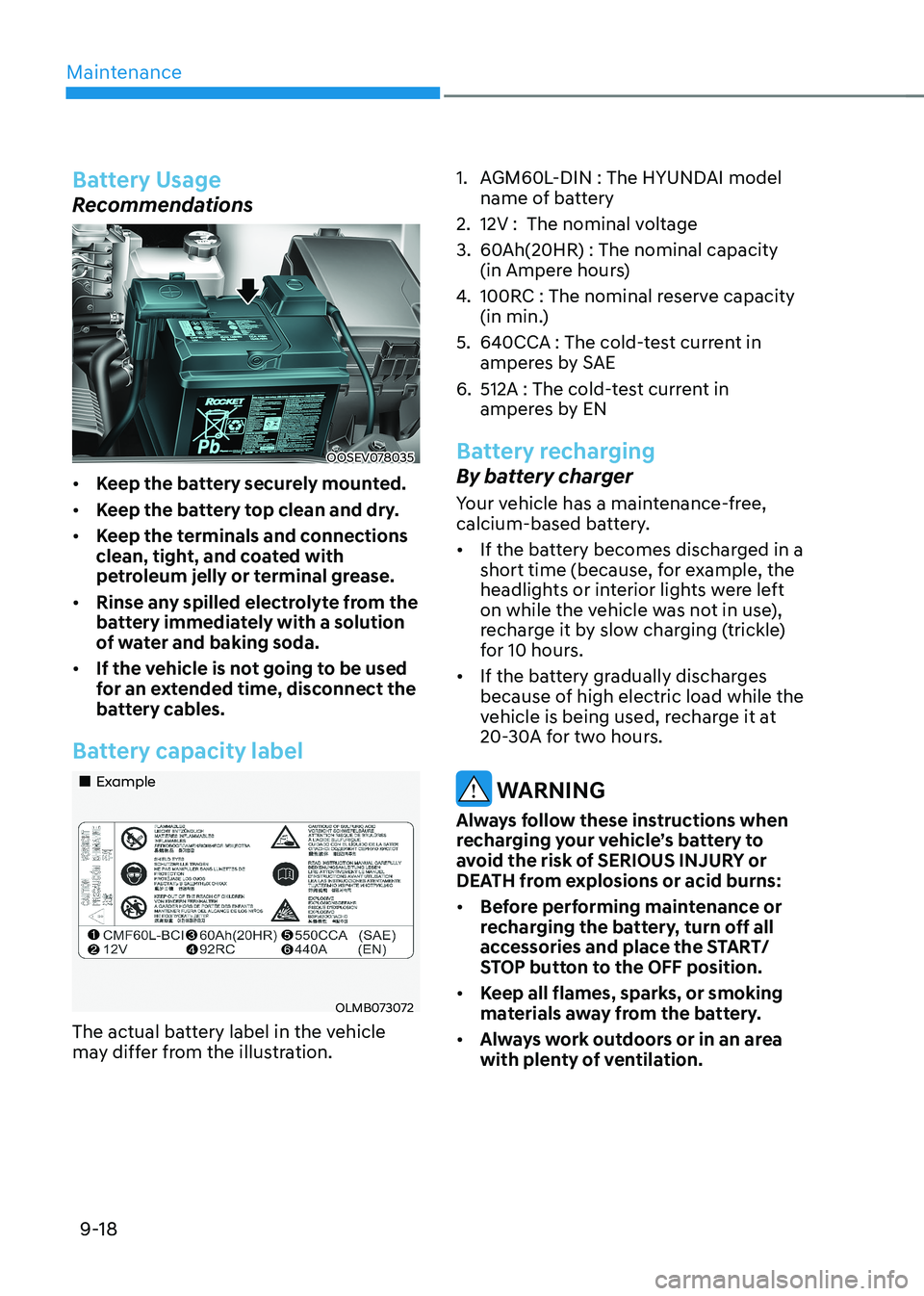
OOSEV078035
• Keep the battery securely mounted.
• Keep the battery top clean and dry.
• Keep the terminals and connections
clean, tight, and coated with
petroleum jelly or terminal grease.
• Rinse any spilled electrolyte from the
battery immediately with a solution
of water and baking soda.
• If the vehicle is not going to be used
for an extended time, disconnect the
battery cables.
Battery capacity label
„„Example
OLMB073072
The actual battery label in the vehicle
may differ from the illustration. 1. AGM60L-DIN : The HYUNDAI model
name of battery
2. 12V : The nominal voltage
3. 60Ah(20HR) : The nominal capacity (in Ampere hours)
4. 100RC : The no minal reserve capacity
(in min.)
5. 640CCA : The cold-test current in amperes by SAE
6. 512A : The cold-test current in amperes by EN
Battery recharging
By battery charger
Your vehicle has a maintenance-free,
calcium-based battery. • If the battery becomes discharged in a
short time (because, for example, the
headlights or interior lights were left
on while the vehicle was not in use),
recharge it by slow charging (trickle)
for 10 hours.
• If the battery gradually discharges
because of high electric load while the
vehicle is being used, recharge it at
20-30A for two hours.
WARNING
Always follow these instructions when
recharging your vehicle’s battery to
avoid the risk of SERIOUS INJURY or
DEATH from explosions or acid burns: • Before performing maintenance or
recharging the battery, turn off all
accessories and place the START/
STOP button to the OFF position.
• Keep all flames, sparks, or smoking
materials away from the battery.
• Always work outdoors or in an area
with plenty of ventilation.
Page 511 of 548
09
9-35
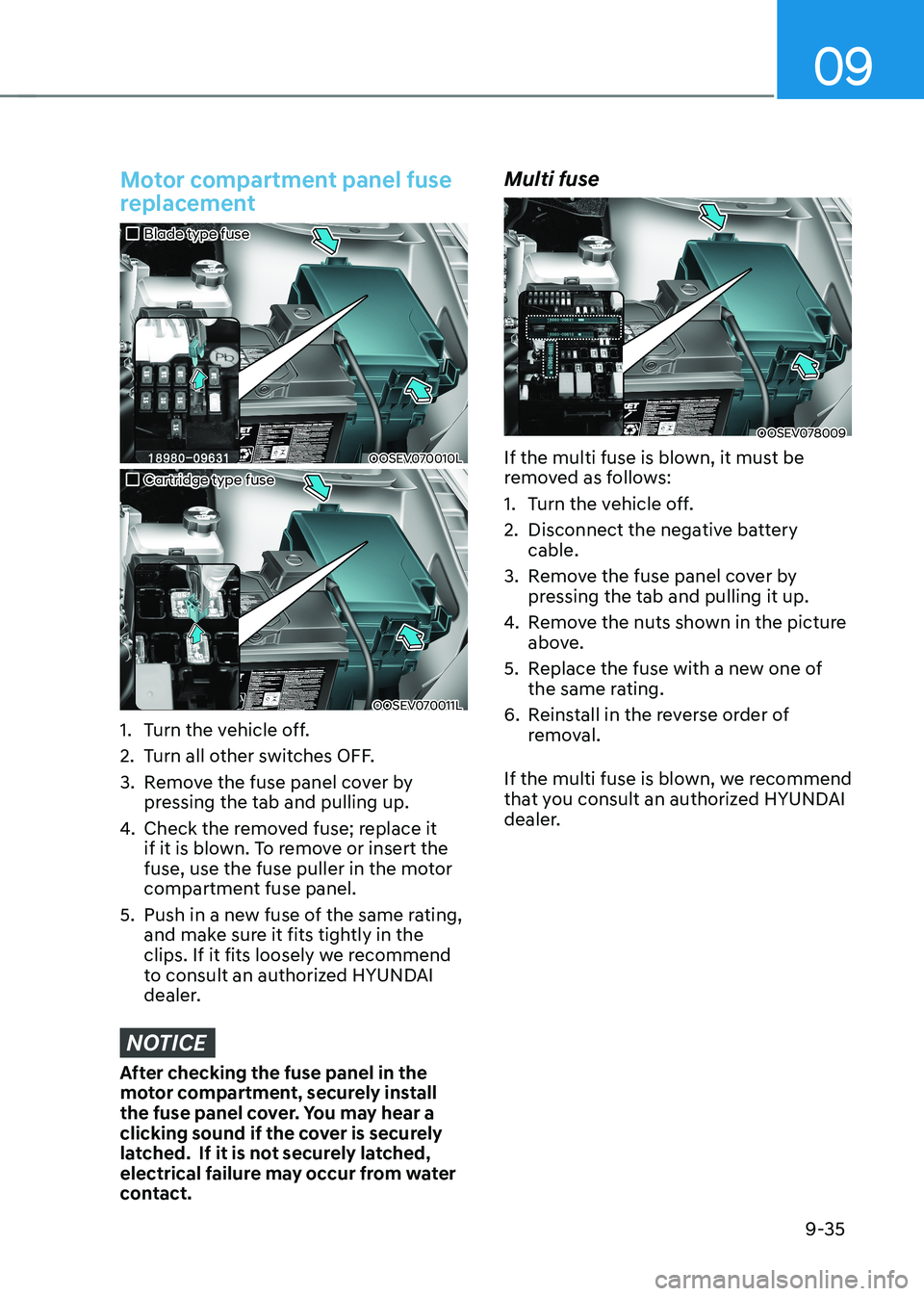
Motor compartment panel fuse
replacement
„„Blade type fuse
OOSEV070010L
„„Cartridge type fuse
OOSEV070011L
1. Turn the vehicle off.
2. Turn all other switches OFF.
3. Remove the fuse panel cover by pressing the tab and pulling up.
4. Check the removed fuse; replace it
if it is blown. To remove or insert the
fuse, use the fuse puller in the motor
compartment fuse panel.
5. push in a new fuse of the same rating, and make sure it fits tightly in the
clips. If it fits loosely we recommend
to consult an authorized HYUNDAI
dealer.
NOTICE
After checking the fuse panel in the
motor compartment, securely install
the fuse panel cover. You may hear a
clicking sound if the cover is securely
latched. If it is not securely latched,
electrical failure may occur from water
contact. Multi fuse
OOSEV078009
If the multi fuse is blown, it must be
removed as follows:
1. Turn the vehicle off.
2. Disconnect the negative battery cable.
3. Remove the fuse panel cover by pressing the tab and pulling it up.
4. Remove the nuts shown in the picture
above.
5. Replace the fuse with a new one of the same rating.
6. Reinstall in the reverse order of removal.
If the multi fuse is blown, we recommend
that you consult an authorized HYUNDAI
dealer.
Page 519 of 548
09
9-43
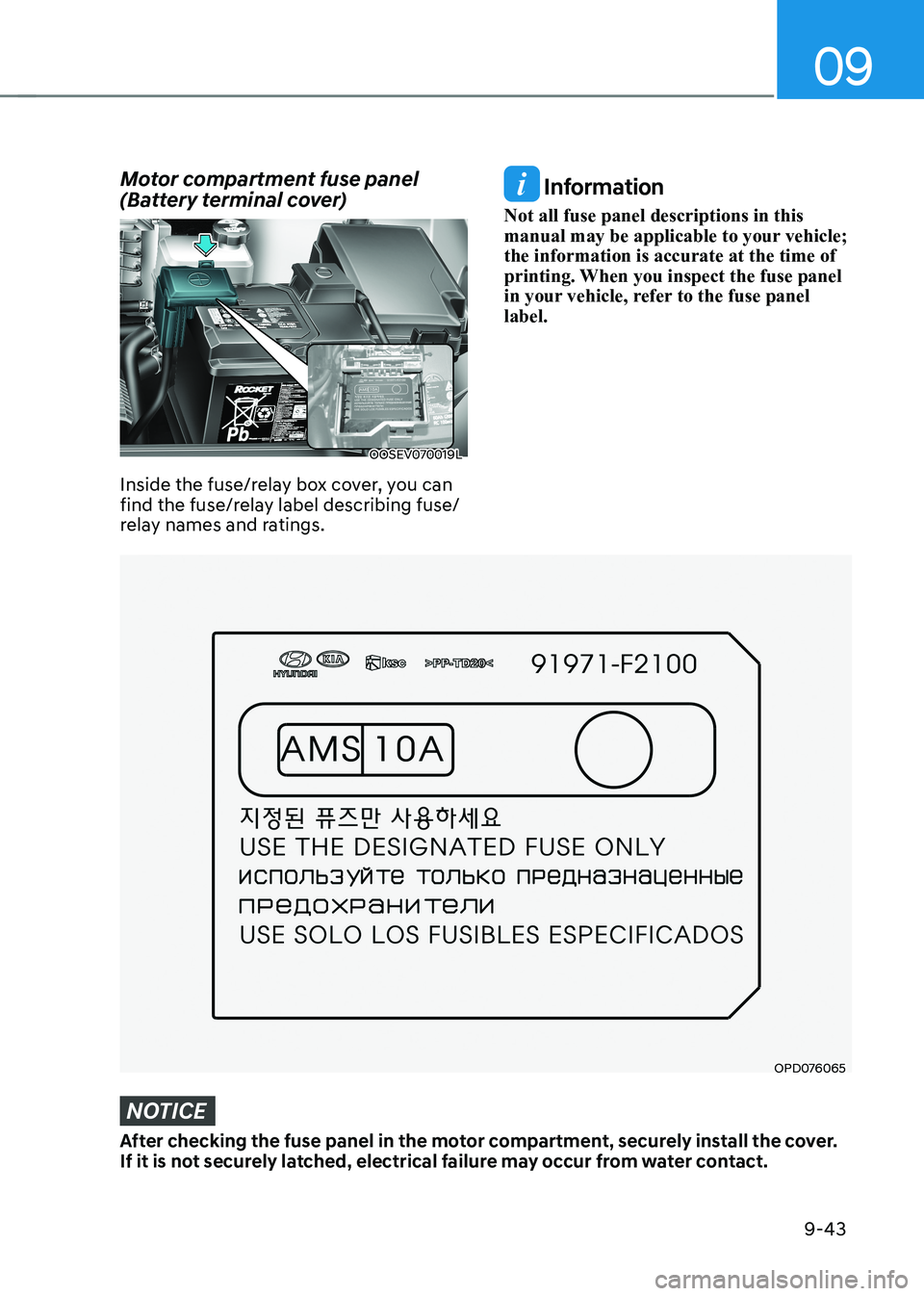
Motor compartment fuse panel
(Battery terminal cover)
OOSEV070019L
Inside the fuse/relay box cover, you can
find the fuse/relay label describing fuse/
relay names and ratings.
OPD076065
Information
Not all fuse panel descriptions in this
manual may be applicable to your vehicle; the information is accurate at the time of
printing. When you inspect the fuse panel
in your vehicle, refer to the fuse panel label.
NOTICE
After checking the fuse panel in the motor compartment, securely install the cover.
If it is not securely latched, electrical failure may occur from water contact.
Page 545 of 548
Index
I-10Seats
....................................................................................................................... 3-3
Front seats .......................................................................................................... 3-5
Headrest ............................................................................................................ 3-13
Rear seats .......................................................................................................... 3-10
Safety precautions .............................................................................................. 3-4
Seat warmers and air ventilation seats .............................................................3-17
Smart Cruise Control (SCC) ............................................................................... 7-64
Smart Cruise Control display and control ........................................................7-69
Smart Cruise Control malfunction and limitations ..........................................7-74
Smart Cruise Control operation ........................................................................ 7-68
Smart Cruise Control settings .......................................................................... 7-65
Smart recuperation system (if equipped with smart cruise control system) ........6-16
Limitations of the system ................................................................................. 6-19
Smart recuperation system will be temporarily cancelled when: .....................6-18
System malfunction .......................................................................................... 6-19
System setting .................................................................................................. 6-16
To activate smart recuperation system .............................................................6-16
To resume smart recuperation system ..............................................................6-18
To turn smart recuperation system off ..............................................................6-18
Vehicle-to-vehicle distance recognition sensor (front radar) ...........................6-18
Special driving conditions ................................................................................... 6-40
Driving at night ................................................................................................ 6-41
Driving in flooded areas ................................................................................... 6-42
Driving in the rain ............................................................................................ 6-41
Hazardous driving conditions ........................................................................... 6-40
Highway driving ............................................................................................... 6-42
Reducing the risk of a rollover ......................................................................... 6-42
Rocking the vehicle .......................................................................................... 6-40
Smooth cornering ............................................................................................. 6-41
START/STOP button ............................................................................................. 6-4
START/STOP button positions .......................................................................... 6-5
Starting the vehicle ............................................................................................. 6-6
Turning off the vehicle ....................................................................................... 6-7
Steering wheel ..................................................................................................... 5-16
Electric power steering (EPS) .......................................................................... 5-16
Heated steering wheel ...................................................................................... 5-18
Horn .................................................................................................................. 5-18
Tilt steering/Telescopic steering ....................................................................... 5-17