warning Hyundai Matrix 2003 Owner's Manual
[x] Cancel search | Manufacturer: HYUNDAI, Model Year: 2003, Model line: Matrix, Model: Hyundai Matrix 2003Pages: 312, PDF Size: 4.1 MB
Page 230 of 312

1- 49
CONTROLS AND EQUIPMENT
B540A01FC-GAT
TAIL GATE
B540A01FC
WARNING: The tail gate should always be kept com-
pletely closed while the vehicle is in mo- tion. If it is left open or ajar, poisonousexhaust gases may enter the car resultingin serious illness or death to the occu-pants. See additional warnings concerningexhaust gases on page 2-1.
o The tail gate can be locked or unlocked with a key.
o The tail gate is opened by pulling the outside handle up, raising the tail gate manually.
o To close, lower the tail gate, then press down on it until it is closed. To be sure thetail gate is fully closed, always try to pull itup again without using the outside handle. LOCK
UNLOCK
B540D01FC-DAT
Luggage Net
Some objects can be kept in the net in the
luggage compartment. Use the luggage net on the floor or at the back
of the luggage compartment to prevent the objects from sliding.
B540D01HP
WARNING:
Fuel vapours are dangerous. Before refuel-
ling, turn off the engine and never allow sparks, lit cigarettes or open flames nearthe filler area. When releasing the fillercap, a small amount of residual pressuremay generate a slight hissing sound whichis not indicative of an abnormality. In theevent of the fuel filler cap requiring re-placement, only a Genuine Hyundai re-placement part should be used to preventfuel leakage.
HFC2016
Page 231 of 312
CONTROLS AND EQUIPMENT
1- 50
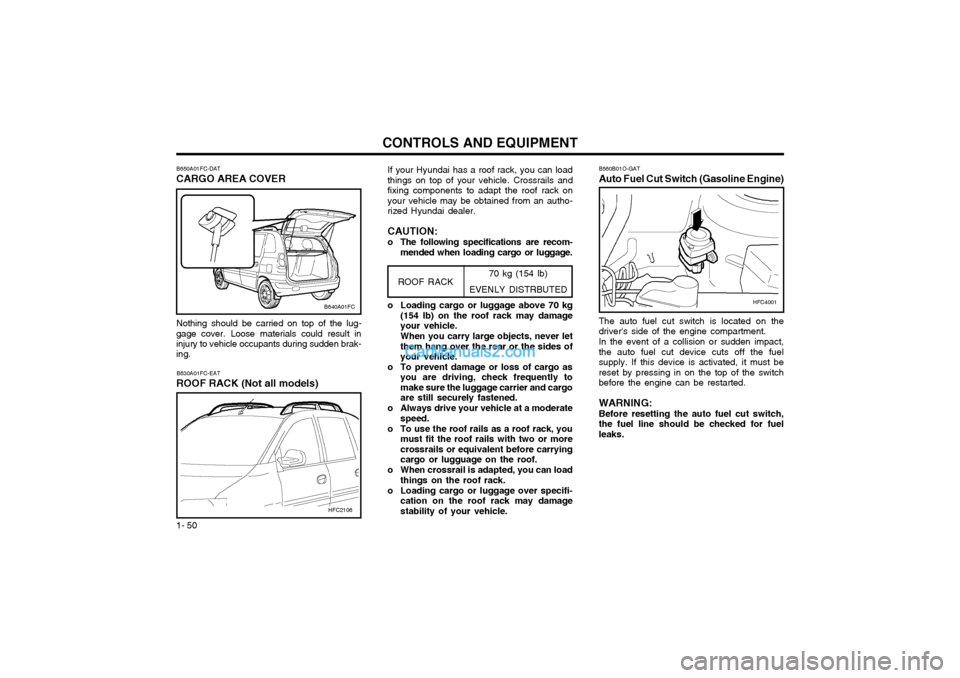
70 kg (154 lb)
EVENLY DISTRBUTED
HFC2106
B630A01FC-EAT
ROOF RACK (Not all models) If your Hyundai has a roof rack, you can load things on top of your vehicle. Crossrails andfixing components to adapt the roof rack onyour vehicle may be obtained from an autho-rized Hyundai dealer. CAUTION:
o The following specifications are recom-
mended when loading cargo or luggage.
ROOF RACK
o Loading cargo or luggage above 70 kg (154 lb) on the roof rack may damage your vehicle. When you carry large objects, never let them hang over the rear or the sides ofyour vehicle.
o To prevent damage or loss of cargo as you are driving, check frequently tomake sure the luggage carrier and cargoare still securely fastened.
o Always drive your vehicle at a moderate speed.
o To use the roof rails as a roof rack, you must fit the roof rails with two or morecrossrails or equivalent before carryingcargo or lugguage on the roof.
o When crossrail is adapted, you can load things on the roof rack.
o Loading cargo or luggage over specifi- cation on the roof rack may damagestability of your vehicle.
B650A01FC-DAT CARGO AREA COVER
B640A01FC
Nothing should be carried on top of the lug- gage cover. Loose materials could result in injury to vehicle occupants during sudden brak- ing. B560B01O-GAT Auto Fuel Cut Switch (Gasoline Engine)HFC4001
The auto fuel cut switch is located on the driver's side of the engine compartment. In the event of a collision or sudden impact, the auto fuel cut device cuts off the fuelsupply. If this device is activated, it must bereset by pressing in on the top of the switchbefore the engine can be restarted. WARNING: Before resetting the auto fuel cut switch, the fuel line should be checked for fuelleaks.
Page 232 of 312

1- 51
CONTROLS AND EQUIPMENTB610A01S-DAT
HORN (With Airbag)
Press the pad of the steering wheel to sound
the horn.
B580A01E-EAT
SUN-VISOR
Sun visors are fitted to both the driver and
passenger side of the vehicle. Certain deriva- tives are equipped with a vanity mirror whichis located on the back of the driver andpassenger visor. The visor may be lowered toreduce the amount of glare from directly ahead,or may be moved towards the side window toreduce glare from the side of the vehicle, oncethe inner pivot has been unclipped from thebracket.
NOTE: The Supplemental Restraint System (SRS)
label containing useful information can be found on the back of each sun visor.
WARNING: Do not place the sun-visor in such a man-
ner that it obscures visibility of the road- way, traffic or other objects. SB520A1-F STEERING WHEEL TILT LEVER
HFC2099HFC2041HFC2094-D
Vanity mirror
To adjust the steering wheel:
1. Push the lever downward to unlock.
2. Raise or lower the steering wheel to the
desired position.
3. After adjustment, securely tighten the lever by pulling it upward
WARNING: Do not attempt to adjust the steering wheel
while driving as this may result in loss ofcontrol of the vehicle and result in death orserious injury.
Page 241 of 312
CONTROLS AND EQUIPMENT
1- 60 B750B02Y-AAT
Using a cellular phone or a two-way radio
When a cellular phone is used inside the
vehicle, noise may be produced from the audio equipment. This does not mean thatsomething is wrong with the audio equipment.In such a case, use the cellular phone at aplace as far as possible from the audio equip-ment.
CAUTION: When using a communication system such
as a cellular phone or a radio inside the vehicle, a separate external antenna mustbe fitted. When a cellular phone or a radio set is
used with an internal antenna alone, it mayinterfere with the vehicle's electrical sys-tem and adversely affect safe operation ofthe vehicle.
WARNING: Don't use a cellular phone when you are
driving, you must stop at a safe place to use a cellular phone.
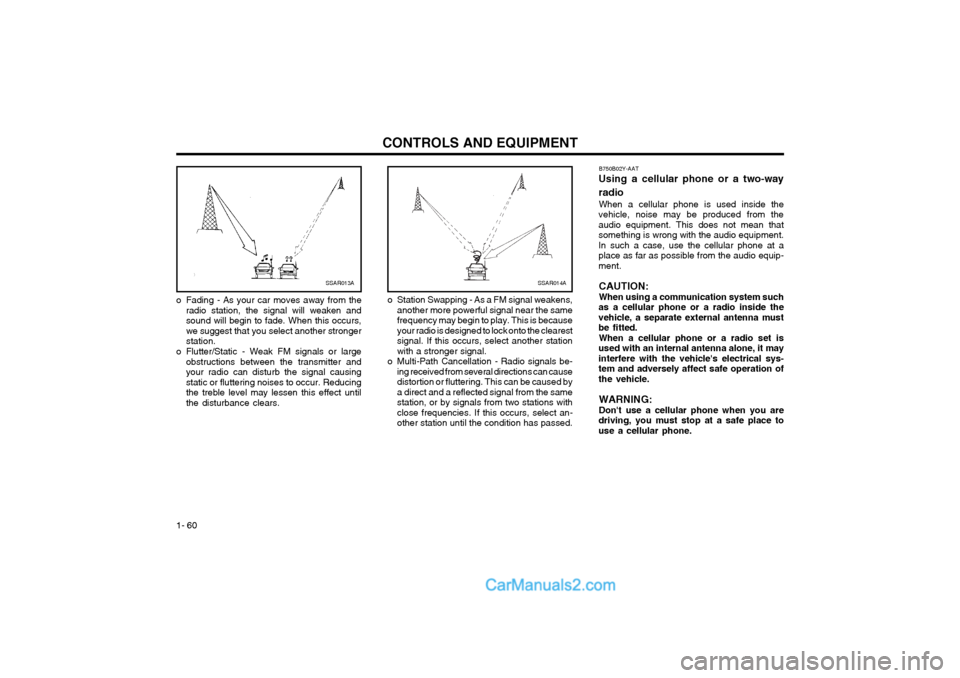
SSAR014A
o Station Swapping - As a FM signal weakens, another more powerful signal near the same frequency may begin to play. This is becauseyour radio is designed to lock onto the clearestsignal. If this occurs, select another stationwith a stronger signal.
o Multi-Path Cancellation - Radio signals be- ing received from several directions can causedistortion or fluttering. This can be caused bya direct and a reflected signal from the samestation, or by signals from two stations withclose frequencies. If this occurs, select an-other station until the condition has passed.SSAR013A
o Fading - As your car moves away from the radio station, the signal will weaken and sound will begin to fade. When this occurs,we suggest that you select another strongerstation.
o Flutter/Static - Weak FM signals or large obstructions between the transmitter andyour radio can disturb the signal causingstatic or fluttering noises to occur. Reducingthe treble level may lessen this effect untilthe disturbance clears.
Page 243 of 312

DRIVING YOUR HYUNDAI 2- 1
SC000A1-E
2. DRIVING YOUR HYUNDAI
SC020A1-E
WARNING: ENGINE EXHAUST CAN BE DANGEROUS!
Engine exhaust gases are potentially lethal. If at any time engine exhaust gas is detected within the passenger compartment, move the vehicle to an open area and open all windows. o Never inhale exhaust gas. Exhaust gases contain Carbon Monoxide which is colourless and odourless. Carbon Monoxide is poisonous and can cause unconsciousness and death by asphyxiation. o Exhaust System Maintenance. Ensure that the exhaust system is maintained in good condition and is free from excessive corrosion and damage which may result in leakage. If the vehicle is driven over an object which strikes the exhaust system, ensure that theexhaust system is inspected at the first available opportunity to ensure that no leakage exists. o Confined Areas. Do not run the engine in confined spaces, allowing the engine to idle in a garage, even when the doors are open is dangerous practice. Only start the engine immediately prior to moving the vehicle out of the garage. o Prolonged Idling. If it is necessary to allow the vehicle to idle for prolonged periods, ensure that the heating system air intake control is set to the "Fresh" position, the blower is set to high speed operation and that the vehicle is standing in an open area. o Load Carrying. If it is necessary to carry long objects which do not permit the boot lid to be fully closed, the side windows must remain closed and the heating air intake control set to the "Fresh" position with the blower running at the highest speed setting. To ensure correct operation of the heater system, the air intake grilles at the base of the windscreen must not be obstructed by snow leaves etc..
2
Page 244 of 312
DRIVING YOUR HYUNDAI
2- 2 C020A01O-EAT
BEFORE STARTING THE ENGINE
Before you start the engine, you should al-
ways:
1. Look around the vehicle to be sure there are no flat tyres, puddles of oil or water or other indications of possible trouble.
2. After entering the car, check to be sure the parking brake is engaged.
3. Check that all windows, and lights are clean.
4. Check that the interior and exterior mirrors are clean and in position.
5. Check your seat, seatback and headrestraint to be sure they are in theirproper positions.
6. Lock all the doors.
7. Fasten your seat belt and be sure that all other occupants have fastened theirs.
8. Turn off all lights and accessories that are not needed.
9. When you turn the ignition switch to "ON" check that all appropriate warning lights are operating and that you have sufficient fuel.
10.Check the operation of warning lights and all bulbs when key is in the "ON" position.
WARNING: (DIESEL ENGINE) To ensure that sufficient vacuum exists
within the brake system during cold weath- er start-up conditions, it is necessary torun the engine at idle for several secondsafter starting the engine. SC040A1-F
COMBINATION IGNITION SWITCH AND STEERING LOCK To Start the Engine
o If your Hyundai is equipped with a manual
transaxle, place the shift lever in neutral and depress the clutch pedal fully.
o If your Hyundai has an automatic transaxle, place the shift lever in "P" (park).
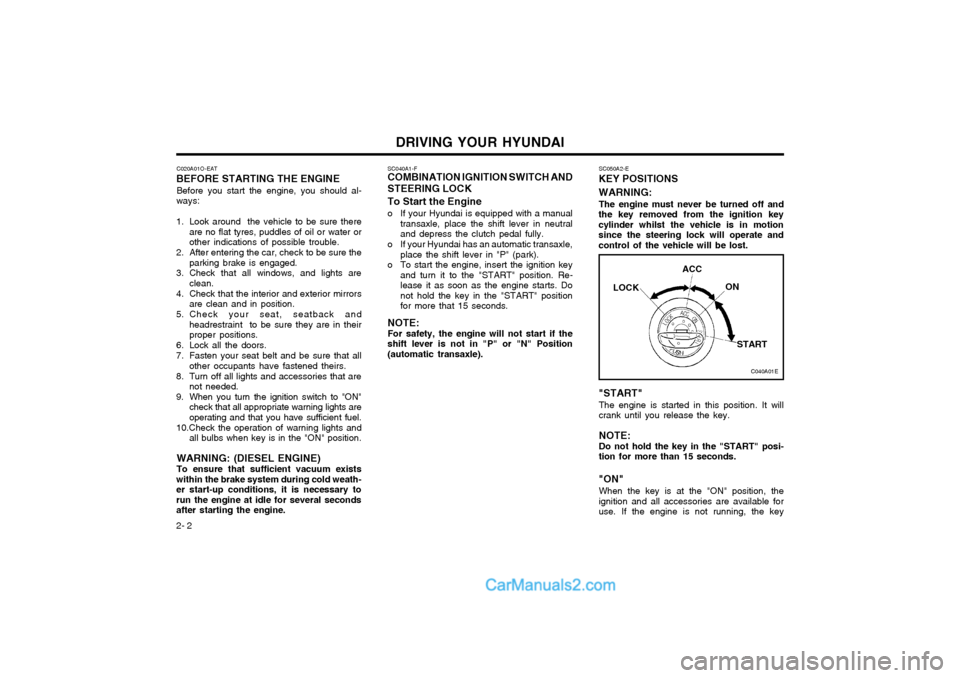
o To start the engine, insert the ignition key and turn it to the "START" position. Re-lease it as soon as the engine starts. Donot hold the key in the "START" positionfor more that 15 seconds.
NOTE: For safety, the engine will not start if the shift lever is not in "P" or "N" Position(automatic transaxle). SC050A2-E
KEY POSITIONS WARNING:
The engine must never be turned off and
the key removed from the ignition key cylinder whilst the vehicle is in motionsince the steering lock will operate andcontrol of the vehicle will be lost. "START"
The engine is started in this position. It will crank until you release the key. NOTE: Do not hold the key in the "START" posi- tion for more than 15 seconds.
"ON" When the key is at the "ON" position, theignition and all accessories are available foruse. If the engine is not running, the key
C040A01E
LOCK
ACC
ON
START
Page 246 of 312
DRIVING YOUR HYUNDAI
2- 4 C050B02S-GAT
NORMAL CONDITIONS The Starting Procedure:
1. Insert key, and fasten the seat belt.
2. Depress the clutch pedal fully and place the gearshift lever (manual transaxle) in neutral or the selector lever (automatictransaxle) in "P" (park) position.
3. After turning the ignition key to the "ON" position, make certain all warning lightsand gauges are functioning properly be-fore starting the engine.
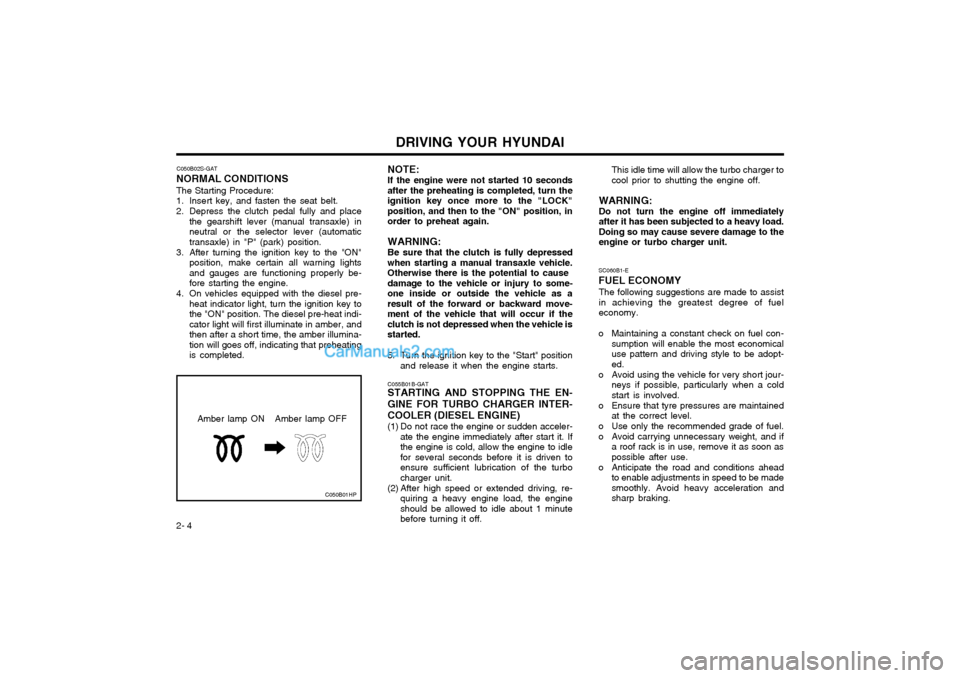
4. On vehicles equipped with the diesel pre- heat indicator light, turn the ignition key tothe "ON" position. The diesel pre-heat indi-cator light will first illuminate in amber, andthen after a short time, the amber illumina-tion will goes off, indicating that preheatingis completed. SC060B1-E FUEL ECONOMY
The following suggestions are made to assist in achieving the greatest degree of fueleconomy.
o Maintaining a constant check on fuel con- sumption will enable the most economicaluse pattern and driving style to be adopt-ed.
o Avoid using the vehicle for very short jour- neys if possible, particularly when a coldstart is involved.
o Ensure that tyre pressures are maintained at the correct level.
o Use only the recommended grade of fuel.
o Avoid carrying unnecessary weight, and if a roof rack is in use, remove it as soon aspossible after use.
o Anticipate the road and conditions ahead to enable adjustments in speed to be madesmoothly. Avoid heavy acceleration andsharp braking.
NOTE: If the engine were not started 10 seconds
after the preheating is completed, turn the ignition key once more to the "LOCK"position, and then to the "ON" position, inorder to preheat again.
WARNING: Be sure that the clutch is fully depressed
when starting a manual transaxle vehicle. Otherwise there is the potential to cause damage to the vehicle or injury to some-
one inside or outside the vehicle as aresult of the forward or backward move-ment of the vehicle that will occur if theclutch is not depressed when the vehicle isstarted.
5. Turn the ignition key to the "Start" position and release it when the engine starts.
C055B01B-GAT
STARTING AND STOPPING THE EN- GINE FOR TURBO CHARGER INTER- COOLER (DIESEL ENGINE)
(1) Do not race the engine or sudden acceler-
ate the engine immediately after start it. If the engine is cold, allow the engine to idlefor several seconds before it is driven toensure sufficient lubrication of the turbocharger unit.
(2) After high speed or extended driving, re- quiring a heavy engine load, the engineshould be allowed to idle about 1 minutebefore turning it off. This idle time will allow the turbo charger tocool prior to shutting the engine off.
WARNING: Do not turn the engine off immediately after it has been subjected to a heavy load.Doing so may cause severe damage to theengine or turbo charger unit.
C050B01HP
Amber lamp ON Amber lamp OFF
Page 251 of 312

DRIVING YOUR HYUNDAI 2- 9
SC130A1-E
OVERDRIVE SWITCH
The overdrive switch prevents the transaxle
upshifting higher than third gear when the switch is turned "OFF". The transaxle will startfrom rest in first gear and upshift to secondand third gear depending upon the roadspeedand throttle opening but will not upshift tofourth gear. When the overdrive switch isturned "ON", the transaxle will start from restin first gear and will upshift, depending uponroadspeed and throttle opening to second,third and fourth gear. Therefore, when theoverdrive switch is turned "OFF", the transaxleperforms as a three speed unit and the over-drive warning light located in the instrumentcluster will be illuminated. When the overdriveswitch is turned "ON", the transaxle functionsas a fully automatic four speed unit with themaximum fuel economy potential of the ve-hicle being realized. o Do not hold the vehicle on the upgrade
with the accelerator pedal. This can causethe transmission to overheat. Always usethe brake pedal or parking brake.
SC140A1-E EFFECTIVE BRAKING Braking system performance and friction ma- terial life are greatly affected by the drivingstyle adopted. The following suggestions aremade to assist in achieving the best resultsfrom the braking system.
o Anticipate the road and conditions ahead
in order that heavy braking may be avoided.
o When descending long gradients, use the engine to assist in retarding the vehicle to minimize the possibility of brake fade oc-curring.
o When trailer towing, ensure that the trailer brakes function correctly and use enginebraking to assist the vehicle braking system.
o Use only genuine Hyundai replacement brake pads and shoes to ensure consis-tent friction characteristics and wear rates.
o After driving through deep water (e.g. fording), the brakes may become wet andperformance reduced. Always check brakeefficiency after emerging from the waterand dry the brakes by lightly depressingthe brake pedal several times whilst driv-ing slowly.
o Apply the parking brake only when the vehicle is at rest.
o Since the power assistance provided by the brake servo is derived from the engine,coasting with the engine turned off or tow-ing of the vehicle with the engine turned offwill result in greatly increased pedal pres-sures being required to stop the vehicle. SC140B1-E
ANTI-LOCK BRAKE SYSTEM (Not all models)
The Anti-Lock Brake System (ABS) is de-
signed to prevent wheel lock-up during sud- den braking or on hazardous road surfaces.The ABS control module monitors the wheelspeed and controls the pressure applied toeach brake. Thus, in emergency situations oron slick roads, ABS will increase vehicle con-trol during braking.
NOTE: During ABS operation, a slight pulsation
may be felt in the brake pedal when the brakes are applied. Also, a noise may beheard in the engine compartment whilstbraking. These conditions are normal andindicate that the anti-lock brake system isfunctioning properly.
WARNING:ABS will not prevent accidents due to im-
proper or dangerous driving maneuvers.Even though vehicle control is improvedduring emergency braking, always maintaina safe distance between you and objectsahead. Vehicle speeds should always bereduced during extreme road conditions.
HFC3023-D
Page 252 of 312

DRIVING YOUR HYUNDAI
2- 10 C300B01O-GAT
TCS ON Mode In the TCS ON mode, the indicator in the instrument cluster will not be illuminated. NOTE:
1) Turn off the engine. Then restart the engine, and the TCS mode will auto- matically turn "ON".
2) When the traction control is operating properly, you can feel a slight pulsationin the vehicle. This is only the effect ofbrake control and indicates nothingunusual. C300D02O-GAT
Indicator and Warning
The indicator should illuminate when the igni-tion key is turned to "ON" or "START", butshould go out after three seconds. If the indicator does not illuminate, have it checked by an authorized Hyundai dealer. Should there be any unusual conditions in the device, TCS illuminates as a warning.If TCS illuminates, pull your car to a safeplace and stop the engine. Then, start the engine again to check if the TCS indicator goes out. If the indicator remains lit even after the engine has been started, have your carchecked by an authorized Hyundai dealer. NOTE: When TCS illuminates, traction control is automatically deactivated for safety.
Driving hints
TCS does not actively apply brakes. Be sure
to decelerate the car sufficiently before enter-ing curves.
CAUTION: When the TCS indicator blinks, SLIP con-
trol has been activated. It also means that the road is slippery or your car is acceler-ating excessively. In this situation, releasefoot pressure from the accelerator pedaland maintain moderate speed.
WARNING: Traction control is only a driving aid; all
normal precautions for driving in inclem- ent weather and on slippery driving sur-faces should be observed. 3) When the engine starts, a click is heard
from the engine compartment; however,this is only the sound of traction controlbeing checked.
4) When moving out of the mud or fresh snow, pressing the accelerator pedalmay not cause the engine speed toincrease.
The braking distance for cars equippedwith an anti-lock braking system may belonger than for those without it in thefollowing road conditions.
o Driving on rough, gravel or snow-cov-
ered roads.
o Driving with tyre chains installed.
o Driving on roads where the road sur- face is pitted or has different surface height.
These roads should be driven at reducedspeeds. The safety features of an ABSequipped vehicle should not be tested byhigh speed driving or cornering. This couldendanger the safety of yourself or others.
C300A01O-EAT
BRAKE TRACTION CONTROL SYSTEM (BTCS) (Not all models)
On slippery road surfaces, the traction control
system (TCS) limits the drive wheels from spinning excessively, thus helping the car toaccelerate. It also provides sufficient drivingforce and steering performance as the carturns at accelerated speeds. SLIP Control
Limits the drive wheels from spinning exces-
sively during starting or while making acceler- ated turns on slippery roads to avoid losingthe driving force of the front wheels.
Page 255 of 312
DRIVING YOUR HYUNDAI 2- 13
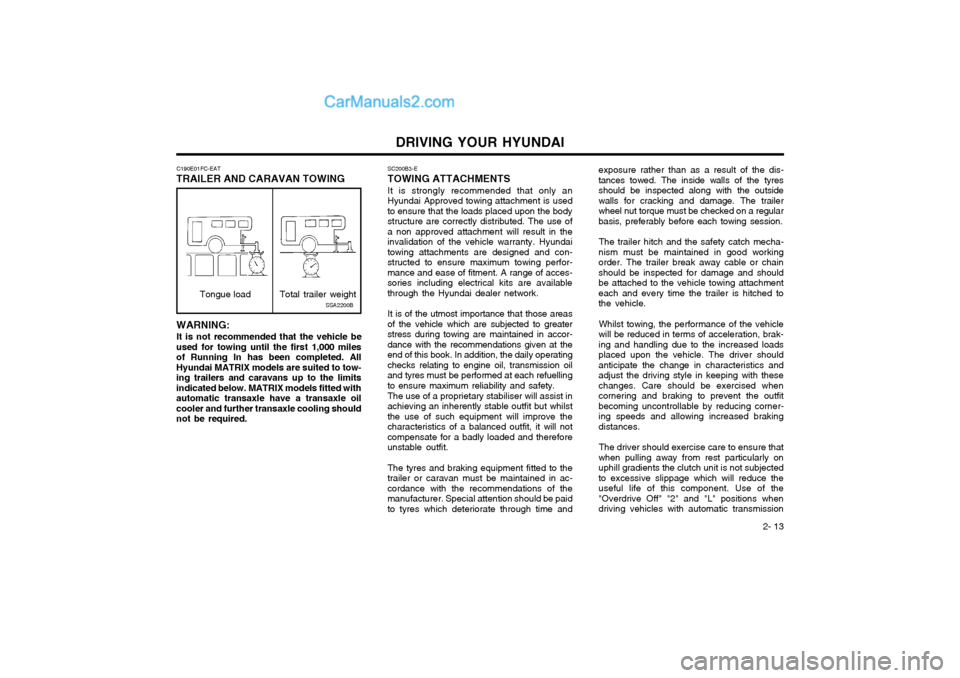
SC200B3-E TOWING ATTACHMENTS It is strongly recommended that only an Hyundai Approved towing attachment is usedto ensure that the loads placed upon the bodystructure are correctly distributed. The use ofa non approved attachment will result in theinvalidation of the vehicle warranty. Hyundaitowing attachments are designed and con-structed to ensure maximum towing perfor-mance and ease of fitment. A range of acces-sories including electrical kits are availablethrough the Hyundai dealer network. It is of the utmost importance that those areas of the vehicle which are subjected to greaterstress during towing are maintained in accor-dance with the recommendations given at theend of this book. In addition, the daily operatingchecks relating to engine oil, transmission oiland tyres must be performed at each refuellingto ensure maximum reliability and safety. The use of a proprietary stabiliser will assist in achieving an inherently stable outfit but whilstthe use of such equipment will improve thecharacteristics of a balanced outfit, it will notcompensate for a badly loaded and thereforeunstable outfit. The tyres and braking equipment fitted to the trailer or caravan must be maintained in ac-cordance with the recommendations of themanufacturer. Special attention should be paidto tyres which deteriorate through time and
WARNING:
It is not recommended that the vehicle be
used for towing until the first 1,000 milesof Running In has been completed. AllHyundai MATRIX models are suited to tow-ing trailers and caravans up to the limitsindicated below. MATRIX models fitted withautomatic transaxle have a transaxle oilcooler and further transaxle cooling shouldnot be required. C190E01FC-EAT
TRAILER AND CARAVAN TOWING
Tongue loadSSA2200B
Total trailer weight
exposure rather than as a result of the dis- tances towed. The inside walls of the tyresshould be inspected along with the outsidewalls for cracking and damage. The trailerwheel nut torque must be checked on a regularbasis, preferably before each towing session.
The trailer hitch and the safety catch mecha-
nism must be maintained in good workingorder. The trailer break away cable or chainshould be inspected for damage and shouldbe attached to the vehicle towing attachmenteach and every time the trailer is hitched tothe vehicle.
Whilst towing, the performance of the vehicle
will be reduced in terms of acceleration, brak-ing and handling due to the increased loadsplaced upon the vehicle. The driver shouldanticipate the change in characteristics andadjust the driving style in keeping with thesechanges. Care should be exercised whencornering and braking to prevent the outfitbecoming uncontrollable by reducing corner-ing speeds and allowing increased brakingdistances.
The driver should exercise care to ensure that
when pulling away from rest particularly onuphill gradients the clutch unit is not subjectedto excessive slippage which will reduce theuseful life of this component. Use of the"Overdrive Off" "2" and "L" positions whendriving vehicles with automatic transmission