clutch Hyundai Matrix 2003 User Guide
[x] Cancel search | Manufacturer: HYUNDAI, Model Year: 2003, Model line: Matrix, Model: Hyundai Matrix 2003Pages: 312, PDF Size: 4.1 MB
Page 150 of 312

DO-IT-YOURSELF MAINTENANCE 6-17
G160A01A-GAT
CHECKING CLUTCH PEDAL FREE-PLAY With the engine off, press lightly on the clutch pedal until you feel a change in resistance. Thisis the clutch pedal freeplay. The freeplay shouldbe within the limits specified in the illustration. Ifit is not, have it inspected by your Hyundaidealer and adjusted or repaired if necessary.
G160A01E
6 ~ 13 mm (0.24 ~ 0.51 in.)
G150A01A-GAT
CHECKING STEERING WHEEL FREEPLAY
To check the steering wheel freeplay, stop the
car with the wheels pointed straight ahead and gently move the steering wheel back and forth.Use very light finger pressure and be sensitiveto changes in resistance that mark the limits ofthe freeplay. If the freeplay is greater thanspecified, have it inspected by your Hyundaidealer and adjusted or repaired if necessary.
G150A01FC
G140D01S-GAT
Checking the Compressor Drive Belt
When the air conditioning is being used regular-
ly, the compressor drive belt tension should be checked at least once a month.
To check the drive belt tension, press down on
the belt halfway between the engine crankshaftand compressor pulleys. Pressing with yourfinger, you should not be able to deflect this beltanymore than 8.0 mm. If you have the instru-ments to check it with a force of 98N (22 lb.),the deflection should be approx. 8.0 mm (0.315in.). If the belt is too loose, have it adjusted byyour Hyundai dealer.
G140D01A
A/C
CRANK PULLEY
TENSION PULLEY
30 mm (1.18 in.)
8mm(0.315 in.)
Page 170 of 312

INDEX10-1
Cargo Area
Cover ............................................................................. 1-52
Cassette Tape Player Operation (H220, H280).1-68 ~ 1-69, 1-80 ~ 1-81 Catalytic Converter .................................................................... 7-1 ~ 7-2
CD Auto Changer ............................................................................. 1-52
CD Auto Changer (H260, H280) ...................... 1-75 ~ 1-76, 1-84 ~ 1-85
Child-Protector Rear Door Lock ......................................................... 1-5
Child Restraint System .......................................................... 1-17 ~ 1-22
Cigarette Lighter ................................................................................ 1-42
Clock ...................................................................................... 1-41 ~ 1-42
Clutch Checking fluid ............................................................................... 6-16
Pedal free play ............................................................................. 6-17
Combination Light Headlight flasher ........................................................................... 1-39
Headlight switch ............................................................................ 1-38
High-beam switch .......................................................................... 1-39
Lane change signal ....................................................................... 1-38
Turn signal operation .................................................................... 1-38
Compact Disc Player Operation (H260, H280) .1-73 ~ 1-74, 1-82 ~ 1-83Cooling Fans ..................................................................................... 6-21
Corrosion Protection
Cleaning the interior ........................................................................ 4-3
Protecting your Hyundai from corrosion ................ ......................... 4-1
Washing and waxing ....................................................................... 4-2
DDefrosting/Defogging .............................................................. 1-58 ~ 1-59
Door Central door lock ............................................................................. 1-6
Door locks ....................................................................................... 1-4Locking and unlocking front doors with a key ....................... 1-4 ~ 1-5
Drink Holder ........................................................................... 1-42 ~ 1-43
Drive Belts ............................................................................... 6-17, 6-19
ZK000A1-G 10. INDEX
A Accessory Tray ................................................................................. 1-50
Air Bag ................................................................................... 1-24 ~ 1-28
Air Cleaner Filter ............................................................................... 6-12
Air Conditioning Care .............................................................................................. 6-16
Operation ....................................................................................... 6-16
Switch ............................................................................................ 1-60
Air Filter ............................................................................................ 1-61
Antenna ............................................................................................. 1-89
Ashtray .............................................................................................. 1-42
Auto Fuel Cut Switch ........................................................................ 1-53
BBattery ...................................................................................... 2-11, 6-20
Brake Anti-lock system ..................................................................... 2-8 ~ 2-9
Checking the brakes ..................................................................... 6-15
Fluid ............................................................................................... 6-16
Pedal clearance ............................................................................ 6-18
Pedal free play .............................................................................. 6-18
Practices ................................................................................ 2-7 ~ 2-8
Brake Pad Wear Warning Sound ..................................................... 1-34
Brake Traction Control System .......................................................... 2-9
Breaking-In your new Hyundai ........................................................... 1-2
Bulbs Wattage ................................................................................... 6-25
C Care of Cassette Tapes ........................................................ 1-87 ~ 1-88
Care of Disc ...................................................................................... 1-87
10
Page 244 of 312
DRIVING YOUR HYUNDAI
2- 2 C020A01O-EAT
BEFORE STARTING THE ENGINE
Before you start the engine, you should al-
ways:
1. Look around the vehicle to be sure there are no flat tyres, puddles of oil or water or other indications of possible trouble.
2. After entering the car, check to be sure the parking brake is engaged.
3. Check that all windows, and lights are clean.
4. Check that the interior and exterior mirrors are clean and in position.
5. Check your seat, seatback and headrestraint to be sure they are in theirproper positions.
6. Lock all the doors.
7. Fasten your seat belt and be sure that all other occupants have fastened theirs.
8. Turn off all lights and accessories that are not needed.
9. When you turn the ignition switch to "ON" check that all appropriate warning lights are operating and that you have sufficient fuel.
10.Check the operation of warning lights and all bulbs when key is in the "ON" position.
WARNING: (DIESEL ENGINE) To ensure that sufficient vacuum exists
within the brake system during cold weath- er start-up conditions, it is necessary torun the engine at idle for several secondsafter starting the engine. SC040A1-F
COMBINATION IGNITION SWITCH AND STEERING LOCK To Start the Engine
o If your Hyundai is equipped with a manual
transaxle, place the shift lever in neutral and depress the clutch pedal fully.
o If your Hyundai has an automatic transaxle, place the shift lever in "P" (park).
o To start the engine, insert the ignition key and turn it to the "START" position. Re-lease it as soon as the engine starts. Donot hold the key in the "START" positionfor more that 15 seconds.
NOTE: For safety, the engine will not start if the shift lever is not in "P" or "N" Position(automatic transaxle). SC050A2-E
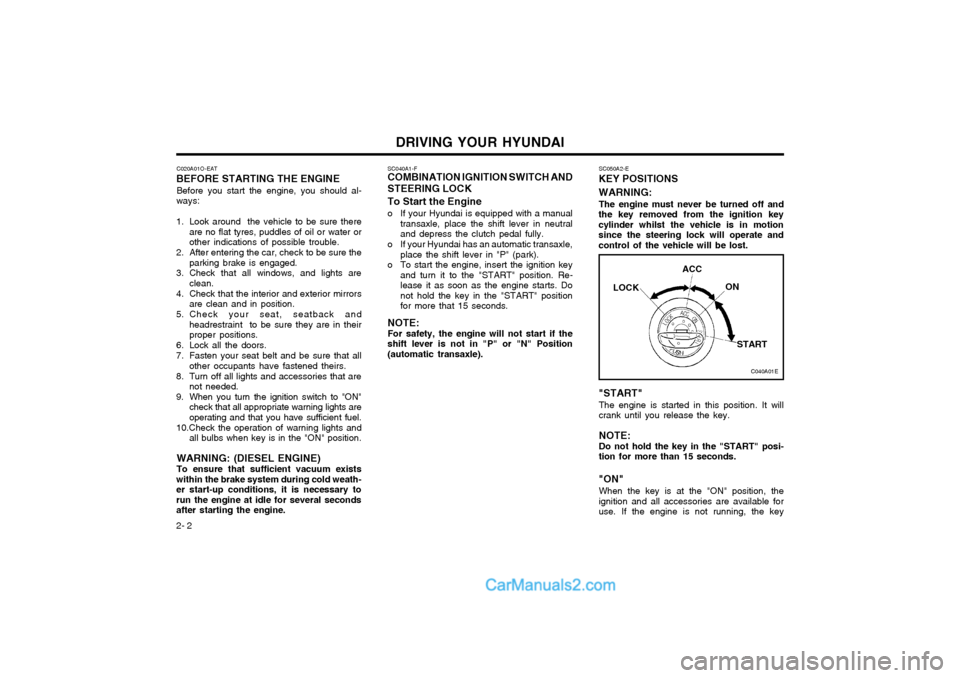
KEY POSITIONS WARNING:
The engine must never be turned off and
the key removed from the ignition key cylinder whilst the vehicle is in motionsince the steering lock will operate andcontrol of the vehicle will be lost. "START"
The engine is started in this position. It will crank until you release the key. NOTE: Do not hold the key in the "START" posi- tion for more than 15 seconds.
"ON" When the key is at the "ON" position, theignition and all accessories are available foruse. If the engine is not running, the key
C040A01E
LOCK
ACC
ON
START
Page 245 of 312

DRIVING YOUR HYUNDAI 2- 3
SB050B1-E
STEERING WHEEL LOCK When the key is removed, the steering col-
umn lock will be activated and will engage when the steering wheel is turned to theappropriate position. It is not necessary toturn the wheel until locked each time the keyis removed since in the event of any unautho-rized attempt at removal, the lock will becomeeffective as soon as the steering wheel isturned. To unlock the steering, insert the keyand turn to the "ACC" position. If the steeringis locked, it may be necessary to rock thesteering wheel slightly to facilitate turning thekey. Under no circumstances should the keybe forced since breakage of the key will occur. SC060A1-E
STARTING THE GASOLINE ENGINE
1. Ensure that the transaxle is in neutral and that the clutch pedal is held depressed (manual transaxle) or the transaxle selec-tor is at the "P" position (automatic transaxlevehicle).
2. Turn the ignition key to and hold at the "Start" position until the engine starts.When the engine has started, release thekey.
NOTE: Do not operate the starter for more than 15
seconds continuously or continue to oper- ate the starter after the engine has startedto avoid damaging the starter motor. If theengine makes a false start, allow it and thestarter motor to come to rest before at-tempting to start the engine again. Neverattempt to start the engine with thetransaxle in gear. Do not depress the ac-
C050A01E
should not be left at this position since the battery will become discharged and damageto the ignition system may also result. Forinformation regarding engine starting, refer to"STARTING THE ENGINE". "ACC"
When the ignition key is at the "ACC" position,
the radio and other accessories may be used."LOCK"
The ignition key may only be inserted or
removed at this position. celerator pedal whilst starting the engine. Allow the engine to idle for 20 seconds orso before driving the vehicle.
CAUTION: Do not leave the vehicle unattended whilst
idling. Never allow the vehicle to idle or warm up in a confined space (ie garage)longer than is necessary to move the vehi-cle into an open area.
C051A01O-EAT
STARTING THE DIESEL ENGINE
ENGINE COLD
o Turn the ignition key to position "ON" and wait for the pre-heat indicator light to goout.
o Operate the starter until the engine runs. ENGINE WARM Operate the starter. If the engine does not respond on the first attempt, wait severalseconds and try again using the pre-heat.
Page 246 of 312
DRIVING YOUR HYUNDAI
2- 4 C050B02S-GAT
NORMAL CONDITIONS The Starting Procedure:
1. Insert key, and fasten the seat belt.
2. Depress the clutch pedal fully and place the gearshift lever (manual transaxle) in neutral or the selector lever (automatictransaxle) in "P" (park) position.
3. After turning the ignition key to the "ON" position, make certain all warning lightsand gauges are functioning properly be-fore starting the engine.
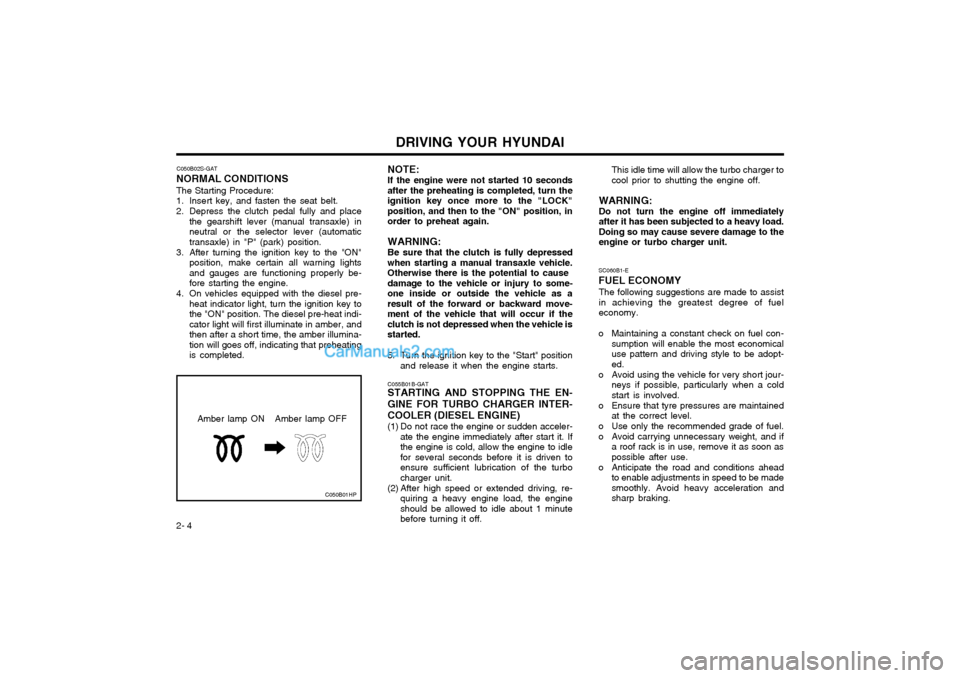
4. On vehicles equipped with the diesel pre- heat indicator light, turn the ignition key tothe "ON" position. The diesel pre-heat indi-cator light will first illuminate in amber, andthen after a short time, the amber illumina-tion will goes off, indicating that preheatingis completed. SC060B1-E FUEL ECONOMY
The following suggestions are made to assist in achieving the greatest degree of fueleconomy.
o Maintaining a constant check on fuel con- sumption will enable the most economicaluse pattern and driving style to be adopt-ed.
o Avoid using the vehicle for very short jour- neys if possible, particularly when a coldstart is involved.
o Ensure that tyre pressures are maintained at the correct level.
o Use only the recommended grade of fuel.
o Avoid carrying unnecessary weight, and if a roof rack is in use, remove it as soon aspossible after use.
o Anticipate the road and conditions ahead to enable adjustments in speed to be madesmoothly. Avoid heavy acceleration andsharp braking.
NOTE: If the engine were not started 10 seconds
after the preheating is completed, turn the ignition key once more to the "LOCK"position, and then to the "ON" position, inorder to preheat again.
WARNING: Be sure that the clutch is fully depressed
when starting a manual transaxle vehicle. Otherwise there is the potential to cause damage to the vehicle or injury to some-
one inside or outside the vehicle as aresult of the forward or backward move-ment of the vehicle that will occur if theclutch is not depressed when the vehicle isstarted.
5. Turn the ignition key to the "Start" position and release it when the engine starts.
C055B01B-GAT
STARTING AND STOPPING THE EN- GINE FOR TURBO CHARGER INTER- COOLER (DIESEL ENGINE)
(1) Do not race the engine or sudden acceler-
ate the engine immediately after start it. If the engine is cold, allow the engine to idlefor several seconds before it is driven toensure sufficient lubrication of the turbocharger unit.
(2) After high speed or extended driving, re- quiring a heavy engine load, the engineshould be allowed to idle about 1 minutebefore turning it off. This idle time will allow the turbo charger tocool prior to shutting the engine off.
WARNING: Do not turn the engine off immediately after it has been subjected to a heavy load.Doing so may cause severe damage to theengine or turbo charger unit.
C050B01HP
Amber lamp ON Amber lamp OFF
Page 247 of 312

DRIVING YOUR HYUNDAI 2- 5
SC090A02-E
MANUAL TRANSAXLE
HFC3029
The five speed fully synchronized transaxle is controlled by a floor mounted shift lever uponwhich the shift pattern is indicated. It is impor-tant that when changing gear, the clutch pedalis fully depressed to avoid transaxle damage. CAUTION:
o Do not attempt to engage reverse gear
when the car is in motion.
o To avoid damaging the selector mecha- nism, do not use the gear shift lever as a hand rest. Release the lever immedi-ately the shift is completed.
o To avoid premature clutch wear, do not use the clutch pedal as a foot rest, anddo not hold the vehicle on a gradientusing the clutch.
o Ensure that the engine is not over-revved by upshifting before the tachometerneedle enters the red zone.
o Do not coast with the shift lever at the neutral position.
o When descending long gradients, make use of the engine braking to assist thefootbrake to avoid brake fade or over-heating.
o When slippery conditions are encoun- tered, increased caution should be ex-ercised when gear changing, braking oraccelerating. Abrupt changes in speedmay cause a loss of traction or controlof the vehicle.
o The starter motor will not operate un- less the clutch pedal is depressed whilstthe engine is being started.
o During cold weather, shifting may be difficult until the transaxle lubricant haswarmed up. This is normal and notharmful to the transaxle. SC090B1-F
Using the Clutch The clutch should be pressed all the way to
the floor before shifting, then released slowly.Do not rest your foot on the clutch pedal whiledriving.
This can cause unnecessary wear. Do not partially engage the clutch to hold the
car on an incline. This causes unnecessary wear.
Use the parking brake to hold the car on an
incline. Do not operate the clutch pedal rapidlyand repeatedly.
o Avoid cruising at unnecessary high speeds.
o Always ensure that the periodic mainte-
nance services are performed by a Hyundai dealer at the time and/or mileage intervalsspecified.
o Use the air conditioning only when neces- sary.
o If you 've come to a complete stop and it's hard to shift into 1 st
or R(Reverse),
put the shift lever in N(Neutral) position and release the clutch. Press the clutchpedal back down, and then shift into 1 st
or R(Reverse) gear position.
o Do not use the shift lever as a handrest during driving, as this can result inpremature wear of the transaxle shiftforks.
Page 253 of 312

DRIVING YOUR HYUNDAI 2- 11
o Don't "lug" or "over-rev" the engine. Lug-
ging is driving too slowly in too high a gear resulting in the engine bucking. If thishappens to you, shift to a lower gear. Over-revving is racing the engine beyond its safe limit. This can be avoided byshifting at the recommended speeds.
o Use your air conditioning sparingly. The air conditioning system is operated by theengine power so your fuel economy isreduced when you use it.
SC150A1-F
DRIVING FOR ECONOMY
You can save fuel and get more miles fromyour car if you follow these suggestions:
o Drive smoothly. Accelerate at a moderate rate. Don't make "jack-rabbit" starts or full-throttle shifts and maintain a steady cruis-ing speed. Don't race between stoplights.Try to adjust your speed to that of the othertraffic so you don't have to change speedsunnecessarily. Avoid heavy traffic whenever possible. Al- ways maintain a safe distance from othervehicles so you can avoid unnecessarybraking. This also reduces brake wear.
o Drive at a moderate speed. The faster you drive, the more fuel your car uses. Drivingat a moderate speed, especially on thehighway, is one of the most effective waysto reduce fuel consumption.
o Don't "ride" the brake or clutch pedal. This can increase fuel consumption and alsoincrease wear on these components. Inaddition, driving with your foot resting onthe brake pedal may cause the brakes tooverheat, which reduces their effective-ness and may lead to more serious con-
sequences.
o Take care of your tyres. Keep them inflated to the recommended pressure. Incorrectinfla-tion, either too much or too little, re-sults in unnecessary tyre wear. Check thetyre pres-sures at least once a month. o Be sure that the wheels are aligned cor-
rectly. Improper alignment can result fromhitting curbs or driving too fast over irregu-lar surfaces. Poor alignment causes fastertyre wear and may also result in otherproblems as well as greater fuel consump-tion.
o Keep your car in good condition. For better fuel economy and reduced maintenancecosts, maintain your car in accordancewith the maintenance schedule in Section5. If you drive your car in severe condi-tions, more frequent maintenance is re-quired (see Section 5 for details).
o Keep your car clean. For maximum ser- vice, your car should be kept clean andfree of corrosive materials. It is especiallyimportant that mud, dirt, ice, etc. not beallowed to accumulate on the underside ofthe car. This extra weight can result inincreased fuel consumption and also con-tribute to corrosion.
o Travel lightly. Don't carry unnecessary weight in your car. Weight is an enemy ofgood fuel economy.
o Don't let the engine idle longer than neces- sary. If you are waiting (and not in traffic),turn off your engine and restart only whenyou're ready to go.
o Remember, your car does not require extended warm-up. As soon as the engineis running smoothly, you can drive away.In very cold weather, however, give yourengine a slightly longer warm-up period. SC160A1-F SMOOTH CORNERING Avoid braking or gear changing in corners, especially when roads are wet. Ideally, cor-ners should always be taken under gentleacceleration. If you follow these suggestions,tyre wear will be held to a minimum. SC170A1-E WINTER MOTORING The onset of winter conditions subject motor vehicles to greater operating demands. There-fore, the following suggestions will assist inmaintaining peak performance and reliabilityduring these periods:
Page 255 of 312
DRIVING YOUR HYUNDAI 2- 13
SC200B3-E TOWING ATTACHMENTS It is strongly recommended that only an Hyundai Approved towing attachment is usedto ensure that the loads placed upon the bodystructure are correctly distributed. The use ofa non approved attachment will result in theinvalidation of the vehicle warranty. Hyundaitowing attachments are designed and con-structed to ensure maximum towing perfor-mance and ease of fitment. A range of acces-sories including electrical kits are availablethrough the Hyundai dealer network. It is of the utmost importance that those areas of the vehicle which are subjected to greaterstress during towing are maintained in accor-dance with the recommendations given at theend of this book. In addition, the daily operatingchecks relating to engine oil, transmission oiland tyres must be performed at each refuellingto ensure maximum reliability and safety. The use of a proprietary stabiliser will assist in achieving an inherently stable outfit but whilstthe use of such equipment will improve thecharacteristics of a balanced outfit, it will notcompensate for a badly loaded and thereforeunstable outfit. The tyres and braking equipment fitted to the trailer or caravan must be maintained in ac-cordance with the recommendations of themanufacturer. Special attention should be paidto tyres which deteriorate through time and
WARNING:
It is not recommended that the vehicle be
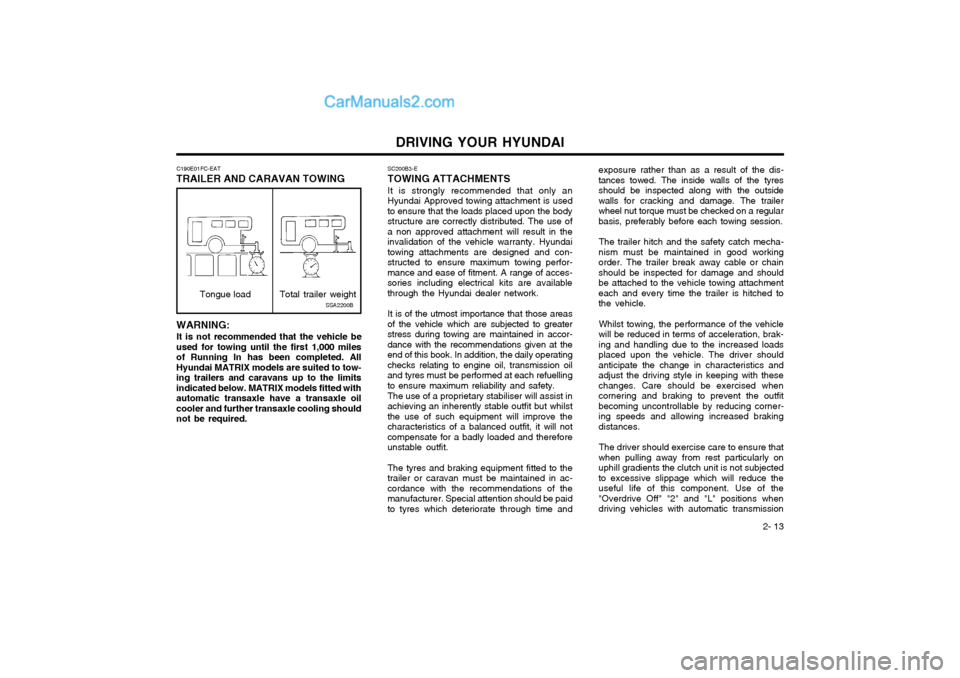
used for towing until the first 1,000 milesof Running In has been completed. AllHyundai MATRIX models are suited to tow-ing trailers and caravans up to the limitsindicated below. MATRIX models fitted withautomatic transaxle have a transaxle oilcooler and further transaxle cooling shouldnot be required. C190E01FC-EAT
TRAILER AND CARAVAN TOWING
Tongue loadSSA2200B
Total trailer weight
exposure rather than as a result of the dis- tances towed. The inside walls of the tyresshould be inspected along with the outsidewalls for cracking and damage. The trailerwheel nut torque must be checked on a regularbasis, preferably before each towing session.
The trailer hitch and the safety catch mecha-
nism must be maintained in good workingorder. The trailer break away cable or chainshould be inspected for damage and shouldbe attached to the vehicle towing attachmenteach and every time the trailer is hitched tothe vehicle.
Whilst towing, the performance of the vehicle
will be reduced in terms of acceleration, brak-ing and handling due to the increased loadsplaced upon the vehicle. The driver shouldanticipate the change in characteristics andadjust the driving style in keeping with thesechanges. Care should be exercised whencornering and braking to prevent the outfitbecoming uncontrollable by reducing corner-ing speeds and allowing increased brakingdistances.
The driver should exercise care to ensure that
when pulling away from rest particularly onuphill gradients the clutch unit is not subjectedto excessive slippage which will reduce theuseful life of this component. Use of the"Overdrive Off" "2" and "L" positions whendriving vehicles with automatic transmission
Page 258 of 312

3-1
IN CASE OF EMERGENCY
SD000A1-E
3. IN CASE OF
EMERGENCY
SD020A1-E
IF THE ENGINE WILL NOT START Seek assistance from the nearest Hyundai dealer with regard to the method of ignition andfuel system diagnosis.
CAUTION:If the engine refuses to start, no attempt
should be made to push or tow start thevehicle. Vehicles with automatic transaxleor fuel injection will not be able to bestarted in this manner since no drive istransmitted through the automatic transaxlewhilst the engine is not running, and in thecase of fuel injected derivatives, the fuelpump will not operate under tow start con-ditions. In addition, if the vehicle isequipped with an exhaust catalyst, dam-age to the catalyst may result if the vehicleis tow started. SD020B1-E
IF THE ENGINE CANNOT BE
CRANKED SD020C1-F
If Engine Turns Over Normally but Does Not Start
SSA3020C
1. Check fuel Level
2. Check all connectors at ignition coil and spark plugs.Replace any that may be disconnected or loose.
3. Check fuel line in the engine room.
4. If engine still refuses to start, call a Hyundai dealer or seek other qualified assistance.
1. If the vehicle is fitted with manual transaxle,
ensure that the clutch pedal is depressed whilst cranking the engine. If the vehicle isfitted with automatic transaxle, ensurethat the transaxle selector is at the "P"or"N" position.
2. Check the battery terminals and connec- tions to ensure that these are clean andalso tight.
3. If the ignition warning lights dim when the engine is cranked and the battery termi-nals have been checked, a dischargedbattery is indicated.
4. Do not attempt to push or tow start the vehicle, refer to "Jump Starting" for infor-mation regarding engine starting when thebattery is discharged. AD020D1-A
If Engine Stalls While Driving
1. Reduce your speed gradually, keeping a straight line. Move cautiously off the road to a safe place.
2. Turn on your emergency flashers.
3. Try starting the engine again. If your ve- hicle will not start, see "IF THE ENGINE WILL NOT START"
3
D010B01FC
Page 271 of 312

VEHICLE MAINTENANCE REQUIREMENTS
5- 4 F030C01E-EAT
R : REPLACE I : INSPECT AND, AFTER INSPECTION, CLEAN, ADJUST, REPAIR OR REPLACE IF NECESSARY
GENERAL MAINTENANCE COOLING SYSTEMCOOLANT GASOLINE ENGINEDIESEL ENGINE
ENGINE COOLANT SPECIFIC GRAVITYMANUAL TRANSAXLE OILAUTOMATIC TRANSAXLE FLUIDBRAKE PIPES, HOSES, AND CONNECTIONSBRAKE FLUIDCLUTCH FLUIDREAR BRAKE LININGS AND CYLINDERSBRAKE PADSSUSPENSION AND STEERING SYSTEMFRONT SUSPENSION BALL JOINTSPOLLEN FILTER (IN FRONT OF BLOWER UNIT)REAR WHEEL BEARINGSTYRE CONDITION AND PRESSURE (incl. Spare)LUBRICATE LOCKS AND HINGESCHECK ALL ELECTRICAL SYSTEMSROAD TESTCHECK ALL SYSTEMS WITH HI-SCAN
60 72
50 60
4048
I
R R
I I
R I
R R I I II
R
IIIII I
I I IIII I I I I
R I III I I
I
R IIII
R R I I I I
R I III I I
30 36
2024
I
R
I IIII I I II
R IIIIII
I
R IIII
R R I I I I
R I III I I
10 12
I I IIII I I I I
R I III I I
MILES X 1,000 MONTHS
NO. DESCRIPTION
1 2 3 456789
10111213141516171819