height Hyundai Matrix 2003 User Guide
[x] Cancel search | Manufacturer: HYUNDAI, Model Year: 2003, Model line: Matrix, Model: Hyundai Matrix 2003Pages: 312, PDF Size: 4.1 MB
Page 190 of 312
1- 9
CONTROLS AND EQUIPMENTSB070F1-F
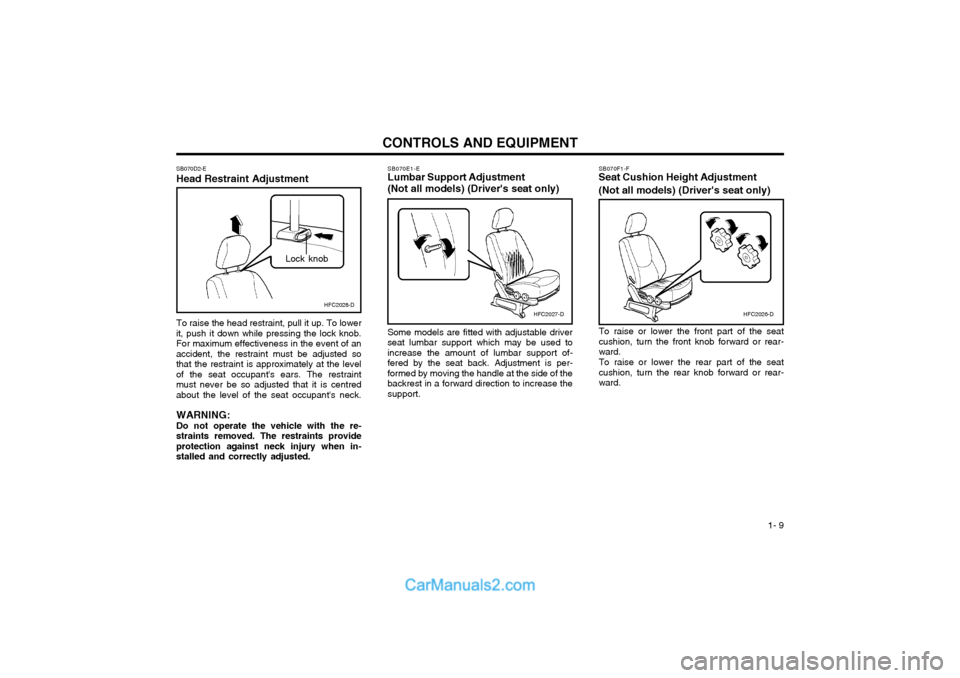
Seat Cushion Height Adjustment (Not all models) (Driver's seat only)
To raise or lower the front part of the seat cushion, turn the front knob forward or rear-ward. To raise or lower the rear part of the seat cushion, turn the rear knob forward or rear-ward.
SB070E1-E Lumbar Support Adjustment (Not all models) (Driver's seat only) Some models are fitted with adjustable driver seat lumbar support which may be used toincrease the amount of lumbar support of-fered by the seat back. Adjustment is per-formed by moving the handle at the side of thebackrest in a forward direction to increase thesupport.
SB070D2-E Head Restraint Adjustment To raise the head restraint, pull it up. To lower
it, push it down while pressing the lock knob. For maximum effectiveness in the event of anaccident, the restraint must be adjusted sothat the restraint is approximately at the levelof the seat occupant's ears. The restraintmust never be so adjusted that it is centredabout the level of the seat occupant's neck.
WARNING:Do not operate the vehicle with the re-
straints removed. The restraints provideprotection against neck injury when in-stalled and correctly adjusted.
HFC2027-DHFC2026-DHFC2028-D
Lock knob
Page 195 of 312
CONTROLS AND EQUIPMENT
1- 14 of movement whilst the belt is being worn. However, in the event of rapid deceleration orimpact, the belt mechanism will automaticallylock.
The mechanism will also lock if the seat belt
webbing is withdrawn too quickly when thebelt is being fastened or if attempts are madeto withdraw the webbing whilst the vehicle isnot on level ground. Should the seat belt lockunder these conditions, it will be possible torelease the mechanism by allowing a smallamount of webbing to be retracted and thebelt withdrawn again.
SSD1090Q
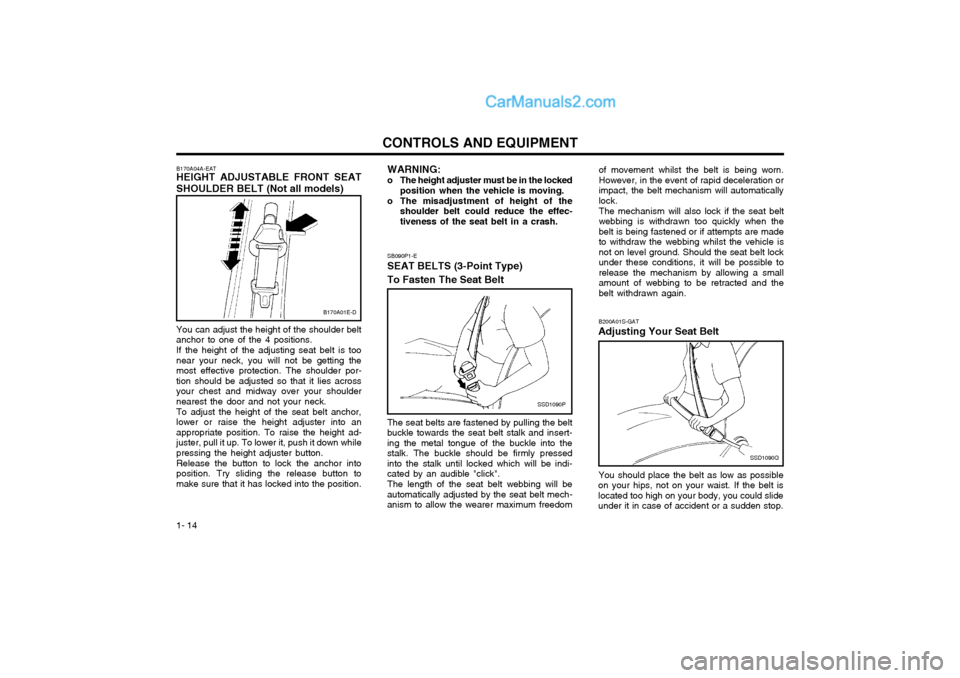
B200A01S-GAT
Adjusting Your Seat Belt
You should place the belt as low as possible
on your hips, not on your waist. If the belt is located too high on your body, you could slideunder it in case of accident or a sudden stop.
SB090P1-E
SEAT BELTS (3-Point Type) To Fasten The Seat Belt
SSD1090P
The seat belts are fastened by pulling the belt
buckle towards the seat belt stalk and insert- ing the metal tongue of the buckle into thestalk. The buckle should be firmly pressedinto the stalk until locked which will be indi-cated by an audible "click".
The length of the seat belt webbing will be
automatically adjusted by the seat belt mech-anism to allow the wearer maximum freedom WARNING:
o The height adjuster must be in the locked position when the vehicle is moving.
o The misadjustment of height of the shoulder belt could reduce the effec-tiveness of the seat belt in a crash.
B170A01E-D
B170A04A-EAT HEIGHT ADJUSTABLE FRONT SEAT SHOULDER BELT (Not all models) You can adjust the height of the shoulder belt anchor to one of the 4 positions. If the height of the adjusting seat belt is too near your neck, you will not be getting themost effective protection. The shoulder por-tion should be adjusted so that it lies acrossyour chest and midway over your shouldernearest the door and not your neck. To adjust the height of the seat belt anchor, lower or raise the height adjuster into anappropriate position. To raise the height ad-juster, pull it up. To lower it, push it down whilepressing the height adjuster button. Release the button to lock the anchor into position. Try sliding the release button tomake sure that it has locked into the position.
Page 197 of 312
CONTROLS AND EQUIPMENT
1- 16 o Since a safety belt or child restraint
system can become very hot if it is left in a closed vehicle, be sure to check theseat cover and buckles before placing achild there.
o When the child restraint system is not in use, fasten it with a safety belt so thatit will not be thrown forward in the caseof a sudden stop or an accident.
o Children who are too large to be in a child restraint should still sit in the rearseat and be restrained with the avail-able lap/shoulder belts. Never allowchildren to ride in the front passengerseat.
o Always make sure that the shoulder belt portion of the outboard lap/shoulder beltis positioned midway over the shoul-der, never across the neck or behindthe back. Moving the child closer to thecenter of the vehicle may help provide agood shoulder belt fit. The lap belt por-tion of the lap/shoulder belt or the cen-ter seat lap belt must always be posi-tioned as low as possible on the child'ships and as snug as possible.
o If the seat belt will not properly fit the child, we recommend the use of anapproved booster seat in the rear seatin order to raise the child's seatingheight so that the seat belt will properlyfit the child.
o Never allow a child to stand up or kneel on the seat.
B230A03P-EAT CHILD RESTRAINT SYSTEM Children riding in the car should sit in the rear seat and must always be properly restrainedto minimize the risk of injury in an accident,sudden stop or sudden maneuver. Accordingto accident statistics, children are safer whenproperly restrained in the rear seats than inthe front seat. Larger children should use oneof the seat belts provided. You are required by law to use safety re- straints for children. If small children ride inyour vehicle you must put them in a childrestraint system (safety seat). Children could be injured or killed in a crash if their restraints are not properly secured. Forsmall children and babies, a child seat orinfant seat must be used. Before buying aparticular child restraint system, make sure itfits your car and seat belts, and fits your child.Follow all the instructions provided by themanufacturer when installing the child restraintsystem. WARNING:
o A child restraint system must be placed
in the rear seat. Never install a child or infant seat on the front passenger's seat. Should an accident occur and cause the passenger side airbag to deploy, itcould severely injure or kill an infant orchild seated in an infant or child seat.Thus, only use a child restraint in therear seat of your vehicle.
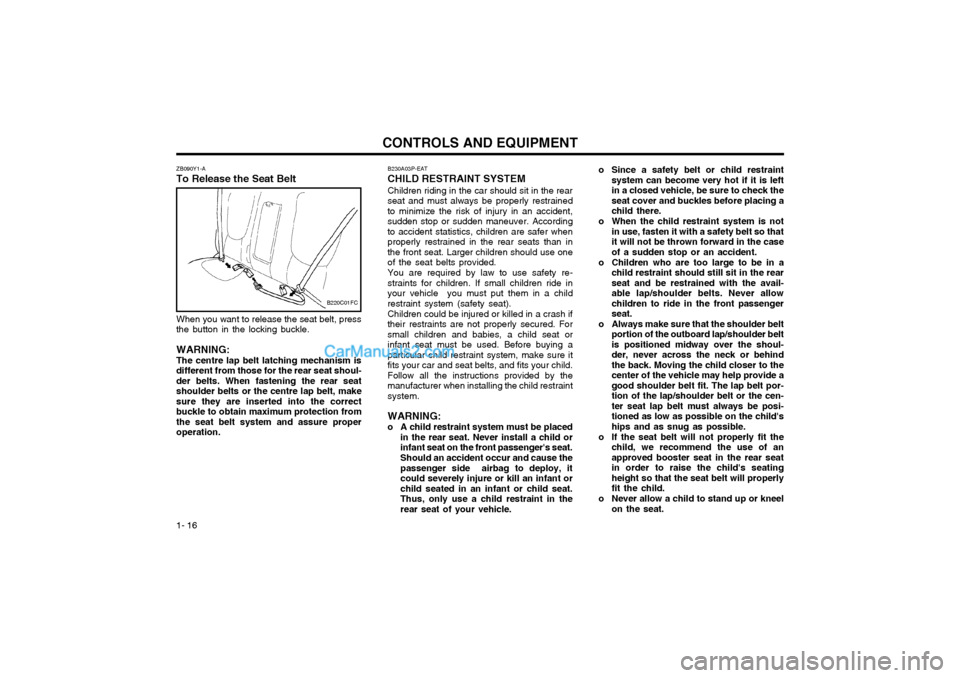
ZB090Y1-A To Release the Seat Belt
B220C01FC
When you want to release the seat belt, press the button in the locking buckle. WARNING: The centre lap belt latching mechanism is different from those for the rear seat shoul-der belts. When fastening the rear seatshoulder belts or the centre lap belt, makesure they are inserted into the correctbuckle to obtain maximum protection fromthe seat belt system and assure properoperation.
Page 242 of 312

1- 61
CONTROLS AND EQUIPMENT
B870D01FC-GAT ANTENNA Roof Antenna
Your car uses a roof antenna to receive both AM and FM broadcast signals. This antenna is a removable type. To remove the antenna, turn the antenna counterclock-wise. To install the antenna, turn the antennaclockwise. CAUTION:
o Be sure to remove the antenna before washing the car in an automatic car wash or it may be damaged.
o Before entering a place with a low height clearance, be sure to adjust the roofantenna low.
o When reinstalling your antenna, it is important that it is fully tightened toensure proper reception.
HFC2100
Page 252 of 312

DRIVING YOUR HYUNDAI
2- 10 C300B01O-GAT
TCS ON Mode In the TCS ON mode, the indicator in the instrument cluster will not be illuminated. NOTE:
1) Turn off the engine. Then restart the engine, and the TCS mode will auto- matically turn "ON".
2) When the traction control is operating properly, you can feel a slight pulsationin the vehicle. This is only the effect ofbrake control and indicates nothingunusual. C300D02O-GAT
Indicator and Warning
The indicator should illuminate when the igni-tion key is turned to "ON" or "START", butshould go out after three seconds. If the indicator does not illuminate, have it checked by an authorized Hyundai dealer. Should there be any unusual conditions in the device, TCS illuminates as a warning.If TCS illuminates, pull your car to a safeplace and stop the engine. Then, start the engine again to check if the TCS indicator goes out. If the indicator remains lit even after the engine has been started, have your carchecked by an authorized Hyundai dealer. NOTE: When TCS illuminates, traction control is automatically deactivated for safety.
Driving hints
TCS does not actively apply brakes. Be sure
to decelerate the car sufficiently before enter-ing curves.
CAUTION: When the TCS indicator blinks, SLIP con-
trol has been activated. It also means that the road is slippery or your car is acceler-ating excessively. In this situation, releasefoot pressure from the accelerator pedaland maintain moderate speed.
WARNING: Traction control is only a driving aid; all
normal precautions for driving in inclem- ent weather and on slippery driving sur-faces should be observed. 3) When the engine starts, a click is heard
from the engine compartment; however,this is only the sound of traction controlbeing checked.
4) When moving out of the mud or fresh snow, pressing the accelerator pedalmay not cause the engine speed toincrease.
The braking distance for cars equippedwith an anti-lock braking system may belonger than for those without it in thefollowing road conditions.
o Driving on rough, gravel or snow-cov-
ered roads.
o Driving with tyre chains installed.
o Driving on roads where the road sur- face is pitted or has different surface height.
These roads should be driven at reducedspeeds. The safety features of an ABSequipped vehicle should not be tested byhigh speed driving or cornering. This couldendanger the safety of yourself or others.
C300A01O-EAT
BRAKE TRACTION CONTROL SYSTEM (BTCS) (Not all models)
On slippery road surfaces, the traction control
system (TCS) limits the drive wheels from spinning excessively, thus helping the car toaccelerate. It also provides sufficient drivingforce and steering performance as the carturns at accelerated speeds. SLIP Control
Limits the drive wheels from spinning exces-
sively during starting or while making acceler- ated turns on slippery roads to avoid losingthe driving force of the front wheels.
Page 306 of 312
VEHICLE SPECIFICATIONS 9-1
Litre
55 Imp.gal
12
SJ000A1-F
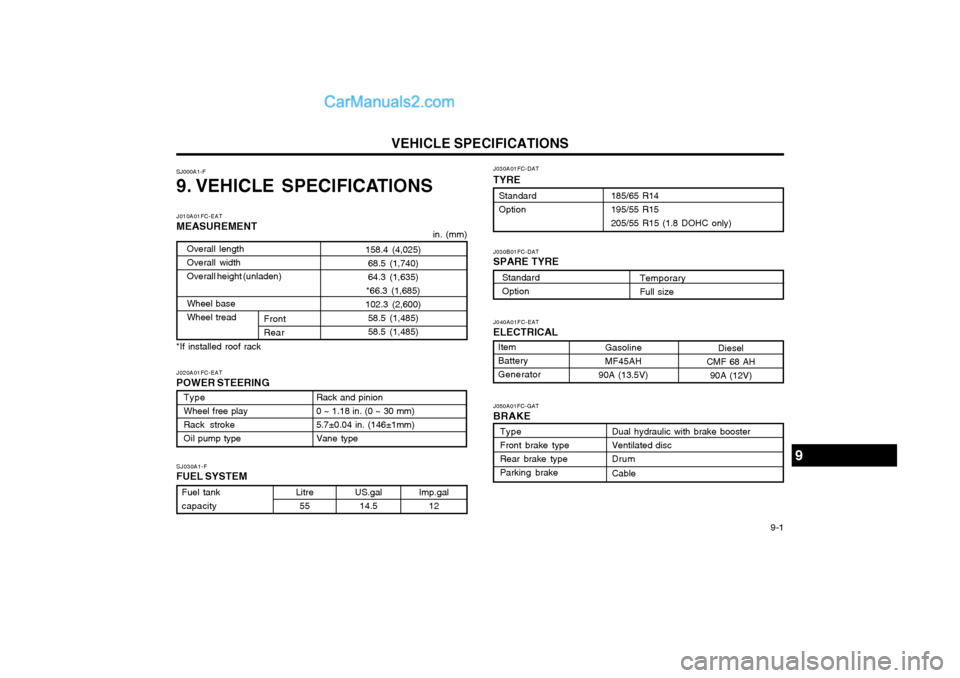
9. VEHICLE SPECIFICATIONS
Fuel tank capacity
Type Wheel free playRack strokeOil pump type
J010A01FC-EAT MEASUREMENT
in. (mm)
Item BatteryGeneratorDiesel
CMF 68 AH 90A (12V)
Gasoline MF45AH
90A (13.5V)
9
J040A01FC-EAT ELECTRICAL
SJ030A1-FFUEL SYSTEM
J020A01FC-EAT POWER STEERING
US.gal14.5
Rack and pinion 0 ~ 1.18 in. (0 ~ 30 mm)5.7±0.04 in. (146±1mm)Vane type J030A01FC-DAT
TYRE
185/65 R14 195/55 R15205/55 R15 (1.8 DOHC only)
StandardOption
Type Front brake typeRear brake typeParking brake Dual hydraulic with brake boosterVentilated discDrum Cable
J050A01FC-GAT BRAKE
Front Rear
Overall lengthOverall widthOverall height (unladen) Wheel base Wheel tread
158.4 (4,025)
68.5 (1,740)64.3 (1,635)
*66.3 (1,685)
102.3 (2,600) 58.5 (1,485)58.5 (1,485)
*If installed roof rack
Standard Option
J030B01FC-DAT SPARE TYRE
Temporary Full size
Page 310 of 312

INDEX
10-2 ENGINE COMPARTMENT ..................................................... 6-1 ~ 6-3 ENGINE COOLANT CHECKING AND REPLACING ........................6-7ENGINE OIL AND FILTER REPLACEMENT .................................. 6-6 ENGINE OIL CONSUMPTION ......................................................... 6-6 ENGINE OIL REPLENISHMENT .................................................... 6-5ENGINE OIL .................................................................................... 6-4EXTERIOR REAR VIEW MIRROR ..................................... 1-44 ~ 1-45 F FOLDING REAR SEATBACK AND SEAT CUSHION ......... 1-11 ~ 1-12 FOLD-UP TRAY ............................................................................ 1-47FRONT ASHTRAY ........................................................................ 1-39FRONT FOG LIGHT SWITCH ....................................................... 1-38FUEL ECONOMY ............................................................................ 2-4FUEL GAUGE ............................................................................... 1-32 FUEL RECOMMENDATIONS .......................................................... 1-1 FUSIBLE LINKS ............................................................................ 6-17 G GLOVE BOX ................................................................................. 1-44 H HAZARD WARNING SYSTEM ....................................................... 1-37HEADLIGHT AIMING ADJUSTEMENT .......................................... 6-20HEADLIGHT BULB ............................................................. 6-19 ~ 6-20
HEADLIGHT LEVELING DEVICE SYSTEM ................................. 1-41HEAD RESTRAINT ADJUSTMENT ........................................ 1-9, 1-11HEATED REAR WINDOW ............................................................. 1-38 HEATING CONTROL .................................................................... 1-55 HEIGHT ADJUSTABLE FRONT SEAT SHOULDER BELT ............. 1-14HORN ............................................................................................ 1-51 I IF THE ENGINE CANNOT BE CRANKED ...................................... 3-1 IF THE ENGINE WILL NOT START ................................................ 3-1 IF THE EVENT OF A PUNCTURE ................................................. 3-4IMMOBILIZER SYSTEM ..........................................................1-2 ~ 1-3INDIVIDUAL CIRCUIT FUSES ....................................................... 6-17INSTRUMENT CLUSTER AND INDICATORS ..................... 1-27 ~ 1-28INSTRUMENTS AND CONTROLS ............................................... 1-26 INTERIOR LIGHT .......................................................................... 1-43 INTERIOR REAR VIEW MIRROR ................................................ 1-46 J JUMP STARTING ............................................................................ 3-1 K KEY POSITIONS ............................................................................. 2-2
Page 311 of 312
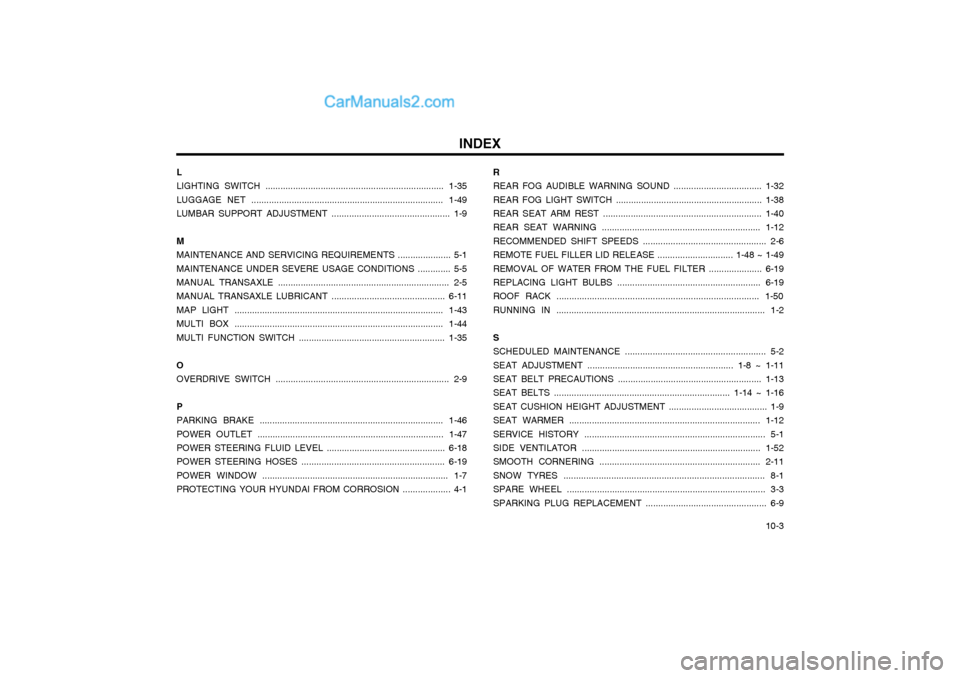
INDEX10-3
L LIGHTING SWITCH ....................................................................... 1-35LUGGAGE NET ............................................................................ 1-49 LUMBAR SUPPORT ADJUSTMENT ............................................... 1-9 M MAINTENANCE AND SERVICING REQUIREMENTS ..................... 5-1MAINTENANCE UNDER SEVERE USAGE CONDITIONS ............. 5-5MANUAL TRANSAXLE .................................................................... 2-5 MANUAL TRANSAXLE LUBRICANT ............................................. 6-11 MAP LIGHT ................................................................................... 1-43MULTI BOX ................................................................................... 1-44MULTI FUNCTION SWITCH .......................................................... 1-35 O OVERDRIVE SWITCH ..................................................................... 2-9 P PARKING BRAKE ......................................................................... 1-46POWER OUTLET .......................................................................... 1-47POWER STEERING FLUID LEVEL ............................................... 6-18 POWER STEERING HOSES ......................................................... 6-19 POWER WINDOW .......................................................................... 1-7PROTECTING YOUR HYUNDAI FROM CORROSION ................... 4-1
RREAR FOG AUDIBLE WARNING SOUND ................................... 1-32REAR FOG LIGHT SWITCH .......................................................... 1-38 REAR SEAT ARM REST ............................................................... 1-40 REAR SEAT WARNING ............................................................... 1-12RECOMMENDED SHIFT SPEEDS ................................................. 2-6REMOTE FUEL FILLER LID RELEASE .............................. 1-48 ~ 1-49REMOVAL OF WATER FROM THE FUEL FILTER ..................... 6-19REPLACING LIGHT BULBS ......................................................... 6-19 ROOF RACK ................................................................................ 1-50 RUNNING IN ................................................................................... 1-2 S SCHEDULED MAINTENANCE ........................................................ 5-2SEAT ADJUSTMENT .......................................................... 1-8 ~ 1-11 SEAT BELT PRECAUTIONS ......................................................... 1-13 SEAT BELTS ...................................................................... 1-14 ~ 1-16SEAT CUSHION HEIGHT ADJUSTMENT ....................................... 1-9SEAT WARMER ............................................................................ 1-12SERVICE HISTORY ........................................................................ 5-1SIDE VENTILATOR ....................................................................... 1-52 SMOOTH CORNERING ................................................................ 2-11 SNOW TYRES ................................................................................ 8-1SPARE WHEEL ............................................................................... 3-3SPARKING PLUG REPLACEMENT ................................................ 6-9