steering wheel Hyundai Matrix 2003 User Guide
[x] Cancel search | Manufacturer: HYUNDAI, Model Year: 2003, Model line: Matrix, Model: Hyundai Matrix 2003Pages: 312, PDF Size: 4.1 MB
Page 111 of 312
DRIVING YOUR HYUNDAI
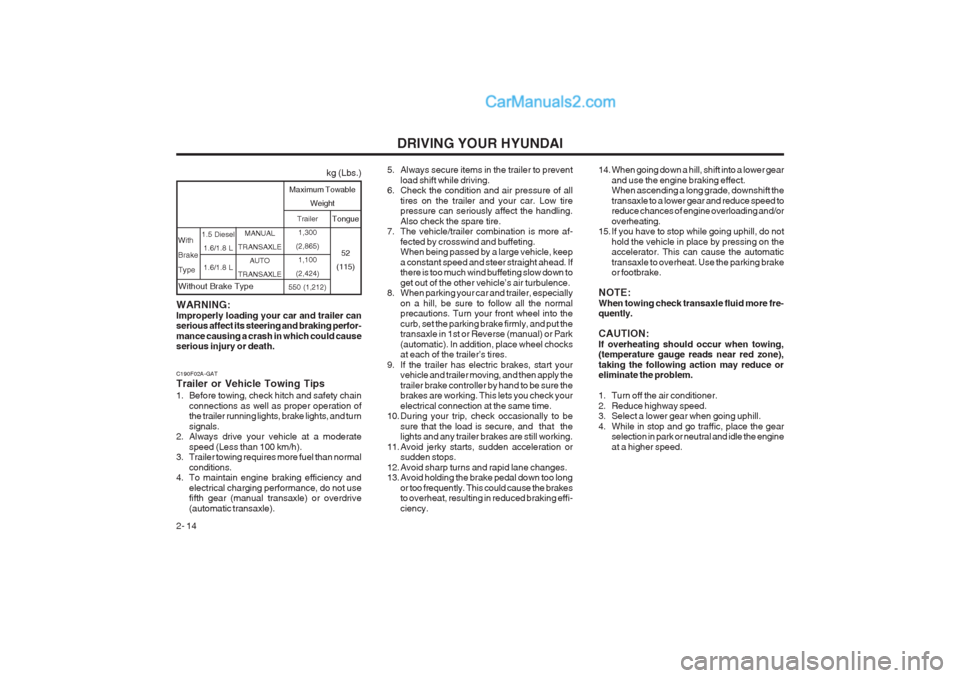
2- 14 MANUAL
TRANSAXLE AUTO
TRANSAXLE Trailer
1,300
(2,865) 1,100
(2,424)
550 (1,212) Tongue
52
(115)
kg (Lbs.)
Maximum Towable Weight
With BrakeType
1.5 Diesel 1.6/1.8 L 1.6/1.8 L
WARNING: Improperly loading your car and trailer can serious affect its steering and braking perfor- mance causing a crash in which could cause serious injury or death.
Without Brake Type
5. Always secure items in the trailer to prevent load shift while driving.
6. Check the condition and air pressure of all
tires on the trailer and your car. Low tire pressure can seriously affect the handling. Also check the spare tire.
7. The vehicle/trailer combination is more af-
fected by crosswind and buffeting. When being passed by a large vehicle, keep a constant speed and steer straight ahead. If there is too much wind buffeting slow down to get out of the other vehicle’s air turbulence.
8. When parking your car and trailer, especially
on a hill, be sure to follow all the normal precautions. Turn your front wheel into the curb, set the parking brake firmly, and put the transaxle in 1st or Reverse (manual) or Park (automatic). In addition, place wheel chocks at each of the trailer’s tires.
9. If the trailer has electric brakes, start your vehicle and trailer moving, and then apply the trailer brake controller by hand to be sure the brakes are working. This lets you check your electrical connection at the same time.
10. During your trip, check occasionally to be
sure that the load is secure, and that the lights and any trailer brakes are still working.
11. Avoid jerky starts, sudden acceleration or sudden stops.
12. Avoid sharp turns and rapid lane changes.
13. Avoid holding the brake pedal down too long or too frequently. This could cause the brakesto overheat, resulting in reduced braking effi- ciency. 14. When going down a hill, shift into a lower gear
and use the engine braking effect. When ascending a long grade, downshift the transaxle to a lower gear and reduce speed to reduce chances of engine overloading and/or overheating.
15. If you have to stop while going uphill, do not
hold the vehicle in place by pressing on the accelerator. This can cause the automatic transaxle to overheat. Use the parking brake or footbrake.
NOTE: When towing check transaxle fluid more fre- quently. CAUTION: If overheating should occur when towing, (temperature gauge reads near red zone), taking the following action may reduce or eliminate the problem.
1. Turn off the air conditioner.
2. Reduce highway speed.
3. Select a lower gear when going uphill.
4. While in stop and go traffic, place the gear selection in park or neutral and idle the engineat a higher speed.
C190F02A-GAT Trailer or Vehicle Towing Tips
1. Before towing, check hitch and safety chain
connections as well as proper operation of the trailer running lights, brake lights, and turn signals.
2. Always drive your vehicle at a moderate
speed (Less than 100 km/h).
3. Trailer towing requires more fuel than normal
conditions.
4. To maintain engine braking efficiency and
electrical charging performance, do not use fifth gear (manual transaxle) or overdrive (automatic transaxle).
Page 119 of 312

WHAT TO DO IN AN EMERGENCY
3-8 D080A02A-GAT IF YOUR CAR MUST BE TOWED CAUTION: Your car can be damaged if towed incorrect- ly! If your car has to be towed, it should be done by your Hyundai dealer or a commercial tow truck service. This will help assure that your car is not damaged in towing. Also, professionals are gen- erally aware of local laws governing towing. In any case, rather than risk damage to your car, it is suggested that you show this information to the tow truck operator. Be sure that a safety chain system is used and that all local laws are ob- served.
D080B01A-AAT Towing a Car with a Manual Transaxle
o If the car is being towed with the rear wheels
on the ground, be sure the parking brake is released.
o If the car is being towed with the front wheels on the ground, be sure that the transaxle is in neutral. Also, be sure that the ignition key is in the "ACC" position. This is necessary to prevent damage to the steering lock mecha- nism, which is not designed to hold the front wheels straight while the car is being towed.
o If any of the loaded wheels or suspension
components are damaged, a towing dolly must be used.
o OK FOR AUTOMATIC OR MANUALTRANSAXLE EQUIPPED VEHICLE D080A01FC o OK FOR AUTOMATIC OR MANUAL
TRANSAXLE EQUIPPED VEHICLE WITH NO DAMAGE D080B01FC
D060J01FC-GAT After Changing Wheels If you have a tire gauge, remove the valve cap and check the air pressure. If the pressure is lower than recommended, drive slowly to the nearest service station and inflate to the correct pressure. If it is too high, adjust it until it is correct. Always reinstall the valve cap after checking or adjusting tire pressure. If the cap is not replaced, air may leak from the tire. If you lose a valve cap, buy another and install it as soon as possible. After you have changed wheels, always secure the flat tire in its place in the luggage room and return the jack and tools to their proper storage locations.
D060B01FC
Page 120 of 312

WHAT TO DO IN AN EMERGENCY 3-9
D080C02A-GAT Towing a Car with an Automatic Transaxle CAUTION: A car with an automatic transaxle should never be towed from the rear with the front wheels on the ground. This can cause seri- ous damage to the transaxle. If the car must be towed from the rear, a towing dolly must be used under the front wheels. If the car is being towed with the rear wheels on the ground, be sure the parking brake is re- leased.
o NOT OK FOR AUTOMATIC TRANSAXLE
EQUIPPED VEHICLE
o OK FOR MANUAL TRANSAXLE
D080C01FC D080D02A-AAT Emergency Towing For emergency towing when no commercial tow vehicle is available, attach a tow cable, chain or strap to one of the tie-down hooks under the front of your car. Do not attempt to tow your vehicle in this manner on any unpaved surface. This could result in serious damage to your car. Nor should towing be attempted if the wheels, drive train, axles, steering or brakes are dam- aged. Before towing, be sure the transaxle is in neutral and the key is in "ACC" (with the engine off) or in the "ON" position (with the engine running). A driver must be in the towed car to steer it and operate the brakes.
D080D01FC
NOTE: Before towing, check the level of the transaxle fluid. If it is below the "HOT" range on the dipstick, add fluid. If you cannot add fluid, a towing dolly must be used.
o OK FOR AUTOMATIC OR MANUAL
TRANSAXLE EQUIPPED VEHICLE D080C02FC
Page 121 of 312
WHAT TO DO IN AN EMERGENCY
3-10
D120A01A-GAT IF YOU LOSE YOUR KEYSIf you lose your keys, many Hyundai dealers can make you a new key if you have your key number. If you lock the keys inside your car and you cannot obtain a new key, many Hyundai dealers can use special tools to open the door for you. Information about the key of immobilizer system (if installed) will be found on page 1-3.
CAUTION:If the car is being towed with all four wheels on the ground, it can be towed only from the front. Be sure that the transaxle is in neutral. Do not tow at speeds greater than 50 km/h
(30 mph) and for more than 25 km (15 miles). Be sure the steering is unlocked by placing the key in the "ACC" position. A driver must be in the towed vehicle to operate the steer- ing and brakes.
Page 133 of 312
VEHICLE MAINTENANCE REQUIREMENTS
5- 8 F070L01A-AAT
o Suspension Mounting Bolts Check the suspension connections for loose-
ness or damage. Retighten to the specified torque. F070M01A-AAT
o Steering Gear Box, Linkage & Boots/
Lower arm Ball Joint
With the vehicle stopped and engine off, check for excessive free-play in the steering wheel. Check the linkage for bends or damage. Check the dust boots and ball joints for deterioration, cracks, or damage. Replace any damaged parts. F070N01A-AAT o
Power Steering Pump, Belt and HosesCheck the power steering pump and hoses for leakage and damage. Replace any damaged or leaking parts immediately. Inspect the power steering belt for evidence of cuts, cracks, ex- cessive wear, oiliness and proper tension. Re- place or adjust it if necessary. F070P01A-AAT o Driveshafts and Boots Check the drive shafts, boots and clamps for cracks, deterioration, or damage. Replace any damaged parts and, if necessary, repack the grease. F070Q01A-AAT
o Air Conditioning Refrigerant Check the air conditioning lines and connec- tions for leakage and damage. Check air condi- tioning performance according to the relevant shop manual if necessary.
Page 137 of 312
DO-IT-YOURSELF MAINTENANCE
6-4
G020A01A-AAT
GENERAL CHECKS Engine Compartment
The following should be checked regularly:
o Engine oil level and condition
o Transaxle fluid level and condition
o Brake fluid level
o Clutch fluid level
o Engine coolant level
o Windshield washer fluid level
o Accessory drive belt condition
o Engine coolant hose condition
o Fluid leaks (on or below components)
o Power steering fluid level
o Battery condition
o Air filter condition
G020B01A-AAT
Vehicle Exterior The following should be checked monthly:
o Overall appearance and condition
o Wheel condition and wheel nut torque
o Exhaust system condition
o Light condition and operation
o Windshield glass condition
o Wiper blade condition
o Paint condition and body corrosion
o Fluid leaks
o Door and hood lock condition
o Tire pressure and condition (including spare tire) G020C01A-AAT
Vehicle Interior
The following should be checked each time when the vehicle is driven:
o Lights operation
o Windshield wiper operation
o Horn operation
o Defroster, heating system operation (and air conditioning, if installed)
o Steering operation and condition
o Mirror condition and operation
o Turn signal operation
o Accelerator pedal operation
o Brake operation, including parking brake
o Manual transaxle operation, including clutch operation
o Automatic transaxle operation, including "Park" mechanism operation
o Seat control condition and operation
o Seat belt condition and operation
o Sunvisor operation
If you notice anything that does not operate correctly or appears to be functioning incorrect-ly, inspect it carefully and seek assistance fromyour Hyundai dealer if service is needed. G030A01FC-GAT
CHECKING THE ENGINE OIL Gasoline EngineRecommended Oil
SSA6030B
20W-40 20W-50
10W-30 15W-40 15W-50
10W-40 10W-50
°C °F -25-13 2068 40104
-15
- 5 -10-14 0
32 1050
5W-40
5W-30
5W-20
Engine oil is essential to the performance and service of the engine. It is suggested that youcheck the oil level at least once a week innormal use and more often if you are on a tripor driving in severe conditions. SH, SG or SG/CD (API) multi-grade and fuel efficient oil is recommended. NOTE: SAE 5W-20 is not recommended for sus- tained high speed vehicle operation.
Page 150 of 312

DO-IT-YOURSELF MAINTENANCE 6-17
G160A01A-GAT
CHECKING CLUTCH PEDAL FREE-PLAY With the engine off, press lightly on the clutch pedal until you feel a change in resistance. Thisis the clutch pedal freeplay. The freeplay shouldbe within the limits specified in the illustration. Ifit is not, have it inspected by your Hyundaidealer and adjusted or repaired if necessary.
G160A01E
6 ~ 13 mm (0.24 ~ 0.51 in.)
G150A01A-GAT
CHECKING STEERING WHEEL FREEPLAY
To check the steering wheel freeplay, stop the
car with the wheels pointed straight ahead and gently move the steering wheel back and forth.Use very light finger pressure and be sensitiveto changes in resistance that mark the limits ofthe freeplay. If the freeplay is greater thanspecified, have it inspected by your Hyundaidealer and adjusted or repaired if necessary.
G150A01FC
G140D01S-GAT
Checking the Compressor Drive Belt
When the air conditioning is being used regular-
ly, the compressor drive belt tension should be checked at least once a month.
To check the drive belt tension, press down on
the belt halfway between the engine crankshaftand compressor pulleys. Pressing with yourfinger, you should not be able to deflect this beltanymore than 8.0 mm. If you have the instru-ments to check it with a force of 98N (22 lb.),the deflection should be approx. 8.0 mm (0.315in.). If the belt is too loose, have it adjusted byyour Hyundai dealer.
G140D01A
A/C
CRANK PULLEY
TENSION PULLEY
30 mm (1.18 in.)
8mm(0.315 in.)
Page 166 of 312
CONSUMER INFORMATION 8-3
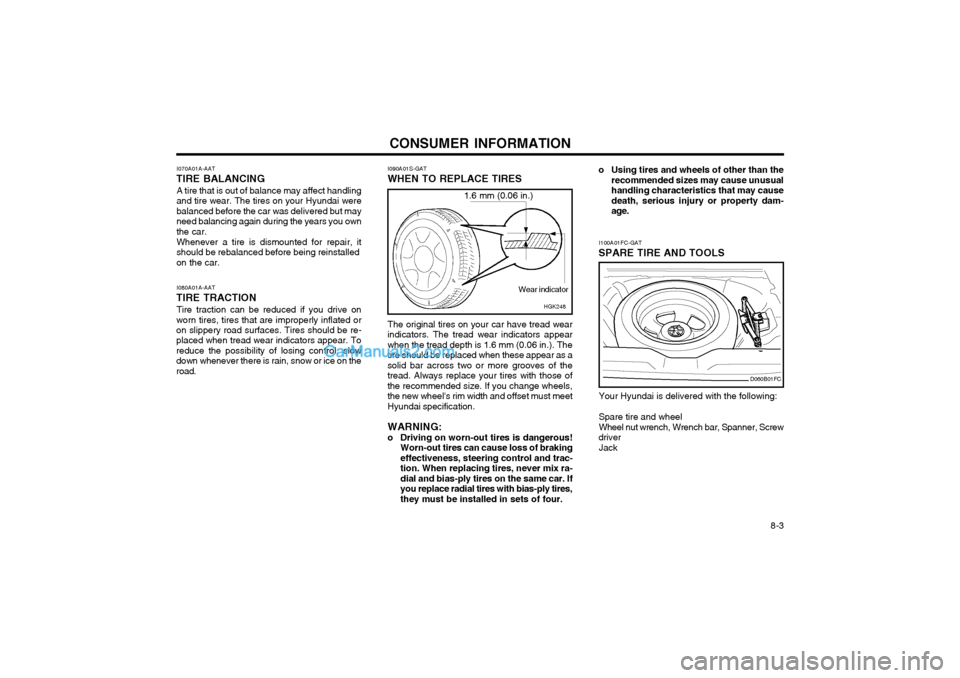
I090A01S-GAT WHEN TO REPLACE TIRES
HGK248
1.6 mm (0.06 in.)
Wear indicator
I070A01A-AAT
TIRE BALANCING
A tire that is out of balance may affect handling and tire wear. The tires on your Hyundai werebalanced before the car was delivered but mayneed balancing again during the years you ownthe car. Whenever a tire is dismounted for repair, it should be rebalanced before being reinstalled on the car. I080A01A-AAT
TIRE TRACTION Tire traction can be reduced if you drive on
worn tires, tires that are improperly inflated or on slippery road surfaces. Tires should be re- placed when tread wear indicators appear. To reduce the possibility of losing control, slowdown whenever there is rain, snow or ice on theroad. The original tires on your car have tread wear
indicators. The tread wear indicators appearwhen the tread depth is 1.6 mm (0.06 in.). Thetire should be replaced when these appear as asolid bar across two or more grooves of thetread. Always replace your tires with those ofthe recommended size. If you change wheels,the new wheel's rim width and offset must meetHyundai specification.
WARNING:
o Driving on worn-out tires is dangerous! Worn-out tires can cause loss of brakingeffectiveness, steering control and trac-tion. When replacing tires, never mix ra-dial and bias-ply tires on the same car. Ifyou replace radial tires with bias-ply tires,they must be installed in sets of four. I100A01FC-GAT
SPARE TIRE AND TOOLS
Your Hyundai is delivered with the following: Spare tire and wheel Wheel nut wrench, Wrench bar, Spanner, Screw
driver Jack
D060B01FC
o Using tires and wheels of other than the recommended sizes may cause unusual handling characteristics that may causedeath, serious injury or property dam-age.
Page 167 of 312
VEHICLE SPECIFICATIONS 9-1
J030A01FC-GAT
TIRE J040A02FC-GAT
ELECTRICAL
ITEM BatteryGenerator
Type Front brake typeRear brake typeParking brake Dual hydraulic with brake boosterVentilated discDrum Cable
J050A01FC-GAT BRAKE
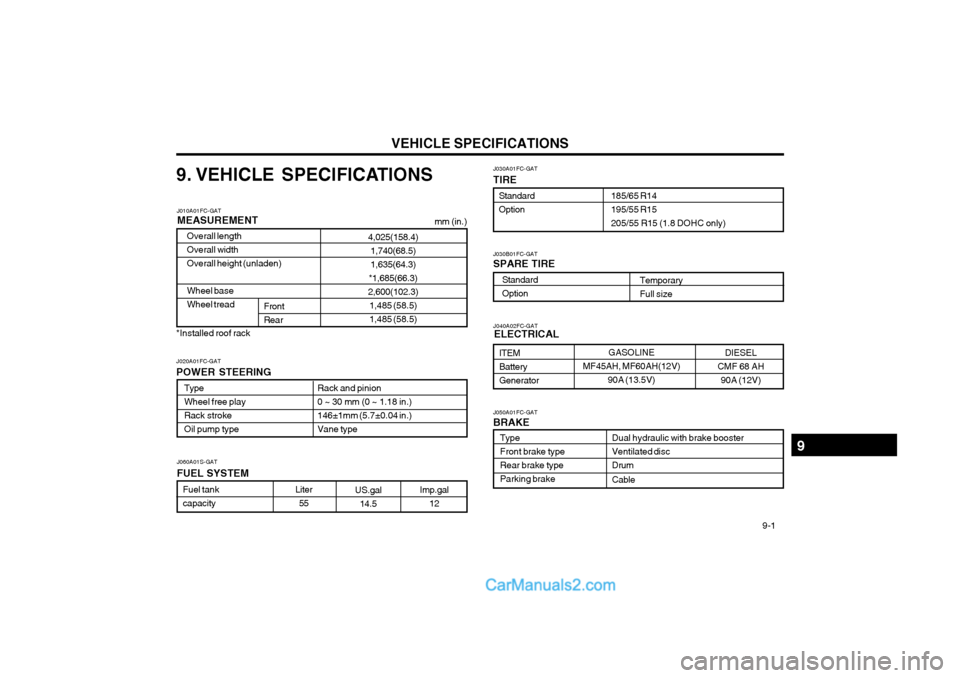
9. VEHICLE SPECIFICATIONS
J010A01FC-GAT
MEASUREMENT
J060A01S-GAT FUEL SYSTEM
J020A01FC-GAT
POWER STEERING Type Wheel free playRack strokeOil pump type Rack and pinion0 ~ 30 mm (0 ~ 1.18 in.)146±1mm (5.7±0.04 in.)Vane type
Front Rear
Fuel tankcapacity Imp.gal
12
US.gal
14.5
Liter
55
Overall lengthOverall widthOverall height (unladen) Wheel base Wheel tread
mm (in.)
4,025(158.4) 1,740(68.5)1,635(64.3)
*1,685(66.3)
2,600(102.3) 1,485 (58.5)1,485 (58.5)
DIESEL
CMF 68 AH 90A (12V)
GASOLINE
MF45AH, MF60AH(12V) 90A (13.5V)
*Installed roof rack
Standard Option
J030B01FC-GAT SPARE TIRE
Temporary Full size
185/65 R14 195/55 R15205/55 R15 (1.8 DOHC only)
StandardOption
9
Page 172 of 312
INDEX10-3
R
Rear Fog Audible Warning Sound
....................................................1-35
Rear Seat Adjustable headrests ..................................................................... 1-11
Adjusting seatback angle .............................................................. 1-11
Adjusting seat forward and rearward ............................................ 1-11
Arm Rest ....................................................................................... 1-43
Fold down ........................................................................... 1-12 ~ 1-13
Rear Window Defroster Switch ......................................................... 1-41
Recommended Shift Poi nts ................................................................ 2-5
Removal of water from the fuel fiter ................................................. 6-22
Replacing Light Bulbs ....................................................................... 6-22
Replacing The Spark Plugs .............................................................. 6-10
Roof R ack ......................................................................................... 1-53
SSeat Belts 2-Point Static Type ............................................................ 1-16 ~ 1-173-Point system ................................................................... 1-15 ~ 1-16
Adjustable height ........................................................................... 1-15
Adjusting your seat belt ................................................................ 1-16
Care of seat belts ......................................................................... 1-14
Precautions ................................................................................... 1-13
Seat Warmer ..................................................................................... 1-13
Spark Plugs ........................................................................... 6-10 ~ 6-11
Spectacle Case ................................................................................. 1-46
Speedometer ..................................................................................... 1-35
Starting Procedures ............................................................................ 2-3Steering Wheel Free play ....................................................................................... 6-17
Tilt lever ........................................................................................ 1-54
Stereo Radio Operation (H210, H220, H260, H280) ............................ 1-64 ~ 1-65, 1-66 ~ 1-67, 1-70 ~ 1-72, 1-77 ~ 1-79
Stereo Sound System ............................................................ 1-62 ~ 1-63
K
Keys .................................................................................................... 1-2
If you lose your keys .................................................................... 3-10
Positions .......................................................................................... 2-2
LLight Bulb Replacement ......................................................... 6-22 ~ 6-23
Lubrication Chart ................................................................................. 9-3
Luggaga Net ..................................................................................... 1-52
M Maintenance Intervals Explanation of scheduled maintenance items ........................ 5-7 ~ 5-8
Maintenance under severe usage conditions ................................. 5-6
Scheduled maintenance ......................................................... 5-3 ~ 5-5
Service requirements ...................................................................... 5-1
Mirros Day-night inside rearview .............................................................. 1-48
Outside rear view .......................................................................... 1-47
Multi Box ........................................................................................... 1-47
O Odometer .......................................................................................... 1-36
Outside Rearview Mirror Heater ....................................................... 1-48
PParking Brake ................................................................................... 1-49
Power Outlet ..................................................................................... 1-50
Power Steering Fluid Level .............................................................. 6-21
Pre-tensioner Seat Belt .......................................................... 1-22 ~ 1-23