water pump Hyundai Matrix 2003 User Guide
[x] Cancel search | Manufacturer: HYUNDAI, Model Year: 2003, Model line: Matrix, Model: Hyundai Matrix 2003Pages: 312, PDF Size: 4.1 MB
Page 211 of 312
CONTROLS AND EQUIPMENT
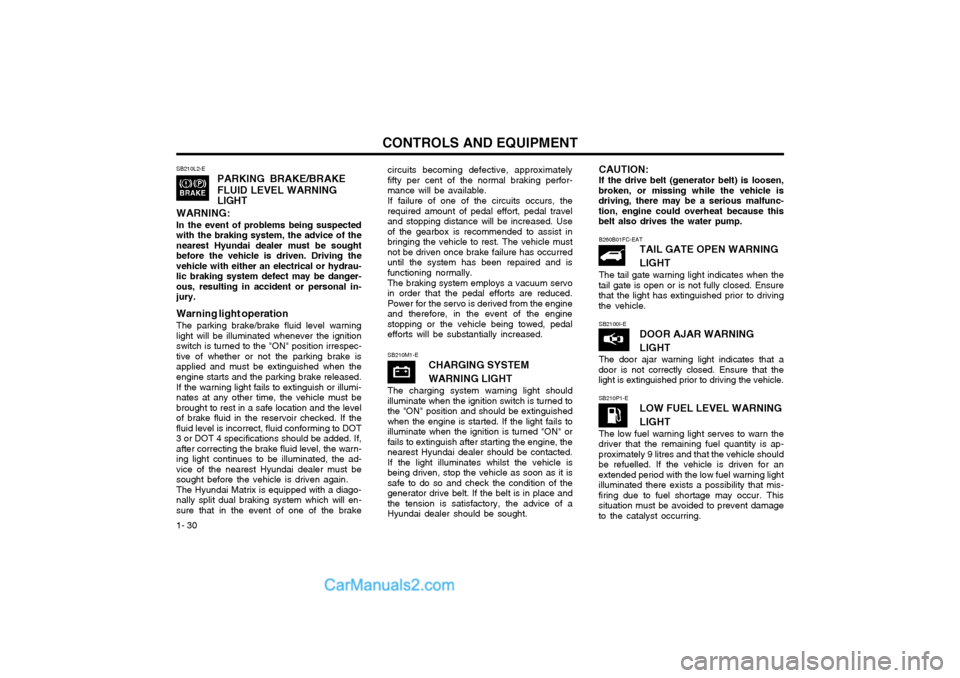
1- 30 circuits becoming defective, approximately fifty per cent of the normal braking perfor-mance will be available.
If failure of one of the circuits occurs, the
required amount of pedal effort, pedal traveland stopping distance will be increased. Useof the gearbox is recommended to assist inbringing the vehicle to rest. The vehicle mustnot be driven once brake failure has occurreduntil the system has been repaired and isfunctioning normally.
The braking system employs a vacuum servo
in order that the pedal efforts are reduced.Power for the servo is derived from the engineand therefore, in the event of the enginestopping or the vehicle being towed, pedalefforts will be substantially increased.
SB210L2-E
PARKING BRAKE/BRAKE FLUID LEVEL WARNING LIGHT
WARNING: In the event of problems being suspected with the braking system, the advice of thenearest Hyundai dealer must be soughtbefore the vehicle is driven. Driving thevehicle with either an electrical or hydrau-lic braking system defect may be danger-ous, resulting in accident or personal in-jury. Warning light operation The parking brake/brake fluid level warning light will be illuminated whenever the ignitionswitch is turned to the "ON" position irrespec-tive of whether or not the parking brake isapplied and must be extinguished when theengine starts and the parking brake released. If the warning light fails to extinguish or illumi- nates at any other time, the vehicle must bebrought to rest in a safe location and the levelof brake fluid in the reservoir checked. If thefluid level is incorrect, fluid conforming to DOT3 or DOT 4 specifications should be added. If,after correcting the brake fluid level, the warn-ing light continues to be illuminated, the ad-vice of the nearest Hyundai dealer must besought before the vehicle is driven again.The Hyundai Matrix is equipped with a diago-nally split dual braking system which will en-sure that in the event of one of the brake
CAUTION: If the drive belt (generator belt) is loosen,
broken, or missing while the vehicle is driving, there may be a serious malfunc-tion, engine could overheat because thisbelt also drives the water pump.
SB210M1-E CHARGING SYSTEM WARNING LIGHT
The charging system warning light should
illuminate when the ignition switch is turned to the "ON" position and should be extinguishedwhen the engine is started. If the light fails toilluminate when the ignition is turned "ON" orfails to extinguish after starting the engine, thenearest Hyundai dealer should be contacted.If the light illuminates whilst the vehicle isbeing driven, stop the vehicle as soon as it issafe to do so and check the condition of thegenerator drive belt. If the belt is in place andthe tension is satisfactory, the advice of aHyundai dealer should be sought.
B260B01FC-EAT
TAIL GATE OPEN WARNING LIGHT
The tail gate warning light indicates when the
tail gate is open or is not fully closed. Ensure that the light has extinguished prior to drivingthe vehicle.
SB2100I-E DOOR AJAR WARNING LIGHT
The door ajar warning light indicates that a
door is not correctly closed. Ensure that the light is extinguished prior to driving the vehicle.
SB210P1-E
LOW FUEL LEVEL WARNING LIGHT
The low fuel warning light serves to warn the
driver that the remaining fuel quantity is ap- proximately 9 litres and that the vehicle shouldbe refuelled. If the vehicle is driven for anextended period with the low fuel warning lightilluminated there exists a possibility that mis-firing due to fuel shortage may occur. Thissituation must be avoided to prevent damageto the catalyst occurring.
Page 213 of 312
CONTROLS AND EQUIPMENT
1- 32
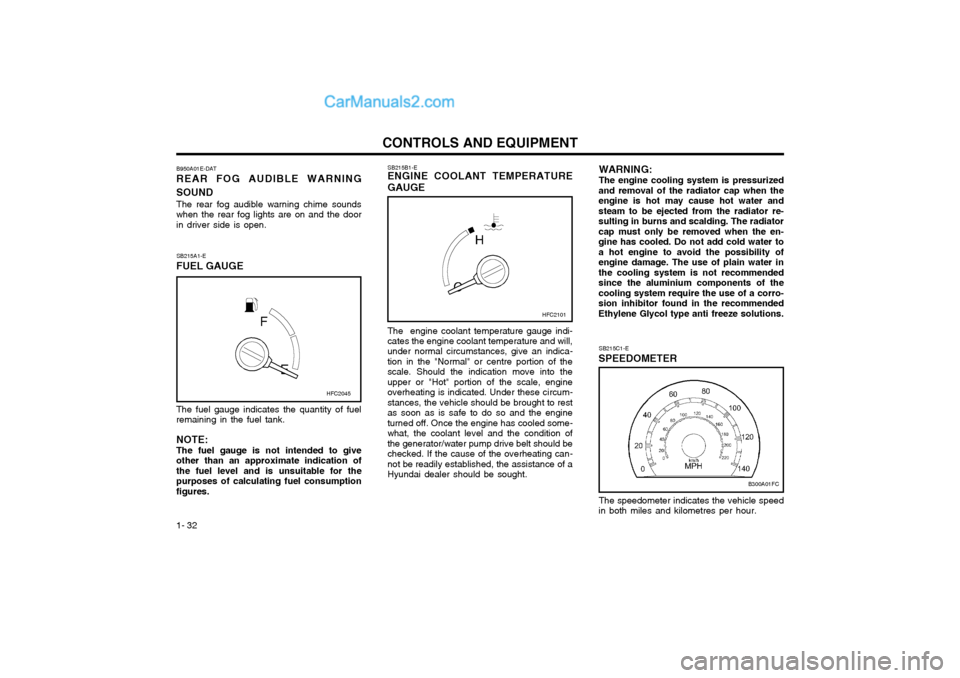
The fuel gauge indicates the quantity of fuel remaining in the fuel tank. NOTE: The fuel gauge is not intended to giveother than an approximate indication ofthe fuel level and is unsuitable for thepurposes of calculating fuel consumptionfigures. SB215B1-E
ENGINE COOLANT TEMPERATURE GAUGE
The engine coolant temperature gauge indi-
cates the engine coolant temperature and will, under normal circumstances, give an indica-tion in the "Normal" or centre portion of thescale. Should the indication move into theupper or "Hot" portion of the scale, engineoverheating is indicated. Under these circum-stances, the vehicle should be brought to restas soon as is safe to do so and the engineturned off. Once the engine has cooled some-what, the coolant level and the condition ofthe generator/water pump drive belt should bechecked. If the cause of the overheating can-not be readily established, the assistance of aHyundai dealer should be sought.
SB215A1-E
FUEL GAUGE
B950A01E-DAT REAR FOG AUDIBLE WARNING SOUND The rear fog audible warning chime sounds when the rear fog lights are on and the doorin driver side is open.
HFC2101
HFC2045
WARNING: The engine cooling system is pressurized
and removal of the radiator cap when the engine is hot may cause hot water andsteam to be ejected from the radiator re-sulting in burns and scalding. The radiatorcap must only be removed when the en-gine has cooled. Do not add cold water toa hot engine to avoid the possibility ofengine damage. The use of plain water inthe cooling system is not recommendedsince the aluminium components of thecooling system require the use of a corro-sion inhibitor found in the recommendedEthylene Glycol type anti freeze solutions.
B300A01FC
SB215C1-E
SPEEDOMETER
The speedometer indicates the vehicle speed
in both miles and kilometres per hour.
Page 259 of 312
IN CASE OF EMERGENCY
3-2
CAUTION:
Personal injury and damage to the vehicle
may occur if jump starting is not per- formed correctly. If any doubt exists as tohow this operation should be performed,seek assistance from qualified personnel. WARNING:
Motor vehicle batteries contain sulphuric
acid and emit hydrogen gas. Protective clothing should be worn and care exer-cised to prevent the acid from coming intocontact with skin or clothing and the ve-hicle. Naked lights should not be permittedin the vicinity of the battery. Care shouldbe exercised to prevent sparks occurringduring connection. If acid accidentallycomes into contact with skin or eyes, theaffected area should immediately be flushed ponents such as the Fuel Injection system
computer and the Automatic Transaxlecomputer. The battery must never be dis-connected whilst the engine is running. SD040A2-E IF THE ENGINE OVERHEATS If the temperature gauge indicates overheat- ing:
1. Pull off the road and stop as soon as it is
safe to do so.
2. Place the gear selector lever in "P" (auto- matic), or neutral (manual transaxle) and set the parking brake. If the air condition-ing is on, turn it off.
3. If coolant is running out under the car or steam is coming out from under the bonnetstop the engine. Do not open the bonnetuntil the coolant has stopped running orthe steaming has stopped. If there is novisible loss of coolant and no steam, leavethe engine running and check to be surethe engine cooling fan is operating. If the fan is not running, turn the engine off.
4. Check to see if the water pump drive belt is missing. If it is not missing, check to see that it is tight. If the drive belt seems to besatisfactory, check for coolant leaking fromthe radiator, hoses or under the car. (If theair conditioning had been in use, it isnormal for cold water to be draining fromit).
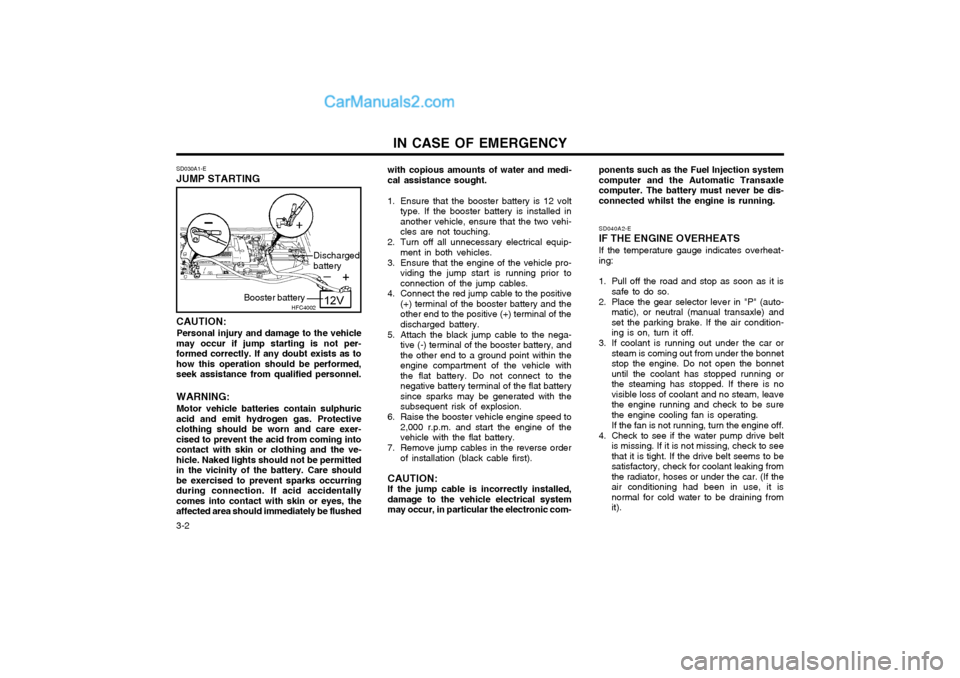
SD030A1-E JUMP STARTING
with copious amounts of water and medi- cal assistance sought.
1. Ensure that the booster battery is 12 volt type. If the booster battery is installed inanother vehicle, ensure that the two vehi-cles are not touching.
2. Turn off all unnecessary electrical equip- ment in both vehicles.
3. Ensure that the engine of the vehicle pro- viding the jump start is running prior toconnection of the jump cables.
4. Connect the red jump cable to the positive (+) terminal of the booster battery and theother end to the positive (+) terminal of thedischarged battery.
5. Attach the black jump cable to the nega- tive (-) terminal of the booster battery, andthe other end to a ground point within theengine compartment of the vehicle withthe flat battery. Do not connect to thenegative battery terminal of the flat batterysince sparks may be generated with thesubsequent risk of explosion.
6. Raise the booster vehicle engine speed to 2,000 r.p.m. and start the engine of thevehicle with the flat battery.
7. Remove jump cables in the reverse order of installation (black cable first).
CAUTION:If the jump cable is incorrectly installed,damage to the vehicle electrical systemmay occur, in particular the electronic com-
HFC4002
Booster battery Discharged battery
Page 260 of 312
3-3
IN CASE OF EMERGENCY
WARNING: While the engine is running, keep hands
and clothing away from moving parts such as the fan and drive belts to preventinjury.
WARNING (Diesel only): Never work on injection system with en-
gine running or within 30 seconds after shutting off engine. High pressure pump,rail, injectors and high pressure pipes aresubject to high pressure even after theengine stopped. The fuel jet produced byfuel leaks may cause serious injury, if ittouch the body. People using pacemak-ers should not move than 30cm closer tothe ECU or wiring harness within theengine room while engine is running,since the high currents in the CommonRail system produce considerable mag-netic fields.
5. If the water pump drive belt is broken or coolant is leaking out, stop the engine immediately and call the nearest Hyundaidealer for assistance.
WARNING: Do not remove the radiator cap when the
engine is hot since steam and boiling wa- ter may be ejected from the radiator result-ing in burns or scalding. D040A01FC-EAT TEMPORARY SPARE TYREThe following instructions for the temporary spare tyre should be observed:
1. Check inflation pressure as soon as pos-
sible after installing the spare tyre, and adjust to the specified pressure. The tyrepressure should be periodically checkedand maintained at the specified pressurewhile the tyre is stored. 2. The spare tyre should only be used tem-
porarily and should be returned to theluggage compartment as soon as the origi-nal tyre can be repaired or replaced.
3. Continuous use at speeds of over 80 km/h (50 mph) is not recommended.
4. As the temporary spare tyre is specifically designed for your car, it should not beused on any other vehicle.
5. The temporary spare tyre should not be used on any other wheels, nor shouldstandard tyre, snow tyre, wheel covers ortrim rings be used with the temporaryspare wheel. If such use is attempted,damage to these items or other car com-ponents may occur.
6. The temporary spare tyre pressure should be checked once a month while the tyre isstored.
CAUTION:
o Do not use snow chains with your tem- porary spare tyre.
o Do not use more than one temporary spare tyre at a time.
Spare Tyre Pressure
Type Size Inflation Pressure T115/70R(D)15420 kPa (60 psi)6. If the cause of the overheating cannot be
found, wait until the engine temperature has returned to normal. Then, if coolanthas been lost, carefully remove the radia-tor cap and add water to bring the fluid levelin the reservoir up to the base of theradiator fill opening. Fill the coolant expan-sion tank to the halfway mark.
7. Proceed with caution until it is established that the engine is operating normally. If theengine overheats repeatedly, the advice ofa Hyundai dealer should be sought.
CAUTION: Serious loss of coolant indicates there is a leak in the cooling system and thisshould be checked as soon as possibleby a Hyundai dealer.
Page 269 of 312
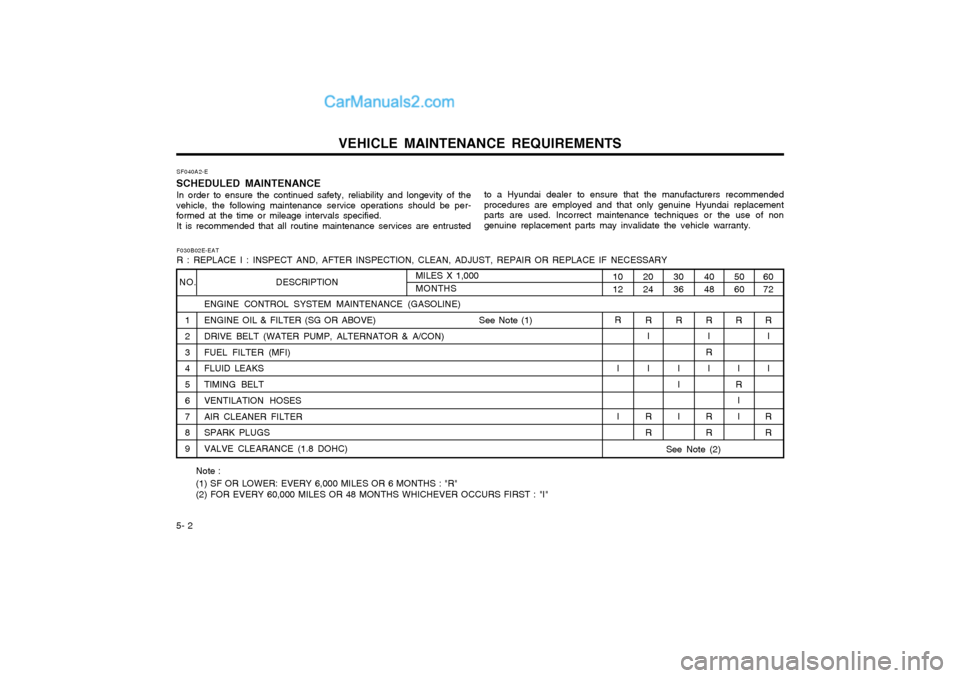
VEHICLE MAINTENANCE REQUIREMENTS
5- 2 SF040A2-E
SCHEDULED MAINTENANCE In order to ensure the continued safety, reliability and longevity of the
vehicle, the following maintenance service operations should be per- formed at the time or mileage intervals specified.
It is recommended that all routine maintenance services are entrusted to a Hyundai dealer to ensure that the manufacturers recommendedprocedures are employed and that only genuine Hyundai replacementparts are used. Incorrect maintenance techniques or the use of nongenuine replacement parts may invalidate the vehicle warranty.
F030B02E-EAT R : REPLACE I : INSPECT AND, AFTER INSPECTION, CLEAN, ADJUST, REPAIR OR REPLACE IF NECESSARY
Note :
(1) SF OR LOWER: EVERY 6,000 MILES OR 6 MONTHS : "R" (2) FOR EVERY 60,000 MILES OR 48 MONTHS WHICHEVER OCCURS FIRST : "I"ENGINE CONTROL SYSTEM MAINTENANCE (GASOLINE)
1 ENGINE OIL & FILTER (SG OR ABOVE) See Note (1)
2 DRIVE BELT (WATER PUMP, ALTERNATOR & A/CON)
3 FUEL FILTER (MFI)
4 FLUID LEAKS
5 TIMING BELT
6 VENTILATION HOSES
7 AIR CLEANER FILTER
8 SPARK PLUGS
9 VALVE CLEARANCE (1.8 DOHC)
NO. DESCRIPTION60 72
5060
4048
3036
2024
1012
MILES X 1,000MONTHS
R
I I
R R
R
I
R I I
R
I
R I
R R
R
I I I
R
II
R R
R
I I
See Note (2)
Page 286 of 312

OWNER MAINTENANCE 6-11
specified in the maintenance schedule. Only those lubricants specified below should beused in order to prevent gear shifting difficul-ties or transaxle damage.
WARNING: The transaxle lubricant level should only
be checked when the engine is cold to preclude the possibility of personal injuryby contact with hot components. Recommended Oil
Use only the approved transaxle lubricant.
The recommended lubricants are complete in themselves and the use of additives is neitherrequired nor recommended. The use of addi-tives may invalidate the vehicle warranty. Transaxle Lubricant Level
Checking
SSA6100B
SG090A2-E
WINDSCREEN WASHER RESERVOIR REPLENISHMENT
and water. If the wipers continue to streak or smear the glass, replace them with genuineHyundai replacement.
CAUTION:
o Do not operate the wipers on dry glass since rapid wear and damage to thewindscreen glass may result.
o Keep the blade rubber out of contact with petroleum products such as en-gine oil, gasoline, etc.
The level of windscreen washer fluid available
should be checked on a daily basis. The levelof fluid will be visible through the side of thereservoir. When the fluid is to be replenished,only a proprietary screen wash additive shouldbe used and in the concentration recommended SG100A1-E
MANUAL TRANSAXLE LUBRICANT The manual transaxle lubricant must be
checked and or changed at the intervals
G110A01EDrain plug
Filler plug
HFC5010 by the manufacturer. The windscreen washer reservoir has a total capacity of 3 litres.
CAUTION: Engine coolant anti freeze must not be
used in the windscreen washer system since damage to the paintwork may result.
Undiluted windscreen washer additive must
not be allowed to come into contact with thepaintwork. If spillage occurs, flush the af-fected area immediately with water. Do notoperate the windscreen washer for morethan 15 seconds continuously or whenthe reservoir is empty since damage tothe washer pump will result.
Page 291 of 312
OWNER MAINTENANCE
6-16
The clutch pedal freeplay should be checked against the specified value. If the freeplay is notcorrect, the clutch should be adjusted by aHyundai dealer.
SG170A1-E
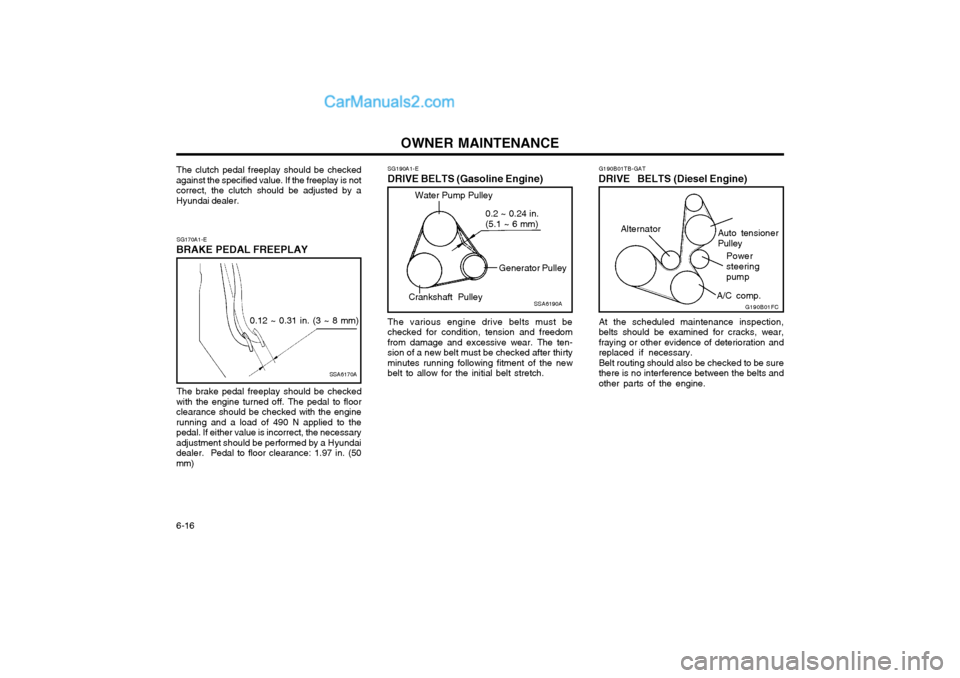
BRAKE PEDAL FREEPLAY
SSA6170A
0.12 ~ 0.31 in. (3 ~ 8 mm)
The brake pedal freeplay should be checked
with the engine turned off. The pedal to floor clearance should be checked with the enginerunning and a load of 490 N applied to thepedal. If either value is incorrect, the necessaryadjustment should be performed by a Hyundaidealer. Pedal to floor clearance: 1.97 in. (50mm) SG190A1-E
DRIVE BELTS (Gasoline Engine)
SSA6190A
Water Pump Pulley
Generator Pulley
Crankshaft Pulley 0.2 ~ 0.24 in. (5.1 ~ 6 mm)
The various engine drive belts must be checked for condition, tension and freedomfrom damage and excessive wear. The ten-sion of a new belt must be checked after thirtyminutes running following fitment of the newbelt to allow for the initial belt stretch.
G190B01TB-GAT
DRIVE BELTS (Diesel Engine)
At the scheduled maintenance inspection, belts should be examined for cracks, wear,fraying or other evidence of deterioration andreplaced if necessary.Belt routing should also be checked to be surethere is no interference between the belts andother parts of the engine.
G190B01FC
Auto tensioner Pulley Powersteeringpump
A/C comp.
Alternator
Page 293 of 312
OWNER MAINTENANCE
6-18 SG230A1-E
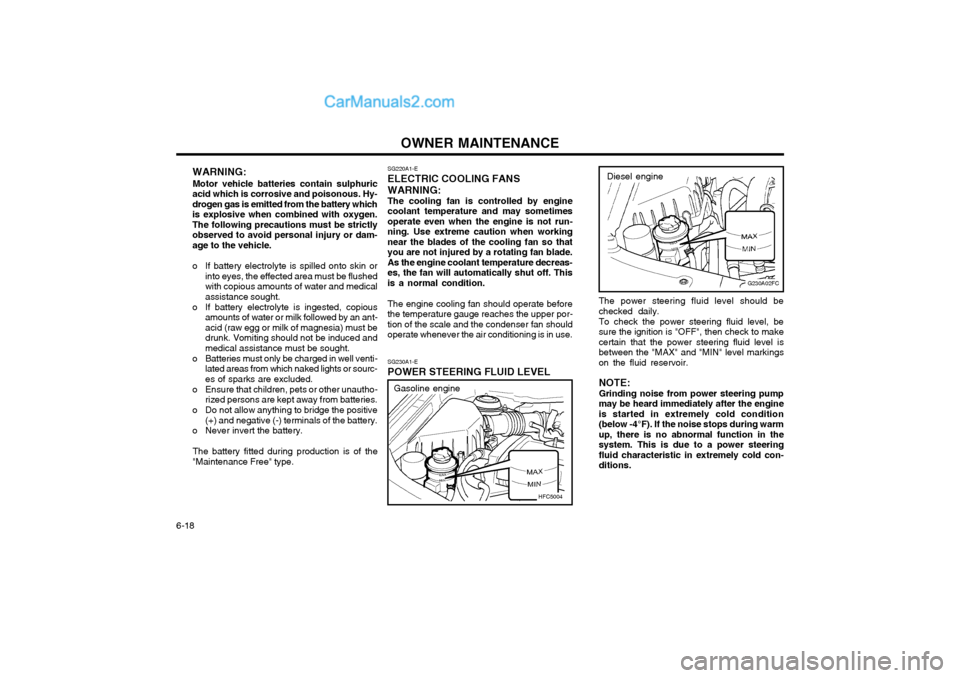
POWER STEERING FLUID LEVEL SG220A1-E
ELECTRIC COOLING FANS
WARNING: The cooling fan is controlled by engine coolant temperature and may sometimesoperate even when the engine is not run-ning. Use extreme caution when workingnear the blades of the cooling fan so thatyou are not injured by a rotating fan blade.As the engine coolant temperature decreas-es, the fan will automatically shut off. Thisis a normal condition. The engine cooling fan should operate before the temperature gauge reaches the upper por-tion of the scale and the condenser fan shouldoperate whenever the air conditioning is in use. The power steering fluid level should bechecked daily. To check the power steering fluid level, be sure the ignition is "OFF", then check to makecertain that the power steering fluid level isbetween the "MAX" and "MIN" level markingson the fluid reservoir. NOTE: Grinding noise from power steering pump may be heard immediately after the engineis started in extremely cold condition(below -4°F). If the noise stops during warmup, there is no abnormal function in thesystem. This is due to a power steeringfluid characteristic in extremely cold con-ditions.
HFC5004
G230A02FC
Gasoline engine Diesel engine
WARNING:
Motor vehicle batteries contain sulphuric
acid which is corrosive and poisonous. Hy- drogen gas is emitted from the battery whichis explosive when combined with oxygen.The following precautions must be strictlyobserved to avoid personal injury or dam-age to the vehicle.
o If battery electrolyte is spilled onto skin or into eyes, the effected area must be flushed with copious amounts of water and medicalassistance sought.
o If battery electrolyte is ingested, copious amounts of water or milk followed by an ant-acid (raw egg or milk of magnesia) must bedrunk. Vomiting should not be induced andmedical assistance must be sought.
o Batteries must only be charged in well venti- lated areas from which naked lights or sourc-es of sparks are excluded.
o Ensure that children, pets or other unautho- rized persons are kept away from batteries.
o Do not allow anything to bridge the positive (+) and negative (-) terminals of the battery.
o Never invert the battery.
The battery fitted during production is of the
"Maintenance Free" type.