air conditioning Hyundai Matrix 2003 Owner's Guide
[x] Cancel search | Manufacturer: HYUNDAI, Model Year: 2003, Model line: Matrix, Model: Hyundai Matrix 2003Pages: 312, PDF Size: 4.1 MB
Page 253 of 312

DRIVING YOUR HYUNDAI 2- 11
o Don't "lug" or "over-rev" the engine. Lug-
ging is driving too slowly in too high a gear resulting in the engine bucking. If thishappens to you, shift to a lower gear. Over-revving is racing the engine beyond its safe limit. This can be avoided byshifting at the recommended speeds.
o Use your air conditioning sparingly. The air conditioning system is operated by theengine power so your fuel economy isreduced when you use it.
SC150A1-F
DRIVING FOR ECONOMY
You can save fuel and get more miles fromyour car if you follow these suggestions:
o Drive smoothly. Accelerate at a moderate rate. Don't make "jack-rabbit" starts or full-throttle shifts and maintain a steady cruis-ing speed. Don't race between stoplights.Try to adjust your speed to that of the othertraffic so you don't have to change speedsunnecessarily. Avoid heavy traffic whenever possible. Al- ways maintain a safe distance from othervehicles so you can avoid unnecessarybraking. This also reduces brake wear.
o Drive at a moderate speed. The faster you drive, the more fuel your car uses. Drivingat a moderate speed, especially on thehighway, is one of the most effective waysto reduce fuel consumption.
o Don't "ride" the brake or clutch pedal. This can increase fuel consumption and alsoincrease wear on these components. Inaddition, driving with your foot resting onthe brake pedal may cause the brakes tooverheat, which reduces their effective-ness and may lead to more serious con-
sequences.
o Take care of your tyres. Keep them inflated to the recommended pressure. Incorrectinfla-tion, either too much or too little, re-sults in unnecessary tyre wear. Check thetyre pres-sures at least once a month. o Be sure that the wheels are aligned cor-
rectly. Improper alignment can result fromhitting curbs or driving too fast over irregu-lar surfaces. Poor alignment causes fastertyre wear and may also result in otherproblems as well as greater fuel consump-tion.
o Keep your car in good condition. For better fuel economy and reduced maintenancecosts, maintain your car in accordancewith the maintenance schedule in Section5. If you drive your car in severe condi-tions, more frequent maintenance is re-quired (see Section 5 for details).
o Keep your car clean. For maximum ser- vice, your car should be kept clean andfree of corrosive materials. It is especiallyimportant that mud, dirt, ice, etc. not beallowed to accumulate on the underside ofthe car. This extra weight can result inincreased fuel consumption and also con-tribute to corrosion.
o Travel lightly. Don't carry unnecessary weight in your car. Weight is an enemy ofgood fuel economy.
o Don't let the engine idle longer than neces- sary. If you are waiting (and not in traffic),turn off your engine and restart only whenyou're ready to go.
o Remember, your car does not require extended warm-up. As soon as the engineis running smoothly, you can drive away.In very cold weather, however, give yourengine a slightly longer warm-up period. SC160A1-F SMOOTH CORNERING Avoid braking or gear changing in corners, especially when roads are wet. Ideally, cor-ners should always be taken under gentleacceleration. If you follow these suggestions,tyre wear will be held to a minimum. SC170A1-E WINTER MOTORING The onset of winter conditions subject motor vehicles to greater operating demands. There-fore, the following suggestions will assist inmaintaining peak performance and reliabilityduring these periods:
Page 254 of 312

DRIVING YOUR HYUNDAI
2- 12 NOTE: Never allow undiluted screen washer fluid additive to spill upon the paintwork or useengine coolant anti-freeze since damage tothe paintwork may result.
o When driving in extreme conditions, the windscreen wiper blades may fail to clearthe screen properly due to the formation ofice upon the blade edge. It will therefore benecessary to periodically remove such iceto restore their efficiency.
o If the power operated door mirrors become frozen, attempts to adjust these may dam-age the mechanism.
o The formation of snow or ice built up inside the wheel arches may interfere with theroad wheels or steering mechanism. Insuch instances, unusual noises or an in-crease in steering effort may result. There-fore, ensure that the wheel arches arechecked periodically and any accumulatedsnow or ice removed.
o It is advisable to carry emergency equip- ment including, torch, shovel, tow rope,blankets etc., if a journey is to be under-taken into areas of severe road conditions.
ZC170D1-E
Door Locks
Should the door lock mechanism becomefrozen, a proprietary lock de-icer should beused. Alternatively, warming the door keymay thaw the door lock. However, the keyshould be handled carefully to avoid burningthe fingers. Never attempt to thaw a frozen door lock using hot water, since the water will eventu-ally freeze and compound the problem. NOTE: The proper temperature for using the im-mobilizer key is from -40°F to 176°F (-40°Cto 80°C). If you heat the immobilizer keyover 176°F (80°C) to open the frozen lock,it may cause damage to the transponderin its head.
SC170E1-E Windscreen Washers and Wipers The windscreen washer bottle should be filled
with a solution of water and a proprietary winter screen wash additive. The windscreenwipers should not be used if the blades arefrozen to the windscreen or if they are cov-ered with snow, before this is removed.
ZC170B1-E
Electrical System
Winter conditions impose severe demandsupon vehicle electrical systems, particularlythe charging circuit. The battery condition andperformance along with the alternator perfor-mance and drive belt condition should bechecked prior to the onset of winter. ZC170C1-E Anti-freeze/Corrosion inhibitorThe cooling system must always contain an Ethylene-Glycol based anti-freeze solution.The system is filled during manufacture withsolution of the correct strength which shouldbe checked before the onset of winter andadjusted or changed as required. NOTE: The anti-freeze solution contains a corro-sion inhibitor to prevent degradation of thealuminum castings contained within theengine. Therefore, never, drain the systemand refill with water only. In addition, anti-freeze solution must ALWAYS be used in vehicles fitted with air conditioning,to prevent the heater matrix from freezing andsubsequently bursting with the refrigerationsystem in use.
Page 259 of 312
IN CASE OF EMERGENCY
3-2
CAUTION:
Personal injury and damage to the vehicle
may occur if jump starting is not per- formed correctly. If any doubt exists as tohow this operation should be performed,seek assistance from qualified personnel. WARNING:
Motor vehicle batteries contain sulphuric
acid and emit hydrogen gas. Protective clothing should be worn and care exer-cised to prevent the acid from coming intocontact with skin or clothing and the ve-hicle. Naked lights should not be permittedin the vicinity of the battery. Care shouldbe exercised to prevent sparks occurringduring connection. If acid accidentallycomes into contact with skin or eyes, theaffected area should immediately be flushed ponents such as the Fuel Injection system
computer and the Automatic Transaxlecomputer. The battery must never be dis-connected whilst the engine is running. SD040A2-E IF THE ENGINE OVERHEATS If the temperature gauge indicates overheat- ing:
1. Pull off the road and stop as soon as it is
safe to do so.
2. Place the gear selector lever in "P" (auto- matic), or neutral (manual transaxle) and set the parking brake. If the air condition-ing is on, turn it off.
3. If coolant is running out under the car or steam is coming out from under the bonnetstop the engine. Do not open the bonnetuntil the coolant has stopped running orthe steaming has stopped. If there is novisible loss of coolant and no steam, leavethe engine running and check to be surethe engine cooling fan is operating. If the fan is not running, turn the engine off.
4. Check to see if the water pump drive belt is missing. If it is not missing, check to see that it is tight. If the drive belt seems to besatisfactory, check for coolant leaking fromthe radiator, hoses or under the car. (If theair conditioning had been in use, it isnormal for cold water to be draining fromit).
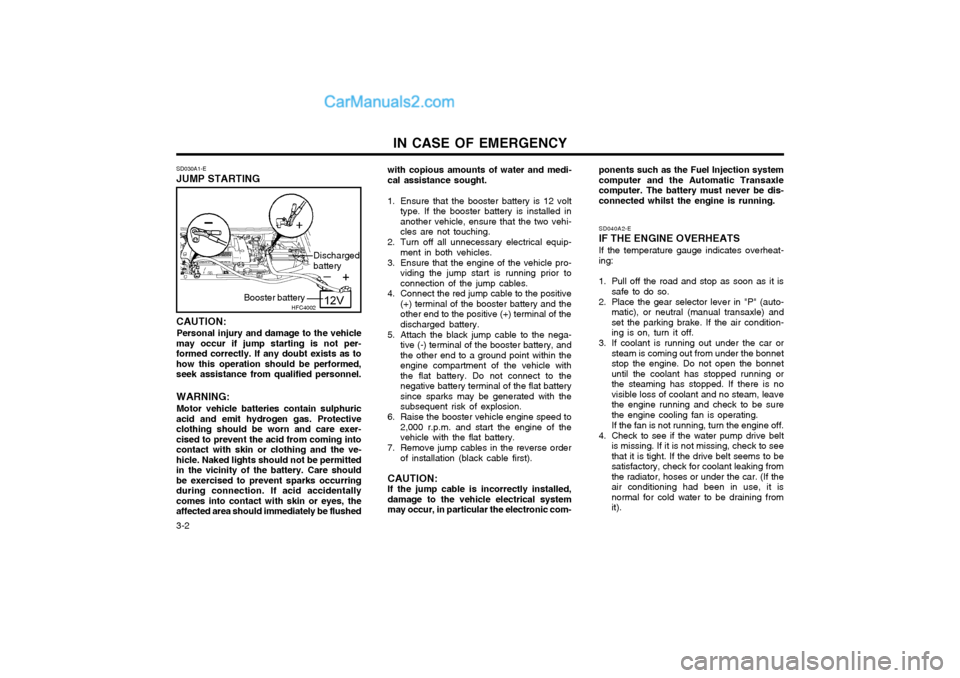
SD030A1-E JUMP STARTING
with copious amounts of water and medi- cal assistance sought.
1. Ensure that the booster battery is 12 volt type. If the booster battery is installed inanother vehicle, ensure that the two vehi-cles are not touching.
2. Turn off all unnecessary electrical equip- ment in both vehicles.
3. Ensure that the engine of the vehicle pro- viding the jump start is running prior toconnection of the jump cables.
4. Connect the red jump cable to the positive (+) terminal of the booster battery and theother end to the positive (+) terminal of thedischarged battery.
5. Attach the black jump cable to the nega- tive (-) terminal of the booster battery, andthe other end to a ground point within theengine compartment of the vehicle withthe flat battery. Do not connect to thenegative battery terminal of the flat batterysince sparks may be generated with thesubsequent risk of explosion.
6. Raise the booster vehicle engine speed to 2,000 r.p.m. and start the engine of thevehicle with the flat battery.
7. Remove jump cables in the reverse order of installation (black cable first).
CAUTION:If the jump cable is incorrectly installed,damage to the vehicle electrical systemmay occur, in particular the electronic com-
HFC4002
Booster battery Discharged battery
Page 275 of 312
VEHICLE MAINTENANCE REQUIREMENTS
5- 8 6ZF070P1-A
o Driveshafts and boots Check the drive shafts, boots and clamps for cracks, deterioration, or damage. Replaceany damaged parts and, if necessary, repackthe grease. 6ZF070Q1-A
o Air conditioning refrigerant Check the air conditioning lines and connec- tions for leakage and damage. Check airconditioning performance according to therelevant shop manual if necessary.
6ZF070L1-A
o Suspension mounting bolts Check the suspension connections for loose-
ness or damage. Retighten to the specifiedtorque. 6ZF070M1-A
o Steering gear box, linkage & boots/
lower arm ball joint
With the vehicle stopped and engine off, check for excessive freeplay in the steering wheel. Check the linkage for bends or damage. Check the dust boots and ball joints for dete-rioration, cracks, or damage. Replace anydamaged parts. 6ZF070N1-A
o Power steering pump, belt and hoses Check the power steering pump and hoses for leakage and damage. Replace any dam-aged or leaking parts immediately. Inspect thepower steering belt for evidence of cuts,cracks, excessive wear, oiliness and propertension. Replace or adjust it if necessary.
Page 283 of 312

OWNER MAINTENANCE
6-8 SG050C1-E
Engine Coolant Level
SG050D1-E
To Change the Engine Coolant The engine coolant should be changed at
those intervals specified in the vehicle main- tenance schedule in Section 5.
NOTE:Care should be taken to ensure that cool-
ant is not allowed to spill onto thepaintwork since the finish may becomedamaged. If coolant spillage occurs, theaffected area should be rinsed thoroughlywith water. The engine coolant level may be observed
through the side of the plastic coolant reservoir(expansion tank) when the engine is cold. If thelevel is below the "LOW" mark, add coolant ofthe correct concentration until the level is be-tween the "LOW" and "Full" marks. If the levelfalls below the "LOW" mark on a regular basisdespite being topped up, consult a Hyundaidealer. 1. Park the vehicle on level ground and en-
sure that the parking brake is firmly ap-plied, and the engine allowed to cool. DO NOT ATTEMPT THIS OPERATION WHILST THE ENGINE IS HOT SINCEBURNING OR SCALDING MAY RESULT.
2. Prepare a suitable receptacle to collect the displaced coolant and position this under theradiator drain tap.
3. With the heater temperature control set to the "HOT" position, remove the radiator capand open the radiator drain tap.
4. When the engine coolant has drained com- pletely, close the drain tap ensuring that thisis not over tightened.
5. Prepare a suitable quantity of new engine coolant (refer to section 9) and pour thisinto the radiator.
6. Start the engine with the radiator cap still removed and continue to add coolant as thelevel decreases as air is expelled from thesystem. When the level remains constant,replace the radiator cap and replenish thecoolant reservoir.
7. When the engine is hot, check to ensure that no coolant leaks are present.
WARNING: The cooling fan is controlled by engine coolant temperature and may sometimesoperate even when the engine is not run-ning. Use extreme caution when workingnear the blades of the cooling fan so that
G050C01FC
G050C02FC
Diesel engine
Gasoline engine
NOTE: It is imperative that vehicles fitted with an
air conditioning system have a coolant concentration of the recommended strengthat all times. The use of the air conditioningsystem when the cooling system is filledwith water only will result in the heatermatrix freezing and subsequently bursting.
Page 290 of 312
OWNER MAINTENANCE 6-15
SG140C1-E
Checking the Refrigerant
1. Start the engine and run at idle for several minutes with the refrigeration system run- ning at the coldest setting.
2. Open the bonnet and inspect the sight glass on the top of the receiver dryer.
3. If the refrigerant charge is insufficient, a flow of bubbles will be observed through the sightglass.
4. If the refrigerant charge is satisfactory, no bubbles will be observed through the sightglass.
CAUTION: Running the air conditioning system with a
low refrigerant level may damage the com- pressor.
SG140D1-E
Off Season Maintenance The air conditioning must be run for ten minutes
or so weekly during periods when the systemwould not normally be used to ensure that thecompressor and seals are lubricated. If thisprecaution is not observed the compressor sealsmay become stuck to the compressor shaft anddamaged when the system is next used result-ing in a loss of refrigerant and damage to thecompressor. SG150A1-E STEERING WHEEL FREEPLAY
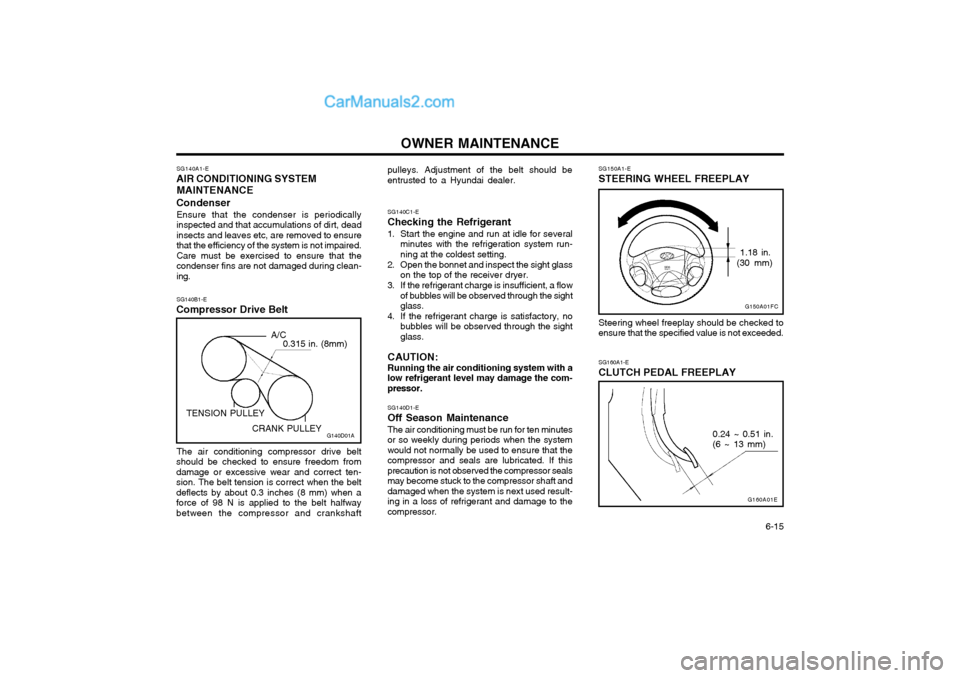
Steering wheel freeplay should be checked to
ensure that the specified value is not exceeded.
SG160A1-E
CLUTCH PEDAL FREEPLAY
SG140B1-E
Compressor Drive Belt
The air conditioning compressor drive belt
should be checked to ensure freedom from damage or excessive wear and correct ten-sion. The belt tension is correct when the beltdeflects by about 0.3 inches (8 mm) when aforce of 98 N is applied to the belt halfwaybetween the compressor and crankshaft SG140A1-E
AIR CONDITIONING SYSTEM
MAINTENANCE
Condenser Ensure that the condenser is periodicallyinspected and that accumulations of dirt, deadinsects and leaves etc, are removed to ensurethat the efficiency of the system is not impaired.Care must be exercised to ensure that thecondenser fins are not damaged during clean-ing.
G160A01E
0.24 ~ 0.51 in. (6 ~ 13 mm)
G150A01FC
G140D01A
A/C
CRANK PULLEY
TENSION PULLEY
1.18 in. (30 mm)
0.315 in. (8mm) pulleys. Adjustment of the belt should be entrusted to a Hyundai dealer.
Page 293 of 312
OWNER MAINTENANCE
6-18 SG230A1-E
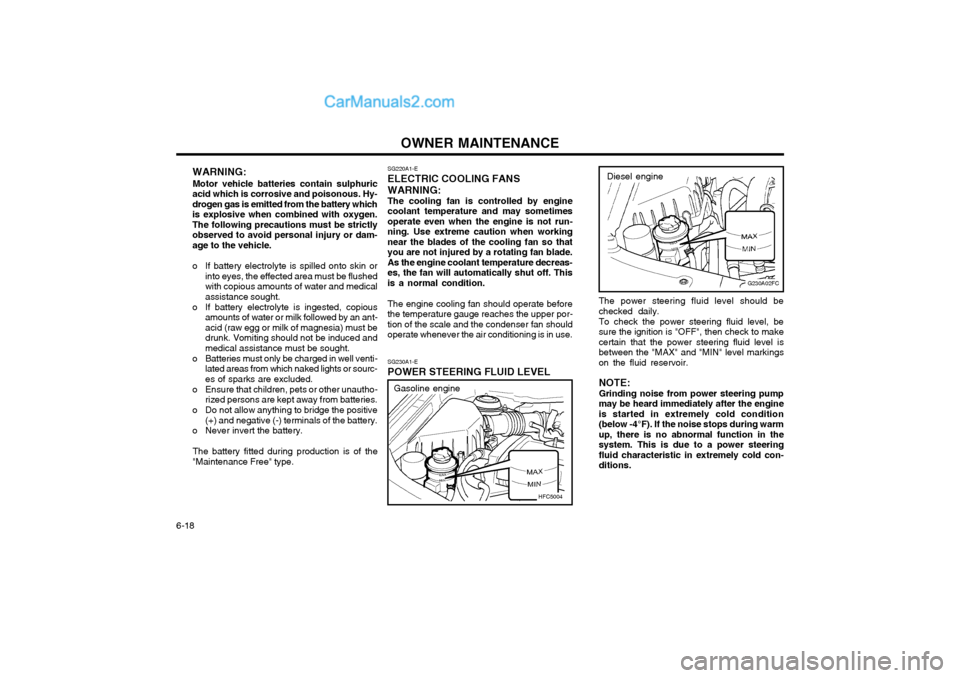
POWER STEERING FLUID LEVEL SG220A1-E
ELECTRIC COOLING FANS
WARNING: The cooling fan is controlled by engine coolant temperature and may sometimesoperate even when the engine is not run-ning. Use extreme caution when workingnear the blades of the cooling fan so thatyou are not injured by a rotating fan blade.As the engine coolant temperature decreas-es, the fan will automatically shut off. Thisis a normal condition. The engine cooling fan should operate before the temperature gauge reaches the upper por-tion of the scale and the condenser fan shouldoperate whenever the air conditioning is in use. The power steering fluid level should bechecked daily. To check the power steering fluid level, be sure the ignition is "OFF", then check to makecertain that the power steering fluid level isbetween the "MAX" and "MIN" level markingson the fluid reservoir. NOTE: Grinding noise from power steering pump may be heard immediately after the engineis started in extremely cold condition(below -4°F). If the noise stops during warmup, there is no abnormal function in thesystem. This is due to a power steeringfluid characteristic in extremely cold con-ditions.
HFC5004
G230A02FC
Gasoline engine Diesel engine
WARNING:
Motor vehicle batteries contain sulphuric
acid which is corrosive and poisonous. Hy- drogen gas is emitted from the battery whichis explosive when combined with oxygen.The following precautions must be strictlyobserved to avoid personal injury or dam-age to the vehicle.
o If battery electrolyte is spilled onto skin or into eyes, the effected area must be flushed with copious amounts of water and medicalassistance sought.
o If battery electrolyte is ingested, copious amounts of water or milk followed by an ant-acid (raw egg or milk of magnesia) must bedrunk. Vomiting should not be induced andmedical assistance must be sought.
o Batteries must only be charged in well venti- lated areas from which naked lights or sourc-es of sparks are excluded.
o Ensure that children, pets or other unautho- rized persons are kept away from batteries.
o Do not allow anything to bridge the positive (+) and negative (-) terminals of the battery.
o Never invert the battery.
The battery fitted during production is of the
"Maintenance Free" type.
Page 309 of 312
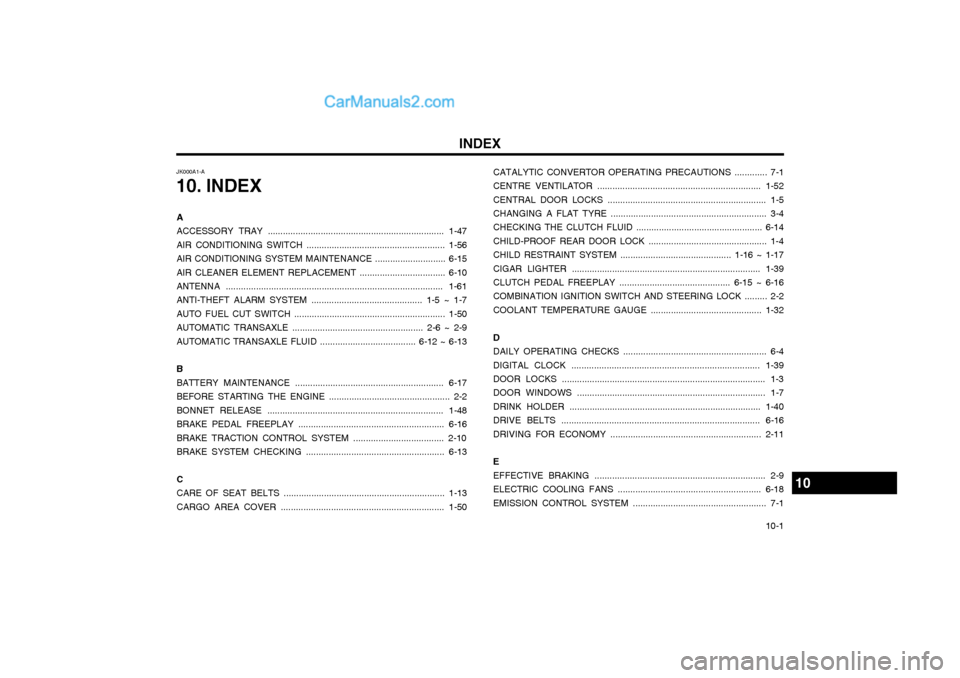
INDEX10-1
A ACCESSORY TRAY ...................................................................... 1-47AIR CONDITIONING SWITCH ....................................................... 1-56AIR CONDITIONING SYSTEM MAINTENANCE ............................ 6-15AIR CLEANER ELEMENT REPLACEMENT .................................. 6-10ANTENNA ...................................................................................... 1-61 ANTI-THEFT ALARM SYSTEM ............................................ 1-5 ~ 1-7 AUTO FUEL CUT SWITCH ............................................................ 1-50AUTOMATIC TRANSAXLE .................................................... 2-6 ~ 2-9AUTOMATIC TRANSAXLE FLUID ...................................... 6-12 ~ 6-13 B BATTERY MAINTENANCE ........................................................... 6-17BEFORE STARTING THE ENGINE ................................................ 2-2BONNET RELEASE ...................................................................... 1-48BRAKE PEDAL FREEPLAY .......................................................... 6-16BRAKE TRACTION CONTROL SYSTEM .................................... 2-10 BRAKE SYSTEM CHECKING ....................................................... 6-13 C CARE OF SEAT BELTS ................................................................ 1-13CARGO AREA COVER ................................................................. 1-50 CATALYTIC CONVERTOR OPERATING PRECAUTIONS ............. 7-1CENTRE VENTILATOR ................................................................. 1-52CENTRAL DOOR LOCKS ............................................................... 1-5 CHANGING A FLAT TYRE .............................................................. 3-4 CHECKING THE CLUTCH FLUID .................................................. 6-14CHILD-PROOF REAR DOOR LOCK ............................................... 1-4CHILD RESTRAINT SYSTEM ............................................ 1-16 ~ 1-17CIGAR LIGHTER ........................................................................... 1-39CLUTCH PEDAL FREEPLAY ............................................ 6-15 ~ 6-16 COMBINATION IGNITION SWITCH AND STEERING LOCK ......... 2-2 COOLANT TEMPERATURE GAUGE ............................................ 1-32 D DAILY OPERATING CHECKS ......................................................... 6-4DIGITAL CLOCK ........................................................................... 1-39 DOOR LOCKS ................................................................................. 1-3 DOOR WINDOWS ........................................................................... 1-7DRINK HOLDER ............................................................................ 1-40DRIVE BELTS ............................................................................... 6-16DRIVING FOR ECONOMY ............................................................ 2-11 E EFFECTIVE BRAKING .................................................................... 2-9ELECTRIC COOLING FANS ......................................................... 6-18EMISSION CONTROL SYSTEM ..................................................... 7-1
JK000A1-A 10. INDEX
10