steering Hyundai Matrix 2003 Owner's Guide
[x] Cancel search | Manufacturer: HYUNDAI, Model Year: 2003, Model line: Matrix, Model: Hyundai Matrix 2003Pages: 312, PDF Size: 4.1 MB
Page 137 of 312
DO-IT-YOURSELF MAINTENANCE
6-4
G020A01A-AAT
GENERAL CHECKS Engine Compartment
The following should be checked regularly:
o Engine oil level and condition
o Transaxle fluid level and condition
o Brake fluid level
o Clutch fluid level
o Engine coolant level
o Windshield washer fluid level
o Accessory drive belt condition
o Engine coolant hose condition
o Fluid leaks (on or below components)
o Power steering fluid level
o Battery condition
o Air filter condition
G020B01A-AAT
Vehicle Exterior The following should be checked monthly:
o Overall appearance and condition
o Wheel condition and wheel nut torque
o Exhaust system condition
o Light condition and operation
o Windshield glass condition
o Wiper blade condition
o Paint condition and body corrosion
o Fluid leaks
o Door and hood lock condition
o Tire pressure and condition (including spare tire) G020C01A-AAT
Vehicle Interior
The following should be checked each time when the vehicle is driven:
o Lights operation
o Windshield wiper operation
o Horn operation
o Defroster, heating system operation (and air conditioning, if installed)
o Steering operation and condition
o Mirror condition and operation
o Turn signal operation
o Accelerator pedal operation
o Brake operation, including parking brake
o Manual transaxle operation, including clutch operation
o Automatic transaxle operation, including "Park" mechanism operation
o Seat control condition and operation
o Seat belt condition and operation
o Sunvisor operation
If you notice anything that does not operate correctly or appears to be functioning incorrect-ly, inspect it carefully and seek assistance fromyour Hyundai dealer if service is needed. G030A01FC-GAT
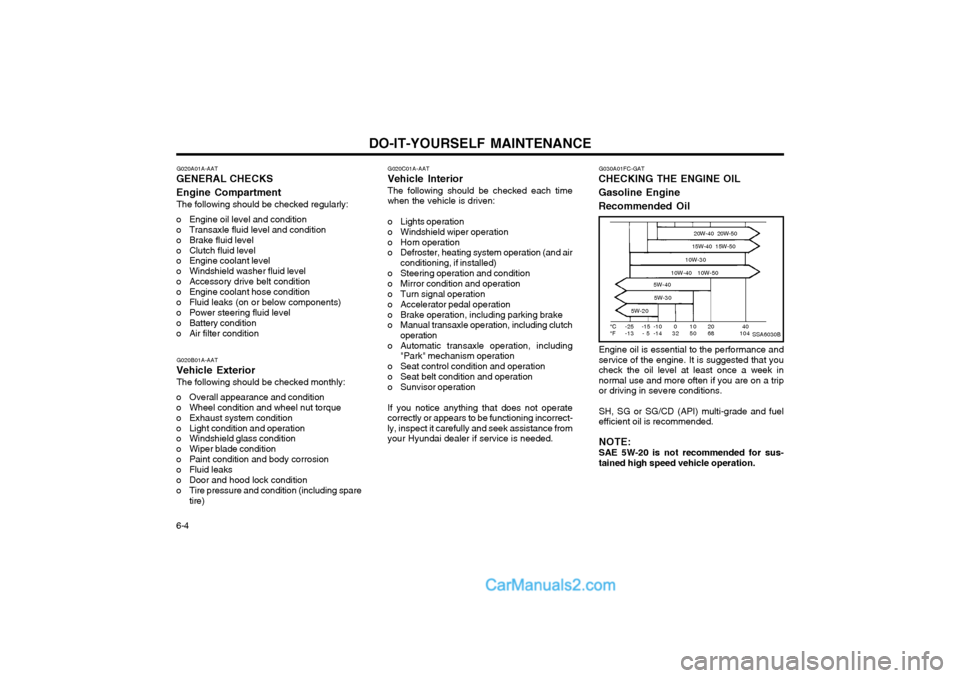
CHECKING THE ENGINE OIL Gasoline EngineRecommended Oil
SSA6030B
20W-40 20W-50
10W-30 15W-40 15W-50
10W-40 10W-50
°C °F -25-13 2068 40104
-15
- 5 -10-14 0
32 1050
5W-40
5W-30
5W-20
Engine oil is essential to the performance and service of the engine. It is suggested that youcheck the oil level at least once a week innormal use and more often if you are on a tripor driving in severe conditions. SH, SG or SG/CD (API) multi-grade and fuel efficient oil is recommended. NOTE: SAE 5W-20 is not recommended for sus- tained high speed vehicle operation.
Page 150 of 312

DO-IT-YOURSELF MAINTENANCE 6-17
G160A01A-GAT
CHECKING CLUTCH PEDAL FREE-PLAY With the engine off, press lightly on the clutch pedal until you feel a change in resistance. Thisis the clutch pedal freeplay. The freeplay shouldbe within the limits specified in the illustration. Ifit is not, have it inspected by your Hyundaidealer and adjusted or repaired if necessary.
G160A01E
6 ~ 13 mm (0.24 ~ 0.51 in.)
G150A01A-GAT
CHECKING STEERING WHEEL FREEPLAY
To check the steering wheel freeplay, stop the
car with the wheels pointed straight ahead and gently move the steering wheel back and forth.Use very light finger pressure and be sensitiveto changes in resistance that mark the limits ofthe freeplay. If the freeplay is greater thanspecified, have it inspected by your Hyundaidealer and adjusted or repaired if necessary.
G150A01FC
G140D01S-GAT
Checking the Compressor Drive Belt
When the air conditioning is being used regular-
ly, the compressor drive belt tension should be checked at least once a month.
To check the drive belt tension, press down on
the belt halfway between the engine crankshaftand compressor pulleys. Pressing with yourfinger, you should not be able to deflect this beltanymore than 8.0 mm. If you have the instru-ments to check it with a force of 98N (22 lb.),the deflection should be approx. 8.0 mm (0.315in.). If the belt is too loose, have it adjusted byyour Hyundai dealer.
G140D01A
A/C
CRANK PULLEY
TENSION PULLEY
30 mm (1.18 in.)
8mm(0.315 in.)
Page 152 of 312

DO-IT-YOURSELF MAINTENANCE 6-19
G200A01A-AAT
CHECKING AND REPLACING FUSES Replacing a Fusible Link
A fusible link will melt if the electrical circuits
from the battery are ever overloaded, thus pre- venting damage to the entire wiring harness.(This could be caused by a short in the systemdrawing too much current.) If this ever happens,have a Hyundai dealer determine the cause,repair the system and replace the fusible link.The fusible links are located in a fuse box foreasy inspection.
CAUTION: When replacing a fusible link, never use
anything but a new fusible link with the same or lower amperage rating. Never use apiece of wire or a higher-rated fusible link.This could result in serious damage andcreate a fire hazard.
AS60310A
Bad Good
G190B01TB-GAT
CHECKING DRIVE BELTS (Diesel Engine)
At the scheduled maintenance inspection, belts
should be examined for cracks, wear, fraying or other evidence of deterioration and replaced ifnecessary. Belt routing should also be checked to be sure
there is no interference between the belts andother parts of the engine.G190B01O
Power steeringpump
A/C comp.
Alternator
G200B01E-AAT
Replacing Accessory Fuse The fuse box for the lights and other electrical accessories will be found in the backside of multibox located in the left side of driver. Inside the boxyou will find a list showing the circuits protectedby each fuse. If any of your car’s lights or other electrical
accessories stop working, a blown fuse couldbe the reason. If the fuse has burned out, youwill see that the metal strip inside the fuse hasburned through. If you suspect a blown fuse,follow this procedure:
1. Turn off the ignition and all other switches.
2. Open the fuse box and examine each fuse. Remove each fuse by pulling it toward you (a small "fuse puller" tool is contained in thefuse box to simplify this operation).
3. Be sure to check all other fuses even if you find one that appears to have burned out.
HFC4010
Alternator
Page 154 of 312

DO-IT-YOURSELF MAINTENANCE 6-21
G220A01A-AAT
CHECKING ELECTRIC COOLING FANS WARNING: The cooling fan is controlled by engine cool-
ant temperature and may sometimes oper- ate even when the engine is not running.Use extreme caution when working near theblades of the coolant fan, so that you are notinjured by a rotating fan blade. As the en-gine coolant temperature decreases the fanwill automatically shut off. This is a normalcondition.
G220B01A-AAT
Checking Engine Cooling Fan The engine coolant fan should come on auto-
matically if the engine coolant temperature ishigh.
G220C01A-AAT
Checking Condenser Cooling Fan The condenser coolant fan should come on
automatically whenever the air conditioning isin operation. G230A03A-GAT
POWER STEERING FLUID LEVEL
HFC5004
G210B01A-AAT
Checking the Battery Keep the battery clean. Any evidence of corro-
sion around the battery posts or terminals should be removed using a solution of household bak-ing soda and warm water. After the batteryterminals are dry, cover them with a light coat-ing of grease.
o If you swallow battery fluid, drink a large
quantity of water or milk followed by milk ofmagnesia, eat a raw egg or drink vegetableoil. Get medical assistance as soon aspossible.
While batteries are being charged (either by abattery charger or by the vehicle’s alternator),they produce explosive gases. Always observethese warnings to prevent injuries from occur-ring:
o Charge batteries only in a well ventilated area.
o Do not permit flames, sparks or smoking in the area.
o Keep children away from the area.
Gasoline engine
The power steering fluid level should be checked
regularly.
To check the power steering fluid level, be sure
the ignition is "OFF", then check to make cer- tain that the power steering fluid level is be-tween the "MAX" and "MIN" level markings onthe fluid reservoir.
G230A02FC
Diesel engine
Page 155 of 312
DO-IT-YOURSELF MAINTENANCE
6-22 G260A03A-GAT
REPLACING HEADLIGHT BULBS Before attempting to replace a headlight bulb, be sure the switch is turned to the "OFF"position. The next paragraph shows how to reach the headlight bulbs so they may be changed. Besure to replace the burned-out bulb with one ofthe same number and wattage rating. CAUTION: Keep the lamps out of contact with petro- leum products, such as oil, gasoline, etc.
G240A01A-AAT
POWER STEERING HOSES
It is suggested that you check the power steer-
ing hose connections for fluid leakage at regular intervals. The power steering hoses should bereplaced if there is severe surface cracking,scuffing or worn spots. Deterioration of thehose could cause premature failure. NOTE: Grinding noise from the power steering
pump may be heard immediately after the engine is started in extremely cold condi-tions (below - 20°C). If the noise stops dur-ing warm up, there is no abnormal functionin the system. It is due to a power steeringfluid characteristic in extremely cold condi-tions.
Recommended Fluid Use PSF-3 type fluid NOTE: Do not start the engine when the power
steering oil reservoir is empty. G300A01B-GAT
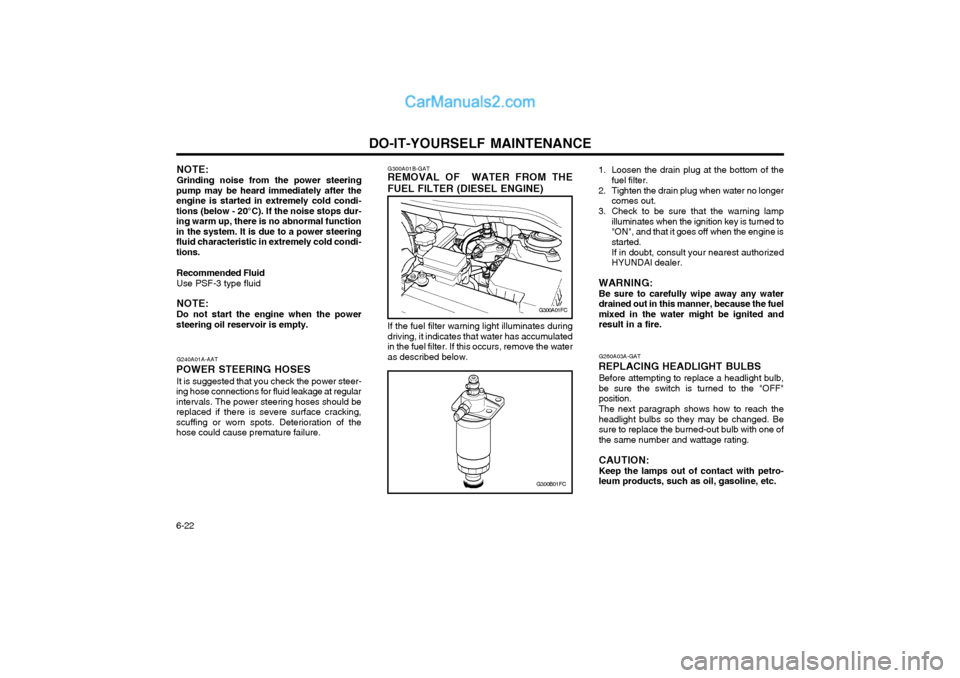
REMOVAL OF WATER FROM THE FUEL FILTER (DIESEL ENGINE)
If the fuel filter warning light illuminates during driving, it indicates that water has accumulatedin the fuel filter. If this occurs, remove the wateras described below. 1. Loosen the drain plug at the bottom of the
fuel filter.
2. Tighten the drain plug when water no longer comes out.
3. Check to be sure that the warning lamp illuminates when the ignition key is turned to"ON", and that it goes off when the engine isstarted. If in doubt, consult your nearest authorized HYUNDAI dealer.
WARNING: Be sure to carefully wipe away any waterdrained out in this manner, because the fuelmixed in the water might be ignited andresult in a fire.
G300A01FC
G300B01FC
Page 166 of 312
CONSUMER INFORMATION 8-3
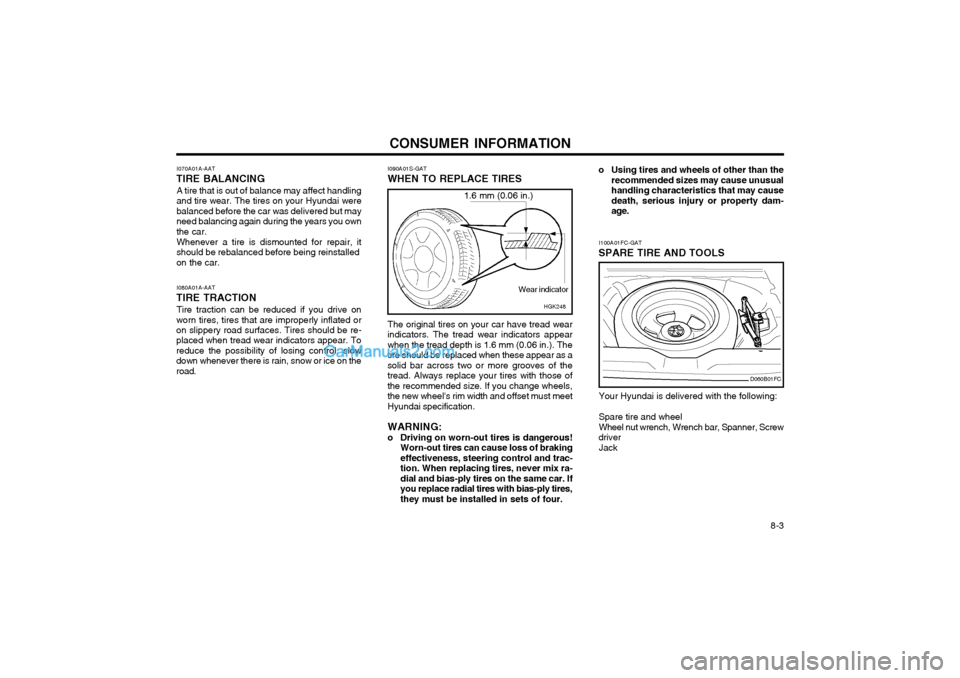
I090A01S-GAT WHEN TO REPLACE TIRES
HGK248
1.6 mm (0.06 in.)
Wear indicator
I070A01A-AAT
TIRE BALANCING
A tire that is out of balance may affect handling and tire wear. The tires on your Hyundai werebalanced before the car was delivered but mayneed balancing again during the years you ownthe car. Whenever a tire is dismounted for repair, it should be rebalanced before being reinstalled on the car. I080A01A-AAT
TIRE TRACTION Tire traction can be reduced if you drive on
worn tires, tires that are improperly inflated or on slippery road surfaces. Tires should be re- placed when tread wear indicators appear. To reduce the possibility of losing control, slowdown whenever there is rain, snow or ice on theroad. The original tires on your car have tread wear
indicators. The tread wear indicators appearwhen the tread depth is 1.6 mm (0.06 in.). Thetire should be replaced when these appear as asolid bar across two or more grooves of thetread. Always replace your tires with those ofthe recommended size. If you change wheels,the new wheel's rim width and offset must meetHyundai specification.
WARNING:
o Driving on worn-out tires is dangerous! Worn-out tires can cause loss of brakingeffectiveness, steering control and trac-tion. When replacing tires, never mix ra-dial and bias-ply tires on the same car. Ifyou replace radial tires with bias-ply tires,they must be installed in sets of four. I100A01FC-GAT
SPARE TIRE AND TOOLS
Your Hyundai is delivered with the following: Spare tire and wheel Wheel nut wrench, Wrench bar, Spanner, Screw
driver Jack
D060B01FC
o Using tires and wheels of other than the recommended sizes may cause unusual handling characteristics that may causedeath, serious injury or property dam-age.
Page 167 of 312
VEHICLE SPECIFICATIONS 9-1
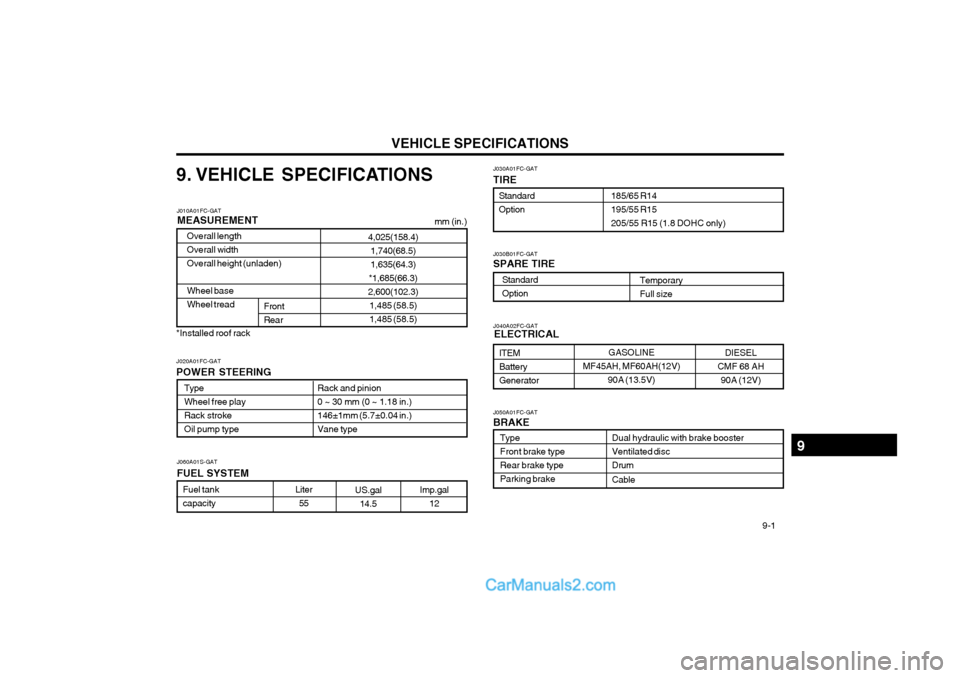
J030A01FC-GAT
TIRE J040A02FC-GAT
ELECTRICAL
ITEM BatteryGenerator
Type Front brake typeRear brake typeParking brake Dual hydraulic with brake boosterVentilated discDrum Cable
J050A01FC-GAT BRAKE
9. VEHICLE SPECIFICATIONS
J010A01FC-GAT
MEASUREMENT
J060A01S-GAT FUEL SYSTEM
J020A01FC-GAT
POWER STEERING Type Wheel free playRack strokeOil pump type Rack and pinion0 ~ 30 mm (0 ~ 1.18 in.)146±1mm (5.7±0.04 in.)Vane type
Front Rear
Fuel tankcapacity Imp.gal
12
US.gal
14.5
Liter
55
Overall lengthOverall widthOverall height (unladen) Wheel base Wheel tread
mm (in.)
4,025(158.4) 1,740(68.5)1,635(64.3)
*1,685(66.3)
2,600(102.3) 1,485 (58.5)1,485 (58.5)
DIESEL
CMF 68 AH 90A (12V)
GASOLINE
MF45AH, MF60AH(12V) 90A (13.5V)
*Installed roof rack
Standard Option
J030B01FC-GAT SPARE TIRE
Temporary Full size
185/65 R14 195/55 R15205/55 R15 (1.8 DOHC only)
StandardOption
9
Page 169 of 312
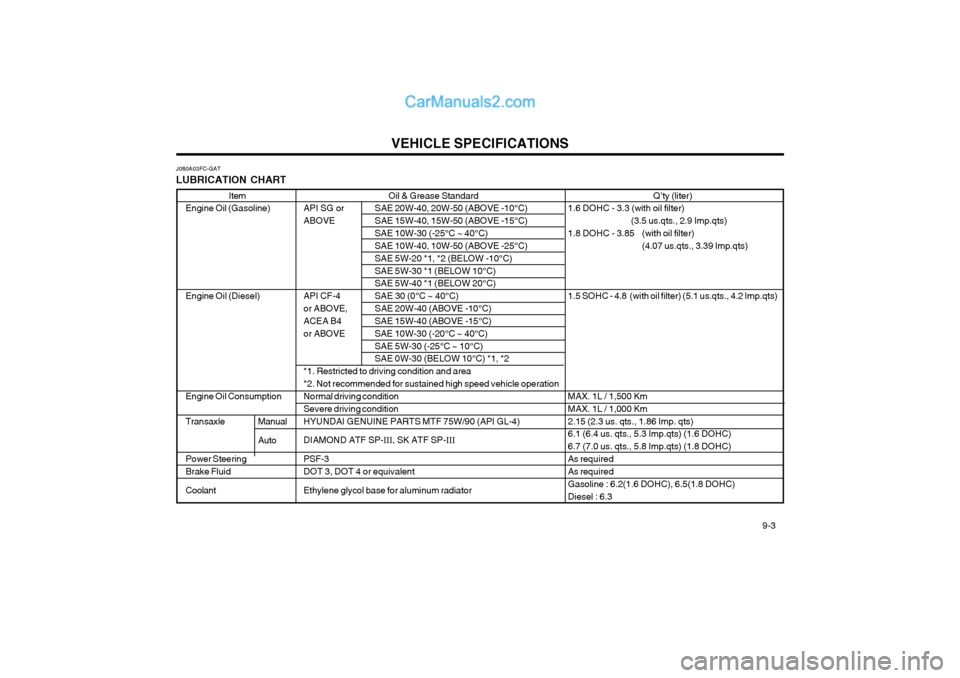
VEHICLE SPECIFICATIONS 9-3
Oil & Grease Standard
API SG or SAE 20W-40, 20W-50 (ABOVE -10°C)
ABOVE SAE 15W-40, 15W-50 (ABOVE -15°C)
SAE 10W-30 (-25°C ~ 40°C) SAE 10W-40, 10W-50 (ABOVE -25°C) SAE 5W-20 *1, *2 (BELOW -10°C)SAE 5W-30 *1 (BELOW 10°C) SAE 5W-40 *1 (BELOW 20°C)
API CF-4 SAE 30 (0°C ~ 40°C)
or ABOVE, SAE 20W-40 (ABOVE -10°C)
ACEA B4 SAE 15W-40 (ABOVE -15°C)
or ABOVE SAE 10W-30 (-20°C ~ 40°C) SAE 5W-30 (-25°C ~ 10°C) SAE 0W-30 (BELOW 10°C) *1, *2
*1. Restricted to driving condition and area *2. Not recommended for sustained high speed vehicle operation Normal driving condition Severe driving conditionHYUNDAI GENUINE PARTS MTF 75W/90 (API GL-4) DIAMOND ATF SP- III, SK ATF SP- III
PSF-3 DOT 3, DOT 4 or equivalent Ethylene glycol base for aluminum radiator
Item
Engine Oil (Gasoline) Engine Oil (Diesel)
Engine Oil Consumption Transaxle
Power Steering Brake Fluid Coolant
J080A03FC-GAT
LUBRICATION CHART
Q’ty (liter)
1.6 DOHC - 3.3 (with oil filter)
(3.5 us.qts., 2.9 Imp.qts)
1.8 DOHC - 3.85 (with oil filter) (4.07 us.qts., 3.39 Imp.qts)
1.5 SOHC - 4.8 (with oil filter) (5.1 us.qts., 4.2 Imp.qts) MAX. 1L / 1,500 Km MAX. 1L / 1,000 Km2.15 (2.3 us. qts., 1.86 Imp. qts) 6.1 (6.4 us. qts., 5.3 Imp.qts) (1.6 DOHC) 6.7 (7.0 us. qts., 5.8 Imp.qts) (1.8 DOHC)As required As required Gasoline : 6.2(1.6 DOHC), 6.5(1.8 DOHC)Diesel : 6.3
Manual Auto
Page 172 of 312
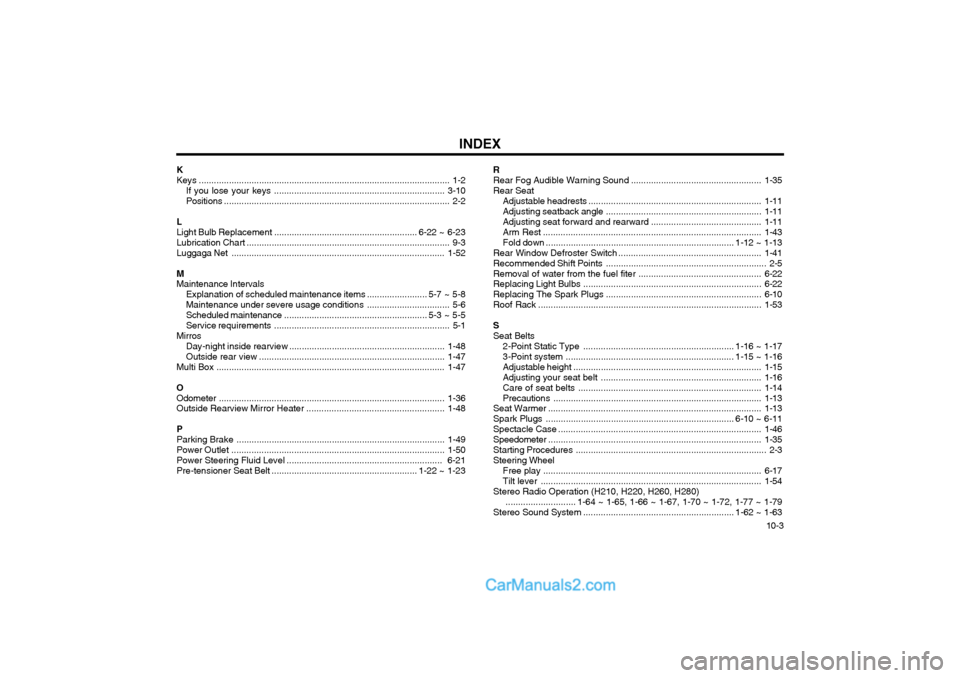
INDEX10-3
R
Rear Fog Audible Warning Sound
....................................................1-35
Rear Seat Adjustable headrests ..................................................................... 1-11
Adjusting seatback angle .............................................................. 1-11
Adjusting seat forward and rearward ............................................ 1-11
Arm Rest ....................................................................................... 1-43
Fold down ........................................................................... 1-12 ~ 1-13
Rear Window Defroster Switch ......................................................... 1-41
Recommended Shift Poi nts ................................................................ 2-5
Removal of water from the fuel fiter ................................................. 6-22
Replacing Light Bulbs ....................................................................... 6-22
Replacing The Spark Plugs .............................................................. 6-10
Roof R ack ......................................................................................... 1-53
SSeat Belts 2-Point Static Type ............................................................ 1-16 ~ 1-173-Point system ................................................................... 1-15 ~ 1-16
Adjustable height ........................................................................... 1-15
Adjusting your seat belt ................................................................ 1-16
Care of seat belts ......................................................................... 1-14
Precautions ................................................................................... 1-13
Seat Warmer ..................................................................................... 1-13
Spark Plugs ........................................................................... 6-10 ~ 6-11
Spectacle Case ................................................................................. 1-46
Speedometer ..................................................................................... 1-35
Starting Procedures ............................................................................ 2-3Steering Wheel Free play ....................................................................................... 6-17
Tilt lever ........................................................................................ 1-54
Stereo Radio Operation (H210, H220, H260, H280) ............................ 1-64 ~ 1-65, 1-66 ~ 1-67, 1-70 ~ 1-72, 1-77 ~ 1-79
Stereo Sound System ............................................................ 1-62 ~ 1-63
K
Keys .................................................................................................... 1-2
If you lose your keys .................................................................... 3-10
Positions .......................................................................................... 2-2
LLight Bulb Replacement ......................................................... 6-22 ~ 6-23
Lubrication Chart ................................................................................. 9-3
Luggaga Net ..................................................................................... 1-52
M Maintenance Intervals Explanation of scheduled maintenance items ........................ 5-7 ~ 5-8
Maintenance under severe usage conditions ................................. 5-6
Scheduled maintenance ......................................................... 5-3 ~ 5-5
Service requirements ...................................................................... 5-1
Mirros Day-night inside rearview .............................................................. 1-48
Outside rear view .......................................................................... 1-47
Multi Box ........................................................................................... 1-47
O Odometer .......................................................................................... 1-36
Outside Rearview Mirror Heater ....................................................... 1-48
PParking Brake ................................................................................... 1-49
Power Outlet ..................................................................................... 1-50
Power Steering Fluid Level .............................................................. 6-21
Pre-tensioner Seat Belt .......................................................... 1-22 ~ 1-23
Page 202 of 312
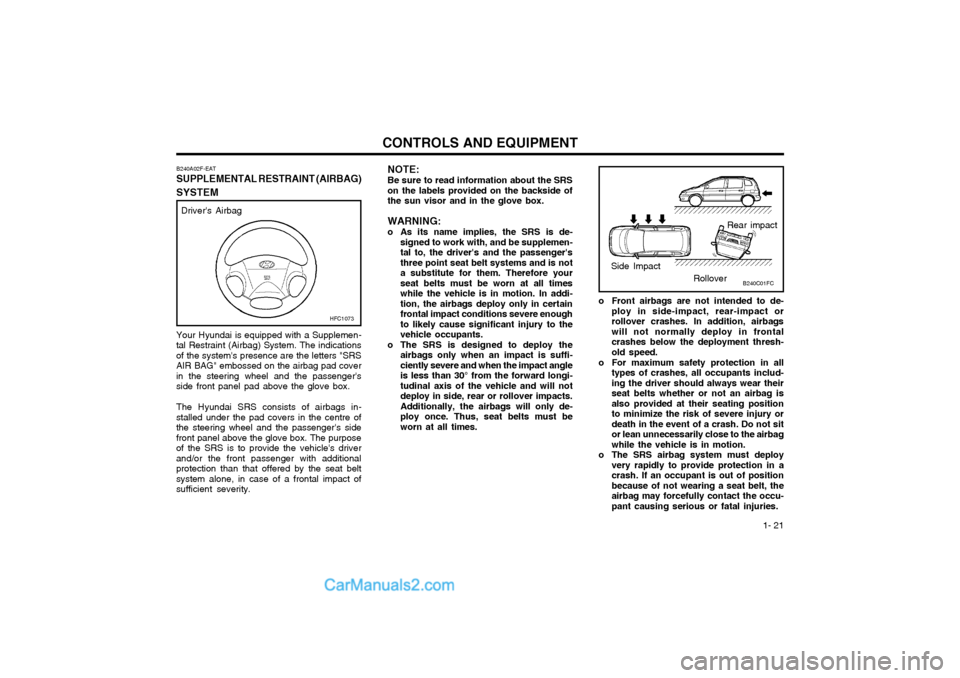
1- 21
CONTROLS AND EQUIPMENT
Your Hyundai is equipped with a Supplemen-
tal Restraint (Airbag) System. The indications of the system's presence are the letters "SRSAIR BAG" embossed on the airbag pad coverin the steering wheel and the passenger'sside front panel pad above the glove box.
The Hyundai SRS consists of airbags in-
stalled under the pad covers in the centre ofthe steering wheel and the passenger's sidefront panel above the glove box. The purposeof the SRS is to provide the vehicle's driverand/or the front passenger with additionalprotection than that offered by the seat beltsystem alone, in case of a frontal impact ofsufficient severity. NOTE: Be sure to read information about the SRS on the labels provided on the backside ofthe sun visor and in the glove box. WARNING:
o As its name implies, the SRS is de-
signed to work with, and be supplemen- tal to, the driver's and the passenger'sthree point seat belt systems and is nota substitute for them. Therefore yourseat belts must be worn at all timeswhile the vehicle is in motion. In addi-tion, the airbags deploy only in certainfrontal impact conditions severe enoughto likely cause significant injury to thevehicle occupants.
o The SRS is designed to deploy the airbags only when an impact is suffi-ciently severe and when the impact angleis less than 30° from the forward longi-tudinal axis of the vehicle and will notdeploy in side, rear or rollover impacts.Additionally, the airbags will only de-ploy once. Thus, seat belts must beworn at all times.
Driver's Airbag
B240A02F-EAT
SUPPLEMENTAL RESTRAINT (AIRBAG)
SYSTEM
HFC1073
Rear impact
Side Impact RolloverB240C01FC
o Front airbags are not intended to de-
ploy in side-impact, rear-impact or rollover crashes. In addition, airbagswill not normally deploy in frontalcrashes below the deployment thresh-old speed.
o For maximum safety protection in all types of crashes, all occupants includ-ing the driver should always wear theirseat belts whether or not an airbag isalso provided at their seating positionto minimize the risk of severe injury ordeath in the event of a crash. Do not sitor lean unnecessarily close to the airbagwhile the vehicle is in motion.
o The SRS airbag system must deploy very rapidly to provide protection in acrash. If an occupant is out of positionbecause of not wearing a seat belt, theairbag may forcefully contact the occu-pant causing serious or fatal injuries.