steering Hyundai Matrix 2003 Owner's Guide
[x] Cancel search | Manufacturer: HYUNDAI, Model Year: 2003, Model line: Matrix, Model: Hyundai Matrix 2003Pages: 312, PDF Size: 4.1 MB
Page 203 of 312
CONTROLS AND EQUIPMENT
1- 22
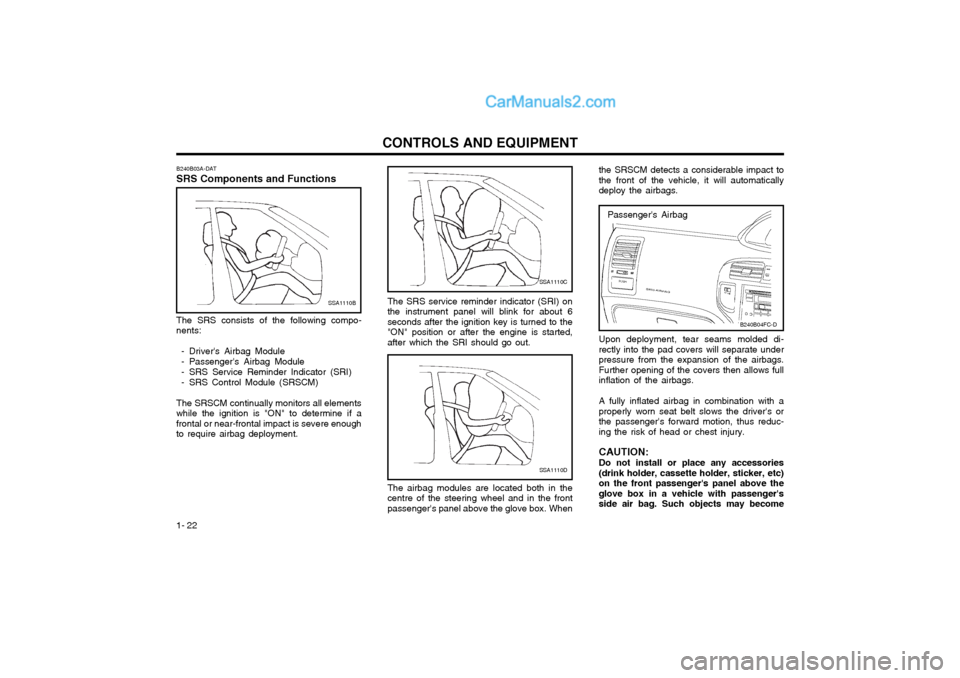
Passenger's Airbag
B240B04FC-D
Upon deployment, tear seams molded di- rectly into the pad covers will separate underpressure from the expansion of the airbags.Further opening of the covers then allows fullinflation of the airbags. A fully inflated airbag in combination with a properly worn seat belt slows the driver's orthe passenger's forward motion, thus reduc-ing the risk of head or chest injury. CAUTION: Do not install or place any accessories (drink holder, cassette holder, sticker, etc)on the front passenger's panel above theglove box in a vehicle with passenger'sside air bag. Such objects may become
the SRSCM detects a considerable impact tothe front of the vehicle, it will automaticallydeploy the airbags.
SSA1110C
The SRS service reminder indicator (SRI) on the instrument panel will blink for about 6seconds after the ignition key is turned to the"ON" position or after the engine is started,after which the SRI should go out.
SSA1110D
The airbag modules are located both in the centre of the steering wheel and in the frontpassenger's panel above the glove box. When
B240B03A-DAT SRS Components and Functions
SSA1110B
The SRS consists of the following compo- nents:
- Driver's Airbag Module
- Passenger's Airbag Module
- SRS Service Reminder Indicator (SRI)
- SRS Control Module (SRSCM)
The SRSCM continually monitors all elements while the ignition is "ON" to determine if afrontal or near-frontal impact is severe enoughto require airbag deployment.
Page 205 of 312

CONTROLS AND EQUIPMENT
1- 24
YT10355A
WARNING:
o Do not install a child restraint system in the front passenger seat position.
A child restraint system must never be placed in the front seat. The infant orchild could be severely injured by anairbag deployment in case of an accident.
o Extreme Hazard! Do not use a rearward facing child restraint on a seat pro-tected by an airbag in front of it!
o Modification to SRS components or wir- ing, including the addition of any kindof badges to the pad covers or modifi-cations to the body structure, can ad-versely affect SRS performance and leadto possible injury.
WARNING:
o For best protection from the side airbag
system and to avoid being injured is by the deploying side impact airbag, both front seat occupants should sit in an upright position with the seat belt prop-erly fastened. The driver's hands shouldbe placed on the steering wheel at the9:00 and 3:00 o'clock positions. Thepassenger's arms and hands should beplaced in their laps.
o Do not use any accessory seat covers.
o Use of seat covers could reduce or prevent the effectiveness of the system.
o Do not install any accessories on the side or near the side impact airbag.
o Do not use excessive force on the side of the seat.
o Do not place any objects over the airbag or between the airbag and yourself. B240C03Y-GAT SRS Care The SRS is virtually maintenance-free and there are no parts you can safely service byyourself. The entire SRS system must beinspected by an authorized Hyundai dealer in10 years after the date that the vehicle wasmanufactured. Any work on the SRS system, such as remov- ing, installing, repairing, or any work on thesteering wheel must be performed by a quali-fied Hyundai technician. Improper handling ofthe SRS system may result in serious per-sonal injury.
HFC2092-DSide airbag sensor
o Do not place any objects (an umbrella,
bag, etc.) between the front door and the front seat. Such objects may be-come dangerous projectiles and causeinjury if the supplemental side impactair bag inflates.
o To prevent unexpected deployment of the side impact air bag that may resultin personal injury, avoid impact to theside airbag sensor when the ignitionkey is on.
Page 206 of 312
1- 25
CONTROLS AND EQUIPMENT
o For cleaning the airbag pad covers, use only a soft, dry cloth or one which has been moistened with plain water.Solvents or cleaners could adverselyaffect the airbag covers and properdeployment of the system.
o No objects should be placed over or near the airbag modules on the steeringwheel, instrument panel, and the frontpassenger's panel above the glove box,because any such object could causeharm if the vehicle is in a crash severeenough to cause the airbags to inflate.
o If the airbags inflate, they must be re- placed by an authorized Hyundai dealer.
o Do not tamper with or disconnect SRS wiring, or other components of the SRSsystem. Doing so could result in injury,due to accidental firing of the airbags orby rendering the SRS inoperative.
o If components of the airbag system must be discarded, or if the vehicle must bescrapped, certain safety precautionsmust be observed. Your Hyundai dealerknows these precautions and can giveyou the necessary information. Failureto follow these precautions and proce-dures could increase the risk of per-sonal injury. o If you sell your vehicle, be sure to
inform the new owner of these impor-tant points and make certain that thismanual is transferred to the new owner.
o If your car was flooded and has soaked carpeting or water on flooring, youshouldn't try to start engine; have thecar towed to authorized Hyundaidealer.
o Do not replace the bumper or the bumper guard with the one other thanthe Hyundai genuine parts. Otherwise,it can adversely affect SRS performanceand lead to unexpected injury.
Page 216 of 312

1- 35
CONTROLS AND EQUIPMENTThe vehicle sidelights and headlights are op-
erated by rotating the end of the turn signal switch barrel. To operate the parking lights,rotating the switch to the first detent withignition switch at the "OFF" position will causethe lights to illuminate. To operate the head-lights, the turn signal switch barrel should berotated to the second detent. The headlightswill only operate when the ignition switch is atthe "On" position. If the ignition switch isturned to the "Off" position, only the parkinglights will function. Parking light auto cut (Not all models)
If you do not turn the parking lights "OFF"
after driving, the parking light will automati- cally shut "OFF" when the driver's door isopened.
To turn them "ON" again you must simply turn
the ignition key to the "ON" position.
B340C01FC-EAT LIGHTING SWITCH
SB220A1-E
MULTI FUNCTION SWITCH Turn Signal Operation
To signal an intention to turn right, the switch
lever should be pressed down. To signal an intention to turn left, the switch lever should bepushed upwards. In both instances, the turnsignal lights on one side of the car will flash andthe warning light located in the instrumentcluster will flash in sympathy. Upon completionof the manoeuvre, the lever will, under normalcircumstances, return to the "Off" position.However, if the manoeuvre involved only asmall movement of the steering wheel, thesignal may need to be cancelled manually. Ifeither turn signal indicator flashes more rapidlythan normal or refuses to flash at all, a mal-function of the turn signal system may exist. SB220B1-E Lane Change Signal To indicate an intention to change lanes, moving the lever slightly towards the directionof the relevant turn signal will cause the turnsignal lights to flash. When the lever is re-leased, it will return to the "off" position.
3. DRIVE TIME
Drive time symbol
Drive timeHFC2054
o This mode indicates the drive time trav- elled since the last drive time reset.
o Pressing the reset switch for more than 1 second, when the drive time is being dis- played, clears the drive time to zero. B340C01FC-D
B340B01FC-D
Page 217 of 312
CONTROLS AND EQUIPMENT
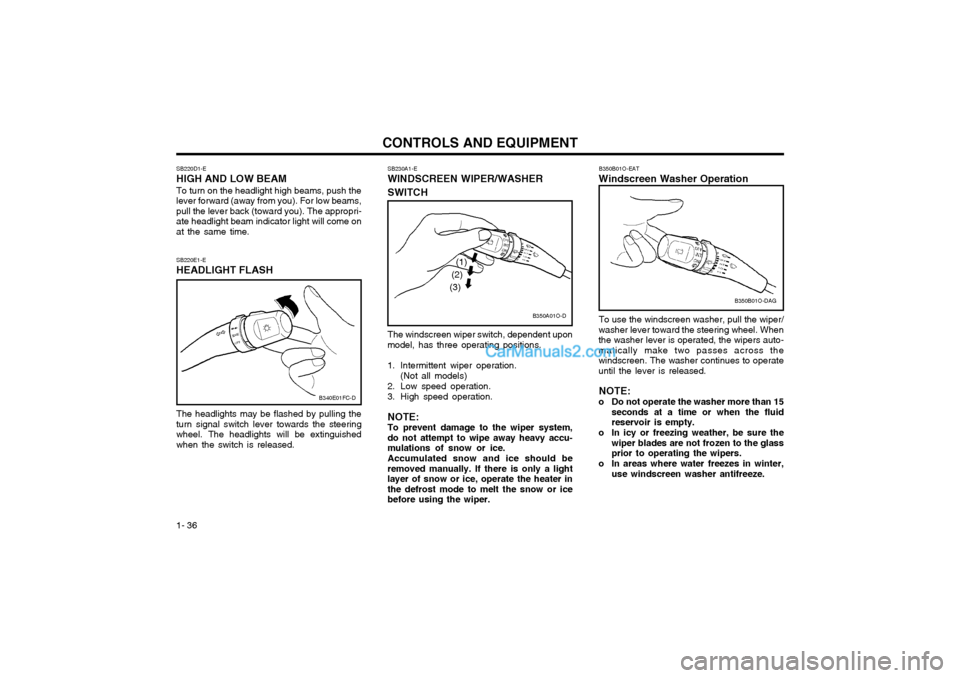
1- 36 The windscreen wiper switch, dependent upon
model, has three operating positions.
1. Intermittent wiper operation.
(Not all models)
2. Low speed operation.
3. High speed operation.
NOTE: To prevent damage to the wiper system,
do not attempt to wipe away heavy accu-mulations of snow or ice.
Accumulated snow and ice should be
removed manually. If there is only a lightlayer of snow or ice, operate the heater inthe defrost mode to melt the snow or icebefore using the wiper. SB230A1-E
WINDSCREEN WIPER/WASHER SWITCH
SB220E1-E HEADLIGHT FLASH The headlights may be flashed by pulling the turn signal switch lever towards the steeringwheel. The headlights will be extinguishedwhen the switch is released.
SB220D1-E HIGH AND LOW BEAM To turn on the headlight high beams, push the lever forward (away from you). For low beams,pull the lever back (toward you). The appropri-ate headlight beam indicator light will come onat the same time.
B340E01FC-D
B350A01O-D
(1)
(2)
(3)
B350B01O-EAT
Windscreen Washer Operation
To use the windscreen washer, pull the wiper/
washer lever toward the steering wheel. When the washer lever is operated, the wipers auto-matically make two passes across thewindscreen. The washer continues to operateuntil the lever is released.
NOTE:
o Do not operate the washer more than 15 seconds at a time or when the fluidreservoir is empty.
o In icy or freezing weather, be sure the wiper blades are not frozen to the glassprior to operating the wipers.
o In areas where water freezes in winter, use windscreen washer antifreeze. B350B01O-DAG
Page 232 of 312

1- 51
CONTROLS AND EQUIPMENTB610A01S-DAT
HORN (With Airbag)
Press the pad of the steering wheel to sound
the horn.
B580A01E-EAT
SUN-VISOR
Sun visors are fitted to both the driver and
passenger side of the vehicle. Certain deriva- tives are equipped with a vanity mirror whichis located on the back of the driver andpassenger visor. The visor may be lowered toreduce the amount of glare from directly ahead,or may be moved towards the side window toreduce glare from the side of the vehicle, oncethe inner pivot has been unclipped from thebracket.
NOTE: The Supplemental Restraint System (SRS)
label containing useful information can be found on the back of each sun visor.
WARNING: Do not place the sun-visor in such a man-
ner that it obscures visibility of the road- way, traffic or other objects. SB520A1-F STEERING WHEEL TILT LEVER
HFC2099HFC2041HFC2094-D
Vanity mirror
To adjust the steering wheel:
1. Push the lever downward to unlock.
2. Raise or lower the steering wheel to the
desired position.
3. After adjustment, securely tighten the lever by pulling it upward
WARNING: Do not attempt to adjust the steering wheel
while driving as this may result in loss ofcontrol of the vehicle and result in death orserious injury.
Page 244 of 312
DRIVING YOUR HYUNDAI
2- 2 C020A01O-EAT
BEFORE STARTING THE ENGINE
Before you start the engine, you should al-
ways:
1. Look around the vehicle to be sure there are no flat tyres, puddles of oil or water or other indications of possible trouble.
2. After entering the car, check to be sure the parking brake is engaged.
3. Check that all windows, and lights are clean.
4. Check that the interior and exterior mirrors are clean and in position.
5. Check your seat, seatback and headrestraint to be sure they are in theirproper positions.
6. Lock all the doors.
7. Fasten your seat belt and be sure that all other occupants have fastened theirs.
8. Turn off all lights and accessories that are not needed.
9. When you turn the ignition switch to "ON" check that all appropriate warning lights are operating and that you have sufficient fuel.
10.Check the operation of warning lights and all bulbs when key is in the "ON" position.
WARNING: (DIESEL ENGINE) To ensure that sufficient vacuum exists
within the brake system during cold weath- er start-up conditions, it is necessary torun the engine at idle for several secondsafter starting the engine. SC040A1-F
COMBINATION IGNITION SWITCH AND STEERING LOCK To Start the Engine
o If your Hyundai is equipped with a manual
transaxle, place the shift lever in neutral and depress the clutch pedal fully.
o If your Hyundai has an automatic transaxle, place the shift lever in "P" (park).
o To start the engine, insert the ignition key and turn it to the "START" position. Re-lease it as soon as the engine starts. Donot hold the key in the "START" positionfor more that 15 seconds.
NOTE: For safety, the engine will not start if the shift lever is not in "P" or "N" Position(automatic transaxle). SC050A2-E
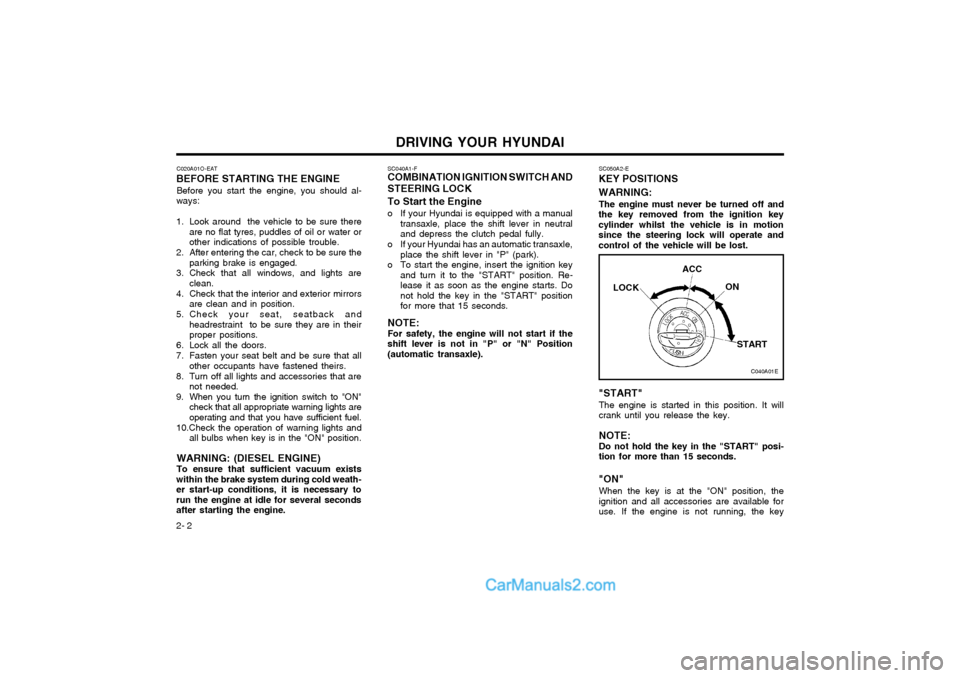
KEY POSITIONS WARNING:
The engine must never be turned off and
the key removed from the ignition key cylinder whilst the vehicle is in motionsince the steering lock will operate andcontrol of the vehicle will be lost. "START"
The engine is started in this position. It will crank until you release the key. NOTE: Do not hold the key in the "START" posi- tion for more than 15 seconds.
"ON" When the key is at the "ON" position, theignition and all accessories are available foruse. If the engine is not running, the key
C040A01E
LOCK
ACC
ON
START
Page 245 of 312

DRIVING YOUR HYUNDAI 2- 3
SB050B1-E
STEERING WHEEL LOCK When the key is removed, the steering col-
umn lock will be activated and will engage when the steering wheel is turned to theappropriate position. It is not necessary toturn the wheel until locked each time the keyis removed since in the event of any unautho-rized attempt at removal, the lock will becomeeffective as soon as the steering wheel isturned. To unlock the steering, insert the keyand turn to the "ACC" position. If the steeringis locked, it may be necessary to rock thesteering wheel slightly to facilitate turning thekey. Under no circumstances should the keybe forced since breakage of the key will occur. SC060A1-E
STARTING THE GASOLINE ENGINE
1. Ensure that the transaxle is in neutral and that the clutch pedal is held depressed (manual transaxle) or the transaxle selec-tor is at the "P" position (automatic transaxlevehicle).
2. Turn the ignition key to and hold at the "Start" position until the engine starts.When the engine has started, release thekey.
NOTE: Do not operate the starter for more than 15
seconds continuously or continue to oper- ate the starter after the engine has startedto avoid damaging the starter motor. If theengine makes a false start, allow it and thestarter motor to come to rest before at-tempting to start the engine again. Neverattempt to start the engine with thetransaxle in gear. Do not depress the ac-
C050A01E
should not be left at this position since the battery will become discharged and damageto the ignition system may also result. Forinformation regarding engine starting, refer to"STARTING THE ENGINE". "ACC"
When the ignition key is at the "ACC" position,
the radio and other accessories may be used."LOCK"
The ignition key may only be inserted or
removed at this position. celerator pedal whilst starting the engine. Allow the engine to idle for 20 seconds orso before driving the vehicle.
CAUTION: Do not leave the vehicle unattended whilst
idling. Never allow the vehicle to idle or warm up in a confined space (ie garage)longer than is necessary to move the vehi-cle into an open area.
C051A01O-EAT
STARTING THE DIESEL ENGINE
ENGINE COLD
o Turn the ignition key to position "ON" and wait for the pre-heat indicator light to goout.
o Operate the starter until the engine runs. ENGINE WARM Operate the starter. If the engine does not respond on the first attempt, wait severalseconds and try again using the pre-heat.
Page 252 of 312

DRIVING YOUR HYUNDAI
2- 10 C300B01O-GAT
TCS ON Mode In the TCS ON mode, the indicator in the instrument cluster will not be illuminated. NOTE:
1) Turn off the engine. Then restart the engine, and the TCS mode will auto- matically turn "ON".
2) When the traction control is operating properly, you can feel a slight pulsationin the vehicle. This is only the effect ofbrake control and indicates nothingunusual. C300D02O-GAT
Indicator and Warning
The indicator should illuminate when the igni-tion key is turned to "ON" or "START", butshould go out after three seconds. If the indicator does not illuminate, have it checked by an authorized Hyundai dealer. Should there be any unusual conditions in the device, TCS illuminates as a warning.If TCS illuminates, pull your car to a safeplace and stop the engine. Then, start the engine again to check if the TCS indicator goes out. If the indicator remains lit even after the engine has been started, have your carchecked by an authorized Hyundai dealer. NOTE: When TCS illuminates, traction control is automatically deactivated for safety.
Driving hints
TCS does not actively apply brakes. Be sure
to decelerate the car sufficiently before enter-ing curves.
CAUTION: When the TCS indicator blinks, SLIP con-
trol has been activated. It also means that the road is slippery or your car is acceler-ating excessively. In this situation, releasefoot pressure from the accelerator pedaland maintain moderate speed.
WARNING: Traction control is only a driving aid; all
normal precautions for driving in inclem- ent weather and on slippery driving sur-faces should be observed. 3) When the engine starts, a click is heard
from the engine compartment; however,this is only the sound of traction controlbeing checked.
4) When moving out of the mud or fresh snow, pressing the accelerator pedalmay not cause the engine speed toincrease.
The braking distance for cars equippedwith an anti-lock braking system may belonger than for those without it in thefollowing road conditions.
o Driving on rough, gravel or snow-cov-
ered roads.
o Driving with tyre chains installed.
o Driving on roads where the road sur- face is pitted or has different surface height.
These roads should be driven at reducedspeeds. The safety features of an ABSequipped vehicle should not be tested byhigh speed driving or cornering. This couldendanger the safety of yourself or others.
C300A01O-EAT
BRAKE TRACTION CONTROL SYSTEM (BTCS) (Not all models)
On slippery road surfaces, the traction control
system (TCS) limits the drive wheels from spinning excessively, thus helping the car toaccelerate. It also provides sufficient drivingforce and steering performance as the carturns at accelerated speeds. SLIP Control
Limits the drive wheels from spinning exces-
sively during starting or while making acceler- ated turns on slippery roads to avoid losingthe driving force of the front wheels.
Page 254 of 312

DRIVING YOUR HYUNDAI
2- 12 NOTE: Never allow undiluted screen washer fluid additive to spill upon the paintwork or useengine coolant anti-freeze since damage tothe paintwork may result.
o When driving in extreme conditions, the windscreen wiper blades may fail to clearthe screen properly due to the formation ofice upon the blade edge. It will therefore benecessary to periodically remove such iceto restore their efficiency.
o If the power operated door mirrors become frozen, attempts to adjust these may dam-age the mechanism.
o The formation of snow or ice built up inside the wheel arches may interfere with theroad wheels or steering mechanism. Insuch instances, unusual noises or an in-crease in steering effort may result. There-fore, ensure that the wheel arches arechecked periodically and any accumulatedsnow or ice removed.
o It is advisable to carry emergency equip- ment including, torch, shovel, tow rope,blankets etc., if a journey is to be under-taken into areas of severe road conditions.
ZC170D1-E
Door Locks
Should the door lock mechanism becomefrozen, a proprietary lock de-icer should beused. Alternatively, warming the door keymay thaw the door lock. However, the keyshould be handled carefully to avoid burningthe fingers. Never attempt to thaw a frozen door lock using hot water, since the water will eventu-ally freeze and compound the problem. NOTE: The proper temperature for using the im-mobilizer key is from -40°F to 176°F (-40°Cto 80°C). If you heat the immobilizer keyover 176°F (80°C) to open the frozen lock,it may cause damage to the transponderin its head.
SC170E1-E Windscreen Washers and Wipers The windscreen washer bottle should be filled
with a solution of water and a proprietary winter screen wash additive. The windscreenwipers should not be used if the blades arefrozen to the windscreen or if they are cov-ered with snow, before this is removed.
ZC170B1-E
Electrical System
Winter conditions impose severe demandsupon vehicle electrical systems, particularlythe charging circuit. The battery condition andperformance along with the alternator perfor-mance and drive belt condition should bechecked prior to the onset of winter. ZC170C1-E Anti-freeze/Corrosion inhibitorThe cooling system must always contain an Ethylene-Glycol based anti-freeze solution.The system is filled during manufacture withsolution of the correct strength which shouldbe checked before the onset of winter andadjusted or changed as required. NOTE: The anti-freeze solution contains a corro-sion inhibitor to prevent degradation of thealuminum castings contained within theengine. Therefore, never, drain the systemand refill with water only. In addition, anti-freeze solution must ALWAYS be used in vehicles fitted with air conditioning,to prevent the heater matrix from freezing andsubsequently bursting with the refrigerationsystem in use.