check engine Hyundai Matrix 2003 Workshop Manual
[x] Cancel search | Manufacturer: HYUNDAI, Model Year: 2003, Model line: Matrix, Model: Hyundai Matrix 2003Pages: 312, PDF Size: 4.1 MB
Page 212 of 312

1- 31
CONTROLS AND EQUIPMENTSB210S1-E BRAKE PAD WEAR INDICATOR The front brake disc pads are fitted with an audible wear indicator which will cause a highpitched noise to be emitted when the remain-ing amount of friction lining is below the speci-fied value. When the wear indicator is heard,the brake pads should be replaced withoutdelay to avoid damage occurring to the brakediscs and a severe reduction in braking effi-ciency.
B260N02FC-EAT
MALFUNCTION INDICATOR LIGHT
This light illuminates when there is a malfunc- tion of an exhaust gas related component,and the system is not functioning properly sothat the exhaust gas regulation values are notsatisfied. This light will illuminate when theignition key is tuned to the "ON" position, andwill go out after the engine start. If it illumi-nates while driving, or does not illuminatewhen the ignition key is turned to the "ON"position, take your car to your nearest autho-rized Hyundai dealer and have the systemchecked.
B260S01B-GAT DIESEL PRE-HEAT INDICATOR LIGHT-AMBER(Diesel Engine)
The indicator light illuminates amber when the ignition switch is placed at the "ON" position.The engine can be started after the pre-heatindicator light goes off. The illuminating timevaries with the water temperature, air tem-perature and battery condition. NOTE: If the engine were not started 10 seconds after the preheating is completed, turn theignition key once more to the "LOCK"position, and then to the "ON" position, inorder to preheat again.
B265A01B-GAT FUEL FILTER WARNING LIGHT-RED (Diesel Engine)
This light illuminates when the ignition switch
is set to the "ON" position and goes off after the engine has started. If it lights up while theengine is running, it indicates that water hasaccumulated inside the fuel filter. If this hap-pens, remove the water from the fuel filter.
(Refer to "6-19 page")
B260C02E-EAT
TRACTION CONTROL INDICATOR LIGHT(Not all models)
The traction control indicator changes opera- tion according to the ignition switch positionand whether or not the system is in operation. It will also illuminate when the ignition key is turned to the "ON" position, and then go off ina few seconds. If the TCS indicator stays on,take your car to your authorized Hyundaidealer and have the system checked. Seesection 2 for more information about the TCSsystem.
B270B02O-EAT
PARKING START WARNING SOUND (Not all models)
If the vehicle is driven at 6mph(10km/h) for
more than 2~3 seconds, the warning chime will sound continuously when the parking brake engaged.
B900A01A-EAT ACOUSTIC WARNING SOUND (Not all models) The acoustic warning chime sounds when the tail lights are on and the door in driver side isopen. This prevents the battery from dis-charging when the car is left with the tail lightson. The chime sounds until the tail lights areturned off.
Page 213 of 312
CONTROLS AND EQUIPMENT
1- 32
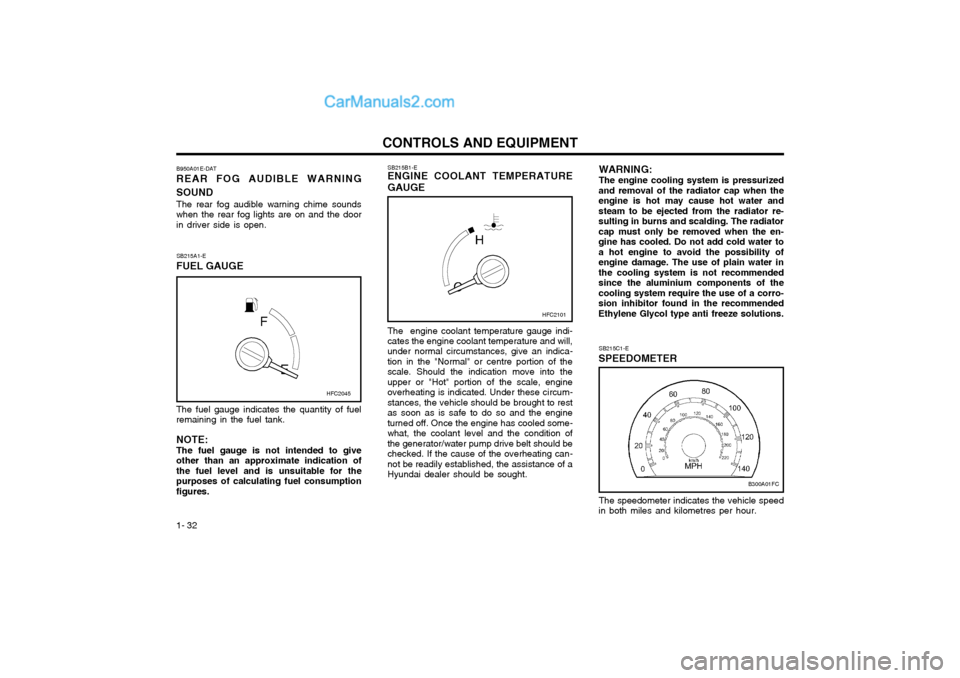
The fuel gauge indicates the quantity of fuel remaining in the fuel tank. NOTE: The fuel gauge is not intended to giveother than an approximate indication ofthe fuel level and is unsuitable for thepurposes of calculating fuel consumptionfigures. SB215B1-E
ENGINE COOLANT TEMPERATURE GAUGE
The engine coolant temperature gauge indi-
cates the engine coolant temperature and will, under normal circumstances, give an indica-tion in the "Normal" or centre portion of thescale. Should the indication move into theupper or "Hot" portion of the scale, engineoverheating is indicated. Under these circum-stances, the vehicle should be brought to restas soon as is safe to do so and the engineturned off. Once the engine has cooled some-what, the coolant level and the condition ofthe generator/water pump drive belt should bechecked. If the cause of the overheating can-not be readily established, the assistance of aHyundai dealer should be sought.
SB215A1-E
FUEL GAUGE
B950A01E-DAT REAR FOG AUDIBLE WARNING SOUND The rear fog audible warning chime sounds when the rear fog lights are on and the doorin driver side is open.
HFC2101
HFC2045
WARNING: The engine cooling system is pressurized
and removal of the radiator cap when the engine is hot may cause hot water andsteam to be ejected from the radiator re-sulting in burns and scalding. The radiatorcap must only be removed when the en-gine has cooled. Do not add cold water toa hot engine to avoid the possibility ofengine damage. The use of plain water inthe cooling system is not recommendedsince the aluminium components of thecooling system require the use of a corro-sion inhibitor found in the recommendedEthylene Glycol type anti freeze solutions.
B300A01FC
SB215C1-E
SPEEDOMETER
The speedometer indicates the vehicle speed
in both miles and kilometres per hour.
Page 231 of 312
CONTROLS AND EQUIPMENT
1- 50
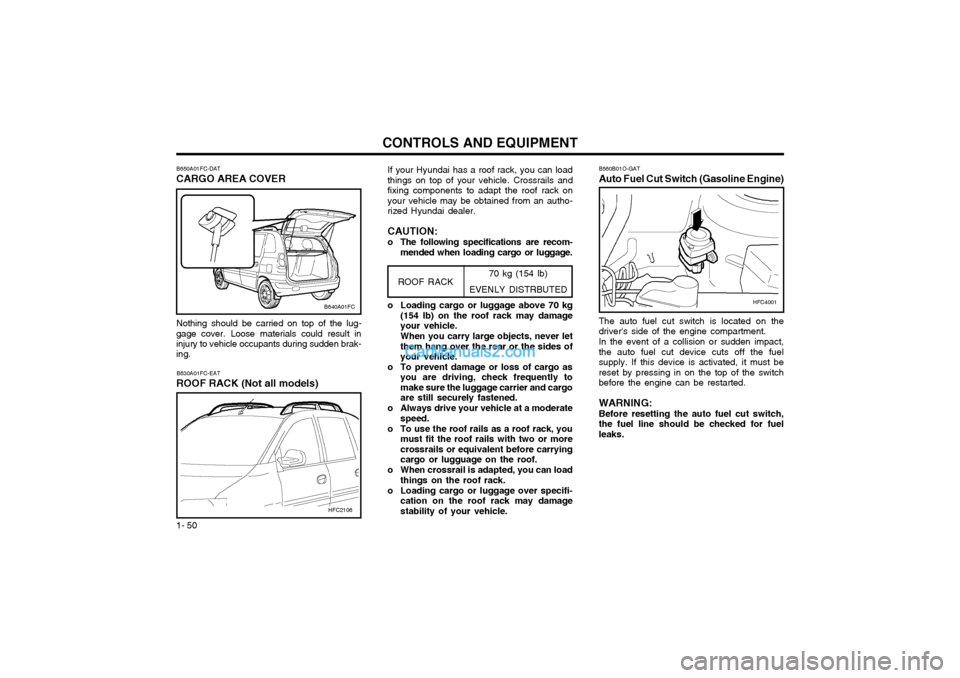
70 kg (154 lb)
EVENLY DISTRBUTED
HFC2106
B630A01FC-EAT
ROOF RACK (Not all models) If your Hyundai has a roof rack, you can load things on top of your vehicle. Crossrails andfixing components to adapt the roof rack onyour vehicle may be obtained from an autho-rized Hyundai dealer. CAUTION:
o The following specifications are recom-
mended when loading cargo or luggage.
ROOF RACK
o Loading cargo or luggage above 70 kg (154 lb) on the roof rack may damage your vehicle. When you carry large objects, never let them hang over the rear or the sides ofyour vehicle.
o To prevent damage or loss of cargo as you are driving, check frequently tomake sure the luggage carrier and cargoare still securely fastened.
o Always drive your vehicle at a moderate speed.
o To use the roof rails as a roof rack, you must fit the roof rails with two or morecrossrails or equivalent before carryingcargo or lugguage on the roof.
o When crossrail is adapted, you can load things on the roof rack.
o Loading cargo or luggage over specifi- cation on the roof rack may damagestability of your vehicle.
B650A01FC-DAT CARGO AREA COVER
B640A01FC
Nothing should be carried on top of the lug- gage cover. Loose materials could result in injury to vehicle occupants during sudden brak- ing. B560B01O-GAT Auto Fuel Cut Switch (Gasoline Engine)HFC4001
The auto fuel cut switch is located on the driver's side of the engine compartment. In the event of a collision or sudden impact, the auto fuel cut device cuts off the fuelsupply. If this device is activated, it must bereset by pressing in on the top of the switchbefore the engine can be restarted. WARNING: Before resetting the auto fuel cut switch, the fuel line should be checked for fuelleaks.
Page 244 of 312
DRIVING YOUR HYUNDAI
2- 2 C020A01O-EAT
BEFORE STARTING THE ENGINE
Before you start the engine, you should al-
ways:
1. Look around the vehicle to be sure there are no flat tyres, puddles of oil or water or other indications of possible trouble.
2. After entering the car, check to be sure the parking brake is engaged.
3. Check that all windows, and lights are clean.
4. Check that the interior and exterior mirrors are clean and in position.
5. Check your seat, seatback and headrestraint to be sure they are in theirproper positions.
6. Lock all the doors.
7. Fasten your seat belt and be sure that all other occupants have fastened theirs.
8. Turn off all lights and accessories that are not needed.
9. When you turn the ignition switch to "ON" check that all appropriate warning lights are operating and that you have sufficient fuel.
10.Check the operation of warning lights and all bulbs when key is in the "ON" position.
WARNING: (DIESEL ENGINE) To ensure that sufficient vacuum exists
within the brake system during cold weath- er start-up conditions, it is necessary torun the engine at idle for several secondsafter starting the engine. SC040A1-F
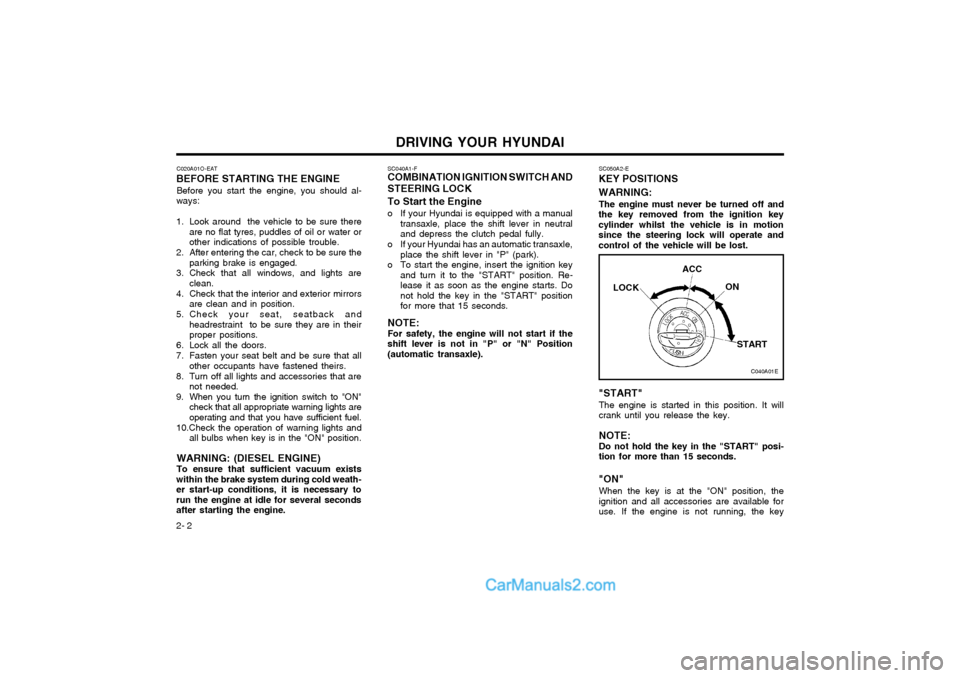
COMBINATION IGNITION SWITCH AND STEERING LOCK To Start the Engine
o If your Hyundai is equipped with a manual
transaxle, place the shift lever in neutral and depress the clutch pedal fully.
o If your Hyundai has an automatic transaxle, place the shift lever in "P" (park).
o To start the engine, insert the ignition key and turn it to the "START" position. Re-lease it as soon as the engine starts. Donot hold the key in the "START" positionfor more that 15 seconds.
NOTE: For safety, the engine will not start if the shift lever is not in "P" or "N" Position(automatic transaxle). SC050A2-E
KEY POSITIONS WARNING:
The engine must never be turned off and
the key removed from the ignition key cylinder whilst the vehicle is in motionsince the steering lock will operate andcontrol of the vehicle will be lost. "START"
The engine is started in this position. It will crank until you release the key. NOTE: Do not hold the key in the "START" posi- tion for more than 15 seconds.
"ON" When the key is at the "ON" position, theignition and all accessories are available foruse. If the engine is not running, the key
C040A01E
LOCK
ACC
ON
START
Page 246 of 312
DRIVING YOUR HYUNDAI
2- 4 C050B02S-GAT
NORMAL CONDITIONS The Starting Procedure:
1. Insert key, and fasten the seat belt.
2. Depress the clutch pedal fully and place the gearshift lever (manual transaxle) in neutral or the selector lever (automatictransaxle) in "P" (park) position.
3. After turning the ignition key to the "ON" position, make certain all warning lightsand gauges are functioning properly be-fore starting the engine.
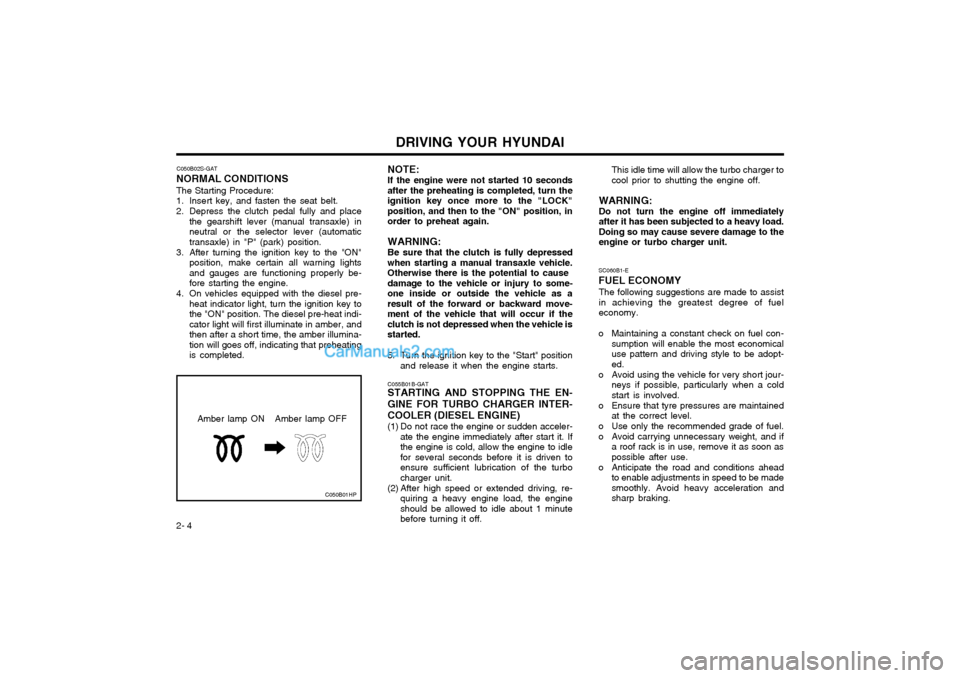
4. On vehicles equipped with the diesel pre- heat indicator light, turn the ignition key tothe "ON" position. The diesel pre-heat indi-cator light will first illuminate in amber, andthen after a short time, the amber illumina-tion will goes off, indicating that preheatingis completed. SC060B1-E FUEL ECONOMY
The following suggestions are made to assist in achieving the greatest degree of fueleconomy.
o Maintaining a constant check on fuel con- sumption will enable the most economicaluse pattern and driving style to be adopt-ed.
o Avoid using the vehicle for very short jour- neys if possible, particularly when a coldstart is involved.
o Ensure that tyre pressures are maintained at the correct level.
o Use only the recommended grade of fuel.
o Avoid carrying unnecessary weight, and if a roof rack is in use, remove it as soon aspossible after use.
o Anticipate the road and conditions ahead to enable adjustments in speed to be madesmoothly. Avoid heavy acceleration andsharp braking.
NOTE: If the engine were not started 10 seconds
after the preheating is completed, turn the ignition key once more to the "LOCK"position, and then to the "ON" position, inorder to preheat again.
WARNING: Be sure that the clutch is fully depressed
when starting a manual transaxle vehicle. Otherwise there is the potential to cause damage to the vehicle or injury to some-
one inside or outside the vehicle as aresult of the forward or backward move-ment of the vehicle that will occur if theclutch is not depressed when the vehicle isstarted.
5. Turn the ignition key to the "Start" position and release it when the engine starts.
C055B01B-GAT
STARTING AND STOPPING THE EN- GINE FOR TURBO CHARGER INTER- COOLER (DIESEL ENGINE)
(1) Do not race the engine or sudden acceler-
ate the engine immediately after start it. If the engine is cold, allow the engine to idlefor several seconds before it is driven toensure sufficient lubrication of the turbocharger unit.
(2) After high speed or extended driving, re- quiring a heavy engine load, the engineshould be allowed to idle about 1 minutebefore turning it off. This idle time will allow the turbo charger tocool prior to shutting the engine off.
WARNING: Do not turn the engine off immediately after it has been subjected to a heavy load.Doing so may cause severe damage to theengine or turbo charger unit.
C050B01HP
Amber lamp ON Amber lamp OFF
Page 250 of 312

DRIVING YOUR HYUNDAI
2- 8 o Always engage the parking brake when
the vehicle is unattended, never use the "P" position in place of the parking brake.
o Under normal circumstances, the selector should be placed in the "D" position andthe transaxle allowed to select the mostideal ratio for the circumstances. In thisposition maximum fuel economy will beachieved.
o When descending steep gradients where engine braking is required, the selectorshould be placed at the "2" or "L" positiondepending upon the vehicle speed.
o When ascending steep gradients using large throttle openings, the transaxle mayre-peatedly change between two adjacentratios. This is a normal characteristic andmay be prevented by cancelling the over-drive facility if the shifting occurs betweenthird and fourth ratios, selecting position"2" if the shifting occurs between third andsecond ratios or selecting position "1" if theshifting occurs between first and secondratios.
o Never move the selector to or from the "P" or "N" position with the accelerator de-pressed.
o Ensure that the overdrive switch is at the "ON" position for maximum economy. o If rapid acceleration is required, fully de-
press the accelerator pedal. In this condi-tion, the kickdown mechanism will be oper-ated and the transaxle will automaticallydownshift according to the vehicle speed.
o The automatic transaxle may be used to great effect if the vehicle becomes stuck insnow or mud by allowing the vehicle to berocked to and fro. The engine speed shouldbe held at approximately 1,000rpm bymeans of the accelerator pedal and theselector lever moved between the "D" and"R" positions to induce a rocking motion.
o Do not depress the accelerator pedal with the brakes applied and the selector at the"R", "D", "2" or "L" position.
o Turn the overdrive switch on for good fuel economy and smooth driving. But if enginebraking is needed in the "D" range or ifrepeated upshifting and downshifting be-tween the 3rd and 4th gear is neededwhen climbing a gentle slope, it is recom-mended that the overdrive switch be turnedoff. Turn the overdrive switch back onimmediately afterward.
C090I02A-EAT
CAUTION:
o Shift into "R" and "P" only when the vehicle has completely stopped.
o Do not accelerate the engine in reverse or any of the forward positions with the brakes applied.
o Always apply the footbrake when shift- ing from "P" or "N", to "R", "D", "2" or"L" position.
o Do not use the "P" (Park) position in place of the parking brake. Always setthe parking brake, shift the transaxleinto "P" (Park) and turn off the ignitionwhen you leave the vehicle, even mo-mentarily. Never leave the vehicle unat-tended whilst the engine is running.
o Check the automatic transaxle fluid level regularly, and add fluid as necessary. See the maintenance schedule for the proper fluid recommendation.
FC120D1-E
General Operating Instructions
o The button in the selector handle must be depressed before the selector can be moved.
o The engine may only be started when the selector is at position "P" or "N".
o Ensure that the footbrake is firmly applied when shifting from "P" or "N" to "D", "2", "L"or "R" and vice versa.
Page 251 of 312

DRIVING YOUR HYUNDAI 2- 9
SC130A1-E
OVERDRIVE SWITCH
The overdrive switch prevents the transaxle
upshifting higher than third gear when the switch is turned "OFF". The transaxle will startfrom rest in first gear and upshift to secondand third gear depending upon the roadspeedand throttle opening but will not upshift tofourth gear. When the overdrive switch isturned "ON", the transaxle will start from restin first gear and will upshift, depending uponroadspeed and throttle opening to second,third and fourth gear. Therefore, when theoverdrive switch is turned "OFF", the transaxleperforms as a three speed unit and the over-drive warning light located in the instrumentcluster will be illuminated. When the overdriveswitch is turned "ON", the transaxle functionsas a fully automatic four speed unit with themaximum fuel economy potential of the ve-hicle being realized. o Do not hold the vehicle on the upgrade
with the accelerator pedal. This can causethe transmission to overheat. Always usethe brake pedal or parking brake.
SC140A1-E EFFECTIVE BRAKING Braking system performance and friction ma- terial life are greatly affected by the drivingstyle adopted. The following suggestions aremade to assist in achieving the best resultsfrom the braking system.
o Anticipate the road and conditions ahead
in order that heavy braking may be avoided.
o When descending long gradients, use the engine to assist in retarding the vehicle to minimize the possibility of brake fade oc-curring.
o When trailer towing, ensure that the trailer brakes function correctly and use enginebraking to assist the vehicle braking system.
o Use only genuine Hyundai replacement brake pads and shoes to ensure consis-tent friction characteristics and wear rates.
o After driving through deep water (e.g. fording), the brakes may become wet andperformance reduced. Always check brakeefficiency after emerging from the waterand dry the brakes by lightly depressingthe brake pedal several times whilst driv-ing slowly.
o Apply the parking brake only when the vehicle is at rest.
o Since the power assistance provided by the brake servo is derived from the engine,coasting with the engine turned off or tow-ing of the vehicle with the engine turned offwill result in greatly increased pedal pres-sures being required to stop the vehicle. SC140B1-E
ANTI-LOCK BRAKE SYSTEM (Not all models)
The Anti-Lock Brake System (ABS) is de-
signed to prevent wheel lock-up during sud- den braking or on hazardous road surfaces.The ABS control module monitors the wheelspeed and controls the pressure applied toeach brake. Thus, in emergency situations oron slick roads, ABS will increase vehicle con-trol during braking.
NOTE: During ABS operation, a slight pulsation
may be felt in the brake pedal when the brakes are applied. Also, a noise may beheard in the engine compartment whilstbraking. These conditions are normal andindicate that the anti-lock brake system isfunctioning properly.
WARNING:ABS will not prevent accidents due to im-
proper or dangerous driving maneuvers.Even though vehicle control is improvedduring emergency braking, always maintaina safe distance between you and objectsahead. Vehicle speeds should always bereduced during extreme road conditions.
HFC3023-D
Page 252 of 312

DRIVING YOUR HYUNDAI
2- 10 C300B01O-GAT
TCS ON Mode In the TCS ON mode, the indicator in the instrument cluster will not be illuminated. NOTE:
1) Turn off the engine. Then restart the engine, and the TCS mode will auto- matically turn "ON".
2) When the traction control is operating properly, you can feel a slight pulsationin the vehicle. This is only the effect ofbrake control and indicates nothingunusual. C300D02O-GAT
Indicator and Warning
The indicator should illuminate when the igni-tion key is turned to "ON" or "START", butshould go out after three seconds. If the indicator does not illuminate, have it checked by an authorized Hyundai dealer. Should there be any unusual conditions in the device, TCS illuminates as a warning.If TCS illuminates, pull your car to a safeplace and stop the engine. Then, start the engine again to check if the TCS indicator goes out. If the indicator remains lit even after the engine has been started, have your carchecked by an authorized Hyundai dealer. NOTE: When TCS illuminates, traction control is automatically deactivated for safety.
Driving hints
TCS does not actively apply brakes. Be sure
to decelerate the car sufficiently before enter-ing curves.
CAUTION: When the TCS indicator blinks, SLIP con-
trol has been activated. It also means that the road is slippery or your car is acceler-ating excessively. In this situation, releasefoot pressure from the accelerator pedaland maintain moderate speed.
WARNING: Traction control is only a driving aid; all
normal precautions for driving in inclem- ent weather and on slippery driving sur-faces should be observed. 3) When the engine starts, a click is heard
from the engine compartment; however,this is only the sound of traction controlbeing checked.
4) When moving out of the mud or fresh snow, pressing the accelerator pedalmay not cause the engine speed toincrease.
The braking distance for cars equippedwith an anti-lock braking system may belonger than for those without it in thefollowing road conditions.
o Driving on rough, gravel or snow-cov-
ered roads.
o Driving with tyre chains installed.
o Driving on roads where the road sur- face is pitted or has different surface height.
These roads should be driven at reducedspeeds. The safety features of an ABSequipped vehicle should not be tested byhigh speed driving or cornering. This couldendanger the safety of yourself or others.
C300A01O-EAT
BRAKE TRACTION CONTROL SYSTEM (BTCS) (Not all models)
On slippery road surfaces, the traction control
system (TCS) limits the drive wheels from spinning excessively, thus helping the car toaccelerate. It also provides sufficient drivingforce and steering performance as the carturns at accelerated speeds. SLIP Control
Limits the drive wheels from spinning exces-
sively during starting or while making acceler- ated turns on slippery roads to avoid losingthe driving force of the front wheels.
Page 253 of 312

DRIVING YOUR HYUNDAI 2- 11
o Don't "lug" or "over-rev" the engine. Lug-
ging is driving too slowly in too high a gear resulting in the engine bucking. If thishappens to you, shift to a lower gear. Over-revving is racing the engine beyond its safe limit. This can be avoided byshifting at the recommended speeds.
o Use your air conditioning sparingly. The air conditioning system is operated by theengine power so your fuel economy isreduced when you use it.
SC150A1-F
DRIVING FOR ECONOMY
You can save fuel and get more miles fromyour car if you follow these suggestions:
o Drive smoothly. Accelerate at a moderate rate. Don't make "jack-rabbit" starts or full-throttle shifts and maintain a steady cruis-ing speed. Don't race between stoplights.Try to adjust your speed to that of the othertraffic so you don't have to change speedsunnecessarily. Avoid heavy traffic whenever possible. Al- ways maintain a safe distance from othervehicles so you can avoid unnecessarybraking. This also reduces brake wear.
o Drive at a moderate speed. The faster you drive, the more fuel your car uses. Drivingat a moderate speed, especially on thehighway, is one of the most effective waysto reduce fuel consumption.
o Don't "ride" the brake or clutch pedal. This can increase fuel consumption and alsoincrease wear on these components. Inaddition, driving with your foot resting onthe brake pedal may cause the brakes tooverheat, which reduces their effective-ness and may lead to more serious con-
sequences.
o Take care of your tyres. Keep them inflated to the recommended pressure. Incorrectinfla-tion, either too much or too little, re-sults in unnecessary tyre wear. Check thetyre pres-sures at least once a month. o Be sure that the wheels are aligned cor-
rectly. Improper alignment can result fromhitting curbs or driving too fast over irregu-lar surfaces. Poor alignment causes fastertyre wear and may also result in otherproblems as well as greater fuel consump-tion.
o Keep your car in good condition. For better fuel economy and reduced maintenancecosts, maintain your car in accordancewith the maintenance schedule in Section5. If you drive your car in severe condi-tions, more frequent maintenance is re-quired (see Section 5 for details).
o Keep your car clean. For maximum ser- vice, your car should be kept clean andfree of corrosive materials. It is especiallyimportant that mud, dirt, ice, etc. not beallowed to accumulate on the underside ofthe car. This extra weight can result inincreased fuel consumption and also con-tribute to corrosion.
o Travel lightly. Don't carry unnecessary weight in your car. Weight is an enemy ofgood fuel economy.
o Don't let the engine idle longer than neces- sary. If you are waiting (and not in traffic),turn off your engine and restart only whenyou're ready to go.
o Remember, your car does not require extended warm-up. As soon as the engineis running smoothly, you can drive away.In very cold weather, however, give yourengine a slightly longer warm-up period. SC160A1-F SMOOTH CORNERING Avoid braking or gear changing in corners, especially when roads are wet. Ideally, cor-ners should always be taken under gentleacceleration. If you follow these suggestions,tyre wear will be held to a minimum. SC170A1-E WINTER MOTORING The onset of winter conditions subject motor vehicles to greater operating demands. There-fore, the following suggestions will assist inmaintaining peak performance and reliabilityduring these periods:
Page 254 of 312

DRIVING YOUR HYUNDAI
2- 12 NOTE: Never allow undiluted screen washer fluid additive to spill upon the paintwork or useengine coolant anti-freeze since damage tothe paintwork may result.
o When driving in extreme conditions, the windscreen wiper blades may fail to clearthe screen properly due to the formation ofice upon the blade edge. It will therefore benecessary to periodically remove such iceto restore their efficiency.
o If the power operated door mirrors become frozen, attempts to adjust these may dam-age the mechanism.
o The formation of snow or ice built up inside the wheel arches may interfere with theroad wheels or steering mechanism. Insuch instances, unusual noises or an in-crease in steering effort may result. There-fore, ensure that the wheel arches arechecked periodically and any accumulatedsnow or ice removed.
o It is advisable to carry emergency equip- ment including, torch, shovel, tow rope,blankets etc., if a journey is to be under-taken into areas of severe road conditions.
ZC170D1-E
Door Locks
Should the door lock mechanism becomefrozen, a proprietary lock de-icer should beused. Alternatively, warming the door keymay thaw the door lock. However, the keyshould be handled carefully to avoid burningthe fingers. Never attempt to thaw a frozen door lock using hot water, since the water will eventu-ally freeze and compound the problem. NOTE: The proper temperature for using the im-mobilizer key is from -40°F to 176°F (-40°Cto 80°C). If you heat the immobilizer keyover 176°F (80°C) to open the frozen lock,it may cause damage to the transponderin its head.
SC170E1-E Windscreen Washers and Wipers The windscreen washer bottle should be filled
with a solution of water and a proprietary winter screen wash additive. The windscreenwipers should not be used if the blades arefrozen to the windscreen or if they are cov-ered with snow, before this is removed.
ZC170B1-E
Electrical System
Winter conditions impose severe demandsupon vehicle electrical systems, particularlythe charging circuit. The battery condition andperformance along with the alternator perfor-mance and drive belt condition should bechecked prior to the onset of winter. ZC170C1-E Anti-freeze/Corrosion inhibitorThe cooling system must always contain an Ethylene-Glycol based anti-freeze solution.The system is filled during manufacture withsolution of the correct strength which shouldbe checked before the onset of winter andadjusted or changed as required. NOTE: The anti-freeze solution contains a corro-sion inhibitor to prevent degradation of thealuminum castings contained within theengine. Therefore, never, drain the systemand refill with water only. In addition, anti-freeze solution must ALWAYS be used in vehicles fitted with air conditioning,to prevent the heater matrix from freezing andsubsequently bursting with the refrigerationsystem in use.