oil temperature Hyundai Matrix 2003 Owner's Manual
[x] Cancel search | Manufacturer: HYUNDAI, Model Year: 2003, Model line: Matrix, Model: Hyundai Matrix 2003Pages: 312, PDF Size: 4.1 MB
Page 9 of 312
FEATURES OF YOUR HYUNDAI 1- 1
1. FEATURES OF
YOUR HYUNDAI
B010A01FC-1
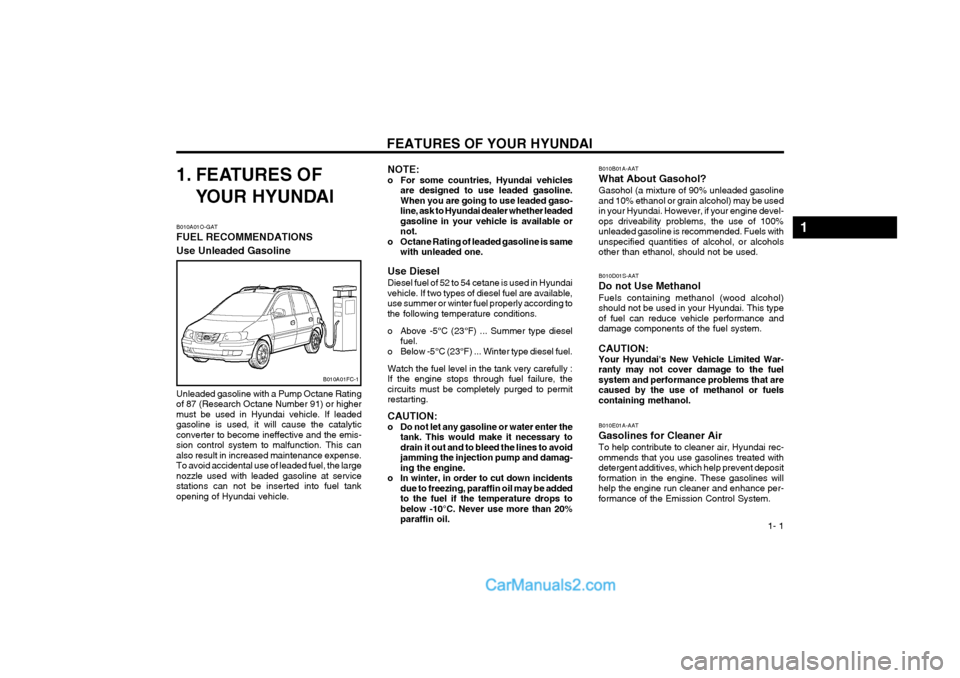
B010A01O-GAT FUEL RECOMMENDATIONS Use Unleaded Gasoline Unleaded gasoline with a Pump Octane Rating of 87 (Research Octane Number 91) or highermust be used in Hyundai vehicle. If leadedgasoline is used, it will cause the catalyticconverter to become ineffective and the emis-sion control system to malfunction. This canalso result in increased maintenance expense.To avoid accidental use of leaded fuel, the largenozzle used with leaded gasoline at servicestations can not be inserted into fuel tankopening of Hyundai vehicle. NOTE:
o For some countries, Hyundai vehicles
are designed to use leaded gasoline.When you are going to use leaded gaso-line, ask to Hyundai dealer whether leadedgasoline in your vehicle is available ornot.
o Octane Rating of leaded gasoline is same with unleaded one.
Use Diesel Diesel fuel of 52 to 54 cetane is used in Hyundai vehicle. If two types of diesel fuel are available,
use summer or winter fuel properly according tothe following temperature conditions.
o Above -5°C (23°F) ... Summer type diesel fuel.
o Below -5°C (23°F) ... Winter type diesel fuel.Watch the fuel level in the tank very carefully : If the engine stops through fuel failure, thecircuits must be completely purged to permitrestarting. CAUTION:
o Do not let any gasoline or water enter the tank. This would make it necessary todrain it out and to bleed the lines to avoidjamming the injection pump and damag-ing the engine.
o In winter, in order to cut down incidents due to freezing, paraffin oil may be addedto the fuel if the temperature drops tobelow -10°C. Never use more than 20%paraffin oil. B010B01A-AAT What About Gasohol?Gasohol (a mixture of 90% unleaded gasoline and 10% ethanol or grain alcohol) may be usedin your Hyundai. However, if your engine devel-ops driveability problems, the use of 100%unleaded gasoline is recommended. Fuels withunspecified quantities of alcohol, or alcoholsother than ethanol, should not be used. B010E01A-AAT Gasolines for Cleaner Air To help contribute to cleaner air, Hyundai rec- ommends that you use gasolines treated withdetergent additives, which help prevent depositformation in the engine. These gasolines willhelp the engine run cleaner and enhance per-formance of the Emission Control System.
B010D01S-AAT Do not Use Methanol Fuels containing methanol (wood alcohol) should not be used in your Hyundai. This typeof fuel can reduce vehicle performance anddamage components of the fuel system. CAUTION: Your Hyundai's New Vehicle Limited War-
ranty may not cover damage to the fuelsystem and performance problems that are
caused by the use of methanol or fuelscontaining methanol.
1
Page 38 of 312
FEATURES OF YOUR HYUNDAI
1- 30
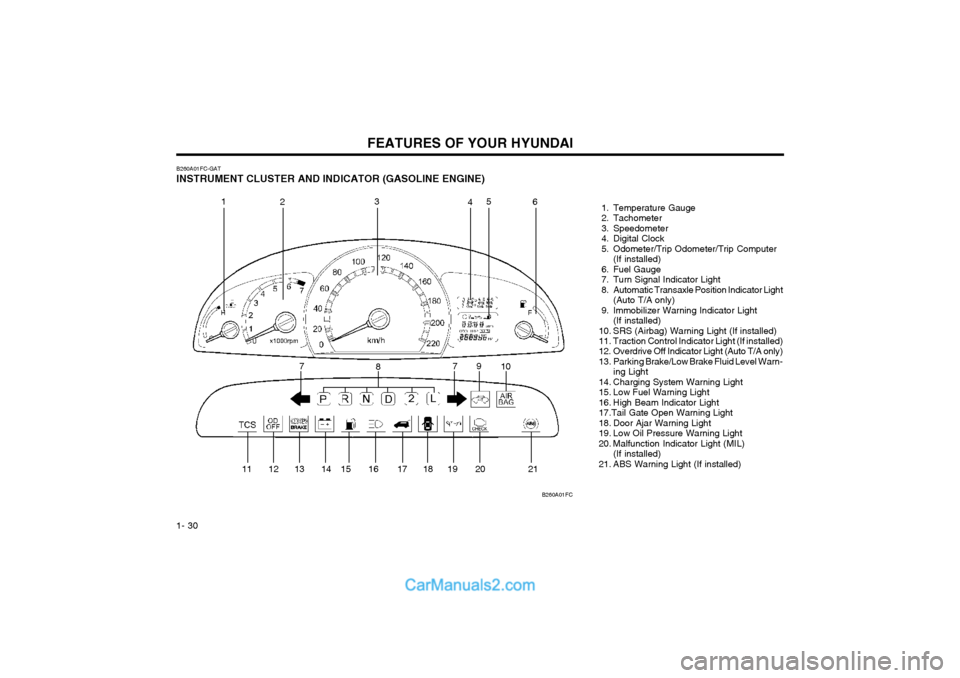
B260A01FC-GAT
INSTRUMENT CLUSTER AND INDICATOR (GASOLINE ENGINE) 1. Temperature Gauge
2. Tachometer
3. Speedometer
4. Digital Clock
5. Odometer/Trip Odometer/Trip Computer(If installed)
6. Fuel Gauge
7. Turn Signal Indicator Light
8. Automatic Transaxle Position Indicator Light (Auto T/A only)
9. Immobilizer Warning Indicator Light (If installed)
10. SRS (Airbag) Warning Light (If installed)
11. Traction Control Indicator Light (If installed)
12. Overdrive Off Indicator Light (Auto T/A only)
13. Parking Brake/Low Brake Fluid Level Warn- ing Light
14. Charging System Warning Light
15. Low Fuel Warning Light
16. High Beam Indicator Light17.Tail Gate Open Warning Light
18. Door Ajar Warning Light
19. Low Oil Pressure Warning Light
20. Malfunction Indicator Light (MIL) (If installed)
21. ABS Warning Light (If installed)
B260A01FC
1
2 3
45
6
7 8 9
10
11 12 13 14 15 16 17 18 19 20 21 7
Page 39 of 312
FEATURES OF YOUR HYUNDAI 1- 31
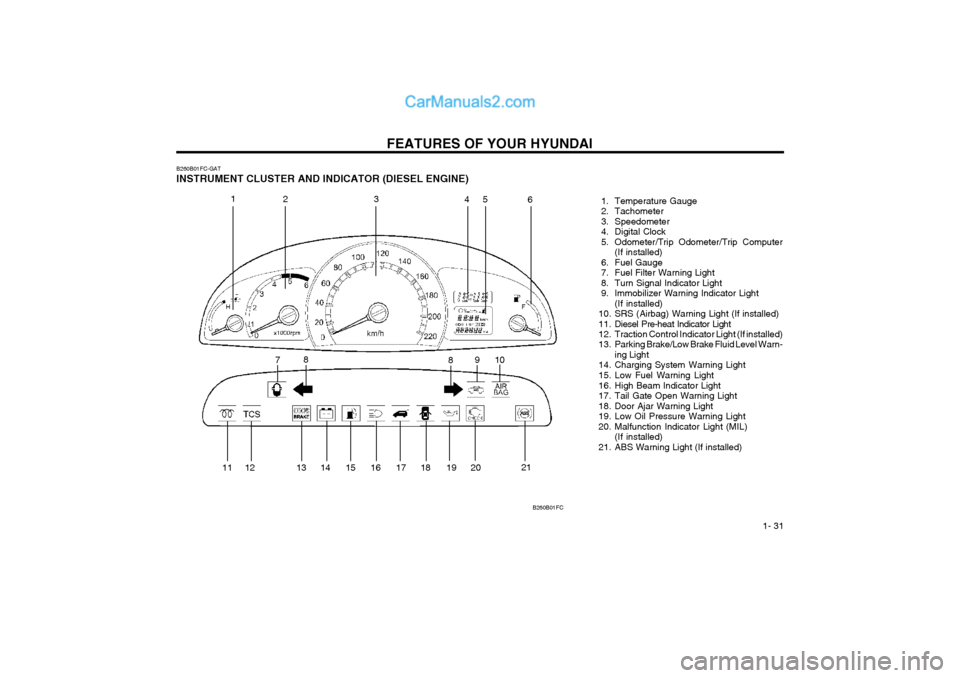
B260B01FC-GAT INSTRUMENT CLUSTER AND INDICATOR (DIESEL ENGINE)
1. Temperature Gauge
2. Tachometer
3. Speedometer
4. Digital Clock
5. Odometer/Trip Odometer/Trip Computer(If installed)
6. Fuel Gauge
7. Fuel Filter Warning Light
8. Turn Signal Indicator Light
9. Immobilizer Warning Indicator Light (If installed)
10. SRS (Airbag) Warning Light (If installed)
11. Diesel Pre-heat Indicator Light
12. Traction Control Indicator Light (If installed)
13. Parking Brake/Low Brake Fluid Level Warn- ing Light
14. Charging System Warning Light
15. Low Fuel Warning Light
16. High Beam Indicator Light
17. Tail Gate Open Warning Light
18. Door Ajar Warning Light
19. Low Oil Pressure Warning Light
20. Malfunction Indicator Light (MIL) (If installed)
21. ABS Warning Light (If installed)
B260B01FC
1 23 45
6
7 8
910
8
11 12 13 14 15 16 17 18 19 20 21
Page 82 of 312
FEATURES OF YOUR HYUNDAI
1- 74
B260D02O-AAT
1. Playing CD
o Insert the CD with the label facing upward.
o Insert the CD to start CD playback, during
radio operation.
o When a disc is in the CD deck, if you press the CD button, the CD player will beginplaying even if the radio is being used.
o The CD player can be used when the igni- tion switch is in either the "ON" or "ACC"position.
2. FF/REW ( / ) If you want to fast forward or reverse through the compact disc track, push and hold in the FF( ) or REW ( ) button.When you release the button, the compact discplayer will resume playing.
3. TRACK UP/DOWN
o The desired track on the disc currently being played can be selected using the track number.
o Press once to skip forward to the beginn- ing of the next track. Press once to skipback to the beginning of the track.
4. SCAN Button
o Press the SCAN button to playback the first 10 seconds of each track.
o Press the SCAN button again within 10 sec. When you have reached the desired track. 5. REPEAT Button
o To repeat the track you are currently listen-
ing to, press the RPT button. To cancel , press again.
o If you do not release RPT operation when the track ends, it will automatically be re-played.This process will be continued until youpush the button again.
6. EJECT Button When the EJECT button is pressed with a CD loaded, the CD will eject. NOTE:
o To assure proper operation of the unit, keep the vehicle interior temperaturewithin a normal range by using thevehicle's air conditioning or heating sys-tem.
o When replacing the fuse, replace it with a fuse having the correct capacity.
o The preset station frequencies are all erased when the car battery is discon-nected. Therefore, all data will have to beset again if this should occur.
o Do not add any oil to the rotating parts. Keep magnets, screwdrivers and othermetallic objects away from the tapemechanism and head.
o This equipment is designed to be used only in a 12 volt DC battery system withnegative ground.
o This unit is made of precision parts. Donot attempt to disassemble or adjust any parts.
o When driving your vehicle, be sure to keep the volume of the unit set low enoughto allow you to hear sounds coming fromthe outside.
o Do not expose this equipment (including the speakers) to water or excessive mois-ture.
Page 91 of 312
FEATURES OF YOUR HYUNDAI 1- 83
H290F01O-GAT
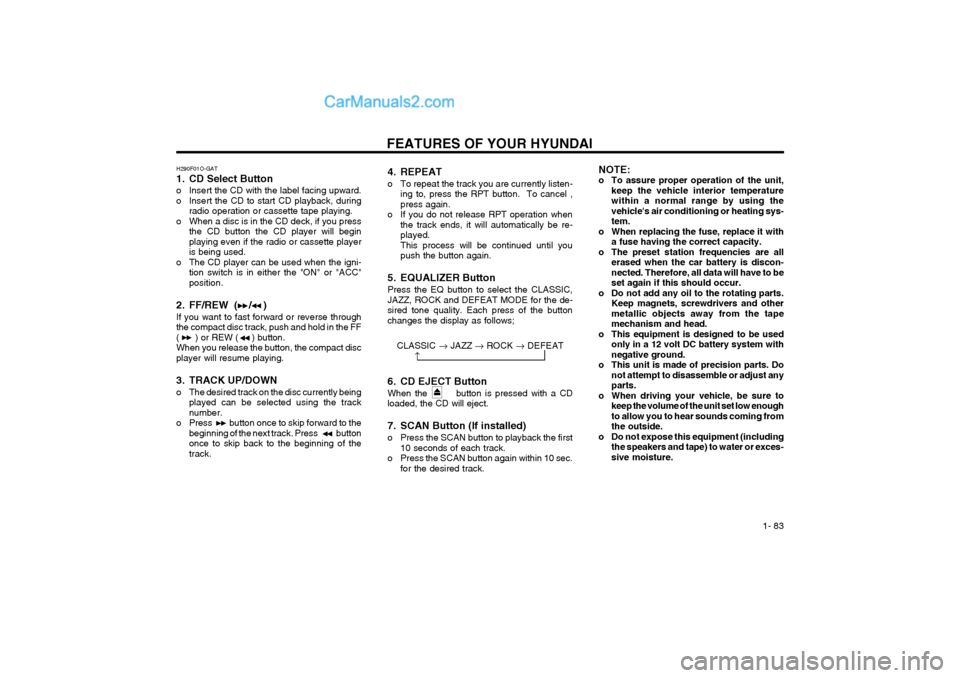
1. CD Select Button
o Insert the CD with the label facing upward.
o Insert the CD to start CD playback, during
radio operation or cassette tape playing.
o When a disc is in the CD deck, if you press the CD button the CD player will beginplaying even if the radio or cassette playeris being used.
o The CD player can be used when the igni- tion switch is in either the "ON" or "ACC"position.
2. FF/REW ( / ) If you want to fast forward or reverse through the compact disc track, push and hold in the FF( ) or REW ( ) button.When you release the button, the compact discplayer will resume playing.
3. TRACK UP/DOWN
o The desired track on the disc currently being played can be selected using the track number.
o Press button once to skip forward to the beginning of the next track. Press buttononce to skip back to the beginning of thetrack. 4. REPEAT
o To repeat the track you are currently listen-
ing to, press the RPT button. To cancel , press again.
o If you do not release RPT operation when the track ends, it will automatically be re-played.This process will be continued until youpush the button again.
5. EQUALIZER Button Press the EQ button to select the CLASSIC, JAZZ, ROCK and DEFEAT MODE for the de-sired tone quality. Each press of the buttonchanges the display as follows; NOTE:
o To assure proper operation of the unit,
keep the vehicle interior temperaturewithin a normal range by using thevehicle's air conditioning or heating sys-tem.
o When replacing the fuse, replace it with a fuse having the correct capacity.
o The preset station frequencies are all erased when the car battery is discon-nected. Therefore, all data will have to beset again if this should occur.
o Do not add any oil to the rotating parts. Keep magnets, screwdrivers and othermetallic objects away from the tapemechanism and head.
o This equipment is designed to be used only in a 12 volt DC battery system withnegative ground.
o This unit is made of precision parts. Do not attempt to disassemble or adjust anyparts.
o When driving your vehicle, be sure to keep the volume of the unit set low enoughto allow you to hear sounds coming fromthe outside.
o Do not expose this equipment (including the speakers and tape) to water or exces-sive moisture.
CLASSIC JAZZ ROCK DEFEAT
6. CD EJECT Button When the button is pressed with a CD loaded, the CD will eject.
7. SCAN Button (If installed)
o Press the SCAN button to playback the first 10 seconds of each track.
o Press the SCAN button again within 10 sec. for the desired track.
Page 95 of 312

FEATURES OF YOUR HYUNDAI 1- 87
B850A01F-AAT CARE OF DISC Proper Handling
Do not grip or pull out the disc with your hand while the disc is being pulled into the unit by theself loading mechanism.Do not pull the unit from the dash immediatelyafter a disc is inserted or the eject switch hasbeen pressed. If the unit is pulled out before anoperation is completed, the disc will be un-stable in the unit and may be damaged.Do not attempt to insert a disc into the unit whenthe unit is out of the dash or the power is off. Keep Your Discs Clean
YL11240B
Handle your disc as shown. Do not drop the disc. Hold the disc so you will not leave finger-prints on the surface. If the surface is scratched,it may cause the pickup to skip signal tracks. Donot affix tape, paper, or gummed labels on thedisc. Do not write on the disc. Damaged Disc Do not attempt to play damaged, warped or cracked discs. These could severely damagethe playback mechanism. Storage When not in use, place your discs in their individual cases and store them in a cool placeaway from the sun, heat, and dust.
YL11250B
Fingerprints, dust, or soil on the surface of a disc could cause the pickup to skip signaltracks. Wipe the surface clean with a clean softcloth. If the surface is heavily soiled, dampen aclean soft cloth in a solution of mild neutraldetergent to wipe it clean. See drawing.B860A01A-AAT Care of Cassette Tapes
SSAR040B
Proper care of your cassette tapes will extend the tape life and increase your listening enjoy-ment. Always protect your tapes and cassettecases from direct sunlight, severe cold anddusty conditions. When not in use, cassettesshould always be stored in the protective cas-sette case. When the vehicle is very hot or cold,allow the interior temperature to become morecomfortable before listening to your cassettes.
o Never leave a cassette inserted in the player
when not being played. This could damage the tape player unit and the cassette tape.
o We strongly recommend against the use of tapes longer than C-60 (60 minutes total).Tapes such as C-120 or C-180 are very thinand do not perform as well in the automotiveenvironment.
Page 96 of 312

FEATURES OF YOUR HYUNDAI
1- 88
B860A04A
NOTE: Look at a tape before you insert it. If the tapeis loose, tighten it by turning one of the hubswith a pencil or your finger. If the label ispeeling off, do not put it in the drive mecha-nism.Do not leave tapes sitting where they areexposed to hot, warm or, high humidity,such as on top of the dashboard or in theplayer.If a tape is exposed to excessively hot orcold, let it reach a moderate temperaturebefore putting it in the player.
Head
Cotton applicator
B880A01FC SSAR042B
o Be sure that the cassette label is not loose or peeling off or tape ejection may be diffi- cult.
o Never touch or soil the actual audio tape surfaces.
o Keep all magnetized objects, such as elec- tric motors, speakers or transformers awayfrom your cassette tapes and tape playerunit.
o Store cassettes in a cool, dry place with the open side facing down to prevent dust fromsetting in the cassette body.
o Avoid repeated fast reverse usage to replay one given tune or tape section. This cancause poor tape winding to occur, and even-tually cause excessive internal drag andpoor audio quality in the cassette. If thisoccurs, it can sometimes be corrected byfast winding the tape from end to end sev-eral times. If this does not correct the prob-lem, do not continue to use the tape in yourvehicle. o The playback head, capstan and pinch roll-
ers will develop a coating of tape residuethat can result in deterioration of soundquality, such as a wavering sound. Theyshould be cleaned monthly using a com-mercially available head cleaning tape orspecial solution available from audio spe-cialty shops. Follow the supplier's directionscarefully and never oil any part of the tapeplayer unit.
o Always be sure that the tape is tightly wound on its reel before inserting in the player.Rotate a pencil in the drive sprockets towind up any slack.
Page 108 of 312
DRIVING YOUR HYUNDAI 2- 11
C160C01A-AAT Use High Quality Ethylene Glycol Coolant Your Hyundai is delivered with high quality ethyl- ene glycol coolant in the cooling system. It is the only type of coolant that should be used because it helps prevent corrosion in the cooling system, lubricates the water pump and prevents freezing. Be sure to replace or replenish your coolant in accordance with the maintenance schedule in Section 5. Before winter, have your coolant test- ed to assure that its freezing point is sufficient for the temperatures anticipated during the winter. C160D01A-AAT Check Battery and Cables Winter puts additional burdens on the battery system. Visually inspect the battery and cables as described in Section 6. The level of charge in your battery can be checked by your Hyundai dealer or a service station.
C160G01A-GAT To Keep Locks from Freezing To keep the locks from freezing, squirt an ap- proved de-icer fluid or glycerine into the key opening. If a lock is covered with ice, squirt it with an approved de-icing fluid to remove the ice. If the lock is frozen internally, you may be able to thaw it out by using a heated key. Handle the heated key with care to avoid burning your fin- gers. NOTE: The proper temperature for using the immo- bilizer key is from -40°C to 80°C. If you heat the immobilizer key over 80°C to open the frozen lock, it may cause damage to the transponder in its head.
C160E01A-AAT Change to "Winter Weight" Oil if Necessary In some climates it is recommended that a lower viscosity "winter weight" oil be used during cold weather. See Section 9 for recommendations. If you aren’t sure what weight oil you should use, consult your Hyundai dealer. C160F01A-AAT Check Spark Plugs and Ignition System Inspect your spark plugs as described in Section 6 and replace them if necessary. Also check all ignition wiring and components to be sure they are not cracked, worn or damaged in any way.
C160H01A-AAT Use Approved Anti-Freeze in Window Washer System To keep the water in the window washer system from freezing, add an approved anti-freeze solu- tion in accordance with instructions on the con- tainer. Window washer anti-freeze is available from Hyundai dealers and most auto parts out- lets. Do not use engine coolant or other types of anti-freeze as these may damage the finish. C160I01A-AAT Don’t Let Your Parking Brake Freeze Under some conditions your parking brake can freeze in the engaged position. This is most likely to happen when there is an accumulation of snow or ice around or near the rear brakes or if the brakes are wet. If there is a risk the parking brake may freeze, apply it only temporarily while you put the gear selector lever in "P" (automatic) or in first or reverse gear (manual transaxle) and block the rear wheels so the car cannot roll. Then release the parking brake. C160J01A-AAT Don’t Let Ice and Snow Accumulate Underneath Under some conditions, snow and ice can build up under the fenders and interfere with the steer- ing. When driving in severe winter conditions where this may happen, you should periodically check underneath the car to be sure the move- ment of the front wheels and the steering compo- nents is not obstructed.
deceleration, use engine braking to the fullestextent. Sudden brake applications on snowy or icy roads may cause skids to occur. You need to keep sufficient distance between the vehicle in front and your vehicle. Also, apply the brake gently. It should be noted that installing tire chains on the tire will provide a greater driving force, but will not prevent side skids. NOTE: Tire chains are not legal in all provinces. Check province laws before fitting tire chains.
Page 109 of 312
DRIVING YOUR HYUNDAI
2- 12 The hitch should be bolted securely to the car and installed by a qualified technician. DO NOT USE A HITCH DESIGNED FOR TEMPORARY INSTALLATION AND NEVER USE ONE THAT ATTACHES ONLY TO THE BUMPER. C190C03S-GAT Trailer Brakes If your trailer is equipped with a braking system, make sure it conforms to federal and/or local regulations and that it is properly installed and operating correctly. NOTE: If you tow a trailer or vehicle, your car will require more frequent maintenance due to the additional load. See "Maintenance Under Severe Usage Conditions" on page 5-5. CAUTION:
o Never connect a trailer brake system di-
rectly to the vehicle brake system.
o When towing a trailer on steep grades (in excess of 12%) pay close attention to theengine coolant temperature gauge to en- sure the engine does not overheat. If the needle of the coolant temperature gauge moves across the dial towards "H" (HOT), pull over and stop as soon as it is safe to do so, and allow the engine to idle until it cools down. You may proceed once the engine has cooled sufficiently.
C180A01A-AAT USE OF LIGHTS Check your lights regularly for correct operation and always keep them clean. When driving dur- ing the day in conditions of poor visibility, it is helpful to drive with headlights on low beam. This enables you to be seen as well as to see. C190A02A-GAT TRAILER OR VEHICLE TOWINGIf you are considering towing with your car, you should first check with your Province Depart- ment of Motor Vehicles to determine their legal requirements. Since laws vary from province to province, the requirements for towing trailers, cars, other types of vehicles, or apparatus may differ. Ask your Hyundai dealer for further details before towing. CAUTION Do not do any towing with your car during its first 2,000 km (1,200 miles) in order to allow the engine to properly break in. Failure to heed this caution may result in serious en- gine or transaxle damage. C190B01S-AAT Trailer Hitches Select the proper hitch and ball combination, making sure that it’s location is compatible with that of the trailer or vehicle being towed. Use a quality non-equalizing hitch which distrib- utes the tongue load uniformly throughout the chassis.
C160K01A-AAT Carry Emergency Equipment Depending on the severity of the weather where you drive your car, you should carry appropriate emergency equipment. Some of the items you may want to carry include tire chains, tow straps or chains, flashlight, emergency flares, sand, a shovel, jumper cables, a window scraper, gloves, ground cloth, coveralls, a blanket, etc. C170A01A-AAT HIGHER SPEED MOTORING Pre-Trip Inspections 1. Tires: Adjust the tire inflation pressures to specifica- tion. Low tire inflation pressures will result in overheating and possible failure of the tires. Avoid using worn or damaged tires which may result in reduced traction or tire failure. NOTE: Never exceed the maximum tire inflation pres- sure shown on the tires. 2. Fuel, engine coolant and engine oil: High speed travel consumes 1.5 times more fuel than urban motoring. Do not forget to check both engine coolant and engine oil. 3. Drive belt: A loose or damaged drive belt may result in overheating of the engine.
Page 124 of 312

CORROSION PREVENTION AND APPEARANCE CARE 4-3
the surface after washing to remove the solution. Never allow the solution to dry on the painted surfaces.
E030D01A-AAT When to Wax Again You should polish and wax the car again when water no longer beads on a clean surface but spreads out over a larger area. E030E01A-AAT Maintaining Bumpers Special precautions must be observed to pre- serve the appearance of the bumpers on your Hyundai. They are:
o Be careful not to spill battery electrolyte or
hydraulic brake fluid on the bumpers. If you do, wash it off immediately with clear water.
o Be gentle when cleaning the bumper sur- faces. They are made of soft plastic and the surface can be damaged if mistreated. Do not use abrasive cleaners. Use warm water and mild soap or car-washing solution.
o Do not expose the bumpers to high tem-
peratures. For example, if you have your car repainted, do not leave the bumpers on the car if the car is going to be placed in a high- temperature paint booth.
E040A01A-AAT CLEANING THE INTERIOR To Clean the Vinyl Upholstery To clean the vinyl upholstery, first remove loose dirt and dust with a vacuum cleaner. Then apply a solution of mild soap or detergent and water using a clean sponge or soft cloth. Allow this to stay on the surface to loosen the dirt, then wipe with a clean damp sponge or cloth. If all the dirt stains are not removed, repeat this procedure until the upholstery is clean. Do not use gasoline, solvent, paint thinner or other strong cleaners.
E030B01A-AAT Spot Cleaning Don’t use gasoline, strong solvents or corrosive cleaning agents. These can damage the finish of the car. To remove road tar, use turpentine on a clean, soft cloth or commercially available bug and tar remover. Be gentle. To remove dead insects or tree sap, use warm water and mild soap or car-washing solution. Soak the spot and rub gently. If the paint has lost its luster, use a commercial car-cleaning polish. E030C01A-AAT Polishing and WaxingAlways wash and dry the car before polishing or waxing or using a combination cleaner and wax. Use a good quality commercial product and follow the manufacturer’s directions on the con- tainer. Polish and wax the bright trim pieces as well as the paint. E040B01A-AAT To Clean the Leather Upholstery (If Installed) In the normal course of use, leather upholstered surfaces will, like any material, pick-up dust and dirt. This dust and dirt must be cleaned off or it may work into the surface of the leather, causing damage. Fine leather needs care, and should be cleaned when necessary. Washing leather thoroughly with soap and water will keep your leather lus- trous, beautiful and ensure you have many years of wear. Take a piece of cheese cloth and using any mild soap and lukewarm water, work up a good lather. Thoroughly wash the leather. Wipe clean with a slightly damp cloth and dry with soft cloth. Do this as often as the leather becomes soiled. During tanning operations, sufficient oils are in- corporated through processing that none need be applied during the life of the leather. Oil applied to the finished surface will in no way help the leather and may do more harm than good. Varnishes and furniture polishes should never be used under any conditions.