fold seats Hyundai Matrix 2003 Owner's Manual
[x] Cancel search | Manufacturer: HYUNDAI, Model Year: 2003, Model line: Matrix, Model: Hyundai Matrix 2003Pages: 312, PDF Size: 4.1 MB
Page 21 of 312

FEATURES OF YOUR HYUNDAI 1- 13
B140A01B-GAT REAR SEAT WARNING
B140A01FC
For the safety of all passengers, luggage or other cargo should not be piled higher than thetop of the seatback.
B100A01FC-GAT SEAT WARMER (If Installed)
The seat warmer is provided to warm the front seats during cold weather. When the engine isrunning, push either of the switches to warm thedriver's seat or the passenger's seat.During mild weather or under conditions wherethe operation of the seat warmer is not needed,keep the switches in the "OFF" position.
B100A01FC
o When you return the folded down
seatback to its upright position, always be sure to install the headrests in theirproper positions. Headrests are impor-tant to the safety of occupants in a rearcollision. If the headrests are not in-stalled in their proper position, seriousinjury or death could result if a rear endcollision occurs.
B150A02A-GAT SEAT BELT PRECAUTIONS All occupants of the vehicle should wear their seat belts at all times. Indeed, your province's
laws may require that some or all occupants ofthe vehicle use seat belts.The possibility of injury or the severity of injuryin an accident will be decreased if this elemen-tary safety precaution is observed. In addition,the following recommendations are made: B150B01Y-GAT Infant or Small ChildSome countries require the use of child re- straint systems for infants and small children.Whether this is required by law or not, it isstrongly recommended that a child restraintseat or infant restraint system be used forinfants or small children weighing less than 18kilograms (40 pounds). NOTE: Small children are best protected in an acci-dent when properly restrained by a childrestraint system.
B150C03A-AAT
Larger Children
Children who are too large for child restraintsystems should always occupy the rear seatand use the available lap/shoulder belts. Thelap portion should be fastened snug on thehips and as low as possible. Check belt fitperiodically. A child's squirming could put thebelt out of position. Children are afforded themost safety in the event of an accident whenthey are restrained by a proper restraint sys-tem in the rear seat. If a larger child (over age13) must be seated in the front seat, the childshould be securely restrained by the availablelap/shoulder belt and the seat should be placedin the rearmost position. Children under theage of 13 should be restrained securely in therear seat. Never place a child under the age
Page 22 of 312
FEATURES OF YOUR HYUNDAI
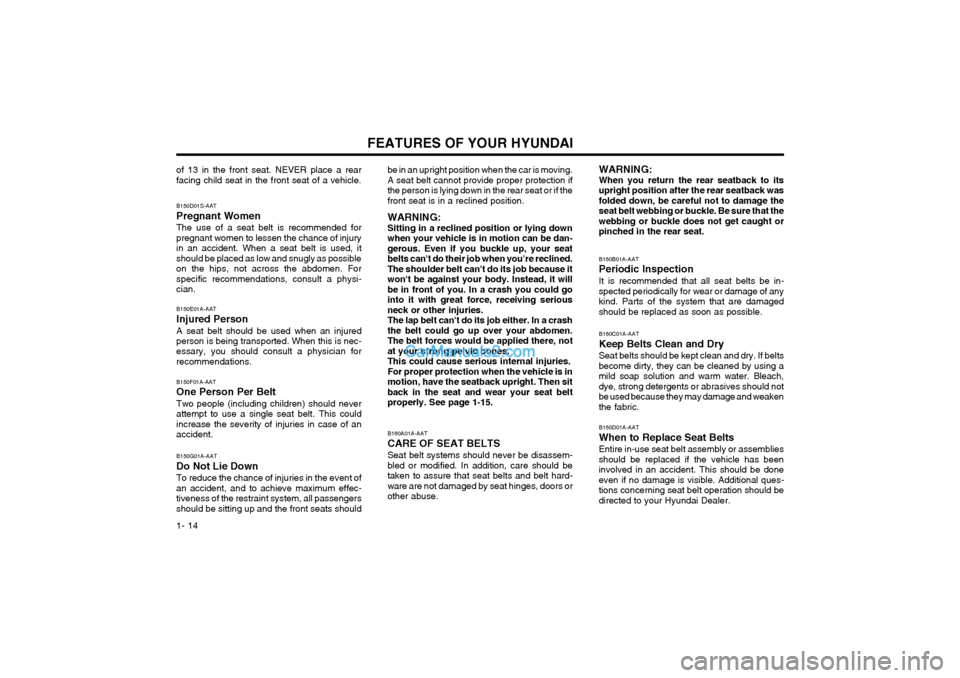
1- 14 be in an upright position when the car is moving. A seat belt cannot provide proper protection ifthe person is lying down in the rear seat or if thefront seat is in a reclined position. WARNING: Sitting in a reclined position or lying downwhen your vehicle is in motion can be dan-gerous. Even if you buckle up, your seatbelts can't do their job when you're reclined.The shoulder belt can't do its job because itwon't be against your body. Instead, it willbe in front of you. In a crash you could gointo it with great force, receiving seriousneck or other injuries.The lap belt can't do its job either. In a crashthe belt could go up over your abdomen.The belt forces would be applied there, notat your strong pelvic bones.This could cause serious internal injuries.For proper protection when the vehicle is inmotion, have the seatback upright. Then sitback in the seat and wear your seat beltproperly. See page 1-15.
B160B01A-AAT Periodic Inspection It is recommended that all seat belts be in- spected periodically for wear or damage of anykind. Parts of the system that are damagedshould be replaced as soon as possible. B160C01A-AAT Keep Belts Clean and DrySeat belts should be kept clean and dry. If belts become dirty, they can be cleaned by using amild soap solution and warm water. Bleach,dye, strong detergents or abrasives should notbe used because they may damage and weakenthe fabric. B160D01A-AAT When to Replace Seat Belts Entire in-use seat belt assembly or assemblies should be replaced if the vehicle has beeninvolved in an accident. This should be doneeven if no damage is visible. Additional ques-tions concerning seat belt operation should bedirected to your Hyundai Dealer.
B160A01A-AAT CARE OF SEAT BELTS Seat belt systems should never be disassem- bled or modified. In addition, care should betaken to assure that seat belts and belt hard-ware are not damaged by seat hinges, doors orother abuse.
B150D01S-AAT Pregnant Women The use of a seat belt is recommended for pregnant women to lessen the chance of injuryin an accident. When a seat belt is used, itshould be placed as low and snugly as possibleon the hips, not across the abdomen. Forspecific recommendations, consult a physi-cian. B150E01A-AAT Injured Person A seat belt should be used when an injured person is being transported. When this is nec- essary, you should consult a physician forrecommendations. B150F01A-AAT One Person Per BeltTwo people (including children) should never attempt to use a single seat belt. This couldincrease the severity of injuries in case of anaccident. B150G01A-AAT Do Not Lie Down To reduce the chance of injuries in the event of an accident, and to achieve maximum effec-tiveness of the restraint system, all passengersshould be sitting up and the front seats should
of 13 in the front seat. NEVER place a rearfacing child seat in the front seat of a vehicle.
WARNING:When you return the rear seatback to itsupright position after the rear seatback wasfolded down, be careful not to damage theseat belt webbing or buckle. Be sure that thewebbing or buckle does not get caught orpinched in the rear seat.
Page 171 of 312
INDEX
10-2 Driving
Economical dr iving ........................................................................ 2-10
Smooth cornering .......................................................................... 2-10
Winter driving ................................................................................ 2-10
E Emissions Control Systems ................................................................ 7-1
Engine Before starting the engine ............................................................... 2-2Compartment .......................................................................... 6-1 ~ 6-3
Coolant ................................................................................. 6-8 ~ 6-10
Coolant temperature gauge ........................................................... 1-35
If the engine overheats ................................................................... 3-2
Number ............................................................................................ 8-1
Oil ........................................................................................... 6-4 ~ 6-5Starting ............................................................................................ 2-3
Engine Exhaust Can Be Dangerous ................................................... 2-1
FFold-up Tray ...................................................................................... 1-49
Front Fog Light Sw itch ...................................................................... 1-41
Front Seats Adjustable front seats ..................................................................... 1-9
Lumbar support control ................................................................. 1-10
Seat cushion height adjustment .................................................... 1-10
Fuel Capacity .......................................................................................... 9-1
Gauge ............................................................................................ 1-35
Recommendations ........................................................................... 1-1
Fuel Filler Lid
Remote release ............................................................................. 1-51
Fuse Panel Description .......................................................... 6-26 ~ 6-28
Fuses ...................................................................................... 6-19 ~6-20 GGeneral Checks
.................................................................................. 6-4
Glove box .......................................................................................... 1-46
H Hazard Warning System ................................................................... 1-40
Headlight Aiming Adjustment ........................................................... 6-23
Headlight Bulb ................................................................................... 6-23
Headlight Leveling Device System ........................................ 1-43 ~ 1-44
Heating and Ventilation
Air flow control .............................................................................. 1-57
Air intake control ........................................................................... 1-56
Bi-level heating .............................................................................. 1-58
Fan speed control ......................................................................... 1-56
Heating controls ............................................................................ 1-58
Temperature control ...................................................................... 1-58
High-mounted Rear Stoplight ............................................................ 1-49
Hood Release ................................................................................... 1-50
Horn .................................................................................................. 1-54
IIgnition Switch ..................................................................................... 2-2
Immobilizer System ............................................................................. 1-3
Instrument Cluster and Indicator ............................................ 1-30 ~ 1-34
Instruments and Controls .................................................................. 1-29
Interior Light Interior light ................................................................................... 1-46
Map light ........................................................................................ 1-45
Intermittent Wiper .............................................................................. 1-40
JJump Starting ...................................................................................... 3-1
Page 193 of 312

CONTROLS AND EQUIPMENT
1- 12 o Objects should not extend higher than
the top of the front seatbacks. This could allow cargo to slide forward andcause injury or damage during suddenstops.
o When you return the folded down seatback to its upright position, alwaysbe sure to install the headrests in theirproper positions. Headrests are impor-tant to the safety of occupants in a rearcollision. If the headrests are not in-stalled in their proper position, seriousinjury or death could result if a rear endcollision occurs.
B100A01FC-EAT SEAT WARMER (Not all models)
The seat warmer is provided to warm the front seats during cold weather. When the engine isrunning, push either of the switches to warmthe driver's seat or the passenger's seat.
B100A01FC
During mild weather or under conditions where
the operation of the seat warmer is not needed, keep the switches in the "OFF" position. B140A01B-GAT
REAR SEAT WARNING
B140A01FC
For the safety of all passengers, luggage or other cargo should not be piled higher thanthe top of the seatback.
5. To secure the seat, hook the securing strap under the seat cushion to the head- rest stay of front driver and passengerseat.
6. Insert the removed headrests between the seatback and seat cushion, so that theywill not be thrown forward in the case of asudden stop or an accident.
7. To return the seatback and seat cushion to its normal position, reverse the above pro-cedure.
o When you return the seatback to its upright position, always be sure it is locked intoposition by pulling and pushing on the topof seatback.
WARNING:
o When you return the folded down seat back to its upright position, make sure the seat belts are in position to beaccessible and to function properly.
o The purpose of the fold down rear seat back and the fold forward rear seatcushion is to increase cargo space. Donot allow passengers to sit in the cargoarea while the car is moving. This is nota proper seating position and no seatbelts are available for use when the seatback is folded down. Passengers whoare not properly seated and wearingseat belts could sustain serious injuriesor death in case of an accident or asudden stop.